The Cartesian equation x 2 a 2 − y 2 b 2 = 1 \frac{x^2}{a^2} - \frac{y^2}{b^2} = 1 a 2 x 2 − b 2 y 2 = 1 x x x y y y ( x , y ) (x, y) ( x , y ) single parameter θ \theta θ
Because sec 2 θ − tan 2 θ = 1 \sec^2\theta - \tan^2\theta = 1 sec 2 θ − tan 2 θ = 1 θ \theta θ auxiliary circle .
1. The Auxiliary Circle of a Hyperbola§
Consider the standard horizontal hyperbola:
x 2 a 2 − y 2 b 2 = 1 ( a > 0 , b > 0 ) \frac{x^2}{a^2} - \frac{y^2}{b^2} = 1 \qquad (a > 0,\; b > 0) a 2 x 2 − b 2 y 2 = 1 ( a > 0 , b > 0 ) Its transverse axis is the segment A ′ A A'A A ′ A A ′ ( − a , 0 ) A'(-a, 0) A ′ ( − a , 0 ) A ( a , 0 ) A(a, 0) A ( a , 0 ) 2 a 2a 2 a C ( 0 , 0 ) C(0, 0) C ( 0 , 0 )
Definition and Equation§
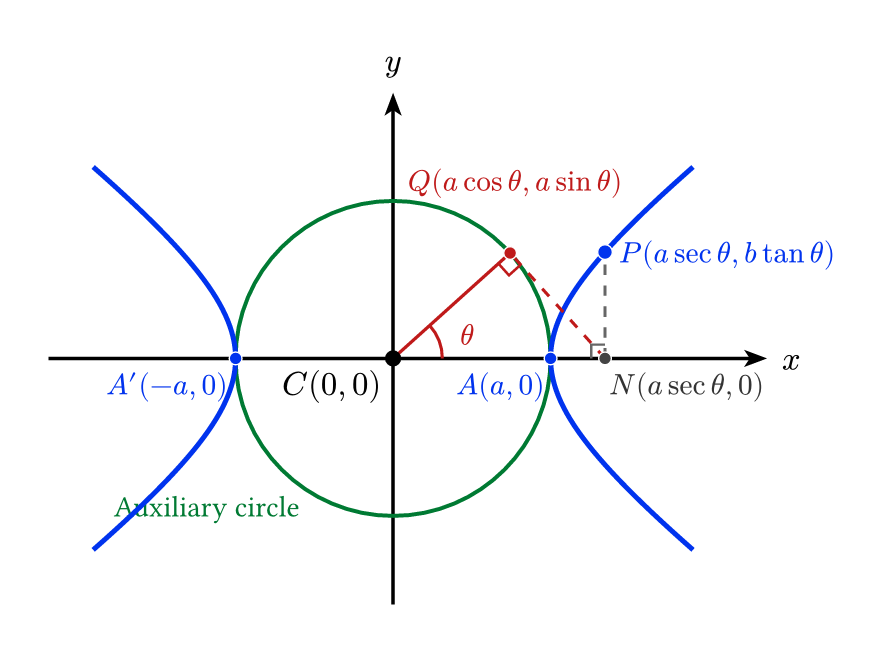
The circle described on the transverse axis A ′ A A'A A ′ A auxiliary circle of the hyperbola.
Since the diameter is A ′ A = 2 a A'A = 2a A ′ A = 2 a C ( 0 , 0 ) C(0, 0) C ( 0 , 0 ) a a a
x 2 + y 2 = a 2 x^2 + y^2 = a^2 x 2 + y 2 = a 2
Comparison with the Ellipse: For an ellipse, ∣ x ∣ ≤ a |x| \le a ∣ x ∣ ≤ a ∣ y ∣ ≤ b < a |y| \le b < a ∣ y ∣ ≤ b < a encloses the ellipse. For a hyperbola, every point satisfies ∣ x ∣ ≥ a |x| \ge a ∣ x ∣ ≥ a ∣ x ∣ ≤ a |x| \le a ∣ x ∣ ≤ a between the two branches, touching the hyperbola only at its two vertices A ( a , 0 ) A(a, 0) A ( a , 0 ) A ′ ( − a , 0 ) A'(-a, 0) A ′ ( − a , 0 )
Let us see how the auxiliary circle generates the parametric coordinates ( a sec θ , b tan θ ) (a\sec\theta,\; b\tan\theta) ( a sec θ , b tan θ )
Corresponding Point on the Auxiliary Circle§
Let P ( x , y ) P(x, y) P ( x , y ) x 2 a 2 − y 2 b 2 = 1 \frac{x^2}{a^2} - \frac{y^2}{b^2} = 1 a 2 x 2 − b 2 y 2 = 1 x > a , y > 0 x > a, y > 0 x > a , y > 0
Drop a perpendicular from P P P x x x N ( x , 0 ) N(x, 0) N ( x , 0 ) C N = x > a CN = x > a C N = x > a
From N N N Q Q Q x 2 + y 2 = a 2 x^2 + y^2 = a^2 x 2 + y 2 = a 2 x x x P P P ∠ C Q N = 90 ∘ \angle CQN = 90^\circ ∠ C QN = 9 0 ∘ N Q ⊥ C Q NQ \perp CQ N Q ⊥ C Q
Join C C C Q Q Q C Q CQ C Q θ \theta θ x x x
∠ Q C A = θ \angle QCA = \theta ∠ QC A = θ Deriving the Parametric Coordinates§
Since Q Q Q a a a θ \theta θ
Q = ( a cos θ , a sin θ ) Q = (a\cos\theta,\; a\sin\theta) Q = ( a cos θ , a sin θ ) In the right-angled triangle △ C Q N \triangle CQN △ C QN Q Q Q C Q = a CQ = a C Q = a C N = x CN = x C N = x
cos θ = C Q C N = a x ⟹ x = a cos θ = a sec θ \cos\theta = \frac{CQ}{CN} = \frac{a}{x} \implies x = \frac{a}{\cos\theta} = a\sec\theta cos θ = C N C Q = x a ⟹ x = cos θ a = a sec θ Now substitute x = a sec θ x = a\sec\theta x = a sec θ x 2 a 2 − y 2 b 2 = 1 \frac{x^2}{a^2} - \frac{y^2}{b^2} = 1 a 2 x 2 − b 2 y 2 = 1
a 2 sec 2 θ a 2 − y 2 b 2 = 1 ⟹ sec 2 θ − y 2 b 2 = 1 \frac{a^2\sec^2\theta}{a^2} - \frac{y^2}{b^2} = 1 \implies \sec^2\theta - \frac{y^2}{b^2} = 1 a 2 a 2 sec 2 θ − b 2 y 2 = 1 ⟹ sec 2 θ − b 2 y 2 = 1 y 2 b 2 = sec 2 θ − 1 = tan 2 θ ⟹ y = ± b tan θ \frac{y^2}{b^2} = \sec^2\theta - 1 = \tan^2\theta \implies y = \pm b\tan\theta b 2 y 2 = sec 2 θ − 1 = tan 2 θ ⟹ y = ± b tan θ Choosing y y y tan θ \tan\theta tan θ parametric equations of the hyperbola:
x = a sec θ , y = b tan θ x = a\sec\theta, \qquad y = b\tan\theta x = a sec θ , y = b tan θ A point with parameter θ \theta θ P ( θ ) P(\theta) P ( θ ) ( a sec θ , b tan θ ) (a\sec\theta, b\tan\theta) ( a sec θ , b tan θ ) θ \theta θ eccentric angle of P P P
Eccentric Angle vs. Polar Angle§
Just as in the ellipse, do not confuse the eccentric angle θ \theta θ α = ∠ P C A \alpha = \angle PCA α = ∠ P C A C P CP C P x x x
θ = ∠ Q C A \theta = \angle QCA θ = ∠ QC A C Q CQ C Q α = ∠ P C A \alpha = \angle PCA α = ∠ P C A
tan α = y x = b tan θ a sec θ = b a sin θ \tan\alpha = \frac{y}{x} = \frac{b\tan\theta}{a\sec\theta} = \frac{b}{a}\sin\theta tan α = x y = a sec θ b tan θ = a b sin θ So θ \theta θ α \alpha α not equal in general (they coincide only at the vertices A A A A ′ A' A ′ θ = 0 \theta = 0 θ = 0 θ = π \theta = \pi θ = π
3. Tracing Both Branches as the Parameter Varies§
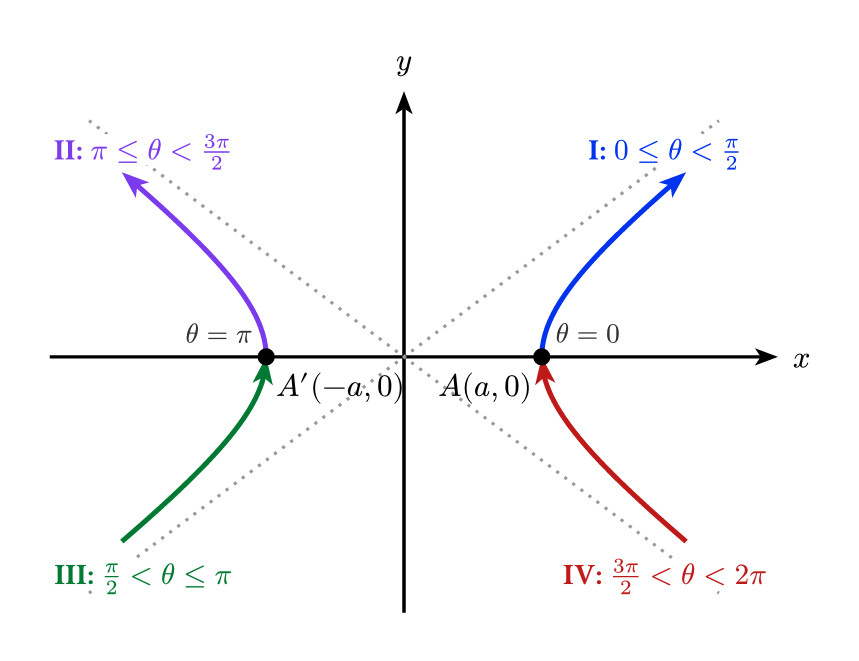
As θ \theta θ [ 0 , 2 π ) [0, 2\pi) [ 0 , 2 π ) θ = π 2 \theta = \frac{\pi}{2} θ = 2 π θ = 3 π 2 \theta = \frac{3\pi}{2} θ = 2 3 π sec θ \sec\theta sec θ tan θ \tan\theta tan θ P ( a sec θ , b tan θ ) P(a\sec\theta, b\tan\theta) P ( a sec θ , b tan θ ) both branches of the hyperbola:
Interval of θ \theta θ
Value & Sign of sec θ \sec\theta sec θ
Value & Sign of tan θ \tan\theta tan θ
Quadrant & Branch
0 ≤ θ < π 2 0 \le \theta < \frac{\pi}{2} 0 ≤ θ < 2 π sec θ ≥ 1 ( + ) \sec\theta \ge 1 \; (+) sec θ ≥ 1 ( + ) tan θ ≥ 0 ( + ) \tan\theta \ge 0 \; (+) tan θ ≥ 0 ( + ) Quadrant I (upper half of right branch)
π 2 < θ ≤ π \frac{\pi}{2} < \theta \le \pi 2 π < θ ≤ π sec θ ≤ − 1 ( − ) \sec\theta \le -1 \; (-) sec θ ≤ − 1 ( − ) tan θ ≤ 0 ( − ) \tan\theta \le 0 \; (-) tan θ ≤ 0 ( − ) Quadrant III (lower half of left branch)
π ≤ θ < 3 π 2 \pi \le \theta < \frac{3\pi}{2} π ≤ θ < 2 3 π sec θ ≤ − 1 ( − ) \sec\theta \le -1 \; (-) sec θ ≤ − 1 ( − ) tan θ ≥ 0 ( + ) \tan\theta \ge 0 \; (+) tan θ ≥ 0 ( + ) Quadrant II (upper half of left branch)
3 π 2 < θ < 2 π \frac{3\pi}{2} < \theta < 2\pi 2 3 π < θ < 2 π sec θ ≥ 1 ( + ) \sec\theta \ge 1 \; (+) sec θ ≥ 1 ( + ) tan θ ≤ 0 ( − ) \tan\theta \le 0 \; (-) tan θ ≤ 0 ( − ) Quadrant IV (lower half of right branch)
Notice that as θ \theta θ π 2 \frac{\pi}{2} 2 π 3 π 2 \frac{3\pi}{2} 2 3 π ∣ x ∣ |x| ∣ x ∣ ∣ y ∣ |y| ∣ y ∣
The identity sec 2 θ − tan 2 θ = 1 \sec^2\theta - \tan^2\theta = 1 sec 2 θ − tan 2 θ = 1 sec θ \sec\theta sec θ positive squared term (the transverse-axis direction) and tan θ \tan\theta tan θ negative squared term (the conjugate-axis direction).
Standard Vertical Hyperbola§
For y 2 b 2 − x 2 a 2 = 1 \frac{y^2}{b^2} - \frac{x^2}{a^2} = 1 b 2 y 2 − a 2 x 2 = 1
Transverse axis: Along the y y y 2 b 2b 2 b Auxiliary circle: x 2 + y 2 = b 2 x^2 + y^2 = b^2 x 2 + y 2 = b 2 B ′ B B'B B ′ B Parametric coordinates:
x = a tan θ , y = b sec θ x = a\tan\theta, \qquad y = b\sec\theta x = a tan θ , y = b sec θ Check: ( b sec θ ) 2 b 2 − ( a tan θ ) 2 a 2 = sec 2 θ − tan 2 θ = 1 \frac{(b\sec\theta)^2}{b^2} - \frac{(a\tan\theta)^2}{a^2} = \sec^2\theta - \tan^2\theta = 1 b 2 ( b s e c θ ) 2 − a 2 ( a t a n θ ) 2 = sec 2 θ − tan 2 θ = 1
Shifted Horizontal Hyperbola§
For ( x − h ) 2 a 2 − ( y − k ) 2 b 2 = 1 \frac{(x - h)^2}{a^2} - \frac{(y - k)^2}{b^2} = 1 a 2 ( x − h ) 2 − b 2 ( y − k ) 2 = 1 C ( h , k ) C(h, k) C ( h , k )
Auxiliary circle: ( x − h ) 2 + ( y − k ) 2 = a 2 (x - h)^2 + (y - k)^2 = a^2 ( x − h ) 2 + ( y − k ) 2 = a 2 Parametric coordinates:
x = h + a sec θ , y = k + b tan θ x = h + a\sec\theta, \qquad y = k + b\tan\theta x = h + a sec θ , y = k + b tan θ Shifted Vertical Hyperbola§
For ( y − k ) 2 b 2 − ( x − h ) 2 a 2 = 1 \frac{(y - k)^2}{b^2} - \frac{(x - h)^2}{a^2} = 1 b 2 ( y − k ) 2 − a 2 ( x − h ) 2 = 1 C ( h , k ) C(h, k) C ( h , k )
Auxiliary circle: ( x − h ) 2 + ( y − k ) 2 = b 2 (x - h)^2 + (y - k)^2 = b^2 ( x − h ) 2 + ( y − k ) 2 = b 2 Parametric coordinates:
x = h + a tan θ , y = k + b sec θ x = h + a\tan\theta, \qquad y = k + b\sec\theta x = h + a tan θ , y = k + b sec θ 5. Equation of a Chord and Focal Chord Condition§
One of the greatest strengths of parametric coordinates is writing the equation of a chord joining two points P ( θ 1 ) P(\theta_1) P ( θ 1 ) Q ( θ 2 ) Q(\theta_2) Q ( θ 2 )
Chord Joining Two Points on a Horizontal Hyperbola§
Let P ( a sec θ 1 , b tan θ 1 ) P(a\sec\theta_1, b\tan\theta_1) P ( a sec θ 1 , b tan θ 1 ) Q ( a sec θ 2 , b tan θ 2 ) Q(a\sec\theta_2, b\tan\theta_2) Q ( a sec θ 2 , b tan θ 2 ) x 2 a 2 − y 2 b 2 = 1 \frac{x^2}{a^2} - \frac{y^2}{b^2} = 1 a 2 x 2 − b 2 y 2 = 1
The slope of P Q PQ P Q
m = b ( tan θ 2 − tan θ 1 ) a ( sec θ 2 − sec θ 1 ) = b a ⋅ sin θ 2 cos θ 2 − sin θ 1 cos θ 1 1 cos θ 2 − 1 cos θ 1 = b a ⋅ sin ( θ 2 − θ 1 ) cos θ 1 − cos θ 2 m = \frac{b(\tan\theta_2 - \tan\theta_1)}{a(\sec\theta_2 - \sec\theta_1)} = \frac{b}{a} \cdot \frac{\frac{\sin\theta_2}{\cos\theta_2} - \frac{\sin\theta_1}{\cos\theta_1}}{\frac{1}{\cos\theta_2} - \frac{1}{\cos\theta_1}} = \frac{b}{a} \cdot \frac{\sin(\theta_2 - \theta_1)}{\cos\theta_1 - \cos\theta_2} m = a ( sec θ 2 − sec θ 1 ) b ( tan θ 2 − tan θ 1 ) = a b ⋅ c o s θ 2 1 − c o s θ 1 1 c o s θ 2 s i n θ 2 − c o s θ 1 s i n θ 1 = a b ⋅ cos θ 1 − cos θ 2 sin ( θ 2 − θ 1 ) Using sin ( θ 2 − θ 1 ) = 2 sin θ 2 − θ 1 2 cos θ 2 − θ 1 2 \sin(\theta_2 - \theta_1) = 2\sin\frac{\theta_2 - \theta_1}{2}\cos\frac{\theta_2 - \theta_1}{2} sin ( θ 2 − θ 1 ) = 2 sin 2 θ 2 − θ 1 cos 2 θ 2 − θ 1 cos θ 1 − cos θ 2 = 2 sin θ 1 + θ 2 2 sin θ 2 − θ 1 2 \cos\theta_1 - \cos\theta_2 = 2\sin\frac{\theta_1 + \theta_2}{2}\sin\frac{\theta_2 - \theta_1}{2} cos θ 1 − cos θ 2 = 2 sin 2 θ 1 + θ 2 sin 2 θ 2 − θ 1
m = b a ⋅ cos ( θ 1 − θ 2 2 ) sin ( θ 1 + θ 2 2 ) m = \frac{b}{a} \cdot \frac{\cos\left(\frac{\theta_1 - \theta_2}{2}\right)}{\sin\left(\frac{\theta_1 + \theta_2}{2}\right)} m = a b ⋅ sin ( 2 θ 1 + θ 2 ) cos ( 2 θ 1 − θ 2 ) Writing the line y − b tan θ 1 = m ( x − a sec θ 1 ) y - b\tan\theta_1 = m(x - a\sec\theta_1) y − b tan θ 1 = m ( x − a sec θ 1 ) chord equation :
x a cos ( θ 1 − θ 2 2 ) − y b sin ( θ 1 + θ 2 2 ) = cos ( θ 1 + θ 2 2 ) \frac{x}{a}\cos\left(\frac{\theta_1 - \theta_2}{2}\right) - \frac{y}{b}\sin\left(\frac{\theta_1 + \theta_2}{2}\right) = \cos\left(\frac{\theta_1 + \theta_2}{2}\right) a x cos ( 2 θ 1 − θ 2 ) − b y sin ( 2 θ 1 + θ 2 ) = cos ( 2 θ 1 + θ 2 ) (You can verify directly that ( a sec θ 1 , b tan θ 1 ) (a\sec\theta_1, b\tan\theta_1) ( a sec θ 1 , b tan θ 1 ) cos ( θ 1 − θ 1 + θ 2 2 ) = cos ( θ 1 − θ 2 2 ) \cos\left(\theta_1 - \frac{\theta_1 + \theta_2}{2}\right) = \cos\left(\frac{\theta_1 - \theta_2}{2}\right) cos ( θ 1 − 2 θ 1 + θ 2 ) = cos ( 2 θ 1 − θ 2 )
Condition for a Focal Chord§
If the chord P Q PQ P Q S ( a e , 0 ) S(ae, 0) S ( a e , 0 ) x = a e , y = 0 x = ae, y = 0 x = a e , y = 0
e cos ( θ 1 − θ 2 2 ) = cos ( θ 1 + θ 2 2 ) e\cos\left(\frac{\theta_1 - \theta_2}{2}\right) = \cos\left(\frac{\theta_1 + \theta_2}{2}\right) e cos ( 2 θ 1 − θ 2 ) = cos ( 2 θ 1 + θ 2 ) Applying componendo and dividendo (or dividing by cos θ 1 2 cos θ 2 2 \cos\frac{\theta_1}{2}\cos\frac{\theta_2}{2} cos 2 θ 1 cos 2 θ 2
1 − e 1 + e = cos ( θ 1 + θ 2 2 ) − cos ( θ 1 − θ 2 2 ) cos ( θ 1 + θ 2 2 ) + cos ( θ 1 − θ 2 2 ) = − tan θ 1 2 tan θ 2 2 \frac{1 - e}{1 + e} = \frac{\cos\left(\frac{\theta_1 + \theta_2}{2}\right) - \cos\left(\frac{\theta_1 - \theta_2}{2}\right)}{\cos\left(\frac{\theta_1 + \theta_2}{2}\right) + \cos\left(\frac{\theta_1 - \theta_2}{2}\right)} = -\tan\frac{\theta_1}{2}\tan\frac{\theta_2}{2} 1 + e 1 − e = cos ( 2 θ 1 + θ 2 ) + cos ( 2 θ 1 − θ 2 ) cos ( 2 θ 1 + θ 2 ) − cos ( 2 θ 1 − θ 2 ) = − tan 2 θ 1 tan 2 θ 2 Wait—watch the signs carefully: cos ( A + B ) − cos ( A − B ) = − 2 sin A sin B \cos(A + B) - \cos(A - B) = -2\sin A\sin B cos ( A + B ) − cos ( A − B ) = − 2 sin A sin B cos ( A + B ) + cos ( A − B ) = 2 cos A cos B \cos(A + B) + \cos(A - B) = 2\cos A\cos B cos ( A + B ) + cos ( A − B ) = 2 cos A cos B
tan θ 1 2 tan θ 2 2 = 1 − e 1 + e ( chord through S ( a e , 0 ) ) \tan\frac{\theta_1}{2}\tan\frac{\theta_2}{2} = \frac{1 - e}{1 + e} \qquad (\text{chord through } S(ae, 0)) tan 2 θ 1 tan 2 θ 2 = 1 + e 1 − e ( chord through S ( a e , 0 )) Similarly, if the chord passes through the left focus S ′ ( − a e , 0 ) S'(-ae, 0) S ′ ( − a e , 0 ) e e e − e -e − e
tan θ 1 2 tan θ 2 2 = 1 + e 1 − e ( chord through S ′ ( − a e , 0 ) ) \tan\frac{\theta_1}{2}\tan\frac{\theta_2}{2} = \frac{1 + e}{1 - e} \qquad (\text{chord through } S'(-ae, 0)) tan 2 θ 1 tan 2 θ 2 = 1 − e 1 + e ( chord through S ′ ( − a e , 0 )) Example 1: Auxiliary Circle Connection and Polar Angle§
A point P P P x 2 16 − y 2 9 = 1 \frac{x^2}{16} - \frac{y^2}{9} = 1 16 x 2 − 9 y 2 = 1 θ = π 3 \theta = \frac{\pi}{3} θ = 3 π
The Cartesian coordinates of P P P
The coordinates of the corresponding point Q Q Q
The polar angle α = ∠ P C A \alpha = \angle PCA α = ∠ P C A C P CP C P x x x
Solution:
Here a 2 = 16 ⟹ a = 4 a^2 = 16 \implies a = 4 a 2 = 16 ⟹ a = 4 b 2 = 9 ⟹ b = 3 b^2 = 9 \implies b = 3 b 2 = 9 ⟹ b = 3
Coordinates of P P P
x = 4 sec π 3 = 4 ( 2 ) = 8 , y = 3 tan π 3 = 3 3 x = 4\sec\frac{\pi}{3} = 4(2) = 8, \qquad y = 3\tan\frac{\pi}{3} = 3\sqrt{3} x = 4 sec 3 π = 4 ( 2 ) = 8 , y = 3 tan 3 π = 3 3 So P = ( 8 , 3 3 ) P = (8,\; 3\sqrt{3}) P = ( 8 , 3 3 )
Corresponding point Q Q Q x 2 + y 2 = 16 x^2 + y^2 = 16 x 2 + y 2 = 16
Q = ( 4 cos π 3 , 4 sin π 3 ) = ( 2 , 2 3 ) Q = \left(4\cos\frac{\pi}{3},\; 4\sin\frac{\pi}{3}\right) = \left(2,\; 2\sqrt{3}\right) Q = ( 4 cos 3 π , 4 sin 3 π ) = ( 2 , 2 3 ) (Check: C Q ⋅ C N CQ \cdot CN C Q ⋅ C N N = ( 8 , 0 ) N = (8, 0) N = ( 8 , 0 ) C Q 2 + Q N 2 = 16 + ( 36 + 12 ) = 64 = C N 2 CQ^2 + QN^2 = 16 + (36 + 12) = 64 = CN^2 C Q 2 + Q N 2 = 16 + ( 36 + 12 ) = 64 = C N 2 ∠ C Q N = 90 ∘ \angle CQN = 90^\circ ∠ C QN = 9 0 ∘
Polar angle α = ∠ P C A \alpha = \angle PCA α = ∠ P C A
tan α = y x = 3 3 8 = b a sin π 3 ⟹ α = tan − 1 ( 3 3 8 ) \tan\alpha = \frac{y}{x} = \frac{3\sqrt{3}}{8} = \frac{b}{a}\sin\frac{\pi}{3} \implies \alpha = \tan^{-1}\left(\frac{3\sqrt{3}}{8}\right) tan α = x y = 8 3 3 = a b sin 3 π ⟹ α = tan − 1 ( 8 3 3 ) Notice α ≈ 33 ∘ \alpha \approx 33^\circ α ≈ 3 3 ∘ θ = 60 ∘ \theta = 60^\circ θ = 6 0 ∘
Example 2: Harmonic Property of a Focal Chord (Parametric Win)§
If P Q PQ P Q x 2 a 2 − y 2 b 2 = 1 \frac{x^2}{a^2} - \frac{y^2}{b^2} = 1 a 2 x 2 − b 2 y 2 = 1 S ( a e , 0 ) S(ae, 0) S ( a e , 0 )
1 S P + 1 S Q = 2 a b 2 \frac{1}{SP} + \frac{1}{SQ} = \frac{2a}{b^2} S P 1 + S Q 1 = b 2 2 a Solution:
Trying to solve this in Cartesian coordinates by intersecting a line y = m ( x − a e ) y = m(x - ae) y = m ( x − a e )
Let P ( θ 1 ) P(\theta_1) P ( θ 1 ) Q ( θ 2 ) Q(\theta_2) Q ( θ 2 ) sec θ 1 > 0 , sec θ 2 > 0 \sec\theta_1 > 0, \sec\theta_2 > 0 sec θ 1 > 0 , sec θ 2 > 0
S P = e x 1 − a = a ( e sec θ 1 − 1 ) , S Q = a ( e sec θ 2 − 1 ) SP = ex_1 - a = a(e\sec\theta_1 - 1), \qquad SQ = a(e\sec\theta_2 - 1) S P = e x 1 − a = a ( e sec θ 1 − 1 ) , S Q = a ( e sec θ 2 − 1 ) Let t 1 = tan θ 1 2 t_1 = \tan\frac{\theta_1}{2} t 1 = tan 2 θ 1 t 2 = tan θ 2 2 t_2 = \tan\frac{\theta_2}{2} t 2 = tan 2 θ 2 sec θ = 1 + t 2 1 − t 2 \sec\theta = \frac{1 + t^2}{1 - t^2} sec θ = 1 − t 2 1 + t 2
e sec θ 1 − 1 = e ( 1 + t 1 2 1 − t 1 2 ) − 1 = ( e − 1 ) + ( e + 1 ) t 1 2 1 − t 1 2 e\sec\theta_1 - 1 = e\left(\frac{1 + t_1^2}{1 - t_1^2}\right) - 1 = \frac{(e - 1) + (e + 1)t_1^2}{1 - t_1^2} e sec θ 1 − 1 = e ( 1 − t 1 2 1 + t 1 2 ) − 1 = 1 − t 1 2 ( e − 1 ) + ( e + 1 ) t 1 2 Since P Q PQ P Q S ( a e , 0 ) S(ae, 0) S ( a e , 0 ) t 1 t 2 = 1 − e 1 + e t_1 t_2 = \frac{1 - e}{1 + e} t 1 t 2 = 1 + e 1 − e t 2 = − e − 1 ( e + 1 ) t 1 t_2 = -\frac{e - 1}{(e + 1)t_1} t 2 = − ( e + 1 ) t 1 e − 1 t 2 t_2 t 2 e sec θ 2 − 1 e\sec\theta_2 - 1 e sec θ 2 − 1
e sec θ 2 − 1 = ( e − 1 ) + ( e + 1 ) ( e − 1 ) 2 ( e + 1 ) 2 t 1 2 1 − ( e − 1 ) 2 ( e + 1 ) 2 t 1 2 = ( e 2 − 1 ) [ ( e − 1 ) + ( e + 1 ) t 1 2 ] ( e + 1 ) 2 t 1 2 − ( e − 1 ) 2 e\sec\theta_2 - 1 = \frac{(e - 1) + (e + 1)\frac{(e - 1)^2}{(e + 1)^2 t_1^2}}{1 - \frac{(e - 1)^2}{(e + 1)^2 t_1^2}} = \frac{(e^2 - 1)\left[(e - 1) + (e + 1)t_1^2\right]}{(e + 1)^2 t_1^2 - (e - 1)^2} e sec θ 2 − 1 = 1 − ( e + 1 ) 2 t 1 2 ( e − 1 ) 2 ( e − 1 ) + ( e + 1 ) ( e + 1 ) 2 t 1 2 ( e − 1 ) 2 = ( e + 1 ) 2 t 1 2 − ( e − 1 ) 2 ( e 2 − 1 ) [ ( e − 1 ) + ( e + 1 ) t 1 2 ] Now add the reciprocals:
1 e sec θ 1 − 1 + 1 e sec θ 2 − 1 = ( e 2 − 1 ) ( 1 − t 1 2 ) + ( e + 1 ) 2 t 1 2 − ( e − 1 ) 2 ( e 2 − 1 ) [ ( e − 1 ) + ( e + 1 ) t 1 2 ] \frac{1}{e\sec\theta_1 - 1} + \frac{1}{e\sec\theta_2 - 1} = \frac{(e^2 - 1)(1 - t_1^2) + (e + 1)^2 t_1^2 - (e - 1)^2}{(e^2 - 1)\left[(e - 1) + (e + 1)t_1^2\right]} e sec θ 1 − 1 1 + e sec θ 2 − 1 1 = ( e 2 − 1 ) [ ( e − 1 ) + ( e + 1 ) t 1 2 ] ( e 2 − 1 ) ( 1 − t 1 2 ) + ( e + 1 ) 2 t 1 2 − ( e − 1 ) 2 Expanding the numerator:
( e 2 − 1 ) − ( e 2 − 1 ) t 1 2 + ( e 2 + 2 e + 1 ) t 1 2 − ( e 2 − 2 e + 1 ) = 2 ( e − 1 ) + 2 ( e + 1 ) t 1 2 (e^2 - 1) - (e^2 - 1)t_1^2 + (e^2 + 2e + 1)t_1^2 - (e^2 - 2e + 1) = 2(e - 1) + 2(e + 1)t_1^2 ( e 2 − 1 ) − ( e 2 − 1 ) t 1 2 + ( e 2 + 2 e + 1 ) t 1 2 − ( e 2 − 2 e + 1 ) = 2 ( e − 1 ) + 2 ( e + 1 ) t 1 2 The factor [ ( e − 1 ) + ( e + 1 ) t 1 2 ] \left[(e - 1) + (e + 1)t_1^2\right] [ ( e − 1 ) + ( e + 1 ) t 1 2 ]
1 e sec θ 1 − 1 + 1 e sec θ 2 − 1 = 2 e 2 − 1 \frac{1}{e\sec\theta_1 - 1} + \frac{1}{e\sec\theta_2 - 1} = \frac{2}{e^2 - 1} e sec θ 1 − 1 1 + e sec θ 2 − 1 1 = e 2 − 1 2 Dividing by a a a b 2 = a 2 ( e 2 − 1 ) b^2 = a^2(e^2 - 1) b 2 = a 2 ( e 2 − 1 )
1 S P + 1 S Q = 2 a ( e 2 − 1 ) = 2 a b 2 \frac{1}{SP} + \frac{1}{SQ} = \frac{2}{a(e^2 - 1)} = \frac{2a}{b^2} S P 1 + S Q 1 = a ( e 2 − 1 ) 2 = b 2 2 a Example 3: Minimum Distance from a Shifted Hyperbola to a Line§
Find the shortest distance from any point P P P ( x − 1 ) 2 9 − ( y + 2 ) 2 16 = 1 \frac{(x - 1)^2}{9} - \frac{(y + 2)^2}{16} = 1 9 ( x − 1 ) 2 − 16 ( y + 2 ) 2 = 1 5 x − 3 y − 11 = 0 5x - 3y - 11 = 0 5 x − 3 y − 11 = 0
Solution:
Here h = 1 , k = − 2 , a = 3 , b = 4 h = 1, k = -2, a = 3, b = 4 h = 1 , k = − 2 , a = 3 , b = 4
P ( θ ) = ( 1 + 3 sec θ , − 2 + 4 tan θ ) P(\theta) = (1 + 3\sec\theta,\; -2 + 4\tan\theta) P ( θ ) = ( 1 + 3 sec θ , − 2 + 4 tan θ ) The perpendicular distance d d d P ( θ ) P(\theta) P ( θ ) 5 x − 3 y − 11 = 0 5x - 3y - 11 = 0 5 x − 3 y − 11 = 0
d = ∣ 5 ( 1 + 3 sec θ ) − 3 ( − 2 + 4 tan θ ) − 11 ∣ 5 2 + ( − 3 ) 2 = ∣ 15 sec θ − 12 tan θ ∣ 34 d = \frac{|5(1 + 3\sec\theta) - 3(-2 + 4\tan\theta) - 11|}{\sqrt{5^2 + (-3)^2}} = \frac{|15\sec\theta - 12\tan\theta|}{\sqrt{34}} d = 5 2 + ( − 3 ) 2 ∣5 ( 1 + 3 sec θ ) − 3 ( − 2 + 4 tan θ ) − 11∣ = 34 ∣15 sec θ − 12 tan θ ∣ To minimize d d d ∣ k ∣ |k| ∣ k ∣ k = 15 sec θ − 12 tan θ k = 15\sec\theta - 12\tan\theta k = 15 sec θ − 12 tan θ cos θ \cos\theta cos θ
k cos θ = 15 − 12 sin θ ⟹ k cos θ + 12 sin θ = 15 k\cos\theta = 15 - 12\sin\theta \implies k\cos\theta + 12\sin\theta = 15 k cos θ = 15 − 12 sin θ ⟹ k cos θ + 12 sin θ = 15 By the standard trigonometric bound ∣ A cos θ + B sin θ ∣ ≤ A 2 + B 2 |A\cos\theta + B\sin\theta| \le \sqrt{A^2 + B^2} ∣ A cos θ + B sin θ ∣ ≤ A 2 + B 2
k 2 + 12 2 ≥ 15 ⟹ k 2 + 144 ≥ 225 ⟹ k 2 ≥ 81 ⟹ ∣ k ∣ ≥ 9 \sqrt{k^2 + 12^2} \ge 15 \implies k^2 + 144 \ge 225 \implies k^2 \ge 81 \implies |k| \ge 9 k 2 + 1 2 2 ≥ 15 ⟹ k 2 + 144 ≥ 225 ⟹ k 2 ≥ 81 ⟹ ∣ k ∣ ≥ 9 Therefore, the minimum distance is:
d min = 9 34 d_{\min} = \frac{9}{\sqrt{34}} d m i n = 34 9 Example 4: Locus on a Shifted Vertical Hyperbola§
A point P P P ( y − 1 ) 2 9 − ( x + 2 ) 2 16 = 1 \frac{(y - 1)^2}{9} - \frac{(x + 2)^2}{16} = 1 9 ( y − 1 ) 2 − 16 ( x + 2 ) 2 = 1 G G G △ C P S \triangle CPS △ C P S C ( − 2 , 1 ) C(-2, 1) C ( − 2 , 1 ) S ( − 2 , 6 ) S(-2, 6) S ( − 2 , 6 )
Solution:
For ( y − 1 ) 2 9 − ( x + 2 ) 2 16 = 1 \frac{(y - 1)^2}{9} - \frac{(x + 2)^2}{16} = 1 9 ( y − 1 ) 2 − 16 ( x + 2 ) 2 = 1 h = − 2 , k = 1 , b = 3 , a = 4 h = -2, k = 1, b = 3, a = 4 h = − 2 , k = 1 , b = 3 , a = 4 b e = b 2 + a 2 = 5 be = \sqrt{b^2 + a^2} = 5 b e = b 2 + a 2 = 5 S ( − 2 , 1 + 5 ) = ( − 2 , 6 ) S(-2, 1 + 5) = (-2, 6) S ( − 2 , 1 + 5 ) = ( − 2 , 6 )
Take any point P P P
P ( θ ) = ( − 2 + 4 tan θ , 1 + 3 sec θ ) P(\theta) = (-2 + 4\tan\theta,\; 1 + 3\sec\theta) P ( θ ) = ( − 2 + 4 tan θ , 1 + 3 sec θ ) Let G ( x , y ) G(x, y) G ( x , y ) △ C P S \triangle CPS △ C P S C ( − 2 , 1 ) C(-2, 1) C ( − 2 , 1 ) S ( − 2 , 6 ) S(-2, 6) S ( − 2 , 6 ) P ( − 2 + 4 tan θ , 1 + 3 sec θ ) P(-2 + 4\tan\theta, 1 + 3\sec\theta) P ( − 2 + 4 tan θ , 1 + 3 sec θ )
x = − 2 + ( − 2 ) + ( − 2 + 4 tan θ ) 3 = − 2 + 4 3 tan θ ⟹ tan θ = 3 ( x + 2 ) 4 x = \frac{-2 + (-2) + (-2 + 4\tan\theta)}{3} = -2 + \frac{4}{3}\tan\theta \implies \tan\theta = \frac{3(x + 2)}{4} x = 3 − 2 + ( − 2 ) + ( − 2 + 4 tan θ ) = − 2 + 3 4 tan θ ⟹ tan θ = 4 3 ( x + 2 ) y = 1 + 6 + ( 1 + 3 sec θ ) 3 = 8 3 + sec θ ⟹ sec θ = y − 8 3 y = \frac{1 + 6 + (1 + 3\sec\theta)}{3} = \frac{8}{3} + \sec\theta \implies \sec\theta = y - \frac{8}{3} y = 3 1 + 6 + ( 1 + 3 sec θ ) = 3 8 + sec θ ⟹ sec θ = y − 3 8 Eliminate θ \theta θ sec 2 θ − tan 2 θ = 1 \sec^2\theta - \tan^2\theta = 1 sec 2 θ − tan 2 θ = 1
( y − 8 3 ) 2 − 9 ( x + 2 ) 2 16 = 1 \left(y - \frac{8}{3}\right)^2 - \frac{9(x + 2)^2}{16} = 1 ( y − 3 8 ) 2 − 16 9 ( x + 2 ) 2 = 1 This is a shifted vertical hyperbola centered at ( − 2 , 8 3 ) \left(-2, \frac{8}{3}\right) ( − 2 , 3 8 )
7. Quick Reference Summary§
Hyperbola Form
Auxiliary Circle
Parametric Coordinates ( x , y ) (x, y) ( x , y )
x 2 a 2 − y 2 b 2 = 1 \dfrac{x^2}{a^2} - \dfrac{y^2}{b^2} = 1 a 2 x 2 − b 2 y 2 = 1 x 2 + y 2 = a 2 x^2 + y^2 = a^2 x 2 + y 2 = a 2 ( a sec θ , b tan θ ) (a\sec\theta,\; b\tan\theta) ( a sec θ , b tan θ )
y 2 b 2 − x 2 a 2 = 1 \dfrac{y^2}{b^2} - \dfrac{x^2}{a^2} = 1 b 2 y 2 − a 2 x 2 = 1 x 2 + y 2 = b 2 x^2 + y^2 = b^2 x 2 + y 2 = b 2 ( a tan θ , b sec θ ) (a\tan\theta,\; b\sec\theta) ( a tan θ , b sec θ )
( x − h ) 2 a 2 − ( y − k ) 2 b 2 = 1 \dfrac{(x - h)^2}{a^2} - \dfrac{(y - k)^2}{b^2} = 1 a 2 ( x − h ) 2 − b 2 ( y − k ) 2 = 1 ( x − h ) 2 + ( y − k ) 2 = a 2 (x - h)^2 + (y - k)^2 = a^2 ( x − h ) 2 + ( y − k ) 2 = a 2 ( h + a sec θ , k + b tan θ ) (h + a\sec\theta,\; k + b\tan\theta) ( h + a sec θ , k + b tan θ )
( y − k ) 2 b 2 − ( x − h ) 2 a 2 = 1 \dfrac{(y - k)^2}{b^2} - \dfrac{(x - h)^2}{a^2} = 1 b 2 ( y − k ) 2 − a 2 ( x − h ) 2 = 1 ( x − h ) 2 + ( y − k ) 2 = b 2 (x - h)^2 + (y - k)^2 = b^2 ( x − h ) 2 + ( y − k ) 2 = b 2 ( h + a tan θ , k + b sec θ ) (h + a\tan\theta,\; k + b\sec\theta) ( h + a tan θ , k + b sec θ )