In Section 08, we found the equations of tangents and normals at a given point on a hyperbola. We now reverse the question: if we start from an arbitrary point Q(h,k) in the plane, how many normals can be drawn from Q to a hyperbola, and what geometric relationships do their feet satisfy?
The feet of the normals drawn from a single point Q(h,k) to a conic are called co-normal points. Just as with the ellipse, up to four normals can be drawn from a general point to a hyperbola—yet the hyperbola's open branches and its rectangular form xy=c2 give rise to remarkably clean algebraic and geometric theorems.
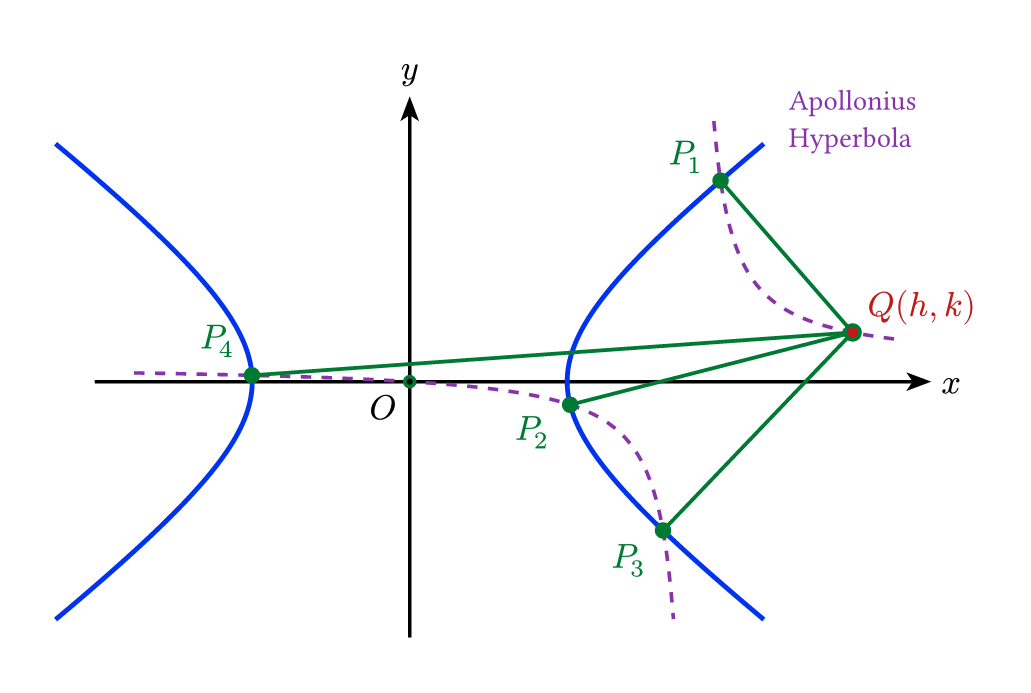
There is a second, purely Cartesian way to see why there are four co-normal points—and it reveals a remarkable curve passing through all four feet.
The normal at a Cartesian point (x1,y1) on a2x2−b2y2=1 is:
x1a2x+y1b2y=a2+b2
If this normal passes through Q(h,k), then the foot (x1,y1) must satisfy:
x1a2h+y1b2k=a2+b2
Clearing denominators and replacing (x1,y1) by (x,y):
(a2+b2)xy−b2kx−a2hy=0
Factoring this general equation (by the method of Section 10):
(x−a2+b2a2h)(y−a2+b2b2k)=(a2+b2)2a2b2hk
This is a rectangular hyperbola with asymptotes parallel to the coordinate axes, known as Apollonius's rectangular hyperbola. Notice two immediate properties:
Setting (x,y)=(0,0) satisfies the equation, so it passes through the center O(0,0).
Setting (x,y)=(h,k) gives (a2+b2)hk−b2hk−a2hk=0, so it passes through Q(h,k).
The four co-normal feet P1,P2,P3,P4 are precisely the four points of intersection of the given hyperbola with Apollonius's rectangular hyperbola!
Properties of Co-normal Points on the Standard Hyperbola§
Recall the tangent-of-sum identity for four angles αi=2θi (where ti=tanαi):
tan(2θ1+θ2+θ3+θ4)=1−S2+S4S1−S3
Substituting S2=0 and S4=−1:
1−S2+S4=1−0+(−1)=0
Since the denominator vanishes (while S1−S3=−bk4ah=0 for h=0), the tangent tends to infinity, which means:
2θ1+θ2+θ3+θ4=nπ+2π(n∈Z)
Multiplying by 2 yields the central eccentric-angle theorem:
θ1+θ2+θ3+θ4=(2n+1)π
Theorem:
The sum of the eccentric angles of four co-normal points on a hyperbola is always an odd multiple of π—the exact same condition as for an ellipse.
The co-normal theory becomes extraordinarily clean for the rectangular hyperbola:
xy=c2
From Section 10, the normal at P(ct,tc) is xt3−yt=c(t4−1). If this normal passes through Q(h,k), then:
ct4−ht3+0⋅t2+kt−c=0
Let t1,t2,t3,t4 be the parameters of the four co-normal points Pi(cti,tic). Applying Vieta's formulas directly to this quartic gives four powerful identities:
1. Product of parameters:
t1t2t3t4=c−c=−1
2. Sum of parameters and sum of abscissae:
i=1∑4ti=ch⟹i=1∑4xi=ci=1∑4ti=h
3. Sum of pairwise products:
1≤i<j≤4∑titj=0
4. Sum of reciprocal parameters and sum of ordinates:
From Vieta's third relation, ∑titjtk=−ck. Dividing by t1t2t3t4=−1:
Three Immediate Geometric Corollaries for xy = c^2§
Corollary 1: Centroid of the Four Co-normal Points
From ∑xi=h and ∑yi=k, the centroid G(xˉ,yˉ) of the four co-normal feet is simply one-quarter of Q(h,k):
G=(4h,4k)
Corollary 2: Sum of Squares of Coordinates
Using ∑ti2=(∑ti)2−2∑titj with ∑titj=0:
i=1∑4xi2=c2i=1∑4ti2=c2(c2h2−0)=h2
Similarly, since ∑titj1=t1t2t3t4∑titj=−10=0:
i=1∑4yi2=c2i=1∑4ti21=c2(c2k2−0)=k2
Adding the two gives a remarkable distance identity: the sum of the squares of the distances of the four co-normal feet from the center O equals OQ2:
OP12+OP22+OP32+OP42=h2+k2=OQ2
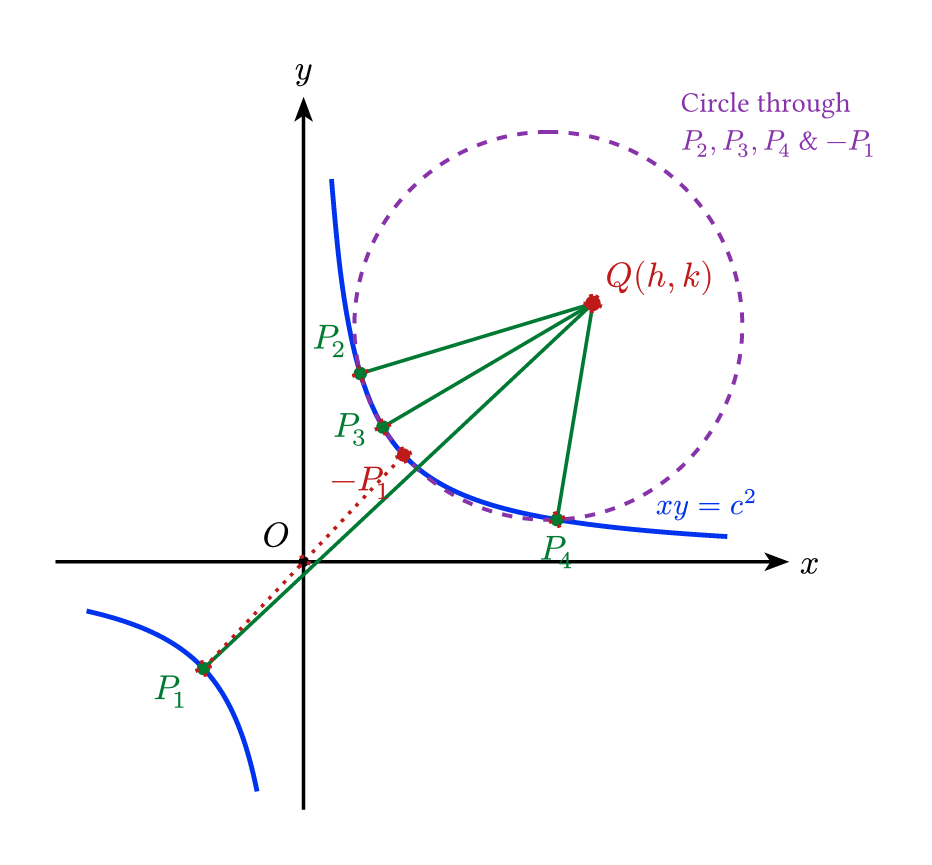
Corollary 3: Co-normal vs. Concyclic Points (Antipodal Circle Theorem)
Recall from Section 10 that four points on xy=c2 are concyclic if and only if t1t2t3t4=+1, whereas four co-normal points satisfy t1t2t3t4=−1.
Suppose P1,P2,P3,P4 are co-normal on xy=c2, and draw the circle passing through any three of them, say P2,P3,P4. Let this circle meet xy=c2 again at a fourth point P′(t′).
Since P2,P3,P4,P′ are concyclic: t2t3t4t′=+1.
Since P1,P2,P3,P4 are co-normal: t1t2t3t4=−1⟹t2t3t4=−t11.
Substituting into the concyclic condition:
(−t11)t′=1⟹t′=−t1
Thus P′=(−ct1,−t1c)=−P1: the circle through any three co-normal points on xy=c2 meets the hyperbola again at the point diametrically opposite to the fourth co-normal point!
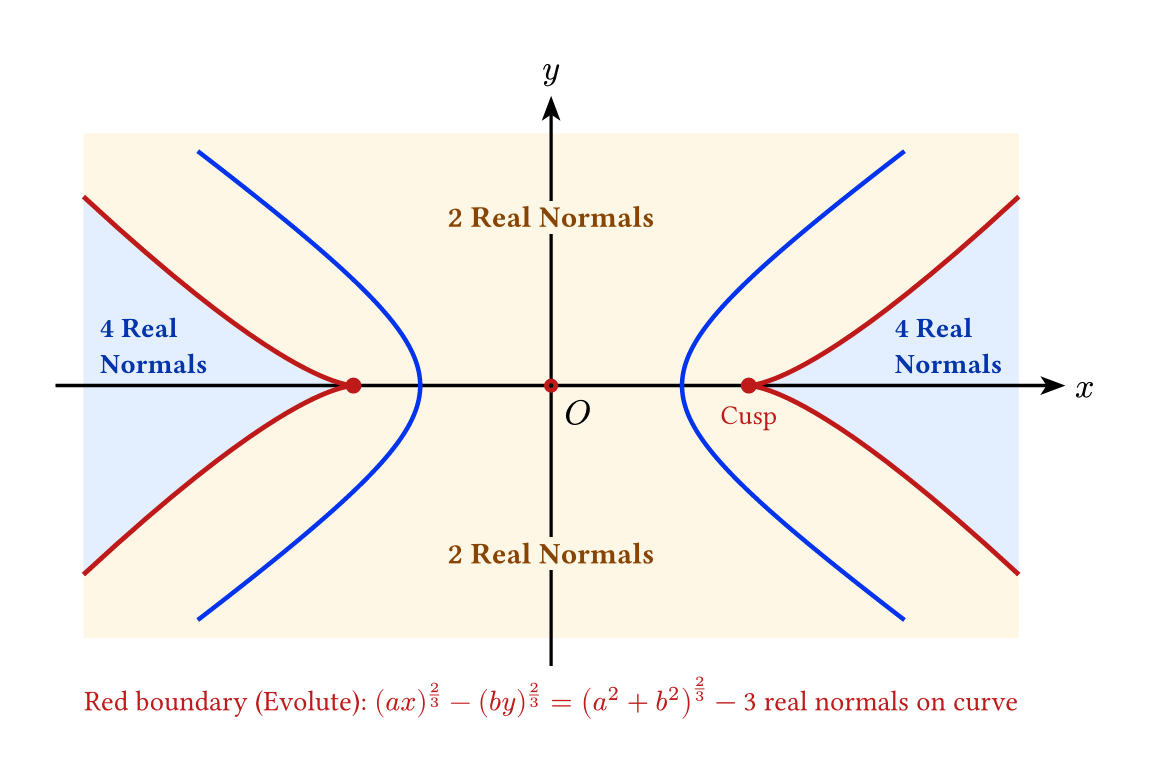
Although the normal equation has degree 4, not all four roots are always real. Because complex roots of a real polynomial come in conjugate pairs, the number of real normals from Q(h,k) to a2x2−b2y2=1 must be either 4, 2, or 3 (on the boundary where two roots coincide).
(Unlike a parabola or ellipse, you can always draw at least 2 real normals to a hyperbola from any point in the plane, because every continuous branch has a point of minimum distance from Q—one on the left branch and one on the right branch!)
Thus we have both trigonometric powers cleanly isolated:
cosθ=(aha2+b2)1/3,sinθ=−(ahbk)1/3
Eliminating θ using the identity cos2θ+sin2θ=1:
(aha2+b2)2/3+(ahbk)2/3=1
Multiplying through by (ah)2/3 and replacing (h,k) by (x,y) gives the equation of the evolute (boundary curve) of the hyperbola:
(ax)2/3−(by)2/3=(a2+b2)2/3
(Compare this with the ellipse's closed 4-cusped astroid (ax)2/3+(by)2/3=(a2−b2)2/3: replacing b2 by −b2 opens the astroid into two symmetric 1-cusped branches with sharp cusps on the x-axis at x=±aa2+b2!)
Example 1: Finding the Fourth Co-normal Eccentric Angle§
The normals at three points on a hyperbola with eccentric angles θ1=6π, θ2=4π, and θ3=3π are concurrent. Find the eccentric angle θ4∈[0,2π) of the fourth co-normal point.
Solution:
For four co-normal points on a hyperbola, the sum of their eccentric angles is an odd multiple of π:
θ1+θ2+θ3+θ4=(2n+1)π
First compute the sum of the three given angles:
θ1+θ2+θ3=6π+4π+3π=122π+3π+4π=129π=43π
Now solve for θ4∈[0,2π):
Taking n=0 (sum =π): θ4=π−43π=4π (which coincides with θ2, so it does not give a distinct fourth point unless θ2 is a repeated foot).
Hence θ4=4π (which tells us that for these three concurrent normals, the normal at θ=4π is a double normal, meaning the point of concurrency lies on the evolute!).
Example 2: Centroid and Sum of Squares for Co-normal Points on xy = c^2§
Four normals are drawn from the point Q(8,12) to the rectangular hyperbola xy=9. Find:
The centroid of the four co-normal feet.
The sum of the squares of the distances of the four feet from the origin.
Solution:
Here c2=9 and (h,k)=(8,12). The four co-normal parameters satisfy 3t4−8t3+12t−3=0.
Example 3: Counting Real Normals from Given Points§
Determine the number of distinct real normals that can be drawn to the hyperbola 9x2−16y2=1 from each of the following points:
A(10,0)
B(8,0)
C(0,5)
Solution:
Here a=3, b=4, and a2+b2=9+16=25.
The evolute boundary is (3∣x∣)2/3−(4∣y∣)2/3=252/3, and its two cusps on the x-axis lie at:
xcusp=±aa2+b2=±325≈±8.33
1. For A(10,0):
Evaluate (3∣x∣)2/3−(4∣y∣)2/3=302/3−0=302/3>252/3.
Since A(10,0) lies strictly inside the right evolute cusp (10>325), 4 distinct real normals can be drawn from A(10,0).
2. For B(8,0):
Here 3∣x∣=24<25, so 242/3<252/3.
Since B(8,0) lies between the two evolute cusps (∣8∣<325), only 2 distinct real normals can be drawn from B(8,0) (in fact, both lie along the x-axis itself, hitting the two vertices (3,0) and (−3,0)!).
3. For C(0,5):
Here (3∣0∣)2/3−(4∣5∣)2/3=−202/3<252/3.
Hence 2 distinct real normals can be drawn from C(0,5) (one to the right branch and one symmetrically to the left branch).
The normals at three points P1,P2,P3 on the rectangular hyperbola xy=4 are concurrent at a point Q, and the fourth co-normal foot is P4(4,1). Find the fourth point of intersection of the circle passing through P1,P2,P3 with the hyperbola xy=4.
Solution:
By Corollary 3 (the Antipodal Circle Theorem), the circle passing through any three co-normal points P1,P2,P3 on xy=c2 intersects the hyperbola again at the point diametrically opposite to the fourth co-normal point P4:
P′=−P4=(−4,−1)
(Quick check: P4(4,1) has c=2 and t4=2, so P′ has t′=−t4=−2, giving (−4,−1) on xy=4.)
Problem 1: Normals Drawn from a Point on the Transverse Axis§
Prove directly (without using the evolute formula) that from a point Q(h,0) on the transverse axis of a2x2−b2y2=1, four distinct real normals can be drawn if and only if ∣h∣>aa2+b2.
Solution:
The normal at a point (x1,y1) on the hyperbola in Cartesian form is x1a2x+y1b2y=a2+b2. Clearing denominators gives a2xy1+b2yx1=(a2+b2)x1y1. Substituting Q(h,0) yields:
y1[(a2+b2)x1−a2h]=0
This splits cleanly into two cases:
Case A (y1=0): This gives the two vertices x1=±a (two real normals along the x-axis, which always exist for every h).
Case B (y1=0): Here x1=a2+b2a2h. For (x1,y1) to be a real point on the hyperbola a2x12−b2y12=1 with y1=0, we require ∣x1∣>a:
a2+b2a2h>a⟺∣h∣>aa2+b2
When ∣h∣>aa2+b2, Case B yields two additional symmetric real feet (x1,±y1), making 4 distinct real normals in total. When ∣h∣≤aa2+b2, Case B gives no new real feet, leaving only the 2 vertex normals! ■
Problem 2: Locus of Intersection of Two Perpendicular Normals to xy = c^2§
Find the locus of the point of intersection Q(h,k) of two mutually perpendicular normals to the rectangular hyperbola xy=c2.
Solution:
Recall from Section 10 that the normal to xy=c2 at P(ct,c/t) has slope mN=t2.
Since t2>0 for every real t=0, every normal to xy=c2 has a strictly positive slope!
Can two lines with positive slopes ever be perpendicular? For perpendicular lines, we need m1m2=−1:
t12t22=−1
Because t12t22=(t1t2)2>0 for all real t1,t2=0, the equation t12t22=−1 has no real solutions!
Therefore, no two normals to a rectangular hyperbola xy=c2 can ever be perpendicular—the locus is the empty set! (Contrast this with a general hyperbola a2x2−b2y2=1, where normal slopes lie in (−ba,ba); perpendicular normals m1m2=−1 require ∣m1∣,∣m2∣ to be able to straddle 1, which is possible if and only if ba>1, i.e. a>b!)
Problem 3: Locus of Point of Concurrency When Two Co-normal Feet on xy = c^2 Are Related§
If the normals at P1(t1),P2(t2),P3(t3),P4(t4) on xy=c2 are concurrent at Q(h,k), and the chord P1P2 has a constant slope m=−λ (λ>0), find the locus of Q(h,k).
Solution:
From Section 10, the slope of the chord joining P1(t1) and P2(t2) on xy=c2 is −t1t21. Given that this slope equals −λ:
−t1t21=−λ⟹t1t2=λ1
Since P1,P2,P3,P4 are co-normal at Q(h,k), they satisfy t1t2t3t4=−1, so:
t3t4=−t1t21=−λ
Now let u=t1+t2 and v=t3+t4. From the co-normal Vieta relations for ct4−ht3+kt−c=0: