Geometric Properties of Tangents, Normals, and Director Circle
In the previous sections, we developed the algebra of tangents, normals, pairs of tangents, and the rectangular hyperbola. We now turn to the geometric properties of a hyperbola—how its tangents and normals interact with the foci, directrices, auxiliary circle, and asymptotes.
Mastering these properties gives you two major advantages:
Problems that look daunting by brute-force algebra often collapse into two or three lines of geometry.
Comparing each theorem with its counterpart for the ellipse reveals a deep, unified symmetry across all conic sections.
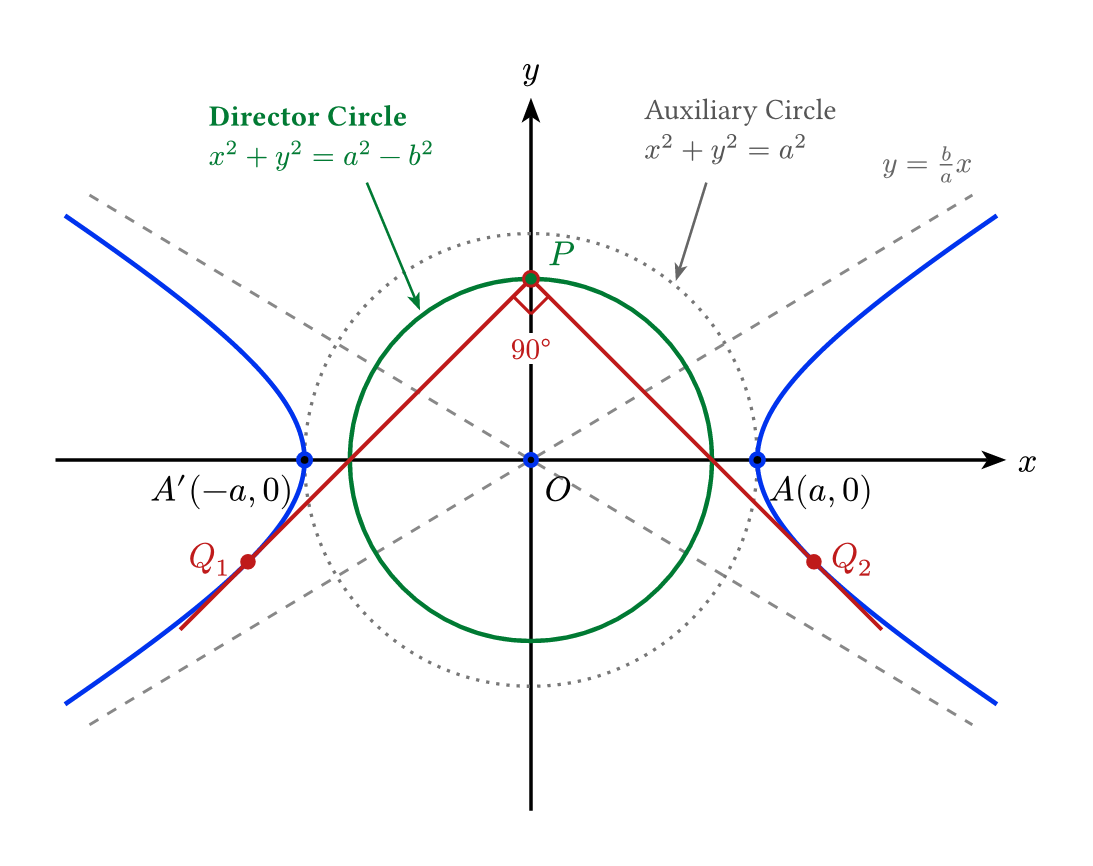
The director circle of a conic is the locus of all points from which a pair of mutually perpendicular tangents can be drawn to the conic.
In Section 09, we saw that the combined tangents SS1=T2 are perpendicular when the sum of the coefficients of x2 and y2 vanishes. Let us now derive the director circle directly from the slope form of the tangent and analyze its complete geometry.
Any tangent of slope m to the horizontal hyperbola a2x2−b2y2=1 has the equation:
y=mx±a2m2−b2
If this tangent passes through an external point P(h,k), then:
k−mh=±a2m2−b2
Squaring both sides and rearranging as a quadratic equation in m:
(k−mh)2=a2m2−b2(h2−a2)m2−2hkm+(k2+b2)=0
The two roots m1,m2 of this quadratic are the slopes of the two tangents drawn from P(h,k). For the tangents to be perpendicular, we require m1m2=−1. By Vieta's product of roots:
m1m2=h2−a2k2+b2=−1k2+b2=−(h2−a2)⟹h2+k2=a2−b2
Replacing (h,k) by (x,y), the equation of the director circle of the horizontal hyperbola a2x2−b2y2=1 is:
Unlike an ellipse—whose director circle x2+y2=a2+b2 is always real and lies outside the auxiliary circle—a hyperbola's director circle depends critically on how a compares with b (or equivalently, how the eccentricity e=1+b2/a2 compares with 2).
Recall that the angle between the two asymptotes y=±abx containing the transverse axis is 2α, where tanα=ab.
Case 1: a>b (equivalently 1<e<2, acute asymptote angle 2α<90∘)
Here a2−b2>0, so the director circle x2+y2=a2−b2 is a real circle of radius R=a2−b2 centered at (0,0).
Notice that a2−b2<a. Therefore, the director circle lies strictly inside the auxiliary circle x2+y2=a2 (and entirely inside the central region between the two branches). For any point on this circle not lying on the asymptotes, the two perpendicular tangents are finite and real. (At the four points where the director circle intersects the asymptotes y=±abx, one of the two tangents degenerates into the asymptote itself, leaving only one finite tangent at those four points.)
Case 2: a=b (equivalently e=2, Rectangular Hyperbola, 2α=90∘)
Here a2−b2=0, so the director circle equation collapses to:
x2+y2=0
This represents the single point (0,0) (a point circle). As we learned in Section 10, the asymptotes of a rectangular hyperbola are themselves perpendicular (90∘). Since the tangents from (0,0) degenerate into the asymptotes, no finite pair of perpendicular tangents can be drawn to a rectangular hyperbola.
Case 3: a<b (equivalently e>2, obtuse asymptote angle 2α>90∘)
Here a2−b2<0, so x2+y2=a2−b2 has no real points (an imaginary circle). Geometrically, the branches open so widely that the angle between any two tangents to opposite branches is always strictly less than 90∘ (or strictly greater than 90∘ on the same side—never 90∘). Hence, no real point exists from which perpendicular tangents can be drawn.
Conjugate Hyperbola Connection:
For the vertical (conjugate) hyperbola b2y2−a2x2=1, swapping a and b gives the director circle:
x2+y2=b2−a2.
Thus, whenever a horizontal hyperbola has a<b (imaginary director circle), its conjugate hyperbola has b>a and possesses a real director circle! For a shifted horizontal hyperbola a2(x−h)2−b2(y−k)2=1, the director circle is simply (x−h)2+(y−k)2=a2−b2.
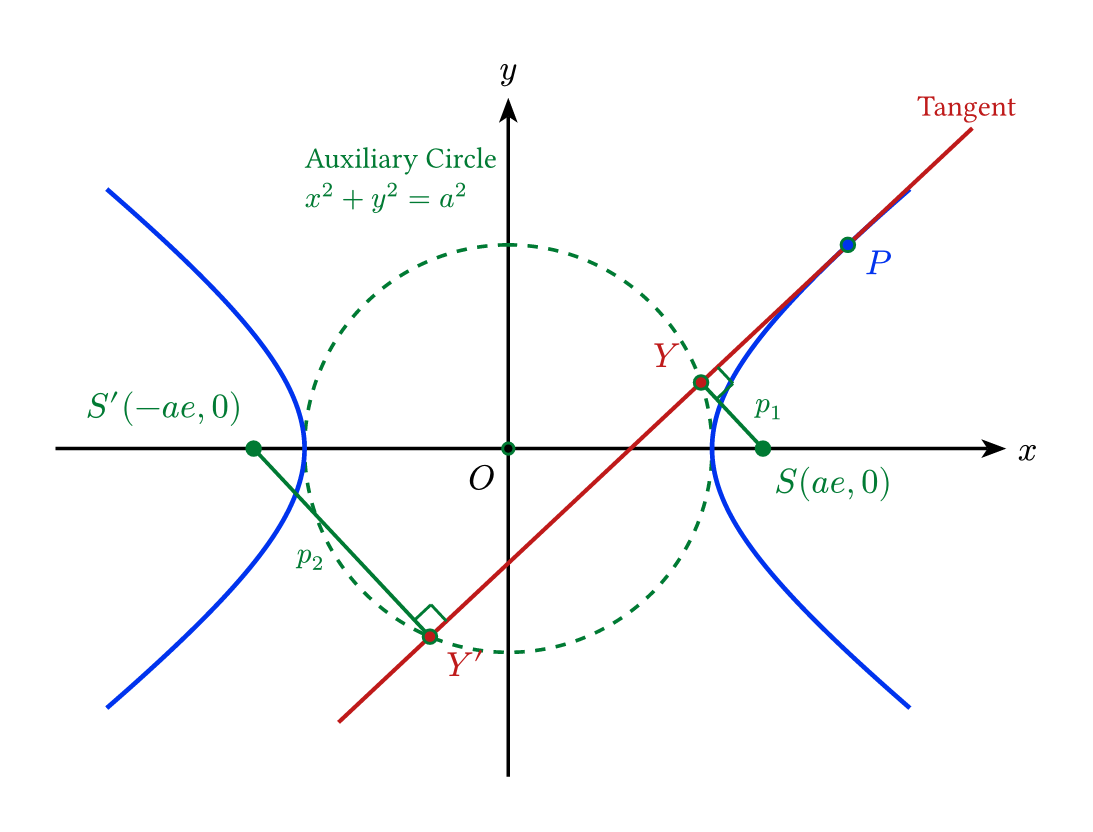
Consider the standard horizontal hyperbola a2x2−b2y2=1 with foci S(ae,0) and S′(−ae,0), and auxiliary circle x2+y2=a2.
Draw any tangent to the hyperbola, and drop perpendiculars SY and S′Y′ from the two foci onto this tangent. Let their lengths be p1=SY and p2=S′Y′.
Property 1: Feet of Focal Perpendiculars Lie on the Auxiliary Circle§
Statement:
The feet of the perpendiculars (Y and Y′) drawn from the two foci onto any tangent of a hyperbola always lie on its auxiliary circlex2+y2=a2.
Proof:
Any tangent of slope m (∣m∣>b/a) to the hyperbola has the equation:
y−mx=±a2m2−b2⋯(1)
The line through the focus S(ae,0) perpendicular to this tangent has slope −m1:
y−0=−m1(x−ae)⟹x+my=ae⋯(2)
The foot of the perpendicular Y(x,y) satisfies both (1) and (2). Squaring and adding equations (1) and (2) eliminates m:
(y−mx)2+(x+my)2=(a2m2−b2)+a2e2
Expanding the left-hand side (the cross terms −2mxy and +2mxy cancel):
(1+m2)(x2+y2)=a2m2+(a2e2−b2)
For a hyperbola, b2=a2(e2−1)=a2e2−a2, which gives a2e2−b2=a2. Substituting this on the right-hand side:
(1+m2)(x2+y2)=a2m2+a2=a2(1+m2)
Dividing both sides by 1+m2=0:
x2+y2=a2
Replacing ae with −ae for the second focus S′(−ae,0) yields the exact same result. Hence both Y and Y′ always lie on the auxiliary circle x2+y2=a2. ■
Statement:
The product of the lengths of the perpendiculars drawn from the two foci onto any tangent of a hyperbola is constant and equal to b2:
p1⋅p2=SY⋅S′Y′=b2.
Proof:
Write the tangent of slope m in linear form as mx−y+c=0, where c=±a2m2−b2 (so c2=a2m2−b2).
Using the perpendicular distance formula from S(ae,0) and S′(−ae,0):
p1=m2+1∣mae+c∣,p2=m2+1∣−mae+c∣
Multiplying the two lengths:
p1p2=m2+1∣(c+mae)(c−mae)∣=m2+1∣c2−a2e2m2∣
Substitute c2=a2m2−b2 and a2e2=a2+b2:
c2−a2e2m2=(a2m2−b2)−(a2+b2)m2=−b2−b2m2=−b2(1+m2)
Taking the absolute value and dividing by m2+1:
p1p2=1+m2∣−b2(1+m2)∣=b2
This completes the proof. ■
Subtle Sign Contrast with the Ellipse:
Notice that inside the absolute value, c2−a2e2m2=−b2(1+m2)<0 is strictly negative (whereas for the ellipse, c2−a2e2m2=+b2(1+m2)>0). Geometrically, this means the two foci S and S′ always lie on opposite sides of every tangent to a hyperbola—whereas for an ellipse, both foci always lie on the same side of every tangent!
Just like the parabola and the ellipse, the hyperbola possesses a remarkable optical reflection property—with an intriguing twist in which line acts as the internal angle bisector.
Property 3: Tangent and Normal as Angle Bisectors§
Statement:
At any point P on a hyperbola:
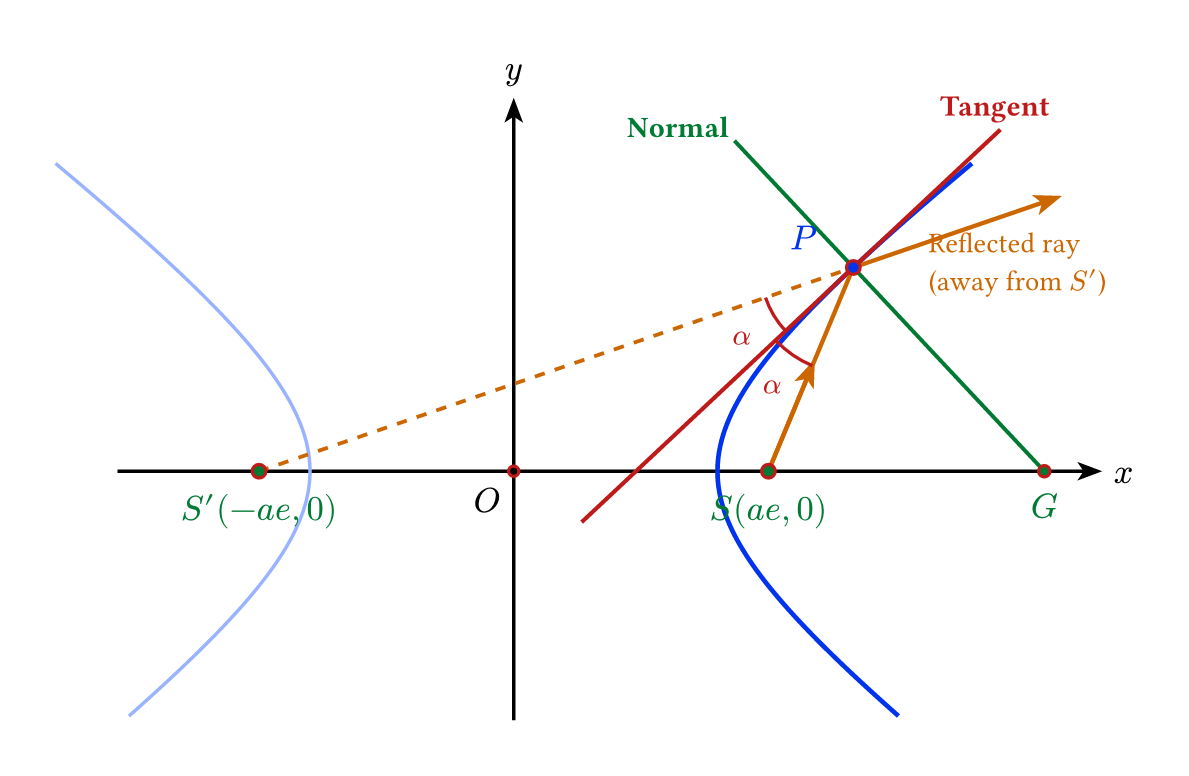
The tangent at P bisects the interior angle ∠S′PS between the focal radii S′P and SP.
The normal at P bisects the exterior angle ∠S′PS.
Proof:
Let P(x1,y1) be a point on the right branch of a2x2−b2y2=1 (so x1≥a).
Recall from Section 01 the exact focal distances for a point on the right branch:
SP=ex1−a,S′P=ex1+a
From Section 08, the equation of the normal at P(x1,y1) is:
x1a2x+y1b2y=a2+b2=a2e2
Setting y=0, the normal meets the transverse axis (x-axis) at G(e2x1,0).
Since x1≥a and e>1, we have e2x1≥e2a>ae, so G lies to the right of S(ae,0) (i.e., G divides the segment S′Sexternally). Let us compute the distances S′G and SG:
By the converse of the External Angle Bisector Theorem in △S′PS, the normal PG bisects the exterior angle of △S′PS at P.
Because the tangent PT is perpendicular to the normal PG, the tangent PT must bisect the interior angle ∠S′PS! ■
Optical Meaning (Hyperbolic Mirrors & Telescopes):
By the law of reflection, a light ray emerging from focus S and striking the reflective inner face of the right branch at P reflects along the line S′P extended—so to an observer, the reflected ray appears to originate directly from the other focus S′. Conversely, an incoming ray aimed directly toward focus S′ reflects off the outer (convex) face of the right branch straight into focus S! This exact principle is used in the hyperbolic secondary mirror of Cassegrain reflecting telescopes.
Corollary: Confocal Ellipses and Hyperbolas Intersect Orthogonally§
Two conics that share the exact same pair of foci S and S′ are called confocal conics.
Suppose an ellipse and a hyperbola are confocal, and they intersect at a point P.
From Chapter 20, the normal to the ellipse at P bisects the interior angle ∠S′PS.
From Property 3 above, the tangent to the hyperbola at P also bisects the interior angle ∠S′PS.
Since a given angle has a unique interior bisector, the tangent to the hyperbola at Pcoincides with the normal to the ellipse at P! Therefore, the two tangents at P are perpendicular:
Orthogonality Theorem:
Every confocal ellipse and hyperbola intersect each other orthogonally (at 90∘) at all four points of intersection.
Tangent-Directrix Right-Angle Property and Focal Chords§
Let us complete our focal geometry with two compact, high-utility results that mirror the parabola and ellipse.
Property 4: Tangent Segment Between Curve and Directrix§
Statement:
The portion of any tangent to a hyperbola intercepted between the point of contact P and the corresponding directrix subtends a right angle (90∘) at the corresponding focus S.
Proof:
Let P(asecθ,btanθ) lie on the right branch. The tangent at P is:
axsecθ−bytanθ=1
Let this tangent intersect the right directrix x=ea at R(ea,yR). Substituting x=ea:
esecθ−byRtanθ=1⟹yR=etanθb(secθ−e)
Now compute the slopes of SP and SR, where S(ae,0):
A chord passing through a focus is called a focal chord. Two classical results are especially useful in geometric problem solving:
1. Harmonic Mean of Focal Segments:
If PQ is a focal chord of a2x2−b2y2=1 with both endpoints on the same branch (around focus S), then the semi-latus rectum l=ab2 is the harmonic mean of SP and SQ:
SP1+SQ1=l2=b22a
(Proof via polar form from Section 01: for P(r1,θ) and Q(r2,θ+π), r1l=1−ecosθ and r2l=1−ecos(θ+π)=1+ecosθ. Adding immediately gives r1l+r2l=2⟹r11+r21=l2. Note that if P and Q lie on opposite branches, the signed version gives SP1−SQ1=l2.)
2. Tangents at the Ends of a Focal Chord Intersect on the Directrix:
Let the tangents at P and Q intersect at R(x1,y1). Then PQ is the chord of contact of R:
a2xx1−b2yy1=1
Since PQ passes through the focus S(ae,0), substituting (ae,0) yields:
a2(ae)x1−0=1⟹x1=ea
Thus R always lies on the corresponding directrix x=ea!
In Section 10, we proved two elegant theorems for the rectangular hyperbola xy=c2: the tangent segment intercepted between the coordinate axes (asymptotes) is bisected at P, and the triangle △OAB has constant area 2c2.
Remarkably, both theorems hold for every hyperbola, not just rectangular ones!
Property 6: Midpoint and Constant Area Between Asymptotes§
Statement:
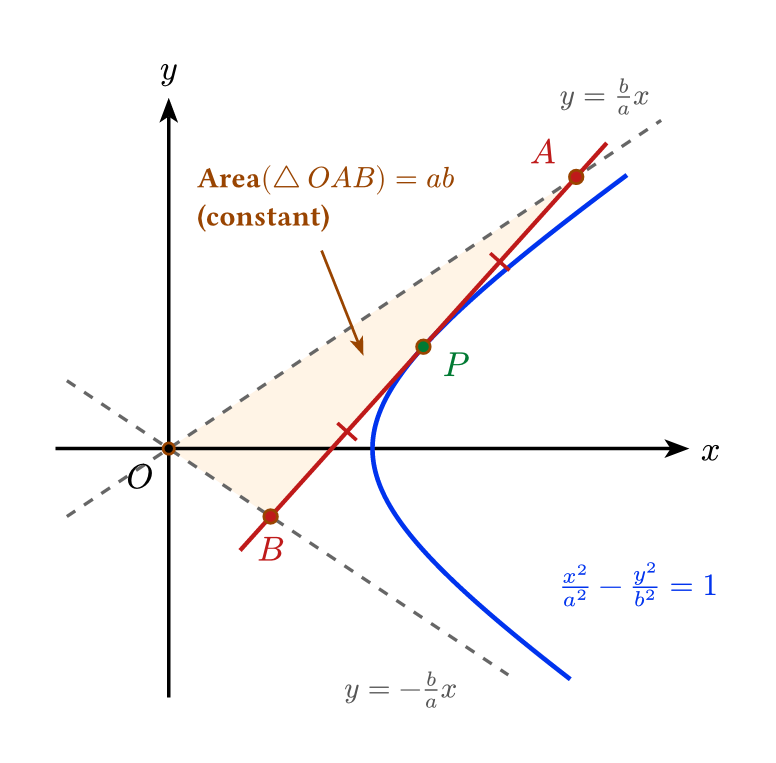
If the tangent at any point P on the hyperbola a2x2−b2y2=1 meets the two asymptotes y=abx and y=−abx at points A and B respectively, then:
P is the exact midpoint of segment AB (AP=PB).
The area of △OAB is constant and equal to ab.
Proof:
Let P(asecθ,btanθ) be any point on the hyperbola. The tangent at P is:
axsecθ−bytanθ=1
Intersection A with asymptote y=abx:
Substitute by=ax into the tangent equation:
ax(secθ−tanθ)=1⟹xA=secθ−tanθa=a(secθ+tanθ)
(using the identity sec2θ−tan2θ=1). Hence yA=abxA=b(secθ+tanθ), so:
The area is strictly independent of θ! Notice that for a rectangular hyperbola (a=b=2c), this immediately specializes to ab=a2=2c2, connecting seamlessly with Section 10. ■
Since a2>b2 (25>9), a real director circle exists:
(x−2)2+(y+1)2=a2−b2=25−9=16
This is a real circle centered at (2,−1) with radius 4.
2. Hyperbola 9x2−16y2=144:
Dividing by 144 gives 16x2−9y2=1, so a2=16 and b2=9.
Since a2>b2, the director circle is real:
x2+y2=16−9=7
3. Hyperbola 16x2−9y2=144:
Dividing by 144 gives 9x2−16y2=1, so a2=9 and b2=16.
Here a2−b2=9−16=−7<0. Hence no real director circle exists—no pair of perpendicular tangents can be drawn to this hyperbola.
Example 2: Using Focal Perpendiculars to Identify a Hyperbola§
The foci of a hyperbola are S(5,0) and S′(−5,0), and the line 3x−2y=6 is tangent to the hyperbola. Find the standard equation of the hyperbola using geometric properties (without solving a quadratic).
Solution:
Step 1: Find b2 from the Product of Focal Perpendiculars (p1p2=b2):
The tangent line is 3x−2y−6=0. Drop perpendiculars from S(5,0) and S′(−5,0):
(Quick check via tangency condition c2=a2m2−b2: the line is y=23x−3, so m=23 and c2=9. Here a2m2−b2=13136⋅49−13189=13306−189=13117=9=c2. Exact!)
Example 3: Tracing a Reflected Ray Off a Hyperbolic Mirror§
A ray of light originating from the focus S(5,0) strikes the hyperbola 9x2−16y2=1 at the point P(5,316). Find the equation of the reflected ray.
Solution:
Step 1: Identify the two foci:
Here a2=9, b2=16, so ae=a2+b2=9+16=5.
Thus the two foci are S(5,0) and S′(−5,0).
Step 2: Apply the Reflection Property (Property 3):
By the reflection property of the hyperbola, any ray coming from focus S and reflecting off the curve at P travels directly along the line joining the other focusS′(−5,0) to P(5,316) (moving away from S′).
Step 3: Write the equation of line S′P:
The slope of S′P is:
m=5−(−5)316−0=1016/3=158
Using point-slope form through S′(−5,0):
y−0=158(x+5)⟹8x−15y+40=0
The reflected ray lies along the line 8x−15y+40=0 (for x≥5). Notice how geometry solved this in three lines without even computing the tangent or normal!
Example 4: Verifying Orthogonality of a Confocal Ellipse and Hyperbola§
Show that the ellipse 25x2+9y2=1 and the hyperbola 12x2−4y2=1 are confocal, and verify directly that they intersect orthogonally.
Solution:
Step 1: Check the foci of both conics:
For the ellipse: cE2=aE2−bE2=25−9=16⟹ foci at (±4,0).
For the hyperbola: cH2=aH2+bH2=12+4=16⟹ foci at (±4,0).
Since both share the exact same foci (±4,0), they are confocal.
Step 2: Direct slope verification at an intersection point (x1,y1):
Differentiating the ellipse equation 25x2+9y2=1:
m1=−25y19x1
Differentiating the hyperbola equation 12x2−4y2=1:
m2=12y14x1=3y1x1
Multiplying the slopes:
m1m2=−25y19x1⋅3y1x1=−25y123x12
Now find y12x12 by subtracting the two conic equations:
A focal chord PQ of the hyperbola 9x2−16y2=1 lies entirely on the right branch. If the focal distance SP=6, find SQ.
Solution:
Here a=3 and b=4, so the semi-latus rectum is:
l=ab2=316
By Property 5, SP1+SQ1=l2:
61+SQ1=16/32=83
Solving for SQ1:
SQ1=83−61=249−4=245⟹SQ=524=4.8
Example 6: Tangent Intercepted Between Asymptotes§
A variable tangent to the hyperbola a2x2−b2y2=1 meets the asymptotes at A and B. If the area of △OAB is 24 square units and the eccentricity of the hyperbola is 35, find the standard equation of the hyperbola.
Solution:
Step 1: Use Property 6 (Constant Area Theorem):
The area of △OAB formed by any tangent and the two asymptotes is always ab:
ab=24⋯(1)
Step 2: Use the eccentricity relation:
Given e=35:
b2=a2(e2−1)=a2(925−1)=916a2⟹b=34a⋯(2)
Step 3: Solve (1) and (2) simultaneously:
Substitute b=34a into ab=24:
a(34a)=24⟹a2=18
Then:
b2=916(18)=32
Therefore, the standard equation of the hyperbola is: