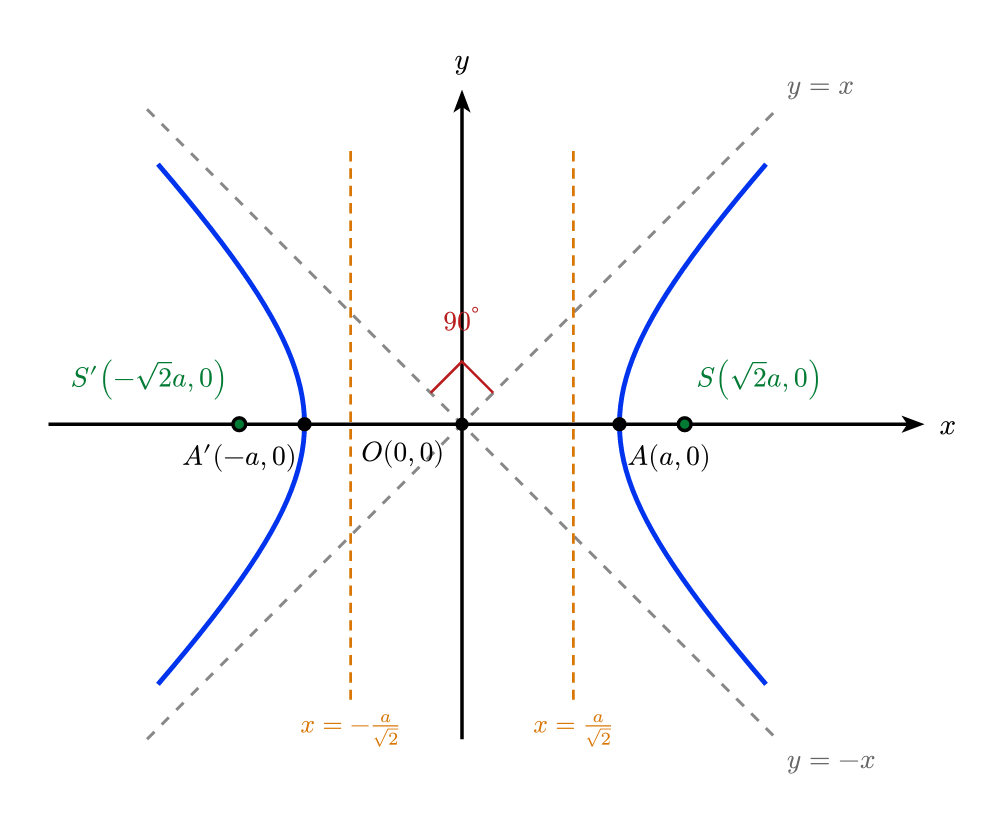
In our study of conic sections, we have encountered standard curves whose geometric behavior simplifies dramatically under special symmetry conditions. For an ellipse, setting the semi-major axis equal to the semi-minor axis (a=b) collapses the eccentricity to zero and produces a circle.
What happens when we impose the exact same condition a=b on a hyperbola?
Instead of collapsing into a circle, the hyperbola unfolds into one of the most elegant curves in all of mathematics: the rectangular hyperbola (also historically known as an equilateral hyperbola). In this chapter, we explore its standard geometry, its transformation into the familiar reciprocal form xy=c2 via a 45∘ coordinate rotation, its tangency and normal conditions, and the remarkable geometric theorems that make it a classic subject in analytic geometry.
A hyperbola whose semi-transverse axis a is equal to its semi-conjugate axis b is called a rectangular hyperbola or equilateral hyperbola.
Taking the standard equation of a horizontal hyperbola:
a2x2−b2y2=1
and substituting b=a, we obtain the standard equation:
x2−y2=a2
Geometric Features of the Standard Rectangular Hyperbola§
Let us compute the fundamental parameters of x2−y2=a2:
1. Eccentricity (e):
Recall the eccentricity formula for a hyperbola:
e=1+a2b2
Setting b=a:
e=1+1=2
Every rectangular hyperbola has an eccentricity strictly equal to 2, completely independent of the scale parameter a.
2. Asymptotes:
The equations of the asymptotes to a2x2−b2y2=1 are y=±abx. Substituting b=a gives:
y=xandy=−x
The slopes of the two asymptotes are m1=1 and m2=−1. Notice that:
m1⋅m2=1⋅(−1)=−1
The asymptotes are mutually perpendicular (they intersect at an angle of 90∘). This perpendicular (right-angled) relationship is precisely why the curve is named a rectangular hyperbola.
3. Foci:
The focal distance from the center is cfocal=ae=a2. The foci are:
S(a2,0)andS′(−a2,0)
4. Directrices:
The directrices are located at x=±ea:
x=±2a
5. Vertices:
The vertices lie on the transverse axis (x-axis) at:
A(a,0)andA′(−a,0)
6. Length of Latus Rectum:
Length of L.R.=a2b2=a2a2=2a
The length of the latus rectum equals the length of the transverse axis (2a).
In the standard Cartesian orientation, the asymptotes are the lines y=x and y=−x, inclined at 45∘ and 135∘ to the positive x-axis.
Because the asymptotes are perpendicular straight lines, they form an ideal candidate for a new Cartesian coordinate system! What happens if we rotate our coordinate axes clockwise by 45∘ so that the coordinate axes coincide with the asymptotes?
Now, substitute these expressions for x and y into the equation x2−y2=a2:
(2X+Y)2−(2Y−X)2=a2
Expanding the squares:
2X2+2XY+Y2−2Y2−2XY+X2=a2
Notice that the X2 and Y2 terms cancel out completely:
2(X2−X2)+4XY+(Y2−Y2)=a2⟹24XY=a2⟹2XY=a2
Dividing both sides by 2:
XY=2a2
Defining the positive constant c2=2a2 (so that c=2a), and returning to lowercase notation (x,y) for the new coordinate axes, we arrive at the classic equation:
Let us establish every geometric parameter of xy=c2 using the relation c=2a (or a=c2):
1. Center:
The center is the point of intersection of the two asymptotes (the origin):
C(0,0)
2. Asymptotes:
The asymptotes are the coordinate axes themselves:
x=0(y-axis)andy=0(x-axis)
3. Transverse Axis:
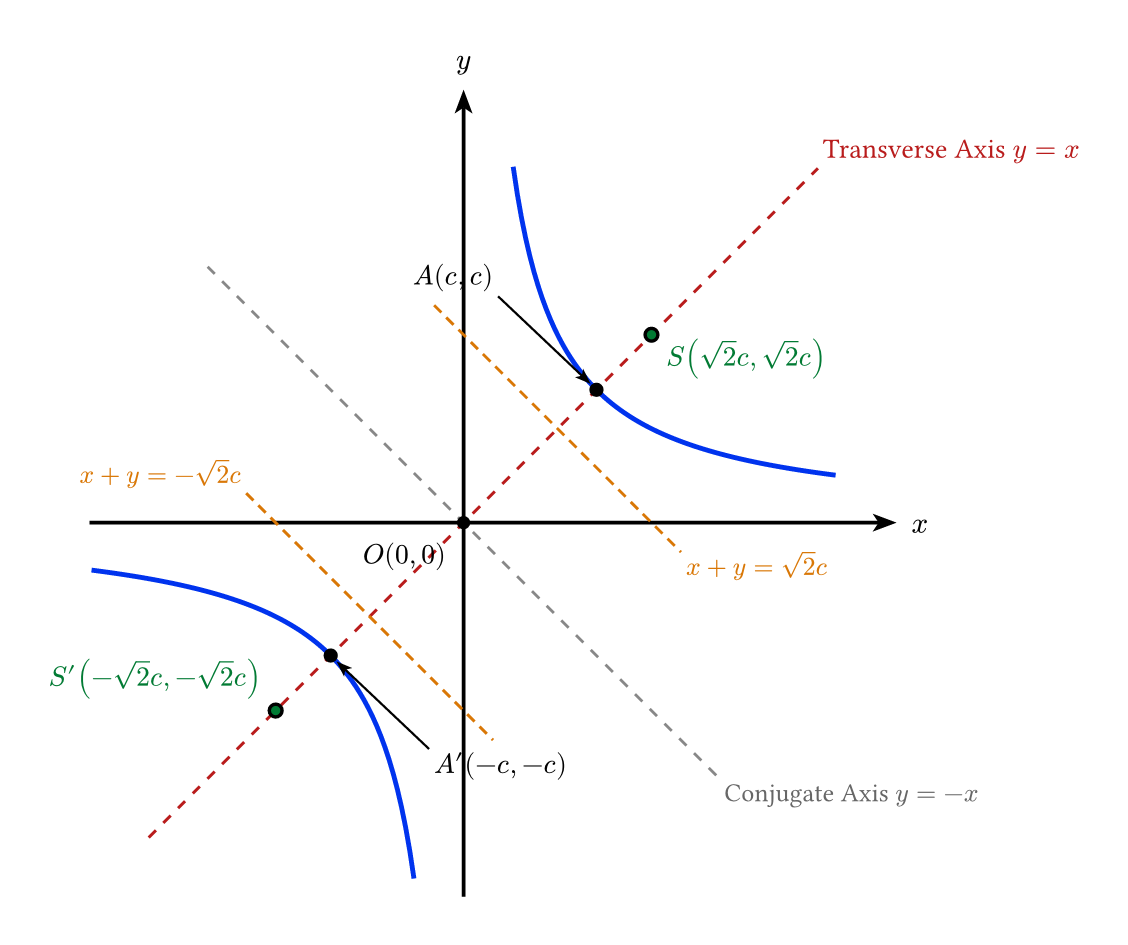
In the original system, the transverse axis was the line y=0. Substituting the transformation y=2Y−X=0, we find Y=X. Thus, the transverse axis is the line:
y=x
Length of the transverse axis: 2a=2(c2)=22c.
4. Conjugate Axis:
In the original system, the conjugate axis was the line x=0. Substituting x=2X+Y=0, we find Y=−X. Thus, the conjugate axis is the line:
y=−x
Length of the conjugate axis: 2b=2a=22c.
5. Vertices:
The vertices are the points where the hyperbola intersects its transverse axis y=x. Substituting y=x into xy=c2:
x2=c2⟹x=±c⟹y=±c
Therefore, the vertices are:
A(c,c)andA′(−c,−c)
The distance from the center O(0,0) to each vertex is c2+c2=c2=a.
6. Foci:
The foci lie on the transverse axis y=x at a distance ae=(c2)(2)=2c from the center. Moving a distance 2c along the line y=x (inclined at 45∘ to the positive x-axis):
If the center of the rectangular hyperbola is translated from (0,0) to (h,k), while keeping the asymptotes parallel to the coordinate axes, its equation becomes:
In many exam problems, the equation of a rectangular hyperbola whose asymptotes are parallel to the axes is given in expanded form:
Axy+Bx+Cy+D=0(A=0)
We can systematically reduce this to standard shifted form (x−h)(y−k)=c2 using algebraic factorization:
Step 1: Multiply the entire equation by A:
A2xy+ABx+ACy+AD=0
Step 2: Group the terms to complete the product of two binomials:
(Ax+C)(Ay+B)−BC+AD=0
Step 3: Move the constant term to the right-hand side:
(Ax+C)(Ay+B)=BC−AD
Step 4: Divide both sides by A2:
(x+AC)(y+AB)=A2BC−AD
Comparing this directly with (x−h)(y−k)=c2, we extract the key parameters:
Center:(h,k)=(−AC,−AB)
Asymptotes:x=−AC and y=−AB
Scale Constant:c2=A2BC−AD
Important Note (Non-Degeneracy Condition):
If BC−AD=0, the equation factorizes into (Ax+C)(Ay+B)=0, which represents a pair of perpendicular straight lines intersecting at (h,k). For the equation to represent a genuine rectangular hyperbola, we must have BC−AD=0.
If A2BC−AD>0, the branches lie in Quadrants I and III relative to the center (h,k). If A2BC−AD<0, the branches lie in Quadrants II and IV relative to (h,k).
Let us determine when the line y=mx+d is tangent to the rectangular hyperbola xy=c2.
Substitute y=mx+d into xy=c2:
x(mx+d)=c2⟹mx2+dx−c2=0
This is a quadratic equation in x. The line is tangent to the hyperbola if and only if this quadratic equation has two equal real roots, which requires the discriminant Δ to be zero:
Because d2≥0 for real lines and c2>0, the condition d2=−4mc2 forces:
−4mc2≥0⟹m<0
Crucial Geometric Insight (Sign of Slope m): All tangents to xy=c2 must have strictly negative slope (m<0)!
Geometrically, this is self-evident: the branches of xy=c2 reside entirely in Quadrants I and III, where y=c2/x. Since dxdy=−x2c2<0 everywhere, the curve slopes downwards from top-left to bottom-right at every single point. No line with a positive or zero slope can ever touch xy=c2!
Solving for d:
d=±2c−m
The equation of a tangent of slope m (m<0) to xy=c2 is:
y=mx±2c−m
The x-coordinate of the point of contact is the repeated root x=−2md:
Using the point-slope form with point (ct,tc) and slope −t21:
y−tc=−t21(x−ct)
Multiply through by t2:
t2y−ct=−x+ct⟹x+t2y=2ct
Dividing the entire equation by t, we obtain the remarkably symmetric form:
tx+yt=2c
Cartesian Form (T=0):
For the curve xy−c2=0, replacing xy by 2xy1+x1y gives the tangent equation xy1+x1y=2c2. Substituting the parametric coordinates (x1,y1)=(ct,c/t) recovers x(tc)+(ct)y=2c2⟹tx+yt=2c.
Connection to Tangent Line:
When t2→t1=t, the secant chord becomes the tangent line x+t2y=2ct.
Five Landmark Theorems of the Rectangular Hyperbola§
Because of its extraordinary symmetry, the rectangular hyperbola satisfies five classic geometric theorems that appear frequently in advanced coordinate geometry.
Theorem 1: Point of Contact as Midpoint of Tangent Intercept§
Statement:
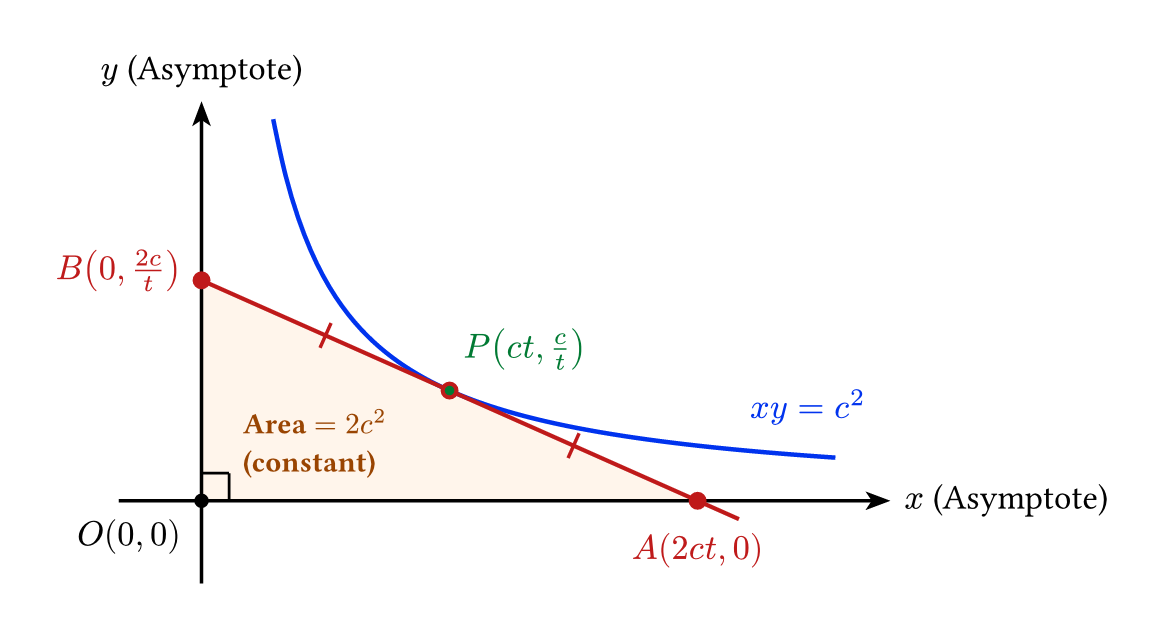
The segment of any tangent to a rectangular hyperbola intercepted between its asymptotes is bisected at the point of contact.
Proof:
Consider the tangent at P(ct,c/t) to xy=c2:
x+t2y=2ct
The asymptotes are the x-axis (y=0) and the y-axis (x=0). Let the tangent intersect the asymptotes at points A and B:
Intersection with the x-axis (y=0):
x+t2(0)=2ct⟹x=2ct⟹A(2ct,0)
Intersection with the y-axis (x=0):
0+t2y=2ct⟹y=t2c⟹B(0,t2c)
Now compute the midpoint M of segment AB:
M=(22ct+0,20+t2c)=(ct,tc)=P
Thus, the point of contact P is the exact midpoint of AB:
The center of the intersecting circle is Ccircle(−g,−f). Comparing coordinates:
Ccircle=(2xˉ,2yˉ)=2G
The center of the circle is exactly twice the centroid of the four concyclic points!
4. Circumcircle and Orthocenter Connection:
If three points A(t1),B(t2),C(t3) define an inscribed triangle, their circumcircle intersects the hyperbola in a fourth point D(t4). From t1t2t3t4=1:
t4=t1t2t31
Recall from Theorem 4 that the orthocenter of △ABC is H(tH) with parameter:
tH=−t1t2t31=−t4
Since tH=−t4, the point H has coordinates (−ct4,−t4c)=−D.
Thus, the orthocenter H and the fourth point of intersection D are diametrically opposite points with respect to the center (0,0) of the hyperbola!
Find the equations of the tangents to the rectangular hyperbola xy=18 that are perpendicular to the line x−2y+7=0.
Solution:
Step 1: Determine the required slope:
The given line x−2y+7=0 has slope mline=21. Since the required tangent is perpendicular to this line, its slope m must satisfy:
m⋅(21)=−1⟹m=−2
Notice that m=−2<0, which satisfies the mandatory condition that all tangents to xy=c2 must have strictly negative slope.
Step 2: Apply the condition of tangency:
Here c2=18. The condition of tangency for slope m is d=±2c−m:
d=±2c2(−m)=±218×2=±236=±12
Step 3: Form the tangent equations:
The equations of the two tangents are:
y=−2x+12andy=−2x−12
or in general linear form:
2x+y−12=0and2x+y+12=0
Example 4: Verifying the Midpoint and Constant Area Properties§
For the rectangular hyperbola xy=16, find the equation of the tangent at P(8,2). Determine its intercepts on the coordinate axes, verify that P is their midpoint, and compute the area of the triangle formed by the tangent and the axes.
Solution:
Step 1: Identify the parameter t:
Here c2=16⟹c=4.
At P(8,2), setting x=ct gives 8=4t⟹t=2.
Check: y=c/t=4/2=2.
Step 2: Equation of the tangent:
Using x+t2y=2ct at t=2:
x+4y=2(4)(2)⟹x+4y=16
Step 3: Find the intercepts on the axes:
For the x-intercept (y=0): x=16⟹A(16,0).
For the y-intercept (x=0): 4y=16⟹y=4⟹B(0,4).
Step 4: Verify the midpoint property:
The midpoint M of segment AB is:
M=(216+0,20+4)=(8,2)=P
The point of contact P(8,2) is indeed the midpoint of AB!
Step 5: Compute the area of △OAB:
Area(△OAB)=21⋅OA⋅OB=21⋅16⋅4=32
Notice that 2c2=2(16)=32. The area equals 2c2 exactly, independent of t.