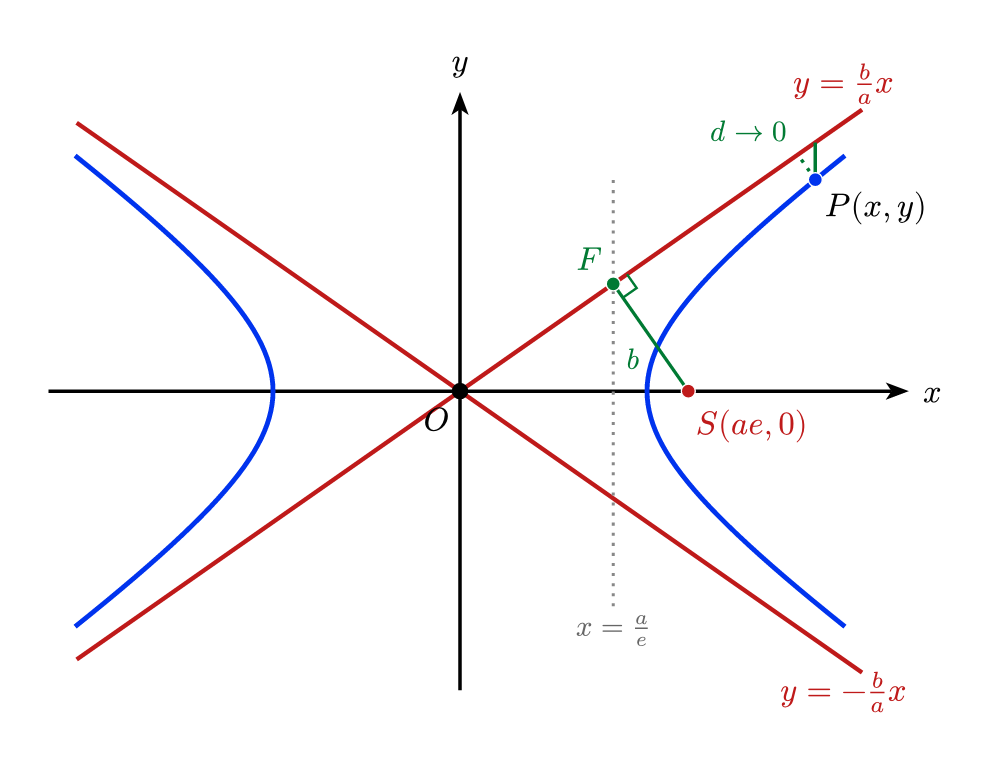
Unlike an ellipse, which is a closed curve, a hyperbola has two branches that stretch out indefinitely far from the origin. As a point moves farther and farther along any branch of a hyperbola, the curve does not wander randomly—it hugs a pair of fixed straight lines closer and closer without ever touching them.
These guiding straight lines are called the asymptotes of the hyperbola. Understanding asymptotes makes sketching any hyperbola effortless and reveals how the curve behaves far away from its center.
Before finding the asymptotes of a hyperbola specifically, let us establish the general limit-based definition and method for finding asymptotes of any plane curve.
A straight line L is called an asymptote to an infinite branch of a curve C if, as a moving point P(x,y) recedes infinitely far along that branch from the origin, the perpendicular distance from P to the line L approaches zero (while the line L itself remains at a finite distance from the origin):
OP→∞limd(P,L)=0
In coordinate geometry, asymptotes fall into three categories depending on the slope of L:
1. Vertical Asymptotes (x=k):
A vertical line x=k is an asymptote to y=f(x) if y becomes unbounded as x approaches k from the right or the left:
x→k+limf(x)=±∞orx→k−limf(x)=±∞
Here, the perpendicular distance from (x,f(x)) to x=k is ∣x−k∣, which approaches 0 while the point escapes vertically to infinity.
2. Horizontal Asymptotes (y=L):
A horizontal line y=L is an asymptote if:
x→+∞limf(x)=Lorx→−∞limf(x)=L
3. Oblique (Slant) Asymptotes (y=mx+c, with m=0):
Suppose a branch y=f(x) extends to x→+∞ (or x→−∞), and let L be the line y=mx+c (written as mx−y+c=0).
The perpendicular distance from P(x,f(x)) to L is:
d(P,L)=m2+1∣mx−f(x)+c∣=m2+1∣f(x)−(mx+c)∣
Because m2+1 is a fixed positive constant, the perpendicular distance tends to zero if and only if the vertical gap between the curve and the line tends to zero:
x→∞limd(P,L)=0⟺x→∞lim[f(x)−mx−c]=0
Deriving the Limit Formulas for Slope and Intercept§
From the single condition limx→∞[f(x)−mx−c]=0, we can deduce bothm and c systematically:
Step 1: Finding the slope m
Since f(x)−mx−c approaches 0 as x→∞, dividing it by x (which grows infinitely large) must also approach 0:
x→∞limxf(x)−mx−c=0
Split the fraction term by term:
x→∞lim[xf(x)−m−xc]=0
Because c is a finite constant, limx→∞xc=0. Therefore:
m=x→∞limxf(x)
Step 2: Finding the y-intercept c
Once the slope m is computed as a finite limit, return directly to limx→∞[f(x)−mx−c]=0 and solve for c:
c=x→∞lim[f(x)−mx]
Summary Rule for Finding Oblique Asymptotes:
To find an asymptote y=mx+c of y=f(x) as x→+∞ (and separately as x→−∞):
Compute m=limx→∞xf(x). If this limit does not exist finitely, there is no slant asymptote in that direction.
Using that value of m, compute c=limx→∞[f(x)−mx]. If c is finite, then y=mx+c is an asymptote.
Proof of the Asymptotes of a Hyperbola Using Limits§
Consider the standard hyperbola:
a2x2−b2y2=1
Solving for y in terms of x gives two continuous branches for ∣x∣≥a:
Upper branches:y=f+(x)=abx2−a2
Lower branches:y=f−(x)=−abx2−a2
Since y is finite for every finite x with ∣x∣≥a, there are no vertical asymptotes. Similarly, limx→±∞∣y∣=+∞, so there are no horizontal asymptotes. We apply our limit formulas to find the oblique asymptotes.
For the lower branches f−(x)=−abx2−a2, symmetry across the x-axis (y→−y) immediately gives:
As x→+∞, the lower-right branch approaches y=−abx.
As x→−∞, the lower-left branch approaches y=abx.
Combining all four branches, the hyperbola a2x2−b2y2=1 has exactly two asymptotes:
y=abxandy=−abx
Alternative Algebraic Proof: Roots Receding to Infinity§
There is also a purely algebraic way to find the asymptotes of a2x2−b2y2=1 by asking when a straight line y=mx+c stops intersecting the hyperbola at finite points because its intersection points move infinitely far away.
Substitute any straight line y=mx+c into the hyperbola a2x2−b2y2=1:
a2x2−b2(mx+c)2=1
Collect terms in descending powers of x:
(a21−b2m2)x2−b22mcx−(b2c2+1)=0
In a quadratic equation Ax2+Bx+C=0, if A→0 and B→0 while C=0, both roots become infinitely large (dividing by x2 gives C(x1)2+B(x1)+A=0, so x1=0 is a double root). Geometrically, both intersection points of the line with the curve recede to infinity, which makes the line an asymptote.
Setting the coefficients of x2 and x equal to zero:
a21−b2m2=0⟹m=±ab.
−b22mc=0⟹c=0 (since m=0).
This yields the exact same two asymptotes y=±abx.
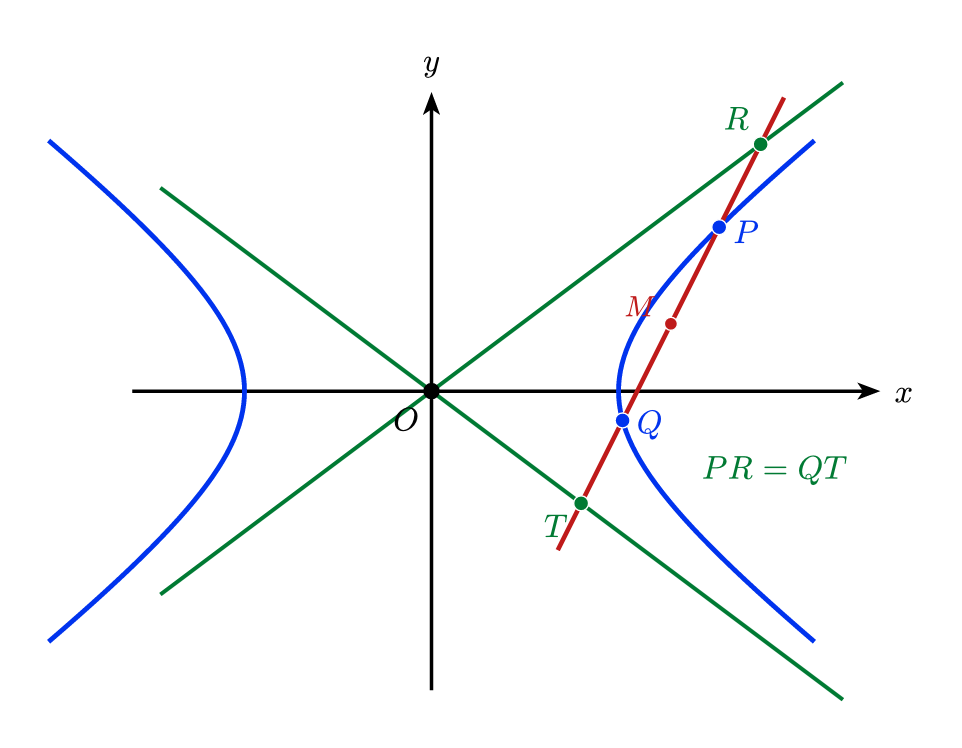
Suppose any straight line y=mx+c (not parallel to either asymptote, so m=±ab) cuts the hyperbola a2x2−b2y2=1 at two points P(x1,y1) and Q(x2,y2), and cuts the asymptotes a2x2−b2y2=0 at R(x3,y3) and T(x4,y4).
Step 1: Midpoint of chord PQ on the hyperbola
Substituting y=mx+c into a2x2−b2y2=1 gives:
(a21−b2m2)x2−b22mcx−(b2c2+1)=0
By Vieta's formulas, the x-coordinate of the midpoint of PQ is:
2x1+x2=a21−b2m2mc/b2=b2−a2m2a2mc
Step 2: Midpoint of segment RT between the asymptotes
Substituting y=mx+c into the combined asymptotes a2x2−b2y2=0 changes only the constant term (1→0):
(a21−b2m2)x2−b22mcx−b2c2=0
Because the coefficients of x2 and x are identical, the sum of the roots is unchanged:
2x3+x4=b2−a2m2a2mc=2x1+x2
Since P,Q,R,T all lie on the same non-vertical line y=mx+c, matching midpoint x-coordinates guarantees that PQ and RT share the exact same midpoint M!
Because M bisects both RT and PQ (RM=MT and PM=MQ), subtracting gives equal outer intercepts:
PR=QT
(For a vertical secant x=k, symmetry about the x-axis gives the exact same result immediately: PQ and RT both have midpoint (k,0), so PR=QT.)
(Notice by long division: y=2x+5+x−110. Because x−110→0 as ∣x∣→∞, y−(2x+5)→0 immediately! Note that this curve is a hyperbola with asymptotes x−1=0 and 2x−y+5=0.)
Example 2: Finding a Standard Hyperbola from Its Asymptotes and Foci§
Find the equation, eccentricity, and length of the latus rectum of a standard hyperbola a2x2−b2y2=1 whose asymptotes are y=±34x and whose foci are at (±5,0). Also find the angle between its asymptotes.
Solution:
Step 1: Find the ratio ab and eccentricity e
Comparing the given asymptotes y=±34x with y=±abx:
ab=34
Using the relation between eccentricity and the asymptote slope (tanθ=ab and e=secθ=1+a2b2):
e=1+(34)2=1+916=35
Step 2: Find a, b, and the equation of the hyperbola
From the given foci (±ae,0)=(±5,0):
ae=5⟹a(35)=5⟹a=3
Then:
b=34a=34(3)=4
Therefore, the equation of the hyperbola is:
9x2−16y2=1
Step 3: Find the latus rectum and the angle between the asymptotes
Length of latus rectum:a2b2=32(16)=332.
Angle between the asymptotes:2θ=2tan−1(ab)=2tan−1(34).
Example 3: Focus-to-Asymptote Distance and Equal Intercepts on a Secant§
Consider the hyperbola 16x2−9y2=1 and the secant line y=x−3.
Find the equations of the asymptotes and the perpendicular distance from the right focus S to each asymptote.
Find the intersection points R and T of the line y=x−3 with the asymptotes, and verify that the midpoint of RT coincides with the midpoint of the chord PQ cut off by the hyperbola.
Solution:
1. Asymptotes and distance from the right focus S:
Here a2=16⟹a=4 and b2=9⟹b=3.
Asymptotes:y=±43x, i.e., 3x−4y=0 and 3x+4y=0.
Eccentricity and right focus:e=1+169=45, so ae=5 and the right focus is S(5,0).
The perpendicular distance from S(5,0) to 3x∓4y=0 is:
d=32+42∣3(5)∓4(0)∣=515=3=b
This directly confirms the property SF=b.
2. Verifying the common midpoint of RT and PQ:
First find R and T, where y=x−3 meets the asymptotes y=±43x:
With y=43x: x−3=43x⟹41x=3⟹R=(12,9).
With y=−43x: x−3=−43x⟹47x=3⟹xT=712,yT=−79, so T=(712,−79).
The midpoint of RT is:
MRT=(212+712,29−79)=(748,727)
Next, substitute y=x−3 into the hyperbola 9x2−16y2=144:
Since its discriminant Δ=962−4(7)(288)=9216−8064=1152>0, the line cuts the hyperbola at two distinct real points P(x1,y1) and Q(x2,y2). By Vieta's formulas:
2x1+x2=2(7)96=748
And since MPQ lies on y=x−3, yM=748−3=727.
Thus MPQ=(748,727)=MRT, confirming that both segments share the same midpoint M(748,727) and therefore PR=QT.