MatheramaMatherama
← Hyperbola
Hyperbola·Section 3·15 min read

Vertical Hyperbola and Conjugate Hyperbola

Earlier, when we studied the parabola (y2=4axy^2 = 4ax vs. x2=4ayx^2 = 4ay) and the ellipse (x2a2+y2b2=1\frac{x^2}{a^2} + \frac{y^2}{b^2} = 1 vs. x2b2+y2a2=1\frac{x^2}{b^2} + \frac{y^2}{a^2} = 1), we saw that placing the focus on the yy-axis simply rotated the standard orientation by 90∘90^\circ.

The exact same idea applies to a hyperbola. What happens when the foci and vertices lie along the yy-axis instead of the xx-axis? Exploring this orientation naturally leads to the vertical hyperbola and its remarkable partner, the conjugate hyperbola.


The Vertical Hyperbola§

Derivation from Focus and Directrix on the y-Axis§

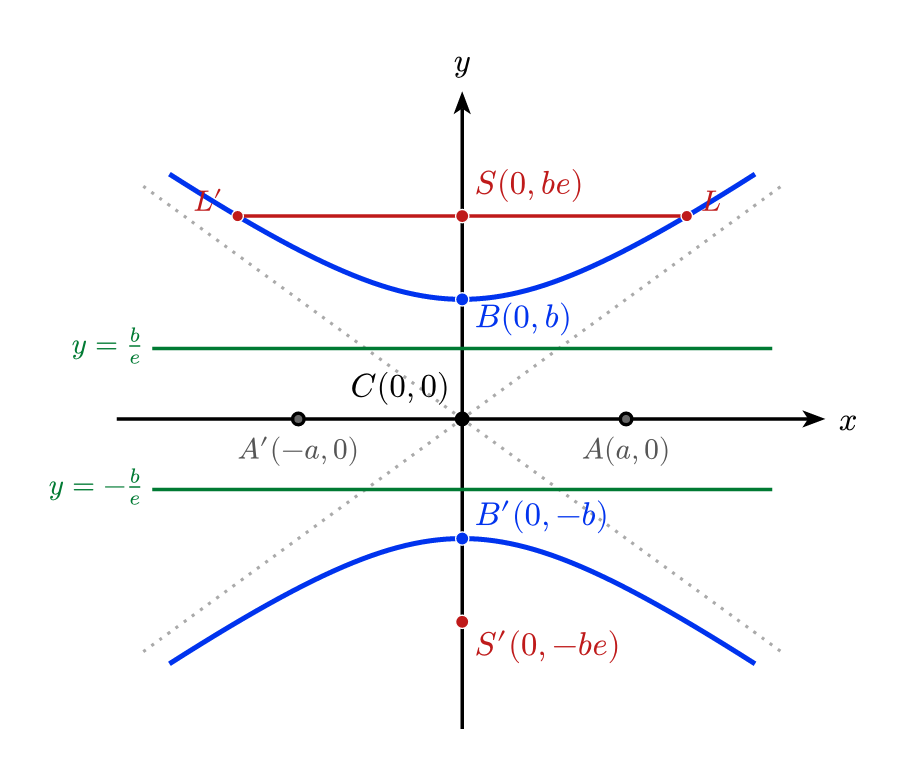
Suppose the center of symmetry is at the origin C(0,0)C(0, 0), while the transverse axis lies along the yy-axis instead of the xx-axis.

Keep our standard naming convention simple: let bb denote the semi-axis along the yy-axis (now the semi-transverse axis), and let e>1e > 1 be the eccentricity. Following the exact same focus-directrix setup along the vertical axis:

  • Focus: S(0,be)S(0, be)
  • Directrix: y=bey = \frac{b}{e} (a horizontal line perpendicular to the yy-axis)

Let P(x,y)P(x, y) be any point on this hyperbola, and let PMPM be the perpendicular from PP onto the directrix y=bey = \frac{b}{e}.

  • Distance from the focus S(0,be)S(0, be): SP=x2+(y−be)2SP = \sqrt{x^2 + (y - be)^2}
  • Perpendicular distance to y=bey = \frac{b}{e}: PM=∣y−be∣PM = \left|y - \frac{b}{e}\right|

By the defining condition SP=e⋅PMSP = e \cdot PM:

SP2=e2⋅PM2SP^2 = e^2 \cdot PM^2 x2+(y−be)2=e2(y−be)2=(ey−b)2x^2 + (y - be)^2 = e^2\left(y - \frac{b}{e}\right)^2 = (ey - b)^2

Expand both sides:

x2+y2−2bey+b2e2=e2y2−2bey+b2x^2 + y^2 - 2bey + b^2 e^2 = e^2 y^2 - 2bey + b^2

Cancel −2bey-2bey from both sides and group y2y^2 and constant terms:

(e2−1)y2−x2=b2(e2−1)(e^2 - 1)y^2 - x^2 = b^2(e^2 - 1)

Divide through by b2(e2−1)b^2(e^2 - 1):

y2b2−x2b2(e2−1)=1\frac{y^2}{b^2} - \frac{x^2}{b^2(e^2 - 1)} = 1

Since e>1e > 1, the quantity b2(e2−1)b^2(e^2 - 1) is strictly positive. Defining a2=b2(e2−1)>0a^2 = b^2(e^2 - 1) > 0 gives the standard equation of a vertical hyperbola:

y2b2−x2a2=1where a2=b2(e2−1)\frac{y^2}{b^2} - \frac{x^2}{a^2} = 1 \quad \text{where } a^2 = b^2(e^2 - 1)

(Notice that you can also get this immediately by interchanging x↔yx \leftrightarrow y and a↔ba \leftrightarrow b in the horizontal hyperbola x2a2−y2b2=1\frac{x^2}{a^2} - \frac{y^2}{b^2} = 1.)


Shape, Extent, and Anatomy§

Solving y2b2−x2a2=1\frac{y^2}{b^2} - \frac{x^2}{a^2} = 1 for xx gives:

x2a2=y2b2−1  ⟹  x=±aby2−b2\frac{x^2}{a^2} = \frac{y^2}{b^2} - 1 \implies x = \pm \frac{a}{b}\sqrt{y^2 - b^2}
  • For real values of xx, we must have y2−b2≥0y^2 - b^2 \ge 0, which means y≥by \ge b or y≤−by \le -b.
  • No part of the curve lies inside the horizontal strip −b<y<b-b < y < b. In particular, the curve does not intersect the xx-axis (y=0y = 0 gives x2=−a2x^2 = -a^2, no real solution).
  • As ∣y∣|y| increases beyond bb, ∣x∣|x| grows without bound, producing two symmetric branches opening upward and downward along the yy-axis.

Anatomy of a Vertical Hyperbola

For the vertical hyperbola y2b2−x2a2=1\frac{y^2}{b^2} - \frac{x^2}{a^2} = 1:

Center: C(0,0)C(0, 0).

Vertices: B(0,b)B(0, b) and B′(0,−b)B'(0, -b).

Transverse Axis: Along the yy-axis, joining (0,−b)(0, -b) and (0,b)(0, b), of length 2b2b.

Conjugate Axis: Along the xx-axis, joining A′(−a,0)A'(-a, 0) and A(a,0)A(a, 0), of length 2a2a.

Eccentricity: From a2=b2(e2−1)a^2 = b^2(e^2 - 1):

e=1+a2b2=a2+b2b>1e = \sqrt{1 + \frac{a^2}{b^2}} = \frac{\sqrt{a^2 + b^2}}{b} > 1

Foci and Directrices: By symmetry about the xx-axis, there is a second focus and second directrix on the negative yy-side:

Foci: (0,±be),Directrices: y=±be\text{Foci: } (0, \pm be), \qquad \text{Directrices: } y = \pm \frac{b}{e}

Latus Rectum: A focal chord perpendicular to the yy-axis has equation y=±bey = \pm be. Substituting into y2b2−x2a2=1\frac{y^2}{b^2} - \frac{x^2}{a^2} = 1:

e2−x2a2=1  ⟹  x2a2=e2−1=a2b2  ⟹  x=±a2be^2 - \frac{x^2}{a^2} = 1 \implies \frac{x^2}{a^2} = e^2 - 1 = \frac{a^2}{b^2} \implies x = \pm \frac{a^2}{b}

So the endpoints are (±a2b,±be)\left(\pm \frac{a^2}{b}, \pm be\right), and:

Length of Latus Rectum=2a2b=2b(e2−1)\text{Length of Latus Rectum} = \frac{2a^2}{b} = 2b(e^2 - 1)

Focal Distances and Constant Difference: For any point P(x1,y1)P(x_1, y_1) on the vertical hyperbola, the perpendicular distances to the horizontal directrices y=±bey = \pm \frac{b}{e} give:

SP=∣ey1−b∣,S′P=∣ey1+b∣SP = |ey_1 - b|, \qquad S'P = |ey_1 + b|
  • On the upper branch (y1≥by_1 \ge b): SP=ey1−bSP = ey_1 - b and S′P=ey1+bS'P = ey_1 + b, so S′P−SP=2bS'P - SP = 2b.
  • On the lower branch (y1≤−by_1 \le -b): SP=b−ey1SP = b - ey_1 and S′P=−b−ey1S'P = -b - ey_1, so SP−S′P=2bSP - S'P = 2b.

Hence, for every point on y2b2−x2a2=1\frac{y^2}{b^2} - \frac{x^2}{a^2} = 1:

∣S′P−SP∣=2b|S'P - SP| = 2b

Crucial Difference from an Ellipse (Signs vs. Sizes):

In an ellipse x2p2+y2q2=1\frac{x^2}{p^2} + \frac{y^2}{q^2} = 1, both signs are positive, so you compare which denominator is larger to decide whether the major axis is horizontal or vertical.

In a hyperbola, you look strictly at the signs of the terms, never at which of aa or bb is bigger:

  • x2a2−y2b2=1\frac{x^2}{a^2} - \frac{y^2}{b^2} = 1 (positive x2x^2-term) always opens left and right along the xx-axis, even if a<ba < b.
  • y2b2−x2a2=1\frac{y^2}{b^2} - \frac{x^2}{a^2} = 1 (positive y2y^2-term) always opens up and down along the yy-axis, even if b<ab < a.

Asymptotes of the Vertical Hyperbola§

Let us find the asymptotes of y2b2−x2a2=1\frac{y^2}{b^2} - \frac{x^2}{a^2} = 1 directly using the limit method from the previous section. Solving for yy gives the upper and lower branches for all x∈Rx \in \mathbb{R}:

y=±bax2+a2y = \pm \frac{b}{a}\sqrt{x^2 + a^2}

Take the upper branch f(x)=bax2+a2f(x) = \frac{b}{a}\sqrt{x^2 + a^2} as x→+∞x \to +\infty:

Step 1: Find the slope mm

m=lim⁡x→+∞f(x)x=lim⁡x→+∞bax2+a2x=lim⁡x→+∞ba1+a2x2=bam = \lim_{x \to +\infty} \frac{f(x)}{x} = \lim_{x \to +\infty} \frac{b}{a}\frac{\sqrt{x^2 + a^2}}{x} = \lim_{x \to +\infty} \frac{b}{a}\sqrt{1 + \frac{a^2}{x^2}} = \frac{b}{a}

Step 2: Find the yy-intercept cc

c=lim⁡x→+∞[bax2+a2−bax]=balim⁡x→+∞(x2+a2−x)c = \lim_{x \to +\infty} \left[\frac{b}{a}\sqrt{x^2 + a^2} - \frac{b}{a}x\right] = \frac{b}{a}\lim_{x \to +\infty}\left(\sqrt{x^2 + a^2} - x\right)

Rationalize using x2+a2+x\sqrt{x^2 + a^2} + x:

c=balim⁡x→+∞(x2+a2)−x2x2+a2+x=balim⁡x→+∞a2x2+a2+x=0c = \frac{b}{a}\lim_{x \to +\infty} \frac{(x^2 + a^2) - x^2}{\sqrt{x^2 + a^2} + x} = \frac{b}{a}\lim_{x \to +\infty} \frac{a^2}{\sqrt{x^2 + a^2} + x} = 0

So y=baxy = \frac{b}{a}x is the asymptote as x→+∞x \to +\infty. Using ∣x∣=−x|x| = -x as x→−∞x \to -\infty and symmetry y→−yy \to -y for the lower branch gives the complete pair of asymptotes:

y=baxandy=−baxy = \frac{b}{a}x \qquad \text{and} \qquad y = -\frac{b}{a}x

Notice one neat difference in position: since x2+a2>∣x∣\sqrt{x^2 + a^2} > |x| for all xx, we always have:

∣y∣=bax2+a2>ba∣x∣|y| = \frac{b}{a}\sqrt{x^2 + a^2} > \frac{b}{a}|x|

That means the upper branch of y2b2−x2a2=1\frac{y^2}{b^2} - \frac{x^2}{a^2} = 1 always lies strictly above both asymptotes, and the lower branch always lies strictly below both asymptotes.


Conjugate Hyperbola§

Two hyperbolas are said to be conjugate to each other when the transverse and conjugate axes of one are respectively the conjugate and transverse axes of the other.

Starting with the standard horizontal hyperbola HH:

H:x2a2−y2b2=1H: \frac{x^2}{a^2} - \frac{y^2}{b^2} = 1

Its transverse axis has length 2a2a (along the xx-axis) and its conjugate axis has length 2b2b (along the yy-axis). Swapping their roles—making the yy-axis segment of length 2b2b the transverse axis and the xx-axis segment of length 2a2a the conjugate axis—gives the conjugate hyperbola CC:

C:y2b2−x2a2=1or equivalentlyx2a2−y2b2=−1C: \frac{y^2}{b^2} - \frac{x^2}{a^2} = 1 \qquad \text{or equivalently} \qquad \frac{x^2}{a^2} - \frac{y^2}{b^2} = -1

Notice the symmetry of this relationship: taking the conjugate of CC gives back HH. Therefore, HH and CC are a conjugate pair—each is the conjugate of the other.

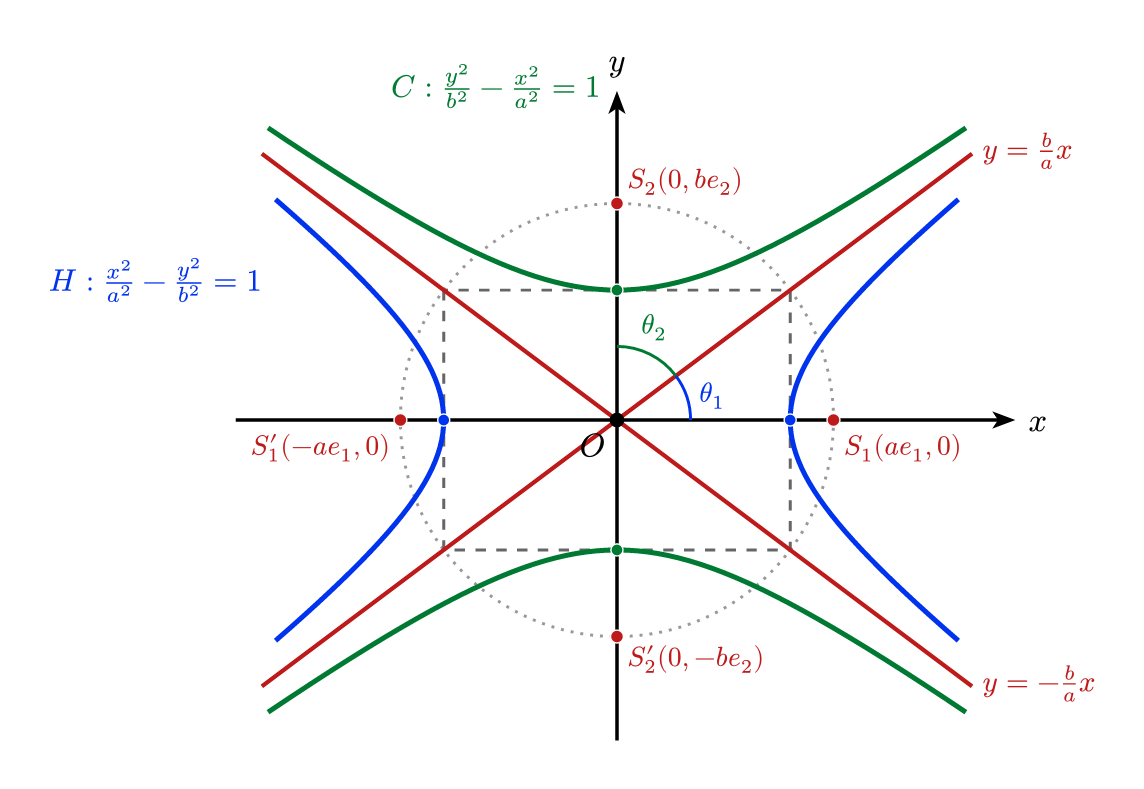
Conjugate Pair of Hyperbolas Sharing Asymptotes

Side-by-Side Comparison of a Conjugate Pair§

Quantity Hyperbola HH: x2a2−y2b2=1\frac{x^2}{a^2} - \frac{y^2}{b^2} = 1 Conjugate Hyperbola CC: y2b2−x2a2=1\frac{y^2}{b^2} - \frac{x^2}{a^2} = 1
Center (0,0)(0, 0) (0,0)(0, 0)
Transverse Axis Along xx-axis, length 2a2a Along yy-axis, length 2b2b
Conjugate Axis Along yy-axis, length 2b2b Along xx-axis, length 2a2a
Vertices (±a,0)(\pm a, 0) (0,±b)(0, \pm b)
Eccentricity e1=1+b2a2e_1 = \sqrt{1 + \frac{b^2}{a^2}} e2=1+a2b2e_2 = \sqrt{1 + \frac{a^2}{b^2}}
Foci S1(ae1,0), S1′(−ae1,0)S_1(ae_1, 0),\ S'_1(-ae_1, 0) S2(0,be2), S2′(0,−be2)S_2(0, be_2),\ S'_2(0, -be_2)
Directrices x=±ae1x = \pm \frac{a}{e_1} y=±be2y = \pm \frac{b}{e_2}
Latus Rectum 2b2a\frac{2b^2}{a} 2a2b\frac{2a^2}{b}
Focal Difference ∥S1′P−S1P∥=2a\|S'_1 P - S_1 P\| = 2a ∥S2′P−S2P∥=2b\|S'_2 P - S_2 P\| = 2b
Asymptotes y=±baxy = \pm \frac{b}{a}x y=±baxy = \pm \frac{b}{a}x

Why Conjugate Hyperbolas Share the Same Asymptotes§

Look closely at the diagram of the conjugate pair above. The two hyperbolas HH and CC never meet, yet they nestle cleanly into opposite regions guided by the exact same pair of straight lines. We can understand this in three complementary ways:

1. Identical Combined Equations:

For HH, the combined equation of its asymptotes is x2a2−y2b2=0\frac{x^2}{a^2} - \frac{y^2}{b^2} = 0.

For CC, the combined equation of its asymptotes is y2b2−x2a2=0\frac{y^2}{b^2} - \frac{x^2}{a^2} = 0.

Multiplying the second equation by −1-1 produces the exact same equation x2a2−y2b2=0\frac{x^2}{a^2} - \frac{y^2}{b^2} = 0, so both hyperbolas share the exact same asymptotes y=±baxy = \pm \frac{b}{a}x.

2. The Central Rectangle and Four Sectors:

Draw the dashed rectangle bounded by x=±ax = \pm a and y=±by = \pm b passing through the vertices (±a,0)(\pm a, 0) of HH and (0,±b)(0, \pm b) of CC. The lines joining opposite corners of this rectangle have equations y=±baxy = \pm \frac{b}{a}x—the asymptotes!

These two diagonals split the coordinate plane into four open wedge-shaped sectors around the origin:

  • HH fills the left and right sectors (where ∣y∣<ba∣x∣|y| < \frac{b}{a}|x|).
  • CC fills the top and bottom sectors (where ∣y∣>ba∣x∣|y| > \frac{b}{a}|x|).

3. Constant-Term Symmetry (H+C=2AH + C = 2A):

Write all three equations in standard form:

  • H(x,y)≡x2a2−y2b2−1=0H(x, y) \equiv \frac{x^2}{a^2} - \frac{y^2}{b^2} - 1 = 0
  • A(x,y)≡x2a2−y2b2=0A(x, y) \equiv \frac{x^2}{a^2} - \frac{y^2}{b^2} = 0
  • C(x,y)≡x2a2−y2b2+1=0C(x, y) \equiv \frac{x^2}{a^2} - \frac{y^2}{b^2} + 1 = 0

Notice that HH, AA, and CC differ only in their constant terms (−1-1, 00, and +1+1). Adding the expressions for HH and CC cancels the +1+1 and −1-1:

H+C=2AH + C = 2A

Key Relations Between a Hyperbola and Its Conjugate§

Let e1e_1 and e2e_2 be the eccentricities of H:x2a2−y2b2=1H: \frac{x^2}{a^2} - \frac{y^2}{b^2} = 1 and C:y2b2−x2a2=1C: \frac{y^2}{b^2} - \frac{x^2}{a^2} = 1, respectively.

1. Relation Between the Two Eccentricities§

From the eccentricity formulas:

e12=1+b2a2=a2+b2a2  ⟹  1e12=a2a2+b2e_1^2 = 1 + \frac{b^2}{a^2} = \frac{a^2 + b^2}{a^2} \implies \frac{1}{e_1^2} = \frac{a^2}{a^2 + b^2} e22=1+a2b2=a2+b2b2  ⟹  1e22=b2a2+b2e_2^2 = 1 + \frac{a^2}{b^2} = \frac{a^2 + b^2}{b^2} \implies \frac{1}{e_2^2} = \frac{b^2}{a^2 + b^2}

Adding these two equations gives the fundamental eccentricity identity:

1e12+1e22=a2a2+b2+b2a2+b2=1\frac{1}{e_1^2} + \frac{1}{e_2^2} = \frac{a^2}{a^2 + b^2} + \frac{b^2}{a^2 + b^2} = 1

In addition, dividing e12e_1^2 by e22e_2^2 gives the ratio of the two eccentricities directly in terms of aa and bb:

e12e22=b2a2  ⟹  e1e2=ba\frac{e_1^2}{e_2^2} = \frac{b^2}{a^2} \implies \frac{e_1}{e_2} = \frac{b}{a}

(Observe the geometric meaning: if HH has narrow branches so e1e_1 is close to 11, then CC must have wide-opening branches with a large eccentricity e2e_2 to keep 1e12+1e22=1\frac{1}{e_1^2} + \frac{1}{e_2^2} = 1. When a=ba = b, both curves have equal eccentricities e1=e2=2e_1 = e_2 = \sqrt{2}.)

2. All Four Foci Lie on a Single Circle§

Compute the distance from the center O(0,0)O(0, 0) to a focus of HH and to a focus of CC:

OS1=ae1=a1+b2a2=a2+b2OS_1 = ae_1 = a\sqrt{1 + \frac{b^2}{a^2}} = \sqrt{a^2 + b^2} OS2=be2=b1+a2b2=a2+b2OS_2 = be_2 = b\sqrt{1 + \frac{a^2}{b^2}} = \sqrt{a^2 + b^2}

Since OS1=OS2=a2+b2OS_1 = OS_2 = \sqrt{a^2 + b^2} (which equals half the diagonal of the central rectangle), all four foci—(±a2+b2,0)(\pm \sqrt{a^2 + b^2}, 0) and (0,±a2+b2)(0, \pm \sqrt{a^2 + b^2})—are at the exact same distance from the center!

Therefore, all four foci lie on the circle:

x2+y2=a2+b2x^2 + y^2 = a^2 + b^2

3. Complementary Angles with the Asymptotes§

Let θ1\theta_1 be the acute angle between the asymptote y=baxy = \frac{b}{a}x and the transverse axis of HH (xx-axis), and θ2\theta_2 be the angle between the same asymptote and the transverse axis of CC (yy-axis):

tan⁡θ1=ba,tan⁡θ2=ab\tan\theta_1 = \frac{b}{a}, \qquad \tan\theta_2 = \frac{a}{b}

Because the xx-axis and yy-axis are perpendicular, θ1+θ2=90∘\theta_1 + \theta_2 = 90^\circ. Hence, the angles between the asymptotes containing HH (2θ12\theta_1) and containing CC (2θ22\theta_2) are supplementary:

2θ1+2θ2=180∘2\theta_1 + 2\theta_2 = 180^\circ

Notice also that e1=sec⁡θ1e_1 = \sec\theta_1 and e2=sec⁡θ2=csc⁡θ1e_2 = \sec\theta_2 = \csc\theta_1, which provides an immediate trigonometric proof of the eccentricity identity:

1e12+1e22=cos⁡2θ1+sin⁡2θ1=1\frac{1}{e_1^2} + \frac{1}{e_2^2} = \cos^2\theta_1 + \sin^2\theta_1 = 1

4. Focus-to-Asymptote Distance and Latera Recta§

  • From any focus of HH to either asymptote, the perpendicular distance is bb (the semi-conjugate axis of HH).
  • From any focus S2(0,be2)S_2(0, be_2) of CC to either asymptote bx∓ay=0bx \mp ay = 0, the perpendicular distance is:
d=∣b(0)∓a(be2)∣a2+b2=abe2be2=ad = \frac{|b(0) \mp a(be_2)|}{\sqrt{a^2 + b^2}} = \frac{abe_2}{be_2} = a

which equals aa (the semi-conjugate axis of CC).

  • Multiplying the lengths of their latera recta L1=2b2aL_1 = \frac{2b^2}{a} and L2=2a2bL_2 = \frac{2a^2}{b} gives:
L1⋅L2=(2b2a)(2a2b)=4abL_1 \cdot L_2 = \left(\frac{2b^2}{a}\right)\left(\frac{2a^2}{b}\right) = 4ab

5. Common Midpoint of Any Secant Line§

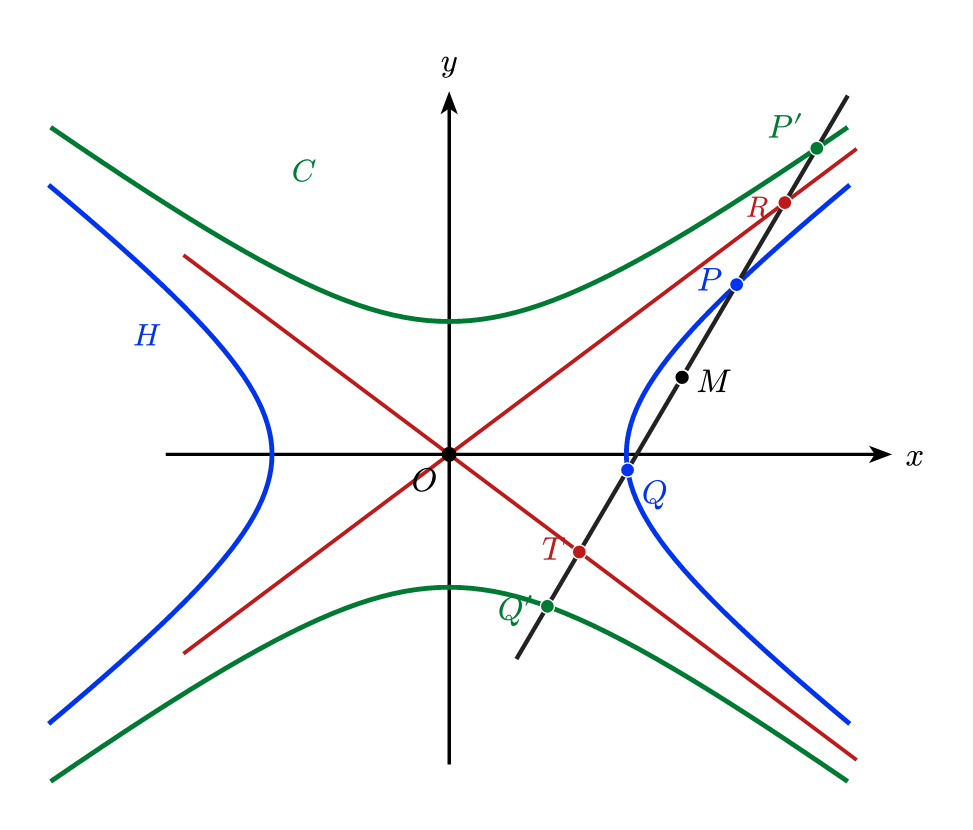
Common Midpoint of a Secant Cutting H, Its Asymptotes, and C

Suppose any non-asymptotic straight line y=mx+cy = mx + c (m≠±bam \neq \pm \frac{b}{a}) meets HH at P,QP, Q, meets the asymptotes AA at R,TR, T, and meets CC at P′,Q′P', Q' (whenever those intersections are real).

Because HH, AA, and CC differ only in their constant terms, substituting y=mx+cy = mx + c into all three equations produces quadratic equations in xx whose x2x^2 and xx coefficients are identical. Therefore, all three pairs of roots have the exact same sum—so the chord PQPQ of HH, the segment RTRT between the asymptotes, and the chord P′Q′P'Q' of CC all share the same midpoint MM.

Consequently, subtracting equal half-lengths from MM shows that the outer intercepts on both sides are equal:

PR=QT,P′R=Q′T,andP′P=Q′QPR = QT, \qquad P'R = Q'T, \qquad \text{and} \qquad P'P = Q'Q

Illustrative Examples§

Example 1: Finding Standard Attributes of a Vertical Hyperbola§

Find the vertices, eccentricity, foci, directrices, latus rectum, and asymptotes of the hyperbola:

16y2−9x2=14416y^2 - 9x^2 = 144

Solution:

Divide through by 144144:

y29−x216=1\frac{y^2}{9} - \frac{x^2}{16} = 1

Because the y2y^2-term is positive (even though 9<169 < 16), this is a vertical hyperbola opening along the yy-axis. Comparing with y2b2−x2a2=1\frac{y^2}{b^2} - \frac{x^2}{a^2} = 1:

b2=9  ⟹  b=3,a2=16  ⟹  a=4b^2 = 9 \implies b = 3, \qquad a^2 = 16 \implies a = 4
  • Vertices: (0,±b)=(0,±3)(0, \pm b) = (0, \pm 3).
  • Eccentricity: e=1+a2b2=1+169=53e = \sqrt{1 + \frac{a^2}{b^2}} = \sqrt{1 + \frac{16}{9}} = \frac{5}{3}.
  • Foci: (0,±be)=(0,±3⋅53)=(0,±5)(0, \pm be) = \left(0, \pm 3 \cdot \frac{5}{3}\right) = (0, \pm 5).
  • Directrices: y=±be=±95y = \pm \frac{b}{e} = \pm \frac{9}{5}.
  • Length of Latus Rectum: 2a2b=2(16)3=323\frac{2a^2}{b} = \frac{2(16)}{3} = \frac{32}{3}.
  • Asymptotes: y=±bax=±34xy = \pm \frac{b}{a}x = \pm \frac{3}{4}x.

Example 2: Finding a Vertical Hyperbola from Its Asymptotes and Foci§

Find the equation and eccentricity of a vertical hyperbola centered at the origin whose foci are at (0,±10)(0, \pm 10) and whose asymptotes are y=±43xy = \pm \frac{4}{3}x.

Solution:

Let the vertical hyperbola be y2b2−x2a2=1\frac{y^2}{b^2} - \frac{x^2}{a^2} = 1.

Step 1: Use the asymptote slopes to relate aa and bb

Comparing y=±baxy = \pm \frac{b}{a}x with y=±43xy = \pm \frac{4}{3}x:

ba=43  ⟹  a=34b\frac{b}{a} = \frac{4}{3} \implies a = \frac{3}{4}b

Step 2: Find the eccentricity ee

e=1+a2b2=1+(34)2=1+916=54e = \sqrt{1 + \frac{a^2}{b^2}} = \sqrt{1 + \left(\frac{3}{4}\right)^2} = \sqrt{1 + \frac{9}{16}} = \frac{5}{4}

Step 3: Use the foci to find bb and aa

Since the foci are (0,±be)=(0,±10)(0, \pm be) = (0, \pm 10):

be=10  ⟹  b(54)=10  ⟹  b=8be = 10 \implies b\left(\frac{5}{4}\right) = 10 \implies b = 8

Then a=34(8)=6a = \frac{3}{4}(8) = 6.

Hence, the equation of the vertical hyperbola is:

y264−x236=1\frac{y^2}{64} - \frac{x^2}{36} = 1

with eccentricity e=54e = \frac{5}{4}.


Example 3: Eccentricity Identity and Circle of Foci§

A standard hyperbola H:x2a2−y2b2=1H: \frac{x^2}{a^2} - \frac{y^2}{b^2} = 1 has eccentricity e1=54e_1 = \frac{5}{4} and latus rectum 92\frac{9}{2}. Find:

  1. The eccentricity e2e_2 of its conjugate hyperbola CC.
  2. The equations of both HH and CC.
  3. The equation of the circle passing through all four foci of HH and CC.

Solution:

1. Eccentricity of the conjugate hyperbola:

Using 1e12+1e22=1\frac{1}{e_1^2} + \frac{1}{e_2^2} = 1:

1(5/4)2+1e22=1  ⟹  1625+1e22=1  ⟹  1e22=925  ⟹  e2=53\frac{1}{(5/4)^2} + \frac{1}{e_2^2} = 1 \implies \frac{16}{25} + \frac{1}{e_2^2} = 1 \implies \frac{1}{e_2^2} = \frac{9}{25} \implies e_2 = \frac{5}{3}

2. Equations of HH and CC:

The length of the latus rectum of HH is 2a(e12−1)=922a(e_1^2 - 1) = \frac{9}{2}:

2a(2516−1)=92  ⟹  2a(916)=92  ⟹  98a=92  ⟹  a=42a\left(\frac{25}{16} - 1\right) = \frac{9}{2} \implies 2a\left(\frac{9}{16}\right) = \frac{9}{2} \implies \frac{9}{8}a = \frac{9}{2} \implies a = 4

Then b2=a2(e12−1)=16(916)=9b^2 = a^2(e_1^2 - 1) = 16\left(\frac{9}{16}\right) = 9.

Therefore:

H:x216−y29=1andC:y29−x216=1H: \frac{x^2}{16} - \frac{y^2}{9} = 1 \qquad \text{and} \qquad C: \frac{y^2}{9} - \frac{x^2}{16} = 1

3. Circle through all four foci:

All four foci lie at distance r=a2+b2=16+9=5r = \sqrt{a^2 + b^2} = \sqrt{16 + 9} = 5 from the center (0,0)(0, 0) (namely (±5,0)(\pm 5, 0) for HH and (0,±5)(0, \pm 5) for CC).

Thus, the circle through all four foci is:

x2+y2=25x^2 + y^2 = 25

Example 4: Common Secant Midpoint of a Conjugate Pair§

A straight line y=2x−3y = 2x - 3 cuts the hyperbola H:x24−y29=1H: \frac{x^2}{4} - \frac{y^2}{9} = 1 at PP and QQ, and cuts its conjugate hyperbola CC at P′P' and Q′Q'. Without solving for the endpoints individually, verify that PQPQ and P′Q′P'Q' share the same midpoint, and find its coordinates.

Solution:

Write both hyperbolas after clearing denominators (3636):

H:9x2−4y2=36andC:9x2−4y2=−36H: 9x^2 - 4y^2 = 36 \qquad \text{and} \qquad C: 9x^2 - 4y^2 = -36

Substitute y=2x−3y = 2x - 3 into HH:

9x2−4(2x−3)2=36  ⟹  9x2−4(4x2−12x+9)=369x^2 - 4(2x - 3)^2 = 36 \implies 9x^2 - 4(4x^2 - 12x + 9) = 36 −7x2+48x−36=36  ⟹  7x2−48x+72=0-7x^2 + 48x - 36 = 36 \implies 7x^2 - 48x + 72 = 0

Since ΔH=482−4(7)(72)=2304−2016=288>0\Delta_H = 48^2 - 4(7)(72) = 2304 - 2016 = 288 > 0, the line cuts HH at two distinct real points P(x1,y1)P(x_1, y_1) and Q(x2,y2)Q(x_2, y_2), with midpoint xx-coordinate:

xM=x1+x22=482(7)=247x_M = \frac{x_1 + x_2}{2} = \frac{48}{2(7)} = \frac{24}{7}

Next, substitute y=2x−3y = 2x - 3 into C:9x2−4y2=−36C: 9x^2 - 4y^2 = -36:

−7x2+48x−36=−36  ⟹  7x2−48x=0-7x^2 + 48x - 36 = -36 \implies 7x^2 - 48x = 0

Again ΔC=482>0\Delta_C = 48^2 > 0, so the line cuts CC at two distinct real points P′(x3,y3)P'(x_3, y_3) and Q′(x4,y4)Q'(x_4, y_4). Because the x2x^2 and xx coefficients are identical, the midpoint xx-coordinate of P′Q′P'Q' is also:

xM′=x3+x42=482(7)=247x_{M'} = \frac{x_3 + x_4}{2} = \frac{48}{2(7)} = \frac{24}{7}

Since both midpoints lie on y=2x−3y = 2x - 3, their common yy-coordinate is:

yM=2(247)−3=277y_M = 2\left(\frac{24}{7}\right) - 3 = \frac{27}{7}

Hence, both chords PQPQ and P′Q′P'Q' share the exact same midpoint (247,277)\left(\frac{24}{7}, \frac{27}{7}\right).


Summary of Key Results§

Property / Relation Vertical Hyperbola / Conjugate Pair Formula
Vertical Hyperbola Equation y2b2−x2a2=1\frac{y^2}{b^2} - \frac{x^2}{a^2} = 1, where a2=b2(e22−1)a^2 = b^2(e_2^2 - 1)
Vertical Orientation Criterion Positive y2y^2-term and negative x2x^2-term (independent of whether a<ba < b or a>ba > b)
Vertical Vertices, Foci, Directrices Vertices (0,±b)(0, \pm b), foci (0,±be2)(0, \pm be_2), directrices y=±be2y = \pm \frac{b}{e_2}, latus rectum 2a2b\frac{2a^2}{b}
Shared Asymptotes H:x2a2−y2b2=1H: \frac{x^2}{a^2} - \frac{y^2}{b^2} = 1 and C:y2b2−x2a2=1C: \frac{y^2}{b^2} - \frac{x^2}{a^2} = 1 share y=±baxy = \pm \frac{b}{a}x, with H+C=2AH + C = 2A
Eccentricity Relation 1e12+1e22=1\frac{1}{e_1^2} + \frac{1}{e_2^2} = 1 and e1e2=ba\frac{e_1}{e_2} = \frac{b}{a}
Circle of Four Foci All four foci lie on x2+y2=a2+b2x^2 + y^2 = a^2 + b^2 (distance a2+b2\sqrt{a^2 + b^2} from center)
Asymptote Angles 2θ1+2θ2=180∘2\theta_1 + 2\theta_2 = 180^\circ (supplementary angles containing HH and CC)
Section 3 of 15 · Hyperbola

Mark this section complete when you have worked through its proofs.