In the previous section, we classified whether a point lies inside, on, or outside a hyperbola. Now we consider the positional relationship between a straight line and a hyperbola: when does a line intersect the curve, when does it touch it as a tangent, and when does it pass by without meeting it?
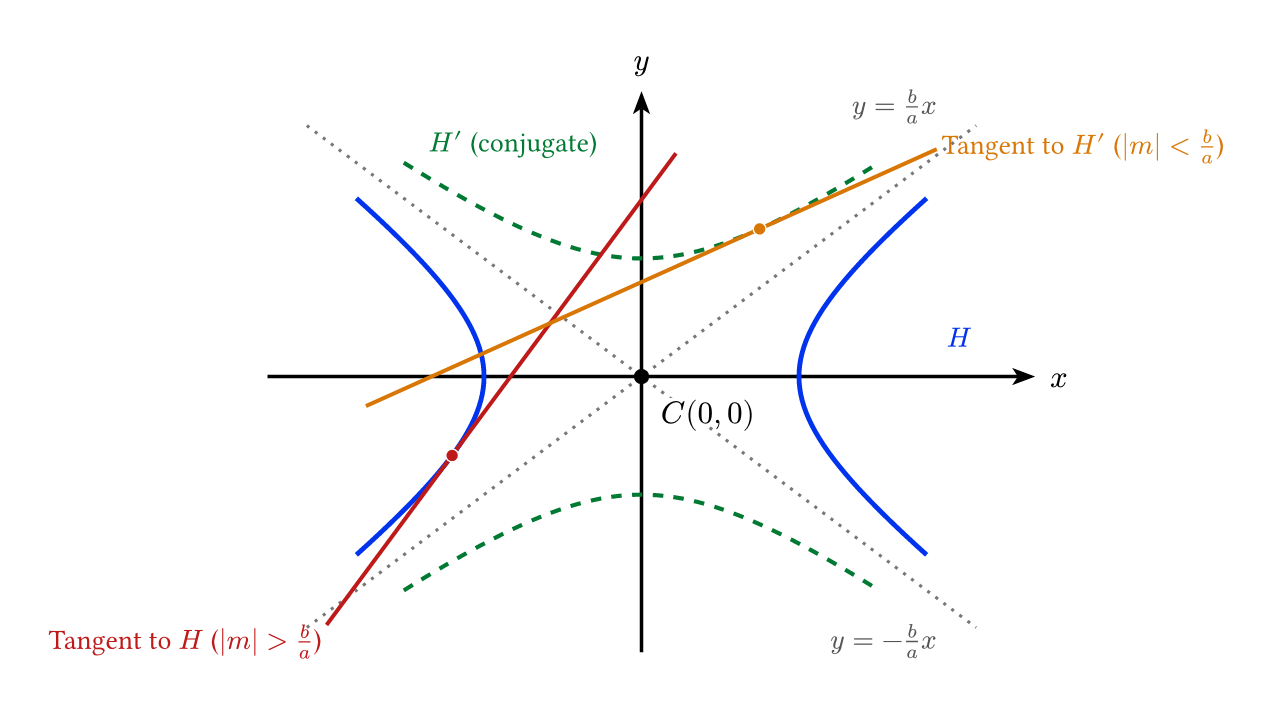
While this question looks algebraically similar to what we did for an ellipse, the open shape and asymptotes of a hyperbola introduce fundamental differences. Most strikingly, tangents of all slopes do not exist for a hyperbola —the asymptotes divide the slope domain strictly between the hyperbola and its conjugate!
1. Intersection of a Line and a Standard Horizontal Hyperbola§
Consider a straight line with slope m m m y y y c c c
y = m x + c y = mx + c y = m x + c and the standard horizontal hyperbola:
x 2 a 2 − y 2 b 2 = 1 ( a > 0 , b > 0 ) \frac{x^2}{a^2} - \frac{y^2}{b^2} = 1 \qquad (a > 0,\; b > 0) a 2 x 2 − b 2 y 2 = 1 ( a > 0 , b > 0 ) To determine where the line meets the hyperbola, substitute y = m x + c y = mx + c y = m x + c
x 2 a 2 − ( m x + c ) 2 b 2 = 1 \frac{x^2}{a^2} - \frac{(mx + c)^2}{b^2} = 1 a 2 x 2 − b 2 ( m x + c ) 2 = 1 Multiply through by a 2 b 2 a^2 b^2 a 2 b 2
b 2 x 2 − a 2 ( m 2 x 2 + 2 m c x + c 2 ) = a 2 b 2 b^2 x^2 - a^2(m^2 x^2 + 2mc\,x + c^2) = a^2 b^2 b 2 x 2 − a 2 ( m 2 x 2 + 2 m c x + c 2 ) = a 2 b 2 Group terms by powers of x x x
( b 2 − a 2 m 2 ) x 2 − 2 a 2 m c x − a 2 ( b 2 + c 2 ) = 0 (b^2 - a^2 m^2)x^2 - 2a^2 mc\,x - a^2(b^2 + c^2) = 0 ( b 2 − a 2 m 2 ) x 2 − 2 a 2 m c x − a 2 ( b 2 + c 2 ) = 0 This is a quadratic equation in x x x A x 2 + B x + C = 0 Ax^2 + Bx + C = 0 A x 2 + B x + C = 0
A = b 2 − a 2 m 2 , B = − 2 a 2 m c , C = − a 2 ( b 2 + c 2 ) A = b^2 - a^2 m^2, \qquad B = -2a^2 mc, \qquad C = -a^2(b^2 + c^2) A = b 2 − a 2 m 2 , B = − 2 a 2 m c , C = − a 2 ( b 2 + c 2 ) A Critical Difference from the Ellipse§
For an ellipse x 2 a 2 + y 2 b 2 = 1 \frac{x^2}{a^2} + \frac{y^2}{b^2} = 1 a 2 x 2 + b 2 y 2 = 1 a 2 m 2 + b 2 a^2 m^2 + b^2 a 2 m 2 + b 2 always strictly positive for every real slope m m m
For a hyperbola, however, the leading coefficient is:
A = b 2 − a 2 m 2 A = b^2 - a^2 m^2 A = b 2 − a 2 m 2 Depending on the slope m m m A A A zero , positive , or negative !
2. Complete Classification of the Line§
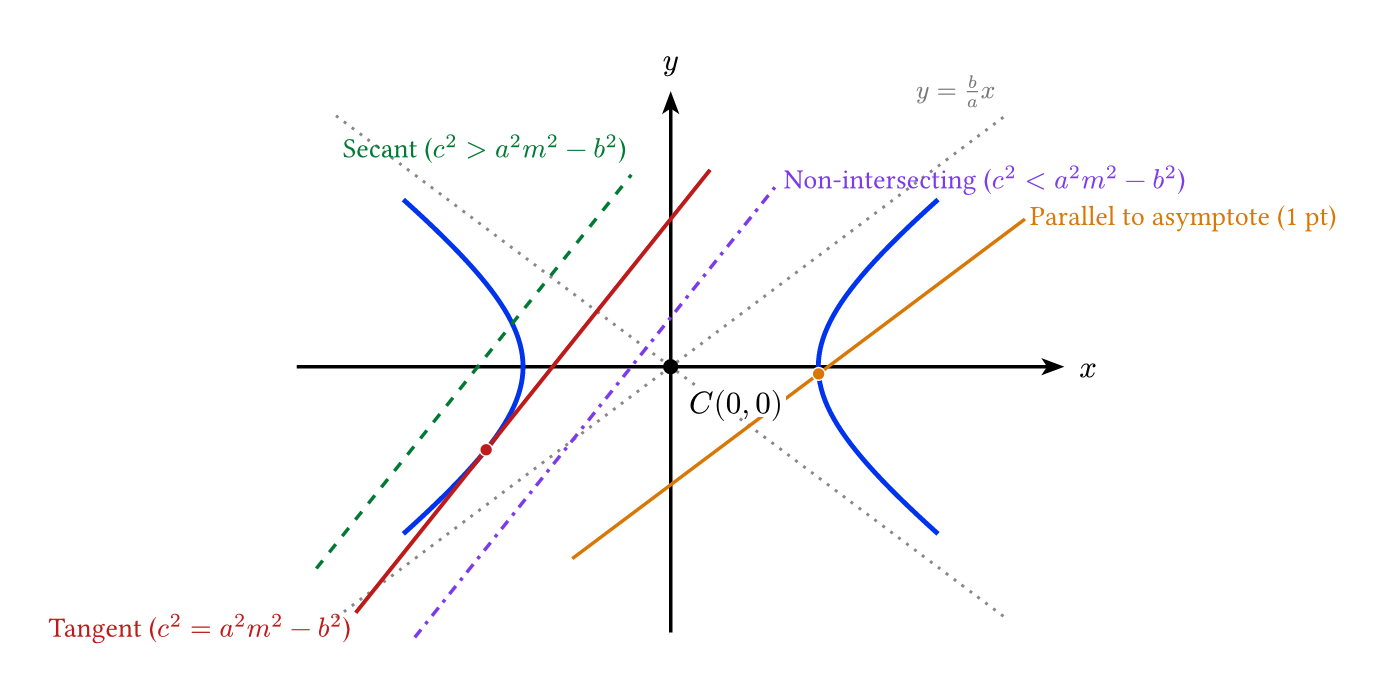
The geometric behavior of the line falls into three distinct regimes depending on how its slope ∣ m ∣ |m| ∣ m ∣ b a \frac{b}{a} a b
Regime 1: Line Parallel to an Asymptote§
When m = ± b a m = \pm \frac{b}{a} m = ± a b x 2 x^2 x 2 A = b 2 − a 2 m 2 = 0 A = b^2 - a^2 m^2 = 0 A = b 2 − a 2 m 2 = 0 linear equation in x x x
− 2 a 2 m c x − a 2 ( b 2 + c 2 ) = 0 -2a^2 mc\,x - a^2(b^2 + c^2) = 0 − 2 a 2 m c x − a 2 ( b 2 + c 2 ) = 0 If c ≠ 0 c \ne 0 c = 0 The line is parallel to one of the asymptotes but does not pass through the center. Solving for x x x
x = − b 2 + c 2 2 m c x = -\frac{b^2 + c^2}{2mc} x = − 2 m c b 2 + c 2 Because there is only one real root, the line intersects the hyperbola at exactly one point ! It slices through one branch and runs parallel to the asymptote along the other branch without ever touching it.
If c = 0 c = 0 c = 0 The line passes through the origin with equation y = ± b a x y = \pm \frac{b}{a}x y = ± a b x − a 2 b 2 = 0 -a^2 b^2 = 0 − a 2 b 2 = 0 is an asymptote itself and meets the hyperbola at no real finite points (touching it only "at infinity").
Regime 2: Line Flatter than Asymptotes§
When ∣ m ∣ < b a |m| < \frac{b}{a} ∣ m ∣ < a b
b 2 − a 2 m 2 > 0 ⟹ A > 0 b^2 - a^2 m^2 > 0 \implies A > 0 b 2 − a 2 m 2 > 0 ⟹ A > 0 Now compute the discriminant D = B 2 − 4 A C D = B^2 - 4AC D = B 2 − 4 A C
D = ( − 2 a 2 m c ) 2 − 4 ( b 2 − a 2 m 2 ) [ − a 2 ( b 2 + c 2 ) ] D = (-2a^2 mc)^2 - 4(b^2 - a^2 m^2)\left[-a^2(b^2 + c^2)\right] D = ( − 2 a 2 m c ) 2 − 4 ( b 2 − a 2 m 2 ) [ − a 2 ( b 2 + c 2 ) ] D = 4 a 4 m 2 c 2 + 4 a 2 ( b 2 − a 2 m 2 ) ( b 2 + c 2 ) D = 4a^4 m^2 c^2 + 4a^2(b^2 - a^2 m^2)(b^2 + c^2) D = 4 a 4 m 2 c 2 + 4 a 2 ( b 2 − a 2 m 2 ) ( b 2 + c 2 ) Factoring out 4 a 2 4a^2 4 a 2
D = 4 a 2 [ a 2 m 2 c 2 + b 4 + b 2 c 2 − a 2 m 2 b 2 − a 2 m 2 c 2 ] = 4 a 2 b 2 [ ( b 2 − a 2 m 2 ) + c 2 ] D = 4a^2\left[a^2 m^2 c^2 + b^4 + b^2 c^2 - a^2 m^2 b^2 - a^2 m^2 c^2\right] = 4a^2 b^2\left[(b^2 - a^2 m^2) + c^2\right] D = 4 a 2 [ a 2 m 2 c 2 + b 4 + b 2 c 2 − a 2 m 2 b 2 − a 2 m 2 c 2 ] = 4 a 2 b 2 [ ( b 2 − a 2 m 2 ) + c 2 ] Since b 2 − a 2 m 2 > 0 b^2 - a^2 m^2 > 0 b 2 − a 2 m 2 > 0 c 2 ≥ 0 c^2 \ge 0 c 2 ≥ 0 strictly positive for all real values of c c c :
D > 0 for every real c D > 0 \quad \text{for every real } c D > 0 for every real c Furthermore, look at the product of the two roots from Vieta's formulas:
x 1 x 2 = C A = − a 2 ( b 2 + c 2 ) b 2 − a 2 m 2 < 0 x_1 x_2 = \frac{C}{A} = \frac{-a^2(b^2 + c^2)}{b^2 - a^2 m^2} < 0 x 1 x 2 = A C = b 2 − a 2 m 2 − a 2 ( b 2 + c 2 ) < 0 Because x 1 x 2 < 0 x_1 x_2 < 0 x 1 x 2 < 0 opposite signs (x 1 > 0 x_1 > 0 x 1 > 0 x 2 < 0 x_2 < 0 x 2 < 0
Conclusion for ∣ m ∣ < b / a |m| < b/a ∣ m ∣ < b / a Any line flatter than the asymptotes intersects the hyperbola in two distinct points lying on opposite branches (one on the right branch and one on the left branch). Such a line can never be a tangent, and can never miss the curve!
Regime 3: Line Steeper than Asymptotes§
When ∣ m ∣ > b a |m| > \frac{b}{a} ∣ m ∣ > a b
b 2 − a 2 m 2 < 0 ⟹ a 2 m 2 − b 2 > 0 b^2 - a^2 m^2 < 0 \implies a^2 m^2 - b^2 > 0 b 2 − a 2 m 2 < 0 ⟹ a 2 m 2 − b 2 > 0 Writing the discriminant in terms of the positive quantity ( a 2 m 2 − b 2 ) (a^2 m^2 - b^2) ( a 2 m 2 − b 2 )
D = 4 a 2 b 2 [ c 2 − ( a 2 m 2 − b 2 ) ] D = 4a^2 b^2\left[c^2 - (a^2 m^2 - b^2)\right] D = 4 a 2 b 2 [ c 2 − ( a 2 m 2 − b 2 ) ] Now the sign of D D D c c c
Case 1: Secant Line (D > 0 ⟺ c 2 > a 2 m 2 − b 2 D > 0 \iff c^2 > a^2 m^2 - b^2 D > 0 ⟺ c 2 > a 2 m 2 − b 2
The line intersects the hyperbola at two distinct points lying on the same branch .
Case 2: Tangent Line (D = 0 ⟺ c 2 = a 2 m 2 − b 2 D = 0 \iff c^2 = a^2 m^2 - b^2 D = 0 ⟺ c 2 = a 2 m 2 − b 2
The line touches the hyperbola at exactly one point .
Case 3: Non-Intersecting Line (D < 0 ⟺ c 2 < a 2 m 2 − b 2 D < 0 \iff c^2 < a^2 m^2 - b^2 D < 0 ⟺ c 2 < a 2 m 2 − b 2
The line passes entirely between the two branches without intersecting or touching either branch.
3. Condition of Tangency and the Slope Restriction§
Setting D = 0 D = 0 D = 0 condition of tangency for the horizontal hyperbola x 2 a 2 − y 2 b 2 = 1 \frac{x^2}{a^2} - \frac{y^2}{b^2} = 1 a 2 x 2 − b 2 y 2 = 1
c 2 = a 2 m 2 − b 2 ⟺ c = ± a 2 m 2 − b 2 c^2 = a^2 m^2 - b^2 \iff c = \pm \sqrt{a^2 m^2 - b^2} c 2 = a 2 m 2 − b 2 ⟺ c = ± a 2 m 2 − b 2 Why Tangents of All Slopes Are NOT Possible§
Look closely at the expression under the square root: a 2 m 2 − b 2 a^2 m^2 - b^2 a 2 m 2 − b 2 c c c
a 2 m 2 − b 2 ≥ 0 ⟹ m 2 ≥ b 2 a 2 ⟹ ∣ m ∣ ≥ b a a^2 m^2 - b^2 \ge 0 \implies m^2 \ge \frac{b^2}{a^2} \implies |m| \ge \frac{b}{a} a 2 m 2 − b 2 ≥ 0 ⟹ m 2 ≥ a 2 b 2 ⟹ ∣ m ∣ ≥ a b
This is one of the most fundamental contrasts in coordinate geometry:
For an Ellipse: c = ± a 2 m 2 + b 2 c = \pm\sqrt{a^2 m^2 + b^2} c = ± a 2 m 2 + b 2 a 2 m 2 + b 2 > 0 a^2 m^2 + b^2 > 0 a 2 m 2 + b 2 > 0 m m m every real slope exist.For a Parabola (y 2 = 4 a x y^2 = 4ax y 2 = 4 a x c = a m c = \frac{a}{m} c = m a every non-zero slope exist.For a Horizontal Hyperbola: Tangents exist only when ∣ m ∣ > b a |m| > \frac{b}{a} ∣ m ∣ > a b (or ∣ m ∣ ≥ b a |m| \ge \frac{b}{a} ∣ m ∣ ≥ a b ( − b a , b a ) \left(-\frac{b}{a},\; \frac{b}{a}\right) ( − a b , a b )
4. Condition of Tangency for a Vertical Hyperbola§
Now consider the standard vertical hyperbola:
y 2 b 2 − x 2 a 2 = 1 \frac{y^2}{b^2} - \frac{x^2}{a^2} = 1 b 2 y 2 − a 2 x 2 = 1 Substitute y = m x + c y = mx + c y = m x + c
( m x + c ) 2 b 2 − x 2 a 2 = 1 ⟹ ( a 2 m 2 − b 2 ) x 2 + 2 a 2 m c x + a 2 ( c 2 − b 2 ) = 0 \frac{(mx + c)^2}{b^2} - \frac{x^2}{a^2} = 1 \implies (a^2 m^2 - b^2)x^2 + 2a^2 mc\,x + a^2(c^2 - b^2) = 0 b 2 ( m x + c ) 2 − a 2 x 2 = 1 ⟹ ( a 2 m 2 − b 2 ) x 2 + 2 a 2 m c x + a 2 ( c 2 − b 2 ) = 0 Setting the discriminant to zero yields the condition of tangency:
c 2 = b 2 − a 2 m 2 ⟺ c = ± b 2 − a 2 m 2 c^2 = b^2 - a^2 m^2 \iff c = \pm \sqrt{b^2 - a^2 m^2} c 2 = b 2 − a 2 m 2 ⟺ c = ± b 2 − a 2 m 2 The Beautiful Complementarity of Slopes§
For c c c
b 2 − a 2 m 2 ≥ 0 ⟹ m 2 ≤ b 2 a 2 ⟹ ∣ m ∣ ≤ b a b^2 - a^2 m^2 \ge 0 \implies m^2 \le \frac{b^2}{a^2} \implies |m| \le \frac{b}{a} b 2 − a 2 m 2 ≥ 0 ⟹ m 2 ≤ a 2 b 2 ⟹ ∣ m ∣ ≤ a b Notice how the two conjugate hyperbolas divide the entire range of real slopes between them:
Horizontal Hyperbola: Real tangents exist only for ∣ m ∣ > b a |m| > \frac{b}{a} ∣ m ∣ > a b Vertical Hyperbola: Real tangents exist only for ∣ m ∣ < b a |m| < \frac{b}{a} ∣ m ∣ < a b Asymptotes (∣ m ∣ = b a |m| = \frac{b}{a} ∣ m ∣ = a b Form the exact boundary separating the two slope domains!
Standard Horizontal Hyperbola§
Substituting c = ± a 2 m 2 − b 2 c = \pm\sqrt{a^2 m^2 - b^2} c = ± a 2 m 2 − b 2 y = m x + c y = mx + c y = m x + c
y = m x ± a 2 m 2 − b 2 ( ∣ m ∣ > b a ) y = mx \pm \sqrt{a^2 m^2 - b^2} \qquad \left(|m| > \frac{b}{a}\right) y = m x ± a 2 m 2 − b 2 ( ∣ m ∣ > a b ) For any permissible slope m m m two parallel tangents , one touching each branch.
Point of Contact:
When D = 0 D = 0 D = 0 ( b 2 − a 2 m 2 ) x 2 − 2 a 2 m c x − a 2 ( b 2 + c 2 ) = 0 (b^2 - a^2 m^2)x^2 - 2a^2 mc\,x - a^2(b^2 + c^2) = 0 ( b 2 − a 2 m 2 ) x 2 − 2 a 2 m c x − a 2 ( b 2 + c 2 ) = 0
x = − B 2 A = 2 a 2 m c 2 ( b 2 − a 2 m 2 ) = a 2 m c − ( a 2 m 2 − b 2 ) = a 2 m c − c 2 = − a 2 m c x = -\frac{B}{2A} = \frac{2a^2 mc}{2(b^2 - a^2 m^2)} = \frac{a^2 mc}{-(a^2 m^2 - b^2)} = \frac{a^2 mc}{-c^2} = -\frac{a^2 m}{c} x = − 2 A B = 2 ( b 2 − a 2 m 2 ) 2 a 2 m c = − ( a 2 m 2 − b 2 ) a 2 m c = − c 2 a 2 m c = − c a 2 m Substituting x x x y = m x + c y = mx + c y = m x + c
y = m ( − a 2 m c ) + c = c 2 − a 2 m 2 c = − b 2 c y = m\left(-\frac{a^2 m}{c}\right) + c = \frac{c^2 - a^2 m^2}{c} = \frac{-b^2}{c} y = m ( − c a 2 m ) + c = c c 2 − a 2 m 2 = c − b 2 Therefore, for a tangent with intercept c c c
( − a 2 m c , − b 2 c ) \left(-\frac{a^2 m}{c},\; -\frac{b^2}{c}\right) ( − c a 2 m , − c b 2 ) Substituting c = ± a 2 m 2 − b 2 c = \pm\sqrt{a^2 m^2 - b^2} c = ± a 2 m 2 − b 2
Point of Contact = ( ∓ a 2 m a 2 m 2 − b 2 , ∓ b 2 a 2 m 2 − b 2 ) \text{Point of Contact} = \left(\mp \frac{a^2 m}{\sqrt{a^2 m^2 - b^2}},\; \mp \frac{b^2}{\sqrt{a^2 m^2 - b^2}}\right) Point of Contact = ( ∓ a 2 m 2 − b 2 a 2 m , ∓ a 2 m 2 − b 2 b 2 ) Standard Vertical Hyperbola§
Substituting c = ± b 2 − a 2 m 2 c = \pm\sqrt{b^2 - a^2 m^2} c = ± b 2 − a 2 m 2 y = m x + c y = mx + c y = m x + c
y = m x ± b 2 − a 2 m 2 ( ∣ m ∣ < b a ) y = mx \pm \sqrt{b^2 - a^2 m^2} \qquad \left(|m| < \frac{b}{a}\right) y = m x ± b 2 − a 2 m 2 ( ∣ m ∣ < a b ) Point of Contact:
Point of Contact = ( ± a 2 m b 2 − a 2 m 2 , ± b 2 b 2 − a 2 m 2 ) \text{Point of Contact} = \left(\pm \frac{a^2 m}{\sqrt{b^2 - a^2 m^2}},\; \pm \frac{b^2}{\sqrt{b^2 - a^2 m^2}}\right) Point of Contact = ( ± b 2 − a 2 m 2 a 2 m , ± b 2 − a 2 m 2 b 2 ) 6. Tangents to Shifted Hyperbolas§
When a hyperbola has center C ( h , k ) C(h, k) C ( h , k ) X = x − h X = x - h X = x − h Y = y − k Y = y - k Y = y − k
Shifted Horizontal Hyperbola§
For ( x − h ) 2 a 2 − ( y − k ) 2 b 2 = 1 \frac{(x - h)^2}{a^2} - \frac{(y - k)^2}{b^2} = 1 a 2 ( x − h ) 2 − b 2 ( y − k ) 2 = 1
In the translated frame, Y = m X ± a 2 m 2 − b 2 Y = mX \pm \sqrt{a^2 m^2 - b^2} Y = m X ± a 2 m 2 − b 2
y − k = m ( x − h ) ± a 2 m 2 − b 2 ( ∣ m ∣ > b a ) y - k = m(x - h) \pm \sqrt{a^2 m^2 - b^2} \qquad \left(|m| > \frac{b}{a}\right) y − k = m ( x − h ) ± a 2 m 2 − b 2 ( ∣ m ∣ > a b ) The points of contact are obtained by adding ( h , k ) (h, k) ( h , k )
( h ∓ a 2 m a 2 m 2 − b 2 , k ∓ b 2 a 2 m 2 − b 2 ) \left(h \mp \frac{a^2 m}{\sqrt{a^2 m^2 - b^2}},\; k \mp \frac{b^2}{\sqrt{a^2 m^2 - b^2}}\right) ( h ∓ a 2 m 2 − b 2 a 2 m , k ∓ a 2 m 2 − b 2 b 2 ) Shifted Vertical Hyperbola§
For ( y − k ) 2 b 2 − ( x − h ) 2 a 2 = 1 \frac{(y - k)^2}{b^2} - \frac{(x - h)^2}{a^2} = 1 b 2 ( y − k ) 2 − a 2 ( x − h ) 2 = 1
y − k = m ( x − h ) ± b 2 − a 2 m 2 ( ∣ m ∣ < b a ) y - k = m(x - h) \pm \sqrt{b^2 - a^2 m^2} \qquad \left(|m| < \frac{b}{a}\right) y − k = m ( x − h ) ± b 2 − a 2 m 2 ( ∣ m ∣ < a b ) The points of contact are:
( h ± a 2 m b 2 − a 2 m 2 , k ± b 2 b 2 − a 2 m 2 ) \left(h \pm \frac{a^2 m}{\sqrt{b^2 - a^2 m^2}},\; k \pm \frac{b^2}{\sqrt{b^2 - a^2 m^2}}\right) ( h ± b 2 − a 2 m 2 a 2 m , k ± b 2 − a 2 m 2 b 2 ) 7. Tangency Condition for a General Line§
Let the line be given in general form l x + m y + n = 0 lx + my + n = 0 l x + m y + n = 0 m ≠ 0 m \ne 0 m = 0
Expressing in slope-intercept form gives slope M = − l m M = -\frac{l}{m} M = − m l C = − n m C = -\frac{n}{m} C = − m n
For the horizontal hyperbola x 2 a 2 − y 2 b 2 = 1 \frac{x^2}{a^2} - \frac{y^2}{b^2} = 1 a 2 x 2 − b 2 y 2 = 1
Applying C 2 = a 2 M 2 − b 2 C^2 = a^2 M^2 - b^2 C 2 = a 2 M 2 − b 2
( − n m ) 2 = a 2 ( − l m ) 2 − b 2 ⟹ a 2 l 2 − b 2 m 2 = n 2 \left(-\frac{n}{m}\right)^2 = a^2\left(-\frac{l}{m}\right)^2 - b^2 \implies a^2 l^2 - b^2 m^2 = n^2 ( − m n ) 2 = a 2 ( − m l ) 2 − b 2 ⟹ a 2 l 2 − b 2 m 2 = n 2
For the vertical hyperbola y 2 b 2 − x 2 a 2 = 1 \frac{y^2}{b^2} - \frac{x^2}{a^2} = 1 b 2 y 2 − a 2 x 2 = 1
Applying C 2 = b 2 − a 2 M 2 C^2 = b^2 - a^2 M^2 C 2 = b 2 − a 2 M 2
( − n m ) 2 = b 2 − a 2 ( − l m ) 2 ⟹ b 2 m 2 − a 2 l 2 = n 2 \left(-\frac{n}{m}\right)^2 = b^2 - a^2\left(-\frac{l}{m}\right)^2 \implies b^2 m^2 - a^2 l^2 = n^2 ( − m n ) 2 = b 2 − a 2 ( − m l ) 2 ⟹ b 2 m 2 − a 2 l 2 = n 2 8. Length of an Intercepted Chord§
When a line cuts a hyperbola in two distinct points P ( x 1 , y 1 ) P(x_1, y_1) P ( x 1 , y 1 ) Q ( x 2 , y 2 ) Q(x_2, y_2) Q ( x 2 , y 2 ) P Q PQ P Q
Eliminating y y y ( b 2 − a 2 m 2 ) x 2 − 2 a 2 m c x − a 2 ( b 2 + c 2 ) = 0 (b^2 - a^2 m^2)x^2 - 2a^2 mc\,x - a^2(b^2 + c^2) = 0 ( b 2 − a 2 m 2 ) x 2 − 2 a 2 m c x − a 2 ( b 2 + c 2 ) = 0
x 1 + x 2 = 2 a 2 m c b 2 − a 2 m 2 , x 1 x 2 = − a 2 ( b 2 + c 2 ) b 2 − a 2 m 2 x_1 + x_2 = \frac{2a^2 mc}{b^2 - a^2 m^2}, \qquad x_1 x_2 = -\frac{a^2(b^2 + c^2)}{b^2 - a^2 m^2} x 1 + x 2 = b 2 − a 2 m 2 2 a 2 m c , x 1 x 2 = − b 2 − a 2 m 2 a 2 ( b 2 + c 2 ) we find the difference between the abscissae:
∣ x 1 − x 2 ∣ = ( x 1 + x 2 ) 2 − 4 x 1 x 2 |x_1 - x_2| = \sqrt{(x_1 + x_2)^2 - 4x_1 x_2} ∣ x 1 − x 2 ∣ = ( x 1 + x 2 ) 2 − 4 x 1 x 2 The length of the chord is then:
P Q = 1 + m 2 ∣ x 1 − x 2 ∣ PQ = \sqrt{1 + m^2}\,|x_1 - x_2| P Q = 1 + m 2 ∣ x 1 − x 2 ∣ 9. Illustrative Examples§
Example 1: Complete Classification of Lines Relative to a Hyperbola§
Classify the relationship between each of the following lines and the hyperbola x 2 16 − y 2 9 = 1 \frac{x^2}{16} - \frac{y^2}{9} = 1 16 x 2 − 9 y 2 = 1
y = 5 4 x + 4 y = \frac{5}{4}x + 4 y = 4 5 x + 4 y = 5 4 x + 5 y = \frac{5}{4}x + 5 y = 4 5 x + 5 y = 5 4 x + 2 y = \frac{5}{4}x + 2 y = 4 5 x + 2 y = 3 4 x − 2 y = \frac{3}{4}x - 2 y = 4 3 x − 2 y = 1 2 x + 1 y = \frac{1}{2}x + 1 y = 2 1 x + 1
Solution:
Here a 2 = 16 ⟹ a = 4 a^2 = 16 \implies a = 4 a 2 = 16 ⟹ a = 4 b 2 = 9 ⟹ b = 3 b^2 = 9 \implies b = 3 b 2 = 9 ⟹ b = 3 b a = 3 4 = 0.75 \frac{b}{a} = \frac{3}{4} = 0.75 a b = 4 3 = 0.75
For Line 1 (y = 5 4 x + 4 y = \frac{5}{4}x + 4 y = 4 5 x + 4
Slope m = 5 4 > 3 4 m = \frac{5}{4} > \frac{3}{4} m = 4 5 > 4 3
Evaluate a 2 m 2 − b 2 = 16 ( 25 16 ) − 9 = 25 − 9 = 16 a^2 m^2 - b^2 = 16\left(\frac{25}{16}\right) - 9 = 25 - 9 = 16 a 2 m 2 − b 2 = 16 ( 16 25 ) − 9 = 25 − 9 = 16
Here c = 4 c = 4 c = 4 c 2 = 16 = a 2 m 2 − b 2 c^2 = 16 = a^2 m^2 - b^2 c 2 = 16 = a 2 m 2 − b 2
Since c 2 = a 2 m 2 − b 2 c^2 = a^2 m^2 - b^2 c 2 = a 2 m 2 − b 2 tangent line .
Point of contact: ( − a 2 m c , − b 2 c ) = ( − 16 ( 5 / 4 ) 4 , − 9 4 ) = ( − 5 , − 9 4 ) \left(-\frac{a^2 m}{c}, -\frac{b^2}{c}\right) = \left(-\frac{16(5/4)}{4}, -\frac{9}{4}\right) = \left(-5, -\frac{9}{4}\right) ( − c a 2 m , − c b 2 ) = ( − 4 16 ( 5/4 ) , − 4 9 ) = ( − 5 , − 4 9 )
For Line 2 (y = 5 4 x + 5 y = \frac{5}{4}x + 5 y = 4 5 x + 5
Slope m = 5 4 > 3 4 m = \frac{5}{4} > \frac{3}{4} m = 4 5 > 4 3 a 2 m 2 − b 2 = 16 a^2 m^2 - b^2 = 16 a 2 m 2 − b 2 = 16
Here c = 5 c = 5 c = 5 c 2 = 25 > 16 c^2 = 25 > 16 c 2 = 25 > 16
Since c 2 > a 2 m 2 − b 2 c^2 > a^2 m^2 - b^2 c 2 > a 2 m 2 − b 2 secant line intersecting the left branch in two distinct points.
For Line 3 (y = 5 4 x + 2 y = \frac{5}{4}x + 2 y = 4 5 x + 2
Slope m = 5 4 > 3 4 m = \frac{5}{4} > \frac{3}{4} m = 4 5 > 4 3 a 2 m 2 − b 2 = 16 a^2 m^2 - b^2 = 16 a 2 m 2 − b 2 = 16
Here c = 2 c = 2 c = 2 c 2 = 4 < 16 c^2 = 4 < 16 c 2 = 4 < 16
Since c 2 < a 2 m 2 − b 2 c^2 < a^2 m^2 - b^2 c 2 < a 2 m 2 − b 2 non-intersecting line passing between the two branches.
For Line 4 (y = 3 4 x − 2 y = \frac{3}{4}x - 2 y = 4 3 x − 2
Slope m = 3 4 = b a m = \frac{3}{4} = \frac{b}{a} m = 4 3 = a b c = − 2 ≠ 0 c = -2 \ne 0 c = − 2 = 0
The line intersects the hyperbola in exactly one point .
Setting up the linear equation: − 2 ( 16 ) ( 3 4 ) ( − 2 ) x − 16 ( 9 + 4 ) = 0 ⟹ 48 x − 208 = 0 ⟹ x = 13 3 -2(16)\left(\frac{3}{4}\right)(-2)x - 16(9 + 4) = 0 \implies 48x - 208 = 0 \implies x = \frac{13}{3} − 2 ( 16 ) ( 4 3 ) ( − 2 ) x − 16 ( 9 + 4 ) = 0 ⟹ 48 x − 208 = 0 ⟹ x = 3 13
For Line 5 (y = 1 2 x + 1 y = \frac{1}{2}x + 1 y = 2 1 x + 1
Slope m = 1 2 < 3 4 = b a m = \frac{1}{2} < \frac{3}{4} = \frac{b}{a} m = 2 1 < 4 3 = a b
The line intersects the hyperbola in two distinct points on opposite branches (one on the left branch, one on the right branch).
Example 2: Tangents of Given Slope to Horizontal and Vertical Hyperbolas§
Find the equations of tangents of slope m = 2 m = 2 m = 2 x 2 9 − y 2 16 = 1 \frac{x^2}{9} - \frac{y^2}{16} = 1 9 x 2 − 16 y 2 = 1
Explain why no real tangent of slope m = 1 m = 1 m = 1 x 2 9 − y 2 16 = 1 \frac{x^2}{9} - \frac{y^2}{16} = 1 9 x 2 − 16 y 2 = 1
Find the tangents of slope m = 1 m = 1 m = 1 y 2 16 − x 2 9 = 1 \frac{y^2}{16} - \frac{x^2}{9} = 1 16 y 2 − 9 x 2 = 1
Solution:
Part 1:
For x 2 9 − y 2 16 = 1 \frac{x^2}{9} - \frac{y^2}{16} = 1 9 x 2 − 16 y 2 = 1 a 2 = 9 a^2 = 9 a 2 = 9 b 2 = 16 b^2 = 16 b 2 = 16 b a = 4 3 \frac{b}{a} = \frac{4}{3} a b = 3 4 m = 2 > 4 3 m = 2 > \frac{4}{3} m = 2 > 3 4
c 2 = a 2 m 2 − b 2 = 9 ( 2 2 ) − 16 = 36 − 16 = 20 ⟹ c = ± 2 5 c^2 = a^2 m^2 - b^2 = 9(2^2) - 16 = 36 - 16 = 20 \implies c = \pm 2\sqrt{5} c 2 = a 2 m 2 − b 2 = 9 ( 2 2 ) − 16 = 36 − 16 = 20 ⟹ c = ± 2 5 The equations of the tangents are:
y = 2 x ± 2 5 y = 2x \pm 2\sqrt{5} y = 2 x ± 2 5 Points of contact ( ∓ a 2 m c , ∓ b 2 c ) \left(\mp \frac{a^2 m}{c},\; \mp \frac{b^2}{c}\right) ( ∓ c a 2 m , ∓ c b 2 )
For y = 2 x + 2 5 y = 2x + 2\sqrt{5} y = 2 x + 2 5 ( − 9 ( 2 ) 2 5 , − 16 2 5 ) = ( − 9 5 , − 8 5 ) \left(-\frac{9(2)}{2\sqrt{5}},\; -\frac{16}{2\sqrt{5}}\right) = \left(-\frac{9}{\sqrt{5}},\; -\frac{8}{\sqrt{5}}\right) ( − 2 5 9 ( 2 ) , − 2 5 16 ) = ( − 5 9 , − 5 8 )
For y = 2 x − 2 5 y = 2x - 2\sqrt{5} y = 2 x − 2 5 ( 9 5 , 8 5 ) \left(\frac{9}{\sqrt{5}},\; \frac{8}{\sqrt{5}}\right) ( 5 9 , 5 8 )
Part 2:
If m = 1 m = 1 m = 1
a 2 m 2 − b 2 = 9 ( 1 2 ) − 16 = − 7 < 0 a^2 m^2 - b^2 = 9(1^2) - 16 = -7 < 0 a 2 m 2 − b 2 = 9 ( 1 2 ) − 16 = − 7 < 0 Since c 2 = − 7 c^2 = -7 c 2 = − 7 no real tangent of slope 1 1 1 for this horizontal hyperbola (the slope 1 1 1 4 3 \frac{4}{3} 3 4
Part 3:
For the vertical hyperbola y 2 16 − x 2 9 = 1 \frac{y^2}{16} - \frac{x^2}{9} = 1 16 y 2 − 9 x 2 = 1 b 2 = 16 , a 2 = 9 b^2 = 16, a^2 = 9 b 2 = 16 , a 2 = 9 c 2 = b 2 − a 2 m 2 c^2 = b^2 - a^2 m^2 c 2 = b 2 − a 2 m 2 m = 1 m = 1 m = 1
c 2 = 16 − 9 ( 1 2 ) = 7 > 0 ⟹ c = ± 7 c^2 = 16 - 9(1^2) = 7 > 0 \implies c = \pm\sqrt{7} c 2 = 16 − 9 ( 1 2 ) = 7 > 0 ⟹ c = ± 7 Because m = 1 < 4 3 m = 1 < \frac{4}{3} m = 1 < 3 4 do exist for the vertical hyperbola:
y = x ± 7 y = x \pm \sqrt{7} y = x ± 7 Example 3: Tangents to a Shifted Hyperbola§
Find the equations of the tangents to the shifted hyperbola
( x − 2 ) 2 4 − ( y + 1 ) 2 5 = 1 \frac{(x - 2)^2}{4} - \frac{(y + 1)^2}{5} = 1 4 ( x − 2 ) 2 − 5 ( y + 1 ) 2 = 1 that are parallel to the straight line 3 x − y + 7 = 0 3x - y + 7 = 0 3 x − y + 7 = 0
Solution:
The line 3 x − y + 7 = 0 3x - y + 7 = 0 3 x − y + 7 = 0 m = 3 m = 3 m = 3
For the hyperbola:
Center ( h , k ) = ( 2 , − 1 ) (h, k) = (2, -1) ( h , k ) = ( 2 , − 1 )
a 2 = 4 ⟹ a = 2 a^2 = 4 \implies a = 2 a 2 = 4 ⟹ a = 2 b 2 = 5 ⟹ b = 5 b^2 = 5 \implies b = \sqrt{5} b 2 = 5 ⟹ b = 5 Asymptote slope b a = 5 2 ≈ 1.118 \frac{b}{a} = \frac{\sqrt{5}}{2} \approx 1.118 a b = 2 5 ≈ 1.118
Since m = 3 > 5 2 m = 3 > \frac{\sqrt{5}}{2} m = 3 > 2 5
a 2 m 2 − b 2 = 4 ( 3 2 ) − 5 = 36 − 5 = 31 \sqrt{a^2 m^2 - b^2} = \sqrt{4(3^2) - 5} = \sqrt{36 - 5} = \sqrt{31} a 2 m 2 − b 2 = 4 ( 3 2 ) − 5 = 36 − 5 = 31 Using the slope form for a shifted hyperbola y − k = m ( x − h ) ± a 2 m 2 − b 2 y - k = m(x - h) \pm \sqrt{a^2 m^2 - b^2} y − k = m ( x − h ) ± a 2 m 2 − b 2
y − ( − 1 ) = 3 ( x − 2 ) ± 31 y - (-1) = 3(x - 2) \pm \sqrt{31} y − ( − 1 ) = 3 ( x − 2 ) ± 31 y + 1 = 3 x − 6 ± 31 ⟹ y = 3 x − 7 ± 31 y + 1 = 3x - 6 \pm \sqrt{31} \implies y = 3x - 7 \pm \sqrt{31} y + 1 = 3 x − 6 ± 31 ⟹ y = 3 x − 7 ± 31 Points of contact:
( h ∓ a 2 m a 2 m 2 − b 2 , k ∓ b 2 a 2 m 2 − b 2 ) = ( 2 ∓ 12 31 , − 1 ∓ 5 31 ) \left(h \mp \frac{a^2 m}{\sqrt{a^2 m^2 - b^2}},\; k \mp \frac{b^2}{\sqrt{a^2 m^2 - b^2}}\right) = \left(2 \mp \frac{12}{\sqrt{31}},\; -1 \mp \frac{5}{\sqrt{31}}\right) ( h ∓ a 2 m 2 − b 2 a 2 m , k ∓ a 2 m 2 − b 2 b 2 ) = ( 2 ∓ 31 12 , − 1 ∓ 31 5 ) Example 4: Tangents Drawn from an External Point§
Find the equations of the tangents drawn from the point ( 1 , 0 ) (1, 0) ( 1 , 0 ) 2 x 2 − 3 y 2 = 6 2x^2 - 3y^2 = 6 2 x 2 − 3 y 2 = 6
Solution:
Divide by 6 6 6
x 2 3 − y 2 2 = 1 ⟹ a 2 = 3 , b 2 = 2 \frac{x^2}{3} - \frac{y^2}{2} = 1 \implies a^2 = 3,\; b^2 = 2 3 x 2 − 2 y 2 = 1 ⟹ a 2 = 3 , b 2 = 2 Any tangent of slope m m m
y = m x ± 3 m 2 − 2 ( m 2 ≥ 2 3 ) y = mx \pm \sqrt{3m^2 - 2} \qquad \left(m^2 \ge \frac{2}{3}\right) y = m x ± 3 m 2 − 2 ( m 2 ≥ 3 2 ) Since the tangent passes through ( 1 , 0 ) (1, 0) ( 1 , 0 ) x = 1 , y = 0 x = 1, y = 0 x = 1 , y = 0
0 = m ( 1 ) ± 3 m 2 − 2 ⟹ − m = ± 3 m 2 − 2 0 = m(1) \pm \sqrt{3m^2 - 2} \implies -m = \pm \sqrt{3m^2 - 2} 0 = m ( 1 ) ± 3 m 2 − 2 ⟹ − m = ± 3 m 2 − 2 Square both sides:
m 2 = 3 m 2 − 2 ⟹ 2 m 2 = 2 ⟹ m 2 = 1 ⟹ m = ± 1 m^2 = 3m^2 - 2 \implies 2m^2 = 2 \implies m^2 = 1 \implies m = \pm 1 m 2 = 3 m 2 − 2 ⟹ 2 m 2 = 2 ⟹ m 2 = 1 ⟹ m = ± 1 Check the slope condition: m 2 = 1 ≥ 2 3 m^2 = 1 \ge \frac{2}{3} m 2 = 1 ≥ 3 2
Now determine the correct sign of the radical for each slope:
For m = 1 m = 1 m = 1
Since − 1 = ± 3 ( 1 ) − 2 = ± 1 -1 = \pm\sqrt{3(1) - 2} = \pm 1 − 1 = ± 3 ( 1 ) − 2 = ± 1 minus sign. The tangent is:
y = x − 1 ⟹ x − y − 1 = 0 y = x - 1 \implies x - y - 1 = 0 y = x − 1 ⟹ x − y − 1 = 0 For m = − 1 m = -1 m = − 1
Since − ( − 1 ) = 1 = ± 3 ( 1 ) − 2 = ± 1 -(-1) = 1 = \pm\sqrt{3(1) - 2} = \pm 1 − ( − 1 ) = 1 = ± 3 ( 1 ) − 2 = ± 1 plus sign. The tangent is:
y = − x + 1 ⟹ x + y − 1 = 0 y = -x + 1 \implies x + y - 1 = 0 y = − x + 1 ⟹ x + y − 1 = 0 Thus, the two tangents are x − y − 1 = 0 x - y - 1 = 0 x − y − 1 = 0 x + y − 1 = 0 x + y - 1 = 0 x + y − 1 = 0
Example 5: Length of an Intercepted Chord§
Find the length of the chord intercepted by the hyperbola x 2 − 2 y 2 = 2 x^2 - 2y^2 = 2 x 2 − 2 y 2 = 2 2 x − y = 4 2x - y = 4 2 x − y = 4
Solution:
In standard form, the hyperbola is x 2 2 − y 2 1 = 1 \frac{x^2}{2} - \frac{y^2}{1} = 1 2 x 2 − 1 y 2 = 1 a 2 = 2 , b 2 = 1 a^2 = 2, b^2 = 1 a 2 = 2 , b 2 = 1 y y y x x x
y = 2 x − 4 y = 2x - 4 y = 2 x − 4 Substitute into x 2 − 2 y 2 = 2 x^2 - 2y^2 = 2 x 2 − 2 y 2 = 2
x 2 − 2 ( 2 x − 4 ) 2 = 2 x^2 - 2(2x - 4)^2 = 2 x 2 − 2 ( 2 x − 4 ) 2 = 2 x 2 − 2 ( 4 x 2 − 16 x + 16 ) = 2 x^2 - 2(4x^2 - 16x + 16) = 2 x 2 − 2 ( 4 x 2 − 16 x + 16 ) = 2 x 2 − 8 x 2 + 32 x − 32 = 2 x^2 - 8x^2 + 32x - 32 = 2 x 2 − 8 x 2 + 32 x − 32 = 2 − 7 x 2 + 32 x − 34 = 0 ⟹ 7 x 2 − 32 x + 34 = 0 -7x^2 + 32x - 34 = 0 \implies 7x^2 - 32x + 34 = 0 − 7 x 2 + 32 x − 34 = 0 ⟹ 7 x 2 − 32 x + 34 = 0 Check the discriminant to confirm intersection:
D = ( − 32 ) 2 − 4 ( 7 ) ( 34 ) = 1024 − 952 = 72 > 0 D = (-32)^2 - 4(7)(34) = 1024 - 952 = 72 > 0 D = ( − 32 ) 2 − 4 ( 7 ) ( 34 ) = 1024 − 952 = 72 > 0 Using Vieta's formulas for the roots x 1 x_1 x 1 x 2 x_2 x 2
x 1 + x 2 = 32 7 , x 1 x 2 = 34 7 x_1 + x_2 = \frac{32}{7}, \qquad x_1 x_2 = \frac{34}{7} x 1 + x 2 = 7 32 , x 1 x 2 = 7 34 Compute the square of the difference between the abscissae:
( x 1 − x 2 ) 2 = ( x 1 + x 2 ) 2 − 4 x 1 x 2 = ( 32 7 ) 2 − 4 ( 34 7 ) = 1024 49 − 136 7 = 1024 − 952 49 = 72 49 (x_1 - x_2)^2 = (x_1 + x_2)^2 - 4x_1 x_2 = \left(\frac{32}{7}\right)^2 - 4\left(\frac{34}{7}\right) = \frac{1024}{49} - \frac{136}{7} = \frac{1024 - 952}{49} = \frac{72}{49} ( x 1 − x 2 ) 2 = ( x 1 + x 2 ) 2 − 4 x 1 x 2 = ( 7 32 ) 2 − 4 ( 7 34 ) = 49 1024 − 7 136 = 49 1024 − 952 = 49 72 Taking the positive square root:
∣ x 1 − x 2 ∣ = 72 7 = 6 2 7 |x_1 - x_2| = \frac{\sqrt{72}}{7} = \frac{6\sqrt{2}}{7} ∣ x 1 − x 2 ∣ = 7 72 = 7 6 2 The slope of the line y = 2 x − 4 y = 2x - 4 y = 2 x − 4 m = 2 m = 2 m = 2
Chord Length = 1 + m 2 ∣ x 1 − x 2 ∣ = 1 + 2 2 ⋅ 6 2 7 = 5 ⋅ 6 2 7 = 6 10 7 \text{Chord Length} = \sqrt{1 + m^2}\,|x_1 - x_2| = \sqrt{1 + 2^2}\cdot \frac{6\sqrt{2}}{7} = \sqrt{5}\cdot \frac{6\sqrt{2}}{7} = \frac{6\sqrt{10}}{7} Chord Length = 1 + m 2 ∣ x 1 − x 2 ∣ = 1 + 2 2 ⋅ 7 6 2 = 5 ⋅ 7 6 2 = 7 6 10 10. Quick Reference Summary§
Hyperbola
Condition of Tangency
Tangent in Slope Form
Permissible Slopes
x 2 a 2 − y 2 b 2 = 1 \dfrac{x^2}{a^2} - \dfrac{y^2}{b^2} = 1 a 2 x 2 − b 2 y 2 = 1 c 2 = a 2 m 2 − b 2 c^2 = a^2 m^2 - b^2 c 2 = a 2 m 2 − b 2 y = m x ± a 2 m 2 − b 2 y = mx \pm \sqrt{a^2 m^2 - b^2} y = m x ± a 2 m 2 − b 2 ∥ m ∥ > b a \|m\| > \dfrac{b}{a} ∥ m ∥ > a b
y 2 b 2 − x 2 a 2 = 1 \dfrac{y^2}{b^2} - \dfrac{x^2}{a^2} = 1 b 2 y 2 − a 2 x 2 = 1 c 2 = b 2 − a 2 m 2 c^2 = b^2 - a^2 m^2 c 2 = b 2 − a 2 m 2 y = m x ± b 2 − a 2 m 2 y = mx \pm \sqrt{b^2 - a^2 m^2} y = m x ± b 2 − a 2 m 2 ∥ m ∥ < b a \|m\| < \dfrac{b}{a} ∥ m ∥ < a b
( x − h ) 2 a 2 − ( y − k ) 2 b 2 = 1 \dfrac{(x - h)^2}{a^2} - \dfrac{(y - k)^2}{b^2} = 1 a 2 ( x − h ) 2 − b 2 ( y − k ) 2 = 1 c 2 = a 2 m 2 − b 2 c^2 = a^2 m^2 - b^2 c 2 = a 2 m 2 − b 2 y − k = m ( x − h ) ± a 2 m 2 − b 2 y - k = m(x - h) \pm \sqrt{a^2 m^2 - b^2} y − k = m ( x − h ) ± a 2 m 2 − b 2 ∥ m ∥ > b a \|m\| > \dfrac{b}{a} ∥ m ∥ > a b
( y − k ) 2 b 2 − ( x − h ) 2 a 2 = 1 \dfrac{(y - k)^2}{b^2} - \dfrac{(x - h)^2}{a^2} = 1 b 2 ( y − k ) 2 − a 2 ( x − h ) 2 = 1 c 2 = b 2 − a 2 m 2 c^2 = b^2 - a^2 m^2 c 2 = b 2 − a 2 m 2 y − k = m ( x − h ) ± b 2 − a 2 m 2 y - k = m(x - h) \pm \sqrt{b^2 - a^2 m^2} y − k = m ( x − h ) ± b 2 − a 2 m 2 ∥ m ∥ < b a \|m\| < \dfrac{b}{a} ∥ m ∥ < a b