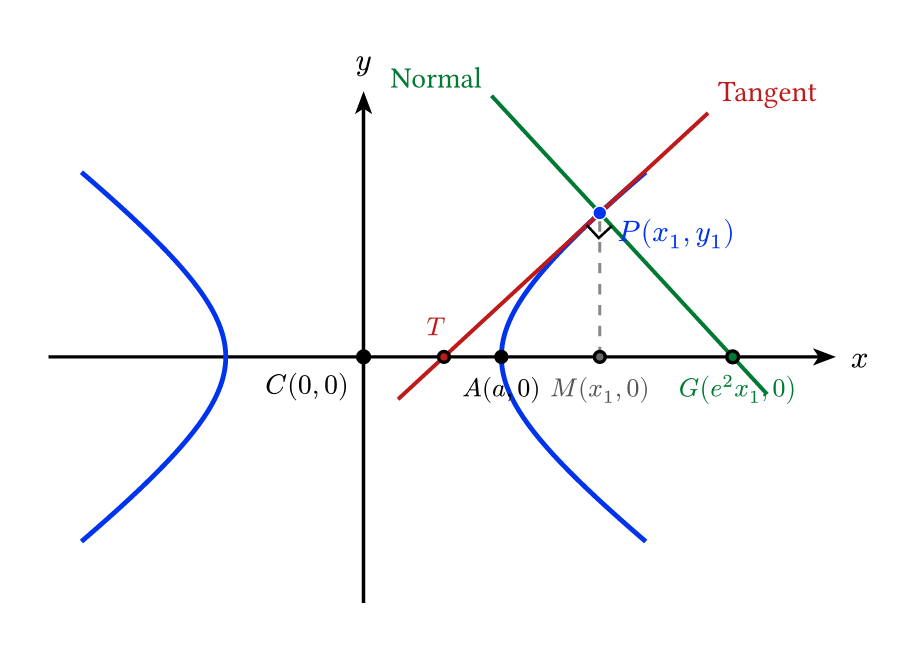
In this section, we study the straight lines that touch a hyperbola (tangents) and the straight lines perpendicular to those tangents at the point of contact (normals).
While the algebraic equations of tangents and normals to a hyperbola closely resemble those of an ellipse (obtained by the algebraic substitution b2→−b2), their geometric properties exhibit profound differences. For example, while tangents to an ellipse can take any slope in R, tangents to a hyperbola are strictly constrained by the slopes of its asymptotes. Similarly, the normal to a hyperbola intersects the transverse axis further away from the center than the foot of the ordinate, reversing the behavior seen in the ellipse.
A straight line that touches the hyperbola at exactly one point (having two coincident points of intersection) is called a tangent to the hyperbola at that point.
The straight line passing through the point of contact P(x1,y1) and perpendicular to the tangent at P is called the normal to the hyperbola at P.
Equation of Normal in Point Form (Cartesian Form)§
Let P(x1,y1) be a point on the hyperbola a2x2−b2y2=1.
As derived earlier, the slope of the tangent at P(x1,y1) is:
mT=a2y1b2x1
Since the normal is perpendicular to the tangent (mN⋅mT=−1), the slope of the normal is:
mN=−mT1=−b2x1a2y1(x1=0,y1=0)
Using the point-slope form:
y−y1=−b2x1a2y1(x−x1)
Divide both sides by y1 and multiply both sides by b2:
y1b2(y−y1)=−x1a2(x−x1)
Expanding both sides:
y1b2y−b2=−x1a2x+a2
Rearranging terms to place all variable terms on the left:
x1a2x+y1b2y=a2+b2
Recall that for a hyperbola, b2=a2(e2−1), which means a2+b2=a2e2. Thus, we can also write the point form as:
x1a2x+y1b2y=a2e2
Comparison with Ellipse:
For the ellipse a2x2+b2y2=1, the normal is x1a2x−y1b2y=a2−b2. In a hyperbola, replacing b2 with −b2 transforms the minus sign into a plus sign on both sides, yielding x1a2x+y1b2y=a2+b2.
For the Vertical Hyperbola:
For b2y2−a2x2=1, the slope of the tangent is mT=a2y1b2x1, so the normal at P(x1,y1) has slope mN=−b2x1a2y1. Carrying out the same steps gives:
From the parametric form axcosθ+bycotθ=a2+b2, we express y in terms of x:
bycotθ=−axcosθ+(a2+b2)y=−bcotθacosθx+bcotθa2+b2
Notice that cotθcosθ=sinθ. Therefore, the slope m of the normal is:
m=−basinθ
Because −1<sinθ<1 for all real points on the hyperbola (excluding the vertices where sinθ=0 giving horizontal normals, and θ→±π/2 where the points recede to infinity):
∣sinθ∣<1⟹∣m∣<ba
Key Geometric Insight on Slopes:
Tangents must have slopes steeper than asymptotes: ∣mtangent∣>ab.
Normals must have slopes flatter than the perpendiculars to asymptotes: ∣mnormal∣<ba.
To write the normal entirely in terms of m, we solve for sinθ and cosθ:
3. Relation Involving Tangent and Normal Intercepts§
Let the tangent at P(x1,y1) meet the x-axis at T. Setting y=0 in a2xx1−b2yy1=1:
xT=x1a2⟹T=(x1a2,0)
Since x1>a for the right branch, xT=x1a2<a. Thus, T lies inside the vertex A(a,0)!
Multiplying the distances from the center C(0,0) to T and M:
CT⋅CM=(x1a2)(x1)=a2=CA2
The product of the abscissa of the tangent intercept and the abscissa of the point of contact always equals the square of the semi-transverse axis a2. Along the positive x-axis, the points are ordered as:
C(0,0)<T(x1a2,0)<A(a,0)<M(x1,0)<G(e2x1,0)
Condition for a General Line to be Normal to a Hyperbola§
We want to find the condition under which the general line lx+my+n=0 is a normal to the hyperbola a2x2−b2y2=1.
Derivation:
The equation of a normal in parametric form at eccentric angle θ is:
(acosθ)x+(bcotθ)y−(a2+b2)=0
If lx+my+n=0 represents the same straight line, the coefficients must be proportional:
lacosθ=mbcotθ=n−(a2+b2)
From the first and third ratios:
cosθ=−anl(a2+b2)
From the second and third ratios:
cotθ=−bnm(a2+b2)
Dividing cosθ by cotθ gives sinθ:
sinθ=cotθcosθ=−bnm(a2+b2)−anl(a2+b2)=ambl
Now recall the fundamental identity csc2θ−cot2θ=1⟹sin2θ1−cot2θ=1:
b2l2a2m2−b2n2m2(a2+b2)2=1
Dividing the entire equation by m2:
b2l2a2−b2n2(a2+b2)2=m21
Multiplying throughout by b2:
l2a2−n2(a2+b2)2=m2b2
Rearranging terms yields the condition of normality:
l2a2−m2b2=n2(a2+b2)2
Finding the Foot of the Normal Using the Parametric Form§
In many competitive examination problems, you are asked to find the foot of the normal (the point of contact P on the hyperbola where the normal is drawn) when given the slope of the normal, or when given a point through which the normal passes.
While you could try using the condition of normality derived above, that formula involves reciprocal squares and high-degree algebra, making it easy to commit calculation errors.
The Recommended Method: Always use the parametric coordinates P(asecθ,btanθ)!
From the equation, bycotθ=−axcosθ+(a2+b2), so the slope of the normal is:
mN=−bcotθacosθ=−basinθ
Solve for the trigonometric values:
sinθ=−abmN
From sinθ, determine:
cosθ=±1−sin2θsecθ=cosθ1,tanθ=cosθsinθ
Write the foot of the normal:
The foot of the normal is immediately obtained as:
P(asecθ,btanθ)
This method requires minimal algebra, never requires memorizing the condition of normality, and directly yields the exact coordinates of the feet of the normals!
Problems asking for the minimum distance between a hyperbola and an external line or point frequently appear in competitive examinations.
Shortest Distance Between a Straight Line and a Hyperbola§
Consider a straight line L:Ax+By+C=0 that does not intersect the hyperbola a2x2−b2y2=1.
Geometric Principle:
The shortest distance between a smooth curve and a straight line occurs along their common normal. Since the line is straight, the normal to the line is simply perpendicular to it. Therefore, at the point P on the hyperbola closest to the line:
The tangent to the hyperbola at the closest point P must be parallel to the given straight line L.
Standard 4-Step Solution Procedure:
Find the slope of the given line:
m=−BA
Verify that tangents of slope m exist:
Check that ∣m∣>ab. If ∣m∣≤ab, no tangent of slope m exists (the line is parallel to or flatter than the asymptotes).
Write the equation of the parallel tangent on the closer branch:
y=mx±a2m2−b2
Select the sign of the constant term that places the tangent on the side closer to the given line L.
Calculate the distance:
Find the distance between the two parallel lines:
dmin=1+m2∣c1−c2∣
Alternatively, find the point of contact P(−ca2m,−cb2) and compute its perpendicular distance to Ax+By+C=0 using:
dmin=A2+B2∣Ax1+By1+C∣
Shortest Distance from an External Point to a Hyperbola§
If Q(x0,y0) is a given point, the shortest distance from Q to the hyperbola occurs along the normal passing through Q.
Write the parametric normal:
axcosθ+bycotθ=a2+b2
Substitute the coordinates of Q(x0,y0) into the normal equation:
ax0cosθ+by0cotθ=a2+b2
Solve for θ to find the foot of the normal P(asecθ,btanθ).
The minimum distance is the Euclidean distance dmin=PQ=(x0−asecθ)2+(y0−btanθ)2.
For the hyperbola 16x2−9y2=1, find the equations of the tangent and normal at the point P(5,49). Verify the position of the normal intercept G relative to the foot of the ordinate M.
Solution:
First, verify that P lies on the hyperbola:
1652−9(9/4)2=1625−981/16=1625−169=1616=1
Here a2=16,b2=9, and x1=5,y1=49.
Equation of Tangent:
Using the point form a2xx1−b2yy1=1:
16x(5)−9y(9/4)=1⟹165x−4y=1
Multiplying throughout by 16:
5x−4y=16
Equation of Normal:
Using the point form x1a2x+y1b2y=a2+b2:
516x+9/49y=16+9516x+4y=25
Multiplying throughout by 5:
16x+20y=125
Verifying the Intercepts:
The foot of the ordinate from P is M(5,0).
The x-intercept G of the normal is found by setting y=0 in 16x+20y=125:
16xG=125⟹xG=16125=7.8125
Recall that e2=1+a2b2=1+169=1625.
e2x1=(1625)(5)=16125=7.8125
Notice that xG=7.8125>x1=5. As predicted, G lies strictly outside M(5,0) on the transverse axis.
The x-intercept T of the tangent is found by setting y=0 in 5x−4y=16:
5xT=16⟹xT=516=3.2
Notice that:
CT⋅CM=(3.2)(5)=16=a2
All theoretical properties hold exactly.
Example 2: Finding the Foot of the Normal Using the Parametric Form§
Find the equations of the normals to the hyperbola 9x2−4y2=1 that have a slope equal to −31, and determine the coordinates of their feet on the hyperbola.
Solution:
Here a2=9⟹a=3, and b2=4⟹b=2.
The normal slope is given as m=−31.
Check Feasibility:
For a normal to exist with slope m, we must have:
∣m∣<ba=23
Since −31=31<23, real normals with this slope exist.
Step 1: Relate slope to eccentric angle θ:
The equation of the normal in parametric form is:
axcosθ+bycotθ=a2+b2⟹3xcosθ+2ycotθ=9+4=13
The slope of this normal is:
m=−basinθ=−23sinθ
Equating this to −31:
−23sinθ=−31⟹sinθ=92
Step 2: Compute cosθ,secθ, and tanθ:
Since sinθ=92>0, θ can lie in Quadrant I or Quadrant II:
Example 3: Shortest Distance Between a Straight Line and a Hyperbola§
Find the shortest distance between the straight line 3x−2y+12=0 and the hyperbola 4x2−5y2=1. Also find the coordinates of the point on the hyperbola closest to the line.
Solution:
Here a2=4⟹a=2, and b2=5⟹b=5.
The asymptote slope is ab=25≈1.118.
The given line is:
2y=3x+12⟹y=23x+6
The slope of the line is m=23=1.5.
Step 1: Check if parallel tangents exist:
∣m∣=1.5>25≈1.118
Since m2=49>45=a2b2, tangents of slope 23 exist.
Step 2: Equations of parallel tangents:
c2=a2m2−b2=4(49)−5=9−5=4⟹c=±2
The two parallel tangents are:
T1:y=23x+2⟹3x−2y+4=0T2:y=23x−2⟹3x−2y−4=0
Step 3: Select the closer tangent:
The given line is L:3x−2y+12=0.
Comparing constant terms:
For T1, C1=4. Distance to L involves ∣12−4∣=8.
For T2, C2=−4. Distance to L involves ∣12−(−4)∣=16.
Clearly, T1 is closer to L.
Step 4: Calculate the shortest distance:
Using the distance between parallel lines 3x−2y+12=0 and 3x−2y+4=0:
dmin=32+(−2)2∣12−4∣=9+48=138
Step 5: Coordinates of the closest point:
The closest point is the point of contact of T1:
x1=−ca2m=−24(3/2)=−3y1=−cb2=−25
Thus, the point on the hyperbola closest to the line is (−3,−25), which lies on the left branch.
Example 4: Tangent and Normal to a Vertical Hyperbola§
Find the equations of the tangent and normal to the vertical hyperbola 16y2−9x2=1 at the point P(3,42).
Solution:
First verify that P(3,42) lies on the curve:
16(42)2−932=1632−99=2−1=1
Here a2=9,b2=16, and x1=3,y1=42.
Equation of Tangent:
Using the point form for a vertical hyperbola b2yy1−a2xx1=1:
16y(42)−9x(3)=1⟹42y−3x=1
Multiplying throughout by 12:
32y−4x=12⟹4x−32y+12=0
Equation of Normal:
For a vertical hyperbola, the point form of the normal is:
y1b2y+x1a2x=b2+a2
Substituting a2=9,b2=16,x1=3,y1=42:
4216y+39x=16+922y+3x=25
Rearranging:
3x+22y=25
Example 5: Condition of Normality Applied to a Line in Normal Form§
If the straight line xcosα+ysinα=p is a normal to the hyperbola a2x2−b2y2=1, prove that:
a2sec2α−b2csc2α=p2(a2+b2)2
Solution:
The given straight line is:
(cosα)x+(sinα)y−p=0
Comparing this with the general linear equation lx+my+n=0:
l=cosα,m=sinα,n=−p
Recall the condition for lx+my+n=0 to be a normal to the hyperbola a2x2−b2y2=1:
l2a2−m2b2=n2(a2+b2)2
Substituting l=cosα,m=sinα,n=−p:
cos2αa2−sin2αb2=(−p)2(a2+b2)2
Since cos2α1=sec2α, sin2α1=csc2α, and (−p)2=p2:
a2sec2α−b2csc2α=p2(a2+b2)2
This completes the proof. Notice how directly this mirrors the corresponding ellipse identity (a2sec2α+b2csc2α=p2(a2−b2)2), with the signs adapting to the hyperbolic geometry.
Section 8 of 15 · Hyperbola
Mark this section complete when you have worked through its proofs.
Type any topic, theorem, or concept to jump directly to the section.