MatheramaMatherama
← Hyperbola
Hyperbola·Section 4·14 min read

Transformation of Hyperbola

So far, we have studied hyperbolas whose center lies at the origin (0,0)(0, 0) and whose transverse and conjugate axes lie along the coordinate axes. In this section, we see what happens when a hyperbola is shifted to a new center (h,k)(h, k) or tilted at an angle in the plane.


1. Translation of Axes: Shifted Hyperbola with Center (h, k)§

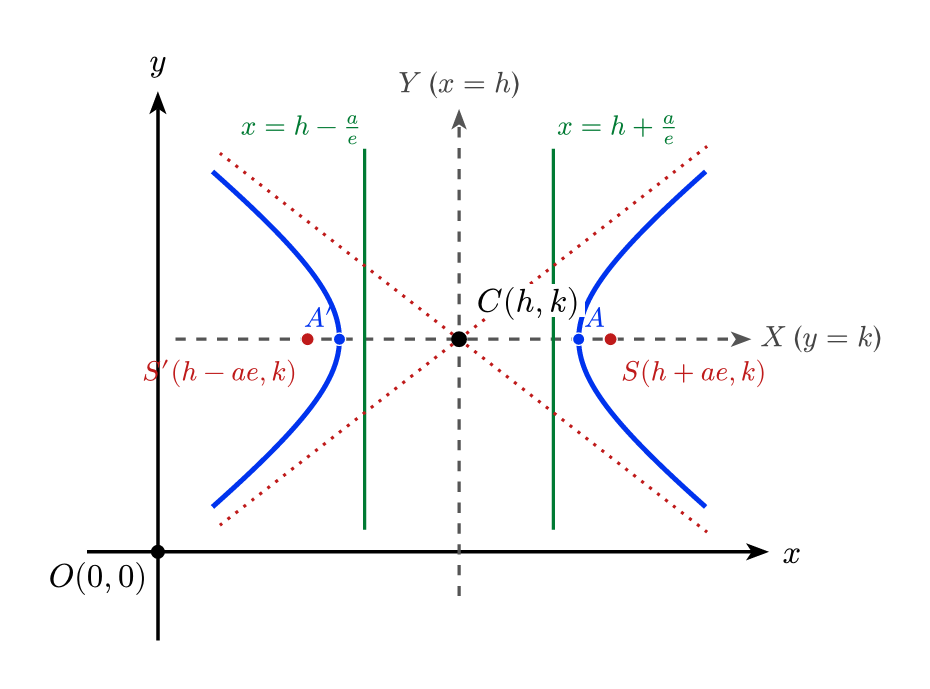
Suppose we take a standard hyperbola and shift its center from (0,0)(0, 0) to (h,k)(h, k) without rotating it, so its axes remain parallel to the coordinate axes.

By translating the origin to (h,k)(h, k) via the substitution

X=x−h,Y=y−kX = x - h, \qquad Y = y - k

every standard formula in (X,Y)(X, Y) carries over directly to (x,y)(x, y).

Shifted horizontal hyperbola with translated axes X and Y, center C(h,k), vertices, foci, directrices, and asymptotes

Case I: Shifted Horizontal Hyperbola§

When the transverse axis is parallel to the xx-axis, the equation is

(x−h)2a2−(y−k)2b2=1(a>0,  b>0)\frac{(x - h)^2}{a^2} - \frac{(y - k)^2}{b^2} = 1 \qquad (a > 0,\; b > 0)

Comparing with the standard horizontal hyperbola X2a2−Y2b2=1\frac{X^2}{a^2} - \frac{Y^2}{b^2} = 1:

  • Center: (X,Y)=(0,0)  ⟹  C(h,k)(X, Y) = (0, 0) \implies C(h, k)
  • Transverse Axis: Y=0  ⟹  y=kY = 0 \implies y = k, of length 2a2a
  • Conjugate Axis: X=0  ⟹  x=hX = 0 \implies x = h, of length 2b2b
  • Vertices: (X,Y)=(±a,0)  ⟹  A(h+a,k)(X, Y) = (\pm a, 0) \implies A(h + a, k) and A′(h−a,k)A'(h - a, k)
  • Eccentricity:
e=1+b2a2(e>1)e = \sqrt{1 + \frac{b^2}{a^2}} \quad (e > 1)
  • Foci: (X,Y)=(±ae,0)  ⟹  S(h+ae,k)(X, Y) = (\pm ae, 0) \implies S(h + ae, k) and S′(h−ae,k)S'(h - ae, k)
  • Directrices: X=±ae  ⟹  x=h±aeX = \pm \frac{a}{e} \implies x = h \pm \frac{a}{e}
  • Length of Latus Rectum: 2b2a\frac{2b^2}{a}
  • Ends of Latera Recta: (h±ae,  k±b2a)\left(h \pm ae,\; k \pm \frac{b^2}{a}\right)
  • Asymptotes: Xa±Yb=0  ⟹  y−k=±ba(x−h)\frac{X}{a} \pm \frac{Y}{b} = 0 \implies y - k = \pm \frac{b}{a}(x - h)

Case II: Shifted Vertical Hyperbola§

When the transverse axis is parallel to the yy-axis, the (y−k)2(y - k)^2 term is positive and the (x−h)2(x - h)^2 term is negative:

(y−k)2b2−(x−h)2a2=1(a>0,  b>0)\frac{(y - k)^2}{b^2} - \frac{(x - h)^2}{a^2} = 1 \qquad (a > 0,\; b > 0)

Comparing with the standard vertical hyperbola Y2b2−X2a2=1\frac{Y^2}{b^2} - \frac{X^2}{a^2} = 1:

  • Center: C(h,k)C(h, k)
  • Transverse Axis: X=0  ⟹  x=hX = 0 \implies x = h, of length 2b2b
  • Conjugate Axis: Y=0  ⟹  y=kY = 0 \implies y = k, of length 2a2a
  • Vertices: (X,Y)=(0,±b)  ⟹  B(h,k+b)(X, Y) = (0, \pm b) \implies B(h, k + b) and B′(h,k−b)B'(h, k - b)
  • Eccentricity:
e=1+a2b2(e>1)e = \sqrt{1 + \frac{a^2}{b^2}} \quad (e > 1)
  • Foci: (X,Y)=(0,±be)  ⟹  S(h,k+be)(X, Y) = (0, \pm be) \implies S(h, k + be) and S′(h,k−be)S'(h, k - be)
  • Directrices: Y=±be  ⟹  y=k±beY = \pm \frac{b}{e} \implies y = k \pm \frac{b}{e}
  • Length of Latus Rectum: 2a2b\frac{2a^2}{b}
  • Ends of Latera Recta: (h±a2b,  k±be)\left(h \pm \frac{a^2}{b},\; k \pm be\right)
  • Asymptotes: Yb±Xa=0  ⟹  y−k=±ba(x−h)\frac{Y}{b} \pm \frac{X}{a} = 0 \implies y - k = \pm \frac{b}{a}(x - h)

Conjugate of a Shifted Hyperbola: Just as at the origin, replacing 11 on the right-hand side by −1-1 turns a shifted horizontal hyperbola into its shifted conjugate vertical hyperbola (and vice versa), sharing the exact same center (h,k)(h, k) and asymptotes y−k=±ba(x−h)y - k = \pm \frac{b}{a}(x - h).


2. Reduction of General Axis-Parallel Equations (Completing Squares)§

Any hyperbola whose axes are parallel to the coordinate axes has a second-degree equation with no xyxy-term:

Ax2+By2+2gx+2fy+c=0(AB<0)Ax^2 + By^2 + 2gx + 2fy + c = 0 \qquad (AB < 0)

Notice the condition AB<0AB < 0: the coefficients of x2x^2 and y2y^2 must have opposite signs (whereas for an ellipse they have the same sign).

To identify the hyperbola, complete the squares in xx and yy:

A(x+gA)2+B(y+fB)2=Δ′A\left(x + \frac{g}{A}\right)^2 + B\left(y + \frac{f}{B}\right)^2 = \Delta'

where Δ′=g2A+f2B−c\Delta' = \frac{g^2}{A} + \frac{f^2}{B} - c.

Suppose A>0A > 0 and B<0B < 0. Depending on the sign of Δ′\Delta', three distinct outcomes occur:

  1. If Δ′>0\Delta' > 0: Dividing both sides by Δ′\Delta' keeps the xx-term positive and the yy-term negative, giving a shifted horizontal hyperbola.
  2. If Δ′<0\Delta' < 0: Dividing both sides by the negative number Δ′\Delta' flips the signs of both terms—making the (y−k)2(y - k)^2 term positive and the (x−h)2(x - h)^2 term negative! This gives a shifted vertical hyperbola. (Be careful: for an ellipse, Δ′<0\Delta' < 0 meant an imaginary curve, but for a hyperbola, Δ′<0\Delta' < 0 is a perfectly real vertical hyperbola!)
  3. If Δ′=0\Delta' = 0: The equation factors into two linear equations, representing a pair of intersecting straight lines (a degenerate hyperbola consisting only of its asymptotes).

3. Examples on Shifted Horizontal and Vertical Hyperbolas§

Example 1: Shifted Horizontal Hyperbola via Completing Squares§

Reduce the equation 9x2−16y2−36x−32y−124=09x^2 - 16y^2 - 36x - 32y - 124 = 0 to standard form and find its center, vertices, eccentricity, foci, directrices, length of latus rectum, and asymptotes.

Solution:

Group the xx-terms and yy-terms together and move the constant to the right-hand side:

9(x2−4x)−16(y2+2y)=1249(x^2 - 4x) - 16(y^2 + 2y) = 124

Complete the squares inside each bracket:

9[(x−2)2−4]−16[(y+1)2−1]=1249\left[(x - 2)^2 - 4\right] - 16\left[(y + 1)^2 - 1\right] = 124 9(x−2)2−36−16(y+1)2+16=1249(x - 2)^2 - 36 - 16(y + 1)^2 + 16 = 124 9(x−2)2−16(y+1)2=1449(x - 2)^2 - 16(y + 1)^2 = 144

Divide both sides by 144144:

(x−2)216−(y+1)29=1\frac{(x - 2)^2}{16} - \frac{(y + 1)^2}{9} = 1

Since the (x−2)2(x - 2)^2 term is positive, this is a shifted horizontal hyperbola with:

  • h=2,  k=−1h = 2,\; k = -1
  • a2=16  ⟹  a=4a^2 = 16 \implies a = 4
  • b2=9  ⟹  b=3b^2 = 9 \implies b = 3

Now compute the remaining parameters:

  • Center: C(2,−1)C(2, -1)
  • Transverse Axis: y=−1y = -1 (length 2a=82a = 8); Conjugate Axis: x=2x = 2 (length 2b=62b = 6)
  • Vertices: (h±a,k)=(2±4,−1)(h \pm a, k) = (2 \pm 4, -1), i.e., A(6,−1)A(6, -1) and A′(−2,−1)A'(-2, -1)
  • Eccentricity:
e=1+b2a2=1+916=54e = \sqrt{1 + \frac{b^2}{a^2}} = \sqrt{1 + \frac{9}{16}} = \frac{5}{4}
  • Foci: Since ae=4⋅54=5ae = 4 \cdot \frac{5}{4} = 5, the foci are (h±ae,k)=(2±5,−1)(h \pm ae, k) = (2 \pm 5, -1), i.e., S(7,−1)S(7, -1) and S′(−3,−1)S'(-3, -1)
  • Directrices: x=h±ae=2±165x = h \pm \frac{a}{e} = 2 \pm \frac{16}{5}, i.e., x=265x = \frac{26}{5} and x=−65x = -\frac{6}{5}
  • Length of Latus Rectum: 2b2a=2(9)4=92\frac{2b^2}{a} = \frac{2(9)}{4} = \frac{9}{2}
  • Asymptotes:
y+1=±34(x−2)y + 1 = \pm \frac{3}{4}(x - 2)

Example 2: Shifted Vertical Hyperbola via Completing Squares (Sign-Flip Case)§

Find the center, eccentricity, vertices, foci, directrices, latus rectum, and asymptotes of the hyperbola

4x2−9y2−16x−54y−29=04x^2 - 9y^2 - 16x - 54y - 29 = 0

Solution:

Notice that x2x^2 has a positive coefficient (+4+4) and y2y^2 has a negative coefficient (−9-9), so do not jump to conclusions about orientation before completing the square!

Group the xx-terms and yy-terms:

4(x2−4x)−9(y2+6y)=294(x^2 - 4x) - 9(y^2 + 6y) = 29

Complete the squares:

4[(x−2)2−4]−9[(y+3)2−9]=294\left[(x - 2)^2 - 4\right] - 9\left[(y + 3)^2 - 9\right] = 29 4(x−2)2−16−9(y+3)2+81=294(x - 2)^2 - 16 - 9(y + 3)^2 + 81 = 29 4(x−2)2−9(y+3)2=29+16−81=−364(x - 2)^2 - 9(y + 3)^2 = 29 + 16 - 81 = -36

Because the right-hand side is negative (−36-36), dividing by −36-36 flips the signs of both terms:

(y+3)24−(x−2)29=1\frac{(y + 3)^2}{4} - \frac{(x - 2)^2}{9} = 1

Now the (y+3)2(y + 3)^2 term is positive, so this is a shifted vertical hyperbola with:

  • h=2,  k=−3h = 2,\; k = -3
  • b2=4  ⟹  b=2b^2 = 4 \implies b = 2 (semi-transverse axis)
  • a2=9  ⟹  a=3a^2 = 9 \implies a = 3 (semi-conjugate axis)

Computing all features:

  • Center: C(2,−3)C(2, -3)
  • Transverse Axis: x=2x = 2 (length 2b=42b = 4); Conjugate Axis: y=−3y = -3 (length 2a=62a = 6)
  • Vertices: (h,k±b)=(2,−3±2)(h, k \pm b) = (2, -3 \pm 2), i.e., B(2,−1)B(2, -1) and B′(2,−5)B'(2, -5)
  • Eccentricity:
e=1+a2b2=1+94=132e = \sqrt{1 + \frac{a^2}{b^2}} = \sqrt{1 + \frac{9}{4}} = \frac{\sqrt{13}}{2}
  • Foci: Since be=2⋅132=13be = 2 \cdot \frac{\sqrt{13}}{2} = \sqrt{13}, the foci are (2,−3±13)(2, -3 \pm \sqrt{13})
  • Directrices: y=k±be=−3±413y = k \pm \frac{b}{e} = -3 \pm \frac{4}{\sqrt{13}}
  • Length of Latus Rectum: 2a2b=2(9)2=9\frac{2a^2}{b} = \frac{2(9)}{2} = 9
  • Asymptotes:
y+3=±23(x−2)y + 3 = \pm \frac{2}{3}(x - 2)

Example 3: Constructing a Shifted Hyperbola from Geometric Data§

Find the equation of the hyperbola whose foci are (2,7)(2, 7) and (2,−3)(2, -3), and whose transverse axis has length 66. Also find its asymptotes.

Solution:

  1. Orientation and Center: Both foci (2,7)(2, 7) and (2,−3)(2, -3) share the same xx-coordinate (x=2x = 2), so the transverse axis is vertical along x=2x = 2. The center C(h,k)C(h, k) is the midpoint of the foci:
C(h,k)=(2+22,  7+(−3)2)=(2,2)C(h, k) = \left(\frac{2 + 2}{2},\; \frac{7 + (-3)}{2}\right) = (2, 2)
  1. Parameters bb, ee, and aa:
    • The transverse axis has length 2b=6  ⟹  b=32b = 6 \implies b = 3.
    • The distance between the foci is SS′=2be=7−(−3)=10  ⟹  be=5SS' = 2be = 7 - (-3) = 10 \implies be = 5.
    • Therefore, e=53e = \frac{5}{3}, and using a2=b2(e2−1)a^2 = b^2(e^2 - 1) (or b2e2=b2+a2b^2 e^2 = b^2 + a^2):
a2=(be)2−b2=52−32=25−9=16  ⟹  a=4a^2 = (be)^2 - b^2 = 5^2 - 3^2 = 25 - 9 = 16 \implies a = 4
  1. Equation of the Hyperbola:
(y−2)29−(x−2)216=1\frac{(y - 2)^2}{9} - \frac{(x - 2)^2}{16} = 1
  1. Asymptotes: Setting the right-hand side to 00:
(y−2)29−(x−2)216=0  ⟹  y−2=±34(x−2)\frac{(y - 2)^2}{9} - \frac{(x - 2)^2}{16} = 0 \implies y - 2 = \pm \frac{3}{4}(x - 2)

4. Oblique (Tilted) Hyperbolas and Geometric Invariants§

When a hyperbola's transverse axis is neither horizontal nor vertical, its general second-degree equation

ax2+2hxy+by2+2gx+2fy+c=0ax^2 + 2hxy + by^2 + 2gx + 2fy + c = 0

contains an xyxy-term (h≠0h \neq 0), and satisfies the hyperbola condition h2−ab>0h^2 - ab > 0 (with Δ≠0\Delta \neq 0). One way to handle such equations is to rotate the coordinate axes through an angle θ\theta satisfying tan⁡2θ=2ha−b\tan 2\theta = \frac{2h}{a - b} to eliminate the xyxy-term.

However, when you are given geometric information (such as a focus, vertex, center, directrix, or eccentricity) for an oblique hyperbola, rotating axes is rarely necessary. Instead, we use coordinate-free geometric invariants along the transverse axis!

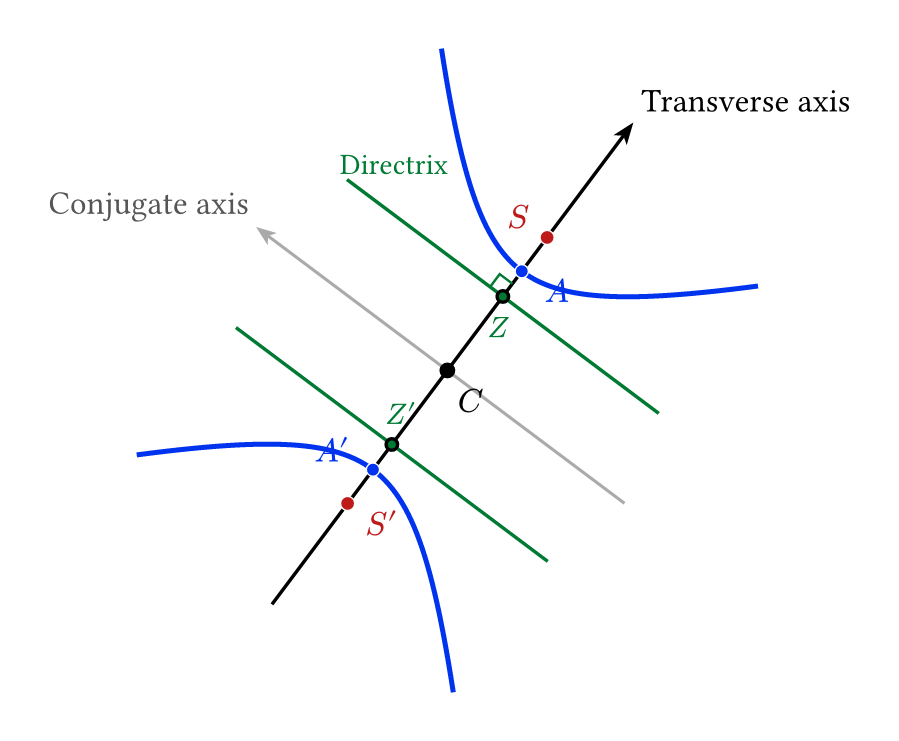
Oblique hyperbola showing collinearity of S', A', Z', C, Z, A, S along the transverse axis and perpendicular directrices

Key Geometric Invariants Along the Transverse Axis§

Because e>1e > 1 for a hyperbola, we always have ae<a<ae\frac{a}{e} < a < ae. As a result, the seven key points on the transverse axis appear in the fixed symmetric order:

S′ — A′ — Z′ — C — Z — A — SS' \text{ — } A' \text{ — } Z' \text{ — } C \text{ — } Z \text{ — } A \text{ — } S

(Notice how this differs from an ellipse, where e<1e < 1 puts the foci inside the vertices!)

From this geometry, the following coordinate-free relations hold regardless of tilt:

  1. Distances from the Center CC:

    • Distance to either foot of the directrix: CZ=CZ′=aeCZ = CZ' = \frac{a}{e}
    • Distance to either vertex: CA=CA′=aCA = CA' = a
    • Distance to either focus: CS=CS′=aeCS = CS' = ae
    • Crucial product: CS⋅CZ=(ae)(ae)=a2CS \cdot CZ = (ae)\left(\frac{a}{e}\right) = a^2
  2. Distances Between Focus and Vertices:

    • Distance from a focus to the nearer vertex: SA=ae−a=a(e−1)SA = ae - a = a(e - 1)
    • Distance from a focus to the farther vertex: S′A=ae+a=a(e+1)S'A = ae + a = a(e + 1)
    • Semi-conjugate axis relation: b2=a2(e2−1)=a(e−1)⋅a(e+1)=SA⋅S′Ab^2 = a^2(e^2 - 1) = a(e - 1)\cdot a(e + 1) = SA \cdot S'A
  3. Vector Stepping Along the Axis: If u^=(cos⁡α,sin⁡α)\hat{u} = (\cos\alpha, \sin\alpha) is the unit vector pointing along the transverse axis from CC toward SS, then any point at signed distance dd from CC is simply

P⃗=C⃗+d u^\vec{P} = \vec{C} + d\,\hat{u}
  1. Directrices: Each directrix is perpendicular to the transverse axis u^\hat{u} and passes through ZZ or Z′Z'. If u^=(ux,uy)\hat{u} = (u_x, u_y), any line perpendicular to u^\hat{u} has the form uxx+uyy=constantu_x x + u_y y = \text{constant}.

  2. Cartesian Equation Directly from Definition: Once a focus S(x0,y0)S(x_0, y_0), its corresponding directrix lx+my+n=0lx + my + n = 0, and the eccentricity ee are known, the equation of the hyperbola is immediately obtained from SP=e⋅PMSP = e \cdot PM:

(x−x0)2+(y−y0)2=e2(lx+my+n)2l2+m2(x - x_0)^2 + (y - y_0)^2 = e^2 \frac{(lx + my + n)^2}{l^2 + m^2}

Let us apply these invariants in two complete oblique hyperbola problems.


Example 4: Oblique Hyperbola from Focus, Nearer Vertex, and Eccentricity§

A hyperbola has focus S(10,13)S(10, 13), nearer vertex A(4,5)A(4, 5), and eccentricity e=2e = 2. Geometrically determine its center, the other vertex, the other focus, the equations of its transverse and conjugate axes, the equations of both directrices, and the length of its latus rectum.

Solution:

  1. Find the unit direction vector u^\hat{u} and semi-transverse axis aa: The vector from the nearer vertex A(4,5)A(4, 5) to the focus S(10,13)S(10, 13) points along the transverse axis:
AS→=(10−4,  13−5)=(6,8)\overrightarrow{AS} = (10 - 4,\; 13 - 5) = (6, 8)

Its length is

AS=62+82=36+64=10AS = \sqrt{6^2 + 8^2} = \sqrt{36 + 64} = 10

Since AA is the vertex nearer to SS, the distance ASAS equals a(e−1)a(e - 1):

a(2−1)=10  ⟹  a=10a(2 - 1) = 10 \implies a = 10

The unit vector along the transverse axis (pointing from CC toward AA and SS) is

u^=110(6,8)=(35,  45)\hat{u} = \frac{1}{10}(6, 8) = \left(\frac{3}{5},\; \frac{4}{5}\right)

Also, ae=10(2)=20ae = 10(2) = 20 and b2=a2(e2−1)=100(4−1)=300  ⟹  b=103b^2 = a^2(e^2 - 1) = 100(4 - 1) = 300 \implies b = 10\sqrt{3}.

  1. Find the Center CC, Other Vertex A′A', and Other Focus S′S': Stepping backwards from AA by distance CA=a=10CA = a = 10 along −u^-\hat{u} gives the center CC:
C=A−10u^=(4,5)−(6,8)=(−2,−3)C = A - 10\hat{u} = (4, 5) - (6, 8) = (-2, -3)

By symmetry about CC:

  • Other vertex A′A': A′=C−10u^=(−2,−3)−(6,8)=(−8,−11)A' = C - 10\hat{u} = (-2, -3) - (6, 8) = (-8, -11)
  • Other focus S′S': S′=C−20u^=(−2,−3)−(12,16)=(−14,−19)S' = C - 20\hat{u} = (-2, -3) - (12, 16) = (-14, -19)
  1. Find the Transverse and Conjugate Axes:
    • Transverse axis: Passes through C(−2,−3)C(-2, -3) and A(4,5)A(4, 5), with slope 5−(−3)4−(−2)=86=43\frac{5 - (-3)}{4 - (-2)} = \frac{8}{6} = \frac{4}{3}:
y+3=43(x+2)  ⟹  4x−3y=1y + 3 = \frac{4}{3}(x + 2) \implies 4x - 3y = 1
  • Conjugate axis: Passes through C(−2,−3)C(-2, -3) and is perpendicular to the transverse axis, so its slope is −34-\frac{3}{4}:
y+3=−34(x+2)  ⟹  3x+4y=−18y + 3 = -\frac{3}{4}(x + 2) \implies 3x + 4y = -18
  1. Find Both Directrices: The distance from CC to the foot of each directrix is CZ=ae=102=5CZ = \frac{a}{e} = \frac{10}{2} = 5. Stepping ±5u^=±(3,4)\pm 5\hat{u} = \pm (3, 4) from C(−2,−3)C(-2, -3) gives the two feet:
Z=(−2,−3)+(3,4)=(1,1),Z′=(−2,−3)−(3,4)=(−5,−7)Z = (-2, -3) + (3, 4) = (1, 1), \qquad Z' = (-2, -3) - (3, 4) = (-5, -7)

Each directrix is perpendicular to u^=(35,45)\hat{u} = \left(\frac{3}{5}, \frac{4}{5}\right), so both have the form 3x+4y=k3x + 4y = k:

  • Directrix corresponding to SS (passing through Z(1,1)Z(1, 1)): 3(1)+4(1)=7  ⟹  3x+4y=73(1) + 4(1) = 7 \implies 3x + 4y = 7.
  • Directrix corresponding to S′S' (passing through Z′(−5,−7)Z'(-5, -7)): 3(−5)+4(−7)=−43  ⟹  3x+4y=−433(-5) + 4(-7) = -43 \implies 3x + 4y = -43.
  1. Length of the Latus Rectum:
Latus rectum=2b2a=2(300)10=60\text{Latus rectum} = \frac{2b^2}{a} = \frac{2(300)}{10} = 60

Example 5: Oblique Hyperbola from Center, One Focus, and Corresponding Directrix§

An oblique hyperbola has center C(1,2)C(1, 2), one focus at S(11,26)S(11, 26), and the corresponding directrix 5x+12y−79=05x + 12y - 79 = 0. Find its eccentricity, the lengths of its transverse and conjugate axes, the other focus, the other directrix, both vertices, the length of the latus rectum, and the Cartesian equation of the hyperbola.

Solution:

  1. Compute CS=aeCS = ae and CZ=aeCZ = \frac{a}{e}:
    • Distance from center C(1,2)C(1, 2) to focus S(11,26)S(11, 26):
ae=CS=(11−1)2+(26−2)2=102+242=676=26ae = CS = \sqrt{(11 - 1)^2 + (26 - 2)^2} = \sqrt{10^2 + 24^2} = \sqrt{676} = 26
  • Perpendicular distance from center C(1,2)C(1, 2) to the directrix 5x+12y−79=05x + 12y - 79 = 0:
ae=CZ=∣5(1)+12(2)−79∣52+122=∣5+24−79∣13=5013\frac{a}{e} = CZ = \frac{|5(1) + 12(2) - 79|}{\sqrt{5^2 + 12^2}} = \frac{|5 + 24 - 79|}{13} = \frac{50}{13}
  1. Find aa, ee, and bb: Multiply the two invariants to eliminate ee:
a2=(ae)(ae)=26⋅5013=100  ⟹  a=10a^2 = (ae)\left(\frac{a}{e}\right) = 26 \cdot \frac{50}{13} = 100 \implies a = 10

Now divide to find ee:

e=aea=2610=135e = \frac{ae}{a} = \frac{26}{10} = \frac{13}{5}

And find bb using b2=(ae)2−a2b^2 = (ae)^2 - a^2:

b2=262−102=676−100=576  ⟹  b=24b^2 = 26^2 - 10^2 = 676 - 100 = 576 \implies b = 24

Therefore, the transverse axis has length 2a=202a = 20 and the conjugate axis has length 2b=482b = 48.

  1. Find the Other Focus S′S' and Other Directrix:
    • Since C(1,2)C(1, 2) is the midpoint of SS′SS':
S′=2C−S=(2(1)−11,  2(2)−26)=(−9,−22)S' = 2C - S = (2(1) - 11,\; 2(2) - 26) = (-9, -22)
  • The other directrix is parallel to 5x+12y−79=05x + 12y - 79 = 0, so it has the form 5x+12y+λ=05x + 12y + \lambda = 0. Because C(1,2)C(1, 2) lies midway between the two parallel directrices, the signed value of 5x+12y+λ5x + 12y + \lambda at C(1,2)C(1, 2) must be the negative of 5(1)+12(2)−79=−505(1) + 12(2) - 79 = -50:
5(1)+12(2)+λ=+50  ⟹  29+λ=50  ⟹  λ=215(1) + 12(2) + \lambda = +50 \implies 29 + \lambda = 50 \implies \lambda = 21

So the other directrix is 5x+12y+21=05x + 12y + 21 = 0.

  1. Find Both Vertices AA and A′A': The unit vector from C(1,2)C(1, 2) toward S(11,26)S(11, 26) is
u^=126(11−1,  26−2)=126(10,24)=(513,  1213)\hat{u} = \frac{1}{26}(11 - 1,\; 26 - 2) = \frac{1}{26}(10, 24) = \left(\frac{5}{13},\; \frac{12}{13}\right)

Stepping ±au^=±10(513,1213)=±(5013,12013)\pm a\hat{u} = \pm 10\left(\frac{5}{13}, \frac{12}{13}\right) = \pm \left(\frac{50}{13}, \frac{120}{13}\right) from C(1,2)C(1, 2):

A=(1+5013,  2+12013)=(6313,  14613),A′=(1−5013,  2−12013)=(−3713,  −9413)A = \left(1 + \frac{50}{13},\; 2 + \frac{120}{13}\right) = \left(\frac{63}{13},\; \frac{146}{13}\right), \qquad A' = \left(1 - \frac{50}{13},\; 2 - \frac{120}{13}\right) = \left(-\frac{37}{13},\; -\frac{94}{13}\right)
  1. Length of the Latus Rectum:
Latus rectum=2b2a=2(576)10=5765\text{Latus rectum} = \frac{2b^2}{a} = \frac{2(576)}{10} = \frac{576}{5}
  1. Cartesian Equation of the Hyperbola: Using SP2=e2⋅PM2SP^2 = e^2 \cdot PM^2 with S(11,26)S(11, 26), directrix 5x+12y−79=05x + 12y - 79 = 0, and e=135e = \frac{13}{5}:
(x−11)2+(y−26)2=(135)2(5x+12y−79)252+122(x - 11)^2 + (y - 26)^2 = \left(\frac{13}{5}\right)^2 \frac{(5x + 12y - 79)^2}{5^2 + 12^2}

Notice how 132=16913^2 = 169 cancels with 52+122=1695^2 + 12^2 = 169:

25[(x−11)2+(y−26)2]=(5x+12y−79)225\left[(x - 11)^2 + (y - 26)^2\right] = (5x + 12y - 79)^2

(Notice that expanding this produces an xyxy-term, confirming the hyperbola is genuinely tilted!)


5. Quick Reference Summary§

Feature Shifted Horizontal Hyperbola Shifted Vertical Hyperbola
Equation (x−h)2a2−(y−k)2b2=1\dfrac{(x - h)^2}{a^2} - \dfrac{(y - k)^2}{b^2} = 1 (y−k)2b2−(x−h)2a2=1\dfrac{(y - k)^2}{b^2} - \dfrac{(x - h)^2}{a^2} = 1
Center (h,k)(h, k) (h,k)(h, k)
Transverse Axis y=ky = k (length 2a2a) x=hx = h (length 2b2b)
Conjugate Axis x=hx = h (length 2b2b) y=ky = k (length 2a2a)
Vertices (h±a,  k)(h \pm a,\; k) (h,  k±b)(h,\; k \pm b)
Eccentricity (ee) 1+b2a2\sqrt{1 + \dfrac{b^2}{a^2}} 1+a2b2\sqrt{1 + \dfrac{a^2}{b^2}}
Foci (h±ae,  k)(h \pm ae,\; k) (h,  k±be)(h,\; k \pm be)
Directrices x=h±aex = h \pm \dfrac{a}{e} y=k±bey = k \pm \dfrac{b}{e}
Latus Rectum 2b2a\dfrac{2b^2}{a} 2a2b\dfrac{2a^2}{b}
Asymptotes y−k=±ba(x−h)y - k = \pm \dfrac{b}{a}(x - h) y−k=±ba(x−h)y - k = \pm \dfrac{b}{a}(x - h)
Section 4 of 15 · Hyperbola

Mark this section complete when you have worked through its proofs.