MatheramaMatherama
← Hyperbola
Hyperbola·Section 12·19 min read

Chord with a Given Midpoint, Diameters, and Conjugate Diameters

In previous sections, we studied tangents, normals, and chords of contact. We now turn to a different question: given a point M(x1,y1)M(x_1, y_1) in the plane, what is the equation of the chord of a hyperbola whose midpoint is MM?

Answering this single question leads naturally to the concept of diameters (the loci of midpoints of parallel chords) and conjugate diameters—where the hyperbola reveals a striking partnership with its conjugate hyperbola and asymptotes.


Chord with a Given Midpoint§

Consider the standard horizontal hyperbola:

S≡x2a2−y2b2−1=0S \equiv \frac{x^2}{a^2} - \frac{y^2}{b^2} - 1 = 0

We want the equation of the chord PQPQ whose midpoint is M(x1,y1)M(x_1, y_1).


Derivation Using Chord Endpoints§

Let the endpoints of the chord be P(α1,β1)P(\alpha_1, \beta_1) and Q(α2,β2)Q(\alpha_2, \beta_2). Since both lie on the hyperbola:

α12a2−β12b2=1⋯(1)\frac{\alpha_1^2}{a^2} - \frac{\beta_1^2}{b^2} = 1 \qquad \cdots (1) α22a2−β22b2=1⋯(2)\frac{\alpha_2^2}{a^2} - \frac{\beta_2^2}{b^2} = 1 \qquad \cdots (2)

Subtracting (2) from (1) and factoring the differences of squares:

(α1−α2)(α1+α2)a2−(β1−β2)(β1+β2)b2=0\frac{(\alpha_1 - \alpha_2)(\alpha_1 + \alpha_2)}{a^2} - \frac{(\beta_1 - \beta_2)(\beta_1 + \beta_2)}{b^2} = 0

Since M(x1,y1)M(x_1, y_1) is the midpoint of PQPQ, we have α1+α2=2x1\alpha_1 + \alpha_2 = 2x_1 and β1+β2=2y1\beta_1 + \beta_2 = 2y_1. Substituting these gives the slope mm of the chord PQPQ:

m=β1−β2α1−α2=b2(α1+α2)a2(β1+β2)=b2x1a2y1(y1≠0)m = \frac{\beta_1 - \beta_2}{\alpha_1 - \alpha_2} = \frac{b^2(\alpha_1 + \alpha_2)}{a^2(\beta_1 + \beta_2)} = \frac{b^2 x_1}{a^2 y_1} \qquad (y_1 \neq 0)

Using the point-slope form through M(x1,y1)M(x_1, y_1):

y−y1=b2x1a2y1(x−x1)y - y_1 = \frac{b^2 x_1}{a^2 y_1}(x - x_1)

Dividing both sides by b2b^2 and rearranging:

yy1−y12b2=xx1−x12a2  ⟹  xx1a2−yy1b2=x12a2−y12b2\frac{y y_1 - y_1^2}{b^2} = \frac{x x_1 - x_1^2}{a^2} \implies \frac{x x_1}{a^2} - \frac{y y_1}{b^2} = \frac{x_1^2}{a^2} - \frac{y_1^2}{b^2}

Subtracting 11 from both sides expresses this in the universal conic notation:

T=S1T = S_1

where T≡xx1a2−yy1b2−1T \equiv \frac{x x_1}{a^2} - \frac{y y_1}{b^2} - 1 and S1≡x12a2−y12b2−1S_1 \equiv \frac{x_1^2}{a^2} - \frac{y_1^2}{b^2} - 1. (Notice that if y1=0y_1 = 0 and x1≠0x_1 \neq 0, the equation T=S1T = S_1 reduces cleanly to the vertical chord x=x1x = x_1.)

Rectangular Hyperbola Form (xy=c2xy = c^2):
Applying T=S1T = S_1 to xy−c2=0xy - c^2 = 0 replaces xyxy with xy1+x1y2\frac{x y_1 + x_1 y}{2}: xy1+x1y2−c2=x1y1−c2  ⟹  xy1+x1y=2x1y1\frac{x y_1 + x_1 y}{2} - c^2 = x_1 y_1 - c^2 \implies x y_1 + x_1 y = 2 x_1 y_1.
Dividing by x1y1x_1 y_1 (for x1,y1≠0x_1, y_1 \neq 0) gives the ultra-compact form: xx1+yy1=2\frac{x}{x_1} + \frac{y}{y_1} = 2.

Same-Branch and Cross-Branch Chords with Given Midpoints

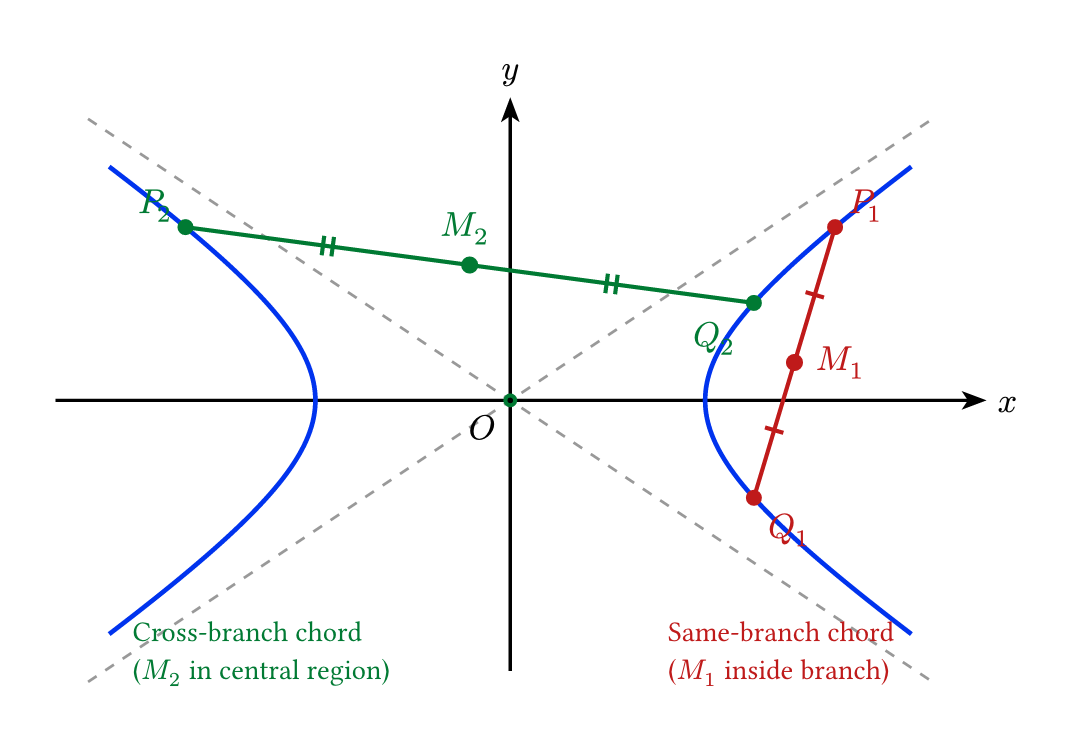
(Notice from the figure that a chord of a hyperbola bisected at MM can either connect two points on the same branch, or bridge across from one branch to the opposite branch. In Example 2 below, we derive the exact region of the plane where real midpoint chords exist.)


Parallel Chords and the Definition of a Diameter§

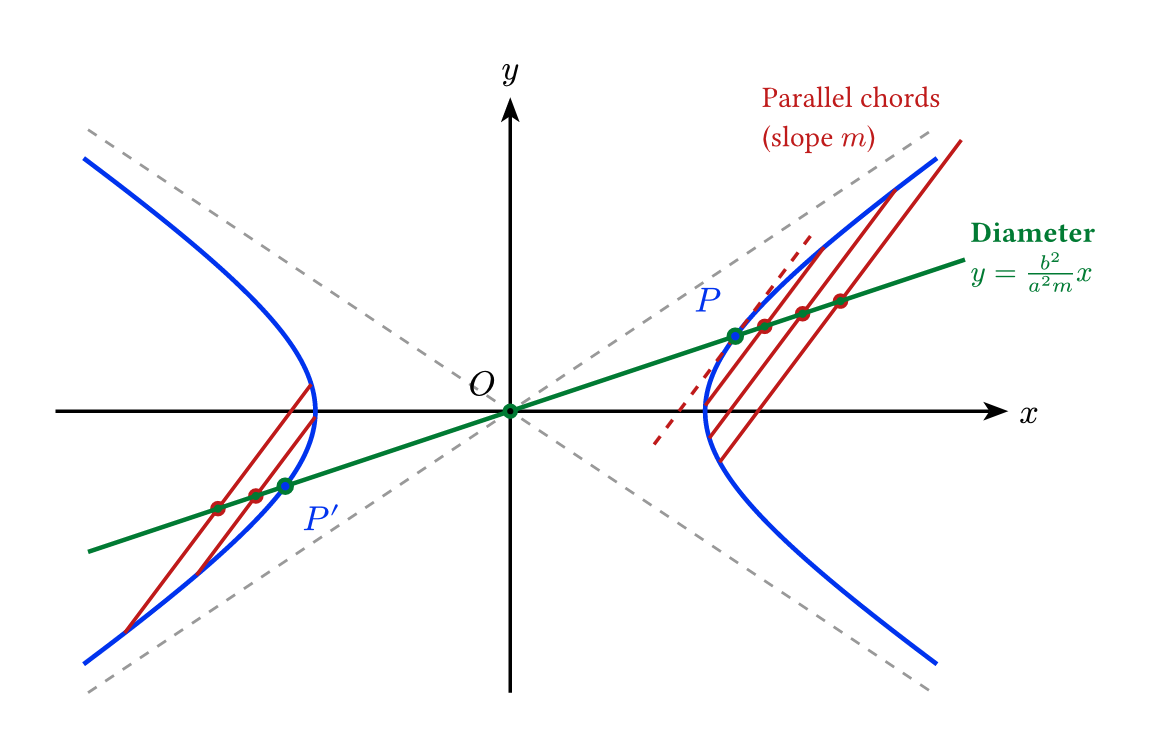
Consider a family of parallel chords of the hyperbola x2a2−y2b2=1\frac{x^2}{a^2} - \frac{y^2}{b^2} = 1, all having the same fixed slope m≠0m \neq 0.


Definition and Equation of a Diameter§

The locus of the midpoints of a system of parallel chords of a conic is called a diameter of the conic.

From our derivation above, if M(h,k)M(h, k) is the midpoint of a chord of slope mm, then:

m=b2ha2k  ⟹  k=b2a2mhm = \frac{b^2 h}{a^2 k} \implies k = \frac{b^2}{a^2 m} h

Replacing (h,k)(h, k) by (x,y)(x, y), the equation of the diameter bisecting all chords of slope mm is:

y=b2a2mxy = \frac{b^2}{a^2 m} x

Diameter Bisecting a Family of Parallel Chords of a Hyperbola

Notice two immediate facts:

  • Every diameter of a hyperbola is a straight line passing through the center O(0,0)O(0, 0).
  • Let m′=b2a2mm' = \frac{b^2}{a^2 m} be the slope of the diameter. If ∣m∣>ba|m| > \frac{b}{a} (so the parallel chords cut a single branch), then ∣m′∣=b2a2∣m∣<ba|m'| = \frac{b^2}{a^2 |m|} < \frac{b}{a}, meaning the diameter intersects the hyperbola in two real points PP and P′P'. Conversely, if ∣m∣<ba|m| < \frac{b}{a} (so the parallel chords bridge opposite branches), then ∣m′∣>ba|m'| > \frac{b}{a}, meaning the diameter misses the hyperbola and instead intersects the conjugate hyperbola!

Conjugate Diameters§

Suppose a diameter y=m1xy = m_1 x bisects all chords parallel to a second diameter y=m2xy = m_2 x. From the formula above:

m1=b2a2m2  ⟹  m1m2=b2a2m_1 = \frac{b^2}{a^2 m_2} \implies m_1 m_2 = \frac{b^2}{a^2}

Because this relation is completely symmetric in m1m_1 and m2m_2, it follows automatically that y=m2xy = m_2 x also bisects all chords parallel to y=m1xy = m_1 x!

Definition:
Two diameters of a hyperbola are called conjugate diameters if each bisects all chords parallel to the other. Their slopes m1m_1 and m2m_2 satisfy: m1m2=b2a2m_1 m_2 = \frac{b^2}{a^2}.


Crucial Geometric Contrast with the Ellipse§

For an ellipse, conjugate diameters satisfy m1m2=−b2a2<0m_1 m_2 = -\frac{b^2}{a^2} < 0, so their slopes have opposite signs (one lies in Quadrants I–III and the other in Quadrants II–IV), and both meet the ellipse.

For a hyperbola, m1m2=+b2a2>0m_1 m_2 = +\frac{b^2}{a^2} > 0, which produces three striking consequences:

  1. Same Quadrants: m1m_1 and m2m_2 always have the same sign—both conjugate diameters lie in the same pair of opposite quadrants.
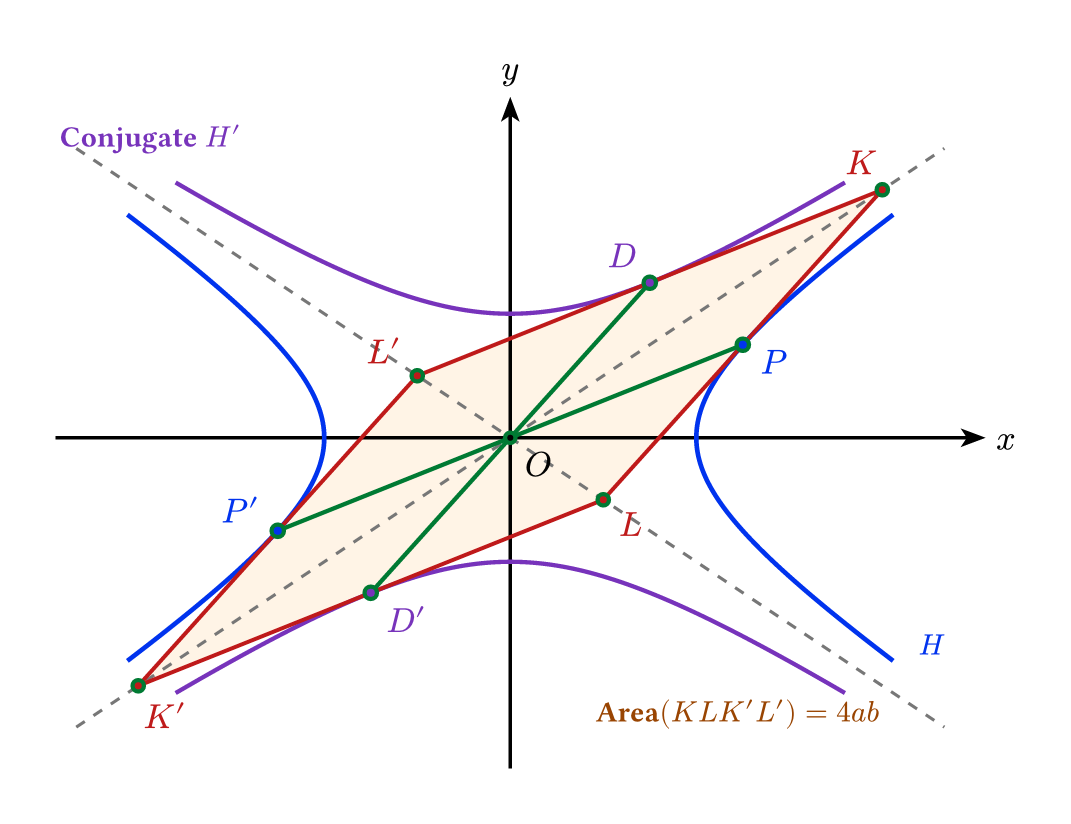
  2. Partnership with the Conjugate Hyperbola: Since ∣m1∣⋅∣m2∣=(ba)2|m_1| \cdot |m_2| = \left(\frac{b}{a}\right)^2, if ∣m1∣<ba|m_1| < \frac{b}{a}, then necessarily ∣m2∣>ba|m_2| > \frac{b}{a}. Therefore, of any pair of conjugate diameters, exactly one intersects the hyperbola HH (in real points P,P′P, P'), while the other misses HH and intersects the conjugate hyperbola H′:x2a2−y2b2=−1H': \frac{x^2}{a^2} - \frac{y^2}{b^2} = -1 (in real points D,D′D, D').
  3. Self-Conjugate Diameters (The Asymptotes): Setting m1=m2=mm_1 = m_2 = m gives m2=b2a2  ⟹  m=±bam^2 = \frac{b^2}{a^2} \implies m = \pm \frac{b}{a}. Thus, the asymptotes are the limiting self-conjugate diameters—each lies midway (in slope-product) between every pair of conjugate diameters!

Parametric Coordinates of Extremities§

Let the diameter PP′PP' meet the hyperbola H:x2a2−y2b2=1H: \frac{x^2}{a^2} - \frac{y^2}{b^2} = 1 at:

P(asec⁡θ,  btan⁡θ)andP′(−asec⁡θ,  −btan⁡θ)P(a\sec\theta,\; b\tan\theta) \qquad \text{and} \qquad P'(-a\sec\theta,\; -b\tan\theta)

Its slope is:

m1=btan⁡θasec⁡θ=basin⁡θm_1 = \frac{b\tan\theta}{a\sec\theta} = \frac{b}{a}\sin\theta

The conjugate diameter DD′DD' must therefore have slope:

m2=b2a2m1=basin⁡θm_2 = \frac{b^2}{a^2 m_1} = \frac{b}{a\sin\theta}

To find where y=basin⁡θxy = \frac{b}{a\sin\theta}x intersects the conjugate hyperbola H′:y2b2−x2a2=1H': \frac{y^2}{b^2} - \frac{x^2}{a^2} = 1, substitute yb=xasin⁡θ\frac{y}{b} = \frac{x}{a\sin\theta}:

x2a2sin⁡2θ−x2a2=1  ⟹  x2a2⋅1−sin⁡2θsin⁡2θ=1  ⟹  x2a2cot⁡2θ=1\frac{x^2}{a^2\sin^2\theta} - \frac{x^2}{a^2} = 1 \implies \frac{x^2}{a^2}\cdot\frac{1 - \sin^2\theta}{\sin^2\theta} = 1 \implies \frac{x^2}{a^2}\cot^2\theta = 1

Hence x=±atan⁡θx = \pm a\tan\theta, and y=basin⁡θ(±atan⁡θ)=±bsec⁡θy = \frac{b}{a\sin\theta}(\pm a\tan\theta) = \pm b\sec\theta. Choosing DD in the same quadrant as PP:

D(atan⁡θ,  bsec⁡θ)andD′(−atan⁡θ,  −bsec⁡θ)D(a\tan\theta,\; b\sec\theta) \qquad \text{and} \qquad D'(-a\tan\theta,\; -b\sec\theta)

Notice how effortless this is to remember: to go from PP on HH to its conjugate extremity DD on H′H', simply swap sec⁡θ\sec\theta and tan⁡θ\tan\theta!


Four Invariant Theorems of Conjugate Diameters§

Let CPCP and CDCD be any pair of conjugate semi-diameters of x2a2−y2b2=1\frac{x^2}{a^2} - \frac{y^2}{b^2} = 1, with C=O(0,0)C = O(0, 0), P(asec⁡θ,btan⁡θ)P(a\sec\theta, b\tan\theta) on HH, and D(atan⁡θ,bsec⁡θ)D(a\tan\theta, b\sec\theta) on H′H'.

Conjugate Diameters and Circumscribed Parallelogram of a Hyperbola


Property 1: Difference of Squares of Conjugate Semi-Diameters Is Constant§

Statement:
CP2−CD2=a2−b2CP^2 - CD^2 = a^2 - b^2 (constant, independent of θ\theta).

Proof:

Compute CP2CP^2 and CD2CD^2 directly from the parametric coordinates:

CP2=a2sec⁡2θ+b2tan⁡2θCP^2 = a^2\sec^2\theta + b^2\tan^2\theta CD2=a2tan⁡2θ+b2sec⁡2θCD^2 = a^2\tan^2\theta + b^2\sec^2\theta

Subtracting the second equation from the first:

CP2−CD2=a2(sec⁡2θ−tan⁡2θ)−b2(sec⁡2θ−tan⁡2θ)CP^2 - CD^2 = a^2(\sec^2\theta - \tan^2\theta) - b^2(\sec^2\theta - \tan^2\theta)

Since sec⁡2θ−tan⁡2θ=1\sec^2\theta - \tan^2\theta = 1:

CP2−CD2=a2−b2CP^2 - CD^2 = a^2 - b^2

This completes the proof. ■\blacksquare

Rectangular Hyperbola Special Case (a=ba = b):
When a=ba = b, CP2−CD2=0  ⟹  CP=CDCP^2 - CD^2 = 0 \implies CP = CD! In a rectangular hyperbola, every pair of conjugate diameters has equal length (and is symmetrically inclined to the asymptotes).


Property 2: Tangents at Extremities Are Parallel to the Conjugate Diameter§

Statement:
The tangents at P,P′P, P' (to HH) are parallel to DD′DD', and the tangents at D,D′D, D' (to H′H') are parallel to PP′PP'.

Proof:

The tangent at P(asec⁡θ,btan⁡θ)P(a\sec\theta, b\tan\theta) to HH is xsec⁡θa−ytan⁡θb=1\frac{x\sec\theta}{a} - \frac{y\tan\theta}{b} = 1, whose slope is:

mT,P=bsec⁡θatan⁡θ=basin⁡θ=mCDm_{T, P} = \frac{b\sec\theta}{a\tan\theta} = \frac{b}{a\sin\theta} = m_{CD}

The tangent at D(atan⁡θ,bsec⁡θ)D(a\tan\theta, b\sec\theta) to H′:y2b2−x2a2=1H': \frac{y^2}{b^2} - \frac{x^2}{a^2} = 1 is ysec⁡θb−xtan⁡θa=1\frac{y\sec\theta}{b} - \frac{x\tan\theta}{a} = 1, whose slope is:

mT,D=btan⁡θasec⁡θ=basin⁡θ=mCPm_{T, D} = \frac{b\tan\theta}{a\sec\theta} = \frac{b}{a}\sin\theta = m_{CP}

Hence the tangents at P,P′P, P' are parallel to DD′DD', and the tangents at D,D′D, D' are parallel to PP′PP'. ■\blacksquare


Property 3: Circumscribed Parallelogram Has Vertices on Asymptotes and Constant Area 4ab§

Statement:
The parallelogram KLK′L′K L K' L' formed by the tangents at P,P′P, P' (to HH) and D,D′D, D' (to H′H') has all four vertices lying on the asymptotes, and its area is constant and equal to 4ab4ab.

Proof:

Because the sides of the parallelogram are parallel to CPCP and CDCD and pass through P,P′,D,D′P, P', D, D', the four vertices are the vector sums ±P±D\pm P \pm D. For example, vertex K=P+DK = P + D has coordinates:

K=(a(sec⁡θ+tan⁡θ),  b(sec⁡θ+tan⁡θ))K = \big(a(\sec\theta + \tan\theta),\; b(\sec\theta + \tan\theta)\big)

Clearly yKxK=ba\frac{y_K}{x_K} = \frac{b}{a}, so KK (and K′=−KK' = -K) lies on the asymptote y=baxy = \frac{b}{a}x. Similarly, vertex L=P−DL = P - D has coordinates:

L=(a(sec⁡θ−tan⁡θ),  −b(sec⁡θ−tan⁡θ))L = \big(a(\sec\theta - \tan\theta),\; -b(\sec\theta - \tan\theta)\big)

Clearly yLxL=−ba\frac{y_L}{x_L} = -\frac{b}{a}, so LL (and L′=−LL' = -L) lies on the asymptote y=−baxy = -\frac{b}{a}x!

The area of the full parallelogram KLK′L′K L K' L' is four times the area of the sub-parallelogram OPKDOPKD spanned by vectors OP⃗\vec{OP} and OD⃗\vec{OD}:

Area(KLK′L′)=4⋅∣xPyD−yPxD∣\text{Area}(K L K' L') = 4 \cdot |x_P y_D - y_P x_D|

Substituting P(asec⁡θ,btan⁡θ)P(a\sec\theta, b\tan\theta) and D(atan⁡θ,bsec⁡θ)D(a\tan\theta, b\sec\theta):

Area(KLK′L′)=4⋅∣(asec⁡θ)(bsec⁡θ)−(btan⁡θ)(atan⁡θ)∣=4ab(sec⁡2θ−tan⁡2θ)=4ab\text{Area}(K L K' L') = 4 \cdot \big|(a\sec\theta)(b\sec\theta) - (b\tan\theta)(a\tan\theta)\big| = 4ab(\sec^2\theta - \tan^2\theta) = 4ab

Notice that the quarter-triangle △OKL\triangle OKL is precisely the tangent-asymptote triangle from Section 11, whose area is 14(4ab)=ab\frac{1}{4}(4ab) = ab! ■\blacksquare


Property 4: Product of Focal Distances in Terms of Conjugate Semi-Diameter§

Statement:
If SS and S′S' are the foci of x2a2−y2b2=1\frac{x^2}{a^2} - \frac{y^2}{b^2} = 1, and CDCD is the semi-diameter conjugate to CPCP, then: SP⋅S′P=CD2SP \cdot S'P = CD^2.

Proof:

For P(asec⁡θ,btan⁡θ)P(a\sec\theta, b\tan\theta) on the right branch (sec⁡θ≥1\sec\theta \ge 1), the focal distances are SP=aesec⁡θ−aSP = ae\sec\theta - a and S′P=aesec⁡θ+aS'P = ae\sec\theta + a. Multiplying them:

SP⋅S′P=(aesec⁡θ−a)(aesec⁡θ+a)=a2e2sec⁡2θ−a2SP \cdot S'P = (ae\sec\theta - a)(ae\sec\theta + a) = a^2 e^2 \sec^2\theta - a^2

Substitute a2e2=a2+b2a^2 e^2 = a^2 + b^2:

SP⋅S′P=(a2+b2)sec⁡2θ−a2=a2(sec⁡2θ−1)+b2sec⁡2θ=a2tan⁡2θ+b2sec⁡2θ=CD2SP \cdot S'P = (a^2 + b^2)\sec^2\theta - a^2 = a^2(\sec^2\theta - 1) + b^2\sec^2\theta = a^2\tan^2\theta + b^2\sec^2\theta = CD^2

This completes the proof. ■\blacksquare


Worked Examples§


Example 1: Finding a Chord Bisected at a Given Point§

Find the equation of the chord of:

  1. The hyperbola x216−y29=1\frac{x^2}{16} - \frac{y^2}{9} = 1 bisected at M(5,1)M(5, 1).
  2. The rectangular hyperbola xy=12xy = 12 bisected at M(4,5)M(4, 5).

Solution:

1. Standard hyperbola x216−y29=1\frac{x^2}{16} - \frac{y^2}{9} = 1 with M(5,1)M(5, 1):

Applying the midpoint-chord formula T=S1T = S_1 with (x1,y1)=(5,1)(x_1, y_1) = (5, 1):

5x16−y9=5216−129=2516−19=209144\frac{5x}{16} - \frac{y}{9} = \frac{5^2}{16} - \frac{1^2}{9} = \frac{25}{16} - \frac{1}{9} = \frac{209}{144}

Multiplying through by 144144:

45x−16y=20945x - 16y = 209

2. Rectangular hyperbola xy=12xy = 12 with M(4,5)M(4, 5):

Using the midpoint-chord formula xx1+yy1=2\frac{x}{x_1} + \frac{y}{y_1} = 2 for xy=c2xy = c^2:

x4+y5=2  ⟹  5x+4y=40\frac{x}{4} + \frac{y}{5} = 2 \implies 5x + 4y = 40

Example 2: Region of Valid Midpoints of Real Chords§

For an ellipse, a real chord bisected at M(x1,y1)M(x_1, y_1) exists if and only if MM lies inside the ellipse. For the hyperbola S≡x2a2−y2b2−1=0S \equiv \frac{x^2}{a^2} - \frac{y^2}{b^2} - 1 = 0:

  1. Find the exact condition on M(x1,y1)M(x_1, y_1) for a real, distinct chord bisected at MM to exist, and identify the valid and forbidden regions of the plane.
  2. Using your result, determine whether a real chord of x29−y216=1\frac{x^2}{9} - \frac{y^2}{16} = 1 can be bisected at M1(2,1)M_1(2, 1) or at M2(1,3)M_2(1, 3), and find the equation of any valid chord.

Solution:

1. Deriving the valid and forbidden regions:

The line T=S1T = S_1 through M(x1,y1)M(x_1, y_1) has slope b2x1a2y1\frac{b^2 x_1}{a^2 y_1}, so any point on this line can be parameterized symmetrically about MM as:

x=x1+λa2y1,y=y1+λb2x1x = x_1 + \lambda a^2 y_1, \qquad y = y_1 + \lambda b^2 x_1

Substituting into x2a2−y2b2=1\frac{x^2}{a^2} - \frac{y^2}{b^2} = 1, the linear term in λ\lambda cancels identically:

(x12a2−y12b2)+λ2(a2y12−b2x12)=1\left(\frac{x_1^2}{a^2} - \frac{y_1^2}{b^2}\right) + \lambda^2(a^2 y_1^2 - b^2 x_1^2) = 1

Notice that x12a2−y12b2=S1+1\frac{x_1^2}{a^2} - \frac{y_1^2}{b^2} = S_1 + 1 and a2y12−b2x12=−a2b2(S1+1)a^2 y_1^2 - b^2 x_1^2 = -a^2 b^2(S_1 + 1). Substituting these gives:

(S1+1)−λ2a2b2(S1+1)=1  ⟹  λ2a2b2(S1+1)=S1(S_1 + 1) - \lambda^2 a^2 b^2(S_1 + 1) = 1 \implies \lambda^2 a^2 b^2(S_1 + 1) = S_1 λ2=S1a2b2(S1+1)\lambda^2 = \frac{S_1}{a^2 b^2(S_1 + 1)}

Two distinct real intersection points exist if and only if λ2>0\lambda^2 > 0, which requires S1S_1 and S1+1S_1 + 1 to have the same sign:

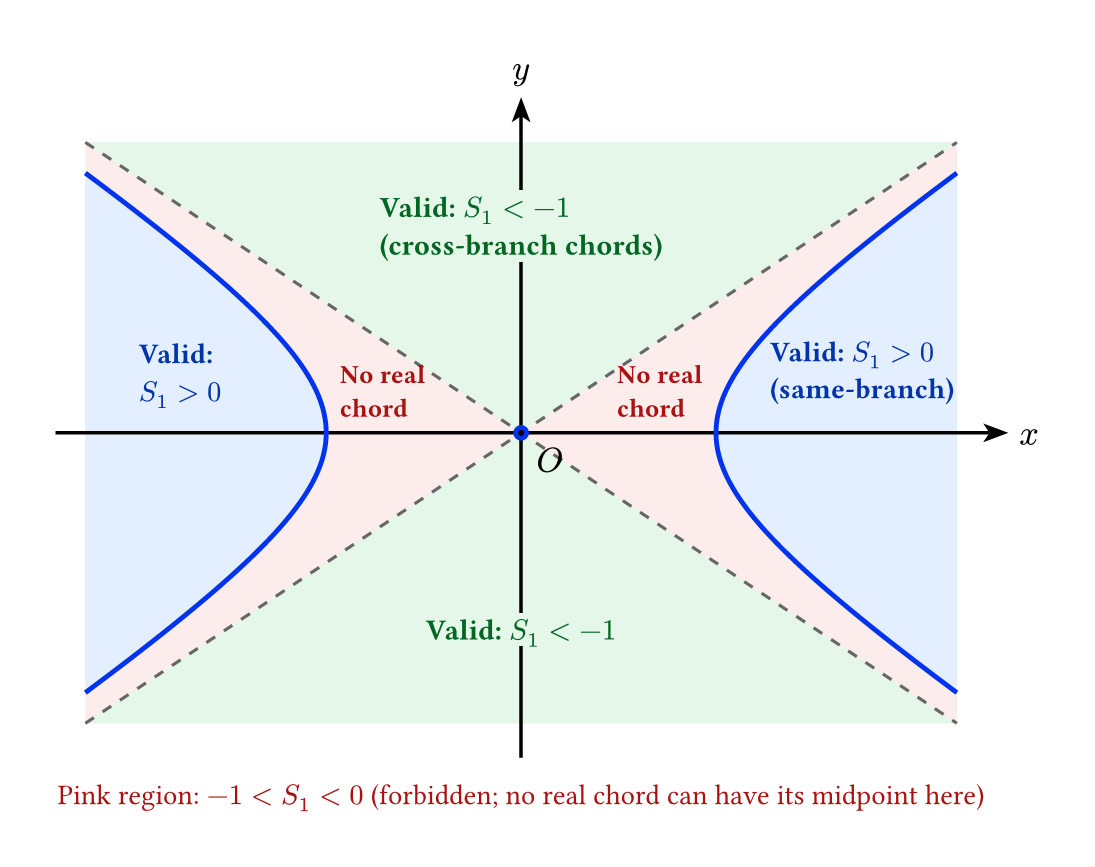
  • Valid Region 1 (S1>0S_1 > 0, shaded blue): MM lies inside either branch; the chord connects two points on the same branch.
  • Valid Region 2 (S1<−1S_1 < -1, i.e. x12a2−y12b2<0\frac{x_1^2}{a^2} - \frac{y_1^2}{b^2} < 0, shaded green): MM lies in the vertical asymptote sector; the chord bridges opposite branches.
  • Forbidden Region (−1<S1<0-1 < S_1 < 0, shaded pink): MM lies in the lateral sector between the asymptotes and the branches; λ2<0\lambda^2 < 0, so no real chord can be bisected at MM.

(On the boundaries: at S1=0S_1 = 0, MM lies on the hyperbola and T=S1T = S_1 degenerates to the tangent T=0T = 0; at S1=−1S_1 = -1, MM lies on an asymptote and T=S1T = S_1 becomes that asymptote itself.)

Shaded Valid and Forbidden Regions for Chord Midpoints

2. Testing M1(2,1)M_1(2, 1) and M2(1,3)M_2(1, 3) for x29−y216=1\frac{x^2}{9} - \frac{y^2}{16} = 1:

For M1(2,1)M_1(2, 1):

S1=229−1216−1=49−116−1=−89144S_1 = \frac{2^2}{9} - \frac{1^2}{16} - 1 = \frac{4}{9} - \frac{1}{16} - 1 = -\frac{89}{144}

Since −1<S1<0-1 < S_1 < 0, M1(2,1)M_1(2, 1) lies in the forbidden pink region. Hence no real chord can be bisected at M1(2,1)M_1(2, 1).

For M2(1,3)M_2(1, 3):

S1=129−3216−1=19−916−1=−209144<−1S_1 = \frac{1^2}{9} - \frac{3^2}{16} - 1 = \frac{1}{9} - \frac{9}{16} - 1 = -\frac{209}{144} < -1

Since S1<−1S_1 < -1, M2(1,3)M_2(1, 3) lies in the vertical asymptote sector, so a real cross-branch chord exists! Its equation (T=S1T = S_1) is:

x9−3y16=19−916=−65144  ⟹  16x−27y+65=0\frac{x}{9} - \frac{3y}{16} = \frac{1}{9} - \frac{9}{16} = -\frac{65}{144} \implies 16x - 27y + 65 = 0

Example 3: Finding the Midpoint of a Given Chord§

Find the midpoint of the chord intercepted by the line 9x−8y=309x - 8y = 30 on the hyperbola x216−y29=1\frac{x^2}{16} - \frac{y^2}{9} = 1.

Solution:

Let M(x1,y1)M(x_1, y_1) be the required midpoint. The equation of the chord bisected at MM is T=S1T = S_1:

xx116−yy19=x1216−y129\frac{x x_1}{16} - \frac{y y_1}{9} = \frac{x_1^2}{16} - \frac{y_1^2}{9}

Since this represents the exact same straight line as 9x−8y=309x - 8y = 30, their corresponding coefficients must be proportional:

x1/169=y1/98=x1216−y12930=k(k≠0)\frac{x_1 / 16}{9} = \frac{y_1 / 9}{8} = \frac{\frac{x_1^2}{16} - \frac{y_1^2}{9}}{30} = k \qquad (k \neq 0)

From the first two ratios:

x1=144k,y1=72kx_1 = 144k, \qquad y_1 = 72k

Substituting into the third ratio:

(144k)216−(72k)29=30k  ⟹  1296k2−576k2=30k  ⟹  720k2=30k\frac{(144k)^2}{16} - \frac{(72k)^2}{9} = 30k \implies 1296k^2 - 576k^2 = 30k \implies 720k^2 = 30k

Since k≠0k \neq 0, dividing by kk gives k=30720=124k = \frac{30}{720} = \frac{1}{24}. Therefore:

x1=144(124)=6,y1=72(124)=3x_1 = 144\left(\frac{1}{24}\right) = 6, \qquad y_1 = 72\left(\frac{1}{24}\right) = 3

The midpoint of the chord is M(6,3)M(6, 3). (Notice how comparing coefficients with T=S1T = S_1 finds the midpoint directly without solving a quadratic for the endpoints!)


Example 4: Finding the Length of a Chord with a Given Midpoint§

Find the length of the chord of the hyperbola x216−y29=1\frac{x^2}{16} - \frac{y^2}{9} = 1 whose midpoint is M(6,3)M(6, 3).

Solution:

Step 1: Write the equation and direction of the chord:

Using T=S1T = S_1 with (x1,y1)=(6,3)(x_1, y_1) = (6, 3):

6x16−3y9=3616−99  ⟹  3x8−y3=54  ⟹  9x−8y=30\frac{6x}{16} - \frac{3y}{9} = \frac{36}{16} - \frac{9}{9} \implies \frac{3x}{8} - \frac{y}{3} = \frac{5}{4} \implies 9x - 8y = 30

The slope of this chord is m=98m = \frac{9}{8}, so a direction vector along the chord is (8,9)(8, 9).

Step 2: Parameterize the chord symmetrically about M(6,3)M(6, 3):

Any point on the chord can be written as:

x=6+8t,y=3+9tx = 6 + 8t, \qquad y = 3 + 9t

Substitute into 9x2−16y2=1449x^2 - 16y^2 = 144:

9(6+8t)2−16(3+9t)2=1449(6 + 8t)^2 - 16(3 + 9t)^2 = 144 9(36+96t+64t2)−16(9+54t+81t2)=1449(36 + 96t + 64t^2) - 16(9 + 54t + 81t^2) = 144

Notice that the linear terms +864t+864t and −864t-864t cancel out automatically (confirming M(6,3)M(6, 3) is the exact midpoint):

(324−144)+(576−1296)t2=144  ⟹  180−720t2=144(324 - 144) + (576 - 1296)t^2 = 144 \implies 180 - 720t^2 = 144 720t2=36  ⟹  t2=120  ⟹  t=±125720t^2 = 36 \implies t^2 = \frac{1}{20} \implies t = \pm \frac{1}{2\sqrt{5}}

Step 3: Compute the chord length PQPQ:

The endpoints PP and QQ correspond to t=+125t = +\frac{1}{2\sqrt{5}} and t=−125t = -\frac{1}{2\sqrt{5}}, so the displacement vector from QQ to PP is (8Δt,  9Δt)(8\Delta t,\; 9\Delta t) with Δt=15\Delta t = \frac{1}{\sqrt{5}}:

PQ=Δt82+92=64+815=1455=29PQ = \Delta t\sqrt{8^2 + 9^2} = \frac{\sqrt{64 + 81}}{\sqrt{5}} = \frac{\sqrt{145}}{\sqrt{5}} = \sqrt{29}

The length of the chord is 29\sqrt{29} units.


Example 5: Locus of Midpoints of Chords Passing Through a Fixed Point§

Find the locus of the midpoints of all chords of the hyperbola x2a2−y2b2=1\frac{x^2}{a^2} - \frac{y^2}{b^2} = 1 that pass through the fixed point A(α,β)A(\alpha, \beta).

Solution:

Let M(h,k)M(h, k) be the midpoint of any such chord. Its equation is T=S1T = S_1:

hxa2−kyb2=h2a2−k2b2\frac{hx}{a^2} - \frac{ky}{b^2} = \frac{h^2}{a^2} - \frac{k^2}{b^2}

Since this chord passes through A(α,β)A(\alpha, \beta), substituting (x,y)=(α,β)(x, y) = (\alpha, \beta) gives:

hαa2−kβb2=h2a2−k2b2\frac{h\alpha}{a^2} - \frac{k\beta}{b^2} = \frac{h^2}{a^2} - \frac{k^2}{b^2}

Replacing (h,k)(h, k) with (x,y)(x, y), the required locus is:

x2a2−y2b2−αxa2+βyb2=0\frac{x^2}{a^2} - \frac{y^2}{b^2} - \frac{\alpha x}{a^2} + \frac{\beta y}{b^2} = 0

Completing the squares shows this is a similar hyperbola centered at (α2,β2)\left(\frac{\alpha}{2}, \frac{\beta}{2}\right) passing through both the origin O(0,0)O(0, 0) and the fixed point A(α,β)A(\alpha, \beta).


Example 6: Locus of Midpoints of Chords Touching the Auxiliary Circle§

Find the locus of the midpoints of all chords of the hyperbola x2a2−y2b2=1\frac{x^2}{a^2} - \frac{y^2}{b^2} = 1 that are tangent to its auxiliary circle x2+y2=a2x^2 + y^2 = a^2.

Solution:

Let M(h,k)M(h, k) be the midpoint of such a chord. Its equation (T=S1T = S_1) is:

hxa2−kyb2−(h2a2−k2b2)=0\frac{hx}{a^2} - \frac{ky}{b^2} - \left(\frac{h^2}{a^2} - \frac{k^2}{b^2}\right) = 0

Since this line is tangent to the circle x2+y2=a2x^2 + y^2 = a^2 (centered at (0,0)(0, 0) with radius aa), the perpendicular distance from (0,0)(0, 0) to the line must equal aa:

∣h2a2−k2b2∣h2a4+k2b4=a\frac{\left|\frac{h^2}{a^2} - \frac{k^2}{b^2}\right|}{\sqrt{\frac{h^2}{a^4} + \frac{k^2}{b^4}}} = a

Squaring both sides and replacing (h,k)(h, k) by (x,y)(x, y):

(x2a2−y2b2)2=a2(x2a4+y2b4)=x2a2+a2y2b4\left(\frac{x^2}{a^2} - \frac{y^2}{b^2}\right)^2 = a^2\left(\frac{x^2}{a^4} + \frac{y^2}{b^4}\right) = \frac{x^2}{a^2} + \frac{a^2 y^2}{b^4}

Example 7: Locus of Midpoints of Chords Touching a Parabola§

Find the locus of the midpoints of all chords of the hyperbola x2a2−y2b2=1\frac{x^2}{a^2} - \frac{y^2}{b^2} = 1 that are tangent to the parabola y2=4cxy^2 = 4cx.

Solution:

Let M(h,k)M(h, k) be the midpoint of such a chord. Rewrite its equation T=S1T = S_1 in slope-intercept form y=mx+dy = mx + d:

hxa2−kyb2=h2a2−k2b2  ⟹  y=b2ha2kx−b2k(h2a2−k2b2)\frac{hx}{a^2} - \frac{ky}{b^2} = \frac{h^2}{a^2} - \frac{k^2}{b^2} \implies y = \frac{b^2 h}{a^2 k} x - \frac{b^2}{k}\left(\frac{h^2}{a^2} - \frac{k^2}{b^2}\right)

Here m=b2ha2km = \frac{b^2 h}{a^2 k} and d=−b2k(h2a2−k2b2)d = -\frac{b^2}{k}\left(\frac{h^2}{a^2} - \frac{k^2}{b^2}\right).

For the line y=mx+dy = mx + d to be tangent to the parabola y2=4cxy^2 = 4cx, we require d=cmd = \frac{c}{m}:

−b2k(h2a2−k2b2)=cb2ha2k=ca2kb2h-\frac{b^2}{k}\left(\frac{h^2}{a^2} - \frac{k^2}{b^2}\right) = \frac{c}{\frac{b^2 h}{a^2 k}} = \frac{c a^2 k}{b^2 h}

Multiplying through by b2hkb^2 h k and replacing (h,k)(h, k) by (x,y)(x, y):

b4x(y2b2−x2a2)=ca2y2b^4 x\left(\frac{y^2}{b^2} - \frac{x^2}{a^2}\right) = c a^2 y^2

or equivalently:

b2x(a2y2−b2x2)=ca4y2b^2 x(a^2 y^2 - b^2 x^2) = c a^4 y^2

Example 8: Locus of Midpoints of Chords of Constant Length in a Rectangular Hyperbola§

Find the locus of the midpoints of all chords of the rectangular hyperbola xy=c2xy = c^2 having constant length 2ℓ2\ell.

Solution:

Let M(h,k)M(h, k) be the midpoint of a chord of length 2ℓ2\ell. The chord equation (T=S1T = S_1) is:

kx+hy=2hkkx + hy = 2hk

Its slope is m=−khm = -\frac{k}{h}, so the unit direction vector along the chord is:

(cos⁡ϕ,  sin⁡ϕ)=(hh2+k2,  −kh2+k2)(\cos\phi,\; \sin\phi) = \left(\frac{h}{\sqrt{h^2 + k^2}},\; -\frac{k}{\sqrt{h^2 + k^2}}\right)

Since the chord has length 2ℓ2\ell, its endpoints lie at distance ℓ\ell from M(h,k)M(h, k):

x=h+ℓcos⁡ϕ,y=k+ℓsin⁡ϕx = h + \ell\cos\phi, \qquad y = k + \ell\sin\phi

Substituting into xy=c2xy = c^2:

(h+ℓcos⁡ϕ)(k+ℓsin⁡ϕ)=c2(h + \ell\cos\phi)(k + \ell\sin\phi) = c^2 hk+ℓ(hsin⁡ϕ+kcos⁡ϕ)+ℓ2sin⁡ϕcos⁡ϕ=c2hk + \ell(h\sin\phi + k\cos\phi) + \ell^2\sin\phi\cos\phi = c^2

Notice that hsin⁡ϕ+kcos⁡ϕ=−hk+hkh2+k2=0h\sin\phi + k\cos\phi = \frac{-hk + hk}{\sqrt{h^2 + k^2}} = 0, while sin⁡ϕcos⁡ϕ=−hkh2+k2\sin\phi\cos\phi = -\frac{hk}{h^2 + k^2}. Substituting these gives:

hk−ℓ2hkh2+k2=c2  ⟹  (hk−c2)(h2+k2)=ℓ2hkhk - \frac{\ell^2 hk}{h^2 + k^2} = c^2 \implies (hk - c^2)(h^2 + k^2) = \ell^2 hk

Replacing (h,k)(h, k) with (x,y)(x, y), the required locus is:

(xy−c2)(x2+y2)=ℓ2xy(xy - c^2)(x^2 + y^2) = \ell^2 xy

Example 9: Locus of Midpoints of Chords Subtending a Right Angle at the Center§

Find the locus of the midpoints of all chords of the hyperbola x2a2−y2b2=1\frac{x^2}{a^2} - \frac{y^2}{b^2} = 1 that subtend a right angle (90∘90^\circ) at the center O(0,0)O(0, 0).

Solution:

Step 1: Write the chord with midpoint M(h,k)M(h, k):

hxa2−kyb2=h2a2−k2b2\frac{hx}{a^2} - \frac{ky}{b^2} = \frac{h^2}{a^2} - \frac{k^2}{b^2}

Let K=h2a2−k2b2K = \frac{h^2}{a^2} - \frac{k^2}{b^2}, so the chord equation is hxa2−kyb2K=1\frac{\frac{hx}{a^2} - \frac{ky}{b^2}}{K} = 1.

Step 2: Homogenize the hyperbola with the chord:

Replacing 11 by (hxa2−kyb2K)2\left(\frac{\frac{hx}{a^2} - \frac{ky}{b^2}}{K}\right)^2 in x2a2−y2b2=1\frac{x^2}{a^2} - \frac{y^2}{b^2} = 1 gives the joint equation of the lines OPOP and OQOQ joining the origin to the chord's endpoints:

x2a2−y2b2=1K2(hxa2−kyb2)2\frac{x^2}{a^2} - \frac{y^2}{b^2} = \frac{1}{K^2}\left(\frac{hx}{a^2} - \frac{ky}{b^2}\right)^2

Step 3: Apply the perpendicularity condition (coeff of x2+coeff of y2=0\text{coeff of } x^2 + \text{coeff of } y^2 = 0):

Since ∠POQ=90∘\angle POQ = 90^\circ:

(1a2−h2a4K2)+(−1b2−k2b4K2)=0\left(\frac{1}{a^2} - \frac{h^2}{a^4 K^2}\right) + \left(-\frac{1}{b^2} - \frac{k^2}{b^4 K^2}\right) = 0

Rearranging:

1a2−1b2=1K2(h2a4+k2b4)\frac{1}{a^2} - \frac{1}{b^2} = \frac{1}{K^2}\left(\frac{h^2}{a^4} + \frac{k^2}{b^4}\right)

Multiplying by K2=(h2a2−k2b2)2K^2 = \left(\frac{h^2}{a^2} - \frac{k^2}{b^2}\right)^2 and replacing (h,k)(h, k) by (x,y)(x, y):

(1a2−1b2)(x2a2−y2b2)2=x2a4+y2b4\left(\frac{1}{a^2} - \frac{1}{b^2}\right)\left(\frac{x^2}{a^2} - \frac{y^2}{b^2}\right)^2 = \frac{x^2}{a^4} + \frac{y^2}{b^4}

(Notice: for a rectangular hyperbola where a=ba = b, the left-hand side is 00 while the right-hand side is strictly positive for (x,y)≠(0,0)(x, y) \neq (0, 0)—which proves cleanly that no chord of a rectangular hyperbola not passing through the origin can subtend 90∘90^\circ at the center!)


Example 10: Finding a Conjugate Diameter and Its Extremities§

For the hyperbola x216−y29=1\frac{x^2}{16} - \frac{y^2}{9} = 1, find the equation of the diameter conjugate to the diameter y=12xy = \frac{1}{2}x, and determine the coordinates of its extremities on the conjugate hyperbola.

Solution:

Step 1: Find the slope of the conjugate diameter:

Here a2=16a^2 = 16, b2=9b^2 = 9, and m1=12m_1 = \frac{1}{2}. Using m1m2=b2a2m_1 m_2 = \frac{b^2}{a^2}:

12m2=916  ⟹  m2=98\frac{1}{2} m_2 = \frac{9}{16} \implies m_2 = \frac{9}{8}

Thus the conjugate diameter is y=98xy = \frac{9}{8}x.

(Check: ∣m1∣=12<34=ba|m_1| = \frac{1}{2} < \frac{3}{4} = \frac{b}{a}, so y=12xy = \frac{1}{2}x meets HH, while ∣m2∣=98>34|m_2| = \frac{9}{8} > \frac{3}{4}, so y=98xy = \frac{9}{8}x meets the conjugate hyperbola H′H'.)

Step 2: Find the extremities D,D′D, D' on the conjugate hyperbola H′:y29−x216=1H': \frac{y^2}{9} - \frac{x^2}{16} = 1:

Substitute y=98xy = \frac{9}{8}x into y29−x216=1\frac{y^2}{9} - \frac{x^2}{16} = 1:

81x264⋅9−x216=1  ⟹  9x264−4x264=1  ⟹  5x264=1  ⟹  x=±85\frac{81x^2}{64 \cdot 9} - \frac{x^2}{16} = 1 \implies \frac{9x^2}{64} - \frac{4x^2}{64} = 1 \implies \frac{5x^2}{64} = 1 \implies x = \pm \frac{8}{\sqrt{5}}

Then y=98(±85)=±95y = \frac{9}{8}\left(\pm \frac{8}{\sqrt{5}}\right) = \pm \frac{9}{\sqrt{5}}.

The extremities of the conjugate diameter on H′H' are D(85,95)D\left(\frac{8}{\sqrt{5}}, \frac{9}{\sqrt{5}}\right) and D′(−85,−95)D'\left(-\frac{8}{\sqrt{5}}, -\frac{9}{\sqrt{5}}\right).


Example 11: Applying the Conjugate Semi-Diameter Invariants§

A point PP lies on the hyperbola x225−y29=1\frac{x^2}{25} - \frac{y^2}{9} = 1 at a distance CP=7CP = 7 from the center C(0,0)C(0, 0). Find:

  1. The length of the conjugate semi-diameter CDCD.
  2. The product of the focal distances SP⋅S′PSP \cdot S'P.

Solution:

Here a2=25a^2 = 25 and b2=9b^2 = 9.

1. Length of CDCD:

By Property 1, CP2−CD2=a2−b2CP^2 - CD^2 = a^2 - b^2:

72−CD2=25−9=16  ⟹  CD2=49−16=33  ⟹  CD=337^2 - CD^2 = 25 - 9 = 16 \implies CD^2 = 49 - 16 = 33 \implies CD = \sqrt{33}

2. Product of focal distances:

By Property 4, SP⋅S′P=CD2SP \cdot S'P = CD^2:

SP⋅S′P=33SP \cdot S'P = 33

Summary Comparison: Hyperbola vs. Ellipse§

Concept / Theorem Horizontal Hyperbola x2a2−y2b2=1\frac{x^2}{a^2} - \frac{y^2}{b^2} = 1 Horizontal Ellipse x2a2+y2b2=1\frac{x^2}{a^2} + \frac{y^2}{b^2} = 1
Chord with Midpoint (x1,y1)(x_1, y_1) T=S1  ⟹  xx1a2−yy1b2=x12a2−y12b2T = S_1 \implies \frac{xx_1}{a^2} - \frac{yy_1}{b^2} = \frac{x_1^2}{a^2} - \frac{y_1^2}{b^2} T=S1  ⟹  xx1a2+yy1b2=x12a2+y12b2T = S_1 \implies \frac{xx_1}{a^2} + \frac{yy_1}{b^2} = \frac{x_1^2}{a^2} + \frac{y_1^2}{b^2}
Existence of Real Chord S1>0S_1 > 0 (same branch) or S1<−1S_1 < -1 (cross-branch) S1<0S_1 < 0 (strictly inside the ellipse)
Diameter for Parallel Chords (mm) y=b2a2mxy = \frac{b^2}{a^2 m} x y=−b2a2mxy = -\frac{b^2}{a^2 m} x
Conjugate Diameters Condition m1m2=+b2a2m_1 m_2 = +\frac{b^2}{a^2} (same quadrants) m1m2=−b2a2m_1 m_2 = -\frac{b^2}{a^2} (opposite quadrants)
Extremities PP and DD P(asec⁡θ,btan⁡θ)P(a\sec\theta, b\tan\theta) on HH; D(atan⁡θ,bsec⁡θ)D(a\tan\theta, b\sec\theta) on H′H' P(acos⁡θ,bsin⁡θ)P(a\cos\theta, b\sin\theta); D(−asin⁡θ,bcos⁡θ)D(-a\sin\theta, b\cos\theta) both on EE
Semi-Diameter Length Invariant CP2−CD2=a2−b2CP^2 - CD^2 = a^2 - b^2 CP2+CD2=a2+b2CP^2 + CD^2 = a^2 + b^2
Parallelogram of Tangents Area =4ab= 4ab; vertices lie on the asymptotes Area =4ab= 4ab; vertices lie on x2a2+y2b2=2\frac{x^2}{a^2} + \frac{y^2}{b^2} = 2
Focal Distance Product SP⋅S′P=CD2SP \cdot S'P = CD^2 SP⋅S′P=CD2SP \cdot S'P = CD^2
Section 12 of 15 · Hyperbola

Mark this section complete when you have worked through its proofs.