
Equation of Ellipse
In our study of conic sections, we defined a conic section by the focus-directrix property: the locus of a point that moves in a plane such that the ratio of its distance from a fixed point to its perpendicular distance from a fixed straight line is a constant , called the eccentricity.
When the eccentricity is equal to (), the curve is a parabola. When the eccentricity is strictly between and (), the curve is an ellipse.
In this chapter, we begin with this fundamental geometric definition. We first write the equation of an ellipse in an arbitrary position and observe why analyzing it directly is difficult. We then follow a natural geometric construction to place the coordinate axes in the most convenient position, arriving at the celebrated standard equation of an ellipse.
The Geometric Definition of an Ellipse§
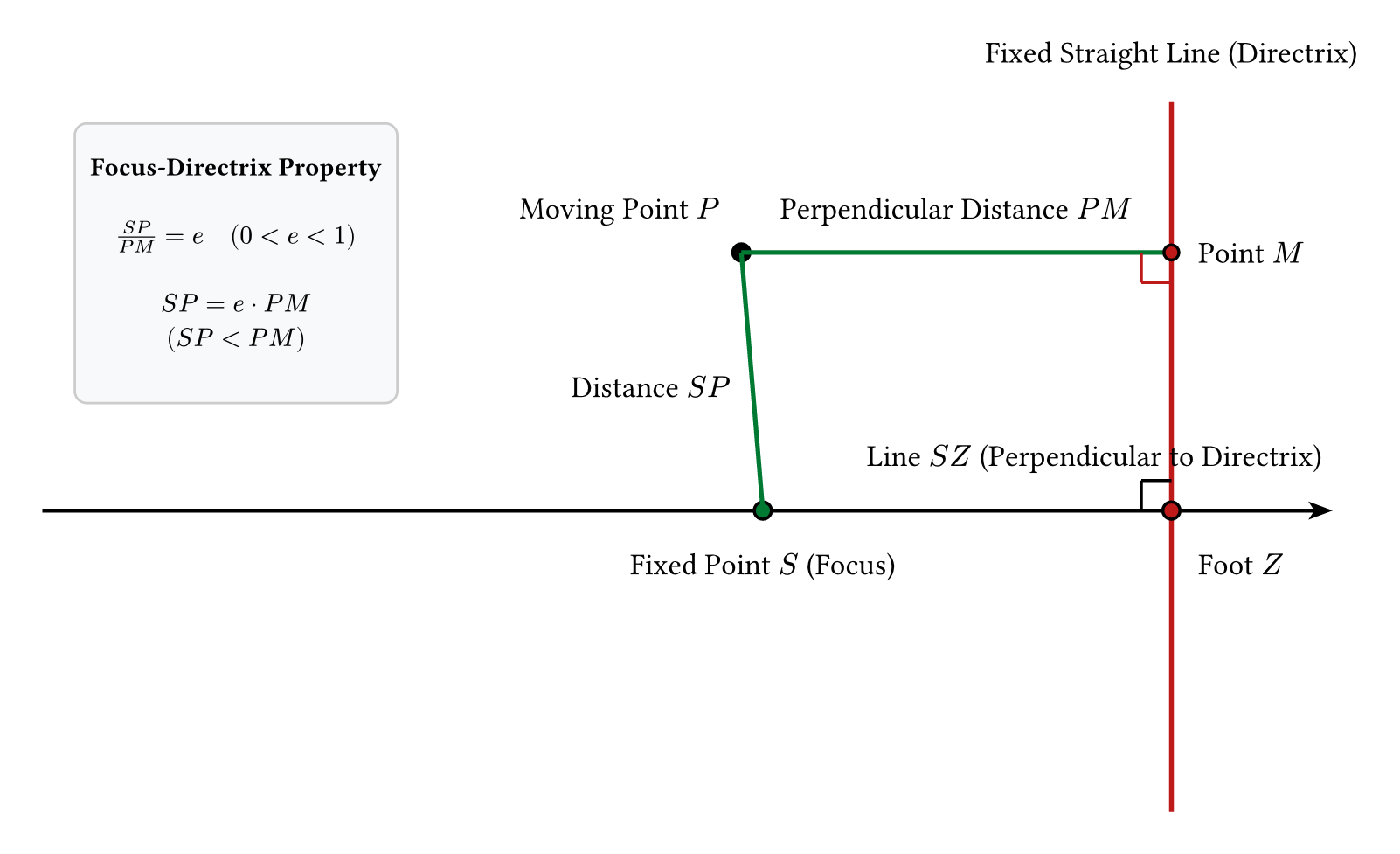
An ellipse is the locus of a point moving in a plane such that the ratio of its distance from a fixed point to its perpendicular distance from a fixed straight line is a constant , where .
- The fixed point is called the focus.
- The fixed straight line is called the directrix.
- The constant ratio is called the eccentricity ().
If is any point on the ellipse, and is the perpendicular drawn from onto the directrix, then by definition:
Because , the distance of any point on the ellipse from the focus is always strictly less than its perpendicular distance from the directrix:
An Example in an Arbitrary Coordinate System§
To appreciate why a carefully chosen coordinate system is necessary, consider an ellipse whose focus and directrix are chosen arbitrarily in the plane.
Let the focus be the point , the directrix be the line , and the eccentricity be .
Let be any point on this ellipse.
The distance between the point and the focus is:
The perpendicular distance from to the directrix line is:
According to the focus-directrix definition:
Squaring both sides:
Substituting the expressions for and :
Multiplying both sides by :
Expanding both sides:
Collecting all terms on the left-hand side:
This is the Cartesian equation of our ellipse.
Why Analyzing the General Equation is Difficult§
Examining the equation obtained above:
we notice several complications:
- The Cross-Term (): The presence of indicates that the axes of symmetry of the ellipse are tilted at an angle to the - and -axes.
- The Linear Terms ( and ): The terms and indicate that the center of the ellipse is displaced away from the origin .
- Bulky Coefficients: Simple geometric quantities—such as the lengths of the axes, the coordinates of the center, the vertices, and the equations of tangents—are obscured by the coefficients.
The shape and geometric properties of an ellipse are intrinsic to the curve itself. They depend only on the relative positions of the focus and directrix and the value of , not on the coordinate axes chosen to describe them.
To study the geometric properties of the ellipse with clarity, we must choose a coordinate system whose origin and axes align with the natural symmetry of the curve.
Constructing the Standard Coordinate System§
To obtain the simplest possible equation, we set up the coordinate axes using the intrinsic geometry of the curve.
The Axis Perpendicular to the Directrix§
Let be the fixed focus, and let the directrix be a fixed straight line placed on the right side.
From the focus , draw a straight line perpendicular to the directrix, meeting the directrix at the point .
This line passing through and is called the axis of the ellipse.
Locating the Vertices on the Axis§
As a point moves such that , consider where the curve cuts the straight line .
For any point lying on the line , the perpendicular distance to the directrix is measured directly along the line to the point . Therefore, a point on the line belongs to the ellipse if and only if:
Because , the distance of such a point from must be strictly less than its distance from . There are two distinct points on the line that satisfy this condition:
1. The Internal Division Point: Between and , there exists a unique point dividing the segment internally in the ratio :
Because satisfies the focus-directrix definition, the moving point passes through .
2. The External Division Point: On the line , to the left of (on the side away from ), there exists a unique point dividing the segment externally in the ratio :
Because also satisfies the focus-directrix definition, the moving point passes through .
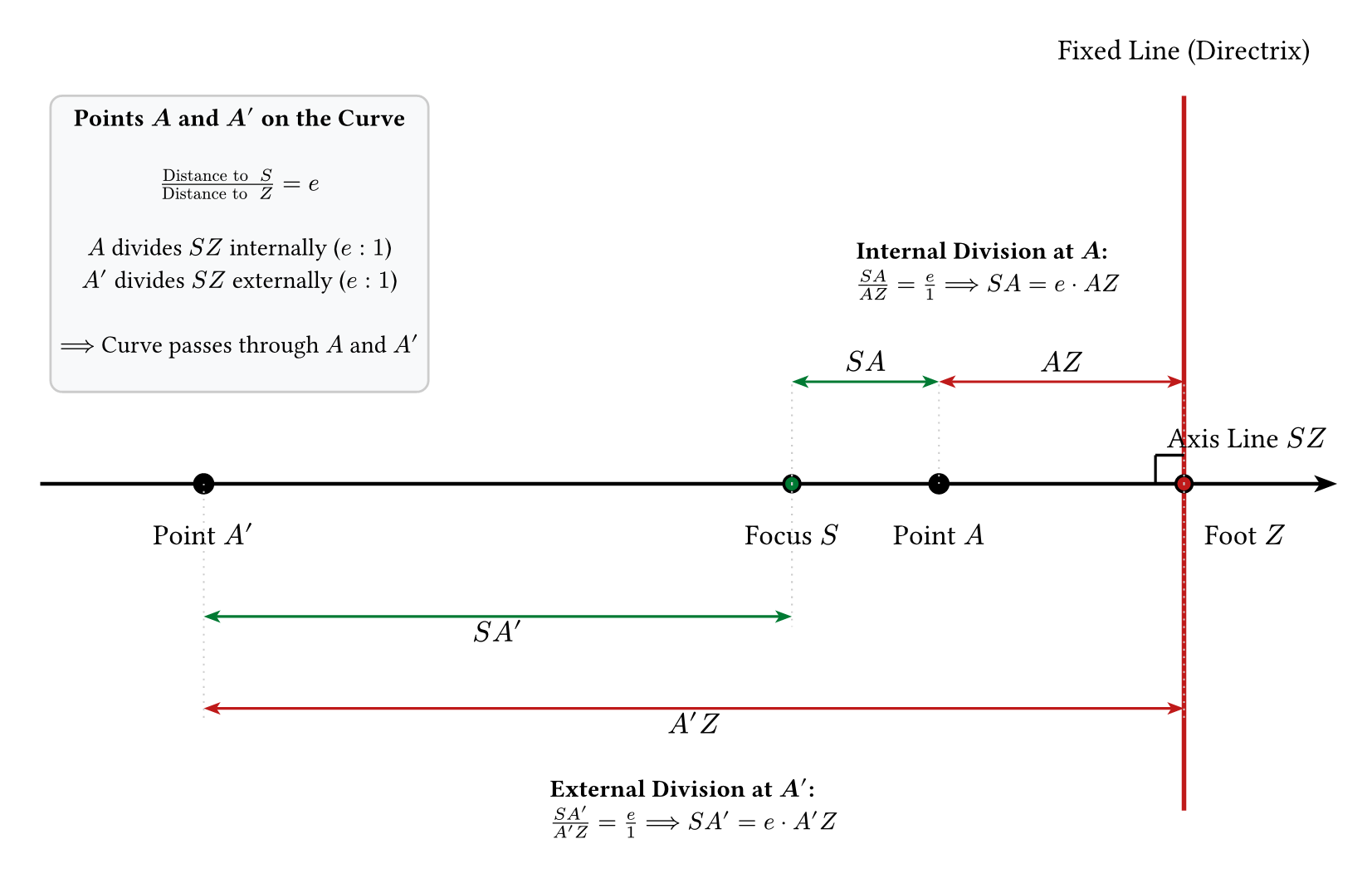
The points and are called the vertices of the ellipse. The ellipse crosses its axis at these two points. The segment is called the major axis.
Determining the Center and Distances§
Let be the midpoint of the segment . This point is called the center of the ellipse.
Let the total length of the major axis be . Since is the midpoint:
Along the line from left to right, the points lie in the order:
We can express the distances appearing in our division relations in terms of the distances from the center :
Substituting these expressions into the internal and external division equations:
To find , add the two equations:
Dividing both sides by :
To find , subtract the first equation from the second:
Dividing both sides by :
These two fundamental relations determine the exact positions of the focus and the directrix relative to the center :
Setting up the Coordinate Axes§
With the positions of , , , , and established, we define our coordinate system:
- Origin: Take the center as the origin .
- -axis: Take the line as the -axis, with the positive direction pointing from towards the focus and directrix foot .
- -axis: Take the straight line passing through perpendicular to the -axis as the -axis.
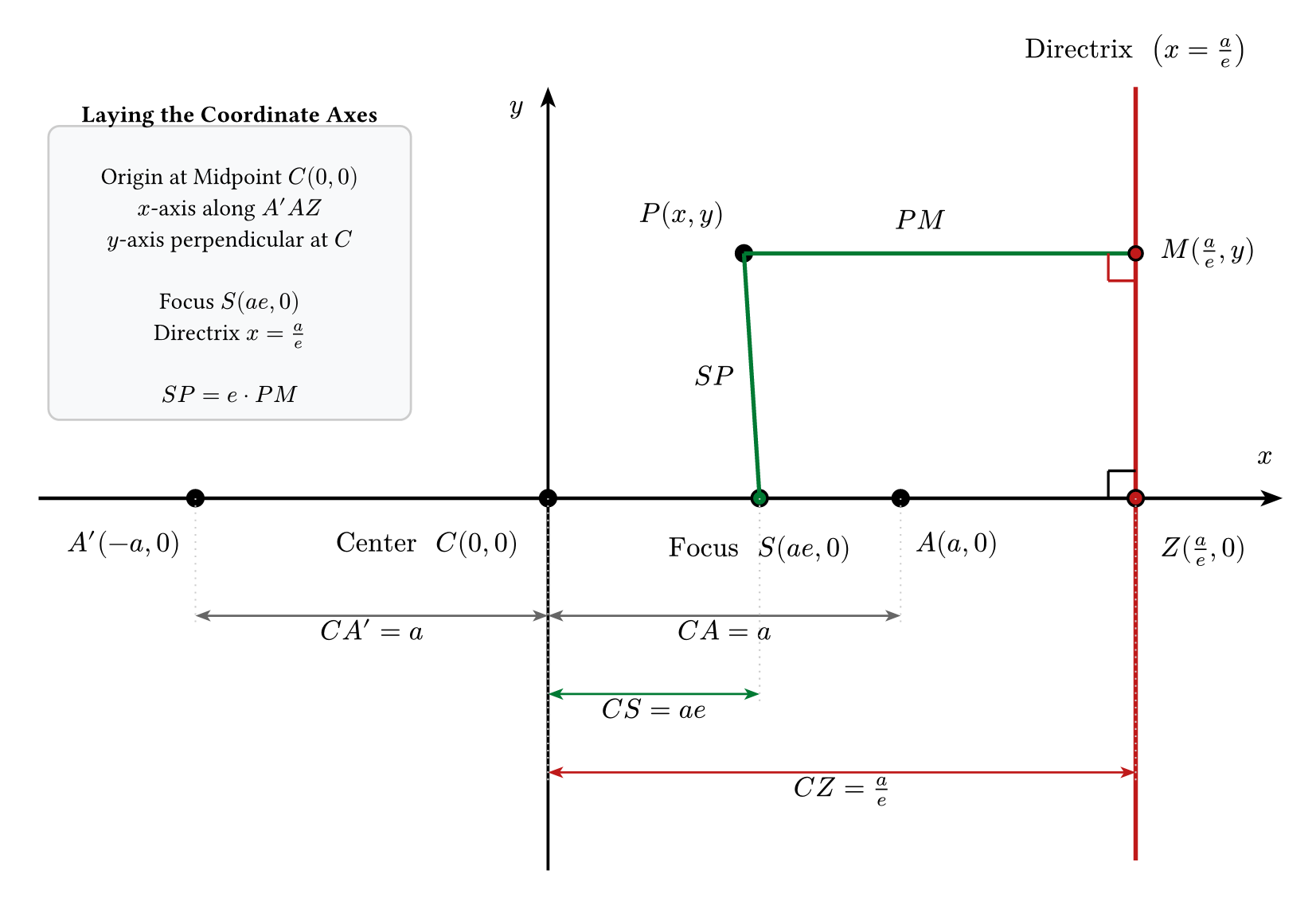
In this coordinate system, the coordinates of the points on the axis are:
- Center:
- Vertices: and
- Focus:
- Directrix foot:
Because the directrix is perpendicular to the -axis and passes through , its equation is:
Derivation of the Standard Equation§
Now let be any point on the ellipse in this coordinate system.
The distance of from the focus is:
The directrix is the vertical line , which can be written as .
The perpendicular distance from to this vertical line is the horizontal distance between and the line:
By the focus-directrix definition of the ellipse:
Squaring both sides:
Substituting the expressions for and :
Since :
Expanding the squares on both sides:
Notice that the cross-term appears on both sides with the same sign and cancels out:
Collecting the terms containing on the left-hand side and constant terms on the right-hand side:
Factoring common terms:
Dividing the entire equation by :
Because , the quantity is strictly positive:
Therefore, is a positive real quantity that is strictly less than . We denote this positive quantity by :
Substituting into our equation gives the standard equation of an ellipse:
Symmetry and the Second Focus and Directrix§
The standard equation of the ellipse reveals a remarkable symmetry that is not immediately obvious from the single focus-directrix definition.
Consider the equation:
Symmetry about the -axis: Replacing with leaves the equation unchanged:
The curve is symmetric about the -axis.
Symmetry about the -axis: Replacing with leaves the equation unchanged:
The curve is symmetric about the -axis.
Symmetry about the Origin: Replacing with leaves the equation unchanged:
The origin is a center of symmetry for the curve.
The Second Focus and Directrix§
Because the curve is completely symmetric with respect to the -axis (), every feature that exists on the positive side of the -axis has an exact counterpart on the negative side:
- Corresponding to the focus on the right, there exists a second focus on the left.
- Corresponding to the directrix on the right, there exists a second directrix on the left.
If we had started our derivation using as the focus and as the directrix with the condition , we would have arrived at the identical equation:
Every ellipse possesses two foci and two directrices:
Anatomy and Terminology of the Standard Ellipse§
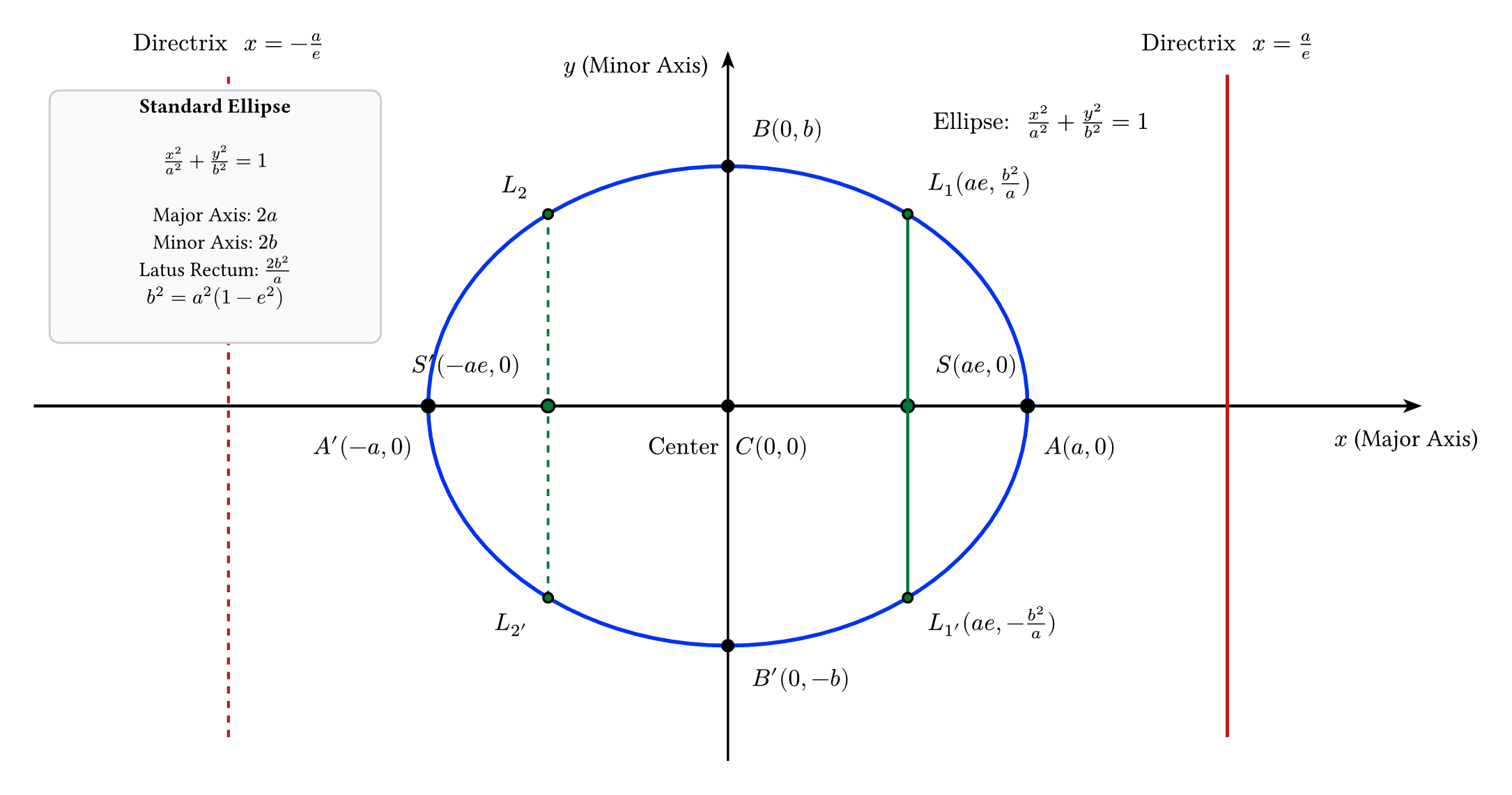
For the standard ellipse with :
Center§
The midpoint of the segment joining the two foci, or the midpoint of the segment joining the two vertices, is the center . Every chord passing through the center is bisected at the center.
Major Axis§
The line segment joining the two vertices and is called the major axis.
- The major axis lies along the -axis ().
- Its length is .
- The quantity is called the semi-major axis.
Minor Axis§
The line segment joining the points and , where the ellipse crosses the -axis, is called the minor axis.
- The minor axis lies along the -axis ().
- Its length is .
- The quantity is called the semi-minor axis.
Since and , we always have . The major axis is always longer than the minor axis.
Vertices§
The points where the ellipse intersects its major axis are the vertices:
Eccentricity§
From the defining relation :
Distance Between Foci§
The two foci are and . The distance between them is:
Distance Between Directrices§
The two directrices are and . The distance between them is:
Double Ordinates and the Latus Rectum§
Double Ordinate§
A chord of the ellipse perpendicular to the major axis (the -axis) is called a double ordinate. If the abscissa of the chord is , its equation is , and its endpoints have coordinates and .
Latus Rectum§
A double ordinate that passes through either focus is called a latus rectum of the ellipse.
Because there are two foci, and , there are two latera recta:
- One passing through , having the equation .
- One passing through , having the equation .
Length of the Latus Rectum§
To find the length of the latus rectum, substitute into the equation of the ellipse:
Recall that , which gives . Substituting this:
Taking the square root:
Therefore, the coordinates of the endpoints of the latus rectum through are:
Similarly, the endpoints of the latus rectum through are:
The length of the latus rectum is the distance between its endpoints:
The semi-latus rectum is:
Using , the length can also be written in terms of and :
Focal Distances of a Point§
A characteristic property of any point lying on the ellipse is the simple expression for its distances from the two foci.
Let and be the feet of the perpendiculars from to the directrices and , respectively.
Distance from the right focus :
By the focus-directrix definition:
Since has coordinates and :
Therefore:
Distance from the left focus :
By the focus-directrix definition:
Since has coordinates and :
Therefore:
Constant Sum of Focal Distances§
Adding the two focal distances:
The sum of the distances of any point on the ellipse from the two foci is constant and equal to the length of the major axis ().
This provides an alternative, classical definition of an ellipse (known as the bifocal or gardener's definition): an ellipse is the locus of a point that moves such that the sum of its distances from two fixed points (the foci) is constant and greater than the distance between them.
Polar Equation of an Ellipse with Focus as Pole§
In Cartesian coordinates, choosing the center of the ellipse as the origin gives the balanced equation .
However, in physics and celestial mechanics (such as Kepler's laws of planetary motion), the Sun or central gravitating body sits at a focus, not at the center. Planets move along an ellipse with the Sun at one focus. For problems involving orbits, focal radii, and focal chords, it is far more natural and powerful to place the origin (pole) directly at the focus.
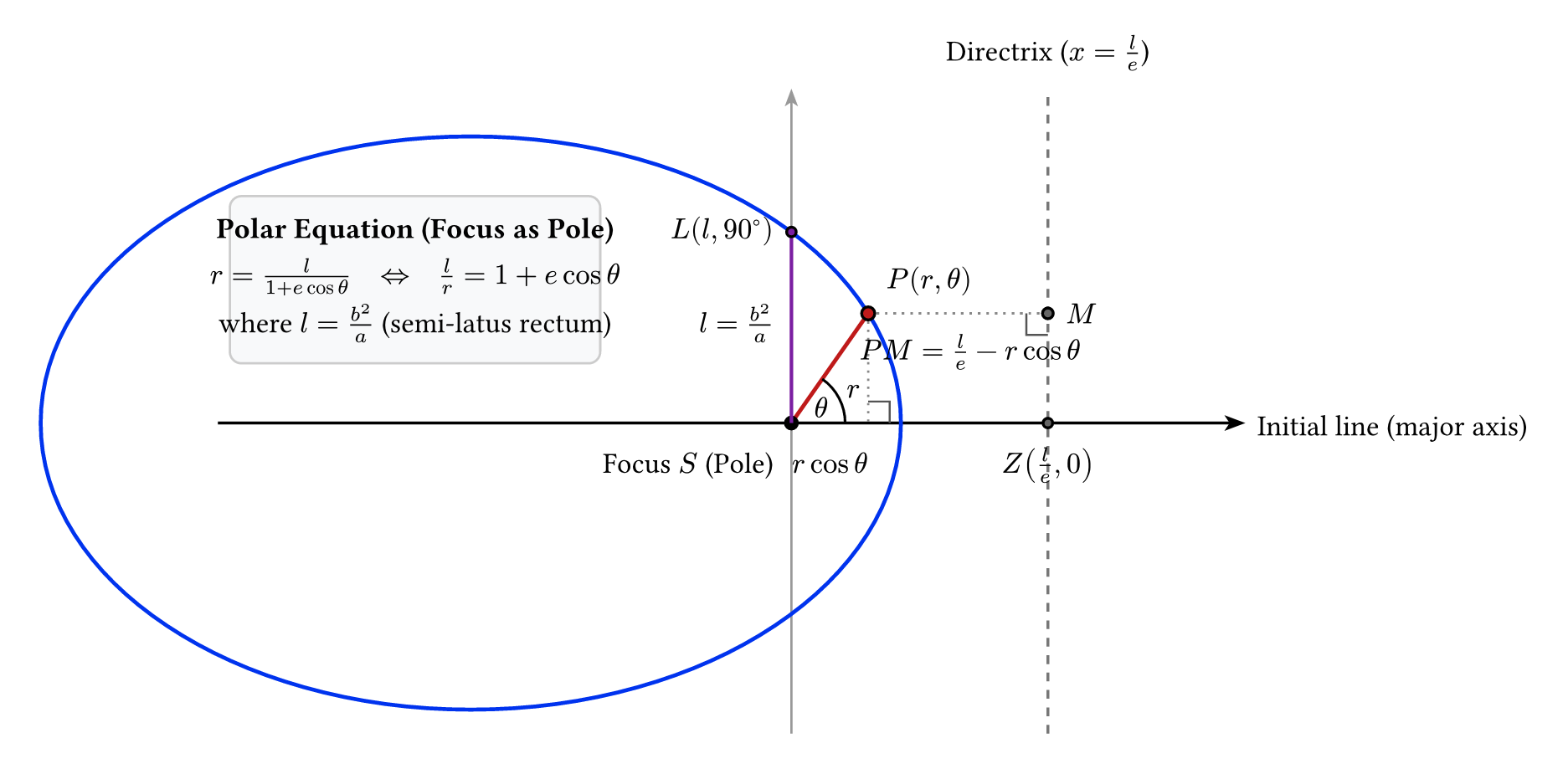
Derivation from the Focus-Directrix Property§
Let the focus be taken as the pole , and let the positive major axis directed toward the nearer directrix be chosen as the initial line (polar axis).
Let be any point on the ellipse, where:
- is the focal distance from to .
- is the angle made by the radius vector with the positive major axis.
The distance from the focus to the corresponding directrix is:
Recall that the semi-latus rectum of an ellipse is:
Therefore, the distance between the focus and its corresponding directrix can be written very neatly as:
From the point , draw a perpendicular to the directrix.
The projection of the segment onto the initial line is . Looking at the geometry along the major axis:
Now apply the fundamental focus-directrix definition ():
Rearranging the terms:
Dividing by :
This is the standard polar equation of an ellipse with the focus as pole and the initial line directed toward the nearer directrix.
Alternative Orientations:
If the initial line is taken in the opposite direction (directed away from the nearer directrix), is replaced by . Since , the polar equation becomes:
More generally, if the major axis is inclined at an angle to the initial line, the equation is:
Key Properties and Physical Importance§
The polar form reveals several remarkable geometric and physical insights:
Closest and Farthest Points from the Focus (Perihelion and Aphelion):
Since , the focal distance varies between two extreme values:
Perihelion (Closest Approach):
Occurs when ():
This is the distance from the focus to the nearest vertex . In astronomy, this point of closest approach to the Sun is called the perihelion.
Aphelion (Farthest Distance):
Occurs when ():
This is the distance from the focus to the farthest vertex . In astronomy, this point is called the aphelion.
Adding the minimum and maximum distances gives the total major axis:
Semi-Latus Rectum as a Geometric Parameter:
When or , the radius vector is perpendicular to the major axis ():
Thus, the semi-latus rectum is simply the focal radius perpendicular to the major axis.
Harmonic Mean of Focal Chords:
A straight line passing through the focus at an inclination intersects the ellipse at two opposite points: at angle , and at angle .
Because , their focal distances are:
Adding their reciprocals:
Notice that the angle completely cancels out! This proves that the sum of the reciprocals of the segments of any focal chord is constant, meaning that the semi-latus rectum is always the harmonic mean between the two segments of any focal chord.
A Unified Equation for All Conic Sections:
The equation is not just for ellipses---it represents all conic sections with a focus as pole:
- When : (a circle with radius ).
- When : an ellipse.
- When : (a parabola).
- When : a hyperbola.
This unified form allows physicists and mathematicians to study gravitational trajectories (bound elliptical orbits, parabolic escape paths, and hyperbolic flybys) using a single, elegant equation.
Illustrative Examples§
Example 1: Finding the Standard Attributes of an Ellipse§
Problem. For the ellipse , find:
- The lengths of the major and minor axes.
- The coordinates of the center and vertices.
- The eccentricity.
- The coordinates of the foci.
- The equations of the directrices.
- The length of the latus rectum.
Solution. Divide the given equation through by :
Comparing this with the standard form :
Since , the major axis lies along the -axis.
Lengths of Axes: The length of the major axis is . The length of the minor axis is .
Center and Vertices: The center is . The vertices are .
Eccentricity:
Foci:
The foci are .
Directrices:
The equations of the directrices are .
Length of Latus Rectum:
Example 2: Finding the Equation from Given Geometric Conditions§
Problem. Find the equation of the ellipse whose axes lie along the coordinate axes, whose distance between foci is , and whose distance between directrices is .
Solution. Let the equation of the ellipse be with .
The distance between the foci is given by:
The distance between the directrices is given by:
Multiplying these two relations:
Dividing the first relation by the second:
Now compute :
Substituting and into the standard form:
Example 3: Completing Squares to Find the Standard Form§
Problem. Find the center, eccentricity, foci, and vertices of the ellipse:
Solution. Group terms in and :
Complete the squares inside the parentheses:
Dividing through by :
Let and . The equation becomes:
Here , and .
Center: . . The center is .
Eccentricity:
Foci: In the system, the foci are . For the right focus: . For the left focus: . The foci are .
Vertices: In the system, the vertices are . For the right vertex: . For the left vertex: . The vertices are and .
Summary of Key Results§
| Feature / Quantity | Formula / Value | Geometric Description |
|---|---|---|
| Standard Equation | () | Symmetrical about both axes, centered at |
| Relation Between Parameters | Defines semi-minor axis () | |
| Eccentricity | Ratio for any point on the curve | |
| Center | Midpoint of major and minor axes | |
| Vertices | and | Points where the ellipse crosses the major axis |
| Foci | and | Two fixed points of the focus-directrix property |
| Directrices | and | Two fixed lines of the focus-directrix property |
| Length of Major Axis | Length of the segment along the -axis | |
| Length of Minor Axis | Length of the segment along the -axis | |
| Distance Between Foci | Distance between and | |
| Distance Between Directrices | Distance between the two directrix lines | |
| Endpoints of Latus Rectum | Coordinates of the 4 extremities of latera recta | |
| Length of Latus Rectum | Total length of the focal chord perpendicular to major axis | |
| Focal Distances of | Distances from the two foci to any point on the curve | |
| Sum of Focal Distances | Constant sum equal to the major axis length | |
| Polar Equation (Focus as Pole) | Origin at focus , (semi-latus rectum) |
Mark this section complete when you have worked through its proofs.