The standard Cartesian equation of an ellipse, x 2 a 2 + y 2 b 2 = 1 \frac{x^2}{a^2} + \frac{y^2}{b^2} = 1 a 2 x 2 + b 2 y 2 = 1 x x x y y y
Because cos 2 θ + sin 2 θ = 1 \cos^2 \theta + \sin^2 \theta = 1 cos 2 θ + sin 2 θ = 1 θ \theta θ auxiliary circle .
The Auxiliary Circle§
Consider the standard horizontal ellipse:
x 2 a 2 + y 2 b 2 = 1 ( a > b > 0 ) \frac{x^2}{a^2} + \frac{y^2}{b^2} = 1 \quad (a > b > 0) a 2 x 2 + b 2 y 2 = 1 ( a > b > 0 ) The major axis of this ellipse is the segment A ′ A A'A A ′ A A ′ ( − a , 0 ) A'(-a, 0) A ′ ( − a , 0 ) A ( a , 0 ) A(a, 0) A ( a , 0 ) 2 a 2a 2 a C ( 0 , 0 ) C(0, 0) C ( 0 , 0 )
Definition§
The circle described on the major axis A ′ A A'A A ′ A auxiliary circle of the ellipse.
Equation of the Auxiliary Circle§
Since the diameter is A ′ A = 2 a A'A = 2a A ′ A = 2 a a a a C ( 0 , 0 ) C(0, 0) C ( 0 , 0 )
The standard equation of the auxiliary circle is therefore:
x 2 + y 2 = a 2 x^2 + y^2 = a^2 x 2 + y 2 = a 2 Since a > b a > b a > b A ( a , 0 ) A(a, 0) A ( a , 0 ) A ′ ( − a , 0 ) A'(-a, 0) A ′ ( − a , 0 )
Geometric Construction of the Parametric Coordinates§
To establish the parametric coordinates of any point on the ellipse, we construct a geometric mapping between the ellipse and its auxiliary circle.
Corresponding Points§
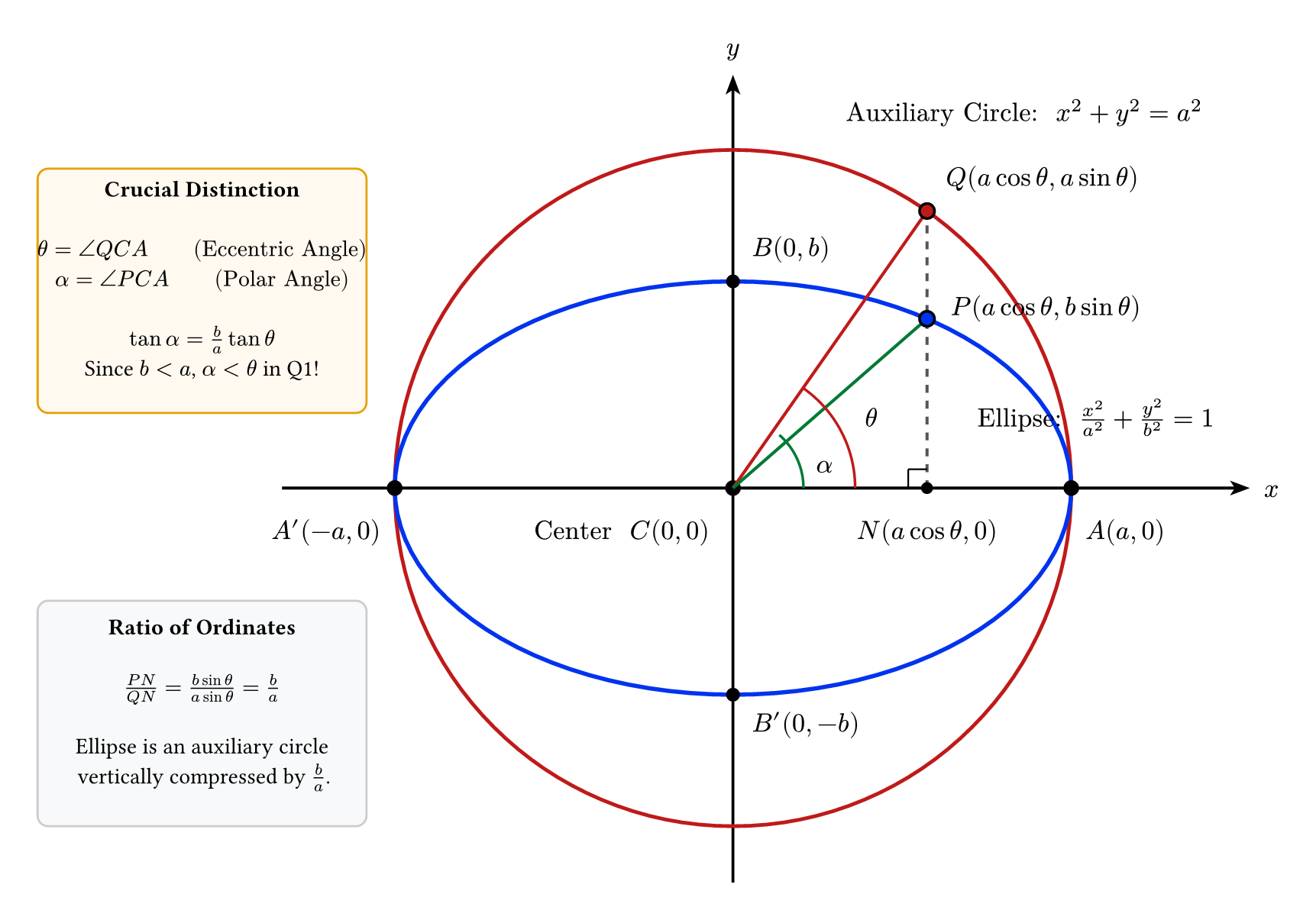
Let P ( x , y ) P(x, y) P ( x , y ) x 2 a 2 + y 2 b 2 = 1 \frac{x^2}{a^2} + \frac{y^2}{b^2} = 1 a 2 x 2 + b 2 y 2 = 1
Drop a perpendicular from P P P x x x N ( x , 0 ) N(x, 0) N ( x , 0 )
Produce the ordinate N P NP N P P P P Q ( x , y ′ ) Q(x, y') Q ( x , y ′ )
The point Q Q Q corresponding point of P P P
By construction:
P P P Q Q Q identical x x x : x P = x Q = x x_P = x_Q = x x P = x Q = x The ordinates y P y_P y P y Q y_Q y Q same sign (both positive, both negative, or both zero), meaning P P P Q Q Q
Derivation of the Parametric Equations§
Join the center C ( 0 , 0 ) C(0, 0) C ( 0 , 0 ) Q Q Q
Let the radius vector C Q CQ C Q θ \theta θ x x x C A CA C A
∠ Q C A = θ \angle QCA = \theta ∠ QC A = θ Since Q Q Q x 2 + y 2 = a 2 x^2 + y^2 = a^2 x 2 + y 2 = a 2 θ \theta θ
x Q = a cos θ , y Q = a sin θ x_Q = a \cos \theta, \quad y_Q = a \sin \theta x Q = a cos θ , y Q = a sin θ Because P P P Q Q Q
x = a cos θ x = a \cos \theta x = a cos θ To find the ordinate y y y P P P x = a cos θ x = a \cos \theta x = a cos θ
( a cos θ ) 2 a 2 + y 2 b 2 = 1 \frac{(a \cos \theta)^2}{a^2} + \frac{y^2}{b^2} = 1 a 2 ( a cos θ ) 2 + b 2 y 2 = 1 a 2 cos 2 θ a 2 + y 2 b 2 = 1 ⟹ cos 2 θ + y 2 b 2 = 1 \frac{a^2 \cos^2 \theta}{a^2} + \frac{y^2}{b^2} = 1 \implies \cos^2 \theta + \frac{y^2}{b^2} = 1 a 2 a 2 cos 2 θ + b 2 y 2 = 1 ⟹ cos 2 θ + b 2 y 2 = 1 y 2 b 2 = 1 − cos 2 θ = sin 2 θ \frac{y^2}{b^2} = 1 - \cos^2 \theta = \sin^2 \theta b 2 y 2 = 1 − cos 2 θ = sin 2 θ y 2 = b 2 sin 2 θ y^2 = b^2 \sin^2 \theta y 2 = b 2 sin 2 θ Taking the square root and noting that y y y y Q = a sin θ y_Q = a \sin \theta y Q = a sin θ
y = b sin θ y = b \sin \theta y = b sin θ Any point P P P x 2 a 2 + y 2 b 2 = 1 \frac{x^2}{a^2} + \frac{y^2}{b^2} = 1 a 2 x 2 + b 2 y 2 = 1 θ \theta θ
x = a cos θ , y = b sin θ x = a \cos \theta, \quad y = b \sin \theta x = a cos θ , y = b sin θ This point is commonly denoted as P ( θ ) P(\theta) P ( θ ) ( a cos θ , b sin θ ) (a \cos \theta, b \sin \theta) ( a cos θ , b sin θ )
The angle θ \theta θ eccentric angle of the point P P P θ \theta θ [ 0 , 2 π ) [0, 2\pi) [ 0 , 2 π ) ( − π , π ] (-\pi, \pi] ( − π , π ] P ( θ ) P(\theta) P ( θ )
Critical Warning: What is the Eccentric Angle Exactly?§
A very common and serious misconception among students is confusing the eccentric angle θ \theta θ P P P polar angle (vectorial angle) ∠ P C A \angle PCA ∠ P C A
The Misconception§
θ ≠ ∠ P C A \theta \ne \angle PCA θ = ∠ P C A The eccentric angle θ \theta θ not the angle made by the radius vector C P CP C P
Rather, θ \theta θ C Q CQ C Q corresponding point Q Q Q with the major axis:
θ = ∠ Q C A \theta = \angle QCA θ = ∠ QC A Relation between Polar Angle and Eccentric Angle§
Let α = ∠ P C A \alpha = \angle PCA α = ∠ P C A P ( a cos θ , b sin θ ) P(a \cos \theta, b \sin \theta) P ( a cos θ , b sin θ ) x x x
In the right-angled triangle △ P N C \triangle PNC △ P N C
tan α = P N C N = y P x P = b sin θ a cos θ = b a tan θ \tan \alpha = \frac{PN}{CN} = \frac{y_P}{x_P} = \frac{b \sin \theta}{a \cos \theta} = \frac{b}{a} \tan \theta tan α = C N P N = x P y P = a cos θ b sin θ = a b tan θ tan α = b a tan θ \tan \alpha = \frac{b}{a} \tan \theta tan α = a b tan θ Since b < a b < a b < a
b a < 1 \frac{b}{a} < 1 a b < 1 This yields fundamental insights:
In the First Quadrant (0 < θ < π 2 0 < \theta < \frac{\pi}{2} 0 < θ < 2 π
tan α < tan θ ⟹ α < θ \tan \alpha < \tan \theta \implies \alpha < \theta tan α < tan θ ⟹ α < θ The ray C P CP C P strictly below the ray C Q CQ C Q
At the Vertices:
At θ = 0 \theta = 0 θ = 0 α = 0 \alpha = 0 α = 0 A ( a , 0 ) A(a, 0) A ( a , 0 )
At θ = π 2 \theta = \frac{\pi}{2} θ = 2 π α = π 2 \alpha = \frac{\pi}{2} α = 2 π B ( 0 , b ) B(0, b) B ( 0 , b )
At θ = π \theta = \pi θ = π α = π \alpha = \pi α = π A ′ ( − a , 0 ) A'(-a, 0) A ′ ( − a , 0 )
At θ = 3 π 2 \theta = \frac{3\pi}{2} θ = 2 3 π α = 3 π 2 \alpha = \frac{3\pi}{2} α = 2 3 π B ′ ( 0 , − b ) B'(0, -b) B ′ ( 0 , − b )
The polar angle α \alpha α θ \theta θ only at the four vertices of the ellipse. At all other points, α ≠ θ \alpha \ne \theta α = θ
Movement of a Point on the Ellipse as the Parameter Varies§
As the parameter θ \theta θ 0 0 0 2 π 2\pi 2 π Q ( a cos θ , a sin θ ) Q(a \cos \theta, a \sin \theta) Q ( a cos θ , a sin θ ) a a a
Simultaneously, the point P ( a cos θ , b sin θ ) P(a \cos \theta, b \sin \theta) P ( a cos θ , b sin θ )
Interval 0 ≤ θ ≤ π 2 0 \le \theta \le \frac{\pi}{2} 0 ≤ θ ≤ 2 π
At θ = 0 \theta = 0 θ = 0 P = ( a , 0 ) P = (a, 0) P = ( a , 0 ) A A A
As θ \theta θ x x x a a a 0 0 0 y y y 0 0 0 b b b
At θ = π 2 \theta = \frac{\pi}{2} θ = 2 π P = ( 0 , b ) P = (0, b) P = ( 0 , b ) B B B
Interval π 2 ≤ θ ≤ π \frac{\pi}{2} \le \theta \le \pi 2 π ≤ θ ≤ π
As θ \theta θ x x x 0 0 0 − a -a − a y y y b b b 0 0 0
At θ = π \theta = \pi θ = π P = ( − a , 0 ) P = (-a, 0) P = ( − a , 0 ) A ′ A' A ′
Interval π ≤ θ ≤ 3 π 2 \pi \le \theta \le \frac{3\pi}{2} π ≤ θ ≤ 2 3 π
As θ \theta θ x x x − a -a − a 0 0 0 y y y 0 0 0 − b -b − b
At θ = 3 π 2 \theta = \frac{3\pi}{2} θ = 2 3 π P = ( 0 , − b ) P = (0, -b) P = ( 0 , − b ) B ′ B' B ′
Interval 3 π 2 ≤ θ ≤ 2 π \frac{3\pi}{2} \le \theta \le 2\pi 2 3 π ≤ θ ≤ 2 π
As θ \theta θ x x x 0 0 0 a a a y y y − b -b − b 0 0 0
At θ = 2 π \theta = 2\pi θ = 2 π P = ( a , 0 ) P = (a, 0) P = ( a , 0 ) A A A
The Constant Ratio of Ordinates§
A defining geometric property connecting the ellipse and its auxiliary circle is the ratio of their ordinates.
For any point P ( a cos θ , b sin θ ) P(a \cos \theta, b \sin \theta) P ( a cos θ , b sin θ ) Q ( a cos θ , a sin θ ) Q(a \cos \theta, a \sin \theta) Q ( a cos θ , a sin θ ) x x x
P N = ∣ y P ∣ = ∣ b sin θ ∣ PN = |y_P| = |b \sin \theta| P N = ∣ y P ∣ = ∣ b sin θ ∣ Q N = ∣ y Q ∣ = ∣ a sin θ ∣ QN = |y_Q| = |a \sin \theta| QN = ∣ y Q ∣ = ∣ a sin θ ∣ Taking their ratio for any point not on the major axis (sin θ ≠ 0 \sin \theta \ne 0 sin θ = 0
P N Q N = b sin θ a sin θ = b a \frac{PN}{QN} = \frac{b \sin \theta}{a \sin \theta} = \frac{b}{a} QN P N = a sin θ b sin θ = a b P N Q N = b a = constant \frac{PN}{QN} = \frac{b}{a} = \text{constant} QN P N = a b = constant Geometric Interpretation: Affine Compression§
The ratio of the ordinate of any point on an ellipse to the ordinate of the corresponding point on the auxiliary circle is constant and equal to b a \frac{b}{a} a b
Geometrically, this means that an ellipse of semi-axes a a a b b b uniformly compressing a circle of radius a a a b a \frac{b}{a} a b
Every vertical segment in the auxiliary circle is scaled by the constant factor b a \frac{b}{a} a b
Area of an Inscribed Triangle and the Maximum Area§
The constant ratio of ordinates provides an extraordinarily elegant method for computing areas of figures inscribed in an ellipse.
Area of a Triangle Inscribed in an Ellipse§
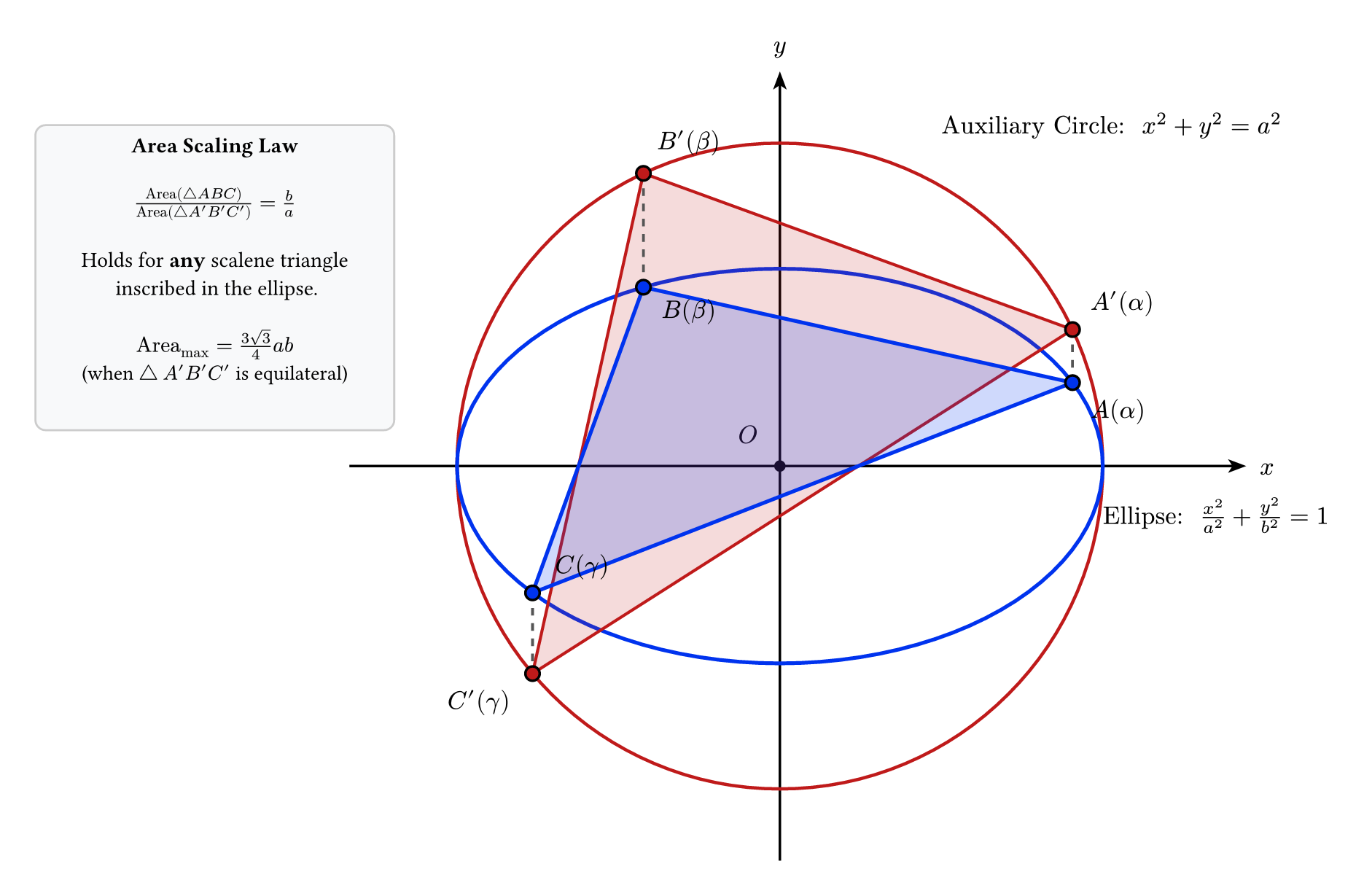
Let three points on the ellipse x 2 a 2 + y 2 b 2 = 1 \frac{x^2}{a^2} + \frac{y^2}{b^2} = 1 a 2 x 2 + b 2 y 2 = 1 α , β , γ \alpha, \beta, \gamma α , β , γ
A ( a cos α , b sin α ) , B ( a cos β , b sin β ) , C ( a cos γ , b sin γ ) A(a \cos \alpha, b \sin \alpha), \quad B(a \cos \beta, b \sin \beta), \quad C(a \cos \gamma, b \sin \gamma) A ( a cos α , b sin α ) , B ( a cos β , b sin β ) , C ( a cos γ , b sin γ ) The area of △ A B C \triangle ABC △ A B C
Area ( △ A B C ) = 1 2 ∣ det ( a cos α b sin α 1 a cos β b sin β 1 a cos γ b sin γ 1 ) ∣ \text{Area}(\triangle ABC) = \frac{1}{2} \left| \det \begin{pmatrix} a \cos \alpha & b \sin \alpha & 1 \\ a \cos \beta & b \sin \beta & 1 \\ a \cos \gamma & b \sin \gamma & 1 \end{pmatrix} \right| Area ( △ A B C ) = 2 1 det a cos α a cos β a cos γ b sin α b sin β b sin γ 1 1 1 Factor out a a a b b b
Area ( △ A B C ) = 1 2 a b ∣ det ( cos α sin α 1 cos β sin β 1 cos γ sin γ 1 ) ∣ \text{Area}(\triangle ABC) = \frac{1}{2} ab \left| \det \begin{pmatrix} \cos \alpha & \sin \alpha & 1 \\ \cos \beta & \sin \beta & 1 \\ \cos \gamma & \sin \gamma & 1 \end{pmatrix} \right| Area ( △ A B C ) = 2 1 ab det cos α cos β cos γ sin α sin β sin γ 1 1 1 Now consider the corresponding points on the auxiliary circle:
A ′ ( a cos α , a sin α ) , B ′ ( a cos β , a sin β ) , C ′ ( a cos γ , a sin γ ) A'(a \cos \alpha, a \sin \alpha), \quad B'(a \cos \beta, a \sin \beta), \quad C'(a \cos \gamma, a \sin \gamma) A ′ ( a cos α , a sin α ) , B ′ ( a cos β , a sin β ) , C ′ ( a cos γ , a sin γ ) The area of the corresponding triangle △ A ′ B ′ C ′ \triangle A'B'C' △ A ′ B ′ C ′
Area ( △ A ′ B ′ C ′ ) = 1 2 ∣ det ( a cos α a sin α 1 a cos β a sin β 1 a cos γ a sin γ 1 ) ∣ = 1 2 a 2 ∣ det ( cos α sin α 1 cos β sin β 1 cos γ sin γ 1 ) ∣ \text{Area}(\triangle A'B'C') = \frac{1}{2} \left| \det \begin{pmatrix} a \cos \alpha & a \sin \alpha & 1 \\ a \cos \beta & a \sin \beta & 1 \\ a \cos \gamma & a \sin \gamma & 1 \end{pmatrix} \right| = \frac{1}{2} a^2 \left| \det \begin{pmatrix} \cos \alpha & \sin \alpha & 1 \\ \cos \beta & \sin \beta & 1 \\ \cos \gamma & \sin \gamma & 1 \end{pmatrix} \right| Area ( △ A ′ B ′ C ′ ) = 2 1 det a cos α a cos β a cos γ a sin α a sin β a sin γ 1 1 1 = 2 1 a 2 det cos α cos β cos γ sin α sin β sin γ 1 1 1 Comparing the two expressions:
Area ( △ A B C ) Area ( △ A ′ B ′ C ′ ) = 1 2 a b Δ 1 2 a 2 Δ = b a \frac{\text{Area}(\triangle ABC)}{\text{Area}(\triangle A'B'C')} = \frac{\frac{1}{2} ab \Delta}{\frac{1}{2} a^2 \Delta} = \frac{b}{a} Area ( △ A ′ B ′ C ′ ) Area ( △ A B C ) = 2 1 a 2 Δ 2 1 ab Δ = a b Area ( △ A B C ) = b a ⋅ Area ( △ A ′ B ′ C ′ ) \text{Area}(\triangle ABC) = \frac{b}{a} \cdot \text{Area}(\triangle A'B'C') Area ( △ A B C ) = a b ⋅ Area ( △ A ′ B ′ C ′ ) The area of any triangle inscribed in an ellipse is always b a \frac{b}{a} a b
Maximum Area of an Inscribed Triangle§
To maximize the area of △ A B C \triangle ABC △ A B C △ A ′ B ′ C ′ \triangle A'B'C' △ A ′ B ′ C ′ x 2 + y 2 = a 2 x^2 + y^2 = a^2 x 2 + y 2 = a 2
From Euclidean geometry, the triangle of maximum area inscribed in a given circle of radius a a a equilateral triangle .
For an equilateral triangle inscribed in a circle of radius a a a s s s
s = 2 a sin 60 ∘ = 2 a ⋅ 3 2 = 3 a s = 2a \sin 60^\circ = 2a \cdot \frac{\sqrt{3}}{2} = \sqrt{3}a s = 2 a sin 6 0 ∘ = 2 a ⋅ 2 3 = 3 a The area of this equilateral triangle is:
Area max ( △ A ′ B ′ C ′ ) = 3 4 s 2 = 3 4 ( 3 a ) 2 = 3 3 4 a 2 \text{Area}_{\max}(\triangle A'B'C') = \frac{\sqrt{3}}{4} s^2 = \frac{\sqrt{3}}{4} (\sqrt{3}a)^2 = \frac{3\sqrt{3}}{4} a^2 Area m a x ( △ A ′ B ′ C ′ ) = 4 3 s 2 = 4 3 ( 3 a ) 2 = 4 3 3 a 2 Therefore, the maximum area of a triangle inscribed in the ellipse x 2 a 2 + y 2 b 2 = 1 \frac{x^2}{a^2} + \frac{y^2}{b^2} = 1 a 2 x 2 + b 2 y 2 = 1
Area max ( △ A B C ) = b a ⋅ ( 3 3 4 a 2 ) = 3 3 4 a b \text{Area}_{\max}(\triangle ABC) = \frac{b}{a} \cdot \left(\frac{3\sqrt{3}}{4} a^2\right) = \frac{3\sqrt{3}}{4} ab Area m a x ( △ A B C ) = a b ⋅ ( 4 3 3 a 2 ) = 4 3 3 ab Condition for Maximum Area§
The maximum area is attained when △ A ′ B ′ C ′ \triangle A'B'C' △ A ′ B ′ C ′ 120 ∘ 120^\circ 12 0 ∘ 2 π 3 \frac{2\pi}{3} 3 2 π
β − α = γ − β = 2 π 3 \beta - \alpha = \gamma - \beta = \frac{2\pi}{3} β − α = γ − β = 3 2 π Thus, the eccentric angles of the vertices of the maximum triangle on the ellipse differ successively by 2 π 3 \frac{2\pi}{3} 3 2 π
Corollary: Total Area of an Ellipse§
The constant ratio of areas extends to any inscribed polygon, and by a limiting process (Riemann sums of vertical strips), to the entire curve.
The area of the auxiliary circle is:
Area ( Auxiliary Circle ) = π a 2 \text{Area}(\text{Auxiliary Circle}) = \pi a^2 Area ( Auxiliary Circle ) = π a 2 Because every vertical strip is scaled by the factor b a \frac{b}{a} a b
Area of Ellipse = b a ⋅ ( π a 2 ) = π a b \text{Area of Ellipse} = \frac{b}{a} \cdot (\pi a^2) = \pi ab Area of Ellipse = a b ⋅ ( π a 2 ) = π ab Equation of the Chord Joining Two Points§
Let P ( θ ) P(\theta) P ( θ ) Q ( ϕ ) Q(\phi) Q ( ϕ ) x 2 a 2 + y 2 b 2 = 1 \frac{x^2}{a^2} + \frac{y^2}{b^2} = 1 a 2 x 2 + b 2 y 2 = 1
P ( a cos θ , b sin θ ) and Q ( a cos ϕ , b sin ϕ ) P(a \cos \theta, b \sin \theta) \quad \text{and} \quad Q(a \cos \phi, b \sin \phi) P ( a cos θ , b sin θ ) and Q ( a cos ϕ , b sin ϕ ) Derivation§
The slope of the secant line passing through P P P Q Q Q
m = b sin θ − b sin ϕ a cos θ − a cos ϕ = b ( sin θ − sin ϕ ) a ( cos θ − cos ϕ ) m = \frac{b \sin \theta - b \sin \phi}{a \cos \theta - a \cos \phi} = \frac{b(\sin \theta - \sin \phi)}{a(\cos \theta - \cos \phi)} m = a cos θ − a cos ϕ b sin θ − b sin ϕ = a ( cos θ − cos ϕ ) b ( sin θ − sin ϕ ) Apply the standard trigonometric sum-to-product identities:
sin θ − sin ϕ = 2 cos ( θ + ϕ 2 ) sin ( θ − ϕ 2 ) \sin \theta - \sin \phi = 2 \cos\left(\frac{\theta + \phi}{2}\right) \sin\left(\frac{\theta - \phi}{2}\right) sin θ − sin ϕ = 2 cos ( 2 θ + ϕ ) sin ( 2 θ − ϕ ) cos θ − cos ϕ = − 2 sin ( θ + ϕ 2 ) sin ( θ − ϕ 2 ) \cos \theta - \cos \phi = -2 \sin\left(\frac{\theta + \phi}{2}\right) \sin\left(\frac{\theta - \phi}{2}\right) cos θ − cos ϕ = − 2 sin ( 2 θ + ϕ ) sin ( 2 θ − ϕ ) Assuming the two points are distinct (θ ≠ ϕ \theta \ne \phi θ = ϕ sin ( θ − ϕ 2 ) ≠ 0 \sin\left(\frac{\theta - \phi}{2}\right) \ne 0 sin ( 2 θ − ϕ ) = 0
m = 2 b cos ( θ + ϕ 2 ) sin ( θ − ϕ 2 ) − 2 a sin ( θ + ϕ 2 ) sin ( θ − ϕ 2 ) = − b cos ( θ + ϕ 2 ) a sin ( θ + ϕ 2 ) m = \frac{2b \cos\left(\frac{\theta + \phi}{2}\right) \sin\left(\frac{\theta - \phi}{2}\right)}{-2a \sin\left(\frac{\theta + \phi}{2}\right) \sin\left(\frac{\theta - \phi}{2}\right)} = -\frac{b \cos\left(\frac{\theta + \phi}{2}\right)}{a \sin\left(\frac{\theta + \phi}{2}\right)} m = − 2 a sin ( 2 θ + ϕ ) sin ( 2 θ − ϕ ) 2 b cos ( 2 θ + ϕ ) sin ( 2 θ − ϕ ) = − a sin ( 2 θ + ϕ ) b cos ( 2 θ + ϕ ) Now write the equation of the line using the point-slope form with point P ( a cos θ , b sin θ ) P(a \cos \theta, b \sin \theta) P ( a cos θ , b sin θ )
y − b sin θ = − b cos ( θ + ϕ 2 ) a sin ( θ + ϕ 2 ) ( x − a cos θ ) y - b \sin \theta = -\frac{b \cos\left(\frac{\theta + \phi}{2}\right)}{a \sin\left(\frac{\theta + \phi}{2}\right)} (x - a \cos \theta) y − b sin θ = − a sin ( 2 θ + ϕ ) b cos ( 2 θ + ϕ ) ( x − a cos θ ) Divide both sides by b b b sin ( θ + ϕ 2 ) \sin\left(\frac{\theta + \phi}{2}\right) sin ( 2 θ + ϕ )
x a cos ( θ + ϕ 2 ) + y b sin ( θ + ϕ 2 ) = cos θ cos ( θ + ϕ 2 ) + sin θ sin ( θ + ϕ 2 ) \frac{x}{a} \cos\left(\frac{\theta + \phi}{2}\right) + \frac{y}{b} \sin\left(\frac{\theta + \phi}{2}\right) = \cos \theta \cos\left(\frac{\theta + \phi}{2}\right) + \sin \theta \sin\left(\frac{\theta + \phi}{2}\right) a x cos ( 2 θ + ϕ ) + b y sin ( 2 θ + ϕ ) = cos θ cos ( 2 θ + ϕ ) + sin θ sin ( 2 θ + ϕ ) The right-hand side is the expansion of cos ( A − B ) \cos(A - B) cos ( A − B ) A = θ A = \theta A = θ B = θ + ϕ 2 B = \frac{\theta + \phi}{2} B = 2 θ + ϕ
θ − θ + ϕ 2 = θ − ϕ 2 \theta - \frac{\theta + \phi}{2} = \frac{\theta - \phi}{2} θ − 2 θ + ϕ = 2 θ − ϕ Therefore:
x a cos ( θ + ϕ 2 ) + y b sin ( θ + ϕ 2 ) = cos ( θ − ϕ 2 ) \frac{x}{a}\cos\left(\frac{\theta + \phi}{2}\right) + \frac{y}{b}\sin\left(\frac{\theta + \phi}{2}\right) = \cos\left(\frac{\theta - \phi}{2}\right) a x cos ( 2 θ + ϕ ) + b y sin ( 2 θ + ϕ ) = cos ( 2 θ − ϕ ) This is the standard equation of the chord joining points with eccentric angles θ \theta θ ϕ \phi ϕ
Tangent as a Limiting Case of a Chord§
As the point Q Q Q P P P ϕ → θ \phi \to \theta ϕ → θ
θ + ϕ 2 → θ and θ − ϕ 2 → 0 \frac{\theta + \phi}{2} \to \theta \quad \text{and} \quad \frac{\theta - \phi}{2} \to 0 2 θ + ϕ → θ and 2 θ − ϕ → 0 Since cos ( 0 ) = 1 \cos(0) = 1 cos ( 0 ) = 1
x a cos θ + y b sin θ = 1 \frac{x}{a}\cos \theta + \frac{y}{b}\sin \theta = 1 a x cos θ + b y sin θ = 1 This is the parametric equation of the tangent to the ellipse at the point P ( θ ) P(\theta) P ( θ )
Condition for a Focal Chord§
A chord joining P ( θ ) P(\theta) P ( θ ) Q ( ϕ ) Q(\phi) Q ( ϕ ) focal chord if it passes through one of the foci.
Chord Passing through the Right Focus§
Substitute x = a e x = ae x = a e y = 0 y = 0 y = 0
a e a cos ( θ + ϕ 2 ) + 0 b sin ( θ + ϕ 2 ) = cos ( θ − ϕ 2 ) \frac{ae}{a} \cos\left(\frac{\theta + \phi}{2}\right) + \frac{0}{b} \sin\left(\frac{\theta + \phi}{2}\right) = \cos\left(\frac{\theta - \phi}{2}\right) a a e cos ( 2 θ + ϕ ) + b 0 sin ( 2 θ + ϕ ) = cos ( 2 θ − ϕ ) e cos ( θ + ϕ 2 ) = cos ( θ − ϕ 2 ) e \cos\left(\frac{\theta + \phi}{2}\right) = \cos\left(\frac{\theta - \phi}{2}\right) e cos ( 2 θ + ϕ ) = cos ( 2 θ − ϕ ) Expand the cosine terms:
e [ cos θ 2 cos ϕ 2 − sin θ 2 sin ϕ 2 ] = cos θ 2 cos ϕ 2 + sin θ 2 sin ϕ 2 e\left[\cos\frac{\theta}{2}\cos\frac{\phi}{2} - \sin\frac{\theta}{2}\sin\frac{\phi}{2}\right] = \cos\frac{\theta}{2}\cos\frac{\phi}{2} + \sin\frac{\theta}{2}\sin\frac{\phi}{2} e [ cos 2 θ cos 2 ϕ − sin 2 θ sin 2 ϕ ] = cos 2 θ cos 2 ϕ + sin 2 θ sin 2 ϕ Divide through by cos θ 2 cos ϕ 2 \cos\frac{\theta}{2}\cos\frac{\phi}{2} cos 2 θ cos 2 ϕ
e [ 1 − tan θ 2 tan ϕ 2 ] = 1 + tan θ 2 tan ϕ 2 e\left[1 - \tan\frac{\theta}{2}\tan\frac{\phi}{2}\right] = 1 + \tan\frac{\theta}{2}\tan\frac{\phi}{2} e [ 1 − tan 2 θ tan 2 ϕ ] = 1 + tan 2 θ tan 2 ϕ e − 1 = ( e + 1 ) tan θ 2 tan ϕ 2 e - 1 = (e + 1)\tan\frac{\theta}{2}\tan\frac{\phi}{2} e − 1 = ( e + 1 ) tan 2 θ tan 2 ϕ tan ( θ 2 ) tan ( ϕ 2 ) = e − 1 e + 1 = − 1 − e 1 + e \tan\left(\frac{\theta}{2}\right) \tan\left(\frac{\phi}{2}\right) = \frac{e - 1}{e + 1} = -\frac{1 - e}{1 + e} tan ( 2 θ ) tan ( 2 ϕ ) = e + 1 e − 1 = − 1 + e 1 − e Chord Passing through the Left Focus§
Substituting x = − a e x = -ae x = − a e y = 0 y = 0 y = 0
− e cos ( θ + ϕ 2 ) = cos ( θ − ϕ 2 ) -e \cos\left(\frac{\theta + \phi}{2}\right) = \cos\left(\frac{\theta - \phi}{2}\right) − e cos ( 2 θ + ϕ ) = cos ( 2 θ − ϕ ) Following identical steps:
tan ( θ 2 ) tan ( ϕ 2 ) = − e − 1 − e + 1 = e + 1 e − 1 = − 1 + e 1 − e \tan\left(\frac{\theta}{2}\right) \tan\left(\frac{\phi}{2}\right) = \frac{-e - 1}{-e + 1} = \frac{e + 1}{e - 1} = -\frac{1 + e}{1 - e} tan ( 2 θ ) tan ( 2 ϕ ) = − e + 1 − e − 1 = e − 1 e + 1 = − 1 − e 1 + e Shifted Ellipse with Displaced Center§
For an ellipse with center C ( h , k ) C(h, k) C ( h , k )
( x − h ) 2 a 2 + ( y − k ) 2 b 2 = 1 \frac{(x - h)^2}{a^2} + \frac{(y - k)^2}{b^2} = 1 a 2 ( x − h ) 2 + b 2 ( y − k ) 2 = 1 Under the translation X = x − h X = x - h X = x − h Y = y − k Y = y - k Y = y − k
X = a cos θ , Y = b sin θ X = a \cos \theta, \quad Y = b \sin \theta X = a cos θ , Y = b sin θ Therefore, the parametric equations are:
x = h + a cos θ , y = k + b sin θ x = h + a \cos \theta, \quad y = k + b \sin \theta x = h + a cos θ , y = k + b sin θ Vertical Ellipse§
For a vertical ellipse x 2 a 2 + y 2 b 2 = 1 \frac{x^2}{a^2} + \frac{y^2}{b^2} = 1 a 2 x 2 + b 2 y 2 = 1 b > a b > a b > a 2 b 2b 2 b y y y
The auxiliary circle is described on the major axis as diameter, so its radius is b b b
x 2 + y 2 = b 2 x^2 + y^2 = b^2 x 2 + y 2 = b 2 The parameterization remains:
x = a cos θ , y = b sin θ x = a \cos \theta, \quad y = b \sin \theta x = a cos θ , y = b sin θ where x 2 a 2 + y 2 b 2 = cos 2 θ + sin 2 θ = 1 \frac{x^2}{a^2} + \frac{y^2}{b^2} = \cos^2 \theta + \sin^2 \theta = 1 a 2 x 2 + b 2 y 2 = cos 2 θ + sin 2 θ = 1
Illustrative Examples§
Example 1: Finding the Eccentric Angle from the Polar Angle§
Problem. For the ellipse x 2 25 + y 2 16 = 1 \frac{x^2}{25} + \frac{y^2}{16} = 1 25 x 2 + 16 y 2 = 1 x x x 30 ∘ 30^\circ 3 0 ∘
Solution. Here a 2 = 25 ⟹ a = 5 a^2 = 25 \implies a = 5 a 2 = 25 ⟹ a = 5 b 2 = 16 ⟹ b = 4 b^2 = 16 \implies b = 4 b 2 = 16 ⟹ b = 4
Let α = 30 ∘ \alpha = 30^\circ α = 3 0 ∘ θ \theta θ
The relation between polar angle and eccentric angle is:
tan α = b a tan θ \tan \alpha = \frac{b}{a} \tan \theta tan α = a b tan θ Substitute α = 30 ∘ , a = 5 , b = 4 \alpha = 30^\circ, a = 5, b = 4 α = 3 0 ∘ , a = 5 , b = 4
tan 30 ∘ = 4 5 tan θ \tan 30^\circ = \frac{4}{5} \tan \theta tan 3 0 ∘ = 5 4 tan θ Since tan 30 ∘ = 1 3 \tan 30^\circ = \frac{1}{\sqrt{3}} tan 3 0 ∘ = 3 1
1 3 = 4 5 tan θ ⟹ tan θ = 5 4 3 = 5 3 12 \frac{1}{\sqrt{3}} = \frac{4}{5} \tan \theta \implies \tan \theta = \frac{5}{4\sqrt{3}} = \frac{5\sqrt{3}}{12} 3 1 = 5 4 tan θ ⟹ tan θ = 4 3 5 = 12 5 3 θ = arctan ( 5 3 12 ) \theta = \arctan\left(\frac{5\sqrt{3}}{12}\right) θ = arctan ( 12 5 3 ) Notice that 5 3 12 ≈ 8.66 12 ≈ 0.722 \frac{5\sqrt{3}}{12} \approx \frac{8.66}{12} \approx 0.722 12 5 3 ≈ 12 8.66 ≈ 0.722 tan 30 ∘ ≈ 0.577 \tan 30^\circ \approx 0.577 tan 3 0 ∘ ≈ 0.577 θ ≈ 35.8 ∘ > 30 ∘ \theta \approx 35.8^\circ > 30^\circ θ ≈ 35. 8 ∘ > 3 0 ∘ θ > α \theta > \alpha θ > α
Example 2: Maximum Area of an Inscribed Triangle§
Problem. Find the maximum possible area of a triangle inscribed in the ellipse 9 x 2 + 16 y 2 = 144 9x^2 + 16y^2 = 144 9 x 2 + 16 y 2 = 144
Solution. Dividing the equation by 144 144 144
x 2 16 + y 2 9 = 1 ⟹ a = 4 , b = 3 \frac{x^2}{16} + \frac{y^2}{9} = 1 \implies a = 4, \quad b = 3 16 x 2 + 9 y 2 = 1 ⟹ a = 4 , b = 3 The maximum area of a triangle inscribed in the ellipse x 2 a 2 + y 2 b 2 = 1 \frac{x^2}{a^2} + \frac{y^2}{b^2} = 1 a 2 x 2 + b 2 y 2 = 1
Area max = 3 3 4 a b \text{Area}_{\max} = \frac{3\sqrt{3}}{4} ab Area m a x = 4 3 3 ab Substitute a = 4 a = 4 a = 4 b = 3 b = 3 b = 3
Area max = 3 3 4 ( 4 ) ( 3 ) = 9 3 sq. units \text{Area}_{\max} = \frac{3\sqrt{3}}{4} (4)(3) = 9\sqrt{3} \text{ sq. units} Area m a x = 4 3 3 ( 4 ) ( 3 ) = 9 3 sq. units Example 3: Chord Joining Given Eccentric Angles§
Problem. Find the equation of the chord joining the points on the ellipse x 2 36 + y 2 9 = 1 \frac{x^2}{36} + \frac{y^2}{9} = 1 36 x 2 + 9 y 2 = 1 θ = π 3 \theta = \frac{\pi}{3} θ = 3 π ϕ = π 6 \phi = \frac{\pi}{6} ϕ = 6 π
Solution. Here a = 6 a = 6 a = 6 b = 3 b = 3 b = 3
Compute the half-sum and half-difference of the angles:
θ + ϕ 2 = π 3 + π 6 2 = π 2 2 = π 4 \frac{\theta + \phi}{2} = \frac{\frac{\pi}{3} + \frac{\pi}{6}}{2} = \frac{\frac{\pi}{2}}{2} = \frac{\pi}{4} 2 θ + ϕ = 2 3 π + 6 π = 2 2 π = 4 π θ − ϕ 2 = π 3 − π 6 2 = π 6 2 = π 12 \frac{\theta - \phi}{2} = \frac{\frac{\pi}{3} - \frac{\pi}{6}}{2} = \frac{\frac{\pi}{6}}{2} = \frac{\pi}{12} 2 θ − ϕ = 2 3 π − 6 π = 2 6 π = 12 π The equation of the chord is:
x a cos ( θ + ϕ 2 ) + y b sin ( θ + ϕ 2 ) = cos ( θ − ϕ 2 ) \frac{x}{a}\cos\left(\frac{\theta + \phi}{2}\right) + \frac{y}{b}\sin\left(\frac{\theta + \phi}{2}\right) = \cos\left(\frac{\theta - \phi}{2}\right) a x cos ( 2 θ + ϕ ) + b y sin ( 2 θ + ϕ ) = cos ( 2 θ − ϕ ) x 6 cos π 4 + y 3 sin π 4 = cos π 12 \frac{x}{6}\cos\frac{\pi}{4} + \frac{y}{3}\sin\frac{\pi}{4} = \cos\frac{\pi}{12} 6 x cos 4 π + 3 y sin 4 π = cos 12 π Since cos π 4 = sin π 4 = 1 2 \cos\frac{\pi}{4} = \sin\frac{\pi}{4} = \frac{1}{\sqrt{2}} cos 4 π = sin 4 π = 2 1 cos π 12 = 6 + 2 4 \cos\frac{\pi}{12} = \frac{\sqrt{6} + \sqrt{2}}{4} cos 12 π = 4 6 + 2
x 6 2 + y 3 2 = 6 + 2 4 \frac{x}{6\sqrt{2}} + \frac{y}{3\sqrt{2}} = \frac{\sqrt{6} + \sqrt{2}}{4} 6 2 x + 3 2 y = 4 6 + 2 Multiply through by 6 2 6\sqrt{2} 6 2
x + 2 y = 6 2 ⋅ 6 + 2 4 = 3 2 ( 6 + 2 ) 2 = 3 ( 2 3 + 2 ) 2 = 3 ( 3 + 1 ) x + 2y = 6\sqrt{2} \cdot \frac{\sqrt{6} + \sqrt{2}}{4} = \frac{3\sqrt{2}(\sqrt{6} + \sqrt{2})}{2} = \frac{3(2\sqrt{3} + 2)}{2} = 3(\sqrt{3} + 1) x + 2 y = 6 2 ⋅ 4 6 + 2 = 2 3 2 ( 6 + 2 ) = 2 3 ( 2 3 + 2 ) = 3 ( 3 + 1 ) The equation of the chord is:
x + 2 y = 3 ( 3 + 1 ) x + 2y = 3(\sqrt{3} + 1) x + 2 y = 3 ( 3 + 1 ) Summary of Key Results§
Concept
Mathematical Form
Geometric Meaning
Auxiliary Circle x 2 + y 2 = a 2 x^2 + y^2 = a^2 x 2 + y 2 = a 2 Circle described on the major axis 2 a 2a 2 a
Parametric Coordinates ( a cos θ , b sin θ ) (a \cos \theta, \; b \sin \theta) ( a cos θ , b sin θ ) Parameter θ \theta θ 0 ≤ θ < 2 π 0 \le \theta < 2\pi 0 ≤ θ < 2 π
Eccentric Angle θ \theta θ θ = ∠ Q C A \theta = \angle QCA θ = ∠ QC A Angle of corresponding point Q Q Q
Polar Angle α \alpha α θ \theta θ tan α = b a tan θ \tan \alpha = \frac{b}{a} \tan \theta tan α = a b tan θ α < θ \alpha < \theta α < θ
Ratio of Ordinates y ellipse y circle = b a \frac{y_{\text{ellipse}}}{y_{\text{circle}}} = \frac{b}{a} y circle y ellipse = a b Ellipse is an auxiliary circle vertically compressed by b a \frac{b}{a} a b
Chord Equation x a cos θ + ϕ 2 + y b sin θ + ϕ 2 = cos θ − ϕ 2 \frac{x}{a}\cos\frac{\theta+\phi}{2} + \frac{y}{b}\sin\frac{\theta+\phi}{2} = \cos\frac{\theta-\phi}{2} a x cos 2 θ + ϕ + b y sin 2 θ + ϕ = cos 2 θ − ϕ Secant line through points P ( θ ) P(\theta) P ( θ ) Q ( ϕ ) Q(\phi) Q ( ϕ )
Tangent at P ( θ ) P(\theta) P ( θ ) x a cos θ + y b sin θ = 1 \frac{x}{a}\cos \theta + \frac{y}{b}\sin \theta = 1 a x cos θ + b y sin θ = 1 Limiting chord as ϕ → θ \phi \to \theta ϕ → θ
Focal Chord through ( a e , 0 ) (ae, 0) ( a e , 0 ) tan θ 2 tan ϕ 2 = − 1 − e 1 + e \tan\frac{\theta}{2} \tan\frac{\phi}{2} = -\frac{1-e}{1+e} tan 2 θ tan 2 ϕ = − 1 + e 1 − e Product of half-angle tangents is constant
Max Inscribed Triangle Area Area max = 3 3 4 a b \text{Area}_{\max} = \frac{3\sqrt{3}}{4} ab Area m a x = 4 3 3 ab Occurs when eccentric angles differ by 2 π 3 \frac{2\pi}{3} 3 2 π
Total Ellipse Area Area = π a b \text{Area} = \pi ab Area = π ab Scaled from auxiliary circle area π a 2 \pi a^2 π a 2 b a \frac{b}{a} a b