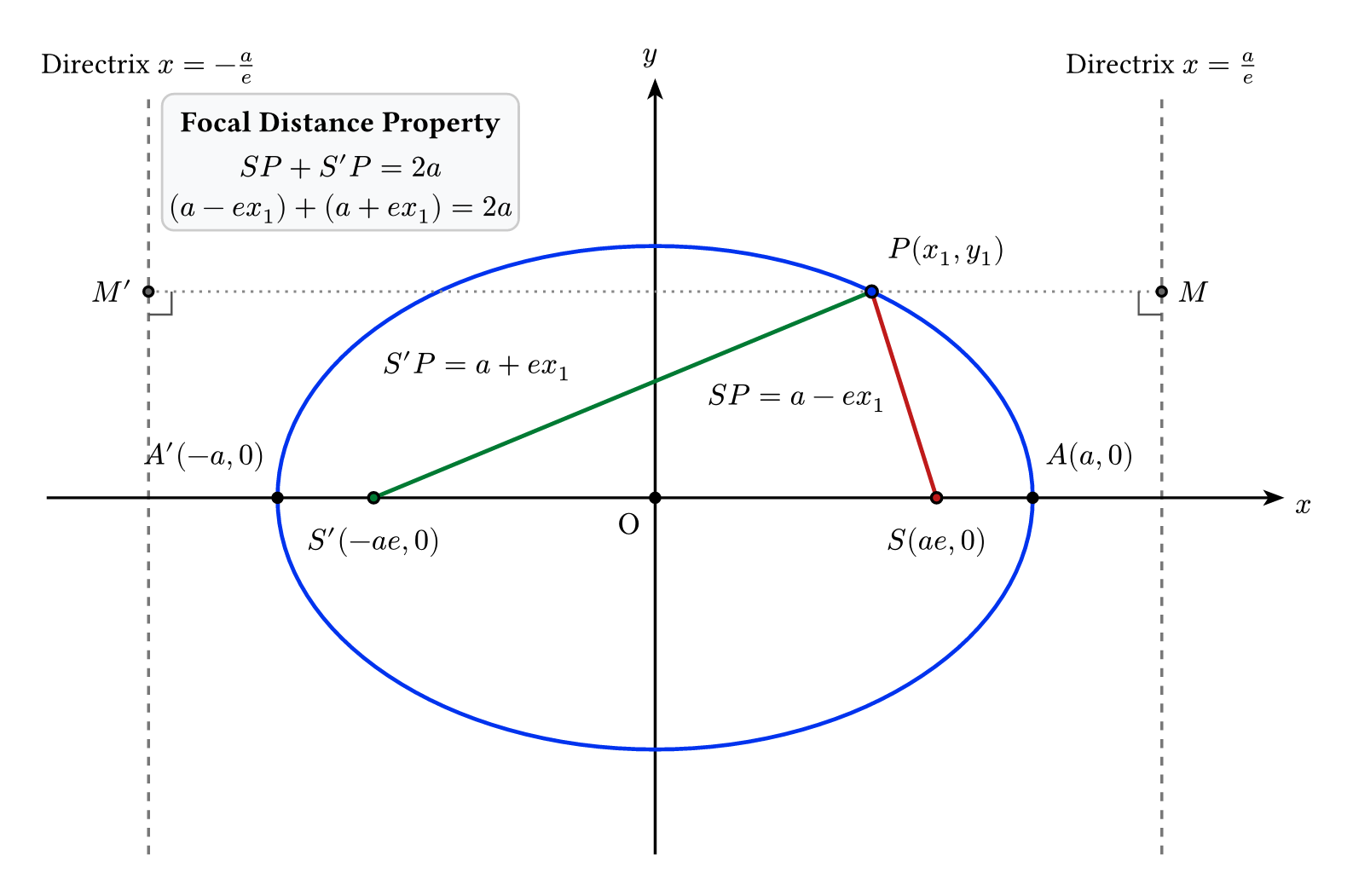
In earlier chapters, we defined an ellipse using a focus and a directrix (S P = e ⋅ P M SP = e \cdot PM S P = e ⋅ P M two foci :
The sum of the distances of any point on an ellipse from its two foci is always constant and equal to the length of the major axis:
S P + S ′ P = 2 a SP + S'P = 2a S P + S ′ P = 2 a This two-focus property is very practical—it is the principle behind the simple pins-and-string method used to draw an ellipse, and it is fundamental in physics and astronomy for describing planetary orbits.
In this chapter, we will:
Derive the formulas for the focal distances S P SP S P S ′ P S'P S ′ P 2 a 2a 2 a
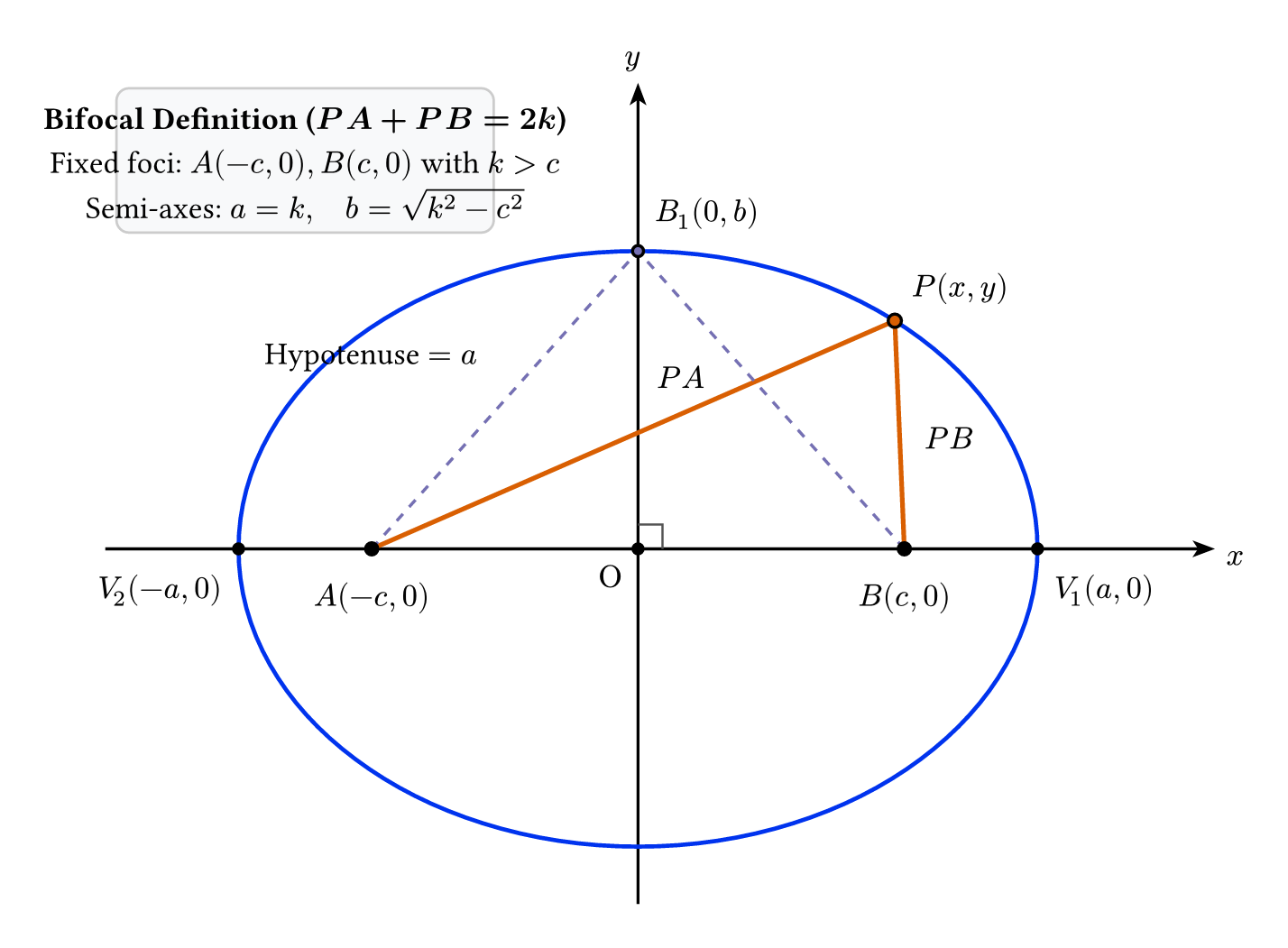
Prove the converse theorem : if a point moves such that the sum of its distances from two fixed points A A A B B B P A + P B = 2 k PA + PB = 2k P A + P B = 2 k A B < 2 k AB < 2k A B < 2 k
Study focal chords : their parametric equations, the relationship between the eccentric angles of their endpoints, their lengths, and the harmonic mean property of focal segments.
Focal Distances of a Point on the Ellipse§
Consider the standard horizontal ellipse with center at the origin:
x 2 a 2 + y 2 b 2 = 1 ( a > b > 0 ) \frac{x^2}{a^2} + \frac{y^2}{b^2} = 1 \quad (a > b > 0) a 2 x 2 + b 2 y 2 = 1 ( a > b > 0 ) where b 2 = a 2 ( 1 − e 2 ) b^2 = a^2(1 - e^2) b 2 = a 2 ( 1 − e 2 ) e = 1 − b 2 a 2 ∈ ( 0 , 1 ) e = \sqrt{1 - \frac{b^2}{a^2}} \in (0, 1) e = 1 − a 2 b 2 ∈ ( 0 , 1 )
The ellipse has two foci:
S ( a e , 0 ) and S ′ ( − a e , 0 ) S(ae, 0) \quad \text{and} \quad S'(-ae, 0) S ( a e , 0 ) and S ′ ( − a e , 0 ) and two corresponding directrices:
x = a e and x = − a e x = \frac{a}{e} \quad \text{and} \quad x = -\frac{a}{e} x = e a and x = − e a Definition of Focal Distance§
The distance from any point P ( x 1 , y 1 ) P(x_1, y_1) P ( x 1 , y 1 ) focal distance (or focal radius ).
Because there are two foci, every point P P P
S P SP S P P P P S ( a e , 0 ) S(ae, 0) S ( a e , 0 ) S ′ P S'P S ′ P P P P S ′ ( − a e , 0 ) S'(-ae, 0) S ′ ( − a e , 0 )
Derivation Using the Focus-Directrix Property§
Let P ( x 1 , y 1 ) P(x_1, y_1) P ( x 1 , y 1 ) P P P
Let M M M P P P x = a e x = \frac{a}{e} x = e a
Let M ′ M' M ′ P P P x = − a e x = -\frac{a}{e} x = − e a
Since P ( x 1 , y 1 ) P(x_1, y_1) P ( x 1 , y 1 ) x x x − a ≤ x 1 ≤ a -a \le x_1 \le a − a ≤ x 1 ≤ a 0 < e < 1 0 < e < 1 0 < e < 1 a e > a \frac{a}{e} > a e a > a
− a e < − a ≤ x 1 ≤ a < a e -\frac{a}{e} < -a \le x_1 \le a < \frac{a}{e} − e a < − a ≤ x 1 ≤ a < e a The perpendicular distance from P ( x 1 , y 1 ) P(x_1, y_1) P ( x 1 , y 1 ) x = a e x = \frac{a}{e} x = e a
P M = a e − x 1 PM = \frac{a}{e} - x_1 P M = e a − x 1 By the focus-directrix definition (S P = e ⋅ P M SP = e \cdot PM S P = e ⋅ P M
S P = e ( a e − x 1 ) = a − e x 1 SP = e\left(\frac{a}{e} - x_1\right) = a - e x_1 S P = e ( e a − x 1 ) = a − e x 1 Similarly, the perpendicular distance from P ( x 1 , y 1 ) P(x_1, y_1) P ( x 1 , y 1 ) x = − a e x = -\frac{a}{e} x = − e a
P M ′ = x 1 − ( − a e ) = a e + x 1 PM' = x_1 - \left(-\frac{a}{e}\right) = \frac{a}{e} + x_1 P M ′ = x 1 − ( − e a ) = e a + x 1 Using the focus-directrix property with respect to S ′ ( − a e , 0 ) S'(-ae, 0) S ′ ( − a e , 0 ) S ′ P = e ⋅ P M ′ S'P = e \cdot PM' S ′ P = e ⋅ P M ′
S ′ P = e ( a e + x 1 ) = a + e x 1 S'P = e\left(\frac{a}{e} + x_1\right) = a + e x_1 S ′ P = e ( e a + x 1 ) = a + e x 1 Thus, we obtain two simple formulas for the focal distances in terms of the x x x P P P
S P = a − e x 1 SP = a - e x_1 S P = a − e x 1 S ′ P = a + e x 1 S'P = a + e x_1 S ′ P = a + e x 1 We can also verify these formulas directly using the standard distance formula between two Cartesian points.
The squared distance from P ( x 1 , y 1 ) P(x_1, y_1) P ( x 1 , y 1 ) S ( a e , 0 ) S(ae, 0) S ( a e , 0 )
S P 2 = ( x 1 − a e ) 2 + y 1 2 = x 1 2 − 2 a e x 1 + a 2 e 2 + y 1 2 SP^2 = (x_1 - ae)^2 + y_1^2 = x_1^2 - 2a e x_1 + a^2 e^2 + y_1^2 S P 2 = ( x 1 − a e ) 2 + y 1 2 = x 1 2 − 2 a e x 1 + a 2 e 2 + y 1 2 Since P ( x 1 , y 1 ) P(x_1, y_1) P ( x 1 , y 1 ) x 1 2 a 2 + y 1 2 b 2 = 1 \frac{x_1^2}{a^2} + \frac{y_1^2}{b^2} = 1 a 2 x 1 2 + b 2 y 1 2 = 1
y 1 2 = b 2 ( 1 − x 1 2 a 2 ) y_1^2 = b^2\left(1 - \frac{x_1^2}{a^2}\right) y 1 2 = b 2 ( 1 − a 2 x 1 2 ) Substitute b 2 = a 2 ( 1 − e 2 ) b^2 = a^2(1 - e^2) b 2 = a 2 ( 1 − e 2 )
y 1 2 = a 2 ( 1 − e 2 ) ( 1 − x 1 2 a 2 ) = a 2 − a 2 e 2 − x 1 2 + e 2 x 1 2 y_1^2 = a^2(1 - e^2)\left(1 - \frac{x_1^2}{a^2}\right) = a^2 - a^2 e^2 - x_1^2 + e^2 x_1^2 y 1 2 = a 2 ( 1 − e 2 ) ( 1 − a 2 x 1 2 ) = a 2 − a 2 e 2 − x 1 2 + e 2 x 1 2 Substitute this expression for y 1 2 y_1^2 y 1 2 S P 2 SP^2 S P 2
S P 2 = ( x 1 2 − 2 a e x 1 + a 2 e 2 ) + ( a 2 − a 2 e 2 − x 1 2 + e 2 x 1 2 ) SP^2 = (x_1^2 - 2a e x_1 + a^2 e^2) + (a^2 - a^2 e^2 - x_1^2 + e^2 x_1^2) S P 2 = ( x 1 2 − 2 a e x 1 + a 2 e 2 ) + ( a 2 − a 2 e 2 − x 1 2 + e 2 x 1 2 ) The terms x 1 2 x_1^2 x 1 2 a 2 e 2 a^2 e^2 a 2 e 2
S P 2 = a 2 − 2 a e x 1 + e 2 x 1 2 = ( a − e x 1 ) 2 SP^2 = a^2 - 2a e x_1 + e^2 x_1^2 = (a - e x_1)^2 S P 2 = a 2 − 2 a e x 1 + e 2 x 1 2 = ( a − e x 1 ) 2 Because − a ≤ x 1 ≤ a -a \le x_1 \le a − a ≤ x 1 ≤ a 0 < e < 1 0 < e < 1 0 < e < 1 ∣ e x 1 ∣ < a |e x_1| < a ∣ e x 1 ∣ < a a − e x 1 a - e x_1 a − e x 1
S P = a − e x 1 SP = a - e x_1 S P = a − e x 1 Following the exact same algebra for S ′ ( − a e , 0 ) S'(-ae, 0) S ′ ( − a e , 0 )
S ′ P 2 = ( x 1 + a e ) 2 + y 1 2 = ( a + e x 1 ) 2 ⟹ S ′ P = a + e x 1 S'P^2 = (x_1 + ae)^2 + y_1^2 = (a + e x_1)^2 \implies S'P = a + e x_1 S ′ P 2 = ( x 1 + a e ) 2 + y 1 2 = ( a + e x 1 ) 2 ⟹ S ′ P = a + e x 1 The Constant Sum of Focal Distances§
Now, add the two focal distances together:
S P + S ′ P = ( a − e x 1 ) + ( a + e x 1 ) = 2 a SP + S'P = (a - e x_1) + (a + e x_1) = 2a S P + S ′ P = ( a − e x 1 ) + ( a + e x 1 ) = 2 a The variable coordinate x 1 x_1 x 1
Theorem. The sum of the focal distances of any point on an ellipse is constant and equal to the length of the major axis (2 a 2a 2 a
S P + S ′ P = 2 a SP + S'P = 2a S P + S ′ P = 2 a Difference of Focal Distances:
Subtracting the two focal distances:
S ′ P − S P = ( a + e x 1 ) − ( a − e x 1 ) = 2 e x 1 S'P - SP = (a + e x_1) - (a - e x_1) = 2e x_1 S ′ P − S P = ( a + e x 1 ) − ( a − e x 1 ) = 2 e x 1 Since − a ≤ x 1 ≤ a -a \le x_1 \le a − a ≤ x 1 ≤ a
− 2 a e ≤ S ′ P − S P ≤ 2 a e -2ae \le S'P - SP \le 2ae − 2 a e ≤ S ′ P − S P ≤ 2 a e ∣ S ′ P − S P ∣ = 2 e ∣ x 1 ∣ ≤ 2 a e |S'P - SP| = 2e|x_1| \le 2ae ∣ S ′ P − S P ∣ = 2 e ∣ x 1 ∣ ≤ 2 a e Notice that:
At the ends of the minor axis (x 1 = 0 x_1 = 0 x 1 = 0 S P = S ′ P = a SP = S'P = a S P = S ′ P = a
At the vertices ( ± a , 0 ) (\pm a, 0) ( ± a , 0 ) 2 a e 2ae 2 a e S S ′ SS' S S ′
Focal Distances for a Vertical Ellipse§
For a vertical ellipse where the major axis lies along the y y y
x 2 a 2 + y 2 b 2 = 1 ( b > a > 0 ) \frac{x^2}{a^2} + \frac{y^2}{b^2} = 1 \quad (b > a > 0) a 2 x 2 + b 2 y 2 = 1 ( b > a > 0 ) the eccentricity is e = 1 − a 2 b 2 e = \sqrt{1 - \frac{a^2}{b^2}} e = 1 − b 2 a 2 S ( 0 , b e ) S(0, be) S ( 0 , b e ) S ′ ( 0 , − b e ) S'(0, -be) S ′ ( 0 , − b e ) y = ± b e y = \pm \frac{b}{e} y = ± e b
For any point P ( x 1 , y 1 ) P(x_1, y_1) P ( x 1 , y 1 ) y y y
S P = b − e y 1 SP = b - e y_1 S P = b − e y 1 S ′ P = b + e y 1 S'P = b + e y_1 S ′ P = b + e y 1 Their sum is constant and equal to the length of the major axis (2 b 2b 2 b
S P + S ′ P = 2 b SP + S'P = 2b S P + S ′ P = 2 b Drawing an Ellipse: The Pins-and-String Method§
The constant-sum property S P + S ′ P = 2 a SP + S'P = 2a S P + S ′ P = 2 a
Fix two pins into a board at the focus positions S S S S ′ S' S ′ 2 c = 2 a e 2c = 2ae 2 c = 2 a e
Tie a piece of non-elastic string of length 2 a 2a 2 a
Place a pencil tip at P P P S S ′ SS' S S ′
Keeping the string tight, move the pencil around. The tip traces out an ellipse with foci S , S ′ S, S' S , S ′ 2 a 2a 2 a
The Two-Focus Definition (The Converse Theorem)§
We have just proven that every point on an ellipse satisfies S P + S ′ P = 2 a SP + S'P = 2a S P + S ′ P = 2 a
Now let us ask the reverse question:
If a point P P P A A A B B B 2 k 2k 2 k P P P
The answer is yes , provided that the constant sum is greater than the distance between the two fixed points (2 k > A B 2k > AB 2 k > A B
Statement of the Converse Theorem§
Theorem. Let A A A B B B A B = 2 c AB = 2c A B = 2 c k k k k > c k > c k > c 2 k > A B 2k > AB 2 k > A B P P P
P A + P B = 2 k PA + PB = 2k P A + P B = 2 k then the locus of P P P A A A B B B A B AB A B a = k a = k a = k b = k 2 − c 2 b = \sqrt{k^2 - c^2} b = k 2 − c 2
Step-by-Step Proof§
To keep the algebra simple, choose coordinate axes based on the positions of A A A B B B
Place the origin O ( 0 , 0 ) O(0, 0) O ( 0 , 0 ) A B AB A B
Choose the straight line passing through A A A B B B x x x
Choose the perpendicular bisector of A B AB A B O O O y y y
Since the total distance between A A A B B B 2 c 2c 2 c
A ( − c , 0 ) and B ( c , 0 ) A(-c, 0) \quad \text{and} \quad B(c, 0) A ( − c , 0 ) and B ( c , 0 ) Let P ( x , y ) P(x, y) P ( x , y ) P A PA P A P B PB P B
P A = ( x + c ) 2 + y 2 PA = \sqrt{(x + c)^2 + y^2} P A = ( x + c ) 2 + y 2 P B = ( x − c ) 2 + y 2 PB = \sqrt{(x - c)^2 + y^2} P B = ( x − c ) 2 + y 2 The condition P A + P B = 2 k PA + PB = 2k P A + P B = 2 k
( x + c ) 2 + y 2 + ( x − c ) 2 + y 2 = 2 k \sqrt{(x + c)^2 + y^2} + \sqrt{(x - c)^2 + y^2} = 2k ( x + c ) 2 + y 2 + ( x − c ) 2 + y 2 = 2 k To remove the square roots, isolate one radical on the right side:
( x − c ) 2 + y 2 = 2 k − ( x + c ) 2 + y 2 \sqrt{(x - c)^2 + y^2} = 2k - \sqrt{(x + c)^2 + y^2} ( x − c ) 2 + y 2 = 2 k − ( x + c ) 2 + y 2 Square both sides:
( x − c ) 2 + y 2 = 4 k 2 − 4 k ( x + c ) 2 + y 2 + ( x + c ) 2 + y 2 (x - c)^2 + y^2 = 4k^2 - 4k\sqrt{(x + c)^2 + y^2} + (x + c)^2 + y^2 ( x − c ) 2 + y 2 = 4 k 2 − 4 k ( x + c ) 2 + y 2 + ( x + c ) 2 + y 2 Expand the squared terms:
x 2 − 2 c x + c 2 + y 2 = 4 k 2 − 4 k ( x + c ) 2 + y 2 + x 2 + 2 c x + c 2 + y 2 x^2 - 2cx + c^2 + y^2 = 4k^2 - 4k\sqrt{(x + c)^2 + y^2} + x^2 + 2cx + c^2 + y^2 x 2 − 2 c x + c 2 + y 2 = 4 k 2 − 4 k ( x + c ) 2 + y 2 + x 2 + 2 c x + c 2 + y 2 Cancel the common terms x 2 x^2 x 2 c 2 c^2 c 2 y 2 y^2 y 2
− 2 c x = 4 k 2 − 4 k ( x + c ) 2 + y 2 + 2 c x -2cx = 4k^2 - 4k\sqrt{(x + c)^2 + y^2} + 2cx − 2 c x = 4 k 2 − 4 k ( x + c ) 2 + y 2 + 2 c x Rearrange to bring the square root to the left side:
4 k ( x + c ) 2 + y 2 = 4 k 2 + 4 c x 4k\sqrt{(x + c)^2 + y^2} = 4k^2 + 4cx 4 k ( x + c ) 2 + y 2 = 4 k 2 + 4 c x Divide both sides by 4 4 4
k ( x + c ) 2 + y 2 = k 2 + c x k\sqrt{(x + c)^2 + y^2} = k^2 + cx k ( x + c ) 2 + y 2 = k 2 + c x Square both sides a second time to remove the remaining square root:
k 2 [ ( x + c ) 2 + y 2 ] = ( k 2 + c x ) 2 k^2\left[(x + c)^2 + y^2\right] = (k^2 + cx)^2 k 2 [ ( x + c ) 2 + y 2 ] = ( k 2 + c x ) 2 Expand both sides:
k 2 ( x 2 + 2 c x + c 2 + y 2 ) = k 4 + 2 k 2 c x + c 2 x 2 k^2\left(x^2 + 2cx + c^2 + y^2\right) = k^4 + 2k^2 cx + c^2 x^2 k 2 ( x 2 + 2 c x + c 2 + y 2 ) = k 4 + 2 k 2 c x + c 2 x 2 k 2 x 2 + 2 k 2 c x + k 2 c 2 + k 2 y 2 = k 4 + 2 k 2 c x + c 2 x 2 k^2 x^2 + 2k^2 cx + k^2 c^2 + k^2 y^2 = k^4 + 2k^2 cx + c^2 x^2 k 2 x 2 + 2 k 2 c x + k 2 c 2 + k 2 y 2 = k 4 + 2 k 2 c x + c 2 x 2 Cancel the term 2 k 2 c x 2k^2 cx 2 k 2 c x
k 2 x 2 + k 2 c 2 + k 2 y 2 = k 4 + c 2 x 2 k^2 x^2 + k^2 c^2 + k^2 y^2 = k^4 + c^2 x^2 k 2 x 2 + k 2 c 2 + k 2 y 2 = k 4 + c 2 x 2 Collect the variable terms (x x x y y y
( k 2 − c 2 ) x 2 + k 2 y 2 = k 4 − k 2 c 2 (k^2 - c^2)x^2 + k^2 y^2 = k^4 - k^2 c^2 ( k 2 − c 2 ) x 2 + k 2 y 2 = k 4 − k 2 c 2 Factor k 2 k^2 k 2
( k 2 − c 2 ) x 2 + k 2 y 2 = k 2 ( k 2 − c 2 ) (k^2 - c^2)x^2 + k^2 y^2 = k^2(k^2 - c^2) ( k 2 − c 2 ) x 2 + k 2 y 2 = k 2 ( k 2 − c 2 ) Since 2 k > A B = 2 c 2k > AB = 2c 2 k > A B = 2 c k > c > 0 k > c > 0 k > c > 0 k 2 − c 2 k^2 - c^2 k 2 − c 2
k 2 − c 2 > 0 k^2 - c^2 > 0 k 2 − c 2 > 0 Let us define:
a = k and b 2 = k 2 − c 2 > 0 a = k \quad \text{and} \quad b^2 = k^2 - c^2 > 0 a = k and b 2 = k 2 − c 2 > 0 Substitute a 2 a^2 a 2 b 2 b^2 b 2
b 2 x 2 + a 2 y 2 = a 2 b 2 b^2 x^2 + a^2 y^2 = a^2 b^2 b 2 x 2 + a 2 y 2 = a 2 b 2 Divide both sides by a 2 b 2 a^2 b^2 a 2 b 2
x 2 a 2 + y 2 b 2 = 1 \frac{x^2}{a^2} + \frac{y^2}{b^2} = 1 a 2 x 2 + b 2 y 2 = 1 This is the standard equation of an ellipse centered at ( 0 , 0 ) (0, 0) ( 0 , 0 ) a = k a = k a = k b = k 2 − c 2 b = \sqrt{k^2 - c^2} b = k 2 − c 2
The eccentricity is:
e = 1 − b 2 a 2 = 1 − k 2 − c 2 k 2 = c k = c a e = \sqrt{1 - \frac{b^2}{a^2}} = \sqrt{1 - \frac{k^2 - c^2}{k^2}} = \frac{c}{k} = \frac{c}{a} e = 1 − a 2 b 2 = 1 − k 2 k 2 − c 2 = k c = a c Since c < k c < k c < k 0 < e < 1 0 < e < 1 0 < e < 1 ( ± a e , 0 ) = ( ± c , 0 ) (\pm ae, 0) = (\pm c, 0) ( ± a e , 0 ) = ( ± c , 0 ) B B B A A A
Special and Limiting Cases§
Why is the condition 2 k > A B 2k > AB 2 k > A B
In any triangle △ P A B \triangle PAB △ P A B
P A + P B ≥ A B PA + PB \ge AB P A + P B ≥ A B Let us examine what happens when we test the boundaries of this condition:
Case 1: When 2 k = A B 2k = AB 2 k = A B k = c k = c k = c
The condition becomes P A + P B = A B PA + PB = AB P A + P B = A B P P P A A A B B B P P P A A A B B B
Algebraically, setting k = c k = c k = c ( k 2 − c 2 ) x 2 + k 2 y 2 = k 2 ( k 2 − c 2 ) (k^2 - c^2)x^2 + k^2 y^2 = k^2(k^2 - c^2) ( k 2 − c 2 ) x 2 + k 2 y 2 = k 2 ( k 2 − c 2 )
0 ⋅ x 2 + c 2 y 2 = 0 ⟹ y = 0 ( with − c ≤ x ≤ c ) 0 \cdot x^2 + c^2 y^2 = 0 \implies y = 0 \quad (\text{with } -c \le x \le c) 0 ⋅ x 2 + c 2 y 2 = 0 ⟹ y = 0 ( with − c ≤ x ≤ c ) The locus is simply the flat line segment A B AB A B
Case 2: When 2 k < A B 2k < AB 2 k < A B k < c k < c k < c
By the triangle inequality, the sum of distances from P P P A A A B B B A B AB A B
No real point in the plane can satisfy P A + P B < A B PA + PB < AB P A + P B < A B empty (no real curve exists).
Focal Chords of an Ellipse§
A chord of an ellipse is a straight line joining any two points on the curve.
Definition of a Focal Chord§
Any chord of an ellipse that passes through either of its foci is called a focal chord .
An ellipse has two families of focal chords:
Chords passing through the right-hand focus S ( a e , 0 ) S(ae, 0) S ( a e , 0 )
Chords passing through the left-hand focus S ′ ( − a e , 0 ) S'(-ae, 0) S ′ ( − a e , 0 )
When a focal chord is perpendicular to the major axis, it is the latus rectum .
Parametric Condition for a Focal Chord§
Let P ( a cos θ , b sin θ ) P(a\cos\theta, b\sin\theta) P ( a cos θ , b sin θ ) Q ( a cos ϕ , b sin ϕ ) Q(a\cos\phi, b\sin\phi) Q ( a cos ϕ , b sin ϕ ) x 2 a 2 + y 2 b 2 = 1 \frac{x^2}{a^2} + \frac{y^2}{b^2} = 1 a 2 x 2 + b 2 y 2 = 1 θ \theta θ ϕ \phi ϕ
From Tutorial 03, the equation of the chord joining P ( θ ) P(\theta) P ( θ ) Q ( ϕ ) Q(\phi) Q ( ϕ )
x a cos ( θ + ϕ 2 ) + y b sin ( θ + ϕ 2 ) = cos ( θ − ϕ 2 ) \frac{x}{a}\cos\left(\frac{\theta + \phi}{2}\right) + \frac{y}{b}\sin\left(\frac{\theta + \phi}{2}\right) = \cos\left(\frac{\theta - \phi}{2}\right) a x cos ( 2 θ + ϕ ) + b y sin ( 2 θ + ϕ ) = cos ( 2 θ − ϕ ) We now find the condition on θ \theta θ ϕ \phi ϕ
Chord Passing Through the Positive Focus
If the chord passes through the positive focus S ( a e , 0 ) S(ae, 0) S ( a e , 0 ) x = a e x = ae x = a e y = 0 y = 0 y = 0
a e a cos ( θ + ϕ 2 ) + 0 = cos ( θ − ϕ 2 ) \frac{ae}{a}\cos\left(\frac{\theta + \phi}{2}\right) + 0 = \cos\left(\frac{\theta - \phi}{2}\right) a a e cos ( 2 θ + ϕ ) + 0 = cos ( 2 θ − ϕ ) e cos ( θ + ϕ 2 ) = cos ( θ − ϕ 2 ) e\cos\left(\frac{\theta + \phi}{2}\right) = \cos\left(\frac{\theta - \phi}{2}\right) e cos ( 2 θ + ϕ ) = cos ( 2 θ − ϕ ) Write this as a ratio:
cos ( θ − ϕ 2 ) cos ( θ + ϕ 2 ) = e 1 \frac{\cos\left(\frac{\theta - \phi}{2}\right)}{\cos\left(\frac{\theta + \phi}{2}\right)} = \frac{e}{1} cos ( 2 θ + ϕ ) cos ( 2 θ − ϕ ) = 1 e Apply componendo and dividendo:
cos ( θ − ϕ 2 ) − cos ( θ + ϕ 2 ) cos ( θ − ϕ 2 ) + cos ( θ + ϕ 2 ) = e − 1 e + 1 \frac{\cos\left(\frac{\theta - \phi}{2}\right) - \cos\left(\frac{\theta + \phi}{2}\right)}{\cos\left(\frac{\theta - \phi}{2}\right) + \cos\left(\frac{\theta + \phi}{2}\right)} = \frac{e - 1}{e + 1} cos ( 2 θ − ϕ ) + cos ( 2 θ + ϕ ) cos ( 2 θ − ϕ ) − cos ( 2 θ + ϕ ) = e + 1 e − 1 Using the standard trigonometric product formulas:
cos ( A − B ) − cos ( A + B ) = 2 sin A sin B \cos(A - B) - \cos(A + B) = 2\sin A \sin B cos ( A − B ) − cos ( A + B ) = 2 sin A sin B cos ( A − B ) + cos ( A + B ) = 2 cos A cos B \cos(A - B) + \cos(A + B) = 2\cos A \cos B cos ( A − B ) + cos ( A + B ) = 2 cos A cos B
with A = θ 2 A = \frac{\theta}{2} A = 2 θ B = ϕ 2 B = \frac{\phi}{2} B = 2 ϕ
2 sin θ 2 sin ϕ 2 2 cos θ 2 cos ϕ 2 = e − 1 e + 1 \frac{2\sin\frac{\theta}{2}\sin\frac{\phi}{2}}{2\cos\frac{\theta}{2}\cos\frac{\phi}{2}} = \frac{e - 1}{e + 1} 2 cos 2 θ cos 2 ϕ 2 sin 2 θ sin 2 ϕ = e + 1 e − 1 tan θ 2 tan ϕ 2 = e − 1 e + 1 = − 1 − e 1 + e \tan\frac{\theta}{2}\tan\frac{\phi}{2} = \frac{e - 1}{e + 1} = -\frac{1 - e}{1 + e} tan 2 θ tan 2 ϕ = e + 1 e − 1 = − 1 + e 1 − e This is the condition connecting the eccentric angles of the two endpoints of any focal chord passing through S ( a e , 0 ) S(ae, 0) S ( a e , 0 )
Chord Passing Through the Negative Focus
If the chord passes through the negative focus S ′ ( − a e , 0 ) S'(-ae, 0) S ′ ( − a e , 0 ) x = − a e x = -ae x = − a e y = 0 y = 0 y = 0
− e cos ( θ + ϕ 2 ) = cos ( θ − ϕ 2 ) -e\cos\left(\frac{\theta + \phi}{2}\right) = \cos\left(\frac{\theta - \phi}{2}\right) − e cos ( 2 θ + ϕ ) = cos ( 2 θ − ϕ ) cos ( θ − ϕ 2 ) cos ( θ + ϕ 2 ) = − e 1 \frac{\cos\left(\frac{\theta - \phi}{2}\right)}{\cos\left(\frac{\theta + \phi}{2}\right)} = -\frac{e}{1} cos ( 2 θ + ϕ ) cos ( 2 θ − ϕ ) = − 1 e Applying componendo and dividendo:
cos ( θ − ϕ 2 ) − cos ( θ + ϕ 2 ) cos ( θ − ϕ 2 ) + cos ( θ + ϕ 2 ) = − e − 1 − e + 1 = e + 1 e − 1 \frac{\cos\left(\frac{\theta - \phi}{2}\right) - \cos\left(\frac{\theta + \phi}{2}\right)}{\cos\left(\frac{\theta - \phi}{2}\right) + \cos\left(\frac{\theta + \phi}{2}\right)} = \frac{-e - 1}{-e + 1} = \frac{e + 1}{e - 1} cos ( 2 θ − ϕ ) + cos ( 2 θ + ϕ ) cos ( 2 θ − ϕ ) − cos ( 2 θ + ϕ ) = − e + 1 − e − 1 = e − 1 e + 1 tan θ 2 tan ϕ 2 = e + 1 e − 1 = − 1 + e 1 − e \tan\frac{\theta}{2}\tan\frac{\phi}{2} = \frac{e + 1}{e - 1} = -\frac{1 + e}{1 - e} tan 2 θ tan 2 ϕ = e − 1 e + 1 = − 1 − e 1 + e Comparison with the Parabola:
Recall that for a parabola y 2 = 4 a x y^2 = 4ax y 2 = 4 a x t 1 t_1 t 1 t 2 t_2 t 2
t 1 t 2 = − 1 t_1 t_2 = -1 t 1 t 2 = − 1 For an ellipse, the quantities tan θ 2 \tan\frac{\theta}{2} tan 2 θ tan ϕ 2 \tan\frac{\phi}{2} tan 2 ϕ t 1 t_1 t 1 t 2 t_2 t 2 e e e
Key Theorems on Focal Chords§
Theorem 1: Harmonic Mean Property of Focal Segments§
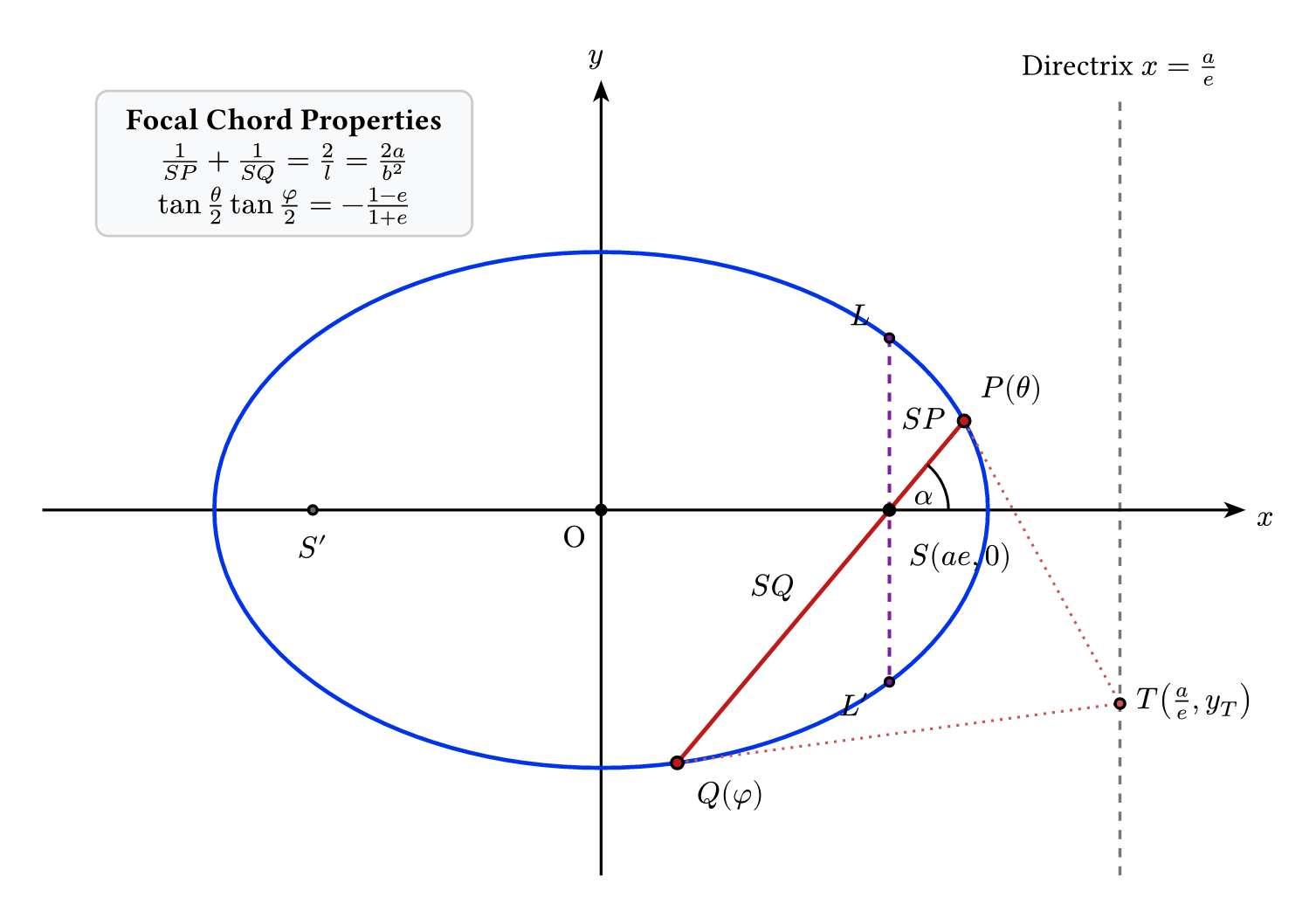
Let a focal chord of an ellipse pass through the focus S S S S P SP S P S Q SQ S Q
Theorem. The semi-latus rectum l = b 2 a l = \frac{b^2}{a} l = a b 2 S P SP S P S Q SQ S Q
1 S P + 1 S Q = 2 l = 2 a b 2 \frac{1}{SP} + \frac{1}{SQ} = \frac{2}{l} = \frac{2a}{b^2} S P 1 + S Q 1 = l 2 = b 2 2 a Proof Using Polar Coordinates
The cleanest proof uses the polar form of the ellipse with the focus S S S
Recall that the distance r r r α \alpha α
r = l 1 + e cos α r = \frac{l}{1 + e\cos\alpha} r = 1 + e cos α l where α \alpha α l = b 2 a l = \frac{b^2}{a} l = a b 2
Let P S Q PSQ P S Q α \alpha α
Focal segment S P SP S P The point P P P α \alpha α
S P = l 1 + e cos α SP = \frac{l}{1 + e\cos\alpha} S P = 1 + e cos α l Focal segment S Q SQ S Q The point Q Q Q α + π \alpha + \pi α + π cos ( α + π ) = − cos α \cos(\alpha + \pi) = -\cos\alpha cos ( α + π ) = − cos α
S Q = l 1 + e cos ( α + π ) = l 1 − e cos α SQ = \frac{l}{1 + e\cos(\alpha + \pi)} = \frac{l}{1 - e\cos\alpha} S Q = 1 + e cos ( α + π ) l = 1 − e cos α l Now take the reciprocals of both focal segments:
1 S P = 1 + e cos α l \frac{1}{SP} = \frac{1 + e\cos\alpha}{l} S P 1 = l 1 + e cos α 1 S Q = 1 − e cos α l \frac{1}{SQ} = \frac{1 - e\cos\alpha}{l} S Q 1 = l 1 − e cos α Add these two equations:
1 S P + 1 S Q = ( 1 + e cos α ) + ( 1 − e cos α ) l = 2 l \frac{1}{SP} + \frac{1}{SQ} = \frac{(1 + e\cos\alpha) + (1 - e\cos\alpha)}{l} = \frac{2}{l} S P 1 + S Q 1 = l ( 1 + e cos α ) + ( 1 − e cos α ) = l 2 Substitute l = b 2 a l = \frac{b^2}{a} l = a b 2
1 S P + 1 S Q = 2 a b 2 \frac{1}{SP} + \frac{1}{SQ} = \frac{2a}{b^2} S P 1 + S Q 1 = b 2 2 a Notice that the angle α \alpha α
This means that no matter what direction the focal chord points, the sum of the reciprocals 1 S P + 1 S Q \frac{1}{SP} + \frac{1}{SQ} S P 1 + S Q 1 2 l \frac{2}{l} l 2 l l l S P SP S P S Q SQ S Q
Theorem 2: Length of a Focal Chord§
Let P S Q PSQ P S Q S S S α \alpha α
The total length of the chord is the sum of its two focal segments:
P Q = S P + S Q PQ = SP + SQ P Q = S P + S Q Using the polar expressions for S P SP S P S Q SQ S Q
P Q = l 1 + e cos α + l 1 − e cos α PQ = \frac{l}{1 + e\cos\alpha} + \frac{l}{1 - e\cos\alpha} P Q = 1 + e cos α l + 1 − e cos α l Combine the fractions:
P Q = l [ ( 1 − e cos α ) + ( 1 + e cos α ) ( 1 + e cos α ) ( 1 − e cos α ) ] = 2 l 1 − e 2 cos 2 α PQ = l\left[\frac{(1 - e\cos\alpha) + (1 + e\cos\alpha)}{(1 + e\cos\alpha)(1 - e\cos\alpha)}\right] = \frac{2l}{1 - e^2\cos^2\alpha} P Q = l [ ( 1 + e cos α ) ( 1 − e cos α ) ( 1 − e cos α ) + ( 1 + e cos α ) ] = 1 − e 2 cos 2 α 2 l Substitute l = b 2 a l = \frac{b^2}{a} l = a b 2
P Q = 2 b 2 a ( 1 − e 2 cos 2 α ) PQ = \frac{2b^2}{a(1 - e^2\cos^2\alpha)} P Q = a ( 1 − e 2 cos 2 α ) 2 b 2 Maximum and Minimum Lengths:
Since 0 ≤ cos 2 α ≤ 1 0 \le \cos^2\alpha \le 1 0 ≤ cos 2 α ≤ 1
Minimum Length (The Latus Rectum):
The denominator is largest when cos 2 α = 0 \cos^2\alpha = 0 cos 2 α = 0 α = 90 ∘ \alpha = 90^\circ α = 9 0 ∘
P Q min = 2 b 2 a PQ_{\min} = \frac{2b^2}{a} P Q m i n = a 2 b 2 The shortest focal chord of an ellipse is its latus rectum.
Maximum Length (The Major Axis):
The denominator is smallest when cos 2 α = 1 \cos^2\alpha = 1 cos 2 α = 1 α = 0 ∘ \alpha = 0^\circ α = 0 ∘
P Q max = 2 b 2 a ( 1 − e 2 ) PQ_{\max} = \frac{2b^2}{a(1 - e^2)} P Q m a x = a ( 1 − e 2 ) 2 b 2 Since b 2 = a 2 ( 1 − e 2 ) b^2 = a^2(1 - e^2) b 2 = a 2 ( 1 − e 2 )
P Q max = 2 a 2 ( 1 − e 2 ) a ( 1 − e 2 ) = 2 a PQ_{\max} = \frac{2a^2(1 - e^2)}{a(1 - e^2)} = 2a P Q m a x = a ( 1 − e 2 ) 2 a 2 ( 1 − e 2 ) = 2 a The longest focal chord of an ellipse is the major axis itself.
Thus, the length of any focal chord P Q PQ P Q
2 b 2 a ≤ P Q ≤ 2 a \frac{2b^2}{a} \le PQ \le 2a a 2 b 2 ≤ P Q ≤ 2 a Theorem 3: Intersection of Tangents at the Ends of a Focal Chord§
Theorem. The tangents drawn at the two ends of any focal chord intersect on the corresponding directrix.
Proof
Let P ( θ ) P(\theta) P ( θ ) Q ( ϕ ) Q(\phi) Q ( ϕ ) S ( a e , 0 ) S(ae, 0) S ( a e , 0 )
The equations of the tangents at P P P Q Q Q
Tangent at P : x a cos θ + y b sin θ = 1 \text{Tangent at } P: \quad \frac{x}{a}\cos\theta + \frac{y}{b}\sin\theta = 1 Tangent at P : a x cos θ + b y sin θ = 1 Tangent at Q : x a cos ϕ + y b sin ϕ = 1 \text{Tangent at } Q: \quad \frac{x}{a}\cos\phi + \frac{y}{b}\sin\phi = 1 Tangent at Q : a x cos ϕ + b y sin ϕ = 1 The point of intersection T ( x 0 , y 0 ) T(x_0, y_0) T ( x 0 , y 0 )
x 0 = a cos ( θ + ϕ 2 ) cos ( θ − ϕ 2 ) x_0 = a\frac{\cos\left(\frac{\theta + \phi}{2}\right)}{\cos\left(\frac{\theta - \phi}{2}\right)} x 0 = a cos ( 2 θ − ϕ ) cos ( 2 θ + ϕ ) y 0 = b sin ( θ + ϕ 2 ) cos ( θ − ϕ 2 ) y_0 = b\frac{\sin\left(\frac{\theta + \phi}{2}\right)}{\cos\left(\frac{\theta - \phi}{2}\right)} y 0 = b cos ( 2 θ − ϕ ) sin ( 2 θ + ϕ ) Since P Q PQ P Q S ( a e , 0 ) S(ae, 0) S ( a e , 0 )
e cos ( θ + ϕ 2 ) = cos ( θ − ϕ 2 ) ⟹ cos ( θ + ϕ 2 ) cos ( θ − ϕ 2 ) = 1 e e\cos\left(\frac{\theta + \phi}{2}\right) = \cos\left(\frac{\theta - \phi}{2}\right) \implies \frac{\cos\left(\frac{\theta + \phi}{2}\right)}{\cos\left(\frac{\theta - \phi}{2}\right)} = \frac{1}{e} e cos ( 2 θ + ϕ ) = cos ( 2 θ − ϕ ) ⟹ cos ( 2 θ − ϕ ) cos ( 2 θ + ϕ ) = e 1 Substitute this ratio directly into x 0 x_0 x 0
x 0 = a ( 1 e ) = a e x_0 = a\left(\frac{1}{e}\right) = \frac{a}{e} x 0 = a ( e 1 ) = e a The x x x a e \frac{a}{e} e a θ \theta θ ϕ \phi ϕ
Since x = a e x = \frac{a}{e} x = e a S ( a e , 0 ) S(ae, 0) S ( a e , 0 ) T T T
Similarly, tangents drawn at the ends of a focal chord through S ′ ( − a e , 0 ) S'(-ae, 0) S ′ ( − a e , 0 ) x = − a e x = -\frac{a}{e} x = − e a
Summary of Key Results§
Concept
Mathematical Formula
Notes
Focal Distances (a > b a > b a > b S P = a − e x 1 , S ′ P = a + e x 1 SP = a - ex_1, \quad S'P = a + ex_1 S P = a − e x 1 , S ′ P = a + e x 1 Distances from P ( x 1 , y 1 ) P(x_1, y_1) P ( x 1 , y 1 ) ( ± a e , 0 ) (\pm ae, 0) ( ± a e , 0 )
Sum of Focal Distances S P + S ′ P = 2 a SP + S'P = 2a S P + S ′ P = 2 a Constant, equals the length of major axis
Difference of Focal Distances ∥ S ′ P − S P ∥ = 2 e ∥ x 1 ∥ \|S'P - SP\| = 2e\|x_1\| ∥ S ′ P − S P ∥ = 2 e ∥ x 1 ∥ Equals 0 0 0 2 a e 2ae 2 a e
Two-Focus Locus Condition P A + P B = 2 k ( 2 k > A B ) PA + PB = 2k \quad (2k > AB) P A + P B = 2 k ( 2 k > A B ) Gives an ellipse with a = k , b = k 2 − c 2 a = k, b = \sqrt{k^2 - c^2} a = k , b = k 2 − c 2
Focal Chord through S ( a e , 0 ) S(ae, 0) S ( a e , 0 ) tan θ 2 tan ϕ 2 = − 1 − e 1 + e \tan\frac{\theta}{2}\tan\frac{\phi}{2} = -\frac{1 - e}{1 + e} tan 2 θ tan 2 ϕ = − 1 + e 1 − e Product of half-angle tangents of endpoints
Focal Chord through S ′ ( − a e , 0 ) S'(-ae, 0) S ′ ( − a e , 0 ) tan θ 2 tan ϕ 2 = − 1 + e 1 − e \tan\frac{\theta}{2}\tan\frac{\phi}{2} = -\frac{1 + e}{1 - e} tan 2 θ tan 2 ϕ = − 1 − e 1 + e Product of half-angle tangents of endpoints
Harmonic Mean Property 1 S P + 1 S Q = 2 a b 2 = 2 l \frac{1}{SP} + \frac{1}{SQ} = \frac{2a}{b^2} = \frac{2}{l} S P 1 + S Q 1 = b 2 2 a = l 2 Semi-latus rectum is the harmonic mean of S P SP S P S Q SQ S Q
Length of a Focal Chord P Q = 2 b 2 a ( 1 − e 2 cos 2 α ) PQ = \frac{2b^2}{a(1 - e^2\cos^2\alpha)} P Q = a ( 1 − e 2 c o s 2 α ) 2 b 2 Inclined at angle α \alpha α
Illustrative Examples§
Example 1: Calculating Focal Distances§
Find the focal distances of the point P ( 2 , 5 3 ) P\left(2, \frac{5}{3}\right) P ( 2 , 3 5 ) 5 x 2 + 9 y 2 = 45 5x^2 + 9y^2 = 45 5 x 2 + 9 y 2 = 45
Solution:
Write the ellipse in standard form by dividing both sides by 45 45 45
x 2 9 + y 2 5 = 1 \frac{x^2}{9} + \frac{y^2}{5} = 1 9 x 2 + 5 y 2 = 1 Here, a 2 = 9 ⟹ a = 3 a^2 = 9 \implies a = 3 a 2 = 9 ⟹ a = 3 b 2 = 5 ⟹ b = 5 b^2 = 5 \implies b = \sqrt{5} b 2 = 5 ⟹ b = 5
Check that P ( 2 , 5 3 ) P\left(2, \frac{5}{3}\right) P ( 2 , 3 5 )
2 2 9 + ( 5 / 3 ) 2 5 = 4 9 + 25 / 9 5 = 4 9 + 5 9 = 1 \frac{2^2}{9} + \frac{(5/3)^2}{5} = \frac{4}{9} + \frac{25/9}{5} = \frac{4}{9} + \frac{5}{9} = 1 9 2 2 + 5 ( 5/3 ) 2 = 9 4 + 5 25/9 = 9 4 + 9 5 = 1 The eccentricity e e e
e = 1 − b 2 a 2 = 1 − 5 9 = 4 9 = 2 3 e = \sqrt{1 - \frac{b^2}{a^2}} = \sqrt{1 - \frac{5}{9}} = \sqrt{\frac{4}{9}} = \frac{2}{3} e = 1 − a 2 b 2 = 1 − 9 5 = 9 4 = 3 2 The foci are at ( ± a e , 0 ) = ( ± 3 ⋅ 2 3 , 0 ) = ( ± 2 , 0 ) (\pm ae, 0) = \left(\pm 3 \cdot \frac{2}{3}, 0\right) = (\pm 2, 0) ( ± a e , 0 ) = ( ± 3 ⋅ 3 2 , 0 ) = ( ± 2 , 0 )
Using the focal distance formulas with x 1 = 2 x_1 = 2 x 1 = 2
S P = a − e x 1 = 3 − ( 2 3 ) ( 2 ) = 3 − 4 3 = 5 3 SP = a - e x_1 = 3 - \left(\frac{2}{3}\right)(2) = 3 - \frac{4}{3} = \frac{5}{3} S P = a − e x 1 = 3 − ( 3 2 ) ( 2 ) = 3 − 3 4 = 3 5 S ′ P = a + e x 1 = 3 + ( 2 3 ) ( 2 ) = 3 + 4 3 = 13 3 S'P = a + e x_1 = 3 + \left(\frac{2}{3}\right)(2) = 3 + \frac{4}{3} = \frac{13}{3} S ′ P = a + e x 1 = 3 + ( 3 2 ) ( 2 ) = 3 + 3 4 = 3 13 Check the sum of the focal distances:
S P + S ′ P = 5 3 + 13 3 = 18 3 = 6 = 2 a SP + S'P = \frac{5}{3} + \frac{13}{3} = \frac{18}{3} = 6 = 2a S P + S ′ P = 3 5 + 3 13 = 3 18 = 6 = 2 a which matches 2 ( 3 ) = 6 2(3) = 6 2 ( 3 ) = 6
Example 2: Finding an Ellipse Equation from Foci and String Length§
A point P P P A ( − 4 , 0 ) A(-4, 0) A ( − 4 , 0 ) B ( 4 , 0 ) B(4, 0) B ( 4 , 0 ) 10 10 10 P P P
Solution:
The two fixed points are A ( − 4 , 0 ) A(-4, 0) A ( − 4 , 0 ) B ( 4 , 0 ) B(4, 0) B ( 4 , 0 )
A B = ( 4 − ( − 4 ) ) 2 + 0 2 = 8 AB = \sqrt{(4 - (-4))^2 + 0^2} = 8 A B = ( 4 − ( − 4 ) ) 2 + 0 2 = 8 The constant sum of distances is:
2 k = 10 ⟹ k = 5 2k = 10 \implies k = 5 2 k = 10 ⟹ k = 5 Since 2 k = 10 > A B = 8 2k = 10 > AB = 8 2 k = 10 > A B = 8
Because the midpoint of A B AB A B ( 0 , 0 ) (0, 0) ( 0 , 0 ) A B AB A B x x x
x 2 a 2 + y 2 b 2 = 1 \frac{x^2}{a^2} + \frac{y^2}{b^2} = 1 a 2 x 2 + b 2 y 2 = 1 From the theorem, the semi-major axis is a = k = 5 a = k = 5 a = k = 5 c = 4 c = 4 c = 4
The semi-minor axis b b b
b 2 = a 2 − c 2 = 5 2 − 4 2 = 25 − 16 = 9 ⟹ b = 3 b^2 = a^2 - c^2 = 5^2 - 4^2 = 25 - 16 = 9 \implies b = 3 b 2 = a 2 − c 2 = 5 2 − 4 2 = 25 − 16 = 9 ⟹ b = 3 Thus, the equation of the ellipse is:
x 2 25 + y 2 9 = 1 \frac{x^2}{25} + \frac{y^2}{9} = 1 25 x 2 + 9 y 2 = 1 The eccentricity is:
e = c a = 4 5 e = \frac{c}{a} = \frac{4}{5} e = a c = 5 4 The length of the major axis is 2 a = 10 2a = 10 2 a = 10 2 b = 6 2b = 6 2 b = 6
Example 3: Finding the Other Endpoint of a Focal Chord§
One endpoint of a focal chord of the ellipse x 2 25 + y 2 16 = 1 \frac{x^2}{25} + \frac{y^2}{16} = 1 25 x 2 + 16 y 2 = 1 θ = π 3 \theta = \frac{\pi}{3} θ = 3 π
Solution:
Here, a 2 = 25 ⟹ a = 5 a^2 = 25 \implies a = 5 a 2 = 25 ⟹ a = 5 b 2 = 16 ⟹ b = 4 b^2 = 16 \implies b = 4 b 2 = 16 ⟹ b = 4
The eccentricity is:
e = 1 − 16 25 = 9 25 = 3 5 e = \sqrt{1 - \frac{16}{25}} = \sqrt{\frac{9}{25}} = \frac{3}{5} e = 1 − 25 16 = 25 9 = 5 3 The chord passes through the positive focus S ( a e , 0 ) = ( 3 , 0 ) S(ae, 0) = (3, 0) S ( a e , 0 ) = ( 3 , 0 )
The relation between the eccentric angles θ \theta θ ϕ \phi ϕ S S S
tan θ 2 tan ϕ 2 = − 1 − e 1 + e \tan\frac{\theta}{2}\tan\frac{\phi}{2} = -\frac{1 - e}{1 + e} tan 2 θ tan 2 ϕ = − 1 + e 1 − e Given θ = π 3 \theta = \frac{\pi}{3} θ = 3 π θ 2 = π 6 \frac{\theta}{2} = \frac{\pi}{6} 2 θ = 6 π
tan θ 2 = tan π 6 = 1 3 \tan\frac{\theta}{2} = \tan\frac{\pi}{6} = \frac{1}{\sqrt{3}} tan 2 θ = tan 6 π = 3 1 Substitute e = 3 5 e = \frac{3}{5} e = 5 3
1 − e 1 + e = 1 − 3 / 5 1 + 3 / 5 = 2 / 5 8 / 5 = 2 8 = 1 4 \frac{1 - e}{1 + e} = \frac{1 - 3/5}{1 + 3/5} = \frac{2/5}{8/5} = \frac{2}{8} = \frac{1}{4} 1 + e 1 − e = 1 + 3/5 1 − 3/5 = 8/5 2/5 = 8 2 = 4 1 Therefore:
( 1 3 ) tan ϕ 2 = − 1 4 ⟹ tan ϕ 2 = − 3 4 \left(\frac{1}{\sqrt{3}}\right)\tan\frac{\phi}{2} = -\frac{1}{4} \implies \tan\frac{\phi}{2} = -\frac{\sqrt{3}}{4} ( 3 1 ) tan 2 ϕ = − 4 1 ⟹ tan 2 ϕ = − 4 3 To find the coordinates of the other endpoint Q ( a cos ϕ , b sin ϕ ) Q(a\cos\phi, b\sin\phi) Q ( a cos ϕ , b sin ϕ )
cos ϕ = 1 − tan 2 ϕ 2 1 + tan 2 ϕ 2 = 1 − ( − 3 4 ) 2 1 + ( − 3 4 ) 2 = 1 − 3 16 1 + 3 16 = 13 / 16 19 / 16 = 13 19 \cos\phi = \frac{1 - \tan^2\frac{\phi}{2}}{1 + \tan^2\frac{\phi}{2}} = \frac{1 - \left(-\frac{\sqrt{3}}{4}\right)^2}{1 + \left(-\frac{\sqrt{3}}{4}\right)^2} = \frac{1 - \frac{3}{16}}{1 + \frac{3}{16}} = \frac{13/16}{19/16} = \frac{13}{19} cos ϕ = 1 + tan 2 2 ϕ 1 − tan 2 2 ϕ = 1 + ( − 4 3 ) 2 1 − ( − 4 3 ) 2 = 1 + 16 3 1 − 16 3 = 19/16 13/16 = 19 13 sin ϕ = 2 tan ϕ 2 1 + tan 2 ϕ 2 = 2 ( − 3 4 ) 1 + 3 16 = − 3 2 19 16 = − 8 3 19 \sin\phi = \frac{2\tan\frac{\phi}{2}}{1 + \tan^2\frac{\phi}{2}} = \frac{2\left(-\frac{\sqrt{3}}{4}\right)}{1 + \frac{3}{16}} = \frac{-\frac{\sqrt{3}}{2}}{\frac{19}{16}} = -\frac{8\sqrt{3}}{19} sin ϕ = 1 + tan 2 2 ϕ 2 tan 2 ϕ = 1 + 16 3 2 ( − 4 3 ) = 16 19 − 2 3 = − 19 8 3 The coordinates of the second endpoint Q Q Q
x Q = a cos ϕ = 5 ( 13 19 ) = 65 19 x_Q = a\cos\phi = 5\left(\frac{13}{19}\right) = \frac{65}{19} x Q = a cos ϕ = 5 ( 19 13 ) = 19 65 y Q = b sin ϕ = 4 ( − 8 3 19 ) = − 32 3 19 y_Q = b\sin\phi = 4\left(-\frac{8\sqrt{3}}{19}\right) = -\frac{32\sqrt{3}}{19} y Q = b sin ϕ = 4 ( − 19 8 3 ) = − 19 32 3 Thus, Q = ( 65 19 , − 32 3 19 ) Q = \left(\frac{65}{19}, -\frac{32\sqrt{3}}{19}\right) Q = ( 19 65 , − 19 32 3 )
Example 4: Applying the Harmonic Mean Property§
For the ellipse x 2 100 + y 2 64 = 1 \frac{x^2}{100} + \frac{y^2}{64} = 1 100 x 2 + 64 y 2 = 1 S ( a e , 0 ) S(ae, 0) S ( a e , 0 ) S P = 4 SP = 4 S P = 4 S Q SQ S Q
Solution:
From the ellipse equation, a 2 = 100 ⟹ a = 10 a^2 = 100 \implies a = 10 a 2 = 100 ⟹ a = 10 b 2 = 64 ⟹ b = 8 b^2 = 64 \implies b = 8 b 2 = 64 ⟹ b = 8
The semi-latus rectum is:
l = b 2 a = 64 10 = 32 5 = 6.4 l = \frac{b^2}{a} = \frac{64}{10} = \frac{32}{5} = 6.4 l = a b 2 = 10 64 = 5 32 = 6.4 By the harmonic mean property of focal segments:
1 S P + 1 S Q = 2 l = 2 a b 2 \frac{1}{SP} + \frac{1}{SQ} = \frac{2}{l} = \frac{2a}{b^2} S P 1 + S Q 1 = l 2 = b 2 2 a Substitute S P = 4 SP = 4 S P = 4 2 a b 2 = 2 ( 10 ) 64 = 20 64 = 5 16 \frac{2a}{b^2} = \frac{2(10)}{64} = \frac{20}{64} = \frac{5}{16} b 2 2 a = 64 2 ( 10 ) = 64 20 = 16 5
1 4 + 1 S Q = 5 16 \frac{1}{4} + \frac{1}{SQ} = \frac{5}{16} 4 1 + S Q 1 = 16 5 1 S Q = 5 16 − 1 4 = 5 16 − 4 16 = 1 16 \frac{1}{SQ} = \frac{5}{16} - \frac{1}{4} = \frac{5}{16} - \frac{4}{16} = \frac{1}{16} S Q 1 = 16 5 − 4 1 = 16 5 − 16 4 = 16 1 S Q = 16 SQ = 16 S Q = 16 The total length of the focal chord is:
P Q = S P + S Q = 4 + 16 = 20 PQ = SP + SQ = 4 + 16 = 20 P Q = S P + S Q = 4 + 16 = 20 Example 5: Finding the Length of a Focal Chord from its Inclination§
Find the length of the focal chord of the ellipse x 2 36 + y 2 20 = 1 \frac{x^2}{36} + \frac{y^2}{20} = 1 36 x 2 + 20 y 2 = 1 60 ∘ 60^\circ 6 0 ∘
Solution:
Here, a 2 = 36 a^2 = 36 a 2 = 36 b 2 = 20 b^2 = 20 b 2 = 20 a = 6 a = 6 a = 6
The eccentricity is:
e 2 = 1 − b 2 a 2 = 1 − 20 36 = 16 36 = 4 9 e^2 = 1 - \frac{b^2}{a^2} = 1 - \frac{20}{36} = \frac{16}{36} = \frac{4}{9} e 2 = 1 − a 2 b 2 = 1 − 36 20 = 36 16 = 9 4 The inclination of the chord is α = 60 ∘ \alpha = 60^\circ α = 6 0 ∘
cos α = cos 60 ∘ = 1 2 ⟹ cos 2 α = 1 4 \cos\alpha = \cos 60^\circ = \frac{1}{2} \implies \cos^2\alpha = \frac{1}{4} cos α = cos 6 0 ∘ = 2 1 ⟹ cos 2 α = 4 1 Use the formula for the length of a focal chord:
P Q = 2 b 2 a ( 1 − e 2 cos 2 α ) PQ = \frac{2b^2}{a(1 - e^2\cos^2\alpha)} P Q = a ( 1 − e 2 cos 2 α ) 2 b 2 Calculate the denominator:
e 2 cos 2 α = ( 4 9 ) ( 1 4 ) = 1 9 e^2\cos^2\alpha = \left(\frac{4}{9}\right)\left(\frac{1}{4}\right) = \frac{1}{9} e 2 cos 2 α = ( 9 4 ) ( 4 1 ) = 9 1 1 − e 2 cos 2 α = 1 − 1 9 = 8 9 1 - e^2\cos^2\alpha = 1 - \frac{1}{9} = \frac{8}{9} 1 − e 2 cos 2 α = 1 − 9 1 = 9 8 Substitute into the formula:
P Q = 2 ( 20 ) 6 ( 8 9 ) = 40 48 9 = 40 ⋅ 9 48 = 360 48 = 15 2 = 7.5 PQ = \frac{2(20)}{6\left(\frac{8}{9}\right)} = \frac{40}{\frac{48}{9}} = \frac{40 \cdot 9}{48} = \frac{360}{48} = \frac{15}{2} = 7.5 P Q = 6 ( 9 8 ) 2 ( 20 ) = 9 48 40 = 48 40 ⋅ 9 = 48 360 = 2 15 = 7.5 The length of the focal chord is 15 2 \frac{15}{2} 2 15
Example 6: Locus of the Incenter of a Focal Triangle§
If P P P x 2 a 2 + y 2 b 2 = 1 \frac{x^2}{a^2} + \frac{y^2}{b^2} = 1 a 2 x 2 + b 2 y 2 = 1 S S S S ′ S' S ′ △ S P S ′ \triangle SPS' △ S P S ′
Solution:
Let P ( x 1 , y 1 ) = ( a cos θ , b sin θ ) P(x_1, y_1) = (a\cos\theta, b\sin\theta) P ( x 1 , y 1 ) = ( a cos θ , b sin θ )
The three vertices of triangle △ S P S ′ \triangle SPS' △ S P S ′
S ( c , 0 ) S(c, 0) S ( c , 0 ) c = a e c = ae c = a e S ′ ( − c , 0 ) S'(-c, 0) S ′ ( − c , 0 ) P ( x 1 , y 1 ) P(x_1, y_1) P ( x 1 , y 1 )
The lengths of the sides opposite these three vertices are:
Opposite P P P a P = S S ′ = 2 c = 2 a e a_P = SS' = 2c = 2ae a P = S S ′ = 2 c = 2 a e
Opposite S S S a S = S ′ P = a + e x 1 a_S = S'P = a + ex_1 a S = S ′ P = a + e x 1
Opposite S ′ S' S ′ a S ′ = S P = a − e x 1 a_{S'} = SP = a - ex_1 a S ′ = S P = a − e x 1
The perimeter of △ S P S ′ \triangle SPS' △ S P S ′
2 s = S S ′ + S ′ P + S P = 2 a e + ( a + e x 1 ) + ( a − e x 1 ) = 2 a e + 2 a = 2 a ( 1 + e ) 2s = SS' + S'P + SP = 2ae + (a + ex_1) + (a - ex_1) = 2ae + 2a = 2a(1 + e) 2 s = S S ′ + S ′ P + S P = 2 a e + ( a + e x 1 ) + ( a − e x 1 ) = 2 a e + 2 a = 2 a ( 1 + e ) Let I ( x , y ) I(x, y) I ( x , y ) △ S P S ′ \triangle SPS' △ S P S ′
x = a P x P + a S x S + a S ′ x S ′ a P + a S + a S ′ x = \frac{a_P x_P + a_S x_S + a_{S'} x_{S'}}{a_P + a_S + a_{S'}} x = a P + a S + a S ′ a P x P + a S x S + a S ′ x S ′ x = ( 2 a e ) x 1 + ( a + e x 1 ) ( a e ) + ( a − e x 1 ) ( − a e ) 2 a ( 1 + e ) x = \frac{(2ae)x_1 + (a + ex_1)(ae) + (a - ex_1)(-ae)}{2a(1 + e)} x = 2 a ( 1 + e ) ( 2 a e ) x 1 + ( a + e x 1 ) ( a e ) + ( a − e x 1 ) ( − a e ) Expand the numerator:
( 2 a e ) x 1 + a 2 e + a e 2 x 1 − a 2 e + a e 2 x 1 = 2 a e x 1 + 2 a e 2 x 1 = 2 a e ( 1 + e ) x 1 (2ae)x_1 + a^2 e + a e^2 x_1 - a^2 e + a e^2 x_1 = 2ae x_1 + 2a e^2 x_1 = 2ae(1 + e)x_1 ( 2 a e ) x 1 + a 2 e + a e 2 x 1 − a 2 e + a e 2 x 1 = 2 a e x 1 + 2 a e 2 x 1 = 2 a e ( 1 + e ) x 1 Divide by the perimeter 2 a ( 1 + e ) 2a(1 + e) 2 a ( 1 + e )
x = 2 a e ( 1 + e ) x 1 2 a ( 1 + e ) = e x 1 ⟹ x 1 = x e x = \frac{2ae(1 + e)x_1}{2a(1 + e)} = e x_1 \implies x_1 = \frac{x}{e} x = 2 a ( 1 + e ) 2 a e ( 1 + e ) x 1 = e x 1 ⟹ x 1 = e x Now find the y y y
y = a P y P + a S y S + a S ′ y S ′ 2 a ( 1 + e ) y = \frac{a_P y_P + a_S y_S + a_{S'} y_{S'}}{2a(1 + e)} y = 2 a ( 1 + e ) a P y P + a S y S + a S ′ y S ′ Since y S = 0 y_S = 0 y S = 0 y S ′ = 0 y_{S'} = 0 y S ′ = 0
y = ( 2 a e ) y 1 + 0 + 0 2 a ( 1 + e ) = e 1 + e y 1 ⟹ y 1 = ( 1 + e e ) y y = \frac{(2ae)y_1 + 0 + 0}{2a(1 + e)} = \frac{e}{1 + e}y_1 \implies y_1 = \left(\frac{1 + e}{e}\right)y y = 2 a ( 1 + e ) ( 2 a e ) y 1 + 0 + 0 = 1 + e e y 1 ⟹ y 1 = ( e 1 + e ) y Since P ( x 1 , y 1 ) P(x_1, y_1) P ( x 1 , y 1 ) x 1 2 a 2 + y 1 2 b 2 = 1 \frac{x_1^2}{a^2} + \frac{y_1^2}{b^2} = 1 a 2 x 1 2 + b 2 y 1 2 = 1 x 1 x_1 x 1 y 1 y_1 y 1
( x e ) 2 a 2 + ( 1 + e e y ) 2 b 2 = 1 \frac{\left(\frac{x}{e}\right)^2}{a^2} + \frac{\left(\frac{1 + e}{e}y\right)^2}{b^2} = 1 a 2 ( e x ) 2 + b 2 ( e 1 + e y ) 2 = 1 x 2 a 2 e 2 + y 2 b 2 e 2 ( 1 + e ) 2 = 1 \frac{x^2}{a^2 e^2} + \frac{y^2}{\frac{b^2 e^2}{(1 + e)^2}} = 1 a 2 e 2 x 2 + ( 1 + e ) 2 b 2 e 2 y 2 = 1 This locus is another ellipse centered at the origin, with semi-major axis a e ae a e b e 1 + e \frac{be}{1 + e} 1 + e b e