Having analyzed the standard and transformed equations of an ellipse, we now turn to fundamental positional relationships: determining whether a given point lies inside, on, or outside an ellipse, and classifying whether a straight line cuts, touches, or misses the curve.
This investigation leads directly to the condition of tangency and the slope form of the tangent , which exhibits an elegant algebraic property that distinguishes the ellipse from the parabola.
Location of a Point with respect to an Ellipse§
Let the standard equation of the ellipse be:
x 2 a 2 + y 2 b 2 = 1 \frac{x^2}{a^2} + \frac{y^2}{b^2} = 1 a 2 x 2 + b 2 y 2 = 1 We define the quadratic expression:
S ≡ x 2 a 2 + y 2 b 2 − 1 S \equiv \frac{x^2}{a^2} + \frac{y^2}{b^2} - 1 S ≡ a 2 x 2 + b 2 y 2 − 1 For any given point P ( x 1 , y 1 ) P(x_1, y_1) P ( x 1 , y 1 ) S S S S 1 S_1 S 1
S 1 ≡ x 1 2 a 2 + y 1 2 b 2 − 1 S_1 \equiv \frac{x_1^2}{a^2} + \frac{y_1^2}{b^2} - 1 S 1 ≡ a 2 x 1 2 + b 2 y 1 2 − 1
The Position Criterion§
The location of P ( x 1 , y 1 ) P(x_1, y_1) P ( x 1 , y 1 ) S 1 S_1 S 1
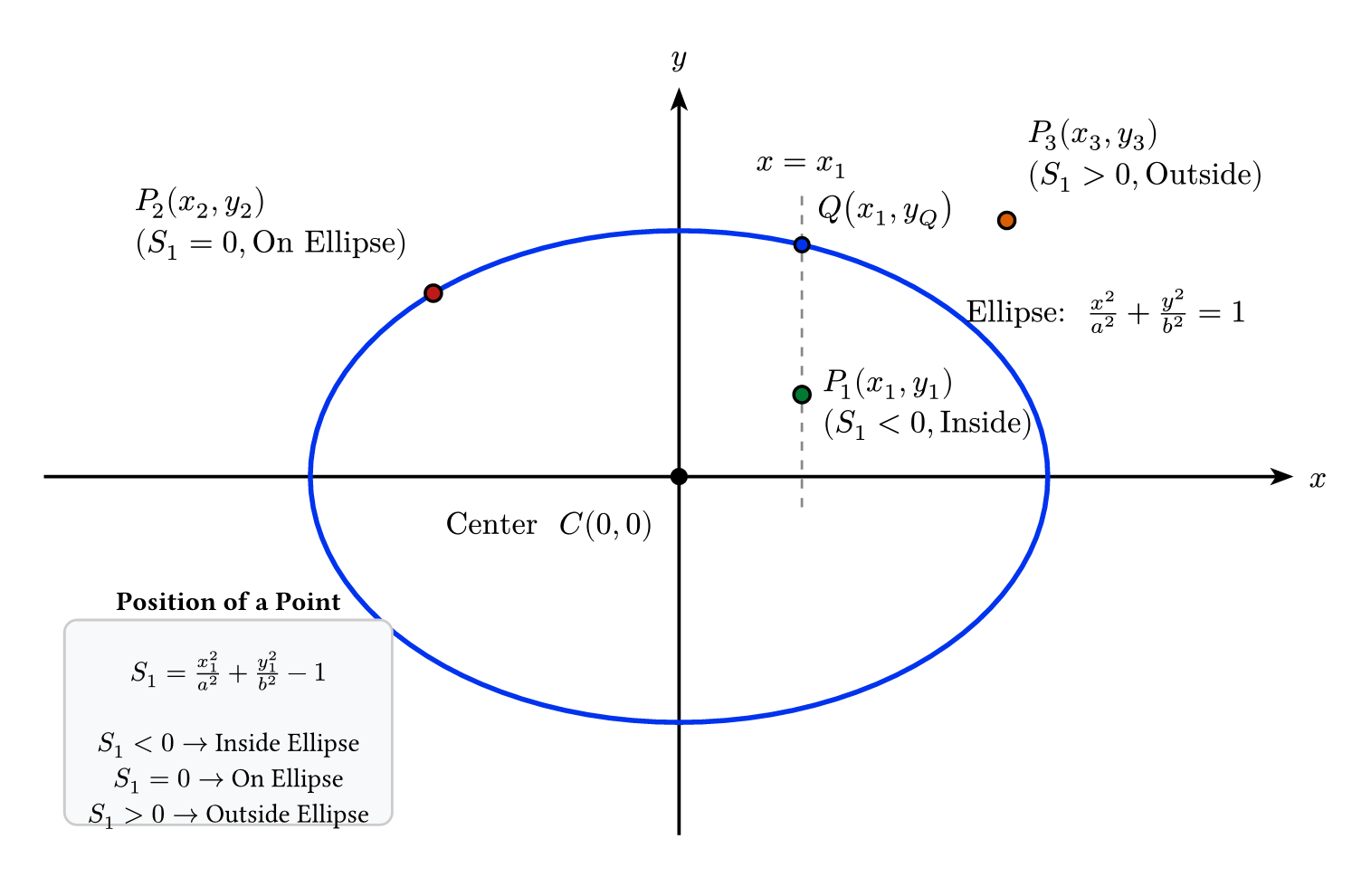
Point Lies Inside the Ellipse (S 1 < 0 S_1 < 0 S 1 < 0
x 1 2 a 2 + y 1 2 b 2 < 1 \frac{x_1^2}{a^2} + \frac{y_1^2}{b^2} < 1 a 2 x 1 2 + b 2 y 1 2 < 1 The point P ( x 1 , y 1 ) P(x_1, y_1) P ( x 1 , y 1 )
Point Lies on the Ellipse (S 1 = 0 S_1 = 0 S 1 = 0
x 1 2 a 2 + y 1 2 b 2 = 1 \frac{x_1^2}{a^2} + \frac{y_1^2}{b^2} = 1 a 2 x 1 2 + b 2 y 1 2 = 1 The point P ( x 1 , y 1 ) P(x_1, y_1) P ( x 1 , y 1 )
Point Lies Outside the Ellipse (S 1 > 0 S_1 > 0 S 1 > 0
x 1 2 a 2 + y 1 2 b 2 > 1 \frac{x_1^2}{a^2} + \frac{y_1^2}{b^2} > 1 a 2 x 1 2 + b 2 y 1 2 > 1 The point P ( x 1 , y 1 ) P(x_1, y_1) P ( x 1 , y 1 )
Geometric Justification§
To understand why the sign of S 1 S_1 S 1 P ( x 1 , y 1 ) P(x_1, y_1) P ( x 1 , y 1 ) P ( x 1 , y 1 ) P(x_1, y_1) P ( x 1 , y 1 ) x = x 1 x = x_1 x = x 1
Let this vertical line intersect the upper half of the ellipse at Q ( x 1 , y Q ) Q(x_1, y_Q) Q ( x 1 , y Q ) y Q > 0 y_Q > 0 y Q > 0 Q Q Q
x 1 2 a 2 + y Q 2 b 2 = 1 ⟹ y Q 2 = b 2 ( 1 − x 1 2 a 2 ) \frac{x_1^2}{a^2} + \frac{y_Q^2}{b^2} = 1 \implies y_Q^2 = b^2\left(1 - \frac{x_1^2}{a^2}\right) a 2 x 1 2 + b 2 y Q 2 = 1 ⟹ y Q 2 = b 2 ( 1 − a 2 x 1 2 ) Now compare the ordinate y 1 y_1 y 1 P P P y Q y_Q y Q
Case 1: P P P ∣ y 1 ∣ < ∣ y Q ∣ |y_1| < |y_Q| ∣ y 1 ∣ < ∣ y Q ∣
y 1 2 < y Q 2 ⟹ y 1 2 < b 2 ( 1 − x 1 2 a 2 ) ⟹ x 1 2 a 2 + y 1 2 b 2 < 1 ⟹ S 1 < 0 y_1^2 < y_Q^2 \implies y_1^2 < b^2\left(1 - \frac{x_1^2}{a^2}\right) \implies \frac{x_1^2}{a^2} + \frac{y_1^2}{b^2} < 1 \implies S_1 < 0 y 1 2 < y Q 2 ⟹ y 1 2 < b 2 ( 1 − a 2 x 1 2 ) ⟹ a 2 x 1 2 + b 2 y 1 2 < 1 ⟹ S 1 < 0 Case 2: P P P ∣ y 1 ∣ = ∣ y Q ∣ |y_1| = |y_Q| ∣ y 1 ∣ = ∣ y Q ∣
y 1 2 = y Q 2 ⟹ x 1 2 a 2 + y 1 2 b 2 = 1 ⟹ S 1 = 0 y_1^2 = y_Q^2 \implies \frac{x_1^2}{a^2} + \frac{y_1^2}{b^2} = 1 \implies S_1 = 0 y 1 2 = y Q 2 ⟹ a 2 x 1 2 + b 2 y 1 2 = 1 ⟹ S 1 = 0 Case 3: P P P ∣ y 1 ∣ > ∣ y Q ∣ |y_1| > |y_Q| ∣ y 1 ∣ > ∣ y Q ∣
y 1 2 > y Q 2 ⟹ x 1 2 a 2 + y 1 2 b 2 > 1 ⟹ S 1 > 0 y_1^2 > y_Q^2 \implies \frac{x_1^2}{a^2} + \frac{y_1^2}{b^2} > 1 \implies S_1 > 0 y 1 2 > y Q 2 ⟹ a 2 x 1 2 + b 2 y 1 2 > 1 ⟹ S 1 > 0 This criterion is completely independent of the choice of vertical or horizontal lines, confirming that S 1 < 0 , S 1 = 0 , S 1 > 0 S_1 < 0, S_1 = 0, S_1 > 0 S 1 < 0 , S 1 = 0 , S 1 > 0
Location with respect to a Shifted Ellipse§
For an ellipse with center C ( h , k ) C(h, k) C ( h , k )
S ≡ ( x − h ) 2 a 2 + ( y − k ) 2 b 2 − 1 = 0 S \equiv \frac{(x - h)^2}{a^2} + \frac{(y - k)^2}{b^2} - 1 = 0 S ≡ a 2 ( x − h ) 2 + b 2 ( y − k ) 2 − 1 = 0 the position of any point P ( x 1 , y 1 ) P(x_1, y_1) P ( x 1 , y 1 ) ( x 1 , y 1 ) (x_1, y_1) ( x 1 , y 1 )
S 1 ≡ ( x 1 − h ) 2 a 2 + ( y 1 − k ) 2 b 2 − 1 S_1 \equiv \frac{(x_1 - h)^2}{a^2} + \frac{(y_1 - k)^2}{b^2} - 1 S 1 ≡ a 2 ( x 1 − h ) 2 + b 2 ( y 1 − k ) 2 − 1 The identical criteria apply:
S 1 < 0 ⟺ P S_1 < 0 \iff P S 1 < 0 ⟺ P S 1 = 0 ⟺ P S_1 = 0 \iff P S 1 = 0 ⟺ P S 1 > 0 ⟺ P S_1 > 0 \iff P S 1 > 0 ⟺ P
Location of a Line with respect to an Ellipse§
Consider a straight line y = m x + c y = mx + c y = m x + c
x 2 a 2 + y 2 b 2 = 1 \frac{x^2}{a^2} + \frac{y^2}{b^2} = 1 a 2 x 2 + b 2 y 2 = 1 To determine the points of intersection, substitute y = m x + c y = mx + c y = m x + c
x 2 a 2 + ( m x + c ) 2 b 2 = 1 \frac{x^2}{a^2} + \frac{(mx + c)^2}{b^2} = 1 a 2 x 2 + b 2 ( m x + c ) 2 = 1 Multiplying through by a 2 b 2 a^2 b^2 a 2 b 2
b 2 x 2 + a 2 ( m x + c ) 2 = a 2 b 2 b^2 x^2 + a^2(mx + c)^2 = a^2 b^2 b 2 x 2 + a 2 ( m x + c ) 2 = a 2 b 2 b 2 x 2 + a 2 ( m 2 x 2 + 2 m c x + c 2 ) = a 2 b 2 b^2 x^2 + a^2(m^2 x^2 + 2mc\,x + c^2) = a^2 b^2 b 2 x 2 + a 2 ( m 2 x 2 + 2 m c x + c 2 ) = a 2 b 2 Group terms in powers of x x x
( a 2 m 2 + b 2 ) x 2 + 2 a 2 m c x + a 2 ( c 2 − b 2 ) = 0 (a^2 m^2 + b^2)x^2 + 2a^2 mc\,x + a^2(c^2 - b^2) = 0 ( a 2 m 2 + b 2 ) x 2 + 2 a 2 m c x + a 2 ( c 2 − b 2 ) = 0 This is a quadratic equation in x x x A x 2 + B x + C = 0 A x^2 + B x + C = 0 A x 2 + B x + C = 0
A = a 2 m 2 + b 2 , B = 2 a 2 m c , C = a 2 ( c 2 − b 2 ) A = a^2 m^2 + b^2, \quad B = 2a^2 mc, \quad C = a^2(c^2 - b^2) A = a 2 m 2 + b 2 , B = 2 a 2 m c , C = a 2 ( c 2 − b 2 ) Since a > 0 a > 0 a > 0 b > 0 b > 0 b > 0 A = a 2 m 2 + b 2 > 0 A = a^2 m^2 + b^2 > 0 A = a 2 m 2 + b 2 > 0 m m m D D D
D = B 2 − 4 A C D = B^2 - 4AC D = B 2 − 4 A C D = ( 2 a 2 m c ) 2 − 4 ( a 2 m 2 + b 2 ) [ a 2 ( c 2 − b 2 ) ] D = (2a^2 mc)^2 - 4(a^2 m^2 + b^2)\left[a^2(c^2 - b^2)\right] D = ( 2 a 2 m c ) 2 − 4 ( a 2 m 2 + b 2 ) [ a 2 ( c 2 − b 2 ) ] D = 4 a 4 m 2 c 2 − 4 a 2 ( a 2 m 2 + b 2 ) ( c 2 − b 2 ) D = 4a^4 m^2 c^2 - 4a^2(a^2 m^2 + b^2)(c^2 - b^2) D = 4 a 4 m 2 c 2 − 4 a 2 ( a 2 m 2 + b 2 ) ( c 2 − b 2 ) Factor out 4 a 2 4a^2 4 a 2
D = 4 a 2 [ a 2 m 2 c 2 − ( a 2 m 2 c 2 − a 2 m 2 b 2 + b 2 c 2 − b 4 ) ] D = 4a^2 \left[ a^2 m^2 c^2 - (a^2 m^2 c^2 - a^2 m^2 b^2 + b^2 c^2 - b^4) \right] D = 4 a 2 [ a 2 m 2 c 2 − ( a 2 m 2 c 2 − a 2 m 2 b 2 + b 2 c 2 − b 4 ) ] Notice that the cross-term a 2 m 2 c 2 a^2 m^2 c^2 a 2 m 2 c 2
D = 4 a 2 [ a 2 m 2 b 2 − b 2 c 2 + b 4 ] D = 4a^2 \left[ a^2 m^2 b^2 - b^2 c^2 + b^4 \right] D = 4 a 2 [ a 2 m 2 b 2 − b 2 c 2 + b 4 ] Factor out b 2 b^2 b 2
D = 4 a 2 b 2 ( a 2 m 2 + b 2 − c 2 ) D = 4a^2 b^2 (a^2 m^2 + b^2 - c^2) D = 4 a 2 b 2 ( a 2 m 2 + b 2 − c 2 ) Since 4 a 2 b 2 > 0 4a^2 b^2 > 0 4 a 2 b 2 > 0 D D D ( a 2 m 2 + b 2 − c 2 ) (a^2 m^2 + b^2 - c^2) ( a 2 m 2 + b 2 − c 2 )
The Three Positional Cases§
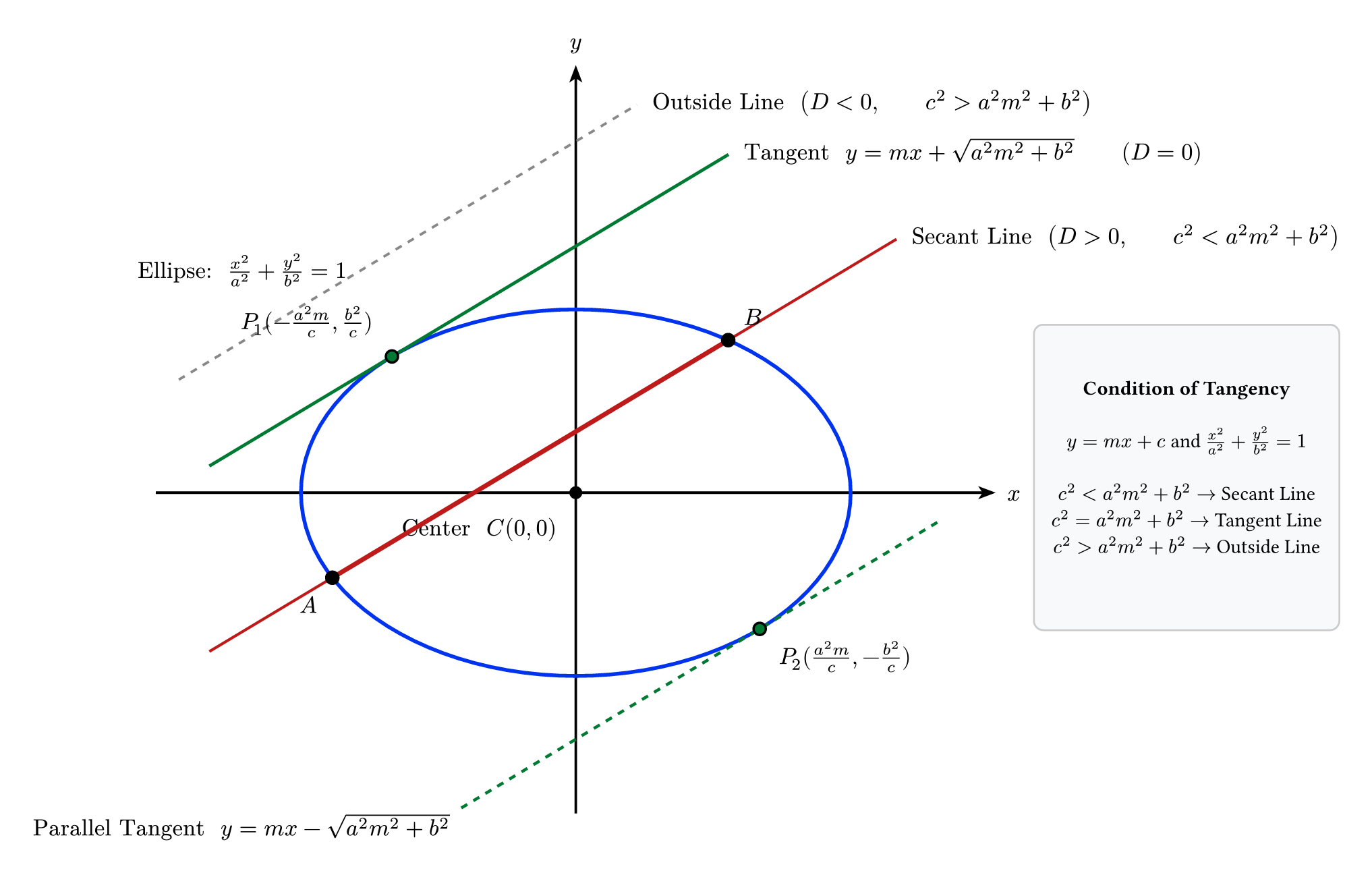
Case 1: Secant Line (D > 0 ⟺ c 2 < a 2 m 2 + b 2 D > 0 \iff c^2 < a^2 m^2 + b^2 D > 0 ⟺ c 2 < a 2 m 2 + b 2
The quadratic equation has two distinct real roots x 1 x_1 x 1 x 2 x_2 x 2 A ( x 1 , y 1 ) A(x_1, y_1) A ( x 1 , y 1 ) B ( x 2 , y 2 ) B(x_2, y_2) B ( x 2 , y 2 ) secant line or chord of the ellipse .
Case 2: Tangent Line (D = 0 ⟺ c 2 = a 2 m 2 + b 2 D = 0 \iff c^2 = a^2 m^2 + b^2 D = 0 ⟺ c 2 = a 2 m 2 + b 2
The quadratic equation has two coincident real roots (x 1 = x 2 x_1 = x_2 x 1 = x 2 tangent line .
Case 3: Non-Intersecting Line (D < 0 ⟺ c 2 > a 2 m 2 + b 2 D < 0 \iff c^2 > a^2 m^2 + b^2 D < 0 ⟺ c 2 > a 2 m 2 + b 2
The quadratic equation has no real roots. The line passes entirely outside the ellipse without intersecting or touching it.
Condition of Tangency: A Crucial Contrast with the Parabola§
The condition D = 0 D = 0 D = 0 condition of tangency for an ellipse:
c 2 = a 2 m 2 + b 2 ⟺ c = ± a 2 m 2 + b 2 c^2 = a^2 m^2 + b^2 \iff c = \pm \sqrt{a^2 m^2 + b^2} c 2 = a 2 m 2 + b 2 ⟺ c = ± a 2 m 2 + b 2 It is illuminating to compare this result with the condition of tangency for parabolas:
For a Parabola:
A horizontal parabola y 2 = 4 a x y^2 = 4ax y 2 = 4 a x x 2 = 4 a y x^2 = 4ay x 2 = 4 a y
For y 2 = 4 a x : c = a m \text{For } y^2 = 4ax: \quad c = \frac{a}{m} For y 2 = 4 a x : c = m a For x 2 = 4 a y : c = − a m 2 \text{For } x^2 = 4ay: \quad c = -am^2 For x 2 = 4 a y : c = − a m 2 A student must memorize two separate conditions depending on the orientation of the parabola.
For an Ellipse:
Both the horizontal ellipse (a > b a > b a > b b > a b > a b > a identical algebraic equation :
x 2 a 2 + y 2 b 2 = 1 \frac{x^2}{a^2} + \frac{y^2}{b^2} = 1 a 2 x 2 + b 2 y 2 = 1 Because the equation is algebraically identical in both cases, the quadratic resulting from substituting y = m x + c y = mx + c y = m x + c
Therefore, one single condition of tangency serves both horizontal and vertical ellipses :
c 2 = a 2 m 2 + b 2 ⟺ c = ± a 2 m 2 + b 2 c^2 = a^2 m^2 + b^2 \iff c = \pm \sqrt{a^2 m^2 + b^2} c 2 = a 2 m 2 + b 2 ⟺ c = ± a 2 m 2 + b 2 There is no need to switch formulas when dealing with a vertical ellipse. The quantities a 2 a^2 a 2 b 2 b^2 b 2 x 2 x^2 x 2 y 2 y^2 y 2
Substituting c = ± a 2 m 2 + b 2 c = \pm \sqrt{a^2 m^2 + b^2} c = ± a 2 m 2 + b 2 y = m x + c y = mx + c y = m x + c slope form of the tangent :
y = m x ± a 2 m 2 + b 2 y = mx \pm \sqrt{a^2 m^2 + b^2} y = m x ± a 2 m 2 + b 2 For any given real slope m m m two parallel tangents to the ellipse, one on each side of the center.
When D = 0 D = 0 D = 0 ( a 2 m 2 + b 2 ) x 2 + 2 a 2 m c x + a 2 ( c 2 − b 2 ) = 0 (a^2 m^2 + b^2)x^2 + 2a^2 mc\,x + a^2(c^2 - b^2) = 0 ( a 2 m 2 + b 2 ) x 2 + 2 a 2 m c x + a 2 ( c 2 − b 2 ) = 0
x = − B 2 A = − 2 a 2 m c 2 ( a 2 m 2 + b 2 ) = − a 2 m c a 2 m 2 + b 2 x = -\frac{B}{2A} = -\frac{2a^2 mc}{2(a^2 m^2 + b^2)} = -\frac{a^2 mc}{a^2 m^2 + b^2} x = − 2 A B = − 2 ( a 2 m 2 + b 2 ) 2 a 2 m c = − a 2 m 2 + b 2 a 2 m c Using the condition of tangency a 2 m 2 + b 2 = c 2 a^2 m^2 + b^2 = c^2 a 2 m 2 + b 2 = c 2
x = − a 2 m c c 2 = − a 2 m c x = -\frac{a^2 mc}{c^2} = -\frac{a^2 m}{c} x = − c 2 a 2 m c = − c a 2 m Now find the corresponding y y y x x x y = m x + c y = mx + c y = m x + c
y = m ( − a 2 m c ) + c = − a 2 m 2 + c 2 c y = m\left(-\frac{a^2 m}{c}\right) + c = \frac{-a^2 m^2 + c^2}{c} y = m ( − c a 2 m ) + c = c − a 2 m 2 + c 2 Since c 2 − a 2 m 2 = b 2 c^2 - a^2 m^2 = b^2 c 2 − a 2 m 2 = b 2
y = b 2 c y = \frac{b^2}{c} y = c b 2 Thus, the point of contact for the tangent with intercept c c c
( − a 2 m c , b 2 c ) \left( -\frac{a^2 m}{c}, \; \frac{b^2}{c} \right) ( − c a 2 m , c b 2 ) Substituting the two values of c = ± a 2 m 2 + b 2 c = \pm \sqrt{a^2 m^2 + b^2} c = ± a 2 m 2 + b 2
For the upper tangent y = m x + a 2 m 2 + b 2 y = mx + \sqrt{a^2 m^2 + b^2} y = m x + a 2 m 2 + b 2 c > 0 c > 0 c > 0
Point of Contact = ( − a 2 m a 2 m 2 + b 2 , b 2 a 2 m 2 + b 2 ) \text{Point of Contact} = \left( -\frac{a^2 m}{\sqrt{a^2 m^2 + b^2}}, \; \frac{b^2}{\sqrt{a^2 m^2 + b^2}} \right) Point of Contact = ( − a 2 m 2 + b 2 a 2 m , a 2 m 2 + b 2 b 2 ) For the lower tangent y = m x − a 2 m 2 + b 2 y = mx - \sqrt{a^2 m^2 + b^2} y = m x − a 2 m 2 + b 2 c < 0 c < 0 c < 0
Point of Contact = ( a 2 m a 2 m 2 + b 2 , − b 2 a 2 m 2 + b 2 ) \text{Point of Contact} = \left( \frac{a^2 m}{\sqrt{a^2 m^2 + b^2}}, \; -\frac{b^2}{\sqrt{a^2 m^2 + b^2}} \right) Point of Contact = ( a 2 m 2 + b 2 a 2 m , − a 2 m 2 + b 2 b 2 ) Notice that the two points of contact are diametrically opposite with respect to the origin: if one is ( x 0 , y 0 ) (x_0, y_0) ( x 0 , y 0 ) ( − x 0 , − y 0 ) (-x_0, -y_0) ( − x 0 , − y 0 )
Tangency Condition for the General Line§
Let the line be given in general form:
l x + m y + n = 0 lx + my + n = 0 l x + m y + n = 0 If m ≠ 0 m \ne 0 m = 0
y = − l m x − n m y = -\frac{l}{m}x - \frac{n}{m} y = − m l x − m n Here, the slope is M = − l m M = -\frac{l}{m} M = − m l y y y C = − n m C = -\frac{n}{m} C = − m n
Applying the condition of tangency C 2 = a 2 M 2 + b 2 C^2 = a^2 M^2 + b^2 C 2 = a 2 M 2 + b 2
( − n m ) 2 = a 2 ( − l m ) 2 + b 2 \left(-\frac{n}{m}\right)^2 = a^2\left(-\frac{l}{m}\right)^2 + b^2 ( − m n ) 2 = a 2 ( − m l ) 2 + b 2 n 2 m 2 = a 2 l 2 m 2 + b 2 \frac{n^2}{m^2} = \frac{a^2 l^2}{m^2} + b^2 m 2 n 2 = m 2 a 2 l 2 + b 2 Multiplying through by m 2 m^2 m 2
a 2 l 2 + b 2 m 2 = n 2 a^2 l^2 + b^2 m^2 = n^2 a 2 l 2 + b 2 m 2 = n 2 This relation holds even if m = 0 m = 0 m = 0 x = ± a x = \pm a x = ± a l = 1 , m = 0 , n = ∓ a ⟹ a 2 ( 1 ) 2 + 0 = a 2 l = 1, m = 0, n = \mp a \implies a^2(1)^2 + 0 = a^2 l = 1 , m = 0 , n = ∓ a ⟹ a 2 ( 1 ) 2 + 0 = a 2
The general condition for the straight line l x + m y + n = 0 lx + my + n = 0 l x + m y + n = 0 x 2 a 2 + y 2 b 2 = 1 \frac{x^2}{a^2} + \frac{y^2}{b^2} = 1 a 2 x 2 + b 2 y 2 = 1
a 2 l 2 + b 2 m 2 = n 2 a^2 l^2 + b^2 m^2 = n^2 a 2 l 2 + b 2 m 2 = n 2 Tangents to a Shifted Ellipse§
Consider an ellipse whose center has been translated to ( h , k ) (h, k) ( h , k )
( x − h ) 2 a 2 + ( y − k ) 2 b 2 = 1 \frac{(x - h)^2}{a^2} + \frac{(y - k)^2}{b^2} = 1 a 2 ( x − h ) 2 + b 2 ( y − k ) 2 = 1 Under the translation X = x − h X = x - h X = x − h Y = y − k Y = y - k Y = y − k X 2 a 2 + Y 2 b 2 = 1 \frac{X^2}{a^2} + \frac{Y^2}{b^2} = 1 a 2 X 2 + b 2 Y 2 = 1
In the ( X , Y ) (X, Y) ( X , Y ) m m m
Y = m X ± a 2 m 2 + b 2 Y = mX \pm \sqrt{a^2 m^2 + b^2} Y = m X ± a 2 m 2 + b 2 Substituting back X = x − h X = x - h X = x − h Y = y − k Y = y - k Y = y − k
y − k = m ( x − h ) ± a 2 m 2 + b 2 y - k = m(x - h) \pm \sqrt{a^2 m^2 + b^2} y − k = m ( x − h ) ± a 2 m 2 + b 2 The points of contact are obtained by translating the standard points of contact by ( h , k ) (h, k) ( h , k )
( h ∓ a 2 m a 2 m 2 + b 2 , k ± b 2 a 2 m 2 + b 2 ) \left( h \mp \frac{a^2 m}{\sqrt{a^2 m^2 + b^2}}, \; k \pm \frac{b^2}{\sqrt{a^2 m^2 + b^2}} \right) ( h ∓ a 2 m 2 + b 2 a 2 m , k ± a 2 m 2 + b 2 b 2 ) Length of the Intercepted Chord§
When c 2 < a 2 m 2 + b 2 c^2 < a^2 m^2 + b^2 c 2 < a 2 m 2 + b 2 y = m x + c y = mx + c y = m x + c A ( x 1 , y 1 ) A(x_1, y_1) A ( x 1 , y 1 ) B ( x 2 , y 2 ) B(x_2, y_2) B ( x 2 , y 2 )
The roots x 1 , x 2 x_1, x_2 x 1 , x 2 ( a 2 m 2 + b 2 ) x 2 + 2 a 2 m c x + a 2 ( c 2 − b 2 ) = 0 (a^2 m^2 + b^2)x^2 + 2a^2 mc\,x + a^2(c^2 - b^2) = 0 ( a 2 m 2 + b 2 ) x 2 + 2 a 2 m c x + a 2 ( c 2 − b 2 ) = 0
x 1 + x 2 = − 2 a 2 m c a 2 m 2 + b 2 x_1 + x_2 = -\frac{2a^2 mc}{a^2 m^2 + b^2} x 1 + x 2 = − a 2 m 2 + b 2 2 a 2 m c x 1 x 2 = a 2 ( c 2 − b 2 ) a 2 m 2 + b 2 x_1 x_2 = \frac{a^2(c^2 - b^2)}{a^2 m^2 + b^2} x 1 x 2 = a 2 m 2 + b 2 a 2 ( c 2 − b 2 ) The difference between the roots is:
( x 1 − x 2 ) 2 = ( x 1 + x 2 ) 2 − 4 x 1 x 2 = D ( a 2 m 2 + b 2 ) 2 = 4 a 2 b 2 ( a 2 m 2 + b 2 − c 2 ) ( a 2 m 2 + b 2 ) 2 (x_1 - x_2)^2 = (x_1 + x_2)^2 - 4x_1 x_2 = \frac{D}{(a^2 m^2 + b^2)^2} = \frac{4a^2 b^2(a^2 m^2 + b^2 - c^2)}{(a^2 m^2 + b^2)^2} ( x 1 − x 2 ) 2 = ( x 1 + x 2 ) 2 − 4 x 1 x 2 = ( a 2 m 2 + b 2 ) 2 D = ( a 2 m 2 + b 2 ) 2 4 a 2 b 2 ( a 2 m 2 + b 2 − c 2 ) ∣ x 1 − x 2 ∣ = 2 a b a 2 m 2 + b 2 − c 2 a 2 m 2 + b 2 |x_1 - x_2| = \frac{2ab\sqrt{a^2 m^2 + b^2 - c^2}}{a^2 m^2 + b^2} ∣ x 1 − x 2 ∣ = a 2 m 2 + b 2 2 ab a 2 m 2 + b 2 − c 2 Since both points lie on the line y = m x + c y = mx + c y = m x + c y 1 − y 2 = m ( x 1 − x 2 ) y_1 - y_2 = m(x_1 - x_2) y 1 − y 2 = m ( x 1 − x 2 ) A B AB A B
A B = ( x 1 − x 2 ) 2 + ( y 1 − y 2 ) 2 = 1 + m 2 ∣ x 1 − x 2 ∣ AB = \sqrt{(x_1 - x_2)^2 + (y_1 - y_2)^2} = \sqrt{1 + m^2} |x_1 - x_2| A B = ( x 1 − x 2 ) 2 + ( y 1 − y 2 ) 2 = 1 + m 2 ∣ x 1 − x 2 ∣ Length of Intercepted Chord = 2 a b 1 + m 2 a 2 m 2 + b 2 − c 2 a 2 m 2 + b 2 \text{Length of Intercepted Chord} = \frac{2ab\sqrt{1 + m^2}\sqrt{a^2 m^2 + b^2 - c^2}}{a^2 m^2 + b^2} Length of Intercepted Chord = a 2 m 2 + b 2 2 ab 1 + m 2 a 2 m 2 + b 2 − c 2 As c 2 → a 2 m 2 + b 2 c^2 \to a^2 m^2 + b^2 c 2 → a 2 m 2 + b 2 0 0 0
[!TIP] Practical Method for Problem Solving
While the formula above provides valuable theoretical insight into how the chord length varies with c c c y y y x x x x 1 + x 2 x_1 + x_2 x 1 + x 2 x 1 x 2 x_1 x_2 x 1 x 2 ∣ x 1 − x 2 ∣ = ( x 1 + x 2 ) 2 − 4 x 1 x 2 |x_1 - x_2| = \sqrt{(x_1 + x_2)^2 - 4x_1 x_2} ∣ x 1 − x 2 ∣ = ( x 1 + x 2 ) 2 − 4 x 1 x 2 A B = 1 + m 2 ∣ x 1 − x 2 ∣ AB = \sqrt{1 + m^2}|x_1 - x_2| A B = 1 + m 2 ∣ x 1 − x 2 ∣
Illustrative Examples§
Example 1: Determining the Position of Points§
Problem. Determine the positions of the points P ( 1 , 2 ) P(1, 2) P ( 1 , 2 ) Q ( 2 , 3 ) Q(2, 3) Q ( 2 , 3 ) R ( 3 , 1 ) R(3, 1) R ( 3 , 1 ) 4 x 2 + 9 y 2 = 36 4x^2 + 9y^2 = 36 4 x 2 + 9 y 2 = 36
Solution. Write the equation in standard form by dividing by 36 36 36
x 2 9 + y 2 4 = 1 ⟹ S ≡ x 2 9 + y 2 4 − 1 \frac{x^2}{9} + \frac{y^2}{4} = 1 \implies S \equiv \frac{x^2}{9} + \frac{y^2}{4} - 1 9 x 2 + 4 y 2 = 1 ⟹ S ≡ 9 x 2 + 4 y 2 − 1 Evaluate S 1 S_1 S 1
For P ( 1 , 2 ) P(1, 2) P ( 1 , 2 )
S 1 = 1 2 9 + 2 2 4 − 1 = 1 9 + 1 − 1 = 1 9 > 0 S_1 = \frac{1^2}{9} + \frac{2^2}{4} - 1 = \frac{1}{9} + 1 - 1 = \frac{1}{9} > 0 S 1 = 9 1 2 + 4 2 2 − 1 = 9 1 + 1 − 1 = 9 1 > 0 Since S 1 > 0 S_1 > 0 S 1 > 0 P ( 1 , 2 ) P(1, 2) P ( 1 , 2 ) outside the ellipse.
For Q ( 2 , 3 ) Q(2, 3) Q ( 2 , 3 )
S 1 = 2 2 9 + 3 2 4 − 1 = 4 9 + 9 4 − 1 = 16 + 81 − 36 36 = 61 36 > 0 S_1 = \frac{2^2}{9} + \frac{3^2}{4} - 1 = \frac{4}{9} + \frac{9}{4} - 1 = \frac{16 + 81 - 36}{36} = \frac{61}{36} > 0 S 1 = 9 2 2 + 4 3 2 − 1 = 9 4 + 4 9 − 1 = 36 16 + 81 − 36 = 36 61 > 0 Since S 1 > 0 S_1 > 0 S 1 > 0 Q ( 2 , 3 ) Q(2, 3) Q ( 2 , 3 ) outside the ellipse.
For R ( 3 , 1 ) R(3, 1) R ( 3 , 1 )
S 1 = 3 2 9 + 1 2 4 − 1 = 1 + 1 4 − 1 = 1 4 > 0 S_1 = \frac{3^2}{9} + \frac{1^2}{4} - 1 = 1 + \frac{1}{4} - 1 = \frac{1}{4} > 0 S 1 = 9 3 2 + 4 1 2 − 1 = 1 + 4 1 − 1 = 4 1 > 0 Since S 1 > 0 S_1 > 0 S 1 > 0 R ( 3 , 1 ) R(3, 1) R ( 3 , 1 ) outside the ellipse.
(Note: The point ( 0 , 1 ) (0, 1) ( 0 , 1 ) S 1 = 0 + 1 4 − 1 = − 3 4 < 0 S_1 = 0 + \frac{1}{4} - 1 = -\frac{3}{4} < 0 S 1 = 0 + 4 1 − 1 = − 4 3 < 0
Example 2: Classifying a Line and Finding Intercepted Length§
Problem. Determine whether the line x + y = 2 x + y = 2 x + y = 2 2 x 2 + 3 y 2 = 6 2x^2 + 3y^2 = 6 2 x 2 + 3 y 2 = 6
Solution. From the equation of the line, express y y y x x x
y = 2 − x y = 2 - x y = 2 − x Substitute this into the equation of the ellipse 2 x 2 + 3 y 2 = 6 2x^2 + 3y^2 = 6 2 x 2 + 3 y 2 = 6
2 x 2 + 3 ( 2 − x ) 2 = 6 2x^2 + 3(2 - x)^2 = 6 2 x 2 + 3 ( 2 − x ) 2 = 6 2 x 2 + 3 ( 4 − 4 x + x 2 ) = 6 2x^2 + 3(4 - 4x + x^2) = 6 2 x 2 + 3 ( 4 − 4 x + x 2 ) = 6 2 x 2 + 12 − 12 x + 3 x 2 = 6 2x^2 + 12 - 12x + 3x^2 = 6 2 x 2 + 12 − 12 x + 3 x 2 = 6 5 x 2 − 12 x + 6 = 0 5x^2 - 12x + 6 = 0 5 x 2 − 12 x + 6 = 0 This is a quadratic equation in x x x A = 5 A = 5 A = 5 B = − 12 B = -12 B = − 12 C = 6 C = 6 C = 6
Step 1: Classification via the Discriminant
Compute the discriminant D D D
D = B 2 − 4 A C = ( − 12 ) 2 − 4 ( 5 ) ( 6 ) = 144 − 120 = 24 D = B^2 - 4AC = (-12)^2 - 4(5)(6) = 144 - 120 = 24 D = B 2 − 4 A C = ( − 12 ) 2 − 4 ( 5 ) ( 6 ) = 144 − 120 = 24 Since D > 0 D > 0 D > 0 x 1 x_1 x 1 x 2 x_2 x 2 secant line intersecting the ellipse at two distinct real points A ( x 1 , y 1 ) A(x_1, y_1) A ( x 1 , y 1 ) B ( x 2 , y 2 ) B(x_2, y_2) B ( x 2 , y 2 )
(Alternatively, dividing 2 x 2 + 3 y 2 = 6 2x^2 + 3y^2 = 6 2 x 2 + 3 y 2 = 6 6 6 6 x 2 3 + y 2 2 = 1 \frac{x^2}{3} + \frac{y^2}{2} = 1 3 x 2 + 2 y 2 = 1 a 2 = 3 , b 2 = 2 a^2 = 3, b^2 = 2 a 2 = 3 , b 2 = 2 y = − x + 2 y = -x + 2 y = − x + 2 m = − 1 , c = 2 m = -1, c = 2 m = − 1 , c = 2 c 2 = 4 < a 2 m 2 + b 2 = 3 ( − 1 ) 2 + 2 = 5 c^2 = 4 < a^2 m^2 + b^2 = 3(-1)^2 + 2 = 5 c 2 = 4 < a 2 m 2 + b 2 = 3 ( − 1 ) 2 + 2 = 5
Step 2: Length of the Intercepted Chord
Rather than relying on a cumbersome formula, find the length using the standard quadratic relations (Vieta's formulas).
From 5 x 2 − 12 x + 6 = 0 5x^2 - 12x + 6 = 0 5 x 2 − 12 x + 6 = 0
x 1 + x 2 = − B A = 12 5 x_1 + x_2 = -\frac{B}{A} = \frac{12}{5} x 1 + x 2 = − A B = 5 12 x 1 x 2 = C A = 6 5 x_1 x_2 = \frac{C}{A} = \frac{6}{5} x 1 x 2 = A C = 5 6 Compute the square of the difference between the abscissae:
( x 1 − x 2 ) 2 = ( x 1 + x 2 ) 2 − 4 x 1 x 2 = ( 12 5 ) 2 − 4 ( 6 5 ) = 144 25 − 24 5 = 144 − 120 25 = 24 25 (x_1 - x_2)^2 = (x_1 + x_2)^2 - 4x_1 x_2 = \left(\frac{12}{5}\right)^2 - 4\left(\frac{6}{5}\right) = \frac{144}{25} - \frac{24}{5} = \frac{144 - 120}{25} = \frac{24}{25} ( x 1 − x 2 ) 2 = ( x 1 + x 2 ) 2 − 4 x 1 x 2 = ( 5 12 ) 2 − 4 ( 5 6 ) = 25 144 − 5 24 = 25 144 − 120 = 25 24 Taking the positive square root:
∣ x 1 − x 2 ∣ = 24 25 = 2 6 5 |x_1 - x_2| = \sqrt{\frac{24}{25}} = \frac{2\sqrt{6}}{5} ∣ x 1 − x 2 ∣ = 25 24 = 5 2 6 Since both intersection points lie on the line y = − x + 2 y = -x + 2 y = − x + 2 m = − 1 m = -1 m = − 1 A ( x 1 , y 1 ) A(x_1, y_1) A ( x 1 , y 1 ) B ( x 2 , y 2 ) B(x_2, y_2) B ( x 2 , y 2 )
A B = ( x 1 − x 2 ) 2 + ( y 1 − y 2 ) 2 = 1 + m 2 ∣ x 1 − x 2 ∣ AB = \sqrt{(x_1 - x_2)^2 + (y_1 - y_2)^2} = \sqrt{1 + m^2} |x_1 - x_2| A B = ( x 1 − x 2 ) 2 + ( y 1 − y 2 ) 2 = 1 + m 2 ∣ x 1 − x 2 ∣ Substitute m = − 1 m = -1 m = − 1 ∣ x 1 − x 2 ∣ = 2 6 5 |x_1 - x_2| = \frac{2\sqrt{6}}{5} ∣ x 1 − x 2 ∣ = 5 2 6
A B = 1 + ( − 1 ) 2 ⋅ 2 6 5 = 2 ⋅ 2 6 5 = 2 12 5 = 4 3 5 AB = \sqrt{1 + (-1)^2} \cdot \frac{2\sqrt{6}}{5} = \sqrt{2} \cdot \frac{2\sqrt{6}}{5} = \frac{2\sqrt{12}}{5} = \frac{4\sqrt{3}}{5} A B = 1 + ( − 1 ) 2 ⋅ 5 2 6 = 2 ⋅ 5 2 6 = 5 2 12 = 5 4 3 The length of the intercepted chord is 4 3 5 \frac{4\sqrt{3}}{5} 5 4 3
Example 3: Tangents of Given Slope to a Standard Ellipse§
Problem. Find the equations of the tangents to the ellipse x 2 16 + y 2 9 = 1 \frac{x^2}{16} + \frac{y^2}{9} = 1 16 x 2 + 9 y 2 = 1 2 x − y + 5 = 0 2x - y + 5 = 0 2 x − y + 5 = 0
Solution. The given line has slope:
2 x − y + 5 = 0 ⟹ y = 2 x + 5 ⟹ m = 2 2x - y + 5 = 0 \implies y = 2x + 5 \implies m = 2 2 x − y + 5 = 0 ⟹ y = 2 x + 5 ⟹ m = 2 For the ellipse x 2 16 + y 2 9 = 1 \frac{x^2}{16} + \frac{y^2}{9} = 1 16 x 2 + 9 y 2 = 1 a 2 = 16 a^2 = 16 a 2 = 16 b 2 = 9 b^2 = 9 b 2 = 9
Compute a 2 m 2 + b 2 \sqrt{a^2 m^2 + b^2} a 2 m 2 + b 2
a 2 m 2 + b 2 = 16 ( 2 ) 2 + 9 = 16 ( 4 ) + 9 = 64 + 9 = 73 \sqrt{a^2 m^2 + b^2} = \sqrt{16(2)^2 + 9} = \sqrt{16(4) + 9} = \sqrt{64 + 9} = \sqrt{73} a 2 m 2 + b 2 = 16 ( 2 ) 2 + 9 = 16 ( 4 ) + 9 = 64 + 9 = 73 The equations of the two parallel tangents are:
y = m x ± a 2 m 2 + b 2 ⟹ y = 2 x ± 73 y = mx \pm \sqrt{a^2 m^2 + b^2} \implies y = 2x \pm \sqrt{73} y = m x ± a 2 m 2 + b 2 ⟹ y = 2 x ± 73 2 x − y ± 73 = 0 2x - y \pm \sqrt{73} = 0 2 x − y ± 73 = 0 Now find the points of contact:
( ∓ a 2 m a 2 m 2 + b 2 , ± b 2 a 2 m 2 + b 2 ) \left( \mp \frac{a^2 m}{\sqrt{a^2 m^2 + b^2}}, \; \pm \frac{b^2}{\sqrt{a^2 m^2 + b^2}} \right) ( ∓ a 2 m 2 + b 2 a 2 m , ± a 2 m 2 + b 2 b 2 ) Substituting a 2 = 16 , b 2 = 9 , m = 2 , a 2 m 2 + b 2 = 73 a^2 = 16, b^2 = 9, m = 2, \sqrt{a^2 m^2 + b^2} = \sqrt{73} a 2 = 16 , b 2 = 9 , m = 2 , a 2 m 2 + b 2 = 73
For y = 2 x + 73 y = 2x + \sqrt{73} y = 2 x + 73 ( − 32 73 , 9 73 ) \left( -\frac{32}{\sqrt{73}}, \; \frac{9}{\sqrt{73}} \right) ( − 73 32 , 73 9 )
For y = 2 x − 73 y = 2x - \sqrt{73} y = 2 x − 73 ( 32 73 , − 9 73 ) \left( \frac{32}{\sqrt{73}}, \; -\frac{9}{\sqrt{73}} \right) ( 73 32 , − 73 9 )
Example 4: Tangents of Given Slope to a Shifted Ellipse§
Problem. Find the equations of the tangents to the ellipse x 2 + 4 y 2 − 2 x − 16 y + 13 = 0 x^2 + 4y^2 - 2x - 16y + 13 = 0 x 2 + 4 y 2 − 2 x − 16 y + 13 = 0 x + 2 y − 7 = 0 x + 2y - 7 = 0 x + 2 y − 7 = 0
Solution. First, reduce the ellipse to standard form by completing squares:
( x 2 − 2 x ) + 4 ( y 2 − 4 y ) = − 13 (x^2 - 2x) + 4(y^2 - 4y) = -13 ( x 2 − 2 x ) + 4 ( y 2 − 4 y ) = − 13 [ ( x − 1 ) 2 − 1 ] + 4 [ ( y − 2 ) 2 − 4 ] = − 13 \left[(x - 1)^2 - 1\right] + 4\left[(y - 2)^2 - 4\right] = -13 [ ( x − 1 ) 2 − 1 ] + 4 [ ( y − 2 ) 2 − 4 ] = − 13 ( x − 1 ) 2 − 1 + 4 ( y − 2 ) 2 − 16 = − 13 (x - 1)^2 - 1 + 4(y - 2)^2 - 16 = -13 ( x − 1 ) 2 − 1 + 4 ( y − 2 ) 2 − 16 = − 13 ( x − 1 ) 2 + 4 ( y − 2 ) 2 = 4 (x - 1)^2 + 4(y - 2)^2 = 4 ( x − 1 ) 2 + 4 ( y − 2 ) 2 = 4 Divide by 4 4 4
( x − 1 ) 2 4 + ( y − 2 ) 2 1 = 1 \frac{(x - 1)^2}{4} + \frac{(y - 2)^2}{1} = 1 4 ( x − 1 ) 2 + 1 ( y − 2 ) 2 = 1 This is a shifted ellipse with:
Center ( h , k ) = ( 1 , 2 ) , a 2 = 4 , b 2 = 1 \text{Center } (h, k) = (1, 2), \quad a^2 = 4, \quad b^2 = 1 Center ( h , k ) = ( 1 , 2 ) , a 2 = 4 , b 2 = 1 The given line has slope:
x + 2 y − 7 = 0 ⟹ 2 y = − x + 7 ⟹ y = − 1 2 x + 7 2 ⟹ m line = − 1 2 x + 2y - 7 = 0 \implies 2y = -x + 7 \implies y = -\frac{1}{2}x + \frac{7}{2} \implies m_{\text{line}} = -\frac{1}{2} x + 2 y − 7 = 0 ⟹ 2 y = − x + 7 ⟹ y = − 2 1 x + 2 7 ⟹ m line = − 2 1 The tangents are perpendicular to this line, so their slope m m m
m ⋅ ( − 1 2 ) = − 1 ⟹ m = 2 m \cdot \left(-\frac{1}{2}\right) = -1 \implies m = 2 m ⋅ ( − 2 1 ) = − 1 ⟹ m = 2 Now use the slope form of the tangent for a shifted ellipse:
y − k = m ( x − h ) ± a 2 m 2 + b 2 y - k = m(x - h) \pm \sqrt{a^2 m^2 + b^2} y − k = m ( x − h ) ± a 2 m 2 + b 2 Compute a 2 m 2 + b 2 \sqrt{a^2 m^2 + b^2} a 2 m 2 + b 2
a 2 m 2 + b 2 = 4 ( 2 ) 2 + 1 = 4 ( 4 ) + 1 = 17 \sqrt{a^2 m^2 + b^2} = \sqrt{4(2)^2 + 1} = \sqrt{4(4) + 1} = \sqrt{17} a 2 m 2 + b 2 = 4 ( 2 ) 2 + 1 = 4 ( 4 ) + 1 = 17 Substitute ( h , k ) = ( 1 , 2 ) (h, k) = (1, 2) ( h , k ) = ( 1 , 2 ) m = 2 m = 2 m = 2 a 2 m 2 + b 2 = 17 \sqrt{a^2 m^2 + b^2} = \sqrt{17} a 2 m 2 + b 2 = 17
y − 2 = 2 ( x − 1 ) ± 17 y - 2 = 2(x - 1) \pm \sqrt{17} y − 2 = 2 ( x − 1 ) ± 17 y − 2 = 2 x − 2 ± 17 y - 2 = 2x - 2 \pm \sqrt{17} y − 2 = 2 x − 2 ± 17 y = 2 x ± 17 y = 2x \pm \sqrt{17} y = 2 x ± 17 The equations of the two perpendicular tangents are:
2 x − y + 17 = 0 and 2 x − y − 17 = 0 2x - y + \sqrt{17} = 0 \quad \text{and} \quad 2x - y - \sqrt{17} = 0 2 x − y + 17 = 0 and 2 x − y − 17 = 0 Summary of Key Results§
Concept
Mathematical Form
Meaning / Criterion
Point Position P ( x 1 , y 1 ) P(x_1, y_1) P ( x 1 , y 1 ) S 1 = x 1 2 a 2 + y 1 2 b 2 − 1 S_1 = \frac{x_1^2}{a^2} + \frac{y_1^2}{b^2} - 1 S 1 = a 2 x 1 2 + b 2 y 1 2 − 1 S 1 < 0 S_1 < 0 S 1 < 0 S 1 = 0 S_1 = 0 S 1 = 0 S 1 > 0 S_1 > 0 S 1 > 0
Line Position y = m x + c y = mx + c y = m x + c D = 4 a 2 b 2 ( a 2 m 2 + b 2 − c 2 ) D = 4a^2 b^2(a^2 m^2 + b^2 - c^2) D = 4 a 2 b 2 ( a 2 m 2 + b 2 − c 2 ) c 2 < a 2 m 2 + b 2 c^2 < a^2 m^2 + b^2 c 2 < a 2 m 2 + b 2 c 2 = a 2 m 2 + b 2 c^2 = a^2 m^2 + b^2 c 2 = a 2 m 2 + b 2 c 2 > a 2 m 2 + b 2 c^2 > a^2 m^2 + b^2 c 2 > a 2 m 2 + b 2
Condition of Tangency c 2 = a 2 m 2 + b 2 c^2 = a^2 m^2 + b^2 c 2 = a 2 m 2 + b 2 Single universal condition for both horizontal and vertical ellipses
Slope Form of Tangent y = m x ± a 2 m 2 + b 2 y = mx \pm \sqrt{a^2 m^2 + b^2} y = m x ± a 2 m 2 + b 2 Two parallel tangents for any real slope m m m
Points of Contact ( ∓ a 2 m a 2 m 2 + b 2 , ± b 2 a 2 m 2 + b 2 ) \left( \mp \frac{a^2 m}{\sqrt{a^2 m^2 + b^2}}, \; \pm \frac{b^2}{\sqrt{a^2 m^2 + b^2}} \right) ( ∓ a 2 m 2 + b 2 a 2 m , ± a 2 m 2 + b 2 b 2 ) Diametrically opposite points on the ellipse
General Line Form a 2 l 2 + b 2 m 2 = n 2 a^2 l^2 + b^2 m^2 = n^2 a 2 l 2 + b 2 m 2 = n 2 Condition for l x + m y + n = 0 lx + my + n = 0 l x + m y + n = 0
Shifted Tangent Form y − k = m ( x − h ) ± a 2 m 2 + b 2 y - k = m(x - h) \pm \sqrt{a^2 m^2 + b^2} y − k = m ( x − h ) ± a 2 m 2 + b 2 Tangents of slope m m m ( h , k ) (h, k) ( h , k )