MatheramaMatherama
← Ellipse
Ellipse·Section 5·24 min read

Equation of Tangent and Normal to an Ellipse

The study of tangents and normals is central to the analytical geometry of the ellipse. A tangent represents the limiting position of a secant line whose two intersection points coincide, while the normal is the line perpendicular to the tangent at the point of contact.

In this chapter, we develop the equations of tangents and normals to the standard ellipse in three fundamental representations: point form, parametric form, and slope form. We also establish the universal condition for a straight line to be normal to an ellipse and explore geometric optimizations arising from tangent intercepts.


Tangent to an Ellipse§

Consider the standard ellipse whose center is at the origin and whose major and minor axes lie along the coordinate axes:

x2a2+y2b2=1\frac{x^2}{a^2} + \frac{y^2}{b^2} = 1

A straight line is said to be tangent to the ellipse if it touches the curve at exactly one point, which corresponds algebraically to the condition that the points of intersection of the line and the ellipse coincide.

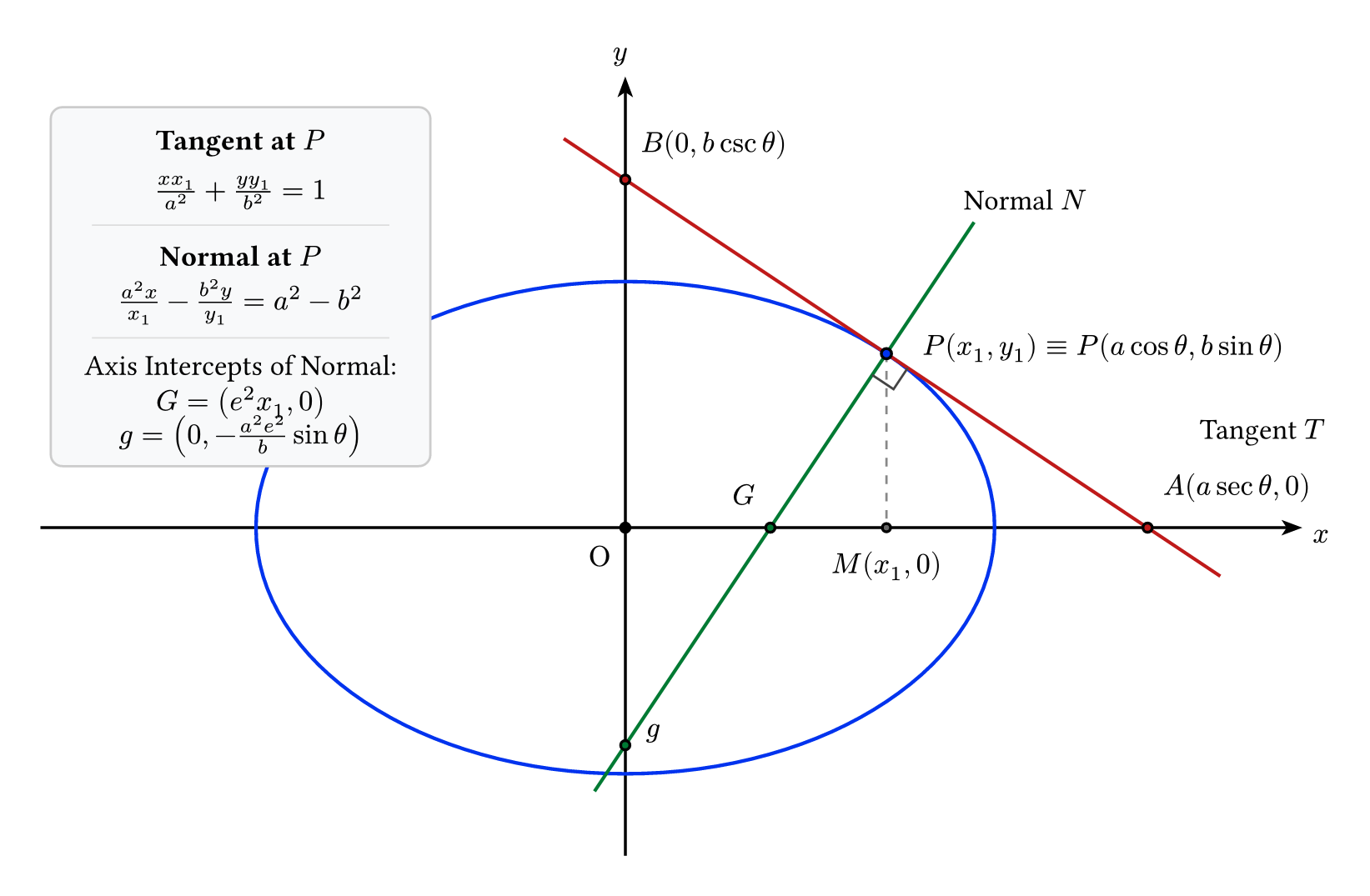
Tangent and Normal to an Ellipse

Equation of Tangent in Point Form§

Let P(x1,y1)P(x_1, y_1) be a point lying on the ellipse x2a2+y2b2=1\frac{x^2}{a^2} + \frac{y^2}{b^2} = 1. Since PP lies on the curve, its coordinates satisfy:

x12a2+y12b2=1\frac{x_1^2}{a^2} + \frac{y_1^2}{b^2} = 1

To determine the slope of the tangent at P(x1,y1)P(x_1, y_1), we differentiate the equation of the ellipse implicitly with respect to xx:

ddx(x2a2+y2b2)=ddx(1)\frac{d}{dx}\left(\frac{x^2}{a^2} + \frac{y^2}{b^2}\right) = \frac{d}{dx}(1) 2xa2+2yb2dydx=0\frac{2x}{a^2} + \frac{2y}{b^2}\frac{dy}{dx} = 0

Solving for the derivative dydx\frac{dy}{dx}:

dydx=−b2xa2y\frac{dy}{dx} = -\frac{b^2 x}{a^2 y}

Evaluating this derivative at the point P(x1,y1)P(x_1, y_1) (assuming y1≠0y_1 \neq 0), the slope mTm_T of the tangent line is:

mT=−b2x1a2y1m_T = -\frac{b^2 x_1}{a^2 y_1}

Using the point-slope equation of a straight line, y−y1=mT(x−x1)y - y_1 = m_T(x - x_1), the equation of the tangent is:

y−y1=−b2x1a2y1(x−x1)y - y_1 = -\frac{b^2 x_1}{a^2 y_1}(x - x_1)

Multiplying both sides by y1y_1 and dividing by b2b^2:

y1(y−y1)b2=−x1(x−x1)a2\frac{y_1(y - y_1)}{b^2} = -\frac{x_1(x - x_1)}{a^2} yy1−y12b2=−xx1−x12a2\frac{y y_1 - y_1^2}{b^2} = -\frac{x x_1 - x_1^2}{a^2}

Rearranging terms to place current coordinates (x,y)(x, y) on the left side and constant terms on the right side:

xx1a2+yy1b2=x12a2+y12b2\frac{x x_1}{a^2} + \frac{y y_1}{b^2} = \frac{x_1^2}{a^2} + \frac{y_1^2}{b^2}

Since P(x1,y1)P(x_1, y_1) lies on the ellipse, the right-hand side is equal to 11. Thus, the equation of the tangent to the ellipse at P(x1,y1)P(x_1, y_1) is:

xx1a2+yy1b2=1\frac{x x_1}{a^2} + \frac{y y_1}{b^2} = 1

Behavior at the Vertices:

When y1=0y_1 = 0, the point is a vertex (±a,0)(\pm a, 0). Here, the tangent is vertical. Substituting x1=±ax_1 = \pm a and y1=0y_1 = 0 into our derived formula gives:

x(±a)a2+0=1  ⟹  ±xa=1  ⟹  x=±a\frac{x(\pm a)}{a^2} + 0 = 1 \implies \pm \frac{x}{a} = 1 \implies x = \pm a

which correctly represents the two vertical tangents at the vertices A(a,0)A(a, 0) and A′(−a,0)A'(-a, 0). Hence, the point form holds universally for every point on the ellipse.

The Operator Notation (T=0T = 0):

Using the standard conic operator TT, the equation of the tangent at P(x1,y1)P(x_1, y_1) is written concisely as:

T=0T = 0

For the standard ellipse x2a2+y2b2−1=0\frac{x^2}{a^2} + \frac{y^2}{b^2} - 1 = 0, the operator TT is defined by:

T≡xx1a2+yy1b2−1T \equiv \frac{x x_1}{a^2} + \frac{y y_1}{b^2} - 1

For an ellipse shifted to center (h,k)(h, k):

(x−h)2a2+(y−k)2b2=1\frac{(x - h)^2}{a^2} + \frac{(y - k)^2}{b^2} = 1

the equation of the tangent at (x1,y1)(x_1, y_1) is obtained by the corresponding linear replacement:

(x−h)(x1−h)a2+(y−k)(y1−k)b2=1\frac{(x - h)(x_1 - h)}{a^2} + \frac{(y - k)(y_1 - k)}{b^2} = 1

Note on the Universal Tangent Equation to Any Conic (T=0T = 0):

The method of linear replacement is not limited to standard or shifted ellipses. It applies universally to the general second-degree equation representing any conic section (circle, parabola, ellipse, or hyperbola, whether in standard orientation, translated, or rotated with an xyxy-term):

ax2+2hxy+by2+2gx+2fy+c=0ax^2 + 2hxy + by^2 + 2gx + 2fy + c = 0

If P(x1,y1)P(x_1, y_1) is any point lying on the curve, the equation of the tangent at PP is obtained immediately by applying the universal replacement rules to each term of the general equation:

x2⟶xx1x^2 \longrightarrow x x_1 y2⟶yy1y^2 \longrightarrow y y_1 2xy⟶xy1+x1y(or xy⟶xy1+x1y2)2xy \longrightarrow x y_1 + x_1 y \quad \left(\text{or } xy \longrightarrow \frac{x y_1 + x_1 y}{2}\right) 2x⟶x+x1(or x⟶x+x12)2x \longrightarrow x + x_1 \quad \left(\text{or } x \longrightarrow \frac{x + x_1}{2}\right) 2y⟶y+y1(or y⟶y+y12)2y \longrightarrow y + y_1 \quad \left(\text{or } y \longrightarrow \frac{y + y_1}{2}\right) c⟶c(the constant term remains unaltered)c \longrightarrow c \quad (\text{the constant term remains unaltered})

Carrying out these substitutions yields the linear expression TT:

T≡axx1+h(xy1+x1y)+byy1+g(x+x1)+f(y+y1)+c=0T \equiv a x x_1 + h(x y_1 + x_1 y) + b y y_1 + g(x + x_1) + f(y + y_1) + c = 0

The line T=0T = 0 represents the exact equation of the tangent at P(x1,y1)P(x_1, y_1) to any conic represented by the general second-degree equation.

Why this rule works: The substitution T=0T = 0 constructs the unique linear equation (polar line) that passes through P(x1,y1)P(x_1, y_1) and shares the exact first-order differential coefficients of the conic at that point. Geometrically, when PP lies on the conic, its polar line coincides identically with the tangent at PP. This algebraic principle holds universally across all conics, eliminating the need to perform implicit differentiation dydx\frac{dy}{dx} from scratch whenever finding a tangent at a known point on the curve.


Equation of Tangent in Parametric Form§

In the preceding chapter, we established that any point PP on the standard ellipse can be parameterized by its eccentric angle θ∈[0,2π)\theta \in [0, 2\pi) as:

x1=acos⁡θ,y1=bsin⁡θx_1 = a\cos\theta, \quad y_1 = b\sin\theta

Substituting these parametric coordinates into the point form of the tangent:

x(acos⁡θ)a2+y(bsin⁡θ)b2=1\frac{x(a\cos\theta)}{a^2} + \frac{y(b\sin\theta)}{b^2} = 1

Canceling the common factors of aa and bb yields the standard parametric equation of the tangent:

xacos⁡θ+ybsin⁡θ=1\frac{x}{a}\cos\theta + \frac{y}{b}\sin\theta = 1

Slope and Axis Intercepts of the Tangent:

From this parametric equation, we read off the following fundamental properties:

Slope of the Tangent:

mT=−cos⁡θasin⁡θb=−bacot⁡θm_T = -\frac{\frac{\cos\theta}{a}}{\frac{\sin\theta}{b}} = -\frac{b}{a}\cot\theta

Intercept on the Major Axis (xx-axis):

Setting y=0y = 0:

xacos⁡θ=1  ⟹  x=acos⁡θ=asec⁡θ\frac{x}{a}\cos\theta = 1 \implies x = \frac{a}{\cos\theta} = a\sec\theta

The tangent cuts the xx-axis at the point A(asec⁡θ,0)A(a\sec\theta, 0).

Intercept on the Minor Axis (yy-axis):

Setting x=0x = 0:

ybsin⁡θ=1  ⟹  y=bsin⁡θ=bcsc⁡θ\frac{y}{b}\sin\theta = 1 \implies y = \frac{b}{\sin\theta} = b\csc\theta

The tangent cuts the yy-axis at the point B(0,bcsc⁡θ)B(0, b\csc\theta).


Equation of Tangent in Slope Form§

When the slope mm of the tangent line is specified rather than the point of contact, the condition of tangency derived in Tutorial 04 provides the equation directly.

For the straight line y=mx+cy = mx + c to touch the ellipse x2a2+y2b2=1\frac{x^2}{a^2} + \frac{y^2}{b^2} = 1, the discriminant of the quadratic equation resulting from their intersection must vanish:

c2=a2m2+b2  ⟹  c=±a2m2+b2c^2 = a^2 m^2 + b^2 \implies c = \pm \sqrt{a^2 m^2 + b^2}

Hence, the equations of the two tangents to the ellipse having slope mm are:

y=mx±a2m2+b2y = mx \pm \sqrt{a^2 m^2 + b^2}

Points of Contact:

Comparing the line mx−y=∓a2m2+b2mx - y = \mp \sqrt{a^2 m^2 + b^2} with the point-form tangent xx1a2+yy1b2=1\frac{x x_1}{a^2} + \frac{y y_1}{b^2} = 1, we find:

x1/a2m=y1/b2−1=1∓a2m2+b2\frac{x_1/a^2}{m} = \frac{y_1/b^2}{-1} = \frac{1}{\mp \sqrt{a^2 m^2 + b^2}}

Solving for x1x_1 and y1y_1:

x1=∓a2ma2m2+b2,y1=±b2a2m2+b2x_1 = \mp \frac{a^2 m}{\sqrt{a^2 m^2 + b^2}}, \quad y_1 = \pm \frac{b^2}{\sqrt{a^2 m^2 + b^2}}

Thus, the tangent y=mx+a2m2+b2y = mx + \sqrt{a^2 m^2 + b^2} touches the ellipse at the point:

(−a2ma2m2+b2,b2a2m2+b2)\left(-\frac{a^2 m}{\sqrt{a^2 m^2 + b^2}}, \frac{b^2}{\sqrt{a^2 m^2 + b^2}}\right)

and the parallel tangent y=mx−a2m2+b2y = mx - \sqrt{a^2 m^2 + b^2} touches at the diametrically opposite point:

(a2ma2m2+b2,−b2a2m2+b2)\left(\frac{a^2 m}{\sqrt{a^2 m^2 + b^2}}, -\frac{b^2}{\sqrt{a^2 m^2 + b^2}}\right)

For every real slope mm, there exist exactly two parallel tangents to an ellipse, located symmetrically on opposite sides of the center.


Normal to an Ellipse§

The normal to an ellipse at any point PP is defined as the straight line passing through PP and perpendicular to the tangent at PP.


Equation of Normal in Point Form§

Let P(x1,y1)P(x_1, y_1) be a point on the ellipse x2a2+y2b2=1\frac{x^2}{a^2} + \frac{y^2}{b^2} = 1.

The slope of the tangent at P(x1,y1)P(x_1, y_1) is:

mT=−b2x1a2y1m_T = -\frac{b^2 x_1}{a^2 y_1}

Since the normal is perpendicular to the tangent, its slope mNm_N satisfies mN⋅mT=−1m_N \cdot m_T = -1:

mN=−1mT=a2y1b2x1(x1≠0,y1≠0)m_N = -\frac{1}{m_T} = \frac{a^2 y_1}{b^2 x_1} \quad (x_1 \neq 0, y_1 \neq 0)

Using the point-slope form with point (x1,y1)(x_1, y_1) and slope mNm_N:

y−y1=a2y1b2x1(x−x1)y - y_1 = \frac{a^2 y_1}{b^2 x_1}(x - x_1)

To express this equation symmetrically, divide both sides by y1y_1 and multiply by b2b^2:

b2(y−y1)y1=a2(x−x1)x1\frac{b^2(y - y_1)}{y_1} = \frac{a^2(x - x_1)}{x_1} b2yy1−b2=a2xx1−a2\frac{b^2 y}{y_1} - b^2 = \frac{a^2 x}{x_1} - a^2

Rearranging the terms:

a2xx1−b2yy1=a2−b2\frac{a^2 x}{x_1} - \frac{b^2 y}{y_1} = a^2 - b^2

Recalling that b2=a2(1−e2)b^2 = a^2(1 - e^2), the difference of the squares of the semi-axes is related to eccentricity by a2−b2=a2e2a^2 - b^2 = a^2 e^2. Thus, the point form of the normal may also be written as:

a2xx1−b2yy1=a2e2\frac{a^2 x}{x_1} - \frac{b^2 y}{y_1} = a^2 e^2

Behavior at the Principal Vertices:

At the major axis vertices (±a,0)(\pm a, 0), y1=0y_1 = 0, the tangent is vertical (x=±ax = \pm a), and the normal is the horizontal major axis (y=0y = 0).

At the minor axis vertices (0,±b)(0, \pm b), x1=0x_1 = 0, the tangent is horizontal (y=±by = \pm b), and the normal is the vertical minor axis (x=0x = 0).

Clearing denominators yields the general form:

a2xy1−b2yx1=(a2−b2)x1y1a^2 x y_1 - b^2 y x_1 = (a^2 - b^2) x_1 y_1

which remains valid without division-by-zero singularities at all four vertices.


Equation of Normal in Parametric Form§

Substituting the parametric coordinates x1=acos⁡θx_1 = a\cos\theta and y1=bsin⁡θy_1 = b\sin\theta into the point form of the normal:

a2xacos⁡θ−b2ybsin⁡θ=a2−b2\frac{a^2 x}{a\cos\theta} - \frac{b^2 y}{b\sin\theta} = a^2 - b^2

Canceling aa and bb from the respective numerators and denominators:

axcos⁡θ−bysin⁡θ=a2−b2\frac{ax}{\cos\theta} - \frac{by}{\sin\theta} = a^2 - b^2

Expressed with reciprocal trigonometric functions, this is:

axsec⁡θ−bycsc⁡θ=a2−b2ax\sec\theta - by\csc\theta = a^2 - b^2

Slope of the Normal:

Writing the parametric equation in slope-intercept form:

bycsc⁡θ=axsec⁡θ−(a2−b2)by\csc\theta = ax\sec\theta - (a^2 - b^2) y=(asec⁡θbcsc⁡θ)x−a2−b2bsin⁡θy = \left(\frac{a\sec\theta}{b\csc\theta}\right)x - \frac{a^2 - b^2}{b}\sin\theta mN=abtan⁡θm_N = \frac{a}{b}\tan\theta

Axis Intercepts of the Normal:

The points where the normal cuts the coordinate axes possess important geometric significance:

Major Axis Intercept (GG):

Setting y=0y = 0 in the parametric equation:

axcos⁡θ=a2−b2  ⟹  x=a2−b2acos⁡θ=a2e2acos⁡θ=ae2cos⁡θ\frac{ax}{\cos\theta} = a^2 - b^2 \implies x = \frac{a^2 - b^2}{a}\cos\theta = \frac{a^2 e^2}{a}\cos\theta = a e^2 \cos\theta

Since x1=acos⁡θx_1 = a\cos\theta, this intercept is simply:

xG=e2x1x_G = e^2 x_1

Let GG denote this intercept point on the major axis:

G=(e2x1,0)=(ae2cos⁡θ,0)G = (e^2 x_1, 0) = (a e^2 \cos\theta, 0)

Because 0<e<10 < e < 1 for an ellipse, we have e2<1e^2 < 1, which proves:

∣xG∣=e2∣x1∣<∣x1∣|x_G| = e^2 |x_1| < |x_1|

Thus, the normal always intersects the major axis strictly between the center O(0,0)O(0, 0) and the foot of the ordinate M(x1,0)M(x_1, 0). Furthermore, because ∣ae2cos⁡θ∣≤ae2<ae|a e^2 \cos\theta| \le a e^2 < ae, the intercept GG always lies strictly between the two foci S(ae,0)S(ae, 0) and S′(−ae,0)S'(-ae, 0).

Minor Axis Intercept (gg):

Setting x=0x = 0 in the parametric equation:

−bysin⁡θ=a2−b2  ⟹  y=−a2−b2bsin⁡θ=−a2e2bsin⁡θ-\frac{by}{\sin\theta} = a^2 - b^2 \implies y = -\frac{a^2 - b^2}{b}\sin\theta = -\frac{a^2 e^2}{b}\sin\theta

Let gg denote this intercept point on the minor axis:

g=(0,−a2−b2bsin⁡θ)=(0,−a2e2bsin⁡θ)g = \left(0, -\frac{a^2 - b^2}{b}\sin\theta\right) = \left(0, -\frac{a^2 e^2}{b}\sin\theta\right)

Equation of Normal in Slope Form§

Suppose the slope of the normal is given as mm. We seek the equation of the normal in terms of mm.

From our parametric derivation, the slope of the normal is:

m=abtan⁡θ  ⟹  tan⁡θ=bmam = \frac{a}{b}\tan\theta \implies \tan\theta = \frac{bm}{a}

Using basic trigonometry to express cos⁡θ\cos\theta and sin⁡θ\sin\theta in terms of tan⁡θ\tan\theta:

cos⁡θ=±11+tan⁡2θ=±11+b2m2a2=±aa2+b2m2\cos\theta = \frac{\pm 1}{\sqrt{1 + \tan^2\theta}} = \frac{\pm 1}{\sqrt{1 + \frac{b^2 m^2}{a^2}}} = \frac{\pm a}{\sqrt{a^2 + b^2 m^2}} sin⁡θ=tan⁡θcos⁡θ=(bma)(±aa2+b2m2)=±bma2+b2m2\sin\theta = \tan\theta \cos\theta = \left(\frac{bm}{a}\right)\left(\frac{\pm a}{\sqrt{a^2 + b^2 m^2}}\right) = \frac{\pm bm}{\sqrt{a^2 + b^2 m^2}}

Substituting these expressions into the parametric normal axcos⁡θ−bysin⁡θ=a2−b2\frac{ax}{\cos\theta} - \frac{by}{\sin\theta} = a^2 - b^2:

ax±aa2+b2m2−by±bma2+b2m2=a2−b2\frac{ax}{\pm \frac{a}{\sqrt{a^2 + b^2 m^2}}} - \frac{by}{\pm \frac{bm}{\sqrt{a^2 + b^2 m^2}}} = a^2 - b^2 ±a2+b2m2(x−ym)=a2−b2\pm \sqrt{a^2 + b^2 m^2}\left(x - \frac{y}{m}\right) = a^2 - b^2 x−ym=±a2−b2a2+b2m2x - \frac{y}{m} = \pm \frac{a^2 - b^2}{\sqrt{a^2 + b^2 m^2}}

Multiplying both sides by mm:

mx−y=±m(a2−b2)a2+b2m2mx - y = \pm \frac{m(a^2 - b^2)}{\sqrt{a^2 + b^2 m^2}}

Isolating yy, we obtain the slope form of the normal to the ellipse:

y=mx±m(a2−b2)a2+b2m2y = mx \pm \frac{m(a^2 - b^2)}{\sqrt{a^2 + b^2 m^2}}

Points of Contact in Terms of Normal Slope:

The coordinates of the points on the ellipse where the normal has slope mm are:

x1=acos⁡θ=±a2a2+b2m2x_1 = a\cos\theta = \pm \frac{a^2}{\sqrt{a^2 + b^2 m^2}} y1=bsin⁡θ=±b2ma2+b2m2y_1 = b\sin\theta = \pm \frac{b^2 m}{\sqrt{a^2 + b^2 m^2}}

For each real slope mm, there are two parallel normals to the ellipse, touching at diametrically opposite points.


Condition for a General Line to be Normal to an Ellipse§

Let a general straight line be given in standard form:

lx+my+n=0lx + my + n = 0

We determine the condition under which this line is a normal to the ellipse x2a2+y2b2=1\frac{x^2}{a^2} + \frac{y^2}{b^2} = 1.

The equation of a normal at eccentric angle θ\theta is:

axcos⁡θ−bysin⁡θ−(a2−b2)=0\frac{ax}{\cos\theta} - \frac{by}{\sin\theta} - (a^2 - b^2) = 0

If lx+my+n=0lx + my + n = 0 represents this normal, the coefficients of xx, yy, and the constant terms must be directly proportional:

lacos⁡θ=m−bsin⁡θ=n−(a2−b2)\frac{l}{\frac{a}{\cos\theta}} = \frac{m}{-\frac{b}{\sin\theta}} = \frac{n}{-(a^2 - b^2)} lcos⁡θa=−msin⁡θb=−na2−b2\frac{l\cos\theta}{a} = -\frac{m\sin\theta}{b} = -\frac{n}{a^2 - b^2}

From these ratios, we isolate cos⁡θ\cos\theta and sin⁡θ\sin\theta:

cos⁡θ=−anl(a2−b2)\cos\theta = -\frac{an}{l(a^2 - b^2)} sin⁡θ=bnm(a2−b2)\sin\theta = \frac{bn}{m(a^2 - b^2)}

Since θ\theta is a real eccentric angle, its coordinates must satisfy the fundamental trigonometric identity cos⁡2θ+sin⁡2θ=1\cos^2\theta + \sin^2\theta = 1:

(−anl(a2−b2))2+(bnm(a2−b2))2=1\left(-\frac{an}{l(a^2 - b^2)}\right)^2 + \left(\frac{bn}{m(a^2 - b^2)}\right)^2 = 1 a2n2l2(a2−b2)2+b2n2m2(a2−b2)2=1\frac{a^2 n^2}{l^2(a^2 - b^2)^2} + \frac{b^2 n^2}{m^2(a^2 - b^2)^2} = 1

Multiplying through by (a2−b2)2n2\frac{(a^2 - b^2)^2}{n^2}, we obtain the celebrated condition of normality:

a2l2+b2m2=(a2−b2)2n2\frac{a^2}{l^2} + \frac{b^2}{m^2} = \frac{(a^2 - b^2)^2}{n^2}

This condition is both necessary and sufficient for the straight line lx+my+n=0lx + my + n = 0 to be a normal to the ellipse x2a2+y2b2=1\frac{x^2}{a^2} + \frac{y^2}{b^2} = 1.


Finding the Foot of the Normal Using the Parametric Form§

In many coordinate geometry and calculus problems, you are asked to find the foot of the normal (the point of contact PP on the ellipse where the normal is drawn) when given the slope of the normal, or when given a point through which the normal passes.

While you could try using the condition of normality, that formula involves reciprocal squares and high-degree algebra.

The Recommended Method: Always use the parametric coordinates P(acos⁡θ,bsin⁡θ)P(a\cos\theta, b\sin\theta)!

Step-by-Step Method for a Given Normal Slope

  1. Write the parametric normal equation:

    axcos⁡θ−bysin⁡θ=a2−b2\frac{ax}{\cos\theta} - \frac{by}{\sin\theta} = a^2 - b^2
  2. Equate the slope:

    The slope of the normal is:

    mN=abtan⁡θm_N = \frac{a}{b}\tan\theta
  3. Solve for the trigonometric values:

    tan⁡θ=bmNa\tan\theta = \frac{b m_N}{a}

    From tan⁡θ\tan\theta, determine:

    cos⁡θ=±11+tan⁡2θ=±aa2+b2mN2\cos\theta = \pm\frac{1}{\sqrt{1 + \tan^2\theta}} = \pm\frac{a}{\sqrt{a^2 + b^2 m_N^2}} sin⁡θ=tan⁡θcos⁡θ=±bmNa2+b2mN2\sin\theta = \tan\theta\cos\theta = \pm\frac{b m_N}{\sqrt{a^2 + b^2 m_N^2}}
  4. Write the foot of the normal:

    The foot of the normal is immediately obtained as:

    P(acos⁡θ,bsin⁡θ)=(±a2a2+b2mN2,  ±b2mNa2+b2mN2)P(a\cos\theta, b\sin\theta) = \left(\pm\frac{a^2}{\sqrt{a^2 + b^2 m_N^2}}, \; \pm\frac{b^2 m_N}{\sqrt{a^2 + b^2 m_N^2}}\right)

This direct trigonometric approach requires minimal calculation and gives both feet of the parallel normals cleanly.


Shortest Distance Problems§

Problems asking for the minimum distance between an ellipse and an external straight line or point are central applications of the normal.


Shortest Distance Between a Straight Line and an Ellipse§

Consider a straight line L:Ax+By+C=0L: Ax + By + C = 0 that does not intersect the ellipse x2a2+y2b2=1\frac{x^2}{a^2} + \frac{y^2}{b^2} = 1.

Geometric Principle:

The shortest distance between a smooth convex curve and a straight line occurs along their common normal. Because the line is straight, its normal is simply perpendicular to it. Therefore, at the point PP on the ellipse closest to the line:

The tangent to the ellipse at the closest point PP must be parallel to the given straight line LL.

Standard Solution Procedure:

  1. Find the slope of the given line:

    m=−ABm = -\frac{A}{B}
  2. Write the equations of the parallel tangents to the ellipse:

    y=mx±a2m2+b2y = mx \pm \sqrt{a^2 m^2 + b^2}
  3. Select the closer tangent:

    Compare the constants to find which of the two parallel tangents lies closer to the line LL.

  4. Calculate the shortest distance:

    Use the parallel lines distance formula:

    dmin⁡=∣c1−c2∣1+m2d_{\min} = \frac{|c_1 - c_2|}{\sqrt{1 + m^2}}

    Alternatively, determine the point of contact P(−a2mc,b2c)P\left(-\frac{a^2 m}{c}, \frac{b^2}{c}\right) of the closer tangent and compute its perpendicular distance to Ax+By+C=0Ax + By + C = 0.


Shortest Distance from an External Point to an Ellipse§

For a given external point Q(x0,y0)Q(x_0, y_0), the shortest distance to the ellipse occurs along the normal passing through QQ.

  1. Write the parametric normal:

    axcos⁡θ−bysin⁡θ=a2−b2\frac{ax}{\cos\theta} - \frac{by}{\sin\theta} = a^2 - b^2
  2. Substitute the coordinates of Q(x0,y0)Q(x_0, y_0) into the normal equation:

    ax0cos⁡θ−by0sin⁡θ=a2−b2\frac{a x_0}{\cos\theta} - \frac{b y_0}{\sin\theta} = a^2 - b^2
  3. Solve for θ\theta to locate the foot of the normal P(acos⁡θ,bsin⁡θ)P(a\cos\theta, b\sin\theta).

  4. The minimum distance is the Euclidean distance dmin⁡=PQ=(x0−acos⁡θ)2+(y0−bsin⁡θ)2d_{\min} = PQ = \sqrt{(x_0 - a\cos\theta)^2 + (y_0 - b\sin\theta)^2}.


Summary Comparison of Tangents and Normals§

The following table brings together the three primary forms of tangents and normals to the standard ellipse x2a2+y2b2=1\frac{x^2}{a^2} + \frac{y^2}{b^2} = 1:

Form Tangent Line Normal Line Point of Contact (x1,y1)(x_1, y_1)
Point Form xx1a2+yy1b2=1\frac{x x_1}{a^2} + \frac{y y_1}{b^2} = 1 a2xx1−b2yy1=a2−b2\frac{a^2 x}{x_1} - \frac{b^2 y}{y_1} = a^2 - b^2 (x1,y1)(x_1, y_1) on the ellipse
Parametric Form xacos⁡θ+ybsin⁡θ=1\frac{x}{a}\cos\theta + \frac{y}{b}\sin\theta = 1 axcos⁡θ−bysin⁡θ=a2−b2\frac{ax}{\cos\theta} - \frac{by}{\sin\theta} = a^2 - b^2 (acos⁡θ,bsin⁡θ)(a\cos\theta, b\sin\theta)
Slope Form y=mx±a2m2+b2y = mx \pm \sqrt{a^2 m^2 + b^2} y=mx±m(a2−b2)a2+b2m2y = mx \pm \frac{m(a^2 - b^2)}{\sqrt{a^2 + b^2 m^2}} (∓a2ma2m2+b2,±b2a2m2+b2)\left(\mp \frac{a^2 m}{\sqrt{a^2 m^2 + b^2}}, \pm \frac{b^2}{\sqrt{a^2 m^2 + b^2}}\right) (for tangent)

Illustrative Examples§

Example 1: Tangent and Normal at a Cartesian Point§

Find the equations of the tangent and normal to the ellipse x2+4y2=8x^2 + 4y^2 = 8 at the point P(2,1)P(2, 1). Verify that the tangent and normal are mutually perpendicular, and determine the coordinates of their intercepts on the coordinate axes.

Solution:

We first divide the given equation by 88 to express it in standard form:

x28+y22=1\frac{x^2}{8} + \frac{y^2}{2} = 1

Here, a2=8a^2 = 8 and b2=2b^2 = 2. Testing the point P(2,1)P(2, 1):

228+122=48+12=12+12=1\frac{2^2}{8} + \frac{1^2}{2} = \frac{4}{8} + \frac{1}{2} = \frac{1}{2} + \frac{1}{2} = 1

The point P(2,1)P(2, 1) lies on the ellipse.

Equation of Tangent:

Using the point form xx1a2+yy1b2=1\frac{x x_1}{a^2} + \frac{y y_1}{b^2} = 1 with x1=2x_1 = 2 and y1=1y_1 = 1:

x(2)8+y(1)2=1  ⟹  x4+y2=1\frac{x(2)}{8} + \frac{y(1)}{2} = 1 \implies \frac{x}{4} + \frac{y}{2} = 1

Multiplying by 44:

x+2y=4x + 2y = 4

The slope of this tangent line is mT=−12m_T = -\frac{1}{2}.

Equation of Normal:

Using the point form of the normal a2xx1−b2yy1=a2−b2\frac{a^2 x}{x_1} - \frac{b^2 y}{y_1} = a^2 - b^2:

8x2−2y1=8−2\frac{8x}{2} - \frac{2y}{1} = 8 - 2 4x−2y=6  ⟹  2x−y=34x - 2y = 6 \implies 2x - y = 3

The slope of this normal line is mN=2m_N = 2.

Perpendicularity Verification:

mT⋅mN=(−12)⋅(2)=−1m_T \cdot m_N = \left(-\frac{1}{2}\right) \cdot (2) = -1

The tangent and normal are perpendicular at P(2,1)P(2, 1).

Axis Intercepts:

For the tangent x+2y=4x + 2y = 4:

  • xx-intercept: setting y=0y = 0 gives x=4x = 4, so A(4,0)A(4, 0).
  • yy-intercept: setting x=0x = 0 gives y=2y = 2, so B(0,2)B(0, 2).

For the normal 2x−y=32x - y = 3:

  • Major axis intercept GG: setting y=0y = 0 gives x=32x = \frac{3}{2}, so G(32,0)G\left(\frac{3}{2}, 0\right).
  • Minor axis intercept gg: setting x=0x = 0 gives y=−3y = -3, so g(0,−3)g(0, -3).

Notice that e2=1−b2a2=1−28=34e^2 = 1 - \frac{b^2}{a^2} = 1 - \frac{2}{8} = \frac{3}{4}. The major axis intercept predicted by theory is e2x1=34(2)=32e^2 x_1 = \frac{3}{4}(2) = \frac{3}{2}, which matches G(32,0)G\left(\frac{3}{2}, 0\right) exactly.


Example 2: Tangent and Normal in Parametric Form§

For the ellipse x216+y29=1\frac{x^2}{16} + \frac{y^2}{9} = 1, find the equations of the tangent and normal at the point whose eccentric angle is θ=π6\theta = \frac{\pi}{6}. Determine the length of the normal segment between the curve and the major axis.

Solution:

From the standard equation, a2=16  ⟹  a=4a^2 = 16 \implies a = 4, and b2=9  ⟹  b=3b^2 = 9 \implies b = 3.

The coordinates of the point PP at θ=π6\theta = \frac{\pi}{6} are:

x1=4cos⁡π6=4(32)=23x_1 = 4\cos\frac{\pi}{6} = 4\left(\frac{\sqrt{3}}{2}\right) = 2\sqrt{3} y1=3sin⁡π6=3(12)=32y_1 = 3\sin\frac{\pi}{6} = 3\left(\frac{1}{2}\right) = \frac{3}{2}

Equation of the Tangent:

Using the parametric form xacos⁡θ+ybsin⁡θ=1\frac{x}{a}\cos\theta + \frac{y}{b}\sin\theta = 1:

x4(32)+y3(12)=1  ⟹  3x8+y6=1\frac{x}{4}\left(\frac{\sqrt{3}}{2}\right) + \frac{y}{3}\left(\frac{1}{2}\right) = 1 \implies \frac{\sqrt{3}x}{8} + \frac{y}{6} = 1

Multiplying through by 2424:

33x+4y=243\sqrt{3}x + 4y = 24

Equation of the Normal:

Using the parametric form axcos⁡θ−bysin⁡θ=a2−b2\frac{ax}{\cos\theta} - \frac{by}{\sin\theta} = a^2 - b^2:

4x32−3y12=16−9\frac{4x}{\frac{\sqrt{3}}{2}} - \frac{3y}{\frac{1}{2}} = 16 - 9 8x3−6y=7\frac{8x}{\sqrt{3}} - 6y = 7

Multiplying through by 3\sqrt{3}:

8x−63y=738x - 6\sqrt{3}y = 7\sqrt{3}

Major Axis Intercept of the Normal:

Setting y=0y = 0 in the normal equation:

8x=73  ⟹  x=7388x = 7\sqrt{3} \implies x = \frac{7\sqrt{3}}{8}

Thus, the intercept on the major axis is G(738,0)G\left(\frac{7\sqrt{3}}{8}, 0\right).

Length of the Normal Segment PGPG:

The length of the segment of the normal between P(23,32)P\left(2\sqrt{3}, \frac{3}{2}\right) and G(738,0)G\left(\frac{7\sqrt{3}}{8}, 0\right) is:

PG=(23−738)2+(32−0)2PG = \sqrt{\left(2\sqrt{3} - \frac{7\sqrt{3}}{8}\right)^2 + \left(\frac{3}{2} - 0\right)^2} 23−738=163−738=9382\sqrt{3} - \frac{7\sqrt{3}}{8} = \frac{16\sqrt{3} - 7\sqrt{3}}{8} = \frac{9\sqrt{3}}{8} PG2=(938)2+(32)2=24364+94=243+14464=38764PG^2 = \left(\frac{9\sqrt{3}}{8}\right)^2 + \left(\frac{3}{2}\right)^2 = \frac{243}{64} + \frac{9}{4} = \frac{243 + 144}{64} = \frac{387}{64} PG=3878=3438PG = \frac{\sqrt{387}}{8} = \frac{3\sqrt{43}}{8}

Example 3: Minimum Length of Tangent Intercepted Between Coordinate Axes§

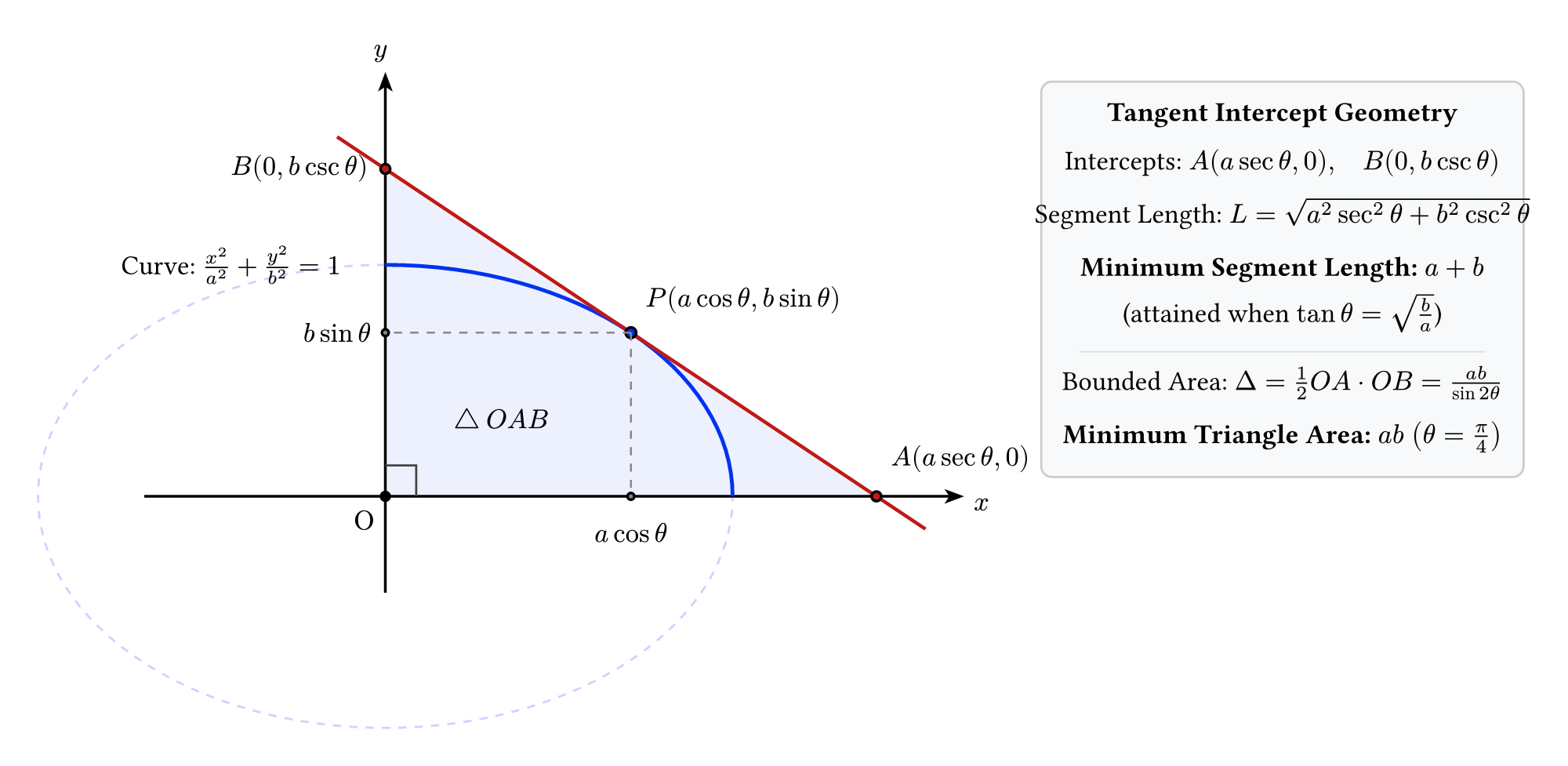
A tangent is drawn to the ellipse x2a2+y2b2=1\frac{x^2}{a^2} + \frac{y^2}{b^2} = 1 at a point PP in the first quadrant, meeting the xx-axis at AA and the yy-axis at BB. Prove that the minimum length of the intercepted segment ABAB is a+ba + b, and find the eccentric angle of PP at which this minimum occurs.

Geometry of Tangent Intercepts

Solution:

Let the point of tangency be P(acos⁡θ,bsin⁡θ)P(a\cos\theta, b\sin\theta), where θ∈(0,π2)\theta \in \left(0, \frac{\pi}{2}\right) since PP lies in the first quadrant.

The parametric equation of the tangent is:

xacos⁡θ+ybsin⁡θ=1\frac{x}{a}\cos\theta + \frac{y}{b}\sin\theta = 1

Finding the intercepts:

  • Setting y=0y = 0 yields xA=asec⁡θx_A = a\sec\theta, so A=(asec⁡θ,0)A = (a\sec\theta, 0).
  • Setting x=0x = 0 yields yB=bcsc⁡θy_B = b\csc\theta, so B=(0,bcsc⁡θ)B = (0, b\csc\theta).

The length LL of the intercepted segment ABAB is:

L2=OA2+OB2=a2sec⁡2θ+b2csc⁡2θL^2 = OA^2 + OB^2 = a^2\sec^2\theta + b^2\csc^2\theta

We express sec⁡2θ\sec^2\theta and csc⁡2θ\csc^2\theta in terms of tan⁡2θ\tan^2\theta and cot⁡2θ\cot^2\theta:

L2=a2(1+tan⁡2θ)+b2(1+cot⁡2θ)L^2 = a^2(1 + \tan^2\theta) + b^2(1 + \cot^2\theta) L2=a2+b2+a2tan⁡2θ+b2cot⁡2θL^2 = a^2 + b^2 + a^2\tan^2\theta + b^2\cot^2\theta

Completing the square in the variable terms:

a2tan⁡2θ+b2cot⁡2θ=(atan⁡θ−bcot⁡θ)2+2(atan⁡θ)(bcot⁡θ)a^2\tan^2\theta + b^2\cot^2\theta = (a\tan\theta - b\cot\theta)^2 + 2(a\tan\theta)(b\cot\theta)

Since tan⁡θcot⁡θ=1\tan\theta \cot\theta = 1, the product term simplifies to 2ab2ab:

L2=a2+b2+2ab+(atan⁡θ−bcot⁡θ)2L^2 = a^2 + b^2 + 2ab + (a\tan\theta - b\cot\theta)^2 L2=(a+b)2+(atan⁡θ−bcot⁡θ)2L^2 = (a + b)^2 + (a\tan\theta - b\cot\theta)^2

Because (atan⁡θ−bcot⁡θ)2≥0(a\tan\theta - b\cot\theta)^2 \ge 0 for all real θ\theta, the minimum value of L2L^2 is achieved when the squared term vanishes:

atan⁡θ−bcot⁡θ=0a\tan\theta - b\cot\theta = 0 atan⁡θ=btan⁡θ  ⟹  tan⁡2θ=baa\tan\theta = \frac{b}{\tan\theta} \implies \tan^2\theta = \frac{b}{a}

Since θ∈(0,π2)\theta \in \left(0, \frac{\pi}{2}\right), tan⁡θ>0\tan\theta > 0, so:

tan⁡θ=ba\tan\theta = \sqrt{\frac{b}{a}}

At this optimal eccentric angle, the minimum value of L2L^2 is:

Lmin⁡2=(a+b)2  ⟹  Lmin⁡=a+bL_{\min}^2 = (a + b)^2 \implies L_{\min} = a + b

Alternative Verification by Calculus:

Let f(θ)=a2sec⁡2θ+b2csc⁡2θf(\theta) = a^2\sec^2\theta + b^2\csc^2\theta. Differentiating with respect to θ\theta:

f′(θ)=2a2sec⁡2θtan⁡θ−2b2csc⁡2θcot⁡θf'(\theta) = 2a^2\sec^2\theta\tan\theta - 2b^2\csc^2\theta\cot\theta

Setting f′(θ)=0f'(\theta) = 0:

a2(1cos⁡2θ)(sin⁡θcos⁡θ)=b2(1sin⁡2θ)(cos⁡θsin⁡θ)a^2\left(\frac{1}{\cos^2\theta}\right)\left(\frac{\sin\theta}{\cos\theta}\right) = b^2\left(\frac{1}{\sin^2\theta}\right)\left(\frac{\cos\theta}{\sin\theta}\right) a2sin⁡θcos⁡3θ=b2cos⁡θsin⁡3θ  ⟹  sin⁡4θcos⁡4θ=b2a2  ⟹  tan⁡4θ=b2a2\frac{a^2\sin\theta}{\cos^3\theta} = \frac{b^2\cos\theta}{\sin^3\theta} \implies \frac{\sin^4\theta}{\cos^4\theta} = \frac{b^2}{a^2} \implies \tan^4\theta = \frac{b^2}{a^2}

Taking the positive square root for the first quadrant:

tan⁡2θ=ba  ⟹  tan⁡θ=ba\tan^2\theta = \frac{b}{a} \implies \tan\theta = \sqrt{\frac{b}{a}}

Substituting tan⁡2θ=ba\tan^2\theta = \frac{b}{a} gives sec⁡2θ=1+ba=a+ba\sec^2\theta = 1 + \frac{b}{a} = \frac{a+b}{a} and csc⁡2θ=1+ab=a+bb\csc^2\theta = 1 + \frac{a}{b} = \frac{a+b}{b}:

Lmin⁡2=a2(a+ba)+b2(a+bb)=a(a+b)+b(a+b)=(a+b)2L_{\min}^2 = a^2\left(\frac{a+b}{a}\right) + b^2\left(\frac{a+b}{b}\right) = a(a+b) + b(a+b) = (a+b)^2

Thus, Lmin⁡=a+bL_{\min} = a + b, which confirms the algebraic result.


Example 4: Minimum Area of Triangle Formed by Tangent and Axes§

A tangent is drawn to the ellipse x2a2+y2b2=1\frac{x^2}{a^2} + \frac{y^2}{b^2} = 1 at a point in the first quadrant, meeting the coordinate axes at AA and BB. Find the minimum area of the triangle △OAB\triangle OAB, and determine the coordinates of the point of contact where this minimum is achieved.

Solution:

Let the point of contact be P(acos⁡θ,bsin⁡θ)P(a\cos\theta, b\sin\theta) with θ∈(0,π2)\theta \in \left(0, \frac{\pi}{2}\right).

The tangent equation is:

xacos⁡θ+ybsin⁡θ=1\frac{x}{a}\cos\theta + \frac{y}{b}\sin\theta = 1

The intercepts on the coordinate axes are OA=asec⁡θOA = a\sec\theta and OB=bcsc⁡θOB = b\csc\theta.

Since △OAB\triangle OAB is a right-angled triangle at the origin OO, its area Δ\Delta is:

Δ=12⋅OA⋅OB=12(asec⁡θ)(bcsc⁡θ)\Delta = \frac{1}{2} \cdot OA \cdot OB = \frac{1}{2}(a\sec\theta)(b\csc\theta) Δ=ab2sin⁡θcos⁡θ\Delta = \frac{ab}{2\sin\theta\cos\theta}

Using the double-angle identity 2sin⁡θcos⁡θ=sin⁡2θ2\sin\theta\cos\theta = \sin 2\theta:

Δ=absin⁡2θ\Delta = \frac{ab}{\sin 2\theta}

For θ∈(0,π2)\theta \in \left(0, \frac{\pi}{2}\right), the angle 2θ2\theta satisfies 0<2θ<π0 < 2\theta < \pi. On this interval:

0<sin⁡2θ≤10 < \sin 2\theta \le 1

Because the numerator abab is constant, the area Δ\Delta is minimized when the denominator sin⁡2θ\sin 2\theta attains its maximum value:

sin⁡2θ=1  ⟹  2θ=π2  ⟹  θ=π4\sin 2\theta = 1 \implies 2\theta = \frac{\pi}{2} \implies \theta = \frac{\pi}{4}

Substituting sin⁡2θ=1\sin 2\theta = 1:

Δmin⁡=ab1=ab\Delta_{\min} = \frac{ab}{1} = ab

Point of Contact:

At θ=π4\theta = \frac{\pi}{4}:

x1=acos⁡π4=a2x_1 = a\cos\frac{\pi}{4} = \frac{a}{\sqrt{2}} y1=bsin⁡π4=b2y_1 = b\sin\frac{\pi}{4} = \frac{b}{\sqrt{2}}

Thus, the minimum triangle area is abab, achieved when the tangent touches the ellipse at the point (a2,b2)\left(\frac{a}{\sqrt{2}}, \frac{b}{\sqrt{2}}\right).

The equation of this optimal tangent line is:

xa2+yb2=1  ⟹  xa+yb=2\frac{x}{a\sqrt{2}} + \frac{y}{b\sqrt{2}} = 1 \implies \frac{x}{a} + \frac{y}{b} = \sqrt{2}

Example 5: Normals with a Given Slope§

Find the equations of the normals to the ellipse x216+y29=1\frac{x^2}{16} + \frac{y^2}{9} = 1 that have slope m=1m = 1, and determine the coordinates of their points of contact.

Solution:

From the given equation, a2=16a^2 = 16 and b2=9b^2 = 9, which gives a=4a = 4, b=3b = 3, and:

a2−b2=16−9=7a^2 - b^2 = 16 - 9 = 7

The slope of the normal is specified as m=1m = 1.

Equations of the Normals:

Using the slope form of the normal:

y=mx±m(a2−b2)a2+b2m2y = mx \pm \frac{m(a^2 - b^2)}{\sqrt{a^2 + b^2 m^2}}

Substituting m=1m = 1, a2−b2=7a^2 - b^2 = 7, a2=16a^2 = 16, and b2=9b^2 = 9:

y=1x±1(7)16+9(1)2=x±725=x±75y = 1x \pm \frac{1(7)}{\sqrt{16 + 9(1)^2}} = x \pm \frac{7}{\sqrt{25}} = x \pm \frac{7}{5}

Multiplying through by 55:

5y=5x±7  ⟹  5x−5y±7=05y = 5x \pm 7 \implies 5x - 5y \pm 7 = 0

Thus, the two normals having slope 11 are:

5x−5y+7=0and5x−5y−7=05x - 5y + 7 = 0 \quad \text{and} \quad 5x - 5y - 7 = 0

Points of Contact:

To find the points of contact, recall the relationship between the slope of the normal and the eccentric angle:

m=abtan⁡θ  ⟹  1=43tan⁡θ  ⟹  tan⁡θ=34m = \frac{a}{b}\tan\theta \implies 1 = \frac{4}{3}\tan\theta \implies \tan\theta = \frac{3}{4}

Since tan⁡θ=34>0\tan\theta = \frac{3}{4} > 0, θ\theta lies either in the first or third quadrant:

Case 1: First quadrant (θ\theta):

cos⁡θ=45,sin⁡θ=35\cos\theta = \frac{4}{5}, \quad \sin\theta = \frac{3}{5}

The point of contact is:

P1=(acos⁡θ,bsin⁡θ)=(4⋅45,3⋅35)=(165,95)P_1 = (a\cos\theta, b\sin\theta) = \left(4 \cdot \frac{4}{5}, 3 \cdot \frac{3}{5}\right) = \left(\frac{16}{5}, \frac{9}{5}\right)

Testing this point in the normal equation:

5(165)−5(95)=16−9=7  ⟹  5x−5y−7=05\left(\frac{16}{5}\right) - 5\left(\frac{9}{5}\right) = 16 - 9 = 7 \implies 5x - 5y - 7 = 0

Thus, P1(165,95)P_1\left(\frac{16}{5}, \frac{9}{5}\right) is the point of contact for the normal 5x−5y−7=05x - 5y - 7 = 0.

Case 2: Third quadrant (θ+π\theta + \pi):

cos⁡θ=−45,sin⁡θ=−35\cos\theta = -\frac{4}{5}, \quad \sin\theta = -\frac{3}{5}

The point of contact is:

P2=(−165,−95)P_2 = \left(-\frac{16}{5}, -\frac{9}{5}\right)

Testing this point in the normal equation:

5(−165)−5(−95)=−16+9=−7  ⟹  5x−5y+7=05\left(-\frac{16}{5}\right) - 5\left(-\frac{9}{5}\right) = -16 + 9 = -7 \implies 5x - 5y + 7 = 0

Thus, P2(−165,−95)P_2\left(-\frac{16}{5}, -\frac{9}{5}\right) is the point of contact for the normal 5x−5y+7=05x - 5y + 7 = 0.


Example 6: Tangents Perpendicular to a Given Line§

Find the equations of the tangents to the ellipse 3x2+4y2=123x^2 + 4y^2 = 12 that are perpendicular to the line 2x+y=42x + y = 4, and find their points of contact.

Solution:

We first convert the ellipse equation to standard form by dividing by 1212:

x24+y23=1\frac{x^2}{4} + \frac{y^2}{3} = 1

Here, a2=4a^2 = 4 and b2=3b^2 = 3.

The given line is y=−2x+4y = -2x + 4, which has slope m1=−2m_1 = -2.

Since the required tangents are perpendicular to this line, their slope mm satisfies m⋅(−2)=−1m \cdot (-2) = -1:

m=12m = \frac{1}{2}

Equations of Tangents:

Using the slope form of the tangent y=mx±a2m2+b2y = mx \pm \sqrt{a^2 m^2 + b^2}:

y=12x±4(12)2+3y = \frac{1}{2}x \pm \sqrt{4\left(\frac{1}{2}\right)^2 + 3} y=12x±4(14)+3=12x±1+3=12x±2y = \frac{1}{2}x \pm \sqrt{4\left(\frac{1}{4}\right) + 3} = \frac{1}{2}x \pm \sqrt{1 + 3} = \frac{1}{2}x \pm 2

Multiplying by 22:

2y=x±4  ⟹  x−2y±4=02y = x \pm 4 \implies x - 2y \pm 4 = 0

The two tangents are:

x−2y+4=0andx−2y−4=0x - 2y + 4 = 0 \quad \text{and} \quad x - 2y - 4 = 0

Points of Contact:

The points of contact for tangents of slope mm are:

(∓a2ma2m2+b2,±b2a2m2+b2)\left(\mp \frac{a^2 m}{\sqrt{a^2 m^2 + b^2}}, \pm \frac{b^2}{\sqrt{a^2 m^2 + b^2}}\right)

Here, a2m2+b2=2\sqrt{a^2 m^2 + b^2} = 2.

For the tangent y=12x+2y = \frac{1}{2}x + 2 (c=+2c = +2, which corresponds to x−2y+4=0x - 2y + 4 = 0):

x1=−a2mc=−4(1/2)2=−1x_1 = -\frac{a^2 m}{c} = -\frac{4(1/2)}{2} = -1 y1=b2c=32y_1 = \frac{b^2}{c} = \frac{3}{2}

Point of contact: (−1,32)\left(-1, \frac{3}{2}\right). Testing in the ellipse equation: 3(−1)2+4(32)2=3(1)+4(94)=3+9=123(-1)^2 + 4\left(\frac{3}{2}\right)^2 = 3(1) + 4\left(\frac{9}{4}\right) = 3 + 9 = 12.

For the tangent y=12x−2y = \frac{1}{2}x - 2 (c=−2c = -2, which corresponds to x−2y−4=0x - 2y - 4 = 0):

x1=−a2mc=−4(1/2)−2=1x_1 = -\frac{a^2 m}{c} = -\frac{4(1/2)}{-2} = 1 y1=b2c=3−2=−32y_1 = \frac{b^2}{c} = \frac{3}{-2} = -\frac{3}{2}

Point of contact: (1,−32)\left(1, -\frac{3}{2}\right). Testing in the ellipse equation: 3(1)2+4(−32)2=3+9=123(1)^2 + 4\left(-\frac{3}{2}\right)^2 = 3 + 9 = 12.


Example 7: Line in Normal Form as a Normal to an Ellipse§

If the straight line xcos⁡α+ysin⁡α=px\cos\alpha + y\sin\alpha = p is a normal to the ellipse x2a2+y2b2=1\frac{x^2}{a^2} + \frac{y^2}{b^2} = 1, prove that:

a2sec⁡2α+b2csc⁡2α=(a2−b2)2p2a^2\sec^2\alpha + b^2\csc^2\alpha = \frac{(a^2 - b^2)^2}{p^2}

Solution:

The given straight line is:

(cos⁡α)x+(sin⁡α)y−p=0(\cos\alpha)x + (\sin\alpha)y - p = 0

Comparing this with the general linear form lx+my+n=0lx + my + n = 0, we have:

l=cos⁡α,m=sin⁡α,n=−pl = \cos\alpha, \quad m = \sin\alpha, \quad n = -p

Recall the condition for the general line lx+my+n=0lx + my + n = 0 to be a normal to the ellipse x2a2+y2b2=1\frac{x^2}{a^2} + \frac{y^2}{b^2} = 1:

a2l2+b2m2=(a2−b2)2n2\frac{a^2}{l^2} + \frac{b^2}{m^2} = \frac{(a^2 - b^2)^2}{n^2}

Substituting l=cos⁡αl = \cos\alpha, m=sin⁡αm = \sin\alpha, and n=−pn = -p:

a2cos⁡2α+b2sin⁡2α=(a2−b2)2(−p)2\frac{a^2}{\cos^2\alpha} + \frac{b^2}{\sin^2\alpha} = \frac{(a^2 - b^2)^2}{(-p)^2}

Since 1cos⁡2α=sec⁡2α\frac{1}{\cos^2\alpha} = \sec^2\alpha, 1sin⁡2α=csc⁡2α\frac{1}{\sin^2\alpha} = \csc^2\alpha, and (−p)2=p2(-p)^2 = p^2:

a2sec⁡2α+b2csc⁡2α=(a2−b2)2p2a^2\sec^2\alpha + b^2\csc^2\alpha = \frac{(a^2 - b^2)^2}{p^2}

This completes the proof.


Example 8: Finding the Feet of Normals Using the Parametric Form§

Find the equations of the normals to the ellipse x216+y29=1\frac{x^2}{16} + \frac{y^2}{9} = 1 that are perpendicular to the line x+2y−5=0x + 2y - 5 = 0, and determine the coordinates of their feet on the ellipse.

Solution:

Here a2=16  ⟹  a=4a^2 = 16 \implies a = 4, and b2=9  ⟹  b=3b^2 = 9 \implies b = 3.

The given line is x+2y−5=0x + 2y - 5 = 0, which has slope mL=−12m_L = -\frac{1}{2}.

Since the normal is perpendicular to this line:

mN=−1mL=2m_N = -\frac{1}{m_L} = 2

Step 1: Relate normal slope to eccentric angle θ\theta:

The equation of the normal in parametric form is:

4xcos⁡θ−3ysin⁡θ=16−9=7\frac{4x}{\cos\theta} - \frac{3y}{\sin\theta} = 16 - 9 = 7

The slope of the normal is:

mN=abtan⁡θ=43tan⁡θm_N = \frac{a}{b}\tan\theta = \frac{4}{3}\tan\theta

Equating this to 22:

43tan⁡θ=2  ⟹  tan⁡θ=32\frac{4}{3}\tan\theta = 2 \implies \tan\theta = \frac{3}{2}

Step 2: Determine cos⁡θ\cos\theta and sin⁡θ\sin\theta:

Since tan⁡θ=32>0\tan\theta = \frac{3}{2} > 0, θ\theta can lie in Quadrant I or Quadrant III:

sec⁡2θ=1+tan⁡2θ=1+94=134  ⟹  cos⁡θ=±213\sec^2\theta = 1 + \tan^2\theta = 1 + \frac{9}{4} = \frac{13}{4} \implies \cos\theta = \pm\frac{2}{\sqrt{13}} sin⁡θ=tan⁡θcos⁡θ=(32)(±213)=±313\sin\theta = \tan\theta\cos\theta = \left(\frac{3}{2}\right)\left(\pm\frac{2}{\sqrt{13}}\right) = \pm\frac{3}{\sqrt{13}}

Step 3: Coordinates of the feet of the normals:

Using P(acos⁡θ,bsin⁡θ)=(4cos⁡θ,3sin⁡θ)P(a\cos\theta, b\sin\theta) = (4\cos\theta, 3\sin\theta):

  • Quadrant I:

    P1=(4⋅213,  3⋅313)=(813,  913)P_1 = \left(4 \cdot \frac{2}{\sqrt{13}}, \; 3 \cdot \frac{3}{\sqrt{13}}\right) = \left(\frac{8}{\sqrt{13}}, \; \frac{9}{\sqrt{13}}\right)
  • Quadrant III:

    P2=(4⋅(−213),  3⋅(−313))=(−813,  −913)P_2 = \left(4 \cdot \left(-\frac{2}{\sqrt{13}}\right), \; 3 \cdot \left(-\frac{3}{\sqrt{13}}\right)\right) = \left(-\frac{8}{\sqrt{13}}, \; -\frac{9}{\sqrt{13}}\right)

Step 4: Equations of the normals:

Using y−y1=2(x−x1)y - y_1 = 2(x - x_1):

For P1P_1:

y−913=2(x−813)  ⟹  2x−y=16−913=713y - \frac{9}{\sqrt{13}} = 2\left(x - \frac{8}{\sqrt{13}}\right) \implies 2x - y = \frac{16 - 9}{\sqrt{13}} = \frac{7}{\sqrt{13}}

For P2P_2:

2x−y=−7132x - y = -\frac{7}{\sqrt{13}}

Thus, the two normals are 2x−y=±7132x - y = \pm\frac{7}{\sqrt{13}}.


Example 9: Shortest Distance Between a Straight Line and an Ellipse§

Find the shortest distance between the straight line x+y−10=0x + y - 10 = 0 and the ellipse x216+y29=1\frac{x^2}{16} + \frac{y^2}{9} = 1, and find the coordinates of the closest point on the ellipse.

Solution:

Here a2=16  ⟹  a=4a^2 = 16 \implies a = 4, and b2=9  ⟹  b=3b^2 = 9 \implies b = 3.

The given line is L:x+y−10=0L: x + y - 10 = 0, which has slope m=−1m = -1.

Step 1: Write the equations of the parallel tangents:

Using the slope form y=mx±a2m2+b2y = mx \pm \sqrt{a^2 m^2 + b^2} with m=−1m = -1:

y=−x±16(−1)2+9=−x±25=−x±5y = -x \pm \sqrt{16(-1)^2 + 9} = -x \pm \sqrt{25} = -x \pm 5

The two parallel tangents are:

T1:x+y−5=0T_1: x + y - 5 = 0 T2:x+y+5=0T_2: x + y + 5 = 0

Step 2: Select the closer tangent:

The given line is L:x+y−10=0L: x + y - 10 = 0.

  • Distance between LL and T1T_1 involves ∣−10−(−5)∣=5|-10 - (-5)| = 5.
  • Distance between LL and T2T_2 involves ∣−10−5∣=15|-10 - 5| = 15.

Clearly, T1:x+y−5=0T_1: x + y - 5 = 0 is the closer tangent.

Step 3: Calculate the shortest distance:

Using the distance between parallel lines:

dmin⁡=∣−10−(−5)∣12+12=52=522d_{\min} = \frac{|-10 - (-5)|}{\sqrt{1^2 + 1^2}} = \frac{5}{\sqrt{2}} = \frac{5\sqrt{2}}{2}

Step 4: Find the closest point on the ellipse:

The closest point is the point of contact of T1:y=−x+5T_1: y = -x + 5, where c=5c = 5:

x1=−a2mc=−16(−1)5=165x_1 = -\frac{a^2 m}{c} = -\frac{16(-1)}{5} = \frac{16}{5} y1=b2c=95y_1 = \frac{b^2}{c} = \frac{9}{5}

Thus, the point on the ellipse closest to the given line is (165,95)\left(\frac{16}{5}, \frac{9}{5}\right).

Section 5 of 13 · Ellipse

Mark this section complete when you have worked through its proofs.