MatheramaMatherama
← Ellipse
Ellipse·Section 7·16 min read

Point of Contact of Tangent and Normal to an Ellipse

When dealing with straight lines that touch or cut orthogonally across an ellipse, finding the exact point of contact (or the foot of the normal) is one of the most frequent tasks in coordinate geometry.

In Tutorial 05, we derived the slope-form coordinates of the contact point:

P(∓a2ma2m2+b2,±b2a2m2+b2)P\left(\mp \frac{a^2 m}{\sqrt{a^2 m^2 + b^2}}, \pm \frac{b^2}{\sqrt{a^2 m^2 + b^2}}\right)

However, committing these radical formulas—and their even more cumbersome counterparts for normals—to memory is difficult and prone to sign errors. Under exam conditions, trying to memorize multiple variations for general lines Ax+By+C=0Ax + By + C = 0, shifted ellipses, and parametric equations is neither practical nor necessary.

There is a far more elegant, intuitive, and universal technique: The Method of Comparison (Comparing Coefficients).

Instead of memorizing a formula for the point, we simply assume the unknown point of contact (x1,y1)(x_1, y_1) or (acos⁡θ,bsin⁡θ)(a\cos\theta, b\sin\theta), write the standard equation of the tangent (or normal) through that point, and equate the ratio of corresponding coefficients with the given line.


The Method of Comparison for Tangents§

Let the standard ellipse be:

x2a2+y2b2=1\frac{x^2}{a^2} + \frac{y^2}{b^2} = 1

Suppose a given straight line:

Ax+By+C=0Ax + By + C = 0

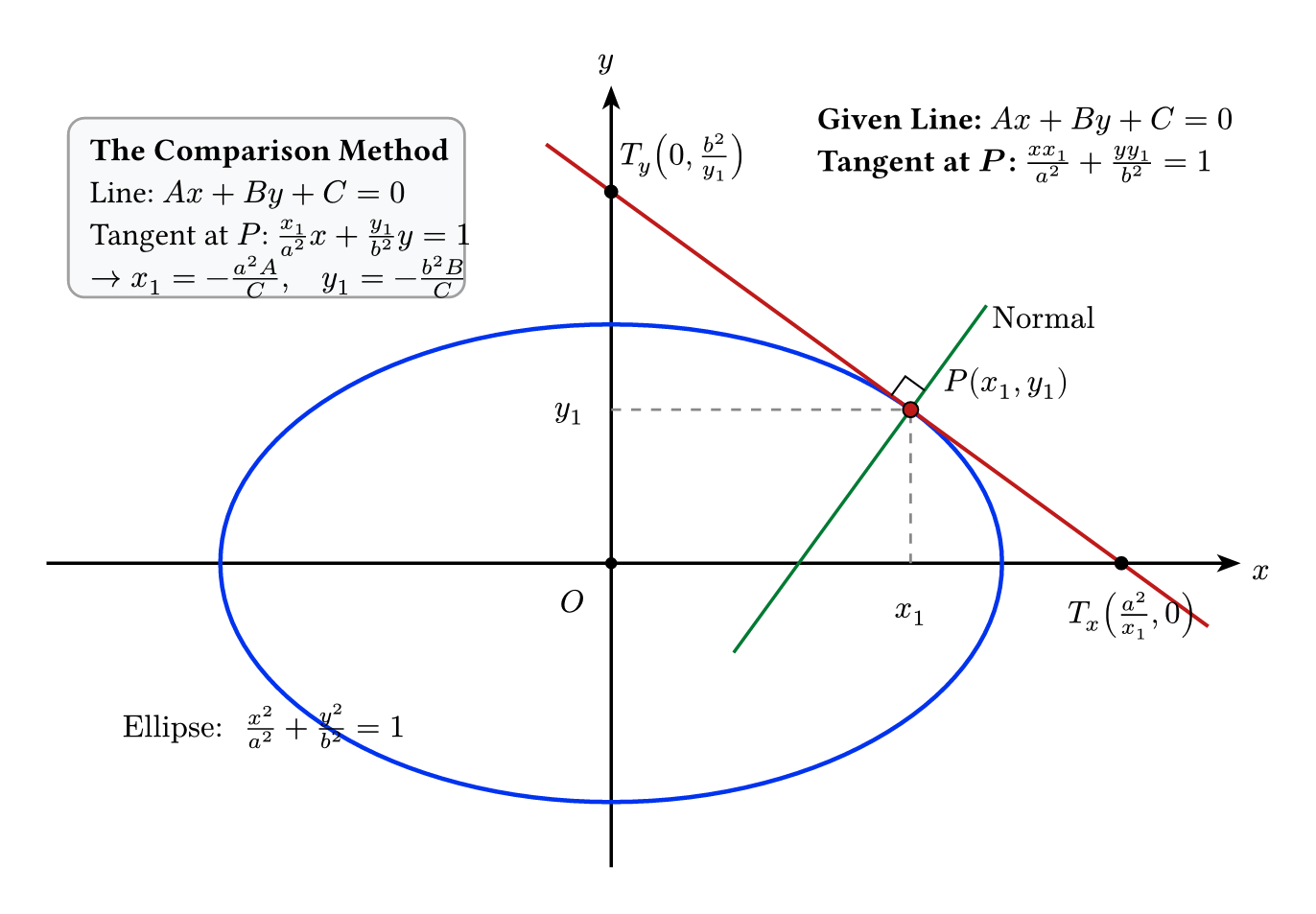
is known (or required) to touch the ellipse. We want to find the exact coordinates of the point of contact PP.

Point of Contact of a Tangent to an Ellipse

Step-by-Step Procedure in Cartesian Form§

Step 1: Assume the unknown point

Let the point of contact on the ellipse be P(x1,y1)P(x_1, y_1).

Step 2: Write the tangent equation at this point

Using the point form T=0T = 0, the equation of the tangent at P(x1,y1)P(x_1, y_1) is:

xx1a2+yy1b2=1  ⟺  (x1a2)x+(y1b2)y−1=0\frac{x x_1}{a^2} + \frac{y y_1}{b^2} = 1 \iff \left(\frac{x_1}{a^2}\right)x + \left(\frac{y_1}{b^2}\right)y - 1 = 0

Step 3: Compare coefficients with the given line

The given line is Ax+By+C=0Ax + By + C = 0. Since both equations represent the exact same line in the coordinate plane, the coefficients of xx, yy, and the constant term must be strictly proportional:

x1a2A=y1b2B=−1C\frac{\frac{x_1}{a^2}}{A} = \frac{\frac{y_1}{b^2}}{B} = \frac{-1}{C}   ⟹  x1a2A=y1b2B=−1C\implies \frac{x_1}{a^2 A} = \frac{y_1}{b^2 B} = -\frac{1}{C}

Step 4: Solve directly for the coordinates

x1=−a2AC,y1=−b2BCx_1 = -\frac{a^2 A}{C}, \qquad y_1 = -\frac{b^2 B}{C}

Application to Slope Form§

If the given line is expressed in slope-intercept form y=mx+cy = mx + c, rewrite it as:

mx−y+c=0mx - y + c = 0

Here A=mA = m, B=−1B = -1, and C=cC = c. Applying the comparison ratios directly:

x1=−a2(m)c=−a2mc,y1=−b2(−1)c=b2cx_1 = -\frac{a^2(m)}{c} = -\frac{a^2 m}{c}, \qquad y_1 = -\frac{b^2(-1)}{c} = \frac{b^2}{c}

Since c2=a2m2+b2  ⟹  c=±a2m2+b2c^2 = a^2 m^2 + b^2 \implies c = \pm \sqrt{a^2 m^2 + b^2}, the point of contact is:

P(−a2mc,b2c)P\left(-\frac{a^2 m}{c}, \frac{b^2}{c}\right)

Whenever cc is known, you never have to compute square roots or debate plus/minus signs. The sign of cc automatically determines the correct quadrant!


Tangents in Parametric Form§

When the problem involves trigonometric relations, eccentric angles, or symmetric equations, assuming the point in parametric form is especially powerful.

Procedure§

Step 1: Assume the point

Let the point of contact be P(acos⁡θ,bsin⁡θ)P(a\cos\theta, b\sin\theta), where θ∈[0,2π)\theta \in [0, 2\pi) is the eccentric angle.

Step 2: Write the parametric tangent

xacos⁡θ+ybsin⁡θ=1\frac{x}{a}\cos\theta + \frac{y}{b}\sin\theta = 1

Step 3: Compare with the line

Write the given line as Ax+By=−CAx + By = -C:

cos⁡θaA=sin⁡θbB=1−C\frac{\frac{\cos\theta}{a}}{A} = \frac{\frac{\sin\theta}{b}}{B} = \frac{1}{-C}

Step 4: Solve for the trigonometric ratios

cos⁡θ=−aAC,sin⁡θ=−bBC\cos\theta = -\frac{a A}{C}, \qquad \sin\theta = -\frac{b B}{C}

Step 5: Determine the angle and point

The values and signs of cos⁡θ\cos\theta and sin⁡θ\sin\theta directly fix the eccentric angle θ∈[0,2π)\theta \in [0, 2\pi) and identify its quadrant, giving the contact point (acos⁡θ,bsin⁡θ)(a\cos\theta, b\sin\theta) without any sign ambiguity.


Direct Simultaneous Solving: The Perfect Square Method§

Can we find the point of contact without using the comparison method or any formula, simply by solving the equations of the line and the ellipse simultaneously?

Yes, absolutely. In fact, this approach directly demonstrates the fundamental algebraic meaning of tangency.

When a straight line touches an ellipse, it intersects the curve at two coincident points. If we eliminate one variable by substituting the linear equation into the ellipse equation, the resulting quadratic equation must have equal roots (D=0D = 0).

How the Perfect Square Arises§

Step 1: Substitute the linear equation into the ellipse

Express one variable from the line equation, for example y=mx+cy = mx + c, and substitute it into the standard ellipse x2a2+y2b2=1\frac{x^2}{a^2} + \frac{y^2}{b^2} = 1:

x2a2+(mx+c)2b2=1\frac{x^2}{a^2} + \frac{(mx + c)^2}{b^2} = 1

Clearing denominators:

b2x2+a2(m2x2+2mc x+c2)=a2b2b^2 x^2 + a^2(m^2 x^2 + 2mc\, x + c^2) = a^2 b^2 (a2m2+b2)x2+2a2mc x+a2(c2−b2)=0(a^2 m^2 + b^2)x^2 + 2a^2 mc\, x + a^2(c^2 - b^2) = 0

Step 2: The discriminant vanishes for a tangent

This is a standard quadratic equation in xx of the form A0x2+B0x+C0=0A_0 x^2 + B_0 x + C_0 = 0. Because the line touches the ellipse at a single point of contact, the two points of intersection must coincide, which means the discriminant must be zero:

D=B02−4A0C0=0D = B_0^2 - 4A_0 C_0 = 0

Step 3: A quadratic with zero discriminant collapses into a perfect square

Whenever any quadratic equation A0x2+B0x+C0=0A_0 x^2 + B_0 x + C_0 = 0 has D=0D = 0, it factors into a perfect square:

A0(x+B02A0)2=0  ⟺  (px±q)2=0A_0\left(x + \frac{B_0}{2A_0}\right)^2 = 0 \iff (px \pm q)^2 = 0

The single repeated root gives the xx-coordinate of the point of contact directly:

x1=−B02A0=−2a2mc2(a2m2+b2)=−a2mca2m2+b2x_1 = -\frac{B_0}{2A_0} = -\frac{2a^2 mc}{2(a^2 m^2 + b^2)} = -\frac{a^2 mc}{a^2 m^2 + b^2}

Since a2m2+b2=c2a^2 m^2 + b^2 = c^2 at tangency, this simplifies to:

x1=−a2mcx_1 = -\frac{a^2 m}{c}

Substituting x1x_1 back into y=mx+cy = mx + c immediately gives y1=b2cy_1 = \frac{b^2}{c}.

When to Use Simultaneous Solving vs. The Comparison Method§

  • Direct Simultaneous Solving: Highly intuitive and requires no memorization at all. When the line and ellipse have simple numeric coefficients, substituting one into the other and factoring the resulting perfect square is fast and straightforward. Moreover, it serves as a self-verifying test: if the quadratic does not factor into a perfect square, the line is simply not tangent to the ellipse!
  • The Comparison Method: Much faster and cleaner when dealing with general coefficients (Ax+By+C=0Ax + By + C = 0), normals, shifted ellipses, or parametric problems, where expanding and solving a quadratic would involve heavy, error-prone algebra.

The Method of Comparison for Normals§

A straight line Ax+By+C=0Ax + By + C = 0 can also be a normal to the ellipse. Finding the foot of the normal (the point on the ellipse where the line is perpendicular to the tangent) by traditional formulas is notorious for causing arithmetic blunders.

The comparison method solves this effortlessly.

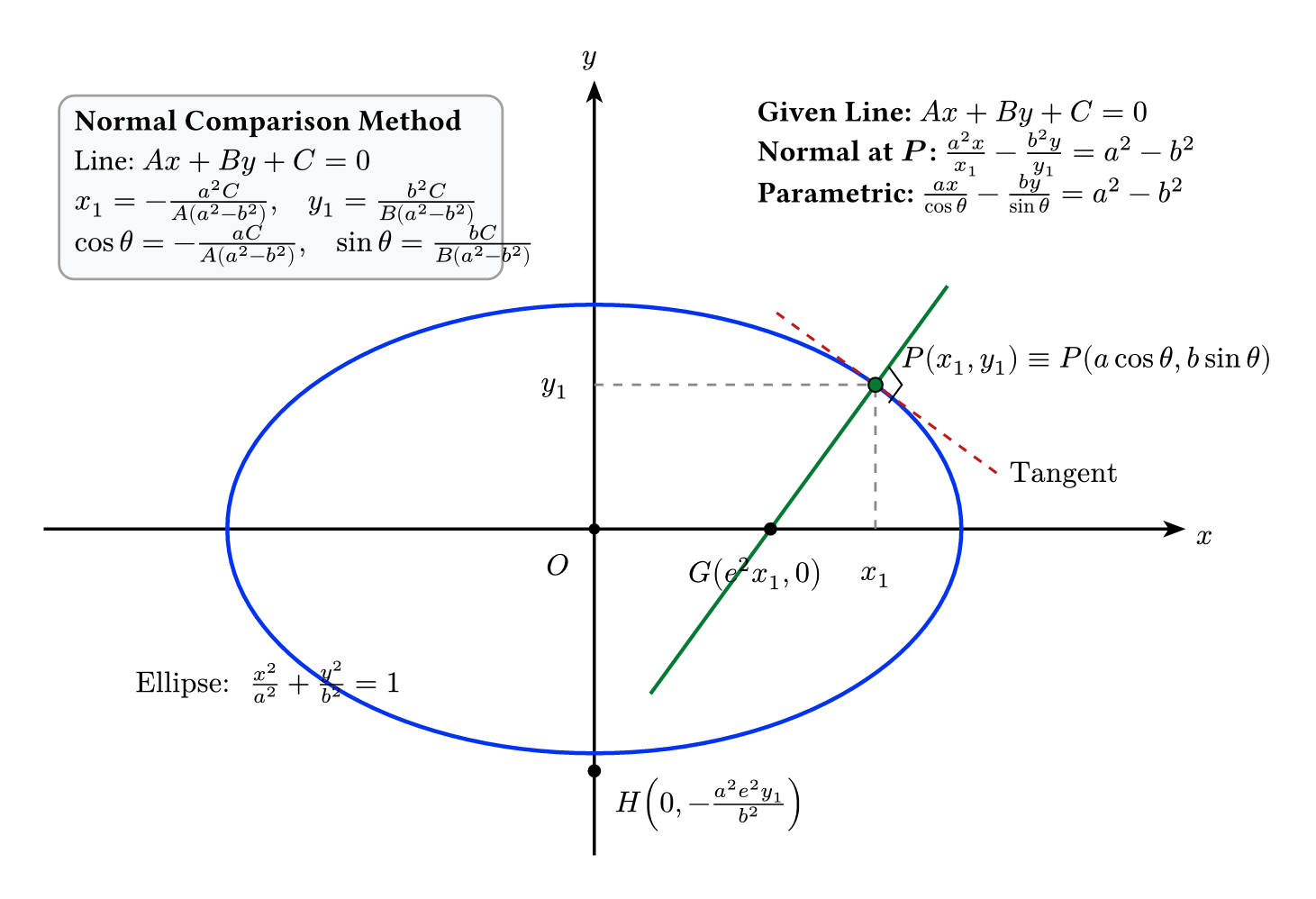
Point of Contact of a Normal to an Ellipse

Step-by-Step Procedure in Cartesian Form§

Step 1: Assume the unknown foot of the normal

Let the point on the ellipse be P(x1,y1)P(x_1, y_1).

Step 2: Write the normal equation at this point

Using the point form derived in Tutorial 05:

a2xx1−b2yy1=a2−b2\frac{a^2 x}{x_1} - \frac{b^2 y}{y_1} = a^2 - b^2

Rewrite it in linear form:

(a2x1)x−(b2y1)y−(a2−b2)=0\left(\frac{a^2}{x_1}\right)x - \left(\frac{b^2}{y_1}\right)y - (a^2 - b^2) = 0

Step 3: Compare coefficients with the given line

The given line is Ax+By+C=0Ax + By + C = 0, or Ax+By=−CAx + By = -C. Comparing coefficients:

a2x1A=−b2y1B=a2−b2−C\frac{\frac{a^2}{x_1}}{A} = \frac{-\frac{b^2}{y_1}}{B} = \frac{a^2 - b^2}{-C}

Step 4: Solve for x1x_1 and y1y_1

a2Ax1=−a2−b2C  ⟹  x1=−a2CA(a2−b2)\frac{a^2}{A x_1} = -\frac{a^2 - b^2}{C} \implies x_1 = -\frac{a^2 C}{A(a^2 - b^2)} −b2By1=−a2−b2C  ⟹  y1=b2CB(a2−b2)-\frac{b^2}{B y_1} = -\frac{a^2 - b^2}{C} \implies y_1 = \frac{b^2 C}{B(a^2 - b^2)}

Normals in Parametric Form§

In parametric form, the comparison method for normals is even cleaner.

Step 1: Assume the point

Let the foot of the normal be P(acos⁡θ,bsin⁡θ)P(a\cos\theta, b\sin\theta).

Step 2: Write the parametric normal equation

axcos⁡θ−bysin⁡θ=a2−b2\frac{ax}{\cos\theta} - \frac{by}{\sin\theta} = a^2 - b^2

Step 3: Compare with the line Ax+By=−CAx + By = -C

acos⁡θA=−bsin⁡θB=a2−b2−C\frac{\frac{a}{\cos\theta}}{A} = \frac{-\frac{b}{\sin\theta}}{B} = \frac{a^2 - b^2}{-C}

Step 4: Solve for cos⁡θ\cos\theta and sin⁡θ\sin\theta

cos⁡θ=−aCA(a2−b2),sin⁡θ=bCB(a2−b2)\cos\theta = -\frac{a C}{A(a^2 - b^2)}, \qquad \sin\theta = \frac{b C}{B(a^2 - b^2)}

Step 5: Determine the foot of the normal

Substitute these directly into (acos⁡θ,bsin⁡θ)(a\cos\theta, b\sin\theta):

P(−a2CA(a2−b2),b2CB(a2−b2))P\left(-\frac{a^2 C}{A(a^2 - b^2)}, \frac{b^2 C}{B(a^2 - b^2)}\right)

Notice that the Cartesian and Parametric comparison methods arrive at identical expressions, but the parametric method gives the eccentric angle θ\theta as a bonus!


Summary of the Comparison Method§

The following reference table contrasts how the comparison method applies to tangents versus normals for the ellipse x2a2+y2b2=1\frac{x^2}{a^2} + \frac{y^2}{b^2} = 1 and the line Ax+By+C=0Ax + By + C = 0:

Feature Tangent Line Normal Line
Point Form Equation (x1a2)x+(y1b2)y=1\left(\frac{x_1}{a^2}\right)x + \left(\frac{y_1}{b^2}\right)y = 1 (a2x1)x−(b2y1)y=a2−b2\left(\frac{a^2}{x_1}\right)x - \left(\frac{b^2}{y_1}\right)y = a^2 - b^2
Parametric Equation (cos⁡θa)x+(sin⁡θb)y=1\left(\frac{\cos\theta}{a}\right)x + \left(\frac{\sin\theta}{b}\right)y = 1 (acos⁡θ)x−(bsin⁡θ)y=a2−b2\left(\frac{a}{\cos\theta}\right)x - \left(\frac{b}{\sin\theta}\right)y = a^2 - b^2
Coefficient Ratios x1/a2A=y1/b2B=−1C\frac{x_1/a^2}{A} = \frac{y_1/b^2}{B} = -\frac{1}{C} a2/x1A=−b2/y1B=a2−b2−C\frac{a^2/x_1}{A} = \frac{-b^2/y_1}{B} = \frac{a^2 - b^2}{-C}
Point of Contact x1x_1 x1=−a2ACx_1 = -\frac{a^2 A}{C} x1=−a2CA(a2−b2)x_1 = -\frac{a^2 C}{A(a^2 - b^2)}
Point of Contact y1y_1 y1=−b2BCy_1 = -\frac{b^2 B}{C} y1=b2CB(a2−b2)y_1 = \frac{b^2 C}{B(a^2 - b^2)}
Parametric Angle θ\theta cos⁡θ=−aAC,  sin⁡θ=−bBC\cos\theta = -\frac{a A}{C}, \; \sin\theta = -\frac{b B}{C} cos⁡θ=−aCA(a2−b2),  sin⁡θ=bCB(a2−b2)\cos\theta = -\frac{a C}{A(a^2 - b^2)}, \; \sin\theta = \frac{b C}{B(a^2 - b^2)}

Handling Shifted Ellipses§

When an ellipse is shifted so its center is (h,k)(h, k):

(x−h)2a2+(y−k)2b2=1\frac{(x - h)^2}{a^2} + \frac{(y - k)^2}{b^2} = 1

Do not expand the equation into general form. Instead, use a temporary coordinate shift:

X=x−h,Y=y−kX = x - h, \qquad Y = y - k

Step 1: Express the given line in terms of XX and YY by substituting x=X+hx = X + h and y=Y+ky = Y + k.

Step 2: Apply the comparison method to the standard form X2a2+Y2b2=1\frac{X^2}{a^2} + \frac{Y^2}{b^2} = 1 to find the contact point (X1,Y1)(X_1, Y_1).

Step 3: Transform back to the original coordinates:

x1=X1+h,y1=Y1+kx_1 = X_1 + h, \qquad y_1 = Y_1 + k

This avoids long expansions and keeps the arithmetic clean.


Illustrative Examples§

Example 1: Point of Contact of a Tangent Line (Cartesian Form)§

Find the point of contact of the straight line x+2y−4=0x + 2y - 4 = 0 with the ellipse x2+4y2=8x^2 + 4y^2 = 8.

Method 1: The Comparison Method

Convert the ellipse equation to standard form by dividing by 88:

x28+y22=1  ⟹  a2=8,b2=2\frac{x^2}{8} + \frac{y^2}{2} = 1 \implies a^2 = 8, \quad b^2 = 2

Let the point of contact be P(x1,y1)P(x_1, y_1) on the ellipse. The equation of the tangent at PP is:

xx18+yy12=1  ⟺  (x18)x+(y12)y=1\frac{x x_1}{8} + \frac{y y_1}{2} = 1 \iff \left(\frac{x_1}{8}\right)x + \left(\frac{y_1}{2}\right)y = 1

Rewrite the given line in the same format with constant 11 on the right side:

x+2y=4  ⟺  (14)x+(24)y=1  ⟺  (14)x+(12)y=1x + 2y = 4 \iff \left(\frac{1}{4}\right)x + \left(\frac{2}{4}\right)y = 1 \iff \left(\frac{1}{4}\right)x + \left(\frac{1}{2}\right)y = 1

Since both equations describe the exact same straight line, compare their coefficients:

x18=14  ⟹  x1=84=2\frac{x_1}{8} = \frac{1}{4} \implies x_1 = \frac{8}{4} = 2 y12=12  ⟹  y1=1\frac{y_1}{2} = \frac{1}{2} \implies y_1 = 1

The point of contact is (2,1)(2, 1).

Method 2: Direct Simultaneous Solving (The Perfect Square)

From the equation of the line x+2y−4=0x + 2y - 4 = 0, express xx in terms of yy:

x=4−2yx = 4 - 2y

Substitute this into the ellipse equation x2+4y2=8x^2 + 4y^2 = 8:

(4−2y)2+4y2=8(4 - 2y)^2 + 4y^2 = 8 (16−16y+4y2)+4y2=8(16 - 16y + 4y^2) + 4y^2 = 8 8y2−16y+8=08y^2 - 16y + 8 = 0

Divide the entire equation by 88:

y2−2y+1=0  ⟹  (y−1)2=0y^2 - 2y + 1 = 0 \implies (y - 1)^2 = 0

Because the line is truly tangent to the ellipse, the quadratic equation collapses into a perfect square!

The repeated root gives:

y1=1y_1 = 1

Substitute y1=1y_1 = 1 back into the linear expression for xx:

x1=4−2(1)=2x_1 = 4 - 2(1) = 2

Thus, the point of contact is P(2,1)P(2, 1), exactly matching Method 1.


Example 2: Tangents with a Given Slope and Their Contact Points§

Find the equations of the tangents to the ellipse x216+y29=1\frac{x^2}{16} + \frac{y^2}{9} = 1 having slope m=12m = \frac{1}{2}, and find their points of contact by comparing coefficients.

Solution:

Here a2=16a^2 = 16 and b2=9b^2 = 9.

For a tangent with slope m=12m = \frac{1}{2}, the condition of tangency gives:

c2=a2m2+b2=16(12)2+9=16(14)+9=4+9=13c^2 = a^2 m^2 + b^2 = 16\left(\frac{1}{2}\right)^2 + 9 = 16\left(\frac{1}{4}\right) + 9 = 4 + 9 = 13 c=±13c = \pm \sqrt{13}

Hence, the two tangent lines are:

y=12x+13  ⟺  x−2y+213=0y = \frac{1}{2}x + \sqrt{13} \iff x - 2y + 2\sqrt{13} = 0 y=12x−13  ⟺  x−2y−213=0y = \frac{1}{2}x - \sqrt{13} \iff x - 2y - 2\sqrt{13} = 0

Finding the Point of Contact for Tangent 1: x−2y=−213x - 2y = -2\sqrt{13}

Let the point of contact be P1(x1,y1)P_1(x_1, y_1). The tangent in point form is:

x116x+y19y=1\frac{x_1}{16}x + \frac{y_1}{9}y = 1

Rewrite the line so the right side is 11:

x−213−2y−213=1  ⟺  (−1213)x+(113)y=1\frac{x}{-2\sqrt{13}} - \frac{2y}{-2\sqrt{13}} = 1 \iff \left(-\frac{1}{2\sqrt{13}}\right)x + \left(\frac{1}{\sqrt{13}}\right)y = 1

Comparing coefficients:

x116=−1213  ⟹  x1=−813\frac{x_1}{16} = -\frac{1}{2\sqrt{13}} \implies x_1 = -\frac{8}{\sqrt{13}} y19=113  ⟹  y1=913\frac{y_1}{9} = \frac{1}{\sqrt{13}} \implies y_1 = \frac{9}{\sqrt{13}}

Thus, the point of contact for the first tangent is:

P1(−813,913)P_1\left(-\frac{8}{\sqrt{13}}, \frac{9}{\sqrt{13}}\right)

Finding the Point of Contact for Tangent 2: x−2y=213x - 2y = 2\sqrt{13}

Rewriting:

(1213)x−(113)y=1\left(\frac{1}{2\sqrt{13}}\right)x - \left(\frac{1}{\sqrt{13}}\right)y = 1

Comparing coefficients:

x116=1213  ⟹  x1=813\frac{x_1}{16} = \frac{1}{2\sqrt{13}} \implies x_1 = \frac{8}{\sqrt{13}} y19=−113  ⟹  y1=−913\frac{y_1}{9} = -\frac{1}{\sqrt{13}} \implies y_1 = -\frac{9}{\sqrt{13}}

Thus, the point of contact for the second tangent is:

P2(813,−913)P_2\left(\frac{8}{\sqrt{13}}, -\frac{9}{\sqrt{13}}\right)

Example 3: Eccentric Angle and Point of Contact (Parametric Form)§

The straight line 2x+33y=122x + 3\sqrt{3}y = 12 touches the ellipse x29+y24=1\frac{x^2}{9} + \frac{y^2}{4} = 1. Determine the eccentric angle of the point of contact, and find its coordinates.

Solution:

Here a=3a = 3 and b=2b = 2.

Let the point of contact be P(3cos⁡θ,2sin⁡θ)P(3\cos\theta, 2\sin\theta).

The equation of the tangent at P(θ)P(\theta) is:

x3cos⁡θ+y2sin⁡θ=1  ⟺  (cos⁡θ3)x+(sin⁡θ2)y=1\frac{x}{3}\cos\theta + \frac{y}{2}\sin\theta = 1 \iff \left(\frac{\cos\theta}{3}\right)x + \left(\frac{\sin\theta}{2}\right)y = 1

Divide the given line 2x+33y=122x + 3\sqrt{3}y = 12 by 1212:

212x+3312y=1  ⟺  (16)x+(34)y=1\frac{2}{12}x + \frac{3\sqrt{3}}{12}y = 1 \iff \left(\frac{1}{6}\right)x + \left(\frac{\sqrt{3}}{4}\right)y = 1

Comparing coefficients:

cos⁡θ3=16  ⟹  cos⁡θ=36=12\frac{\cos\theta}{3} = \frac{1}{6} \implies \cos\theta = \frac{3}{6} = \frac{1}{2} sin⁡θ2=34  ⟹  sin⁡θ=234=32\frac{\sin\theta}{2} = \frac{\sqrt{3}}{4} \implies \sin\theta = \frac{2\sqrt{3}}{4} = \frac{\sqrt{3}}{2}

Finding the Angle:

Both cos⁡θ>0\cos\theta > 0 and sin⁡θ>0\sin\theta > 0, so θ\theta lies in the first quadrant:

θ=π3(60∘)\theta = \frac{\pi}{3} \quad (60^\circ)

Coordinates of Contact Point:

P(acos⁡θ,bsin⁡θ)=(3×12,2×32)=(32,3)P(a\cos\theta, b\sin\theta) = \left(3 \times \frac{1}{2}, 2 \times \frac{\sqrt{3}}{2}\right) = \left(\frac{3}{2}, \sqrt{3}\right)

Example 4: Foot of Normal via Comparison (Cartesian Form)§

The straight line 5x−5y=75x - 5y = 7 is normal to the ellipse x216+y29=1\frac{x^2}{16} + \frac{y^2}{9} = 1. Find the coordinates of the point on the ellipse where this normal is drawn.

Solution:

From the ellipse equation, a2=16a^2 = 16 and b2=9b^2 = 9, which gives a2−b2=16−9=7a^2 - b^2 = 16 - 9 = 7.

Let the foot of the normal be P(x1,y1)P(x_1, y_1) on the ellipse. The equation of the normal at PP is:

a2xx1−b2yy1=a2−b2  ⟹  16xx1−9yy1=7\frac{a^2 x}{x_1} - \frac{b^2 y}{y_1} = a^2 - b^2 \implies \frac{16x}{x_1} - \frac{9y}{y_1} = 7

Write this as:

(16x1)x−(9y1)y=7\left(\frac{16}{x_1}\right)x - \left(\frac{9}{y_1}\right)y = 7

The given line is:

5x−5y=75x - 5y = 7

Since both equations represent the same straight line, compare their coefficients directly:

16x1=5  ⟹  x1=165\frac{16}{x_1} = 5 \implies x_1 = \frac{16}{5} −9y1=−5  ⟹  y1=95-\frac{9}{y_1} = -5 \implies y_1 = \frac{9}{5}

Verification:

Check if P(165,95)P\left(\frac{16}{5}, \frac{9}{5}\right) lies on the ellipse:

x1216+y129=(16/5)216+(9/5)29=25625×16+8125×9=1625+925=2525=1\frac{x_1^2}{16} + \frac{y_1^2}{9} = \frac{(16/5)^2}{16} + \frac{(9/5)^2}{9} = \frac{256}{25 \times 16} + \frac{81}{25 \times 9} = \frac{16}{25} + \frac{9}{25} = \frac{25}{25} = 1

The point lies exactly on the ellipse. Hence, the foot of the normal is:

P(165,95)P\left(\frac{16}{5}, \frac{9}{5}\right)

Notice that without memorizing any formula, the coordinates were found in two simple lines!


Example 5: Foot of Normal via Comparison (Parametric Form)§

Find the eccentric angle and the coordinates of the points on the ellipse 3x2+4y2=123x^2 + 4y^2 = 12 where the normal is parallel to the line 2x−y+5=02x - y + 5 = 0.

Solution:

Standard form of the ellipse:

x24+y23=1  ⟹  a2=4,b2=3,a=2,b=3\frac{x^2}{4} + \frac{y^2}{3} = 1 \implies a^2 = 4, \quad b^2 = 3, \quad a = 2, \quad b = \sqrt{3}

The difference of squared semi-axes is a2−b2=4−3=1a^2 - b^2 = 4 - 3 = 1.

The normal must be parallel to 2x−y+5=02x - y + 5 = 0, so its slope is m=2m = 2.

The equation of the normal at P(θ)=(2cos⁡θ,3sin⁡θ)P(\theta) = (2\cos\theta, \sqrt{3}\sin\theta) is:

axcos⁡θ−bysin⁡θ=a2−b2  ⟹  2xcos⁡θ−3ysin⁡θ=1\frac{ax}{\cos\theta} - \frac{by}{\sin\theta} = a^2 - b^2 \implies \frac{2x}{\cos\theta} - \frac{\sqrt{3}y}{\sin\theta} = 1

Rearranging into slope-intercept form:

3ysin⁡θ=2xcos⁡θ−1  ⟹  y=(23tan⁡θ)x−sin⁡θ3\frac{\sqrt{3}y}{\sin\theta} = \frac{2x}{\cos\theta} - 1 \implies y = \left(\frac{2}{\sqrt{3}}\tan\theta\right)x - \frac{\sin\theta}{\sqrt{3}}

Equate the slope to 22:

23tan⁡θ=2  ⟹  tan⁡θ=3\frac{2}{\sqrt{3}}\tan\theta = 2 \implies \tan\theta = \sqrt{3}

This gives two possible values for θ∈[0,2π)\theta \in [0, 2\pi):

θ1=π3(60∘),θ2=4π3(240∘)\theta_1 = \frac{\pi}{3} \quad (60^\circ), \qquad \theta_2 = \frac{4\pi}{3} \quad (240^\circ)

Case 1: θ=π3\theta = \frac{\pi}{3}

cos⁡θ=12,sin⁡θ=32\cos\theta = \frac{1}{2}, \qquad \sin\theta = \frac{\sqrt{3}}{2}

The foot of the normal is:

P1(acos⁡θ,bsin⁡θ)=(2×12,3×32)=(1,32)P_1(a\cos\theta, b\sin\theta) = \left(2 \times \frac{1}{2}, \sqrt{3} \times \frac{\sqrt{3}}{2}\right) = \left(1, \frac{3}{2}\right)

The equation of this normal is:

2x1/2−3y3/2=1  ⟹  4x−2y=1  ⟹  2x−y=12\frac{2x}{1/2} - \frac{\sqrt{3}y}{\sqrt{3}/2} = 1 \implies 4x - 2y = 1 \implies 2x - y = \frac{1}{2}

Case 2: θ=4π3\theta = \frac{4\pi}{3}

cos⁡θ=−12,sin⁡θ=−32\cos\theta = -\frac{1}{2}, \qquad \sin\theta = -\frac{\sqrt{3}}{2}

The foot of the normal is:

P2(−1,−32)P_2\left(-1, -\frac{3}{2}\right)

The equation of this normal is:

2x−1/2−3y−3/2=1  ⟹  −4x+2y=1  ⟹  2x−y=−12\frac{2x}{-1/2} - \frac{\sqrt{3}y}{-\sqrt{3}/2} = 1 \implies -4x + 2y = 1 \implies 2x - y = -\frac{1}{2}

Example 6: Finding an Unknown Parameter for Normality§

Find all values of the constant kk such that the line x+y=kx + y = k is a normal to the ellipse x216+y29=1\frac{x^2}{16} + \frac{y^2}{9} = 1, and determine the corresponding feet of the normals.

Solution:

From the ellipse equation, a2=16a^2 = 16 and b2=9b^2 = 9, which gives a2−b2=16−9=7a^2 - b^2 = 16 - 9 = 7.

Let the foot of the normal be P(x1,y1)P(x_1, y_1) on the ellipse. The equation of the normal at PP is:

a2xx1−b2yy1=a2−b2  ⟹  16xx1−9yy1=7\frac{a^2 x}{x_1} - \frac{b^2 y}{y_1} = a^2 - b^2 \implies \frac{16x}{x_1} - \frac{9y}{y_1} = 7

Write this as:

(16x1)x−(9y1)y=7\left(\frac{16}{x_1}\right)x - \left(\frac{9}{y_1}\right)y = 7

The given line is:

x+y=kx + y = k

Comparing coefficients between the normal and the given line:

16/x11=−9/y11=7k\frac{16/x_1}{1} = \frac{-9/y_1}{1} = \frac{7}{k}   ⟹  x1=16k7,y1=−9k7\implies x_1 = \frac{16k}{7}, \qquad y_1 = -\frac{9k}{7}

Now, since the foot of the normal P(x1,y1)P(x_1, y_1) lies on the ellipse x1216+y129=1\frac{x_1^2}{16} + \frac{y_1^2}{9} = 1, we substitute these coordinates:

(16k7)216+(−9k7)29=1\frac{\left(\frac{16k}{7}\right)^2}{16} + \frac{\left(-\frac{9k}{7}\right)^2}{9} = 1 162k249×16+92k249×9=1\frac{16^2 k^2}{49 \times 16} + \frac{9^2 k^2}{49 \times 9} = 1 16k249+9k249=1  ⟹  25k249=1\frac{16 k^2}{49} + \frac{9 k^2}{49} = 1 \implies \frac{25 k^2}{49} = 1 k2=4925  ⟹  k=±75k^2 = \frac{49}{25} \implies k = \pm \frac{7}{5}

Notice how the comparison method determines the unknown parameter kk directly without needing to recall any separate formula!

Case 1: When k=75k = \frac{7}{5}

x1=16(7/5)7=165,y1=−9(7/5)7=−95x_1 = \frac{16(7/5)}{7} = \frac{16}{5}, \qquad y_1 = -\frac{9(7/5)}{7} = -\frac{9}{5}

The foot of the normal is:

P1(165,−95)P_1\left(\frac{16}{5}, -\frac{9}{5}\right)

Case 2: When k=−75k = -\frac{7}{5}

x1=16(−7/5)7=−165,y1=−9(−7/5)7=95x_1 = \frac{16(-7/5)}{7} = -\frac{16}{5}, \qquad y_1 = -\frac{9(-7/5)}{7} = \frac{9}{5}

The foot of the normal is:

P2(−165,95)P_2\left(-\frac{16}{5}, \frac{9}{5}\right)

Verification:

For P1P_1: x1+y1=165−95=75=kx_1 + y_1 = \frac{16}{5} - \frac{9}{5} = \frac{7}{5} = k. Correct.

Also (16/5)216+(−9/5)29=1625+925=1\frac{(16/5)^2}{16} + \frac{(-9/5)^2}{9} = \frac{16}{25} + \frac{9}{25} = 1. Correct.


Example 7: Shifted Ellipse Tangent and Point of Contact§

Find the point of contact of the line x+y=8x + y = 8 with the shifted ellipse:

(x−1)216+(y−2)29=1\frac{(x - 1)^2}{16} + \frac{(y - 2)^2}{9} = 1

Solution:

The ellipse is centered at (h,k)=(1,2)(h, k) = (1, 2) with a2=16a^2 = 16 and b2=9b^2 = 9.

Introduce shifted coordinates:

X=x−1,Y=y−2  ⟹  x=X+1,y=Y+2X = x - 1, \qquad Y = y - 2 \implies x = X + 1, \quad y = Y + 2

In shifted coordinates, the ellipse is in standard form:

X216+Y29=1\frac{X^2}{16} + \frac{Y^2}{9} = 1

Substitute xx and yy into the given line x+y=8x + y = 8:

(X+1)+(Y+2)=8  ⟹  X+Y+3=8  ⟹  X+Y=5(X + 1) + (Y + 2) = 8 \implies X + Y + 3 = 8 \implies X + Y = 5

Now, apply the comparison method in X−YX-Y coordinates:

Let the contact point be (X1,Y1)(X_1, Y_1). The tangent in point form is:

XX116+YY19=1\frac{X X_1}{16} + \frac{Y Y_1}{9} = 1

Divide the line X+Y=5X + Y = 5 by 55:

(15)X+(15)Y=1\left(\frac{1}{5}\right)X + \left(\frac{1}{5}\right)Y = 1

Comparing coefficients:

X116=15  ⟹  X1=165\frac{X_1}{16} = \frac{1}{5} \implies X_1 = \frac{16}{5} Y19=15  ⟹  Y1=95\frac{Y_1}{9} = \frac{1}{5} \implies Y_1 = \frac{9}{5}

Check on shifted ellipse:

(16/5)216+(9/5)29=1625+925=1\frac{(16/5)^2}{16} + \frac{(9/5)^2}{9} = \frac{16}{25} + \frac{9}{25} = 1

Finally, convert back to the original x−yx-y coordinates:

x1=X1+h=165+1=215x_1 = X_1 + h = \frac{16}{5} + 1 = \frac{21}{5} y1=Y1+k=95+2=195y_1 = Y_1 + k = \frac{9}{5} + 2 = \frac{19}{5}

The point of contact on the shifted ellipse is:

P(215,195)P\left(\frac{21}{5}, \frac{19}{5}\right)

Example 8: Locus of the Midpoint of Tangent Intercepts§

A tangent to the ellipse x2a2+y2b2=1\frac{x^2}{a^2} + \frac{y^2}{b^2} = 1 intersects the coordinate axes at AA and BB. If M(h,k)M(h, k) is the midpoint of the segment ABAB, find the locus of MM and express the point of contact on the ellipse in terms of hh and kk.

Solution:

Let the point of contact on the ellipse be P(x1,y1)P(x_1, y_1).

The equation of the tangent at PP is:

xx1a2+yy1b2=1\frac{x x_1}{a^2} + \frac{y y_1}{b^2} = 1

Find the intercepts by setting y=0y = 0 and x=0x = 0:

  • Setting y=0  ⟹  xA=a2x1  ⟹  A(a2x1,0)y = 0 \implies x_A = \frac{a^2}{x_1} \implies A\left(\frac{a^2}{x_1}, 0\right)
  • Setting x=0  ⟹  yB=b2y1  ⟹  B(0,b2y1)x = 0 \implies y_B = \frac{b^2}{y_1} \implies B\left(0, \frac{b^2}{y_1}\right)

Since M(h,k)M(h, k) is the midpoint of ABAB:

h=a2x1+02=a22x1  ⟹  x1=a22hh = \frac{\frac{a^2}{x_1} + 0}{2} = \frac{a^2}{2x_1} \implies x_1 = \frac{a^2}{2h} k=0+b2y12=b22y1  ⟹  y1=b22kk = \frac{0 + \frac{b^2}{y_1}}{2} = \frac{b^2}{2y_1} \implies y_1 = \frac{b^2}{2k}

Point of Contact in terms of Midpoint:

P(x1,y1)=(a22h,b22k)P(x_1, y_1) = \left(\frac{a^2}{2h}, \frac{b^2}{2k}\right)

Finding the Locus:

Because P(x1,y1)P(x_1, y_1) lies on the ellipse x12a2+y12b2=1\frac{x_1^2}{a^2} + \frac{y_1^2}{b^2} = 1:

1a2(a22h)2+1b2(b22k)2=1\frac{1}{a^2}\left(\frac{a^2}{2h}\right)^2 + \frac{1}{b^2}\left(\frac{b^2}{2k}\right)^2 = 1 a24h2+b24k2=1  ⟹  a2h2+b2k2=4\frac{a^2}{4h^2} + \frac{b^2}{4k^2} = 1 \implies \frac{a^2}{h^2} + \frac{b^2}{k^2} = 4

Replacing (h,k)(h, k) by general running coordinates (x,y)(x, y), the locus of the midpoint MM is:

a2x2+b2y2=4\frac{a^2}{x^2} + \frac{b^2}{y^2} = 4

Key Takeaways§

  1. Never memorize the point of contact formula: Writing the line as Ax+By=−CAx + By = -C and comparing coefficients with x1a2x+y1b2y=1\frac{x_1}{a^2}x + \frac{y_1}{b^2}y = 1 gives x1=−a2ACx_1 = -\frac{a^2 A}{C} and y1=−b2BCy_1 = -\frac{b^2 B}{C} in seconds.

  2. The same method works for normals: Compare Ax+By=−CAx + By = -C with a2x1x−b2y1y=a2−b2\frac{a^2}{x_1}x - \frac{b^2}{y_1}y = a^2 - b^2 to find the foot of the normal: x1=−a2CA(a2−b2)x_1 = -\frac{a^2 C}{A(a^2 - b^2)} and y1=b2CB(a2−b2)y_1 = \frac{b^2 C}{B(a^2 - b^2)}.

  3. Parametric form resolves signs automatically: Comparing with parametric equations yields cos⁡θ\cos\theta and sin⁡θ\sin\theta. Their signs uniquely fix the quadrant of the eccentric angle θ\theta, eliminating any guesswork about signs.

  4. Shifted ellipses are simplified by substitution: Shift coordinates X=x−h,Y=y−kX = x - h, Y = y - k first, solve in standard form, and translate back.

  5. Simultaneous solving yields a perfect square: If a given line is truly a tangent to the ellipse, substituting the line into the curve equation always produces a quadratic with D=0D = 0, which collapses into a perfect square (px±q)2=0(px \pm q)^2 = 0. The single repeated root directly gives the point of contact coordinate without memorizing any formula.

Section 7 of 13 · Ellipse

Mark this section complete when you have worked through its proofs.