In the previous sections, we found the equations of tangents and normals to an ellipse using algebra and calculus. Now we look at their geometric properties—especially how tangents and normals interact with the foci, the directrices, and the auxiliary circle.
Understanding these geometric relationships is very helpful because:
Problems that look lengthy when solved by brute-force algebra often reduce to two or three simple steps using geometry.
These properties explain how an ellipse behaves in nature—such as how light and sound waves reflect inside an elliptical room.
Let us explore these properties step by step in a natural, logical sequence.
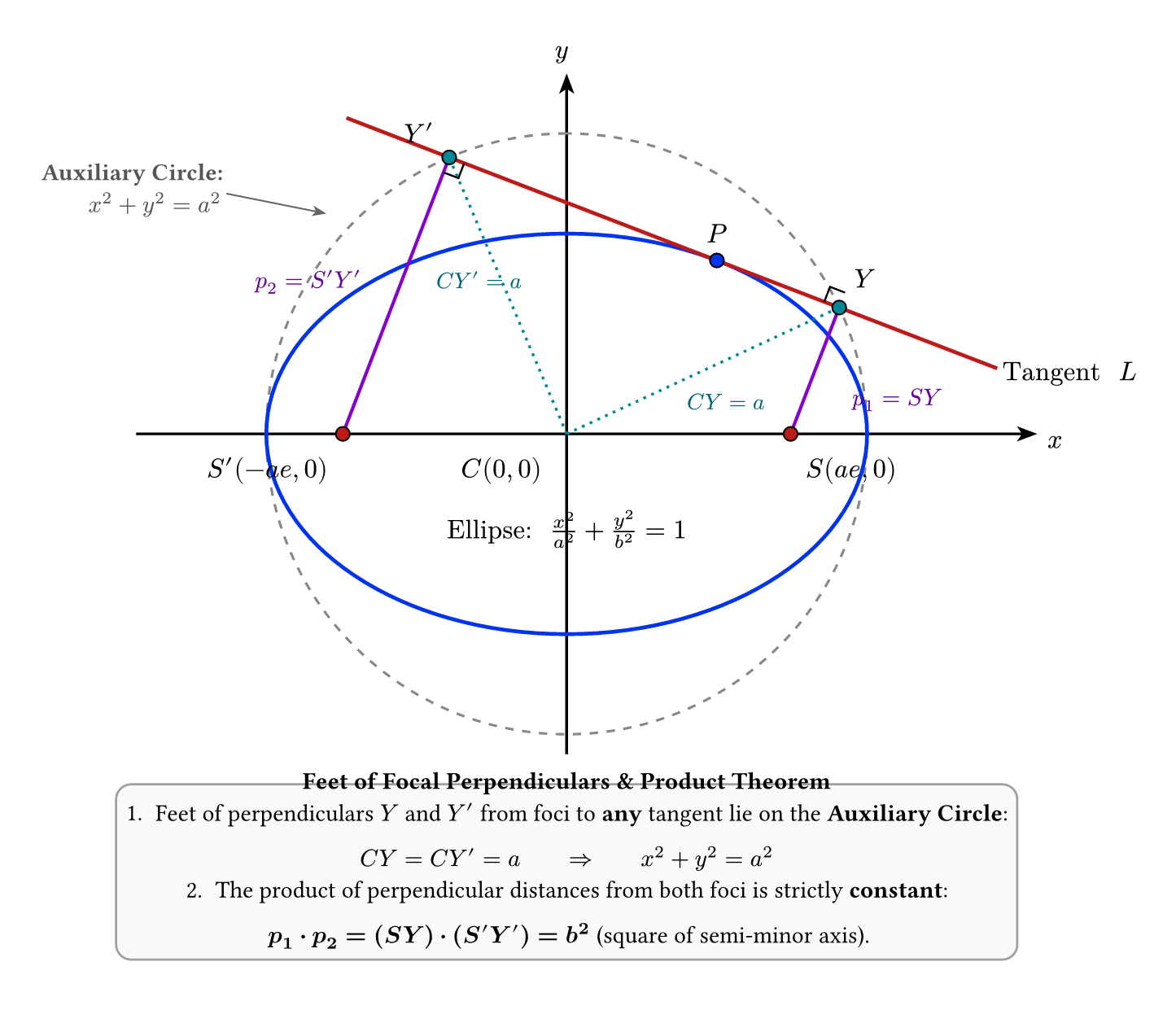
Feet of Focal Perpendiculars Lie on the Auxiliary Circle§
Consider the standard ellipse:
a2x2+b2y2=1(a>b)
Its foci are S(ae,0) and S′(−ae,0), and its auxiliary circle is the circle drawn on the major axis as diameter:
x2+y2=a2
Suppose we draw any tangent line L to the ellipse, and then drop perpendiculars SY and S′Y′ from the two foci onto this tangent line.
Any tangent to the ellipse a2x2+b2y2=1 with slope m has the equation:
y=mx+a2m2+b2
We can rewrite this by bringing mx to the left side:
y−mx=a2m2+b2⋯(1)
Now, consider the line passing through the focus S(ae,0) that is perpendicular to this tangent. Since the tangent has slope m, the perpendicular line has slope −m1, so its equation is:
y−0=−m1(x−ae)
Multiply both sides by m and rearrange:
my=−x+ae⟹x+my=ae⋯(2)
The foot of the perpendicular Y(x,y) is the point of intersection of lines (1) and (2), so its coordinates satisfy both equations. To find the locus of Y, we eliminate m by squaring and adding equations (1) and (2):
(y−mx)2+(x+my)2=(a2m2+b2)2+(ae)2
Expand the left-hand side:
(y2−2mxy+m2x2)+(x2+2mxy+m2y2)=a2m2+b2+a2e2
Notice that the −2mxy and +2mxy terms cancel out. Factoring (1+m2) on the left side gives:
(1+m2)(x2+y2)=a2m2+(b2+a2e2)
For an ellipse, we know that b2=a2(1−e2)=a2−a2e2, which means b2+a2e2=a2. Substituting this on the right side:
(1+m2)(x2+y2)=a2m2+a2=a2(1+m2)
Since 1+m2=0, we divide both sides by (1+m2):
x2+y2=a2
This is the equation of the auxiliary circle! Since the exact same steps apply when we replace ae with −ae for the second focus S′(−ae,0), both feet Y and Y′ always lie on the auxiliary circle x2+y2=a2.
Example 1: Verifying Feet of Perpendiculars on the Auxiliary Circle§
Find the equations of the tangents of slope m=1 to the ellipse 16x2+9y2=1. For one of these tangents, find the foot of the perpendicular drawn from the focus S, and verify that it lies on the auxiliary circle.
Solution:
Step 1: Find the tangent and focus
Here a2=16⟹a=4, and b2=9⟹b=3.
The focal distance from the center is:
c=ae=a2−b2=16−9=7
So the foci are S(7,0) and S′(−7,0).
Using the slope form y=mx±a2m2+b2 with m=1:
y=x±16(1)2+9=x±5
Let us take the tangent x−y+5=0.
Step 2: Find the foot of the perpendicular Y from S(7,0)
The line through S(7,0) perpendicular to x−y+5=0 has slope −1:
y−0=−1(x−7)⟹x+y=7
Solving x−y=−5 and x+y=7 simultaneously:
Adding the two equations gives:
2x=7−5⟹x=27−5
Subtracting the first from the second gives:
2y=7+5⟹y=27+5
So the foot of the perpendicular is Y(27−5,27+5).
Step 3: Check if Y lies on the auxiliary circle
The auxiliary circle is x2+y2=a2=16. Substituting the coordinates of Y:
Since x2+y2=16, the foot Y lies on the auxiliary circle.
Product of Focal Perpendiculars onto Any Tangent is Constant§
Now let us look at the lengths of those two perpendiculars, p1=SY and p2=S′Y′, dropped from the two foci onto a tangent line.
As you move the point of contact P around the ellipse, p1 gets larger or smaller, and p2 changes in the opposite way. Remarkably, their product never changes!
The product of the perpendicular distances from the two foci onto any tangent to the ellipse is constant and equal to the square of the semi-minor axis:
Thus, (SY)(S′Y′)=b2 for every tangent to the ellipse.
(Note: Even for the two vertical tangents x=a and x=−a where slope m is undefined, the distances from S(ae,0) and S′(−ae,0) to x=a are a−ae and a+ae, whose product is a2(1−e2)=b2.)
Example 2: Finding Ellipse Parameters from Focal Perpendiculars§
The perpendicular distances from the two foci of an ellipse to a certain tangent line are 2 units and 8 units. If the distance between the foci is 45 units, find the semi-minor axis b, the semi-major axis a, and the eccentricity e.
Solution:
Step 1: Find b using the Product Property
Given p1=2 and p2=8:
b2=p1⋅p2=(2)(8)=16⟹b=4
Step 2: Find a and e
The distance between the two foci is 2ae=45⟹ae=25.
Using the relation a2e2=a2−b2:
(25)2=a2−16⟹20=a2−16⟹a2=36⟹a=6
Therefore, the eccentricity is:
e=aae=625=35
Tangent-Directrix Right-Angle Property and Vertex Tangents§
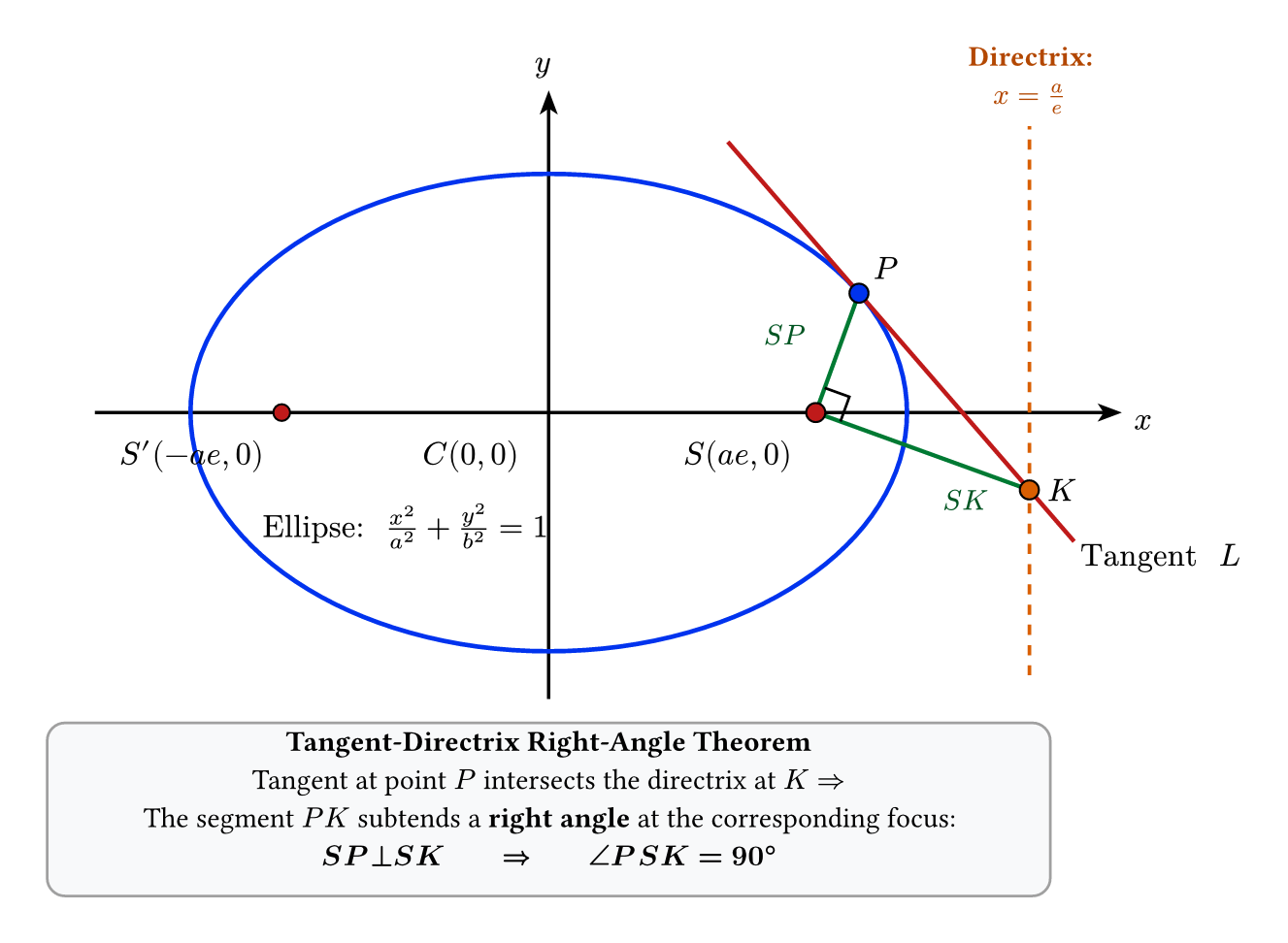
Next, let us see what happens when a tangent line meets the directrix of the ellipse.
Substituting the foci (±ae,0) into this circle gives (±ae)2+0−0−a2e2=0, proving that the circle passes through both foci S and S′.
Example 3: Verifying the Right Angle at the Focus§
For the ellipse 9x2+5y2=1, find the equation of the tangent at the point P(2,35). Find the point K where this tangent meets the corresponding directrix, and verify that ∠PSK=90∘.
Solution:
Step 1: Identify focus and directrix
Here a2=9⟹a=3, and b2=5.
c=a2−b2=9−5=2⟹e=32
The right focus is S(2,0) and the corresponding directrix is x=ea=2/33=29.
Step 2: Equation of tangent at P(2,35) and point K
Using a2xx1+b2yy1=1:
9x(2)+5y(5/3)=1⟹92x+3y=1⟹2x+3y=9
Substitute x=29 to find K:
2(29)+3y=9⟹9+3y=9⟹y=0
So K is the point (29,0).
Step 3: Check the angle ∠PSK
Notice that S(2,0) and P(2,35) have the same x-coordinate (x=2), so the segment SP is a vertical line.
Meanwhile, S(2,0) and K(29,0) both lie on the x-axis (y=0), so the segment SK is a horizontal line.
Since a vertical line and a horizontal line are perpendicular, SP⊥SK, confirming ∠PSK=90∘.
The Normal Bisects the Angle Between the Focal Radii§
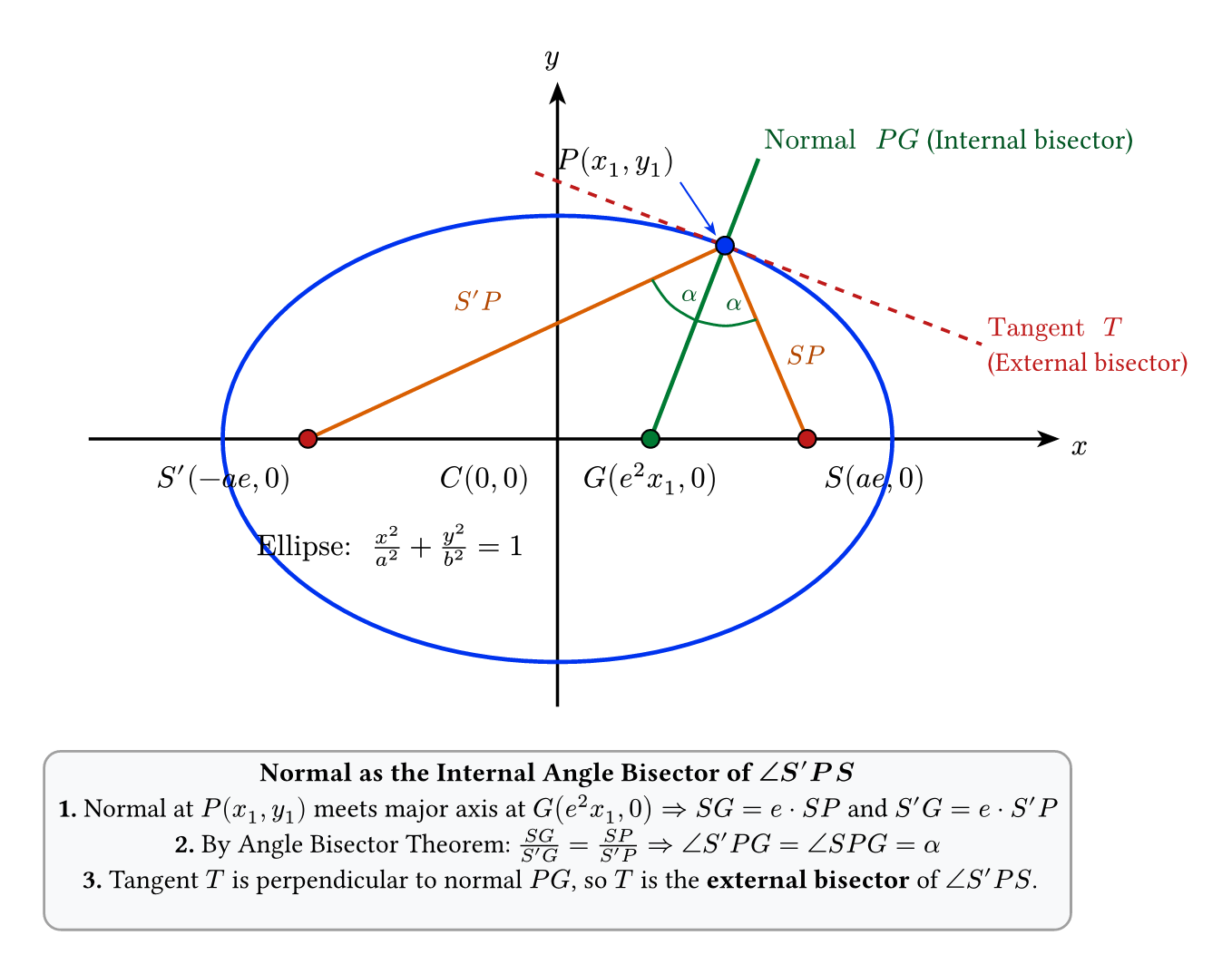
Now let us study the normal at any point P(x1,y1) on the ellipse and see how it divides the angle ∠S′PS formed by the two focal segments SP and S′P.
Recall from geometry that in any triangle ΔS′PS, a line from vertex P meeting the opposite side S′S at G is the internal bisector of ∠S′PS if and only if it divides the opposite side in the ratio of the adjacent sides:
S′GSG=S′PSP
Let us find the coordinates of G and compute both ratios:
Step 1: Find the point G where the normal meets the major axis
The equation of the normal to a2x2+b2y2=1 at P(x1,y1) is:
x1a2x−y1b2y=a2−b2
To find where this normal crosses the major axis (x-axis), put y=0 and use a2−b2=a2e2:
x1a2xG=a2e2⟹xG=e2x1
Thus, the normal meets the major axis at the point:
G(e2x1,0)
(Notice that the distance of G from the center C(0,0) is CG=e2∣x1∣.)
Step 2: Find the distances SG and S′G
The foci are S(ae,0) and S′(−ae,0). Since −a≤x1≤a and e<1, the point G(e2x1,0) lies between S′ and S:
Step 3: Compare with the focal distances SP and S′P
We already know from the focal distance formulas of an ellipse that for any point P(x1,y1):
SP=a−ex1andS′P=a+ex1
Substituting these into our expressions for SG and S′G:
SG=e⋅SP⟹SPSG=eS′G=e⋅S′P⟹S′PS′G=e
Dividing the first relation by the second:
S′GSG=e⋅S′Pe⋅SP=S′PSP
By the converse of the Internal Angle Bisector Theorem, the normal PG bisects the interior angle ∠S′PS:
∠S′PG=∠SPG
Finally, since the tangent line T is perpendicular to the normal PG, the angles that the focal rays make with the tangent are complementary to the equal angles ∠S′PG and ∠SPG. Thus, the tangent is the external angle bisector of ∠S′PS.
Example 4: Normal Intercept and Angle Bisector Ratio§
At the point P(3,2) on the ellipse 18x2+8y2=1, the normal is drawn to meet the major axis at G. Find the coordinates of G, the focal distances SP and S′P, and verify that S′GSG=S′PSP and SPSG=e.
Solution:
Step 1: Find a, b, e, and foci
Here a2=18⟹a=32, and b2=8⟹b=22.
c=a2−b2=18−8=10⟹e=ac=3210=35
So e2=95, and the foci are S(10,0) and S′(−10,0).
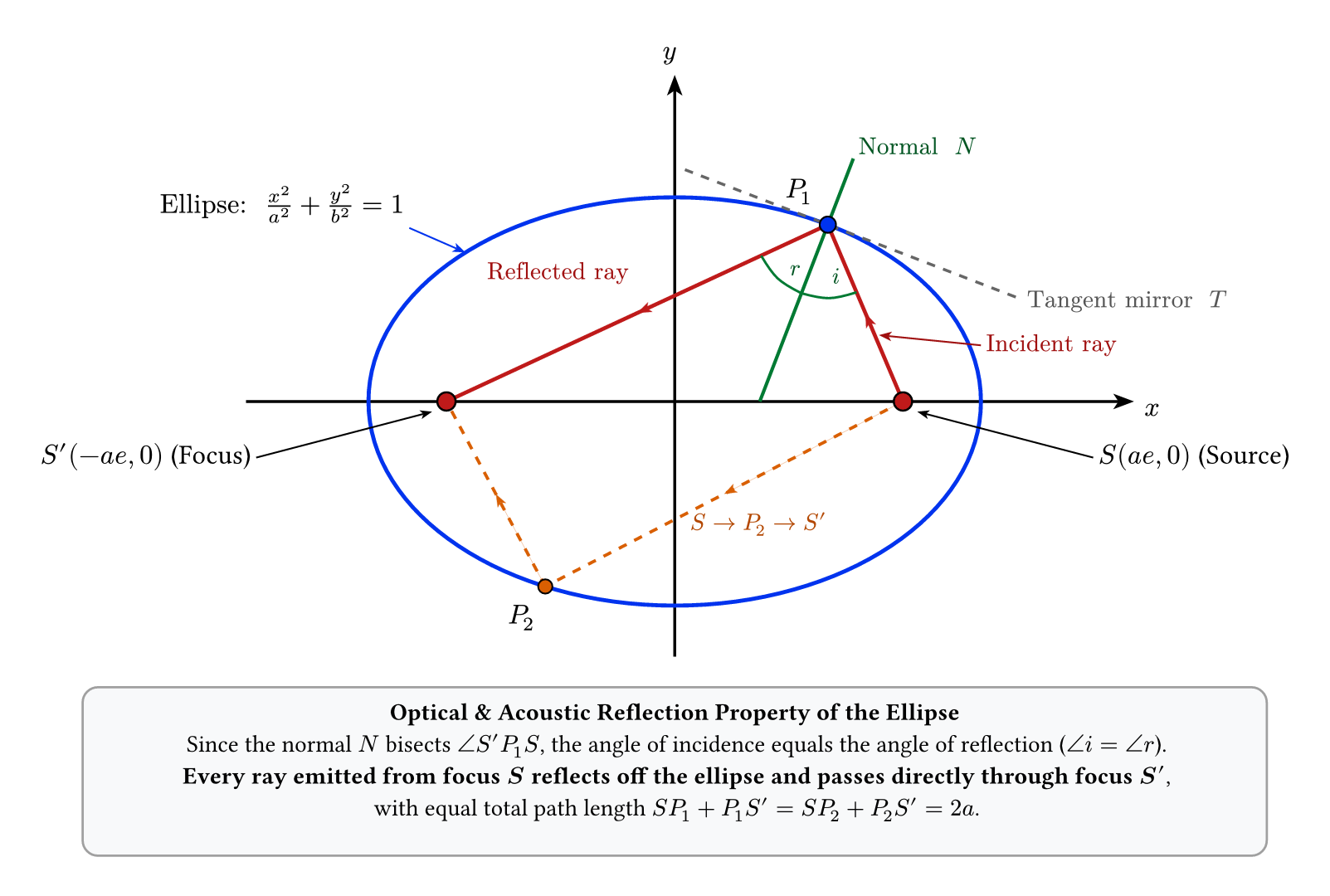
If a ray of light (or sound wave) is emitted from one focus S of an ellipse, it reflects off the ellipse and passes directly through the other focus S′.
When a light ray travelling from focus S strikes the ellipse at a point P, the surface of the ellipse at P acts like a tiny flat mirror along the tangent line, and the normal PG is the perpendicular to this mirror.
By the Law of Reflection in physics, the angle of incidence ∠i (between the incoming ray SP and the normal PG) must equal the angle of reflection ∠r (between the reflected ray and the normal PG).
Since we just proved in Property 5 that the normal PG bisects the angle ∠S′PS:
∠SPG=∠S′PG
the reflected ray must travel precisely along the line PS′, heading straight to the second focus S′!
Furthermore, because SP+PS′=2a is the same for every point P on the ellipse, waves emitted in all directions from S at the same moment travel the exact same total distance 2a and arrive at S′ simultaneously.
A ray of light starts from the focus S(3,0) of the ellipse 25x2+16y2=1 and strikes the ellipse at the point P(3,516). Find the equation of the reflected ray.
Solution:
Step 1: Verify the foci of the ellipse
Here a2=25 and b2=16, so:
c=a2−b2=25−16=3
The two foci are S(3,0) and S′(−3,0).
Step 2: Use the reflection property
Since the incident ray starts from focus S(3,0), after reflecting at P(3,516) on the ellipse, the reflected ray must pass directly through the other focus S′(−3,0).
(We do not need to find the normal at P or compute the angle of reflection!)
Step 3: Write the equation of line PS′
The slope of the line joining S′(−3,0) and P(3,516) is:
m=3−(−3)516−0=3016=158
The equation of the reflected ray passing through S′(−3,0) is:
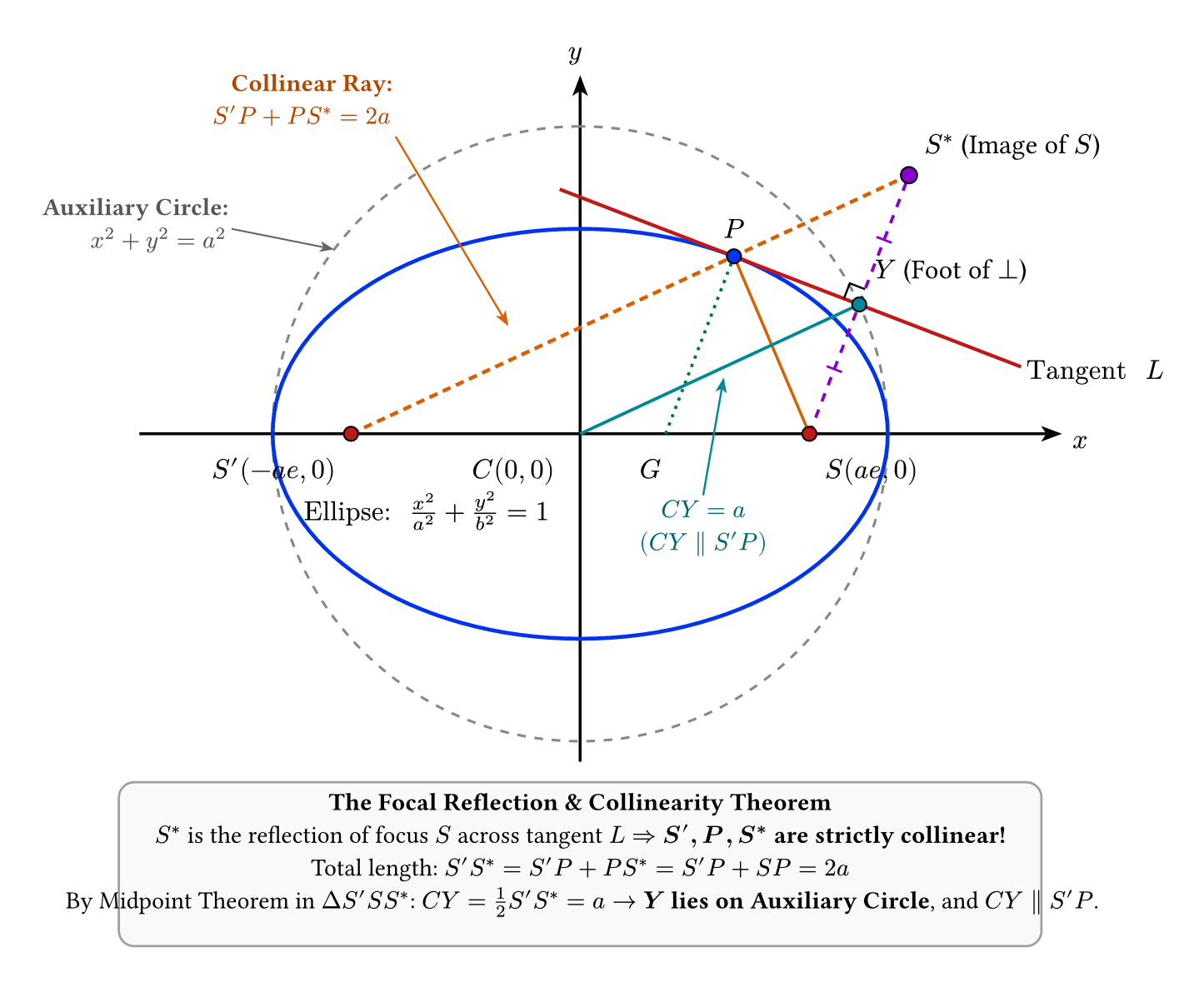
Now that we understand how a ray from one focus S reflects off the tangent at P to reach the other focus S′, let us ask a simple question from plane mirror optics:
Where does an observer at S′ see the image of focus S in the tangent mirror?
When you look into a flat mirror, the reflected ray appears to come in a straight line from the mirror image behind the mirror!
Since S∗ is the mirror image of S in the tangent line L, the line L is the perpendicular bisector of the segment SS∗. Since P lies on L:
The distances from P to S and S∗ are equal: PS=PS∗.
The line L makes equal angles with PS and PS∗.
2. Collinearity with S′P:
By the reflection property of the ellipse, the tangent L also makes equal angles with the incoming ray SP and the outgoing ray PS′. Therefore, the segment PS∗ behind the tangent line is the exact straight-line continuation of S′P. Thus, S′, P, and S∗ are collinear.
3. Length of S′S∗:
Since P lies on the line segment between S′ and S∗:
S′S∗=S′P+PS∗
Since PS∗=SP:
S′S∗=S′P+SP=2a
Geometric Bonus: A Pure Geometry Proof of the Auxiliary Circle Property§
Look at the triangle ΔS′SS∗ in the figure above:
The center C(0,0) of the ellipse is the midpoint of S′S.
The foot of the perpendicular Y is the midpoint of SS∗ (because the tangent bisects SS∗ perpendicularly at Y).
By the Midpoint Theorem in ΔS′SS∗, the segment CY joining the midpoints of two sides is parallel to the third side S′S∗ and equals half its length:
CY∥S′PandCY=21S′S∗=21(2a)=a
Since CY=a for any tangent, the foot of the perpendicular Y is always at distance a from the center C, which immediately explains geometrically why Y lies on the auxiliary circle x2+y2=a2!
Let us see how useful this property is through three worked examples. Whenever the foci and a tangent are involved—even if the ellipse is tilted (oblique)—we can find the point of contact and the dimensions of the ellipse using simple straight-line geometry.
Example 6: Oblique Ellipse Given Two Foci and One Tangent§
The two foci of an ellipse are S(1,1) and S′(5,−1), and the line L:x+y−6=0 is tangent to the ellipse. Find:
The point of contact P of the tangent with the ellipse.
The semi-major axis a.
The semi-minor axis b (using the product of focal perpendiculars).
The eccentricity e of the ellipse.
Solution:
Notice that the line joining S(1,1) and S′(5,−1) is tilted, so the axes of this ellipse are not parallel to the coordinate axes. Writing the equation of the ellipse would be very tedious—instead, we use our geometric properties!
Step 1: Find the mirror image S∗ of focus S(1,1) in the tangent x+y−6=0
Recall the straight-line formula for the image (x∗,y∗) of a point (x0,y0) in a line Ax+By+C=0:
(Verification: The distance between the foci S(1,1) and S′(5,−1) is 2ae=(5−1)2+(−1−1)2=20=25, which also gives e=625=35.)
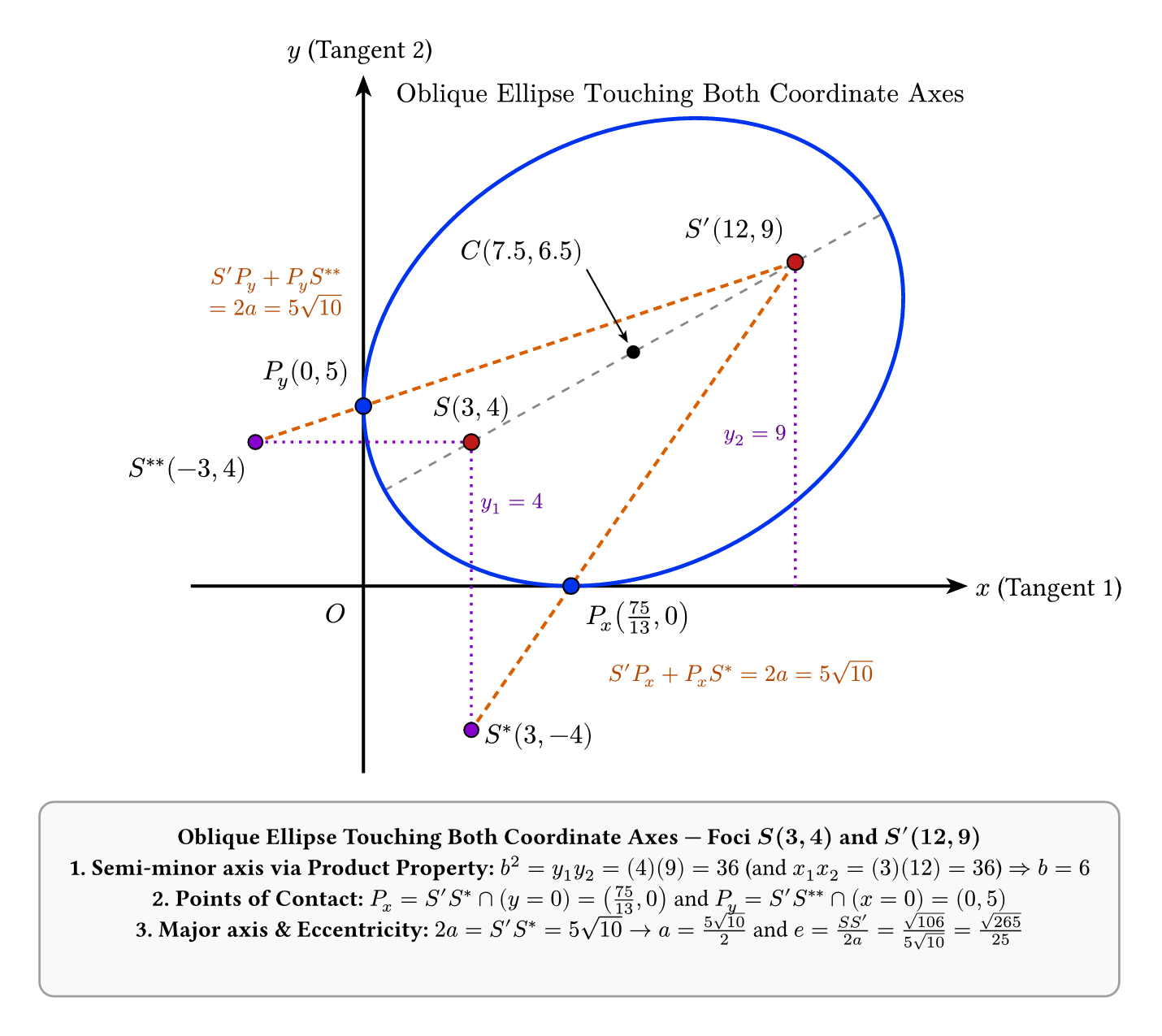
Example 7: Oblique Ellipse Touching Both Coordinate Axes§
An oblique ellipse lies in the first quadrant and touches both the x-axis and the y-axis. If its two foci are S(3,4) and S′(12,9), find:
The semi-minor axis b.
The points of contact of the ellipse with the x-axis and the y-axis.
The semi-major axis a and the eccentricity e of the ellipse.
Solution:
Notice that the line joining the two foci S(3,4) and S′(12,9) has slope 12−39−4=95, so the major axis of this ellipse is tilted (oblique).
Step 1: Find b using the Product of Focal Perpendiculars
Since the ellipse touches both coordinate axes, both the x-axis (y=0) and the y-axis (x=0) are tangents to the ellipse.
For the tangent y=0 (x-axis), the perpendicular distances from the foci S(3,4) and S′(12,9) to the x-axis are simply their y-coordinates:
p1=4andp2=9
By Property 2 (b2=p1p2):
b2=(4)(9)=36⟹b=6
Consistency Check with the y-axis (x=0): Since the y-axis is also a tangent, the perpendicular distances from S(3,4) and S′(12,9) to the y-axis are their x-coordinates 3 and 12. Their product gives the exact same value of b2:
b2=(3)(12)=36⟹b=6
(In general, whenever an ellipse touches both coordinate axes, the coordinates of its foci (x1,y1) and (x2,y2) must always satisfy x1x2=y1y2=b2!)
Step 2: Find the points of contact on the coordinate axes
1. Point of contact Px on the x-axis (y=0):
The mirror image of focus S(3,4) across the tangent y=0 (x-axis) is S∗(3,−4).
By Property 7, the second focus S′(12,9), the point of contact Px, and the reflected image S∗(3,−4) are collinear. Therefore, Px is simply where the line segment S′S∗ crosses the x-axis (y=0).
The equation of the line joining S′(12,9) and S∗(3,−4) is:
y−(−4)=12−39−(−4)(x−3)⟹y+4=913(x−3)
Putting y=0 to find the x-intercept:
4=913(x−3)⟹x−3=1336⟹x=3+1336=1375
Thus, the ellipse touches the x-axis at:
Px(1375,0)
2. Point of contact Py on the y-axis (x=0):
The mirror image of focus S(3,4) across the tangent x=0 (y-axis) is S∗∗(−3,4).
By Property 7, the line joining the second focus S′(12,9) to S∗∗(−3,4) crosses the y-axis (x=0) at the point of contact Py.
The equation of the line joining S′(12,9) and S∗∗(−3,4) is:
(Notice that if we use the second reflected image S∗∗(−3,4) instead, we get the exact same length: S′S∗∗=(12−(−3))2+(9−4)2=152+52=250=510.)
Dividing by 2 gives the semi-major axis:
a=2510
(Check with b: Here a2=4250=62.5 and b2=36, so a2−b2=62.5−36=26.5=253. Let us check the distance between the foci!)
The distance between the given foci S(3,4) and S′(12,9) is 2ae:
2ae=SS′=(12−3)2+(9−4)2=81+25=106
which gives ae=2106⟹a2e2=4106=253=a2−b2, confirming that our values of a and b are completely consistent!
Finally, the eccentricity e is:
e=2a2ae=510106=5553=25265
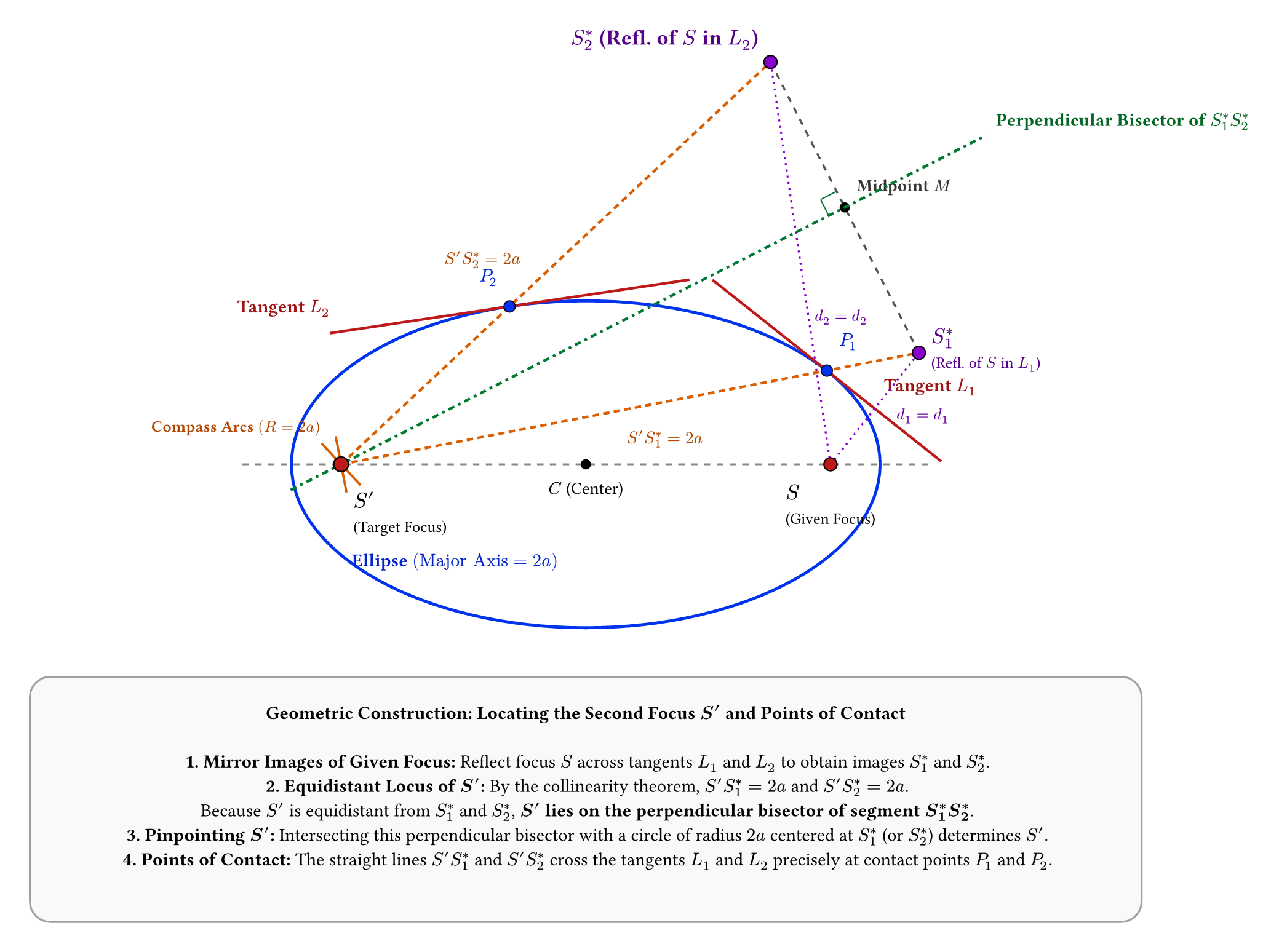
Example 8: One Focus, Major Axis, and Two Tangents Given§
An ellipse has one focus at S(1,1) and a major axis of length 2a=6. If the lines L1:x+y−6=0 and L2:y−3=0 are two tangents to the ellipse, find the possible coordinates of the second focus S′.
Solution:
Step 1: Reflect the given focus S(1,1) across both tangents
From Example 6, the mirror image of S(1,1) in the tangent L1:x+y−6=0 is S1∗(5,5).
For the horizontal tangent L2:y=3, the point S(1,1) lies 2 units below the line, so its mirror image lies 2 units above the line at S2∗(1,5).
Step 2: Use S′S1∗=2a and S′S2∗=2a to locate S′
By Property 7, the distance from the second focus S′ to the mirror image of S in any tangent is equal to 2a=6:
S′S1∗=6andS′S2∗=6
Since S′(x′,y′) is equidistant from S1∗(5,5) and S2∗(1,5), it lies on the perpendicular bisector of the segment joining (5,5) and (1,5), which is the vertical line:
x′=25+1=3
Now substitute x′=3 into (x′−5)2+(y′−5)2=62:
(3−5)2+(y′−5)2=36⟹4+(y′−5)2=36⟹(y′−5)2=32y′=5±42
Since both foci of an ellipse must lie on the same side of any tangent line, and S(1,1) has y<3 (below the tangent y=3), the second focus S′ must also have y′<3. Thus we choose y′=5−42, giving: