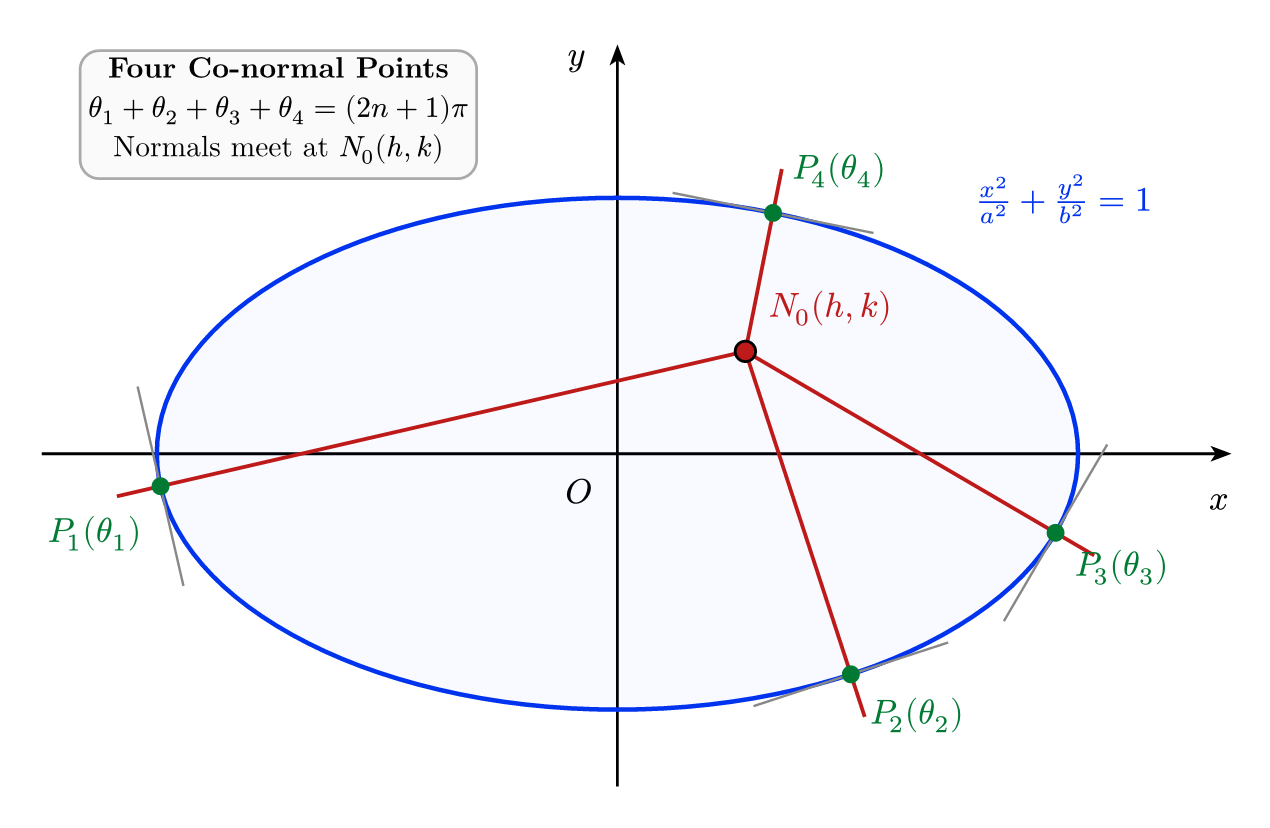
When a normal line is drawn to an ellipse from a point on the curve, the construction is unique. However, if an external point is chosen in the plane, multiple normal lines can often be drawn from that single point to the ellipse.
The points on the ellipse where these normals touch the curve are called co-normal points .
Normals Drawn from an External Point§
Consider the standard ellipse:
x 2 a 2 + y 2 b 2 = 1 \frac{x^2}{a^2} + \frac{y^2}{b^2} = 1 a 2 x 2 + b 2 y 2 = 1 Let P ( a cos θ , b sin θ ) P(a\cos\theta, b\sin\theta) P ( a cos θ , b sin θ ) θ \theta θ P P P
a x cos θ − b y sin θ = a 2 − b 2 \frac{ax}{\cos\theta} - \frac{by}{\sin\theta} = a^2 - b^2 cos θ a x − sin θ b y = a 2 − b 2 Let c 2 = a 2 − b 2 c^2 = a^2 - b^2 c 2 = a 2 − b 2 N 0 ( h , k ) N_0(h, k) N 0 ( h , k ) ( h , k ) (h, k) ( h , k )
a h cos θ − b k sin θ = c 2 \frac{ah}{\cos\theta} - \frac{bk}{\sin\theta} = c^2 cos θ ah − sin θ bk = c 2 Clearing the denominators by multiplying both sides by sin θ cos θ \sin\theta \cos\theta sin θ cos θ
a h sin θ − b k cos θ = c 2 sin θ cos θ ah\sin\theta - bk\cos\theta = c^2 \sin\theta \cos\theta ah sin θ − bk cos θ = c 2 sin θ cos θ To determine how many values of θ \theta θ cos θ \cos\theta cos θ sin θ \sin\theta sin θ t = tan θ 2 t = \tan\frac{\theta}{2} t = tan 2 θ
cos θ = 1 − t 2 1 + t 2 , sin θ = 2 t 1 + t 2 \cos\theta = \frac{1 - t^2}{1 + t^2}, \qquad \sin\theta = \frac{2t}{1 + t^2} cos θ = 1 + t 2 1 − t 2 , sin θ = 1 + t 2 2 t Substituting these relations into a h sin θ − b k cos θ = c 2 sin θ cos θ ah\sin\theta - bk\cos\theta = c^2 \sin\theta \cos\theta ah sin θ − bk cos θ = c 2 sin θ cos θ
a h ( 2 t 1 + t 2 ) − b k ( 1 − t 2 1 + t 2 ) = c 2 ( 2 t 1 + t 2 ) ( 1 − t 2 1 + t 2 ) ah\left(\frac{2t}{1 + t^2}\right) - bk\left(\frac{1 - t^2}{1 + t^2}\right) = c^2 \left(\frac{2t}{1 + t^2}\right)\left(\frac{1 - t^2}{1 + t^2}\right) ah ( 1 + t 2 2 t ) − bk ( 1 + t 2 1 − t 2 ) = c 2 ( 1 + t 2 2 t ) ( 1 + t 2 1 − t 2 ) Multiplying the entire equation by ( 1 + t 2 ) 2 (1 + t^2)^2 ( 1 + t 2 ) 2
2 a h t ( 1 + t 2 ) − b k ( 1 − t 2 ) ( 1 + t 2 ) = 2 c 2 t ( 1 − t 2 ) 2ah t(1 + t^2) - bk(1 - t^2)(1 + t^2) = 2c^2 t(1 - t^2) 2 ah t ( 1 + t 2 ) − bk ( 1 − t 2 ) ( 1 + t 2 ) = 2 c 2 t ( 1 − t 2 ) Expanding each term:
2 a h t + 2 a h t 3 − b k ( 1 − t 4 ) = 2 c 2 t − 2 c 2 t 3 2ah t + 2ah t^3 - bk(1 - t^4) = 2c^2 t - 2c^2 t^3 2 ah t + 2 ah t 3 − bk ( 1 − t 4 ) = 2 c 2 t − 2 c 2 t 3 Rearranging all terms into descending powers of t t t
b k t 4 + 2 ( a h + c 2 ) t 3 + 2 ( a h − c 2 ) t − b k = 0 bk t^4 + 2(ah + c^2)t^3 + 2(ah - c^2)t - bk = 0 bk t 4 + 2 ( ah + c 2 ) t 3 + 2 ( ah − c 2 ) t − bk = 0 This is a polynomial equation of degree 4 in t = tan θ 2 t = \tan\frac{\theta}{2} t = tan 2 θ
By the Fundamental Theorem of Algebra, a degree 4 polynomial has at most 4 roots. Therefore:
At most four normals can be drawn from any given point ( h , k ) (h, k) ( h , k ) co-normal points .
Properties of Co-normal Points§
Let t 1 , t 2 , t 3 , t 4 t_1, t_2, t_3, t_4 t 1 , t 2 , t 3 , t 4
b k t 4 + 2 ( a h + c 2 ) t 3 + 0 ⋅ t 2 + 2 ( a h − c 2 ) t − b k = 0 bk t^4 + 2(ah + c^2)t^3 + 0\cdot t^2 + 2(ah - c^2)t - bk = 0 bk t 4 + 2 ( ah + c 2 ) t 3 + 0 ⋅ t 2 + 2 ( ah − c 2 ) t − bk = 0 Applying Vieta's formulas, the elementary symmetric sums of the roots are:
S 1 = t 1 + t 2 + t 3 + t 4 = − 2 ( a h + c 2 ) b k S_1 = t_1 + t_2 + t_3 + t_4 = -\frac{2(ah + c^2)}{bk} S 1 = t 1 + t 2 + t 3 + t 4 = − bk 2 ( ah + c 2 ) S 2 = ∑ 1 ≤ i < j ≤ 4 t i t j = 0 b k = 0 S_2 = \sum_{1 \le i < j \le 4} t_i t_j = \frac{0}{bk} = 0 S 2 = 1 ≤ i < j ≤ 4 ∑ t i t j = bk 0 = 0 S 3 = ∑ 1 ≤ i < j < k ≤ 4 t i t j t k = − 2 ( a h − c 2 ) b k S_3 = \sum_{1 \le i < j < k \le 4} t_i t_j t_k = -\frac{2(ah - c^2)}{bk} S 3 = 1 ≤ i < j < k ≤ 4 ∑ t i t j t k = − bk 2 ( ah − c 2 ) S 4 = t 1 t 2 t 3 t 4 = − b k b k = − 1 S_4 = t_1 t_2 t_3 t_4 = \frac{-bk}{bk} = -1 S 4 = t 1 t 2 t 3 t 4 = bk − bk = − 1 These relations lead to several fundamental geometric properties.
Sum of the Eccentric Angles§
Let the eccentric angles of the four co-normal points be θ 1 , θ 2 , θ 3 , θ 4 \theta_1, \theta_2, \theta_3, \theta_4 θ 1 , θ 2 , θ 3 , θ 4 t i = tan θ i 2 t_i = \tan\frac{\theta_i}{2} t i = tan 2 θ i
The tangent of half the sum of the four angles is given by the multi-angle tangent addition formula:
tan ( θ 1 + θ 2 + θ 3 + θ 4 2 ) = S 1 − S 3 1 − S 2 + S 4 \tan\left(\frac{\theta_1 + \theta_2 + \theta_3 + \theta_4}{2}\right) = \frac{S_1 - S_3}{1 - S_2 + S_4} tan ( 2 θ 1 + θ 2 + θ 3 + θ 4 ) = 1 − S 2 + S 4 S 1 − S 3 Substituting S 2 = 0 S_2 = 0 S 2 = 0 S 4 = − 1 S_4 = -1 S 4 = − 1
1 − S 2 + S 4 = 1 − 0 + ( − 1 ) = 0 1 - S_2 + S_4 = 1 - 0 + (-1) = 0 1 − S 2 + S 4 = 1 − 0 + ( − 1 ) = 0 Since the denominator vanishes while the numerator S 1 − S 3 = − 4 c 2 b k ≠ 0 S_1 - S_3 = -\frac{4c^2}{bk} \neq 0 S 1 − S 3 = − bk 4 c 2 = 0 k ≠ 0 k \neq 0 k = 0
tan ( θ 1 + θ 2 + θ 3 + θ 4 2 ) → ∞ \tan\left(\frac{\theta_1 + \theta_2 + \theta_3 + \theta_4}{2}\right) \to \infty tan ( 2 θ 1 + θ 2 + θ 3 + θ 4 ) → ∞ Therefore, half the sum of the eccentric angles must be an odd multiple of π 2 \frac{\pi}{2} 2 π
θ 1 + θ 2 + θ 3 + θ 4 2 = n π + π 2 ( n ∈ Z ) \frac{\theta_1 + \theta_2 + \theta_3 + \theta_4}{2} = n\pi + \frac{\pi}{2} \qquad (n \in \mathbb{Z}) 2 θ 1 + θ 2 + θ 3 + θ 4 = nπ + 2 π ( n ∈ Z ) Multiplying by 2:
θ 1 + θ 2 + θ 3 + θ 4 = ( 2 n + 1 ) π \theta_1 + \theta_2 + \theta_3 + \theta_4 = (2n + 1)\pi θ 1 + θ 2 + θ 3 + θ 4 = ( 2 n + 1 ) π
Fundamental Theorem:
The sum of the eccentric angles of four co-normal points on an ellipse is always an odd multiple of π \pi π .
Sum of Trigonometric Coordinates§
Using the roots of the quartic equation, the sum of the coordinates of the four co-normal points can be evaluated directly:
∑ i = 1 4 cos θ i = 2 a h a 2 − b 2 \sum_{i=1}^4 \cos\theta_i = \frac{2ah}{a^2 - b^2} i = 1 ∑ 4 cos θ i = a 2 − b 2 2 ah ∑ i = 1 4 sin θ i = − 2 b k a 2 − b 2 \sum_{i=1}^4 \sin\theta_i = -\frac{2bk}{a^2 - b^2} i = 1 ∑ 4 sin θ i = − a 2 − b 2 2 bk Since the coordinates of each co-normal point are x i = a cos θ i x_i = a\cos\theta_i x i = a cos θ i y i = b sin θ i y_i = b\sin\theta_i y i = b sin θ i
∑ i = 1 4 x i = 2 a 2 h a 2 − b 2 \sum_{i=1}^4 x_i = \frac{2a^2 h}{a^2 - b^2} i = 1 ∑ 4 x i = a 2 − b 2 2 a 2 h ∑ i = 1 4 y i = − 2 b 2 k a 2 − b 2 \sum_{i=1}^4 y_i = -\frac{2b^2 k}{a^2 - b^2} i = 1 ∑ 4 y i = − a 2 − b 2 2 b 2 k The centroid G ( x ˉ , y ˉ ) G(\bar{x}, \bar{y}) G ( x ˉ , y ˉ )
x ˉ = 1 4 ∑ i = 1 4 x i = a 2 h 2 ( a 2 − b 2 ) \bar{x} = \frac{1}{4}\sum_{i=1}^4 x_i = \frac{a^2 h}{2(a^2 - b^2)} x ˉ = 4 1 i = 1 ∑ 4 x i = 2 ( a 2 − b 2 ) a 2 h y ˉ = 1 4 ∑ i = 1 4 y i = − b 2 k 2 ( a 2 − b 2 ) \bar{y} = \frac{1}{4}\sum_{i=1}^4 y_i = -\frac{b^2 k}{2(a^2 - b^2)} y ˉ = 4 1 i = 1 ∑ 4 y i = − 2 ( a 2 − b 2 ) b 2 k Comparison: Co-normal Points vs Concyclic Points§
A classic result in coordinate geometry connects co-normal points with points lying on a circle (concyclic points).
Condition for Concyclic Points on an Ellipse§
Let a general circle be:
x 2 + y 2 + 2 g x + 2 f y + d = 0 x^2 + y^2 + 2gx + 2fy + d = 0 x 2 + y 2 + 2 g x + 2 f y + d = 0 Substitute the parametric coordinates x = a cos θ , y = b sin θ x = a\cos\theta, y = b\sin\theta x = a cos θ , y = b sin θ
a 2 cos 2 θ + b 2 sin 2 θ + 2 g a cos θ + 2 f b sin θ + d = 0 a^2 \cos^2\theta + b^2 \sin^2\theta + 2ga\cos\theta + 2fb\sin\theta + d = 0 a 2 cos 2 θ + b 2 sin 2 θ + 2 g a cos θ + 2 f b sin θ + d = 0 Expressing cos θ \cos\theta cos θ sin θ \sin\theta sin θ t = tan θ 2 t = \tan\frac{\theta}{2} t = tan 2 θ t t t
( a 2 + 2 g a + d ) + 4 f b t + 2 ( 2 b 2 − a 2 + d ) t 2 + 4 f b t 3 + ( a 2 − 2 g a + d ) t 4 = 0 (a^2 + 2ga + d) + 4fb t + 2(2b^2 - a^2 + d)t^2 + 4fb t^3 + (a^2 - 2ga + d)t^4 = 0 ( a 2 + 2 g a + d ) + 4 f b t + 2 ( 2 b 2 − a 2 + d ) t 2 + 4 f b t 3 + ( a 2 − 2 g a + d ) t 4 = 0 Notice that the coefficient of t 3 t^3 t 3 t t t
S 1 ′ = ∑ t i , S 3 ′ = ∑ t i t j t k ⟹ S 1 ′ − S 3 ′ = 0 S_1' = \sum t_i, \qquad S_3' = \sum t_i t_j t_k \implies S_1' - S_3' = 0 S 1 ′ = ∑ t i , S 3 ′ = ∑ t i t j t k ⟹ S 1 ′ − S 3 ′ = 0 Therefore:
tan ( θ 1 + θ 2 + θ 3 + θ 4 2 ) = S 1 ′ − S 3 ′ 1 − S 2 ′ + S 4 ′ = 0 1 − S 2 ′ + S 4 ′ = 0 \tan\left(\frac{\theta_1 + \theta_2 + \theta_3 + \theta_4}{2}\right) = \frac{S_1' - S_3'}{1 - S_2' + S_4'} = \frac{0}{1 - S_2' + S_4'} = 0 tan ( 2 θ 1 + θ 2 + θ 3 + θ 4 ) = 1 − S 2 ′ + S 4 ′ S 1 ′ − S 3 ′ = 1 − S 2 ′ + S 4 ′ 0 = 0 This implies:
θ 1 + θ 2 + θ 3 + θ 4 2 = n π ⟹ θ 1 + θ 2 + θ 3 + θ 4 = 2 n π \frac{\theta_1 + \theta_2 + \theta_3 + \theta_4}{2} = n\pi \implies \theta_1 + \theta_2 + \theta_3 + \theta_4 = 2n\pi 2 θ 1 + θ 2 + θ 3 + θ 4 = nπ ⟹ θ 1 + θ 2 + θ 3 + θ 4 = 2 nπ
Concyclic Condition:
The sum of the eccentric angles of four concyclic points on an ellipse is always an even multiple of π \pi π .
The Circle Through Three Co-normal Points§
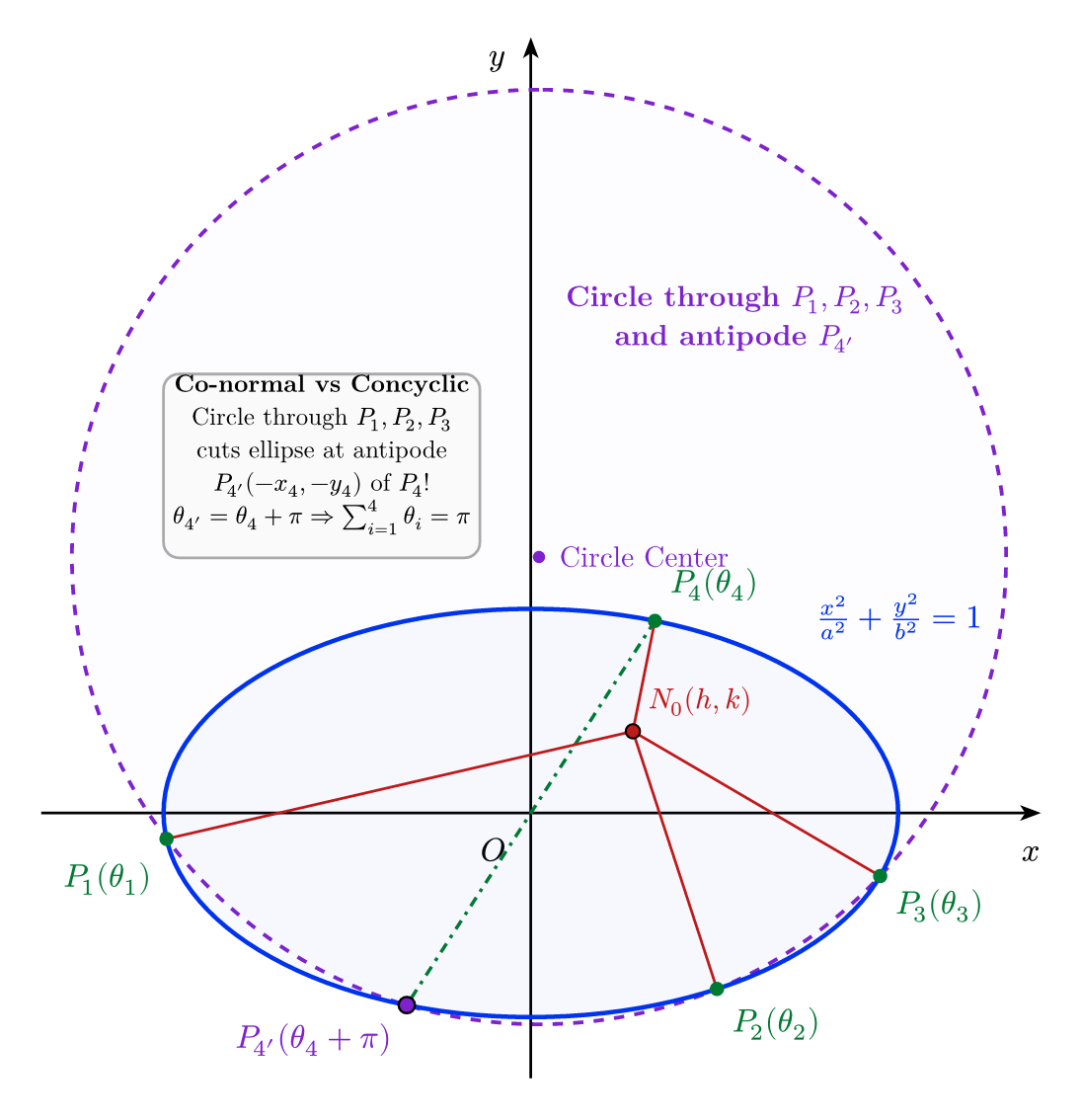
Suppose P 1 ( θ 1 ) , P 2 ( θ 2 ) , P 3 ( θ 3 ) , P 4 ( θ 4 ) P_1(\theta_1), P_2(\theta_2), P_3(\theta_3), P_4(\theta_4) P 1 ( θ 1 ) , P 2 ( θ 2 ) , P 3 ( θ 3 ) , P 4 ( θ 4 ) N 0 ( h , k ) N_0(h, k) N 0 ( h , k )
By the co-normal property:
θ 1 + θ 2 + θ 3 + θ 4 = ( 2 k + 1 ) π \theta_1 + \theta_2 + \theta_3 + \theta_4 = (2k + 1)\pi θ 1 + θ 2 + θ 3 + θ 4 = ( 2 k + 1 ) π Now construct the unique circle passing through the three points P 1 , P 2 , P 3 P_1, P_2, P_3 P 1 , P 2 , P 3 P 4 ′ ( θ 4 ′ ) P_4'(\theta_4') P 4 ′ ( θ 4 ′ )
Since P 1 , P 2 , P 3 , P 4 ′ P_1, P_2, P_3, P_4' P 1 , P 2 , P 3 , P 4 ′
θ 1 + θ 2 + θ 3 + θ 4 ′ = 2 m π \theta_1 + \theta_2 + \theta_3 + \theta_4' = 2m\pi θ 1 + θ 2 + θ 3 + θ 4 ′ = 2 mπ Subtracting the co-normal relation from the concyclic relation:
θ 4 ′ − θ 4 = 2 m π − ( 2 k + 1 ) π = ( 2 m − 2 k − 1 ) π \theta_4' - \theta_4 = 2m\pi - (2k + 1)\pi = (2m - 2k - 1)\pi θ 4 ′ − θ 4 = 2 mπ − ( 2 k + 1 ) π = ( 2 m − 2 k − 1 ) π This difference is an odd multiple of π \pi π
θ 4 ′ = θ 4 + π \theta_4' = \theta_4 + \pi θ 4 ′ = θ 4 + π Evaluating the coordinates of P 4 ′ P_4' P 4 ′
x 4 ′ = a cos ( θ 4 + π ) = − a cos θ 4 = − x 4 x_4' = a\cos(\theta_4 + \pi) = -a\cos\theta_4 = -x_4 x 4 ′ = a cos ( θ 4 + π ) = − a cos θ 4 = − x 4 y 4 ′ = b sin ( θ 4 + π ) = − b sin θ 4 = − y 4 y_4' = b\sin(\theta_4 + \pi) = -b\sin\theta_4 = -y_4 y 4 ′ = b sin ( θ 4 + π ) = − b sin θ 4 = − y 4 The point P 4 ′ ( − x 4 , − y 4 ) P_4'(-x_4, -y_4) P 4 ′ ( − x 4 , − y 4 ) P 4 ( x 4 , y 4 ) P_4(x_4, y_4) P 4 ( x 4 , y 4 )
Antipodal Intersection Theorem:
If a circle passes through three co-normal points P 1 , P 2 , P 3 P_1, P_2, P_3 P 1 , P 2 , P 3 P 4 ′ P_4' P 4 ′ diametrically opposite point (reflection through the center) of the fourth co-normal point P 4 P_4 P 4
Number of Real Normals and the Boundary Curve§
Although the quartic equation in t = tan θ 2 t = \tan\frac{\theta}{2} t = tan 2 θ
b k t 4 + 2 ( a h + c 2 ) t 3 + 2 ( a h − c 2 ) t − b k = 0 bk t^4 + 2(ah + c^2)t^3 + 2(ah - c^2)t - bk = 0 bk t 4 + 2 ( ah + c 2 ) t 3 + 2 ( ah − c 2 ) t − bk = 0 always has four roots by the Fundamental Theorem of Algebra, some roots may be complex conjugate pairs. In coordinate geometry, only real roots correspond to physical normal lines drawn to the ellipse.
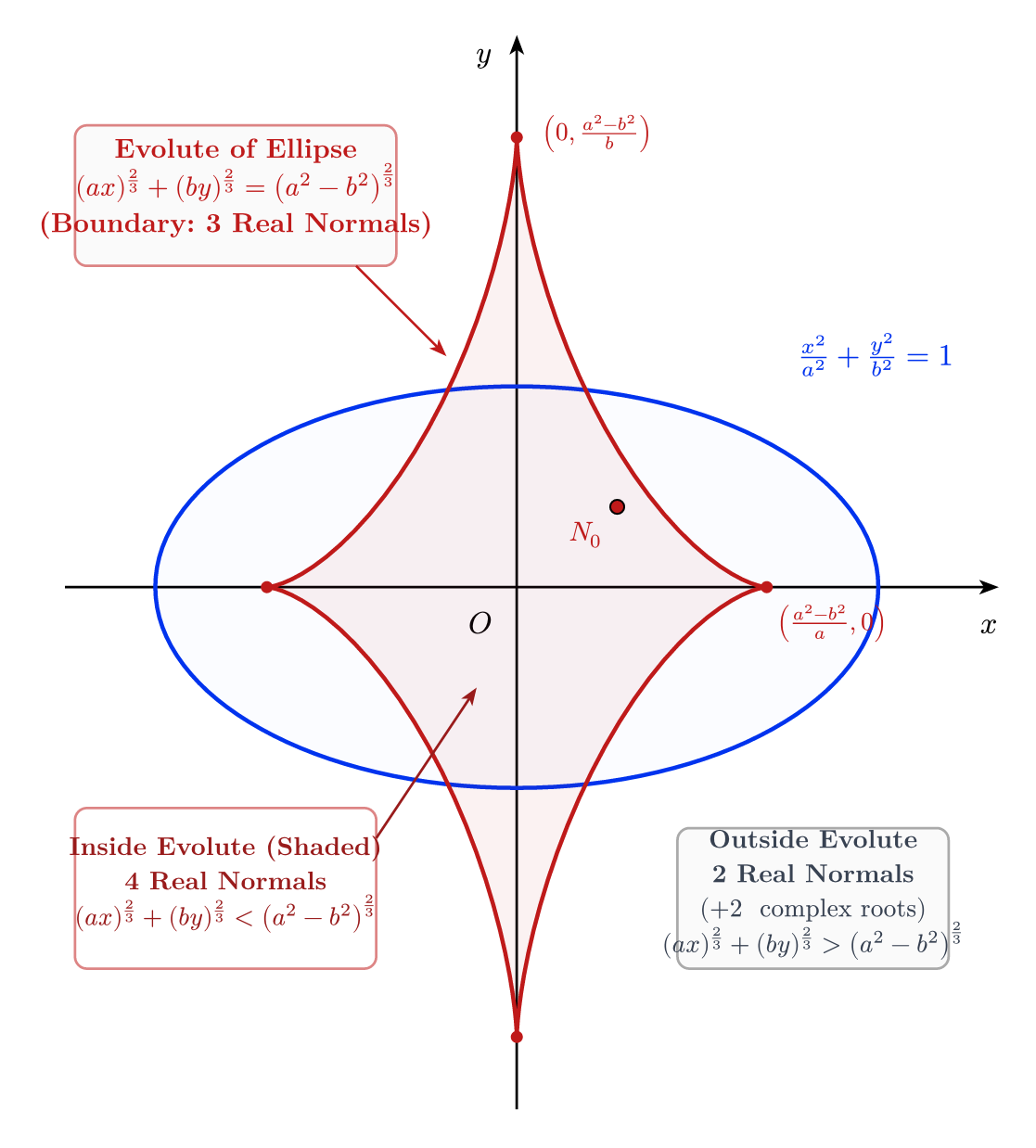
Depending on the position of ( h , k ) (h, k) ( h , k ) real normals drawn to the ellipse can be 4, 3, or 2.
Condition for Repeated Roots§
The transition between 4 distinct real roots and 2 real roots occurs when the quartic equation has a repeated root .
If a polynomial P ( t ) = 0 P(t) = 0 P ( t ) = 0 t t t t t t
P ( t ) = 0 and P ′ ( t ) = 0 P(t) = 0 \qquad \text{and} \qquad P'(t) = 0 P ( t ) = 0 and P ′ ( t ) = 0 Eliminating t t t P ( t ) = 0 P(t) = 0 P ( t ) = 0 P ′ ( t ) = 0 P'(t) = 0 P ′ ( t ) = 0
( a x ) 2 / 3 + ( b y ) 2 / 3 = ( a 2 − b 2 ) 2 / 3 (ax)^{2/3} + (by)^{2/3} = (a^2 - b^2)^{2/3} ( a x ) 2/3 + ( b y ) 2/3 = ( a 2 − b 2 ) 2/3 This boundary is an astroid-shaped curve symmetric about both axes, with four cusps:
1. Cusps on the major axis: ( ± a 2 − b 2 a , 0 ) \left(\pm \frac{a^2 - b^2}{a}, 0\right) ( ± a a 2 − b 2 , 0 )
2. Cusps on the minor axis: ( 0 , ± a 2 − b 2 b ) \left(0, \pm \frac{a^2 - b^2}{b}\right) ( 0 , ± b a 2 − b 2 )
Notice that a 2 − b 2 a < a \frac{a^2 - b^2}{a} < a a a 2 − b 2 < a a 2 − b 2 > b 2 a^2 - b^2 > b^2 a 2 − b 2 > b 2 e > 1 2 e > \frac{1}{\sqrt{2}} e > 2 1
The Three Normal Regions§
1. Point Inside the Boundary Curve:
If ( a h ) 2 / 3 + ( b k ) 2 / 3 < ( a 2 − b 2 ) 2 / 3 (ah)^{2/3} + (bk)^{2/3} < (a^2 - b^2)^{2/3} ( ah ) 2/3 + ( bk ) 2/3 < ( a 2 − b 2 ) 2/3 4 distinct real roots . Exactly 4 distinct real normals can be drawn from ( h , k ) (h, k) ( h , k )
2. Point on the Boundary Curve:
If ( a h ) 2 / 3 + ( b k ) 2 / 3 = ( a 2 − b 2 ) 2 / 3 (ah)^{2/3} + (bk)^{2/3} = (a^2 - b^2)^{2/3} ( ah ) 2/3 + ( bk ) 2/3 = ( a 2 − b 2 ) 2/3 3 real normals can be drawn, two of which are coincident.
3. Point Outside the Boundary Curve:
If ( a h ) 2 / 3 + ( b k ) 2 / 3 > ( a 2 − b 2 ) 2 / 3 (ah)^{2/3} + (bk)^{2/3} > (a^2 - b^2)^{2/3} ( ah ) 2/3 + ( bk ) 2/3 > ( a 2 − b 2 ) 2/3 2 distinct real roots and 2 complex conjugate roots. Exactly 2 real normals can be drawn.
Higher Geometry Note:
The boundary curve ( a x ) 2 / 3 + ( b y ) 2 / 3 = ( a 2 − b 2 ) 2 / 3 (ax)^{2/3} + (by)^{2/3} = (a^2 - b^2)^{2/3} ( a x ) 2/3 + ( b y ) 2/3 = ( a 2 − b 2 ) 2/3 evolute (the envelope of all normal lines) of the ellipse. For a comprehensive, rigorous derivation from first principles covering envelopes, curvature, and multivariable calculus, see the companion monograph:
The Theory of Evolutes and Envelopes (PDF) .
The equation of a normal to x 2 a 2 + y 2 b 2 = 1 \frac{x^2}{a^2} + \frac{y^2}{b^2} = 1 a 2 x 2 + b 2 y 2 = 1 m m m
y = m x − ( a 2 − b 2 ) m a 2 + b 2 m 2 y = mx - \frac{(a^2 - b^2)m}{\sqrt{a^2 + b^2 m^2}} y = m x − a 2 + b 2 m 2 ( a 2 − b 2 ) m If this normal passes through ( h , k ) (h, k) ( h , k )
k − m h = − ( a 2 − b 2 ) m a 2 + b 2 m 2 k - mh = -\frac{(a^2 - b^2)m}{\sqrt{a^2 + b^2 m^2}} k − mh = − a 2 + b 2 m 2 ( a 2 − b 2 ) m Squaring both sides:
( k − m h ) 2 ( a 2 + b 2 m 2 ) = ( a 2 − b 2 ) 2 m 2 (k - mh)^2 (a^2 + b^2 m^2) = (a^2 - b^2)^2 m^2 ( k − mh ) 2 ( a 2 + b 2 m 2 ) = ( a 2 − b 2 ) 2 m 2 Expanding both sides:
( h 2 m 2 − 2 h k m + k 2 ) ( a 2 + b 2 m 2 ) = ( a 2 − b 2 ) 2 m 2 (h^2 m^2 - 2hk m + k^2)(a^2 + b^2 m^2) = (a^2 - b^2)^2 m^2 ( h 2 m 2 − 2 hk m + k 2 ) ( a 2 + b 2 m 2 ) = ( a 2 − b 2 ) 2 m 2 Collecting powers of m m m
b 2 h 2 m 4 − 2 b 2 h k m 3 + [ a 2 h 2 + b 2 k 2 − ( a 2 − b 2 ) 2 ] m 2 − 2 a 2 h k m + a 2 k 2 = 0 b^2 h^2 m^4 - 2b^2 hk m^3 + \left[a^2 h^2 + b^2 k^2 - (a^2 - b^2)^2\right]m^2 - 2a^2 hk m + a^2 k^2 = 0 b 2 h 2 m 4 − 2 b 2 hk m 3 + [ a 2 h 2 + b 2 k 2 − ( a 2 − b 2 ) 2 ] m 2 − 2 a 2 hk m + a 2 k 2 = 0 This is a quartic equation in the slope m m m
If m 1 , m 2 , m 3 , m 4 m_1, m_2, m_3, m_4 m 1 , m 2 , m 3 , m 4 ( h , k ) (h, k) ( h , k )
m 1 m 2 m 3 m 4 = a 2 k 2 b 2 h 2 m_1 m_2 m_3 m_4 = \frac{a^2 k^2}{b^2 h^2} m 1 m 2 m 3 m 4 = b 2 h 2 a 2 k 2 m 1 + m 2 + m 3 + m 4 = 2 h k h 2 = 2 k h m_1 + m_2 + m_3 + m_4 = \frac{2hk}{h^2} = \frac{2k}{h} m 1 + m 2 + m 3 + m 4 = h 2 2 hk = h 2 k Worked Examples§
Example 1: Finding the Fourth Co-normal Point§
Three co-normal points on the ellipse x 2 16 + y 2 9 = 1 \frac{x^2}{16} + \frac{y^2}{9} = 1 16 x 2 + 9 y 2 = 1 θ 1 = π 6 \theta_1 = \frac{\pi}{6} θ 1 = 6 π θ 2 = π 3 \theta_2 = \frac{\pi}{3} θ 2 = 3 π θ 3 = π 2 \theta_3 = \frac{\pi}{2} θ 3 = 2 π θ 4 \theta_4 θ 4
Solution:
The sum of the eccentric angles of four co-normal points must equal an odd multiple of π \pi π
θ 1 + θ 2 + θ 3 + θ 4 = ( 2 n + 1 ) π \theta_1 + \theta_2 + \theta_3 + \theta_4 = (2n + 1)\pi θ 1 + θ 2 + θ 3 + θ 4 = ( 2 n + 1 ) π Substitute the given angles:
π 6 + π 3 + π 2 + θ 4 = ( 2 n + 1 ) π \frac{\pi}{6} + \frac{\pi}{3} + \frac{\pi}{2} + \theta_4 = (2n + 1)\pi 6 π + 3 π + 2 π + θ 4 = ( 2 n + 1 ) π Compute the sum of the first three angles:
π + 2 π + 3 π 6 = 6 π 6 = π \frac{\pi + 2\pi + 3\pi}{6} = \frac{6\pi}{6} = \pi 6 π + 2 π + 3 π = 6 6 π = π Therefore:
π + θ 4 = ( 2 n + 1 ) π ⟹ θ 4 = 2 n π \pi + \theta_4 = (2n + 1)\pi \implies \theta_4 = 2n\pi π + θ 4 = ( 2 n + 1 ) π ⟹ θ 4 = 2 nπ Taking the principal value (n = 0 n = 0 n = 0
θ 4 = 0 \theta_4 = 0 θ 4 = 0 The fourth co-normal point is the right vertex ( a , 0 ) = ( 4 , 0 ) (a, 0) = (4, 0) ( a , 0 ) = ( 4 , 0 )
Example 2: Verifying the Antipodal Circle Property§
For the ellipse x 2 16 + y 2 9 = 1 \frac{x^2}{16} + \frac{y^2}{9} = 1 16 x 2 + 9 y 2 = 1 θ 1 = π 6 , θ 2 = π 3 , θ 3 = π 2 \theta_1 = \frac{\pi}{6}, \theta_2 = \frac{\pi}{3}, \theta_3 = \frac{\pi}{2} θ 1 = 6 π , θ 2 = 3 π , θ 3 = 2 π
Solution:
For any circle intersecting the ellipse at four points, the sum of their eccentric angles must be an even multiple of π \pi π
θ 1 + θ 2 + θ 3 + θ 4 ′ = 2 m π \theta_1 + \theta_2 + \theta_3 + \theta_4' = 2m\pi θ 1 + θ 2 + θ 3 + θ 4 ′ = 2 mπ Substituting θ 1 + θ 2 + θ 3 = π \theta_1 + \theta_2 + \theta_3 = \pi θ 1 + θ 2 + θ 3 = π
π + θ 4 ′ = 2 m π ⟹ θ 4 ′ = ( 2 m − 1 ) π \pi + \theta_4' = 2m\pi \implies \theta_4' = (2m - 1)\pi π + θ 4 ′ = 2 mπ ⟹ θ 4 ′ = ( 2 m − 1 ) π Taking the principal angle with m = 1 m = 1 m = 1
θ 4 ′ = π \theta_4' = \pi θ 4 ′ = π The fourth concyclic intersection is P 4 ′ ( − a , 0 ) = ( − 4 , 0 ) P_4'(-a, 0) = (-4, 0) P 4 ′ ( − a , 0 ) = ( − 4 , 0 )
Since the fourth co-normal point was P 4 ( 4 , 0 ) P_4(4, 0) P 4 ( 4 , 0 )
( − x 4 , − y 4 ) = ( − 4 , 0 ) = P 4 ′ (-x_4, -y_4) = (-4, 0) = P_4' ( − x 4 , − y 4 ) = ( − 4 , 0 ) = P 4 ′ This verifies that the circle through three co-normal points cuts the ellipse at the antipode of the fourth co-normal point.
Example 3: Centroid of Four Co-normal Points§
Four normals are drawn from the point ( h , k ) = ( 2 , 1 ) (h, k) = (2, 1) ( h , k ) = ( 2 , 1 ) x 2 25 + y 2 16 = 1 \frac{x^2}{25} + \frac{y^2}{16} = 1 25 x 2 + 16 y 2 = 1
Solution:
Here a 2 = 25 a^2 = 25 a 2 = 25 b 2 = 16 b^2 = 16 b 2 = 16 a 2 − b 2 = 9 a^2 - b^2 = 9 a 2 − b 2 = 9
The centroid coordinates G ( x ˉ , y ˉ ) G(\bar{x}, \bar{y}) G ( x ˉ , y ˉ )
x ˉ = a 2 h 2 ( a 2 − b 2 ) = 25 × 2 2 × 9 = 50 18 = 25 9 \bar{x} = \frac{a^2 h}{2(a^2 - b^2)} = \frac{25 \times 2}{2 \times 9} = \frac{50}{18} = \frac{25}{9} x ˉ = 2 ( a 2 − b 2 ) a 2 h = 2 × 9 25 × 2 = 18 50 = 9 25 y ˉ = − b 2 k 2 ( a 2 − b 2 ) = − 16 × 1 2 × 9 = − 16 18 = − 8 9 \bar{y} = -\frac{b^2 k}{2(a^2 - b^2)} = -\frac{16 \times 1}{2 \times 9} = -\frac{16}{18} = -\frac{8}{9} y ˉ = − 2 ( a 2 − b 2 ) b 2 k = − 2 × 9 16 × 1 = − 18 16 = − 9 8 The centroid of the four co-normal points is:
G ( 25 9 , − 8 9 ) G\left(\frac{25}{9}, -\frac{8}{9}\right) G ( 9 25 , − 9 8 ) Example 4: Number of Normals from a Given Point§
Determine the number of real normals that can be drawn from the point ( 1 , 2 ) (1, 2) ( 1 , 2 ) x 2 16 + y 2 4 = 1 \frac{x^2}{16} + \frac{y^2}{4} = 1 16 x 2 + 4 y 2 = 1
Solution:
Here a = 4 , b = 2 a = 4, b = 2 a = 4 , b = 2
a 2 − b 2 = 16 − 4 = 12 a^2 - b^2 = 16 - 4 = 12 a 2 − b 2 = 16 − 4 = 12 Calculate the evolute boundary value:
( a 2 − b 2 ) 2 / 3 = 12 2 / 3 ≈ 5.241 (a^2 - b^2)^{2/3} = 12^{2/3} \approx 5.241 ( a 2 − b 2 ) 2/3 = 1 2 2/3 ≈ 5.241 Evaluate the evolute expression at ( h , k ) = ( 1 , 2 ) (h, k) = (1, 2) ( h , k ) = ( 1 , 2 )
( a h ) 2 / 3 + ( b k ) 2 / 3 = ( 4 × 1 ) 2 / 3 + ( 2 × 2 ) 2 / 3 = 4 2 / 3 + 4 2 / 3 = 2 × 4 2 / 3 (ah)^{2/3} + (bk)^{2/3} = (4 \times 1)^{2/3} + (2 \times 2)^{2/3} = 4^{2/3} + 4^{2/3} = 2 \times 4^{2/3} ( ah ) 2/3 + ( bk ) 2/3 = ( 4 × 1 ) 2/3 + ( 2 × 2 ) 2/3 = 4 2/3 + 4 2/3 = 2 × 4 2/3 Since 4 2 / 3 ≈ 2.520 4^{2/3} \approx 2.520 4 2/3 ≈ 2.520
2 × 2.520 = 5.040 2 \times 2.520 = 5.040 2 × 2.520 = 5.040 Comparing the two values:
5.040 < 5.241 ⟹ ( a h ) 2 / 3 + ( b k ) 2 / 3 < ( a 2 − b 2 ) 2 / 3 5.040 < 5.241 \implies (ah)^{2/3} + (bk)^{2/3} < (a^2 - b^2)^{2/3} 5.040 < 5.241 ⟹ ( ah ) 2/3 + ( bk ) 2/3 < ( a 2 − b 2 ) 2/3 The point ( 1 , 2 ) (1, 2) ( 1 , 2 ) inside the evolute of the ellipse. Therefore, 4 distinct real normals can be drawn from ( 1 , 2 ) (1, 2) ( 1 , 2 )
Challenging Synthesis and Locus Problems§
Problem 1: Locus of the Point of Concurrency of Two Perpendicular Normals§
Find the locus of a point N 0 ( h , k ) N_0(h, k) N 0 ( h , k ) x 2 a 2 + y 2 b 2 = 1 \frac{x^2}{a^2} + \frac{y^2}{b^2} = 1 a 2 x 2 + b 2 y 2 = 1
Solution:
The slopes m 1 , m 2 , m 3 , m 4 m_1, m_2, m_3, m_4 m 1 , m 2 , m 3 , m 4
b 2 h 2 m 4 − 2 b 2 h k m 3 + [ a 2 h 2 + b 2 k 2 − ( a 2 − b 2 ) 2 ] m 2 − 2 a 2 h k m + a 2 k 2 = 0 b^2 h^2 m^4 - 2b^2 hk m^3 + \left[a^2 h^2 + b^2 k^2 - (a^2 - b^2)^2\right]m^2 - 2a^2 hk m + a^2 k^2 = 0 b 2 h 2 m 4 − 2 b 2 hk m 3 + [ a 2 h 2 + b 2 k 2 − ( a 2 − b 2 ) 2 ] m 2 − 2 a 2 hk m + a 2 k 2 = 0 Suppose two normals are perpendicular, say m 1 m 2 = − 1 m_1 m_2 = -1 m 1 m 2 = − 1
Let the quartic factor into two quadratic polynomials:
( m 2 + p 1 m − 1 ) ( m 2 + p 2 m − λ ) = 0 (m^2 + p_1 m - 1)(m^2 + p_2 m - \lambda) = 0 ( m 2 + p 1 m − 1 ) ( m 2 + p 2 m − λ ) = 0 Since the constant term is a 2 k 2 b 2 h 2 \frac{a^2 k^2}{b^2 h^2} b 2 h 2 a 2 k 2 ( − 1 ) ( − λ ) = a 2 k 2 b 2 h 2 (-1)(-\lambda) = \frac{a^2 k^2}{b^2 h^2} ( − 1 ) ( − λ ) = b 2 h 2 a 2 k 2 λ = a 2 k 2 b 2 h 2 \lambda = \frac{a^2 k^2}{b^2 h^2} λ = b 2 h 2 a 2 k 2
Matching the coefficient of m 3 m^3 m 3
p 1 + p 2 = 2 k h p_1 + p_2 = \frac{2k}{h} p 1 + p 2 = h 2 k Matching the coefficient of m m m
− λ p 1 − p 2 = − 2 a 2 k b 2 h -\lambda p_1 - p_2 = -\frac{2a^2 k}{b^2 h} − λ p 1 − p 2 = − b 2 h 2 a 2 k Substituting p 2 = 2 k h − p 1 p_2 = \frac{2k}{h} - p_1 p 2 = h 2 k − p 1
− λ p 1 − ( 2 k h − p 1 ) = − 2 a 2 k b 2 h -\lambda p_1 - \left(\frac{2k}{h} - p_1\right) = -\frac{2a^2 k}{b^2 h} − λ p 1 − ( h 2 k − p 1 ) = − b 2 h 2 a 2 k p 1 ( 1 − λ ) = 2 k h ( 1 − a 2 b 2 ) = − 2 k ( a 2 − b 2 ) b 2 h p_1(1 - \lambda) = \frac{2k}{h}\left(1 - \frac{a^2}{b^2}\right) = -\frac{2k(a^2 - b^2)}{b^2 h} p 1 ( 1 − λ ) = h 2 k ( 1 − b 2 a 2 ) = − b 2 h 2 k ( a 2 − b 2 ) Matching the coefficient of m 2 m^2 m 2 p 1 p_1 p 1 p 2 p_2 p 2
( a 2 + b 2 ) ( h 2 + k 2 ) ( a 2 h 2 + b 2 k 2 ) = ( a 2 − b 2 ) 2 ( a 2 h 2 − b 2 k 2 ) (a^2 + b^2)(h^2 + k^2)(a^2 h^2 + b^2 k^2) = (a^2 - b^2)^2 (a^2 h^2 - b^2 k^2) ( a 2 + b 2 ) ( h 2 + k 2 ) ( a 2 h 2 + b 2 k 2 ) = ( a 2 − b 2 ) 2 ( a 2 h 2 − b 2 k 2 ) In coordinates ( x , y ) (x, y) ( x , y )
( a 2 + b 2 ) ( x 2 + y 2 ) ( a 2 x 2 + b 2 y 2 ) = ( a 2 − b 2 ) 2 ( a 2 x 2 − b 2 y 2 ) (a^2 + b^2)(x^2 + y^2)(a^2 x^2 + b^2 y^2) = (a^2 - b^2)^2 (a^2 x^2 - b^2 y^2) ( a 2 + b 2 ) ( x 2 + y 2 ) ( a 2 x 2 + b 2 y 2 ) = ( a 2 − b 2 ) 2 ( a 2 x 2 − b 2 y 2 ) Problem 2: Normals at the Endpoints of a Focal Chord§
Let P ( θ 1 ) P(\theta_1) P ( θ 1 ) Q ( θ 2 ) Q(\theta_2) Q ( θ 2 ) S ( a e , 0 ) S(ae, 0) S ( a e , 0 ) x 2 a 2 + y 2 b 2 = 1 \frac{x^2}{a^2} + \frac{y^2}{b^2} = 1 a 2 x 2 + b 2 y 2 = 1 P P P Q Q Q
Solution:
For a chord through the focus ( a e , 0 ) (ae, 0) ( a e , 0 ) t 1 = tan θ 1 2 t_1 = \tan\frac{\theta_1}{2} t 1 = tan 2 θ 1 t 2 = tan θ 2 2 t_2 = \tan\frac{\theta_2}{2} t 2 = tan 2 θ 2
t 1 t 2 = − 1 − e 1 + e t_1 t_2 = -\frac{1 - e}{1 + e} t 1 t 2 = − 1 + e 1 − e Let the normals at P P P Q Q Q ( h , k ) (h, k) ( h , k ) P P P Q Q Q
a h cos θ 1 − b k sin θ 1 = c 2 , a h cos θ 2 − b k sin θ 2 = c 2 \frac{ah}{\cos\theta_1} - \frac{bk}{\sin\theta_1} = c^2, \qquad \frac{ah}{\cos\theta_2} - \frac{bk}{\sin\theta_2} = c^2 cos θ 1 ah − sin θ 1 bk = c 2 , cos θ 2 ah − sin θ 2 bk = c 2 Subtracting the two equations gives:
a h ( 1 cos θ 1 − 1 cos θ 2 ) = b k ( 1 sin θ 1 − 1 sin θ 2 ) ah\left(\frac{1}{\cos\theta_1} - \frac{1}{\cos\theta_2}\right) = bk\left(\frac{1}{\sin\theta_1} - \frac{1}{\sin\theta_2}\right) ah ( cos θ 1 1 − cos θ 2 1 ) = bk ( sin θ 1 1 − sin θ 2 1 ) Expressing both in terms of t 1 , t 2 t_1, t_2 t 1 , t 2 t 1 t 2 = − 1 − e 1 + e t_1 t_2 = -\frac{1 - e}{1 + e} t 1 t 2 = − 1 + e 1 − e t 1 + t 2 t_1 + t_2 t 1 + t 2
After eliminating the parameter, the locus of ( h , k ) (h, k) ( h , k )
a ( a 2 − b 2 e 2 ) x 2 − b ( a 2 e 2 − b 2 ) y 2 = e 2 ( a 2 − b 2 ) 3 … a(a^2 - b^2 e^2)x^2 - b(a^2 e^2 - b^2)y^2 = e^2 (a^2 - b^2)^3 \dots a ( a 2 − b 2 e 2 ) x 2 − b ( a 2 e 2 − b 2 ) y 2 = e 2 ( a 2 − b 2 ) 3 … More cleanly, using the standard focal chord property, the point of intersection ( x , y ) (x, y) ( x , y )
y 2 = b 6 a 2 c 4 ( x − a e ) 2 ( … ) y^2 = \frac{b^6}{a^2 c^4} (x - ae)^2 \left(\dots\right) y 2 = a 2 c 4 b 6 ( x − a e ) 2 ( … ) Specifically, when the chord passes through ( a e , 0 ) (ae, 0) ( a e , 0 ) x x x x > a e x > ae x > a e e e e
Problem 3: Common Chord of Circle and Ellipse with Co-normal Points§
If three normals to an ellipse x 2 a 2 + y 2 b 2 = 1 \frac{x^2}{a^2} + \frac{y^2}{b^2} = 1 a 2 x 2 + b 2 y 2 = 1
Solution:
Let the three co-normal points be P 1 ( θ 1 ) , P 2 ( θ 2 ) , P 3 ( θ 3 ) P_1(\theta_1), P_2(\theta_2), P_3(\theta_3) P 1 ( θ 1 ) , P 2 ( θ 2 ) , P 3 ( θ 3 )
The normal at P i P_i P i m i = a b tan θ i m_i = \frac{a}{b}\tan\theta_i m i = b a tan θ i
If these three normals are perpendicular to the sides of △ P 1 P 2 P 3 \triangle P_1 P_2 P_3 △ P 1 P 2 P 3
m j k = − 1 m i = − b a cot θ i m_{jk} = -\frac{1}{m_i} = -\frac{b}{a}\cot\theta_i m j k = − m i 1 = − a b cot θ i The slope of the chord joining θ j \theta_j θ j θ k \theta_k θ k
m j k = − b a cot ( θ j + θ k 2 ) m_{jk} = -\frac{b}{a} \cot\left(\frac{\theta_j + \theta_k}{2}\right) m j k = − a b cot ( 2 θ j + θ k ) Equating the two expressions for the slope:
− b a cot ( θ j + θ k 2 ) = − b a cot θ i -\frac{b}{a} \cot\left(\frac{\theta_j + \theta_k}{2}\right) = -\frac{b}{a}\cot\theta_i − a b cot ( 2 θ j + θ k ) = − a b cot θ i cot ( θ j + θ k 2 ) = cot θ i ⟹ θ j + θ k 2 = θ i + n π \cot\left(\frac{\theta_j + \theta_k}{2}\right) = \cot\theta_i \implies \frac{\theta_j + \theta_k}{2} = \theta_i + n\pi cot ( 2 θ j + θ k ) = cot θ i ⟹ 2 θ j + θ k = θ i + nπ Adding these relations for all three pairs of vertices:
θ 1 + θ 2 + θ 3 = 2 k π \theta_1 + \theta_2 + \theta_3 = 2k\pi θ 1 + θ 2 + θ 3 = 2 k π For an inscribed triangle whose eccentric angles satisfy θ 1 + θ 2 + θ 3 = 2 k π \theta_1 + \theta_2 + \theta_3 = 2k\pi θ 1 + θ 2 + θ 3 = 2 k π G G G
x ˉ = a 3 ( cos θ 1 + cos θ 2 + cos θ 3 ) = 0 \bar{x} = \frac{a}{3}(\cos\theta_1 + \cos\theta_2 + \cos\theta_3) = 0 x ˉ = 3 a ( cos θ 1 + cos θ 2 + cos θ 3 ) = 0 y ˉ = b 3 ( sin θ 1 + sin θ 2 + sin θ 3 ) = 0 \bar{y} = \frac{b}{3}(\sin\theta_1 + \sin\theta_2 + \sin\theta_3) = 0 y ˉ = 3 b ( sin θ 1 + sin θ 2 + sin θ 3 ) = 0 Thus, the centroid of the triangle coincides with the center O ( 0 , 0 ) O(0, 0) O ( 0 , 0 )
Concept
Mathematical Formula / Result
Normal at Parametric Point a x cos θ − b y sin θ = a 2 − b 2 \frac{ax}{\cos\theta} - \frac{by}{\sin\theta} = a^2 - b^2 c o s θ a x − s i n θ b y = a 2 − b 2
Quartic in t = tan θ 2 t = \tan\frac{\theta}{2} t = tan 2 θ b k t 4 + 2 ( a h + c 2 ) t 3 + 2 ( a h − c 2 ) t − b k = 0 bk t^4 + 2(ah + c^2)t^3 + 2(ah - c^2)t - bk = 0 bk t 4 + 2 ( ah + c 2 ) t 3 + 2 ( ah − c 2 ) t − bk = 0
Maximum Number of Normals At most 4 normals can be drawn from any point ( h , k ) (h, k) ( h , k )
Sum of Co-normal Angles θ 1 + θ 2 + θ 3 + θ 4 = ( 2 n + 1 ) π \theta_1 + \theta_2 + \theta_3 + \theta_4 = (2n + 1)\pi θ 1 + θ 2 + θ 3 + θ 4 = ( 2 n + 1 ) π π \pi π
Product of Half-Angle Roots t 1 t 2 t 3 t 4 = − 1 t_1 t_2 t_3 t_4 = -1 t 1 t 2 t 3 t 4 = − 1
Sum of Concyclic Angles θ 1 + θ 2 + θ 3 + θ 4 = 2 n π \theta_1 + \theta_2 + \theta_3 + \theta_4 = 2n\pi θ 1 + θ 2 + θ 3 + θ 4 = 2 nπ π \pi π
Circle Through 3 Co-normal Points Cuts the ellipse at the antipode P 4 ′ ( − x 4 , − y 4 ) P_4'(-x_4, -y_4) P 4 ′ ( − x 4 , − y 4 )
Centroid of 4 Co-normal Points x ˉ = a 2 h 2 ( a 2 − b 2 ) , y ˉ = − b 2 k 2 ( a 2 − b 2 ) \bar{x} = \frac{a^2 h}{2(a^2 - b^2)}, \quad \bar{y} = -\frac{b^2 k}{2(a^2 - b^2)} x ˉ = 2 ( a 2 − b 2 ) a 2 h , y ˉ = − 2 ( a 2 − b 2 ) b 2 k
Evolute Boundary Equation ( a x ) 2 / 3 + ( b y ) 2 / 3 = ( a 2 − b 2 ) 2 / 3 (ax)^{2/3} + (by)^{2/3} = (a^2 - b^2)^{2/3} ( a x ) 2/3 + ( b y ) 2/3 = ( a 2 − b 2 ) 2/3
Inside Evolute 4 distinct real normals
On Evolute 3 real normals (2 coincident)
Outside Evolute 2 distinct real normals (+ 2 complex conjugate roots)