MatheramaMatherama
← Ellipse
Ellipse·Section 13·33 min read

Common Tangents, Oblique Ellipses, and Advanced Locus Problems

Once you understand the standard equations of tangents, normals, focal properties, chords with a given midpoint, and poles and polars, the most rewarding problems in coordinate geometry combine several of these tools together.

In this section, we focus on four essential problem-solving themes:

  • Common tangents involving an ellipse and a circle, a parabola, or another ellipse (including vertical tangents that slope formulas can hide).

  • Oblique (tilted) ellipses, where geometric relations like SA=a(1−e)SA = a(1 - e), p1p2=b2p_1 p_2 = b^2, and reflection properties replace standard axis-aligned formulas.

  • Locus and area problems built around chords through fixed points, chords touching other conics, right angles at the center, and tangent intercepts.

  • Advanced locus techniques, including comparing T=1T = 1 with T=S1T = S_1, slope-root relations, geometric definitions, and the affine circle stretch transformation.


Part I: Common Tangents Involving an Ellipse§

To find common tangents between an ellipse and another curve, the standard strategy is:

1. Write the tangent to the ellipse x2a2+y2b2=1\frac{x^2}{a^2} + \frac{y^2}{b^2} = 1 in slope form:

y=mx±a2m2+b2y = mx \pm \sqrt{a^2 m^2 + b^2}

2. Apply the tangency condition of the second curve to this line (for a circle, perpendicular distance from center equals radius; for a parabola y2=4pxy^2 = 4px, intercept c=pmc = \frac{p}{m}; for another centered ellipse, match a12m2+b12\sqrt{a_1^2 m^2 + b_1^2}).

3. Always check vertical tangents separately: Slope form excludes lines of the form x=kx = k, where mm is undefined. For x2a2+y2b2=1\frac{x^2}{a^2} + \frac{y^2}{b^2} = 1, the vertical tangents are x=±ax = \pm a. Always test whether x=±ax = \pm a touches the second curve.


Problem 1: Common Tangents to an Ellipse and a Shifted Circle§

Find all common tangents to the ellipse x29+y24=1\frac{x^2}{9} + \frac{y^2}{4} = 1 and the circle (x−1)2+y2=4(x - 1)^2 + y^2 = 4.

Solution:

Step 1: Set up the slope-form tangent to the ellipse

Here a2=9a^2 = 9 and b2=4b^2 = 4. Any non-vertical tangent to the ellipse has the form:

y=mx±9m2+4  ⟹  mx−y±9m2+4=0y = mx \pm \sqrt{9m^2 + 4} \implies mx - y \pm \sqrt{9m^2 + 4} = 0

Step 2: Apply the tangency condition to the circle

The circle (x−1)2+y2=4(x - 1)^2 + y^2 = 4 has center C(1,0)C(1, 0) and radius r=2r = 2. For the line to touch the circle, the perpendicular distance from C(1,0)C(1, 0) to the line must equal 22:

∣m(1)−0±9m2+4∣m2+1=2\frac{|m(1) - 0 \pm \sqrt{9m^2 + 4}|}{\sqrt{m^2 + 1}} = 2

Multiply across and square both sides:

(m±9m2+4)2=4(m2+1)\left(m \pm \sqrt{9m^2 + 4}\right)^2 = 4(m^2 + 1) m2±2m9m2+4+9m2+4=4m2+4m^2 \pm 2m\sqrt{9m^2 + 4} + 9m^2 + 4 = 4m^2 + 4

Simplify by subtracting 4m2+44m^2 + 4 from both sides:

6m2=∓2m9m2+46m^2 = \mp 2m\sqrt{9m^2 + 4}

Factor out 2m2m:

2m(3m±9m2+4)=02m\left(3m \pm \sqrt{9m^2 + 4}\right) = 0
  • Branch 1 (m=0m = 0): Substituting m=0m = 0 into y=mx±9m2+4y = mx \pm \sqrt{9m^2 + 4} gives the two horizontal common tangents:
y=2andy=−2y = 2 \qquad \text{and} \qquad y = -2

Checking directly: y=±2y = \pm 2 touches the ellipse at (0,±2)(0, \pm 2) and touches the circle at (1,±2)(1, \pm 2).

  • Branch 2 (3m=∓9m2+43m = \mp \sqrt{9m^2 + 4}): Squaring both sides gives:
9m2=9m2+4  ⟹  0=49m^2 = 9m^2 + 4 \implies 0 = 4

This has no finite solution for mm.

Step 3: Check for vertical common tangents

When the highest power of mm cancels out during algebra, a slope root has escaped to infinity (m→∞m \to \infty), signaling a vertical tangent.

The vertical tangents to the ellipse x29+y24=1\frac{x^2}{9} + \frac{y^2}{4} = 1 are x=3x = 3 and x=−3x = -3.

  • Testing x=3x = 3 in the circle equation: (3−1)2+y2=4  ⟹  y2=0(3 - 1)^2 + y^2 = 4 \implies y^2 = 0, a single repeated root y=0y = 0. So x=3x = 3 touches both curves at (3,0)(3, 0).

  • Testing x=−3x = -3 in the circle equation: (−3−1)2+y2=4  ⟹  y2=−12(-3 - 1)^2 + y^2 = 4 \implies y^2 = -12, no real intersection.

Therefore, there are three common tangents:

y=2,y=−2,andx=3y = 2, \qquad y = -2, \qquad \text{and} \qquad x = 3

Note on a Concentric Circle (x2+y2=r2x^2 + y^2 = r^2): For a concentric circle with b<r<ab < r < a, equating a2m2+b21+m2=r2\frac{a^2 m^2 + b^2}{1 + m^2} = r^2 yields m2=r2−b2a2−r2m^2 = \frac{r^2 - b^2}{a^2 - r^2}, producing four symmetric common tangents that form a rhombus centered at the origin.


Problem 2: Common Tangents to an Ellipse and a Parabola§

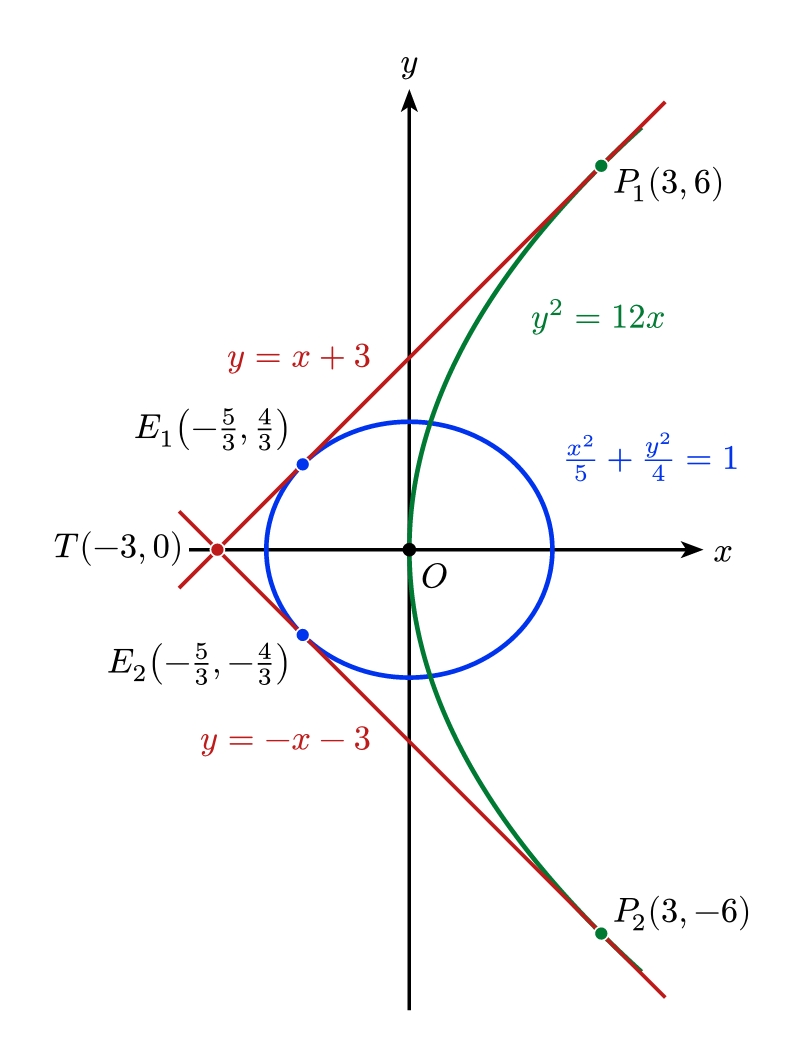
Find the equations of the common tangents to the parabola y2=12xy^2 = 12x and the ellipse x25+y24=1\frac{x^2}{5} + \frac{y^2}{4} = 1. Also find the points of contact on both curves and the area of the quadrilateral formed by these four points of contact.

Common tangents to ellipse and parabola

Solution:

Step 1: Write the tangent equations in slope form

For the parabola y2=12xy^2 = 12x, we have 4p=12  ⟹  p=34p = 12 \implies p = 3. Any non-vertical tangent to the parabola is:

y=mx+3m(m≠0)y = mx + \frac{3}{m} \quad (m \neq 0)

(Note: The vertical tangent to the parabola is x=0x = 0, which intersects the ellipse at (0,±2)(0, \pm 2), so x=0x = 0 is not tangent to the ellipse.)

For this line y=mx+cy = mx + c (with c=3mc = \frac{3}{m}) to be tangent to the ellipse x25+y24=1\frac{x^2}{5} + \frac{y^2}{4} = 1, it must satisfy c2=a2m2+b2c^2 = a^2 m^2 + b^2:

(3m)2=5m2+4\left(\frac{3}{m}\right)^2 = 5m^2 + 4

Multiply through by m2m^2:

5m4+4m2−9=05m^4 + 4m^2 - 9 = 0

Step 2: Solve for mm

Factor the quadratic in m2m^2:

(m2−1)(5m2+9)=0(m^2 - 1)(5m^2 + 9) = 0

Since 5m2+9>05m^2 + 9 > 0 for all real mm, we must have m2=1m^2 = 1, so m=1m = 1 or m=−1m = -1.

Substituting m=±1m = \pm 1 into y=mx+3my = mx + \frac{3}{m}, the two common tangents are:

y=x+3andy=−x−3y = x + 3 \qquad \text{and} \qquad y = -x - 3

These two lines are perpendicular and intersect at T(−3,0)T(-3, 0) (which lies on the directrix x=−3x = -3 of the parabola).

Step 3: Find the four points of contact

For the tangent y=x+3y = x + 3 (m=1,c=3m = 1, c = 3):

  • Point of contact P1P_1 on the parabola y2=12xy^2 = 12x: Using (pm2,2pm)\left(\frac{p}{m^2}, \frac{2p}{m}\right), we get P1=(3,6)P_1 = (3, 6).

  • Point of contact E1E_1 on the ellipse x25+y24=1\frac{x^2}{5} + \frac{y^2}{4} = 1: Using (−a2mc,b2c)\left(-\frac{a^2 m}{c}, \frac{b^2}{c}\right), we get:

E1=(−5(1)3,  43)=(−53,  43)E_1 = \left(-\frac{5(1)}{3}, \; \frac{4}{3}\right) = \left(-\frac{5}{3}, \; \frac{4}{3}\right)

By symmetry about the xx-axis, for the tangent y=−x−3y = -x - 3, the points of contact are P2(3,−6)P_2(3, -6) and E2(−53,−43)E_2\left(-\frac{5}{3}, -\frac{4}{3}\right).

Step 4: Find the area of the quadrilateral E1P1P2E2E_1 P_1 P_2 E_2

Since E1E2E_1 E_2 is vertical at x=−53x = -\frac{5}{3} and P1P2P_1 P_2 is vertical at x=3x = 3, the quadrilateral E1P1P2E2E_1 P_1 P_2 E_2 is an isosceles trapezium with:

  • Parallel sides: E1E2=43−(−43)=83E_1 E_2 = \frac{4}{3} - \left(-\frac{4}{3}\right) = \frac{8}{3} and P1P2=6−(−6)=12P_1 P_2 = 6 - (-6) = 12.

  • Height (horizontal distance between the parallel sides): h=3−(−53)=143h = 3 - \left(-\frac{5}{3}\right) = \frac{14}{3}.

Therefore, the area is:

Area=12(83+12)(143)=12(443)(143)=3089 sq. units\text{Area} = \frac{1}{2} \left(\frac{8}{3} + 12\right)\left(\frac{14}{3}\right) = \frac{1}{2}\left(\frac{44}{3}\right)\left(\frac{14}{3}\right) = \frac{308}{9} \text{ sq. units}

Problem 3: Common Tangents to Two Centered Perpendicular Ellipses§

Find the equations of the common tangents to the two ellipses x2a2+y2b2=1\frac{x^2}{a^2} + \frac{y^2}{b^2} = 1 and x2b2+y2a2=1\frac{x^2}{b^2} + \frac{y^2}{a^2} = 1 (where a≠ba \neq b). Also find the area of the quadrilateral enclosed by these common tangents.

Solution:

Step 1: Equate the yy-intercepts of the slope-form tangents

A line y=mx+cy = mx + c is tangent to the first ellipse if c2=a2m2+b2c^2 = a^2 m^2 + b^2, and tangent to the second ellipse if c2=b2m2+a2c^2 = b^2 m^2 + a^2.

For a common tangent, both conditions hold simultaneously:

a2m2+b2=b2m2+a2  ⟹  (a2−b2)m2=a2−b2a^2 m^2 + b^2 = b^2 m^2 + a^2 \implies (a^2 - b^2)m^2 = a^2 - b^2

Since a≠ba \neq b, divide by a2−b2a^2 - b^2:

m2=1  ⟹  m=±1m^2 = 1 \implies m = \pm 1

(Vertical tangents x=±ax = \pm a and x=±bx = \pm b do not match because a≠ba \neq b.)

Step 2: Write the equations and find the enclosed area

For m=±1m = \pm 1, we have c2=a2+b2  ⟹  c=±a2+b2c^2 = a^2 + b^2 \implies c = \pm \sqrt{a^2 + b^2}. Thus, the four common tangents are:

y=x+a2+b2,y=x−a2+b2,y=−x+a2+b2,y=−x−a2+b2y = x + \sqrt{a^2 + b^2}, \quad y = x - \sqrt{a^2 + b^2}, \quad y = -x + \sqrt{a^2 + b^2}, \quad y = -x - \sqrt{a^2 + b^2}

These lines have slopes +1+1 and −1-1, and each is at perpendicular distance d=a2+b22d = \frac{\sqrt{a^2 + b^2}}{\sqrt{2}} from the origin. Hence, they form a square whose side length is 2d=2(a2+b2)2d = \sqrt{2(a^2 + b^2)}.

Area of the square=(2d)2=2(a2+b2)\text{Area of the square} = (2d)^2 = 2(a^2 + b^2)

Problem 4: Common Tangents to Two Non-Concentric Ellipses§

Find the equations of all common tangents to the two ellipses:

E1:x216+y29=1andE2:(x−1)24+y212=1E_1: \frac{x^2}{16} + \frac{y^2}{9} = 1 \qquad \text{and} \qquad E_2: \frac{(x - 1)^2}{4} + \frac{y^2}{12} = 1

Solution:

Step 1: Check vertical tangents first

The vertical tangents to E1E_1 are x=±4x = \pm 4, while those to E2E_2 are x=1±2x = 1 \pm 2, i.e., x=3x = 3 and x=−1x = -1. Hence, there are no vertical common tangents.

Step 2: Equate the yy-intercepts in slope form

A tangent of slope mm to E1E_1 is:

y=mx±16m2+9y = mx \pm \sqrt{16m^2 + 9}

A tangent of slope mm to E2E_2 is:

y=m(x−1)±4m2+12=mx−m±4m2+12y = m(x - 1) \pm \sqrt{4m^2 + 12} = mx - m \pm \sqrt{4m^2 + 12}

Equating the yy-intercepts (where ε1,ε2∈{+1,−1}\varepsilon_1, \varepsilon_2 \in \{+1, -1\} track the independent sign choices):

ε116m2+9+m=ε24m2+12\varepsilon_1 \sqrt{16m^2 + 9} + m = \varepsilon_2 \sqrt{4m^2 + 12}

Square both sides:

16m2+9+m2+2ε1m16m2+9=4m2+1216m^2 + 9 + m^2 + 2\varepsilon_1 m\sqrt{16m^2 + 9} = 4m^2 + 12 13m2−3=−2ε1m16m2+913m^2 - 3 = -2\varepsilon_1 m\sqrt{16m^2 + 9}

Square both sides again:

(13m2−3)2=4m2(16m2+9)(13m^2 - 3)^2 = 4m^2(16m^2 + 9) 169m4−78m2+9=64m4+36m2169m^4 - 78m^2 + 9 = 64m^4 + 36m^2 105m4−114m2+9=0105m^4 - 114m^2 + 9 = 0

Divide by 33:

35m4−38m2+3=0  ⟹  (m2−1)(35m2−3)=035m^4 - 38m^2 + 3 = 0 \implies (m^2 - 1)(35m^2 - 3) = 0

So the candidate slopes are m=±1m = \pm 1 and m=±335m = \pm \sqrt{\frac{3}{35}}.

Step 3: Verify the exact signs to discard spurious roots

When squaring twice, not every combination of (ε1,ε2)(\varepsilon_1, \varepsilon_2) works. We check each slope directly in the two original tangent equations:

1. Case m=1m = 1: 16(1)+9=5\sqrt{16(1) + 9} = 5 and 4(1)+12=4\sqrt{4(1) + 12} = 4.

  • Tangents to E1E_1 are y=x+5y = x + 5 and y=x−5y = x - 5.

  • Tangents to E2E_2 are y=(x−1)±4y = (x - 1) \pm 4, i.e., y=x+3y = x + 3 and y=x−5y = x - 5.

They share y=x−5y = x - 5.

2. Case m=−1m = -1: 16+9=5\sqrt{16 + 9} = 5 and 4+12=4\sqrt{4 + 12} = 4.

  • Tangents to E1E_1 are y=−x±5y = -x \pm 5.

  • Tangents to E2E_2 are y=−(x−1)±4y = -(x - 1) \pm 4, i.e., y=−x+5y = -x + 5 and y=−x−3y = -x - 3.

They share y=−x+5y = -x + 5.

3. Case m=335m = \sqrt{\frac{3}{35}}: Compute the two radicals:

16(335)+9=36335=11335,4(335)+12=43235=12335\sqrt{16\left(\frac{3}{35}\right) + 9} = \sqrt{\frac{363}{35}} = \frac{11\sqrt{3}}{\sqrt{35}}, \qquad \sqrt{4\left(\frac{3}{35}\right) + 12} = \sqrt{\frac{432}{35}} = \frac{12\sqrt{3}}{\sqrt{35}}
  • Tangents to E1E_1: y=335x±11335y = \frac{\sqrt{3}}{\sqrt{35}}x \pm \frac{11\sqrt{3}}{\sqrt{35}}.

  • Tangents to E2E_2: y=335(x−1)±12335y = \frac{\sqrt{3}}{\sqrt{35}}(x - 1) \pm \frac{12\sqrt{3}}{\sqrt{35}}.

With the ++ sign on both, the intercept of E2E_2's tangent is −335+12335=+11335-\frac{\sqrt{3}}{\sqrt{35}} + \frac{12\sqrt{3}}{\sqrt{35}} = +\frac{11\sqrt{3}}{\sqrt{35}}, which matches! So y=335(x+11)y = \sqrt{\frac{3}{35}}(x + 11) is a common tangent.

4. Case m=−335m = -\sqrt{\frac{3}{35}}: By xx-axis symmetry, using the −- sign on both gives y=−335(x+11)y = -\sqrt{\frac{3}{35}}(x + 11).

Hence, all four common tangents are:

x−y−5=0,x+y−5=0,3x−35y+113=0,3x+35y+113=0x - y - 5 = 0, \qquad x + y - 5 = 0, \qquad \sqrt{3}x - \sqrt{35}y + 11\sqrt{3} = 0, \qquad \sqrt{3}x + \sqrt{35}y + 11\sqrt{3} = 0

Part II: Oblique Ellipse Geometrical Problems§

An oblique ellipse is tilted at an angle to the coordinate axes, so its equation contains an xyxy term and standard axis-aligned formulas (y=mx±a2m2+b2y = mx \pm \sqrt{a^2 m^2 + b^2}, etc.) cannot be applied directly.

Instead, we rely on coordinate-free geometric invariants that hold in any orientation:

1. Major Axis Collinearity: The vertices A′,AA', A, the foci S′,SS', S, and the center CC all lie on one straight line (the major axis) in the symmetric order A′−S′−C−S−AA' - S' - C - S - A.

2. Key Distance Relations:

CS=CS′=ae,CA=CA′=a,SA=a(1−e),SA′=a(1+e)CS = CS' = ae, \qquad CA = CA' = a, \qquad SA = a(1 - e), \qquad SA' = a(1 + e) b2=a2(1−e2)=SA⋅SA′,CZ=ae,SZ=ae−aeb^2 = a^2(1 - e^2) = SA \cdot SA', \qquad CZ = \frac{a}{e}, \qquad SZ = \frac{a}{e} - ae

3. Midpoint & Direction Vector Stepping:

  • CC is the midpoint of SS′SS' and the midpoint of AA′AA'.
  • If u^\hat{u} is the unit vector along the major axis from CC toward SS, then any point along the major axis is reached simply by adding multiples of u^\hat{u}.
  • Directrices are perpendicular to the major axis at distance ae\frac{a}{e} from CC.

4. Tangent Pedal & Reflection Invariants:

  • The product of perpendicular distances from SS and S′S' onto any tangent line equals b2b^2: p1p2=b2p_1 p_2 = b^2.
  • The reflection of one focus SS across a tangent line is collinear with the other focus S′S' and the point of contact PP, with segment length S′S1=2aS'S_1 = 2a.

Problem 5: Focus, Nearer Vertex, and Eccentricity Given§

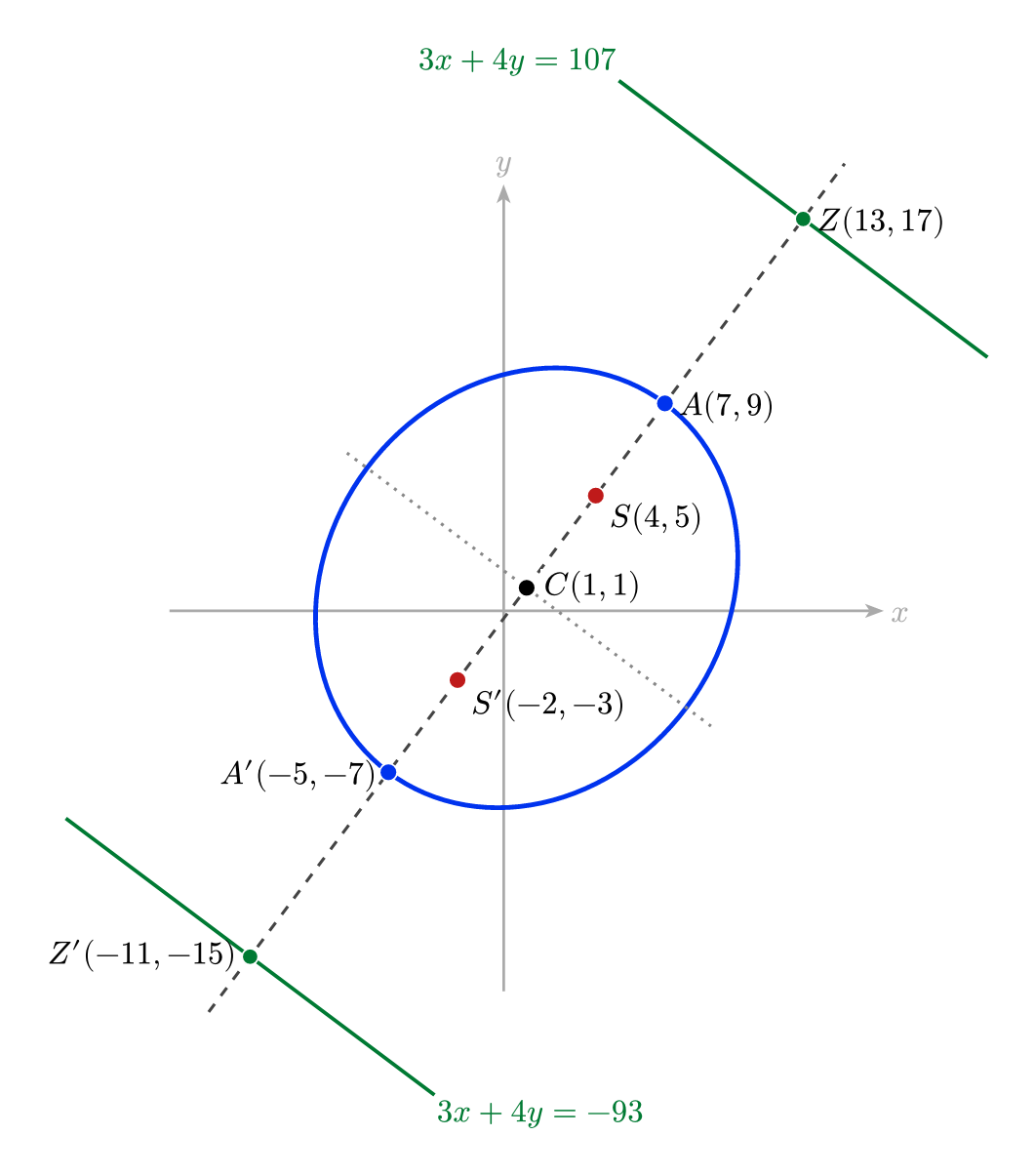
An ellipse has a focus at S(4,5)S(4, 5), its nearer vertex at A(7,9)A(7, 9), and eccentricity e=12e = \frac{1}{2}. Using geometric relations, find:

  1. The semi-major axis aa and semi-minor axis bb.
  2. The coordinates of the center CC, the other focus S′S', and the other vertex A′A'.
  3. The equations of both directrices and the Cartesian equation of the ellipse.

Oblique ellipse from focus and vertex

Solution:

Step 1: Find aa, bb, and the unit vector along the major axis

The distance between focus S(4,5)S(4, 5) and nearer vertex A(7,9)A(7, 9) is:

SA=(7−4)2+(9−5)2=32+42=5SA = \sqrt{(7 - 4)^2 + (9 - 5)^2} = \sqrt{3^2 + 4^2} = 5

Because AA is the nearer vertex to SS, we have SA=a(1−e)SA = a(1 - e):

a(1−12)=5  ⟹  a=10a\left(1 - \frac{1}{2}\right) = 5 \implies a = 10

Then ae=10×12=5ae = 10 \times \frac{1}{2} = 5, and the semi-minor axis bb satisfies:

b2=a2(1−e2)=100(1−14)=75  ⟹  b=53b^2 = a^2(1 - e^2) = 100\left(1 - \frac{1}{4}\right) = 75 \implies b = 5\sqrt{3}

The direction vector from SS to AA is SA→=(7−4,9−5)=(3,4)\overrightarrow{SA} = (7 - 4, 9 - 5) = (3, 4), so the unit vector along the major axis pointing from C→S→AC \to S \to A is:

u^=(35,  45)\hat{u} = \left(\frac{3}{5}, \; \frac{4}{5}\right)

Step 2: Find CC, S′S', and A′A'

Moving opposite to u^\hat{u} from S(4,5)S(4, 5) by distance CS=ae=5CS = ae = 5 reaches the center CC:

C=S−5u^=(4,5)−5(35,  45)=(4−3,  5−4)=(1,1)C = S - 5\hat{u} = (4, 5) - 5\left(\frac{3}{5}, \; \frac{4}{5}\right) = (4 - 3, \; 5 - 4) = (1, 1)

Since C(1,1)C(1, 1) is the midpoint of SS′SS' and AA′AA':

S′=2C−S=(2(1)−4,  2(1)−5)=(−2,−3)S' = 2C - S = (2(1) - 4, \; 2(1) - 5) = (-2, -3) A′=2C−A=(2(1)−7,  2(1)−9)=(−5,−7)A' = 2C - A = (2(1) - 7, \; 2(1) - 9) = (-5, -7)

Step 3: Find the equations of the directrices

The major axis has direction vector (3,4)(3, 4), so any directrix (being perpendicular to the major axis) has normal vector (3,4)(3, 4) and therefore an equation of the form:

3x+4y=k3x + 4y = k

The perpendicular distance from center C(1,1)C(1, 1) to each directrix is ae=101/2=20\frac{a}{e} = \frac{10}{1/2} = 20:

∣3(1)+4(1)−k∣32+42=20  ⟹  ∣7−k∣=100  ⟹  k=107 or k=−93\frac{|3(1) + 4(1) - k|}{\sqrt{3^2 + 4^2}} = 20 \implies |7 - k| = 100 \implies k = 107 \text{ or } k = -93

To identify which directrix belongs to SS, note that the foot of the directrix ZZ corresponding to SS is at Z=C+20u^=(1,1)+(12,16)=(13,17)Z = C + 20\hat{u} = (1, 1) + (12, 16) = (13, 17), which satisfies 3(13)+4(17)=1073(13) + 4(17) = 107.

  • Directrix corresponding to S(4,5)S(4, 5): 3x+4y=1073x + 4y = 107

  • Directrix corresponding to S′(−2,−3)S'(-2, -3): 3x+4y=−933x + 4y = -93

Step 4: Write the Cartesian equation of the ellipse

Using the focus-directrix definition SP=e⋅PMSP = e \cdot PM for any point P(x,y)P(x, y):

(x−4)2+(y−5)2=(12)2(3x+4y−107)225(x - 4)^2 + (y - 5)^2 = \left(\frac{1}{2}\right)^2 \frac{(3x + 4y - 107)^2}{25}

Equivalently, projecting (x−1,y−1)(x - 1, y - 1) along u^=(35,45)\hat{u} = (\frac{3}{5}, \frac{4}{5}) and its perpendicular v^=(−45,35)\hat{v} = (-\frac{4}{5}, \frac{3}{5}) into rotated local coordinates X=3(x−1)+4(y−1)5X = \frac{3(x - 1) + 4(y - 1)}{5} and Y=−4(x−1)+3(y−1)5Y = \frac{-4(x - 1) + 3(y - 1)}{5} gives the clean rotated equation:

(3x+4y−7)22500+(−4x+3y+1)21875=1\frac{(3x + 4y - 7)^2}{2500} + \frac{(-4x + 3y + 1)^2}{1875} = 1

Problem 6: Both Foci and a Tangent Line Given (Reflection Property)§

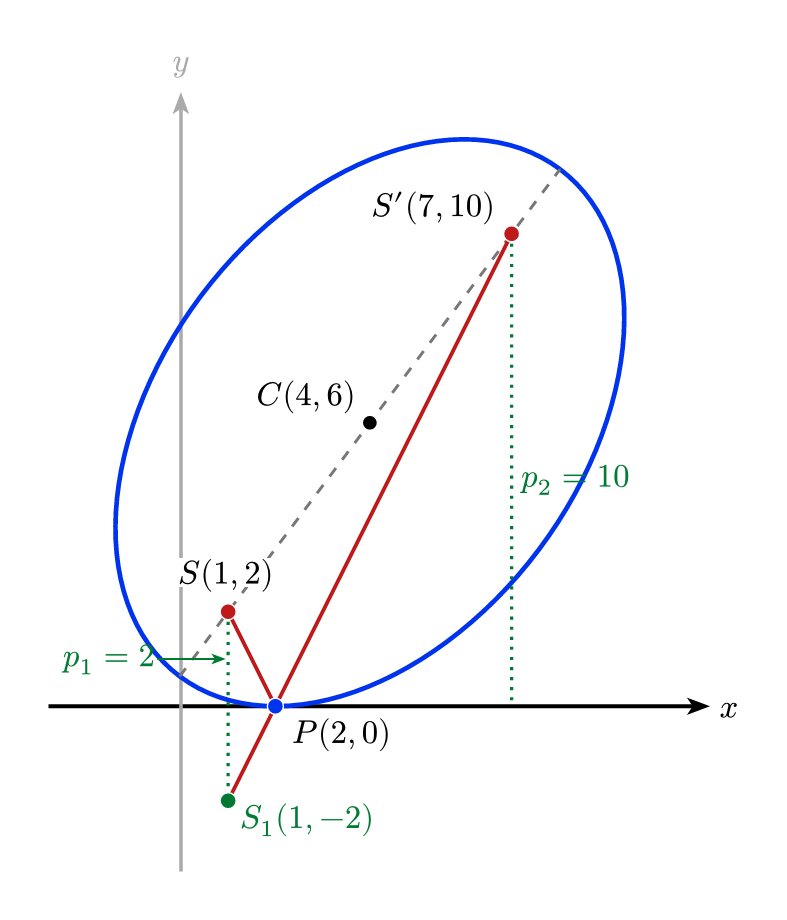
An ellipse has its foci at S(1,2)S(1, 2) and S′(7,10)S'(7, 10), and touches the xx-axis. Find:

  1. The semi-minor axis bb, semi-major axis aa, and eccentricity ee.
  2. The point of contact PP on the xx-axis.
  3. The center CC and equations of both directrices.

Oblique ellipse reflection across tangent

Solution:

Step 1: Find aeae, bb, aa, and ee

The distance between the foci S(1,2)S(1, 2) and S′(7,10)S'(7, 10) is 2ae2ae:

2ae=(7−1)2+(10−2)2=36+64=10  ⟹  ae=52ae = \sqrt{(7 - 1)^2 + (10 - 2)^2} = \sqrt{36 + 64} = 10 \implies ae = 5

The tangent line is the xx-axis (y=0y = 0). The perpendicular distances from the two foci to this tangent are simply their yy-coordinates:

p1=2andp2=10p_1 = 2 \qquad \text{and} \qquad p_2 = 10

Using the invariant p1p2=b2p_1 p_2 = b^2:

b2=2×10=20  ⟹  b=25b^2 = 2 \times 10 = 20 \implies b = 2\sqrt{5}

Now find aa and ee from a2=b2+(ae)2a^2 = b^2 + (ae)^2:

a2=20+25=45  ⟹  a=35a^2 = 20 + 25 = 45 \implies a = 3\sqrt{5} e=aea=535=53e = \frac{ae}{a} = \frac{5}{3\sqrt{5}} = \frac{\sqrt{5}}{3}

Step 2: Find the point of contact PP using the reflection property

Reflect the focus S(1,2)S(1, 2) across the tangent line y=0y = 0 to obtain S1(1,−2)S_1(1, -2).

By the reflection property of the ellipse, the reflected ray S′PS'P is collinear with S1S_1, so the point of contact PP is simply where the straight line S′S1S'S_1 intersects the tangent y=0y = 0.

(Notice also as a consistency check that S′S1=(7−1)2+(10−(−2))2=36+144=180=65=2aS'S_1 = \sqrt{(7 - 1)^2 + (10 - (-2))^2} = \sqrt{36 + 144} = \sqrt{180} = 6\sqrt{5} = 2a.)

Equation of line S′S1S'S_1 passing through (1,−2)(1, -2) and (7,10)(7, 10):

Slope=10−(−2)7−1=2  ⟹  y+2=2(x−1)\text{Slope} = \frac{10 - (-2)}{7 - 1} = 2 \implies y + 2 = 2(x - 1)

Setting y=0y = 0 gives 2=2(x−1)  ⟹  x=22 = 2(x - 1) \implies x = 2. Thus, the point of contact is P(2,0)P(2, 0).

Step 3: Find the center and directrices

The center CC is the midpoint of SS′SS':

C=(1+72,  2+102)=(4,6)C = \left(\frac{1 + 7}{2}, \; \frac{2 + 10}{2}\right) = (4, 6)

The major axis runs along SS′→=(6,8)\overrightarrow{SS'} = (6, 8), so any directrix perpendicular to it has equation 3x+4y=k3x + 4y = k.

The distance from C(4,6)C(4, 6) to each directrix is ae=a2ae=455=9\frac{a}{e} = \frac{a^2}{ae} = \frac{45}{5} = 9:

∣3(4)+4(6)−k∣5=9  ⟹  ∣36−k∣=45  ⟹  k=81 or k=−9\frac{|3(4) + 4(6) - k|}{5} = 9 \implies |36 - k| = 45 \implies k = 81 \text{ or } k = -9

Therefore, the two directrices are 3x+4y=813x + 4y = 81 and 3x+4y=−93x + 4y = -9.


Problem 7: Focus, Corresponding Directrix, and a Vertex Given§

An ellipse has a focus at S(1,1)S(1, 1), its corresponding directrix is x+y−8=0x + y - 8 = 0, and one of its vertices is A(2,2)A(2, 2). Find its eccentricity, center, other focus, other directrix, and its equation in Cartesian form.

Solution:

Step 1: Verify the axis and find eccentricity ee

The major axis passes through S(1,1)S(1, 1) perpendicular to the directrix x+y−8=0x + y - 8 = 0, so the major axis lies on the line x−y=0x - y = 0 (i.e., y=xy = x). Notice A(2,2)A(2, 2) indeed lies on y=xy = x.

The foot of the directrix ZZ on the major axis is the intersection of y=xy = x and x+y=8x + y = 8, which gives Z(4,4)Z(4, 4).

Since A(2,2)A(2, 2) lies between S(1,1)S(1, 1) and Z(4,4)Z(4, 4), AA is the nearer vertex. Computing distances:

SA=(2−1)2+(2−1)2=2,AZ=(4−2)2+(4−2)2=22SA = \sqrt{(2 - 1)^2 + (2 - 1)^2} = \sqrt{2}, \qquad AZ = \sqrt{(4 - 2)^2 + (4 - 2)^2} = 2\sqrt{2}

By the focus-directrix definition (SA=e⋅AZSA = e \cdot AZ):

e=SAAZ=222=12e = \frac{SA}{AZ} = \frac{\sqrt{2}}{2\sqrt{2}} = \frac{1}{2}

Step 2: Find aa, bb, center CC, S′S', A′A', and the other directrix

Using SA=a(1−e)SA = a(1 - e):

a(1−12)=2  ⟹  a=22a\left(1 - \frac{1}{2}\right) = \sqrt{2} \implies a = 2\sqrt{2} b=a1−e2=221−14=6b = a\sqrt{1 - e^2} = 2\sqrt{2}\sqrt{1 - \frac{1}{4}} = \sqrt{6}

Moving back from A(2,2)A(2, 2) along the major axis toward SS by distance a=22a = 2\sqrt{2} (using the unit vector u^=(12,12)\hat{u} = \left(\frac{1}{\sqrt{2}}, \frac{1}{\sqrt{2}}\right)):

C=A−au^=(2,2)−22(12,  12)=(0,0)C = A - a\hat{u} = (2, 2) - 2\sqrt{2}\left(\frac{1}{\sqrt{2}}, \; \frac{1}{\sqrt{2}}\right) = (0, 0)

Thus the center is at the origin O(0,0)O(0, 0)! By symmetry about the origin:

  • Other focus: S′(−1,−1)S'(-1, -1)

  • Other vertex: A′(−2,−2)A'(-2, -2)

  • Other directrix: x+y+8=0x + y + 8 = 0

Step 3: Find the Cartesian equation of the oblique ellipse

Applying SP=e⋅PMSP = e \cdot PM for any point P(x,y)P(x, y):

(x−1)2+(y−1)2=12∣x+y−8∣2\sqrt{(x - 1)^2 + (y - 1)^2} = \frac{1}{2}\frac{|x + y - 8|}{\sqrt{2}}

Square both sides and multiply by 88:

8(x2−2x+1+y2−2y+1)=(x+y−8)28\left(x^2 - 2x + 1 + y^2 - 2y + 1\right) = (x + y - 8)^2 8x2+8y2−16x−16y+16=x2+y2+64+2xy−16x−16y8x^2 + 8y^2 - 16x - 16y + 16 = x^2 + y^2 + 64 + 2xy - 16x - 16y

Notice that −16x-16x and −16y-16y cancel out completely (confirming the center at (0,0)(0, 0)):

7x2−2xy+7y2=487x^2 - 2xy + 7y^2 = 48

Part III: Fundamental Locus and Area Problems§

Most locus problems involving chords of an ellipse follow one clean pipeline:

1. Represent the moving point whose locus is required as (h,k)(h, k).

2. Write the equation of the variable chord or tangent in terms of (h,k)(h, k) (using T=S1T = S_1 for midpoint chords, T=0T = 0 for chords of contact, or parametric angle θ\theta).

3. Impose the given geometric condition (passing through a fixed point, touching another conic, perpendicularity, or intercept ratio) to obtain an algebraic relation in hh and kk, then replace (h,k)→(x,y)(h, k) \to (x, y).


Problem 8: Locus of Midpoints of Chords Passing Through a Fixed Point§

Find the locus of the midpoint of chords of the ellipse x2a2+y2b2=1\frac{x^2}{a^2} + \frac{y^2}{b^2} = 1 which pass through a fixed point P(α,β)P(\alpha, \beta). What happens when PP is a focus of the ellipse?

Solution:

Let M(h,k)M(h, k) be the midpoint of a variable chord passing through P(α,β)P(\alpha, \beta).

Using T=S1T = S_1, the equation of the chord whose midpoint is M(h,k)M(h, k) is:

hxa2+kyb2=h2a2+k2b2\frac{hx}{a^2} + \frac{ky}{b^2} = \frac{h^2}{a^2} + \frac{k^2}{b^2}

Because this chord passes through the fixed point P(α,β)P(\alpha, \beta), substitute x=αx = \alpha and y=βy = \beta:

hαa2+kβb2=h2a2+k2b2\frac{h\alpha}{a^2} + \frac{k\beta}{b^2} = \frac{h^2}{a^2} + \frac{k^2}{b^2}

Replacing (h,k)(h, k) with (x,y)(x, y), the required locus is:

x2a2+y2b2−αxa2−βyb2=0\frac{x^2}{a^2} + \frac{y^2}{b^2} - \frac{\alpha x}{a^2} - \frac{\beta y}{b^2} = 0

Completing the square yields (x−α/2)2a2+(y−β/2)2b2=α24a2+β24b2\frac{(x - \alpha/2)^2}{a^2} + \frac{(y - \beta/2)^2}{b^2} = \frac{\alpha^2}{4a^2} + \frac{\beta^2}{4b^2}, which is a similar ellipse with axes parallel to the original ellipse, centered at the midpoint (α/2,β/2)(\alpha/2, \beta/2) of OPOP, and passing through both O(0,0)O(0, 0) and P(α,β)P(\alpha, \beta).

Special Case (Focal Chords): When PP is the focus (ae,0)(ae, 0), set α=ae,β=0\alpha = ae, \beta = 0:

x2a2+y2b2−exa=0\frac{x^2}{a^2} + \frac{y^2}{b^2} - \frac{ex}{a} = 0

Problem 9: Locus of Midpoints of Chords Touching a Concentric Circle§

Find the locus of the midpoint of chords of the ellipse x2a2+y2b2=1\frac{x^2}{a^2} + \frac{y^2}{b^2} = 1 that touch the concentric circle x2+y2=c2x^2 + y^2 = c^2 (where c<ac < a).

Solution:

Let M(h,k)M(h, k) be the midpoint of the chord. Its equation (T=S1T = S_1) is:

hxa2+kyb2−(h2a2+k2b2)=0\frac{hx}{a^2} + \frac{ky}{b^2} - \left(\frac{h^2}{a^2} + \frac{k^2}{b^2}\right) = 0

Since this line is tangent to the circle x2+y2=c2x^2 + y^2 = c^2, its perpendicular distance from the center (0,0)(0, 0) must equal the radius cc:

∣h2a2+k2b2∣h2a4+k2b4=c\frac{\left|\frac{h^2}{a^2} + \frac{k^2}{b^2}\right|}{\sqrt{\frac{h^2}{a^4} + \frac{k^2}{b^4}}} = c

Square both sides and replace (h,k)(h, k) with (x,y)(x, y):

(x2a2+y2b2)2=c2(x2a4+y2b4)\left(\frac{x^2}{a^2} + \frac{y^2}{b^2}\right)^2 = c^2 \left(\frac{x^2}{a^4} + \frac{y^2}{b^4}\right)

(Note: For a real chord to exist, MM must also lie strictly inside the ellipse, i.e., x2a2+y2b2<1\frac{x^2}{a^2} + \frac{y^2}{b^2} < 1.)


Problem 10: Locus of Midpoints of Chords Touching a Parabola§

Find the locus of the midpoint of chords of the ellipse x2a2+y2b2=1\frac{x^2}{a^2} + \frac{y^2}{b^2} = 1 that are tangent to the parabola y2=4pxy^2 = 4px (p>0p > 0).

Solution:

Step 1: Rewrite the midpoint chord in slope-intercept form

Let M(h,k)M(h, k) be the midpoint of the chord (k≠0k \neq 0). Its equation T=S1T = S_1 is:

hxa2+kyb2=h2a2+k2b2\frac{hx}{a^2} + \frac{ky}{b^2} = \frac{h^2}{a^2} + \frac{k^2}{b^2}

Solve for yy:

y=(−b2ha2k)x+b2k(h2a2+k2b2)y = \left(-\frac{b^2 h}{a^2 k}\right)x + \frac{b^2}{k}\left(\frac{h^2}{a^2} + \frac{k^2}{b^2}\right)

Here, the slope is m=−b2ha2km = -\frac{b^2 h}{a^2 k} and the yy-intercept is c=b2k(h2a2+k2b2)c = \frac{b^2}{k}\left(\frac{h^2}{a^2} + \frac{k^2}{b^2}\right).

Step 2: Apply the parabola tangency condition

A line y=mx+cy = mx + c touches the parabola y2=4pxy^2 = 4px if and only if c=pmc = \frac{p}{m}, i.e., mc=pmc = p:

(−b2ha2k)⋅b2k(h2a2+k2b2)=p\left(-\frac{b^2 h}{a^2 k}\right) \cdot \frac{b^2}{k}\left(\frac{h^2}{a^2} + \frac{k^2}{b^2}\right) = p

Multiply through by a2k2a^2 k^2 and simplify:

−b4h(h2a2+k2b2)=pa2k2-b^4 h\left(\frac{h^2}{a^2} + \frac{k^2}{b^2}\right) = p a^2 k^2

Replacing (h,k)(h, k) with (x,y)(x, y), the locus is:

b4x(x2a2+y2b2)+pa2y2=0b^4 x\left(\frac{x^2}{a^2} + \frac{y^2}{b^2}\right) + p a^2 y^2 = 0

(Geometric check: Because pa2y2≥0p a^2 y^2 \ge 0 and x2a2+y2b2>0\frac{x^2}{a^2} + \frac{y^2}{b^2} > 0, any point on this locus with y≠0y \neq 0 must satisfy x<0x < 0. Geometrically, any slant tangent to y2=4pxy^2 = 4px has a negative xx-intercept −p/m2-p/m^2, so the segment cut off inside a centered ellipse always shifts its midpoint into the left half-plane x<0x < 0.)


Problem 11: Chords Subtending a Right Angle at the Center§

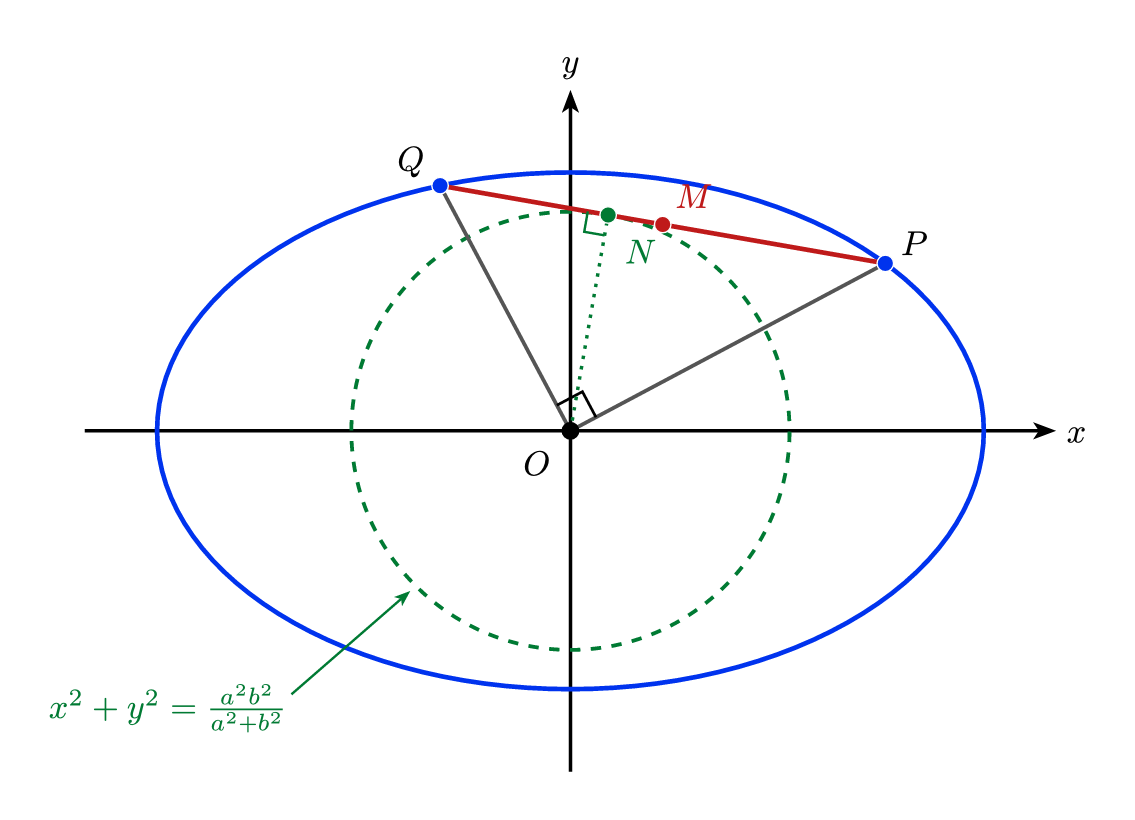
A variable chord PQPQ of the ellipse x2a2+y2b2=1\frac{x^2}{a^2} + \frac{y^2}{b^2} = 1 subtends a right angle at the center O(0,0)O(0, 0). Prove and find:

  1. 1OP2+1OQ2=1a2+1b2\frac{1}{OP^2} + \frac{1}{OQ^2} = \frac{1}{a^2} + \frac{1}{b^2}.
  2. The curve always touched by PQPQ (envelope) and the locus of the foot of the perpendicular NN from OO onto PQPQ.
  3. The locus of the midpoint MM of PQPQ.
  4. The maximum and minimum possible areas of △OPQ\triangle OPQ.

Right-angled chord at the center of an ellipse

Solution:

Part (a): Constant reciprocal-square sum

Let OP=r1OP = r_1 make angle α\alpha with the positive xx-axis, so P=(r1cos⁡α,r1sin⁡α)P = (r_1\cos\alpha, r_1\sin\alpha). Since ∠POQ=90∘\angle POQ = 90^\circ, OQ=r2OQ = r_2 makes angle α+π2\alpha + \frac{\pi}{2}, giving Q=(−r2sin⁡α,r2cos⁡α)Q = (-r_2\sin\alpha, r_2\cos\alpha).

Because both PP and QQ lie on x2a2+y2b2=1\frac{x^2}{a^2} + \frac{y^2}{b^2} = 1:

r12cos⁡2αa2+r12sin⁡2αb2=1  ⟹  1r12=cos⁡2αa2+sin⁡2αb2\frac{r_1^2 \cos^2\alpha}{a^2} + \frac{r_1^2 \sin^2\alpha}{b^2} = 1 \implies \frac{1}{r_1^2} = \frac{\cos^2\alpha}{a^2} + \frac{\sin^2\alpha}{b^2} r22sin⁡2αa2+r22cos⁡2αb2=1  ⟹  1r22=sin⁡2αa2+cos⁡2αb2\frac{r_2^2 \sin^2\alpha}{a^2} + \frac{r_2^2 \cos^2\alpha}{b^2} = 1 \implies \frac{1}{r_2^2} = \frac{\sin^2\alpha}{a^2} + \frac{\cos^2\alpha}{b^2}

Adding the two equations eliminates α\alpha:

1OP2+1OQ2=cos⁡2α+sin⁡2αa2+sin⁡2α+cos⁡2αb2=1a2+1b2\frac{1}{OP^2} + \frac{1}{OQ^2} = \frac{\cos^2\alpha + \sin^2\alpha}{a^2} + \frac{\sin^2\alpha + \cos^2\alpha}{b^2} = \frac{1}{a^2} + \frac{1}{b^2}

Part (b): Envelope of PQPQ and locus of NN

In the right-angled triangle △OPQ\triangle OPQ, let d=ONd = ON be the altitude from the right-angle vertex OO onto hypotenuse PQPQ. Using the standard right-triangle altitude identity 1d2=1OP2+1OQ2\frac{1}{d^2} = \frac{1}{OP^2} + \frac{1}{OQ^2}:

1d2=1a2+1b2  ⟹  d=aba2+b2(constant)\frac{1}{d^2} = \frac{1}{a^2} + \frac{1}{b^2} \implies d = \frac{ab}{\sqrt{a^2 + b^2}} \quad (\text{constant})

Since PQPQ stays at a constant distance dd from the origin OO, PQPQ always touches the fixed circle:

x2+y2=a2b2a2+b2x^2 + y^2 = \frac{a^2 b^2}{a^2 + b^2}

Moreover, since NN is the point of tangency (as ON⊥PQON \perp PQ and ON=dON = d), the locus of the perpendicular foot NN is this exact same circle x2+y2=a2b2a2+b2x^2 + y^2 = \frac{a^2 b^2}{a^2 + b^2}.

Part (c): Locus of the midpoint MM of PQPQ

Let M(h,k)M(h, k) be the midpoint of PQPQ. The equation of PQPQ is hxa2+kyb2=h2a2+k2b2\frac{hx}{a^2} + \frac{ky}{b^2} = \frac{h^2}{a^2} + \frac{k^2}{b^2}.

Setting its distance from the origin equal to d=aba2+b2d = \frac{ab}{\sqrt{a^2 + b^2}}:

(h2a2+k2b2)2h2a4+k2b4=a2b2a2+b2\frac{\left(\frac{h^2}{a^2} + \frac{k^2}{b^2}\right)^2}{\frac{h^2}{a^4} + \frac{k^2}{b^4}} = \frac{a^2 b^2}{a^2 + b^2}

Replacing (h,k)(h, k) with (x,y)(x, y) gives the locus of MM:

(x2a2+y2b2)2=a2b2a2+b2(x2a4+y2b4)\left(\frac{x^2}{a^2} + \frac{y^2}{b^2}\right)^2 = \frac{a^2 b^2}{a^2 + b^2}\left(\frac{x^2}{a^4} + \frac{y^2}{b^4}\right)

Part (d): Maximum and minimum area of △OPQ\triangle OPQ

Since ∠POQ=90∘\angle POQ = 90^\circ, Area(△OPQ)=12r1r2\text{Area}(\triangle OPQ) = \frac{1}{2} r_1 r_2. Compute 1r12r22\frac{1}{r_1^2 r_2^2}:

1r12r22=(cos⁡2αa2+sin⁡2αb2)(sin⁡2αa2+cos⁡2αb2)\frac{1}{r_1^2 r_2^2} = \left(\frac{\cos^2\alpha}{a^2} + \frac{\sin^2\alpha}{b^2}\right)\left(\frac{\sin^2\alpha}{a^2} + \frac{\cos^2\alpha}{b^2}\right) =sin⁡2αcos⁡2α(1a4+1b4)+cos⁡4α+sin⁡4αa2b2= \sin^2\alpha\cos^2\alpha\left(\frac{1}{a^4} + \frac{1}{b^4}\right) + \frac{\cos^4\alpha + \sin^4\alpha}{a^2 b^2}

Using sin⁡2αcos⁡2α=sin⁡22α4\sin^2\alpha\cos^2\alpha = \frac{\sin^2 2\alpha}{4} and cos⁡4α+sin⁡4α=1−sin⁡22α2\cos^4\alpha + \sin^4\alpha = 1 - \frac{\sin^2 2\alpha}{2}:

1r12r22=1a2b2+sin⁡22α4(1a2−1b2)2\frac{1}{r_1^2 r_2^2} = \frac{1}{a^2 b^2} + \frac{\sin^2 2\alpha}{4}\left(\frac{1}{a^2} - \frac{1}{b^2}\right)^2

Since 0≤sin⁡22α≤10 \le \sin^2 2\alpha \le 1:

  • Maximum area: Occurs when sin⁡22α=0\sin^2 2\alpha = 0 (α=0\alpha = 0 or π2\frac{\pi}{2}, i.e., PP and QQ are vertices on the axes). Then 1r12r22=1a2b2  ⟹  r1r2=ab\frac{1}{r_1^2 r_2^2} = \frac{1}{a^2 b^2} \implies r_1 r_2 = ab, giving:
Areamax⁡=12ab\text{Area}_{\max} = \frac{1}{2} ab
  • Minimum area: Occurs when sin⁡22α=1\sin^2 2\alpha = 1 (α=π4\alpha = \frac{\pi}{4}). Then:
1r12r22=1a2b2+14(1a2−1b2)2=14(1a2+1b2)2  ⟹  r1r2=2a2b2a2+b2\frac{1}{r_1^2 r_2^2} = \frac{1}{a^2 b^2} + \frac{1}{4}\left(\frac{1}{a^2} - \frac{1}{b^2}\right)^2 = \frac{1}{4}\left(\frac{1}{a^2} + \frac{1}{b^2}\right)^2 \implies r_1 r_2 = \frac{2a^2 b^2}{a^2 + b^2}

Thus:

Areamin⁡=12(2a2b2a2+b2)=a2b2a2+b2\text{Area}_{\min} = \frac{1}{2}\left(\frac{2a^2 b^2}{a^2 + b^2}\right) = \frac{a^2 b^2}{a^2 + b^2}

Problem 12: Tangent Intercepted Between the Coordinate Axes§

A variable tangent to the ellipse x2a2+y2b2=1\frac{x^2}{a^2} + \frac{y^2}{b^2} = 1 meets the xx-axis at AA and the yy-axis at BB. Find:

  1. The minimum area of △OAB\triangle OAB.
  2. The minimum length of the intercepted segment ABAB.
  3. The locus of the circumcenter of △OAB\triangle OAB (and the locus of its centroid).

Solution:

Let the point of tangency be P(acos⁡θ,bsin⁡θ)P(a\cos\theta, b\sin\theta), where θ∈(0,π2)\theta \in (0, \frac{\pi}{2}) (by symmetry, any quadrant yields the same magnitudes).

The equation of the tangent is:

xacos⁡θ+ybsin⁡θ=1\frac{x}{a}\cos\theta + \frac{y}{b}\sin\theta = 1

Its intercepts on the axes are A=(asec⁡θ,0)A = (a\sec\theta, 0) and B=(0,bcsc⁡θ)B = (0, b\csc\theta).

1. Minimum area of △OAB\triangle OAB:

Area(△OAB)=12∣OA∣⋅∣OB∣=12∣absin⁡θcos⁡θ∣=ab∣sin⁡2θ∣\text{Area}(\triangle OAB) = \frac{1}{2} |OA| \cdot |OB| = \frac{1}{2}\left|\frac{ab}{\sin\theta\cos\theta}\right| = \frac{ab}{|\sin 2\theta|}

Since ∣sin⁡2θ∣≤1|\sin 2\theta| \le 1, the minimum area occurs when sin⁡2θ=1\sin 2\theta = 1 (θ=π4\theta = \frac{\pi}{4}):

Areamin⁡=ab\text{Area}_{\min} = ab

2. Minimum length of segment ABAB:

AB2=a2sec⁡2θ+b2csc⁡2θ=a2(1+tan⁡2θ)+b2(1+cot⁡2θ)AB^2 = a^2 \sec^2\theta + b^2 \csc^2\theta = a^2(1 + \tan^2\theta) + b^2(1 + \cot^2\theta) AB2=a2+b2+(a2tan⁡2θ+b2cot⁡2θ)AB^2 = a^2 + b^2 + \left(a^2 \tan^2\theta + b^2 \cot^2\theta\right)

By AM-GM on the two positive terms a2tan⁡2θa^2\tan^2\theta and b2cot⁡2θb^2\cot^2\theta:

a2tan⁡2θ+b2cot⁡2θ≥2a2b2tan⁡2θcot⁡2θ=2aba^2\tan^2\theta + b^2\cot^2\theta \ge 2\sqrt{a^2 b^2 \tan^2\theta \cot^2\theta} = 2ab

Therefore:

AB2≥a2+b2+2ab=(a+b)2  ⟹  ABmin⁡=a+bAB^2 \ge a^2 + b^2 + 2ab = (a + b)^2 \implies AB_{\min} = a + b

(Equality occurs when atan⁡θ=bcot⁡θ  ⟹  tan⁡2θ=baa\tan\theta = b\cot\theta \implies \tan^2\theta = \frac{b}{a}.)

3. Locus of the circumcenter and centroid of △OAB\triangle OAB:

Because △OAB\triangle OAB is right-angled at O(0,0)O(0, 0), its circumcenter is the midpoint M(h,k)M(h, k) of the hypotenuse ABAB:

h=a2cos⁡θ,k=b2sin⁡θh = \frac{a}{2\cos\theta}, \qquad k = \frac{b}{2\sin\theta}

Solve for cos⁡θ=a2h\cos\theta = \frac{a}{2h} and sin⁡θ=b2k\sin\theta = \frac{b}{2k}, then eliminate θ\theta using cos⁡2θ+sin⁡2θ=1\cos^2\theta + \sin^2\theta = 1:

(a2h)2+(b2k)2=1  ⟹  a2x2+b2y2=4\left(\frac{a}{2h}\right)^2 + \left(\frac{b}{2k}\right)^2 = 1 \implies \frac{a^2}{x^2} + \frac{b^2}{y^2} = 4

Similarly, for the centroid G(h,k)G(h, k) of △OAB\triangle OAB, h=a3cos⁡θh = \frac{a}{3\cos\theta} and k=b3sin⁡θk = \frac{b}{3\sin\theta}, giving the locus a2x2+b2y2=9\frac{a^2}{x^2} + \frac{b^2}{y^2} = 9.


Part IV: Advanced and Tricky Locus Problems§

In this section, we examine deeper locus techniques that combine multiple properties of the ellipse: comparing T=1T = 1 with T=S1T = S_1, using Vieta's formulas on the slope quadratic, transforming the ellipse into a circle, and using geometric locus definitions directly without heavy squaring.


Problem 13: Midpoints of Chords Whose Tangents Intersect on the Director Circle§

Find the locus of the midpoint of chords of the ellipse x2a2+y2b2=1\frac{x^2}{a^2} + \frac{y^2}{b^2} = 1 such that the tangents at the ends of the chord intersect on the director circle x2+y2=a2+b2x^2 + y^2 = a^2 + b^2 (i.e., tangents at the ends of the chord are perpendicular).

Solution:

Step 1: Write the same chord in two different ways

Let M(h,k)M(h, k) be the midpoint of the chord, and let the tangents at the ends of the chord meet at P(x1,y1)P(x_1, y_1) on the director circle x12+y12=a2+b2x_1^2 + y_1^2 = a^2 + b^2.

  • As a chord with midpoint M(h,k)M(h, k) (T=S1T = S_1):
hxa2+kyb2=h2a2+k2b2\frac{hx}{a^2} + \frac{ky}{b^2} = \frac{h^2}{a^2} + \frac{k^2}{b^2}
  • As the chord of contact of P(x1,y1)P(x_1, y_1) (T=1T = 1):
x1xa2+y1yb2=1\frac{x_1 x}{a^2} + \frac{y_1 y}{b^2} = 1

Step 2: Identify the two equations and substitute into the director circle

Since both equations represent the exact same line, their coefficients are proportional:

x1h=y1k=1h2a2+k2b2\frac{x_1}{h} = \frac{y_1}{k} = \frac{1}{\frac{h^2}{a^2} + \frac{k^2}{b^2}}

Therefore:

x1=hh2a2+k2b2,y1=kh2a2+k2b2x_1 = \frac{h}{\frac{h^2}{a^2} + \frac{k^2}{b^2}}, \qquad y_1 = \frac{k}{\frac{h^2}{a^2} + \frac{k^2}{b^2}}

Since P(x1,y1)P(x_1, y_1) lies on x12+y12=a2+b2x_1^2 + y_1^2 = a^2 + b^2:

h2+k2(h2a2+k2b2)2=a2+b2\frac{h^2 + k^2}{\left(\frac{h^2}{a^2} + \frac{k^2}{b^2}\right)^2} = a^2 + b^2

Replacing (h,k)(h, k) with (x,y)(x, y), the required locus is:

x2+y2=(a2+b2)(x2a2+y2b2)2x^2 + y^2 = (a^2 + b^2)\left(\frac{x^2}{a^2} + \frac{y^2}{b^2}\right)^2

(Notice how comparing T=1T = 1 and T=S1T = S_1 instantly maps any locus of tangent intersection points onto the corresponding locus of chord midpoints!)


Problem 14: Tangents Equally Inclined to the Axes (Product of Slopes Fixed)§

From a moving point P(h,k)P(h, k), two tangents are drawn to the ellipse x2a2+y2b2=1\frac{x^2}{a^2} + \frac{y^2}{b^2} = 1. Find the locus of PP if the two tangents make complementary angles with the positive xx-axis (equally inclined to the lines y=±xy = \pm x, so θ1+θ2=π2\theta_1 + \theta_2 = \frac{\pi}{2}).

Solution:

Any tangent of slope mm passes through P(h,k)P(h, k) if:

k=mh±a2m2+b2  ⟹  (k−mh)2=a2m2+b2k = mh \pm \sqrt{a^2 m^2 + b^2} \implies (k - mh)^2 = a^2 m^2 + b^2

Expanding and grouping in powers of mm gives the standard slope quadratic:

(h2−a2)m2−2hkm+(k2−b2)=0(h^2 - a^2)m^2 - 2hkm + (k^2 - b^2) = 0

The roots m1=tan⁡θ1m_1 = \tan\theta_1 and m2=tan⁡θ2m_2 = \tan\theta_2 are the slopes of the two tangents from PP.

Because θ1+θ2=π2\theta_1 + \theta_2 = \frac{\pi}{2}, we have m2=tan⁡(π2−θ1)=cot⁡θ1=1m1m_2 = \tan\left(\frac{\pi}{2} - \theta_1\right) = \cot\theta_1 = \frac{1}{m_1}, so:

m1m2=1m_1 m_2 = 1

By Vieta's formula for the product of roots:

k2−b2h2−a2=1  ⟹  h2−k2=a2−b2\frac{k^2 - b^2}{h^2 - a^2} = 1 \implies h^2 - k^2 = a^2 - b^2

Replacing (h,k)(h, k) with (x,y)(x, y), the locus is:

x2−y2=a2−b2=a2e2x^2 - y^2 = a^2 - b^2 = a^2 e^2

This is a rectangular hyperbola sharing the exact same foci (±ae,0)(\pm ae, 0) as the ellipse (a confocal rectangular hyperbola)!


Problem 15: Chords with Constant Eccentric Angle Difference (Affine Stretch Method)§

Let P(acos⁡θ1,bsin⁡θ1)P(a\cos\theta_1, b\sin\theta_1) and Q(acos⁡θ2,bsin⁡θ2)Q(a\cos\theta_2, b\sin\theta_2) be two points on the ellipse x2a2+y2b2=1\frac{x^2}{a^2} + \frac{y^2}{b^2} = 1 such that the difference of their eccentric angles is a constant, θ2−θ1=2α\theta_2 - \theta_1 = 2\alpha (with 0<α<π20 < \alpha < \frac{\pi}{2}). Find:

  1. The locus of the midpoint MM of chord PQPQ, and the curve always touched by PQPQ.
  2. The locus of the point of intersection TT of the tangents at PP and QQ.
  3. The area of △TPQ\triangle TPQ, proving it is independent of the position of PP and QQ.

Solution:

Let ϕ=θ1+θ22\phi = \frac{\theta_1 + \theta_2}{2} be the mean eccentric angle, while θ2−θ12=α\frac{\theta_2 - \theta_1}{2} = \alpha is constant.

1. Midpoint locus and envelope of PQPQ:

The coordinates of the midpoint M(h,k)M(h, k) are:

h=acos⁡θ1+cos⁡θ22=acos⁡ϕcos⁡α,k=bsin⁡θ1+sin⁡θ22=bsin⁡ϕcos⁡αh = a\frac{\cos\theta_1 + \cos\theta_2}{2} = a\cos\phi\cos\alpha, \qquad k = b\frac{\sin\theta_1 + \sin\theta_2}{2} = b\sin\phi\cos\alpha

Eliminating the varying parameter ϕ\phi using cos⁡2ϕ+sin⁡2ϕ=1\cos^2\phi + \sin^2\phi = 1:

x2a2+y2b2=cos⁡2α\frac{x^2}{a^2} + \frac{y^2}{b^2} = \cos^2\alpha

Notice also the equation of chord PQPQ is:

xacos⁡ϕ+ybsin⁡ϕ=cos⁡α\frac{x}{a}\cos\phi + \frac{y}{b}\sin\phi = \cos\alpha

Substituting a′=acos⁡αa' = a\cos\alpha and b′=bcos⁡αb' = b\cos\alpha, this is xa′cos⁡ϕ+yb′sin⁡ϕ=1\frac{x}{a'}\cos\phi + \frac{y}{b'}\sin\phi = 1, which is the tangent to the inner concentric ellipse x2a2+y2b2=cos⁡2α\frac{x^2}{a^2} + \frac{y^2}{b^2} = \cos^2\alpha at MM!

2. Locus of tangent intersection TT:

Using the standard formula for the intersection of tangents at θ1\theta_1 and θ2\theta_2:

h=acos⁡θ1+θ22cos⁡θ2−θ12=acos⁡ϕcos⁡α,k=bsin⁡θ1+θ22cos⁡θ2−θ12=bsin⁡ϕcos⁡αh = a\frac{\cos\frac{\theta_1 + \theta_2}{2}}{\cos\frac{\theta_2 - \theta_1}{2}} = \frac{a\cos\phi}{\cos\alpha}, \qquad k = b\frac{\sin\frac{\theta_1 + \theta_2}{2}}{\cos\frac{\theta_2 - \theta_1}{2}} = \frac{b\sin\phi}{\cos\alpha}

Eliminating ϕ\phi:

x2a2+y2b2=sec⁡2α\frac{x^2}{a^2} + \frac{y^2}{b^2} = \sec^2\alpha

Thus, TT traces a larger concentric and similar ellipse.

3. Area of △TPQ\triangle TPQ via the affine circle transformation:

Apply the coordinate scaling X=xaX = \frac{x}{a} and Y=ybY = \frac{y}{b}. This maps:

  • The ellipse x2a2+y2b2=1\frac{x^2}{a^2} + \frac{y^2}{b^2} = 1 onto the unit circle X2+Y2=1X^2 + Y^2 = 1.

  • Points P,QP, Q onto P′(cos⁡θ1,sin⁡θ1)P'(\cos\theta_1, \sin\theta_1) and Q′(cos⁡θ2,sin⁡θ2)Q'(\cos\theta_2, \sin\theta_2), separated by a fixed central angle 2α2\alpha.

  • Tangent intersection TT onto T′(sec⁡αcos⁡ϕ,sec⁡αsin⁡ϕ)T'(\sec\alpha\cos\phi, \sec\alpha\sin\phi) at distance OT′=sec⁡αOT' = \sec\alpha from the center.

In the unit circle, the chord P′Q′P'Q' has length 2sin⁡α2\sin\alpha, and the perpendicular distance from T′T' to chord P′Q′P'Q' is sec⁡α−cos⁡α=1−cos⁡2αcos⁡α=sin⁡2αcos⁡α\sec\alpha - \cos\alpha = \frac{1 - \cos^2\alpha}{\cos\alpha} = \frac{\sin^2\alpha}{\cos\alpha}. Hence:

Area(△T′P′Q′)=12(2sin⁡α)(sin⁡2αcos⁡α)=sin⁡3αcos⁡α=sin⁡2αtan⁡α\text{Area}(\triangle T'P'Q') = \frac{1}{2}(2\sin\alpha)\left(\frac{\sin^2\alpha}{\cos\alpha}\right) = \frac{\sin^3\alpha}{\cos\alpha} = \sin^2\alpha\tan\alpha

Because scaling x=aXx = aX and y=bYy = bY multiplies every planar area by the constant factor abab:

Area(△TPQ)=absin⁡2αtan⁡α\text{Area}(\triangle TPQ) = ab \sin^2\alpha \tan\alpha

This area depends solely on a,ba, b, and the fixed angle difference 2α2\alpha, remaining completely constant as PP and QQ slide around the ellipse!


Problem 16: Center of a Variable Circle Touching the Auxiliary Circle and Passing Through a Focus§

A variable circle passes through the focus S(ae,0)S(ae, 0) of the ellipse x2a2+y2b2=1\frac{x^2}{a^2} + \frac{y^2}{b^2} = 1 and touches its auxiliary circle x2+y2=a2x^2 + y^2 = a^2 internally. Find the locus of the center of this variable circle.

Solution:

Let P(h,k)P(h, k) be the center of the variable circle and rr be its radius.

  • Since the circle passes through S(ae,0)S(ae, 0), its radius equals the distance from its center to SS:
r=PSr = PS
  • Because S(ae,0)S(ae, 0) lies strictly inside the auxiliary circle x2+y2=a2x^2 + y^2 = a^2 (since ae<aae < a), any circle passing through SS and touching x2+y2=a2x^2 + y^2 = a^2 must lie inside the auxiliary circle and touch it internally.

  • For two circles of radii aa and rr touching internally, the distance between their centers O(0,0)O(0, 0) and P(h,k)P(h, k) is OP=a−rOP = a - r:

OP=a−PS  ⟹  OP+PS=aOP = a - PS \implies OP + PS = a

Look closely at that equation: the sum of distances from P(h,k)P(h, k) to the two fixed points O(0,0)O(0, 0) and S(ae,0)S(ae, 0) is constant and equal to aa (with a>OS=aea > OS = ae)!

By the fundamental geometric definition of an ellipse, PP traces an ellipse with:

  • Foci at O(0,0)O(0, 0) and S(ae,0)S(ae, 0), so its center is their midpoint (ae2,0)\left(\frac{ae}{2}, 0\right).

  • Major axis length 2A=a  ⟹  A=a22A = a \implies A = \frac{a}{2}.

  • Focal separation 2Ae′=ae  ⟹  Ae′=ae22Ae' = ae \implies Ae' = \frac{ae}{2}.

  • Semi-minor axis squared: B2=A2−(Ae′)2=a24(1−e2)=b24B^2 = A^2 - (Ae')^2 = \frac{a^2}{4}(1 - e^2) = \frac{b^2}{4}.

Therefore, replacing (h,k)(h, k) with (x,y)(x, y), the locus of the center is:

(x−ae2)2a2/4+y2b2/4=1  ⟹  (2x−ae)2a2+4y2b2=1\frac{\left(x - \frac{ae}{2}\right)^2}{a^2 / 4} + \frac{y^2}{b^2 / 4} = 1 \implies \frac{(2x - ae)^2}{a^2} + \frac{4y^2}{b^2} = 1

Problem 17: Locus of the Midpoint of a Normal Segment Intercepted Between the Axes§

The normal at any point P(acos⁡θ,bsin⁡θ)P(a\cos\theta, b\sin\theta) on the ellipse x2a2+y2b2=1\frac{x^2}{a^2} + \frac{y^2}{b^2} = 1 meets the major axis at GG and the minor axis at gg. Find:

  1. The locus of the midpoint MM of the segment GgGg.
  2. The locus of the midpoint NN of the segment PGPG.

Solution:

The equation of the normal at P(acos⁡θ,bsin⁡θ)P(a\cos\theta, b\sin\theta) is:

axcos⁡θ−bysin⁡θ=a2−b2\frac{ax}{\cos\theta} - \frac{by}{\sin\theta} = a^2 - b^2

Step 1: Find the axis intercepts GG and gg

  • Setting y=0y = 0 gives the xx-intercept at GG:
axcos⁡θ=a2−b2=a2e2  ⟹  xG=ae2cos⁡θ\frac{ax}{\cos\theta} = a^2 - b^2 = a^2 e^2 \implies x_G = a e^2 \cos\theta

So G=(ae2cos⁡θ,  0)G = (a e^2 \cos\theta, \; 0).

  • Setting x=0x = 0 gives the yy-intercept at gg:
−bysin⁡θ=a2−b2  ⟹  yg=−a2−b2bsin⁡θ-\frac{by}{\sin\theta} = a^2 - b^2 \implies y_g = -\frac{a^2 - b^2}{b}\sin\theta

So g=(0,  −a2−b2bsin⁡θ)g = \left(0, \; -\frac{a^2 - b^2}{b}\sin\theta\right).

Step 2: Locus of the midpoint M(h,k)M(h, k) of GgGg

h=ae2cos⁡θ2,k=−a2−b22bsin⁡θh = \frac{a e^2 \cos\theta}{2}, \qquad k = -\frac{a^2 - b^2}{2b}\sin\theta

Solve for cos⁡θ\cos\theta and sin⁡θ\sin\theta and eliminate θ\theta using cos⁡2θ+sin⁡2θ=1\cos^2\theta + \sin^2\theta = 1:

(2hae2)2+(2bka2−b2)2=1  ⟹  4x2a2e4+4b2y2(a2−b2)2=1\left(\frac{2h}{a e^2}\right)^2 + \left(\frac{2bk}{a^2 - b^2}\right)^2 = 1 \implies \frac{4x^2}{a^2 e^4} + \frac{4b^2 y^2}{(a^2 - b^2)^2} = 1

Step 3: Locus of the midpoint N(h,k)N(h, k) of PGPG

Since P=(acos⁡θ,bsin⁡θ)P = (a\cos\theta, b\sin\theta) and G=(ae2cos⁡θ,0)G = (a e^2\cos\theta, 0):

h=acos⁡θ+ae2cos⁡θ2=a(1+e2)2cos⁡θ,k=bsin⁡θ2h = \frac{a\cos\theta + a e^2\cos\theta}{2} = \frac{a(1 + e^2)}{2}\cos\theta, \qquad k = \frac{b\sin\theta}{2}

Eliminating θ\theta:

4x2a2(1+e2)2+4y2b2=1\frac{4x^2}{a^2(1 + e^2)^2} + \frac{4y^2}{b^2} = 1

Both loci are concentric ellipses!


Problem 18: Locus of the Incenter of the Focal Triangle§

Let PP be any moving point on the ellipse x2a2+y2b2=1\frac{x^2}{a^2} + \frac{y^2}{b^2} = 1, and let S(ae,0)S(ae, 0) and S′(−ae,0)S'(-ae, 0) be its two foci. Find the locus of the incenter II of △SPS′\triangle SPS' and determine the eccentricity of this locus in terms of ee.

Solution:

Let P=(acos⁡θ,bsin⁡θ)P = (a\cos\theta, b\sin\theta).

Step 1: Find the three side lengths of △SPS′\triangle SPS'

Using the focal distance formulas SP=a−exPSP = a - ex_P and S′P=a+exPS'P = a + ex_P:

SP=a(1−ecos⁡θ),S′P=a(1+ecos⁡θ),SS′=2aeSP = a(1 - e\cos\theta), \qquad S'P = a(1 + e\cos\theta), \qquad SS' = 2ae

The perimeter of △SPS′\triangle SPS' is constant:

SP+S′P+SS′=2a+2ae=2a(1+e)SP + S'P + SS' = 2a + 2ae = 2a(1 + e)

Step 2: Apply the incenter coordinate formula

For △SPS′\triangle SPS', the side opposite S′S' is SPSP, the side opposite SS is S′PS'P, and the side opposite PP is SS′SS'. Thus, the incenter I(h,k)I(h, k) has coordinates:

h=SP⋅xS′+S′P⋅xS+SS′⋅xPSP+S′P+SS′h = \frac{SP \cdot x_{S'} + S'P \cdot x_S + SS' \cdot x_P}{SP + S'P + SS'} =a(1−ecos⁡θ)(−ae)+a(1+ecos⁡θ)(ae)+2ae(acos⁡θ)2a(1+e)= \frac{a(1 - e\cos\theta)(-ae) + a(1 + e\cos\theta)(ae) + 2ae(a\cos\theta)}{2a(1 + e)}

Expand the numerator:

h=a2e[−(1−ecos⁡θ)+(1+ecos⁡θ)+2cos⁡θ]2a(1+e)=2a2e(1+e)cos⁡θ2a(1+e)=aecos⁡θh = \frac{a^2 e\left[-(1 - e\cos\theta) + (1 + e\cos\theta) + 2\cos\theta\right]}{2a(1 + e)} = \frac{2a^2 e(1 + e)\cos\theta}{2a(1 + e)} = ae\cos\theta

Similarly, for kk (since yS=yS′=0y_S = y_{S'} = 0):

k=SP(0)+S′P(0)+2ae(bsin⁡θ)2a(1+e)=eb1+esin⁡θk = \frac{SP(0) + S'P(0) + 2ae(b\sin\theta)}{2a(1 + e)} = \frac{eb}{1 + e}\sin\theta

Step 3: Eliminate θ\theta and find the eccentricity of the locus

Solving for cos⁡θ=hae\cos\theta = \frac{h}{ae} and sin⁡θ=k(1+e)eb\sin\theta = \frac{k(1 + e)}{eb}, and using cos⁡2θ+sin⁡2θ=1\cos^2\theta + \sin^2\theta = 1:

x2a2e2+y2(eb1+e)2=1\frac{x^2}{a^2 e^2} + \frac{y^2}{\left(\frac{eb}{1 + e}\right)^2} = 1

This is a concentric ellipse with semi-axes A=aeA = ae and B=eb1+eB = \frac{eb}{1 + e}. Using b2=a2(1−e2)=a2(1−e)(1+e)b^2 = a^2(1 - e^2) = a^2(1 - e)(1 + e):

B2=e2a2(1−e)(1+e)(1+e)2=e2a2(1−e)1+eB^2 = \frac{e^2 a^2 (1 - e)(1 + e)}{(1 + e)^2} = \frac{e^2 a^2(1 - e)}{1 + e}

Notice B2<A2B^2 < A^2 because 1−e1+e<1\frac{1 - e}{1 + e} < 1. Therefore, the eccentricity eIe_I of the locus is:

eI=1−B2A2=1−1−e1+e=2e1+ee_I = \sqrt{1 - \frac{B^2}{A^2}} = \sqrt{1 - \frac{1 - e}{1 + e}} = \sqrt{\frac{2e}{1 + e}}

Problem 19: Chords Subtending a Right Angle at a Vertex§

A variable chord PQPQ of the ellipse x2a2+y2b2=1\frac{x^2}{a^2} + \frac{y^2}{b^2} = 1 subtends a right angle at the major-axis vertex A(a,0)A(a, 0).

  1. Prove that PQPQ always passes through a fixed point FF on the major axis, and find its coordinates.
  2. Hence find the locus of the midpoint MM of chord PQPQ.

Solution:

Step 1: Translate the perpendicularity condition into eccentric angles

Let P=(acos⁡θ1,bsin⁡θ1)P = (a\cos\theta_1, b\sin\theta_1) and Q=(acos⁡θ2,bsin⁡θ2)Q = (a\cos\theta_2, b\sin\theta_2), both distinct from A(a,0)A(a, 0).

The slope of APAP is:

mAP=bsin⁡θ1a(cos⁡θ1−1)=2bsin⁡θ12cos⁡θ12−2asin⁡2θ12=−bacot⁡θ12m_{AP} = \frac{b\sin\theta_1}{a(\cos\theta_1 - 1)} = \frac{2b\sin\frac{\theta_1}{2}\cos\frac{\theta_1}{2}}{-2a\sin^2\frac{\theta_1}{2}} = -\frac{b}{a}\cot\frac{\theta_1}{2}

Similarly, mAQ=−bacot⁡θ22m_{AQ} = -\frac{b}{a}\cot\frac{\theta_2}{2}. Since AP⊥AQAP \perp AQ, we have mAPmAQ=−1m_{AP} m_{AQ} = -1:

b2a2cot⁡θ12cot⁡θ22=−1  ⟹  tan⁡θ12tan⁡θ22=−b2a2\frac{b^2}{a^2}\cot\frac{\theta_1}{2}\cot\frac{\theta_2}{2} = -1 \implies \tan\frac{\theta_1}{2}\tan\frac{\theta_2}{2} = -\frac{b^2}{a^2}

Step 2: Find where chord PQPQ cuts the xx-axis

The equation of chord PQPQ is:

xacos⁡θ1+θ22+ybsin⁡θ1+θ22=cos⁡θ1−θ22\frac{x}{a}\cos\frac{\theta_1 + \theta_2}{2} + \frac{y}{b}\sin\frac{\theta_1 + \theta_2}{2} = \cos\frac{\theta_1 - \theta_2}{2}

Setting y=0y = 0 to find the xx-intercept of PQPQ:

x=a⋅cos⁡θ1−θ22cos⁡θ1+θ22=a⋅cos⁡θ12cos⁡θ22+sin⁡θ12sin⁡θ22cos⁡θ12cos⁡θ22−sin⁡θ12sin⁡θ22x = a \cdot \frac{\cos\frac{\theta_1 - \theta_2}{2}}{\cos\frac{\theta_1 + \theta_2}{2}} = a \cdot \frac{\cos\frac{\theta_1}{2}\cos\frac{\theta_2}{2} + \sin\frac{\theta_1}{2}\sin\frac{\theta_2}{2}}{\cos\frac{\theta_1}{2}\cos\frac{\theta_2}{2} - \sin\frac{\theta_1}{2}\sin\frac{\theta_2}{2}}

Divide both numerator and denominator by cos⁡θ12cos⁡θ22\cos\frac{\theta_1}{2}\cos\frac{\theta_2}{2}:

x=a⋅1+tan⁡θ12tan⁡θ221−tan⁡θ12tan⁡θ22x = a \cdot \frac{1 + \tan\frac{\theta_1}{2}\tan\frac{\theta_2}{2}}{1 - \tan\frac{\theta_1}{2}\tan\frac{\theta_2}{2}}

Substitute tan⁡θ12tan⁡θ22=−b2a2\tan\frac{\theta_1}{2}\tan\frac{\theta_2}{2} = -\frac{b^2}{a^2}:

x=a⋅1−b2a21+b2a2=a(a2−b2a2+b2)x = a \cdot \frac{1 - \frac{b^2}{a^2}}{1 + \frac{b^2}{a^2}} = a\left(\frac{a^2 - b^2}{a^2 + b^2}\right)

This xx-intercept is completely independent of θ1\theta_1 and θ2\theta_2. Hence, every such chord passes through the fixed point:

F(a(a2−b2a2+b2),  0)F\left(a\left(\frac{a^2 - b^2}{a^2 + b^2}\right), \; 0\right)

Step 3: Deduce the locus of the midpoint MM of PQPQ

Because PQPQ always passes through the fixed point F(α,0)F(\alpha, 0) with α=a(a2−b2a2+b2)\alpha = a\left(\frac{a^2 - b^2}{a^2 + b^2}\right), we apply the result of Problem 8 directly (x2a2+y2b2=αxa2+βyb2\frac{x^2}{a^2} + \frac{y^2}{b^2} = \frac{\alpha x}{a^2} + \frac{\beta y}{b^2} with β=0\beta = 0):

x2a2+y2b2=(a2−b2a2+b2)xa\frac{x^2}{a^2} + \frac{y^2}{b^2} = \left(\frac{a^2 - b^2}{a^2 + b^2}\right)\frac{x}{a}

Summary of Key Problem-Solving Tools§

Problem Type Primary Tool / Equation Watch Out For
Common Tangents y=mx±a2m2+b2y = mx \pm \sqrt{a^2 m^2 + b^2} matched with the second curve Always test vertical tangents x=±ax = \pm a; verify ±\pm signs after squaring
Oblique Ellipses SA=a(1−e)SA = a(1-e), b2=SA⋅SA′b^2 = SA \cdot SA', p1p2=b2p_1 p_2 = b^2, focus reflection S′S1=2aS'S_1 = 2a Never apply standard horizontal/vertical formulas when axes are tilted
Midpoint Chords T=S1T = S_1: hxa2+kyb2=h2a2+k2b2\frac{hx}{a^2} + \frac{ky}{b^2} = \frac{h^2}{a^2} + \frac{k^2}{b^2} Compare coefficients with T=1T = 1 to link chord midpoints to tangent intersections
Right-Angled Chord at OO 1OP2+1OQ2=1a2+1b2=1d2\frac{1}{OP^2} + \frac{1}{OQ^2} = \frac{1}{a^2} + \frac{1}{b^2} = \frac{1}{d^2} Chord touches circle x2+y2=a2b2a2+b2x^2 + y^2 = \frac{a^2 b^2}{a^2 + b^2}; Area∈[a2b2a2+b2,12ab]\text{Area} \in \left[\frac{a^2 b^2}{a^2 + b^2}, \frac{1}{2}ab\right]
Area & Angle Difference Affine stretch X=xa,Y=ybX = \frac{x}{a}, Y = \frac{y}{b} Ellipse maps to unit circle X2+Y2=1X^2 + Y^2 = 1; all areas scale by factor abab
Circle Touching Auxiliary Circle OP+PS=aOP + PS = a (when passing through SS) Recognize PP satisfies the focal-sum definition directly without expanding square roots
Section 13 of 13 · Ellipse

Mark this section complete when you have worked through its proofs.