MatheramaMatherama
← Ellipse
Ellipse·Section 8·28 min read

Pair of Tangents and Chord of Contact

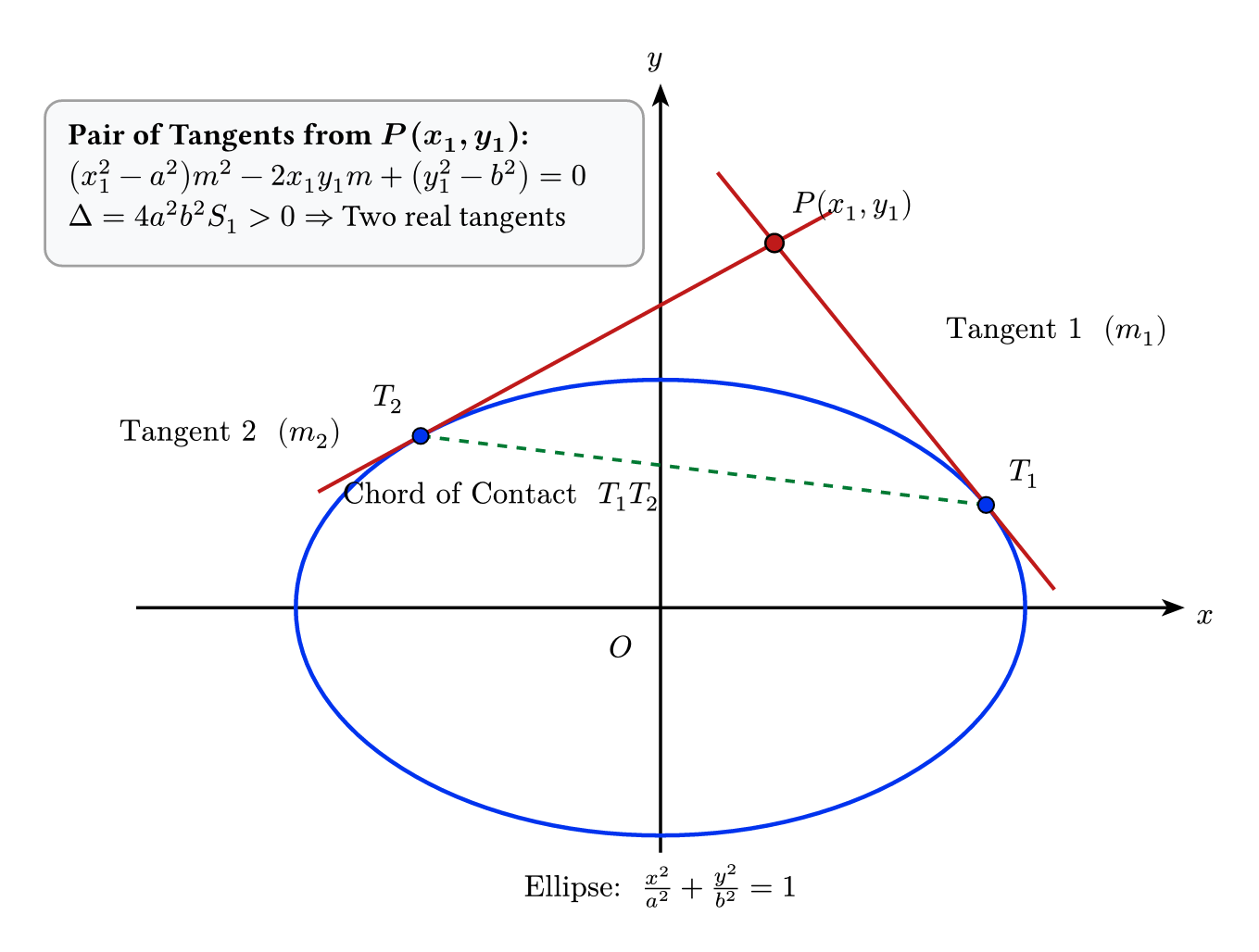
From any point in the plane, how many tangents can we draw to an ellipse?

If you picture an ellipse drawn on paper, simple geometric intuition gives us an immediate answer:

  • If a point lies inside the ellipse, every straight line drawn through it slices right through the interior as a secant chord. No tangent can be drawn.
  • If a point lies on the boundary of the ellipse, exactly one line grazes the curve at that point.
  • If a point lies outside the ellipse, we can clearly draw two distinct tangents grazing the upper and lower flanks of the ellipse.

Here lies the true beauty and power of mathematics: we do not have to rely on visual imagination or faith. Pure algebra reveals this exact geometric behavior with complete logical precision. More importantly, algebra can guide us even when geometry becomes difficult to visualize, such as in higher dimensions or complex coordinate systems.

In this tutorial, we construct the algebraic equations of lines drawn from an external point to an ellipse, establish the quadratic equation that governs their slopes, and examine how vertical tangents emerge.


Line Through an External Point§

Let the equation of the standard ellipse be:

x2a2+y2b2=1\frac{x^2}{a^2} + \frac{y^2}{b^2} = 1

Let P(x1,y1)P(x_1, y_1) be a given fixed point in the Cartesian plane.

Any non-vertical straight line passing through P(x1,y1)P(x_1, y_1) with slope mm has the point-slope equation:

y−y1=m(x−x1)y - y_1 = m(x - x_1)

Rearranging this into slope-intercept form y=mx+cy = mx + c:

y=mx+(y1−mx1)y = mx + (y_1 - mx_1)

Here, the yy-intercept of the line is:

c=y1−mx1c = y_1 - mx_1

Applying the Condition of Tangency§

We already established that for any line y=mx+cy = mx + c to touch the standard ellipse x2a2+y2b2=1\frac{x^2}{a^2} + \frac{y^2}{b^2} = 1, it must satisfy the condition of tangency:

c2=a2m2+b2c^2 = a^2 m^2 + b^2

Substituting c=y1−mx1c = y_1 - mx_1 into this condition gives:

(y1−mx1)2=a2m2+b2(y_1 - mx_1)^2 = a^2 m^2 + b^2

Now, expand the squared binomial on the left-hand side:

y12−2x1y1m+x12m2=a2m2+b2y_1^2 - 2x_1 y_1 m + x_1^2 m^2 = a^2 m^2 + b^2

Collect all terms on one side and group them by powers of mm:

(x12−a2)m2−2x1y1m+(y12−b2)=0(x_1^2 - a^2)m^2 - 2x_1 y_1 m + (y_1^2 - b^2) = 0

This is a fundamental relation in coordinate geometry: a quadratic equation in the slope mm.

Each real root of this quadratic equation corresponds to the slope of a valid tangent line that can be drawn from the point P(x1,y1)P(x_1, y_1) to the ellipse.


The Number of Tangents: Analyzing the Discriminant§

Because the equation governing mm is a quadratic of the form Am2+Bm+C=0A m^2 + B m + C = 0, where:

A=x12−a2,B=−2x1y1,C=y12−b2A = x_1^2 - a^2, \qquad B = -2x_1 y_1, \qquad C = y_1^2 - b^2

the number and nature of the tangent lines are dictated entirely by its discriminant Δ=B2−4AC\Delta = B^2 - 4AC:

Δ=(−2x1y1)2−4(x12−a2)(y12−b2)\Delta = (-2x_1 y_1)^2 - 4(x_1^2 - a^2)(y_1^2 - b^2) Δ=4x12y12−4(x12y12−b2x12−a2y12+a2b2)\Delta = 4x_1^2 y_1^2 - 4\left(x_1^2 y_1^2 - b^2 x_1^2 - a^2 y_1^2 + a^2 b^2\right)

Notice that the term 4x12y124x_1^2 y_1^2 cancels out completely:

Δ=4(b2x12+a2y12−a2b2)\Delta = 4\left(b^2 x_1^2 + a^2 y_1^2 - a^2 b^2\right)

To express this in terms of the standard position of the point with respect to the ellipse, divide and multiply by a2b2a^2 b^2:

Δ=4a2b2(x12a2+y12b2−1)\Delta = 4a^2 b^2 \left(\frac{x_1^2}{a^2} + \frac{y_1^2}{b^2} - 1\right)

Recall from Tutorial 04 that the notation S1S_1 denotes the power of the point P(x1,y1)P(x_1, y_1) with respect to the ellipse:

S1=x12a2+y12b2−1S_1 = \frac{x_1^2}{a^2} + \frac{y_1^2}{b^2} - 1

Therefore, the discriminant simplifies to:

Δ=4a2b2S1\Delta = 4a^2 b^2 S_1

Since 4a2b24a^2 b^2 is strictly positive for any ellipse (a,b>0a, b > 0), the sign of Δ\Delta depends entirely on the sign of S1S_1:

  1. When S1>0S_1 > 0 (Point PP lies outside the ellipse): Here Δ>0\Delta > 0. The quadratic equation has two real and distinct roots m1m_1 and m2m_2. Therefore, exactly two real tangents can be drawn from an external point to an ellipse.

  2. When S1=0S_1 = 0 (Point PP lies on the ellipse): Here Δ=0\Delta = 0. The quadratic equation has two equal real roots (m1=m2m_1 = m_2). Therefore, only one tangent exists through PP, which is the tangent at that point.

  3. When S1<0S_1 < 0 (Point PP lies inside the ellipse): Here Δ<0\Delta < 0. The roots are imaginary (complex conjugates). Therefore, no real tangent can be drawn from an internal point to the ellipse.

The algebra reproduces our physical intuition with absolute rigor.

Pair of tangents from an external point to an ellipse


Slopes of the Tangents: Vieta's Relations§

When P(x1,y1)P(x_1, y_1) lies outside the ellipse (S1>0S_1 > 0) and x12≠a2x_1^2 \ne a^2, the quadratic equation:

(x12−a2)m2−2x1y1m+(y12−b2)=0(x_1^2 - a^2)m^2 - 2x_1 y_1 m + (y_1^2 - b^2) = 0

yields two real slopes, m1m_1 and m2m_2. By Vieta's relations:

Sum of Slopes:

m1+m2=2x1y1x12−a2m_1 + m_2 = \frac{2x_1 y_1}{x_1^2 - a^2}

Product of Slopes:

m1m2=y12−b2x12−a2m_1 m_2 = \frac{y_1^2 - b^2}{x_1^2 - a^2}

Difference of Slopes:

∣m1−m2∣=Δ∣A∣=4a2b2S1∣x12−a2∣=2abS1∣x12−a2∣|m_1 - m_2| = \frac{\sqrt{\Delta}}{|A|} = \frac{\sqrt{4a^2 b^2 S_1}}{|x_1^2 - a^2|} = \frac{2ab\sqrt{S_1}}{|x_1^2 - a^2|}

Angle Between the Tangents§

If θ\theta is the acute angle between the two tangents drawn from P(x1,y1)P(x_1, y_1), then:

tan⁡θ=∣m1−m21+m1m2∣\tan\theta = \left|\frac{m_1 - m_2}{1 + m_1 m_2}\right|

Substituting the expressions for ∣m1−m2∣|m_1 - m_2| and m1m2m_1 m_2:

tan⁡θ=∣2abS1x12−a21+y12−b2x12−a2∣=∣2abS1x12−a2(x12−a2)+(y12−b2)x12−a2∣\tan\theta = \left|\frac{\frac{2ab\sqrt{S_1}}{x_1^2 - a^2}}{1 + \frac{y_1^2 - b^2}{x_1^2 - a^2}}\right| = \left|\frac{\frac{2ab\sqrt{S_1}}{x_1^2 - a^2}}{\frac{(x_1^2 - a^2) + (y_1^2 - b^2)}{x_1^2 - a^2}}\right| tan⁡θ=2abS1∣x12+y12−(a2+b2)∣\tan\theta = \frac{2ab\sqrt{S_1}}{|x_1^2 + y_1^2 - (a^2 + b^2)|}

This formula gives the angle between the two tangents drawn from any external point P(x1,y1)P(x_1, y_1) directly.


The Special Case: When the Equation is Not Quadratic (Vertical Tangents)§

Look closely at the leading coefficient of our quadratic equation in mm:

(x12−a2)m2−2x1y1m+(y12−b2)=0(x_1^2 - a^2)m^2 - 2x_1 y_1 m + (y_1^2 - b^2) = 0

The leading coefficient is x12−a2x_1^2 - a^2.

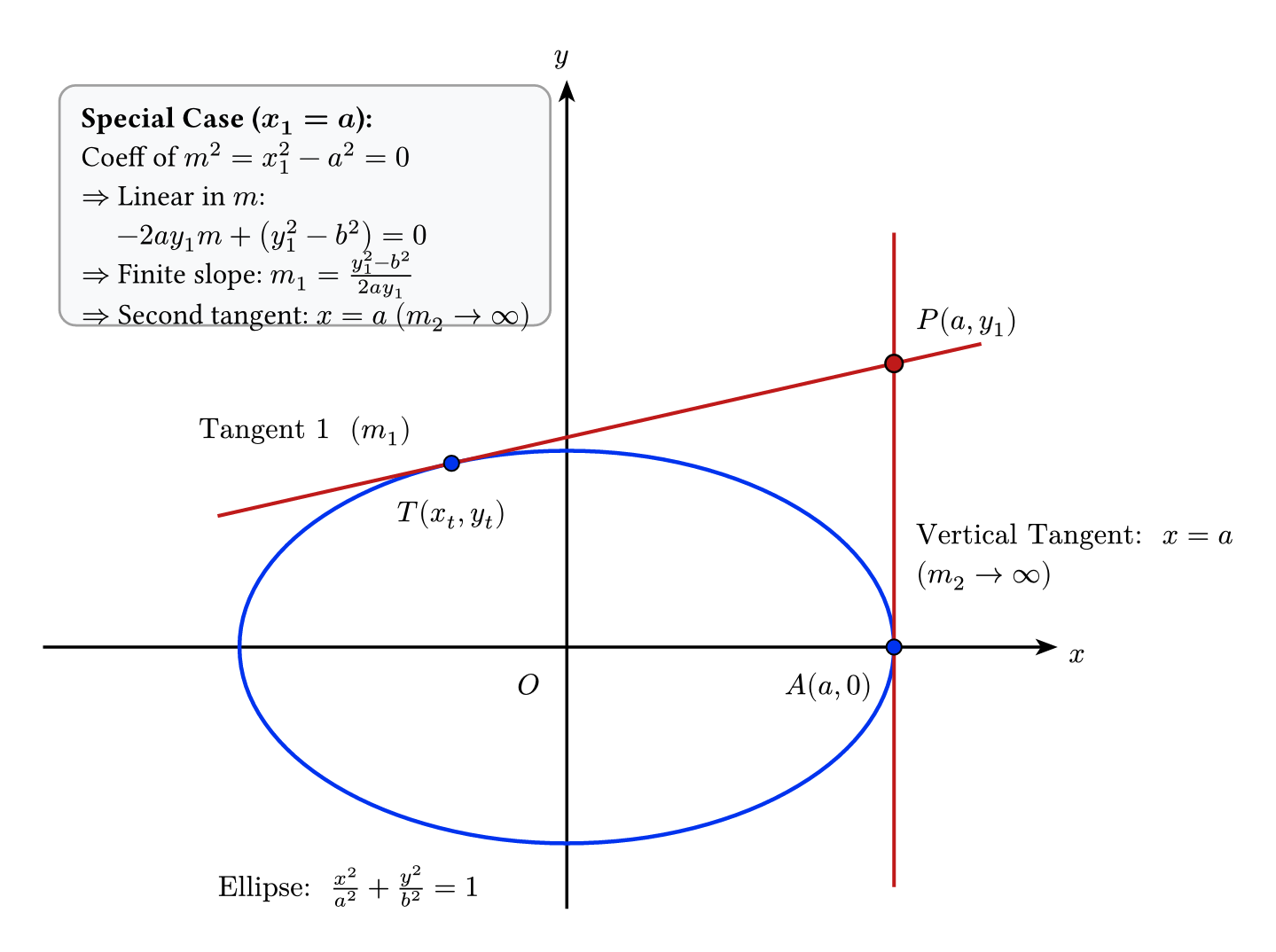
What happens if the given external point P(x1,y1)P(x_1, y_1) has an xx-coordinate equal to aa or −a-a?

x12−a2=0  ⟺  x1=aorx1=−ax_1^2 - a^2 = 0 \iff x_1 = a \quad \text{or} \quad x_1 = -a

In this situation, the m2m^2 term vanishes entirely! The equation reduces to a linear equation in mm:

−2x1y1m+(y12−b2)=0-2x_1 y_1 m + (y_1^2 - b^2) = 0

Solving this linear equation gives only one finite slope:

m1=y12−b22x1y1m_1 = \frac{y_1^2 - b^2}{2x_1 y_1}

Where Did the Second Tangent Go?§

A student encountering this in an exam might worry: "Does an external point with x1=±ax_1 = \pm a have only one tangent? Where did the other tangent go?"

The second tangent has not vanished.

Recall from basic coordinate geometry that a vertical line has an undefined slope (m→∞m \to \infty). In algebra, whenever the leading coefficient of a quadratic equation approaches zero, one of its roots shoots off to infinity:

m2→∞m_2 \to \infty

Because x1=ax_1 = a (or x1=−ax_1 = -a), the point PP lies on the vertical line x=ax = a (or x=−ax = -a). But x=ax = a and x=−ax = -a are precisely the vertical tangent lines to the ellipse at its major axis vertices (a,0)(a, 0) and (−a,0)(-a, 0)!

Therefore, the second tangent is simply the vertical line:

x=x1(i.e., x=a or x=−a)x = x_1 \quad (\text{i.e., } x = a \text{ or } x = -a)

External point on a vertical tangent line to an ellipse

A Crucial Rule for Problem Solving§

Whenever you set up the slope equation for tangents from an external point and obtain a linear equation instead of a quadratic:

  1. Solve the linear equation to get the single finite slope m1m_1, which gives the first tangent: y−y1=m1(x−x1)y - y_1 = m_1(x - x_1).

  2. Immediately recognize that the second tangent is vertical (m2=∞m_2 = \infty), with the equation: x=x1x = x_1.

Never conclude that there is only one tangent from an external point. An external point always has two tangents; if one of them has an undefined slope, algebra signals this by dropping the degree of the equation from 22 to 11.


Illustrative Examples§

Example 1: Finding Both Slopes and Tangents from an External Point§

Find the equations of the tangents drawn from the point P(3,2)P(3, 2) to the ellipse:

x24+y23=1\frac{x^2}{4} + \frac{y^2}{3} = 1

Solution:

Step 1: Check the position of the point

Here a2=4a^2 = 4, b2=3b^2 = 3, and (x1,y1)=(3,2)(x_1, y_1) = (3, 2).

S1=x12a2+y12b2−1=324+223−1=94+43−1=27+16−1212=3112>0S_1 = \frac{x_1^2}{a^2} + \frac{y_1^2}{b^2} - 1 = \frac{3^2}{4} + \frac{2^2}{3} - 1 = \frac{9}{4} + \frac{4}{3} - 1 = \frac{27 + 16 - 12}{12} = \frac{31}{12} > 0

Since S1>0S_1 > 0, the point P(3,2)P(3, 2) lies strictly outside the ellipse, so exactly two real tangents exist.

Step 2: Set up the equation of a line through P(3,2)P(3, 2)

Any non-vertical line through (3,2)(3, 2) with slope mm is:

y−2=m(x−3)  ⟹  y=mx+(2−3m)y - 2 = m(x - 3) \implies y = mx + (2 - 3m)

Here, the yy-intercept is c=2−3mc = 2 - 3m.

Step 3: Apply the condition of tangency

For this line to touch the ellipse x24+y23=1\frac{x^2}{4} + \frac{y^2}{3} = 1:

c2=a2m2+b2c^2 = a^2 m^2 + b^2 (2−3m)2=4m2+3(2 - 3m)^2 = 4m^2 + 3 4−12m+9m2=4m2+34 - 12m + 9m^2 = 4m^2 + 3 5m2−12m+1=05m^2 - 12m + 1 = 0

Notice that this matches the formula (x12−a2)m2−2x1y1m+(y12−b2)=0(x_1^2 - a^2)m^2 - 2x_1 y_1 m + (y_1^2 - b^2) = 0:

  • x12−a2=32−4=5x_1^2 - a^2 = 3^2 - 4 = 5
  • −2x1y1=−2(3)(2)=−12-2x_1 y_1 = -2(3)(2) = -12
  • y12−b2=22−3=1y_1^2 - b^2 = 2^2 - 3 = 1

Step 4: Solve for the slopes

Using the quadratic formula:

m=−(−12)±(−12)2−4(5)(1)2(5)=12±144−2010=12±12410=12±23110=6±315m = \frac{-(-12) \pm \sqrt{(-12)^2 - 4(5)(1)}}{2(5)} = \frac{12 \pm \sqrt{144 - 20}}{10} = \frac{12 \pm \sqrt{124}}{10} = \frac{12 \pm 2\sqrt{31}}{10} = \frac{6 \pm \sqrt{31}}{5}

The two slopes are:

m1=6+315,m2=6−315m_1 = \frac{6 + \sqrt{31}}{5}, \qquad m_2 = \frac{6 - \sqrt{31}}{5}

Step 5: Write the equations of the tangents

Using y−2=m(x−3)y - 2 = m(x - 3):

First Tangent:

y−2=(6+315)(x−3)  ⟹  (6+31)x−5y−(8+331)=0y - 2 = \left(\frac{6 + \sqrt{31}}{5}\right)(x - 3) \implies (6 + \sqrt{31})x - 5y - (8 + 3\sqrt{31}) = 0

Second Tangent:

y−2=(6−315)(x−3)  ⟹  (6−31)x−5y−(8−331)=0y - 2 = \left(\frac{6 - \sqrt{31}}{5}\right)(x - 3) \implies (6 - \sqrt{31})x - 5y - (8 - 3\sqrt{31}) = 0

Example 2: External Point on a Vertical Tangent Line§

Find the equations of the tangents drawn from the point P(2,3)P(2, 3) to the ellipse:

x24+y2=1\frac{x^2}{4} + y^2 = 1

Solution:

Step 1: Check the position and identify the special coordinate

Here a2=4  ⟹  a=2a^2 = 4 \implies a = 2, and b2=1  ⟹  b=1b^2 = 1 \implies b = 1.

The given point is P(x1,y1)=(2,3)P(x_1, y_1) = (2, 3).

Notice immediately that:

x1=2=ax_1 = 2 = a

Because x1=ax_1 = a, the point lies on the vertical line x=2x = 2, which touches the ellipse at its right vertex (2,0)(2, 0)!

Let us see what happens when we set up the algebra.

Step 2: Set up the line through (2,3)(2, 3)

y−3=m(x−2)  ⟹  y=mx+(3−2m)y - 3 = m(x - 2) \implies y = mx + (3 - 2m)

Condition of tangency c2=a2m2+b2c^2 = a^2 m^2 + b^2:

(3−2m)2=4m2+1(3 - 2m)^2 = 4m^2 + 1 9−12m+4m2=4m2+19 - 12m + 4m^2 = 4m^2 + 1

Notice that the 4m24m^2 terms cancel out on both sides:

−12m+8=0  ⟹  12m=8  ⟹  m1=23-12m + 8 = 0 \implies 12m = 8 \implies m_1 = \frac{2}{3}

Step 3: Interpret the result and identify both tangents

The quadratic equation reduced to a linear equation because the coefficient of m2m^2 became zero (x12−a2=22−4=0x_1^2 - a^2 = 2^2 - 4 = 0).

This tells us:

  • First Tangent (Finite Slope): With slope m1=23m_1 = \frac{2}{3}, the line is y−3=23(x−2)  ⟹  2x−3y+5=0y - 3 = \frac{2}{3}(x - 2) \implies 2x - 3y + 5 = 0.
  • Second Tangent (Vertical Line): With undefined slope (m2→∞m_2 \to \infty), the vertical line through x=2x = 2 is x=2x = 2.

Both lines pass through P(2,3)P(2, 3) and are tangent to the ellipse x24+y2=1\frac{x^2}{4} + y^2 = 1.


The Director Circle of an Ellipse§

When we draw two tangents from an external point P(x1,y1)P(x_1, y_1) to an ellipse, the angle between them varies depending on where PP is placed.

What is the locus of all points P(x1,y1)P(x_1, y_1) from which the two tangents are mutually perpendicular?


Derivation of the Locus§

From our earlier analysis, the slopes m1m_1 and m2m_2 of the two tangents drawn from P(x1,y1)P(x_1, y_1) to the standard ellipse x2a2+y2b2=1\frac{x^2}{a^2} + \frac{y^2}{b^2} = 1 are the roots of the quadratic equation:

(x12−a2)m2−2x1y1m+(y12−b2)=0(x_1^2 - a^2)m^2 - 2x_1 y_1 m + (y_1^2 - b^2) = 0

For the two tangents to be perpendicular, the product of their slopes must equal −1-1:

m1m2=−1m_1 m_2 = -1

Using Vieta's relation for the product of roots:

m1m2=y12−b2x12−a2m_1 m_2 = \frac{y_1^2 - b^2}{x_1^2 - a^2}

Setting this product equal to −1-1:

y12−b2x12−a2=−1\frac{y_1^2 - b^2}{x_1^2 - a^2} = -1 y12−b2=−(x12−a2)y_1^2 - b^2 = -(x_1^2 - a^2) y12−b2=−x12+a2y_1^2 - b^2 = -x_1^2 + a^2

Rearranging the terms:

x12+y12=a2+b2x_1^2 + y_1^2 = a^2 + b^2

Replacing the coordinates of the moving point (x1,y1)(x_1, y_1) with the running coordinates (x,y)(x, y), we obtain the equation of the locus:

x2+y2=a2+b2x^2 + y^2 = a^2 + b^2

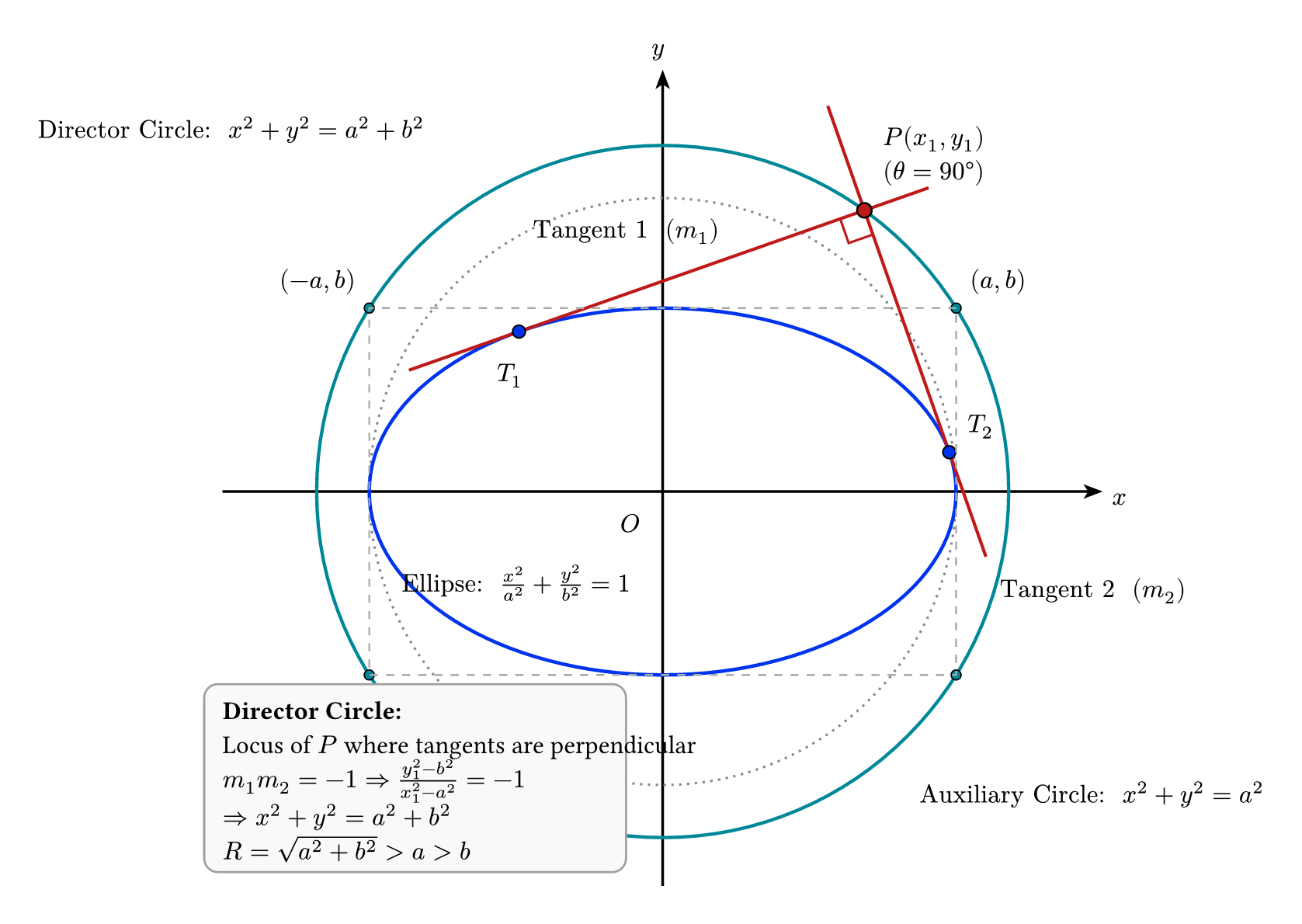
This circle is called the Director Circle of the ellipse.


Geometric Properties of the Director Circle§

1. Center and Radius:

The director circle is concentric with the ellipse, having its center at the origin (0,0)(0, 0). Its radius RR is:

R=a2+b2R = \sqrt{a^2 + b^2}

2. Radius Hierarchy:

Comparing the radii of the curves centered at the origin:

b<a<a2+b2b < a < \sqrt{a^2 + b^2}
  • The ellipse extends horizontally to distance aa and vertically to distance bb.
  • The Auxiliary Circle has radius aa: x2+y2=a2x^2 + y^2 = a^2.
  • The Director Circle has radius a2+b2\sqrt{a^2 + b^2}: x2+y2=a2+b2x^2 + y^2 = a^2 + b^2.

Therefore, the director circle lies entirely outside both the ellipse and the auxiliary circle.

3. Intersection of Bounding Tangents:

The standard ellipse is bounded by four principal tangents:

  • Two vertical tangents: x=ax = a and x=−ax = -a
  • Two horizontal tangents: y=by = b and y=−by = -b

These tangents intersect at the four corner vertices of the circumscribing rectangle:

(a,b),(−a,b),(−a,−b),(a,−b)(a, b), \quad (-a, b), \quad (-a, -b), \quad (a, -b)

Since the horizontal and vertical tangents are perpendicular by definition, each of these four vertices must lie on the director circle. Substituting any of these corner points into the circle equation verifies this immediately:

(±a)2+(±b)2=a2+b2(\pm a)^2 + (\pm b)^2 = a^2 + b^2

4. Always Real:

Because a>0a > 0 and b>0b > 0, the sum a2+b2a^2 + b^2 is always strictly positive. Therefore, unlike a hyperbola (where the director circle can be imaginary or degenerate), every real ellipse possesses a real director circle.

Director Circle of an Ellipse


Combined Equation of the Pair of Tangents§

Rather than calculating the two slopes m1m_1 and m2m_2 separately and writing two separate equations, we can find a single second-degree equation in xx and yy that represents both tangent lines simultaneously.

Standard Conic Notation§

Recall the standard shorthand notation:

  • Curve: S≡x2a2+y2b2−1=0S \equiv \frac{x^2}{a^2} + \frac{y^2}{b^2} - 1 = 0
  • Point value at P(x1,y1)P(x_1, y_1): S1≡x12a2+y12b2−1S_1 \equiv \frac{x_1^2}{a^2} + \frac{y_1^2}{b^2} - 1
  • Tangent-like expression: T≡xx1a2+yy1b2−1T \equiv \frac{x x_1}{a^2} + \frac{y y_1}{b^2} - 1

Derivation via Section Ratio§

Let P(x1,y1)P(x_1, y_1) be a fixed external point to the ellipse S=0S = 0.

Let Q(x,y)Q(x, y) be any arbitrary point lying on either of the two tangent lines drawn from PP to the ellipse.

Now consider a point RR dividing the straight line segment PQPQ in the ratio λ:1\lambda : 1. By the section formula, the coordinates of RR are:

(λx+x1λ+1,  λy+y1λ+1)\left(\frac{\lambda x + x_1}{\lambda + 1}, \; \frac{\lambda y + y_1}{\lambda + 1}\right)

If the point RR lies on the ellipse x2a2+y2b2−1=0\frac{x^2}{a^2} + \frac{y^2}{b^2} - 1 = 0, its coordinates must satisfy the ellipse equation:

(λx+x1λ+1)2a2+(λy+y1λ+1)2b2−1=0\frac{\left(\frac{\lambda x + x_1}{\lambda + 1}\right)^2}{a^2} + \frac{\left(\frac{\lambda y + y_1}{\lambda + 1}\right)^2}{b^2} - 1 = 0

Multiplying the entire equation by (λ+1)2(\lambda + 1)^2 eliminates the denominators:

(λx+x1)2a2+(λy+y1)2b2−(λ+1)2=0\frac{(\lambda x + x_1)^2}{a^2} + \frac{(\lambda y + y_1)^2}{b^2} - (\lambda + 1)^2 = 0

Expanding each squared binomial:

λ2x2+2λxx1+x12a2+λ2y2+2λyy1+y12b2−(λ2+2λ+1)=0\frac{\lambda^2 x^2 + 2\lambda x x_1 + x_1^2}{a^2} + \frac{\lambda^2 y^2 + 2\lambda y y_1 + y_1^2}{b^2} - (\lambda^2 + 2\lambda + 1) = 0

Now, collect all terms according to descending powers of λ\lambda:

λ2(x2a2+y2b2−1)+2λ(xx1a2+yy1b2−1)+(x12a2+y12b2−1)=0\lambda^2 \left(\frac{x^2}{a^2} + \frac{y^2}{b^2} - 1\right) + 2\lambda \left(\frac{x x_1}{a^2} + \frac{y y_1}{b^2} - 1\right) + \left(\frac{x_1^2}{a^2} + \frac{y_1^2}{b^2} - 1\right) = 0

Using our shorthand notations SS, TT, and S1S_1, this simplifies to a quadratic equation in λ\lambda:

λ2S+2λT+S1=0\lambda^2 S + 2\lambda T + S_1 = 0

The roots of this quadratic equation give the ratios λ\lambda for the points where the straight line PQPQ intersects the ellipse.

Since the line PQPQ is a tangent line, it touches the ellipse at a single point. This means the two intersection points must coincide, so the quadratic equation in λ\lambda must have equal roots.

A quadratic equation has equal roots if and only if its discriminant vanishes:

Δ=(2T)2−4(S)(S1)=0\Delta = (2T)^2 - 4(S)(S_1) = 0 4T2−4SS1=04T^2 - 4SS_1 = 0 SS1=T2SS_1 = T^2

Written out in full Cartesian coordinates:

(x2a2+y2b2−1)(x12a2+y12b2−1)=(xx1a2+yy1b2−1)2\left(\frac{x^2}{a^2} + \frac{y^2}{b^2} - 1\right)\left(\frac{x_1^2}{a^2} + \frac{y_1^2}{b^2} - 1\right) = \left(\frac{x x_1}{a^2} + \frac{y y_1}{b^2} - 1\right)^2

This single equation represents the pair of tangents drawn from P(x1,y1)P(x_1, y_1) to the ellipse.


Connection to the Theory of Pair of Straight Lines§

The formula SS1=T2SS_1 = T^2 looks very compact, but when expanded, it is a general second-degree polynomial in xx and yy:

Ax2+2Hxy+By2+2Gx+2Fy+C=0A x^2 + 2H xy + B y^2 + 2G x + 2F y + C = 0

Because it factors into two real linear equations passing through P(x1,y1)P(x_1, y_1), all the standard theorems from the theory of pairs of straight lines apply directly:

Point of Intersection:

The point of intersection of the two lines represented by SS1=T2SS_1 = T^2 is precisely P(x1,y1)P(x_1, y_1).

Angle Between the Lines:

In any second-degree homogeneous-in-shifts equation, the acute angle θ\theta between the two lines is given by:

tan⁡θ=2H2−AB∣A+B∣\tan\theta = \frac{2\sqrt{H^2 - AB}}{|A + B|}

Let us find the coefficients of x2x^2, xyxy, and y2y^2 in SS1=T2SS_1 = T^2:

Coefficient of x2x^2 (AA):

The term in x2x^2 on the left is x2a2S1\frac{x^2}{a^2} S_1, and on the right it is (xx1a2)2=x2x12a4\left(\frac{x x_1}{a^2}\right)^2 = \frac{x^2 x_1^2}{a^4}:

A=S1a2−x12a4=1a2(x12a2+y12b2−1)−x12a4=y12−b2a2b2A = \frac{S_1}{a^2} - \frac{x_1^2}{a^4} = \frac{1}{a^2}\left(\frac{x_1^2}{a^2} + \frac{y_1^2}{b^2} - 1\right) - \frac{x_1^2}{a^4} = \frac{y_1^2 - b^2}{a^2 b^2}

Coefficient of y2y^2 (BB):

Similarly, the term in y2y^2 is:

B=S1b2−y12b4=x12−a2a2b2B = \frac{S_1}{b^2} - \frac{y_1^2}{b^4} = \frac{x_1^2 - a^2}{a^2 b^2}

Coefficient of 2xy2xy (2H2H):

The cross-product term 2Hxy2H xy comes only from the right-hand side:

2(xx1a2)(yy1b2)=2x1y1a2b2xy  ⟹  H=−x1y1a2b22\left(\frac{x x_1}{a^2}\right)\left(\frac{y y_1}{b^2}\right) = \frac{2x_1 y_1}{a^2 b^2} xy \implies H = -\frac{x_1 y_1}{a^2 b^2}

Now observe two remarkable results:

Condition for Perpendicular Lines (A+B=0A + B = 0):

A+B=y12−b2a2b2+x12−a2a2b2=x12+y12−(a2+b2)a2b2=0A + B = \frac{y_1^2 - b^2}{a^2 b^2} + \frac{x_1^2 - a^2}{a^2 b^2} = \frac{x_1^2 + y_1^2 - (a^2 + b^2)}{a^2 b^2} = 0 x12+y12=a2+b2x_1^2 + y_1^2 = a^2 + b^2

This reproduces the Director Circle directly from the pair of straight lines condition!

The Angle Formula:

H2−AB=(−x1y1a2b2)2−(y12−b2a2b2)(x12−a2a2b2)=a2b2S1a4b4=S1a2b2H^2 - AB = \left(-\frac{x_1 y_1}{a^2 b^2}\right)^2 - \left(\frac{y_1^2 - b^2}{a^2 b^2}\right)\left(\frac{x_1^2 - a^2}{a^2 b^2}\right) = \frac{a^2 b^2 S_1}{a^4 b^4} = \frac{S_1}{a^2 b^2}

Substituting into tan⁡θ=2H2−AB∣A+B∣\tan\theta = \frac{2\sqrt{H^2 - AB}}{|A + B|}:

tan⁡θ=2S1a2b2∣x12+y12−(a2+b2)a2b2∣=2abS1∣x12+y12−(a2+b2)∣\tan\theta = \frac{2\sqrt{\frac{S_1}{a^2 b^2}}}{\left|\frac{x_1^2 + y_1^2 - (a^2 + b^2)}{a^2 b^2}\right|} = \frac{2ab\sqrt{S_1}}{|x_1^2 + y_1^2 - (a^2 + b^2)|}

This matches our earlier slope-based derivation, confirming the structural harmony of coordinate geometry.


Chord of Contact§

When two tangents are drawn from an external point P(x1,y1)P(x_1, y_1) to an ellipse, let them touch the curve at two distinct points, say Q(x′,y′)Q(x', y') and R(x′′,y′′)R(x'', y'').

The straight line segment connecting these two points of contact, QRQR, is called the chord of contact of tangents from PP.


Derivation of the Equation of Chord of Contact§

We can derive the equation of the chord of contact using the Cartesian duality argument.

The equation of the tangent line to the ellipse x2a2+y2b2=1\frac{x^2}{a^2} + \frac{y^2}{b^2} = 1 at the point of contact Q(x′,y′)Q(x', y') is:

xx′a2+yy′b2=1\frac{x x'}{a^2} + \frac{y y'}{b^2} = 1

Since this tangent line passes through the external point P(x1,y1)P(x_1, y_1), the coordinates (x1,y1)(x_1, y_1) must satisfy this equation:

x1x′a2+y1y′b2=1⋯(1)\frac{x_1 x'}{a^2} + \frac{y_1 y'}{b^2} = 1 \qquad \cdots (1)

Similarly, the equation of the tangent line at the point of contact R(x′′,y′′)R(x'', y'') is:

xx′′a2+yy′′b2=1\frac{x x''}{a^2} + \frac{y y''}{b^2} = 1

Since this tangent line also passes through P(x1,y1)P(x_1, y_1), its coordinates must satisfy:

x1x′′a2+y1y′′b2=1⋯(2)\frac{x_1 x''}{a^2} + \frac{y_1 y''}{b^2} = 1 \qquad \cdots (2)

Now, examine the linear equation:

xx1a2+yy1b2=1\frac{x x_1}{a^2} + \frac{y y_1}{b^2} = 1

Notice two essential facts about this equation:

  1. It represents a straight line: Both xx and yy appear to the first power.
  2. It passes through both points QQ and RR:
    • Substituting Q(x′,y′)Q(x', y') into this equation gives x′x1a2+y′y1b2=1\frac{x' x_1}{a^2} + \frac{y' y_1}{b^2} = 1, which is identically true by equation (1).
    • Substituting R(x′′,y′′)R(x'', y'') into this equation gives x′′x1a2+y′′y1b2=1\frac{x'' x_1}{a^2} + \frac{y'' y_1}{b^2} = 1, which is identically true by equation (2).

Since two distinct points uniquely define a straight line in the plane, this line is none other than the chord passing through QQ and RR.

Therefore, the equation of the chord of contact of tangents from P(x1,y1)P(x_1, y_1) is:

T=0  ⟺  xx1a2+yy1b2=1\mathbf{T = 0} \iff \frac{x x_1}{a^2} + \frac{y y_1}{b^2} = 1

The Inverse Problem: Finding the Point of Intersection Given the Chord§

In many problems, the situation is reversed: we are given the equation of a straight line, and we are told that it is the chord of contact of tangents drawn from some unknown external point P(x1,y1)P(x_1, y_1). Our goal is to determine the coordinates of PP.

Method of Coefficient Comparison§

Let the given line be:

Lx+My+N=0  ⟺  Lx+My=−NL x + M y + N = 0 \iff L x + M y = -N

We know that the theoretical equation of the chord of contact from an unknown point P(x1,y1)P(x_1, y_1) to the standard ellipse x2a2+y2b2=1\frac{x^2}{a^2} + \frac{y^2}{b^2} = 1 is:

(x1a2)x+(y1b2)y=1\left(\frac{x_1}{a^2}\right)x + \left(\frac{y_1}{b^2}\right)y = 1

Since both equations represent the exact same straight line, the coefficients of xx, yy, and the constant term must be in the same proportion:

x1/a2L=y1/b2M=1−N\frac{x_1 / a^2}{L} = \frac{y_1 / b^2}{M} = \frac{1}{-N}

Solving for x1x_1 and y1y_1:

x1=−a2LNx_1 = -\frac{a^2 L}{N} y1=−b2MNy_1 = -\frac{b^2 M}{N}

Therefore, the tangents must have been drawn from the point:

P(−a2LN,  −b2MN)P\left(-\frac{a^2 L}{N}, \; -\frac{b^2 M}{N}\right)

Condition for Real Tangents§

For these tangents to be real, the point P(x1,y1)P(x_1, y_1) must lie strictly outside the ellipse (S1>0S_1 > 0):

x12a2+y12b2−1>0\frac{x_1^2}{a^2} + \frac{y_1^2}{b^2} - 1 > 0 (−a2LN)2a2+(−b2MN)2b2>1\frac{\left(-\frac{a^2 L}{N}\right)^2}{a^2} + \frac{\left(-\frac{b^2 M}{N}\right)^2}{b^2} > 1 a2L2N2+b2M2N2>1\frac{a^2 L^2}{N^2} + \frac{b^2 M^2}{N^2} > 1 a2L2+b2M2>N2a^2 L^2 + b^2 M^2 > N^2
  • When a2L2+b2M2>N2a^2 L^2 + b^2 M^2 > N^2: The given line cuts the ellipse in two real points, so real tangents can be drawn from PP to form this chord of contact.
  • When a2L2+b2M2=N2a^2 L^2 + b^2 M^2 = N^2: The line is tangent to the ellipse. The point PP lies on the ellipse, and the chord of contact degenerates into the point of contact itself.
  • When a2L2+b2M2<N2a^2 L^2 + b^2 M^2 < N^2: The line lies entirely outside the ellipse without intersecting it. No real chord of contact exists.

This inverse relationship forms the foundation of the theory of Pole and Polar, where the point PP is called the pole and the line is called its polar.


Important Properties of the Chord of Contact§

1. Area of the Triangle Formed by the Tangents and the Chord of Contact§

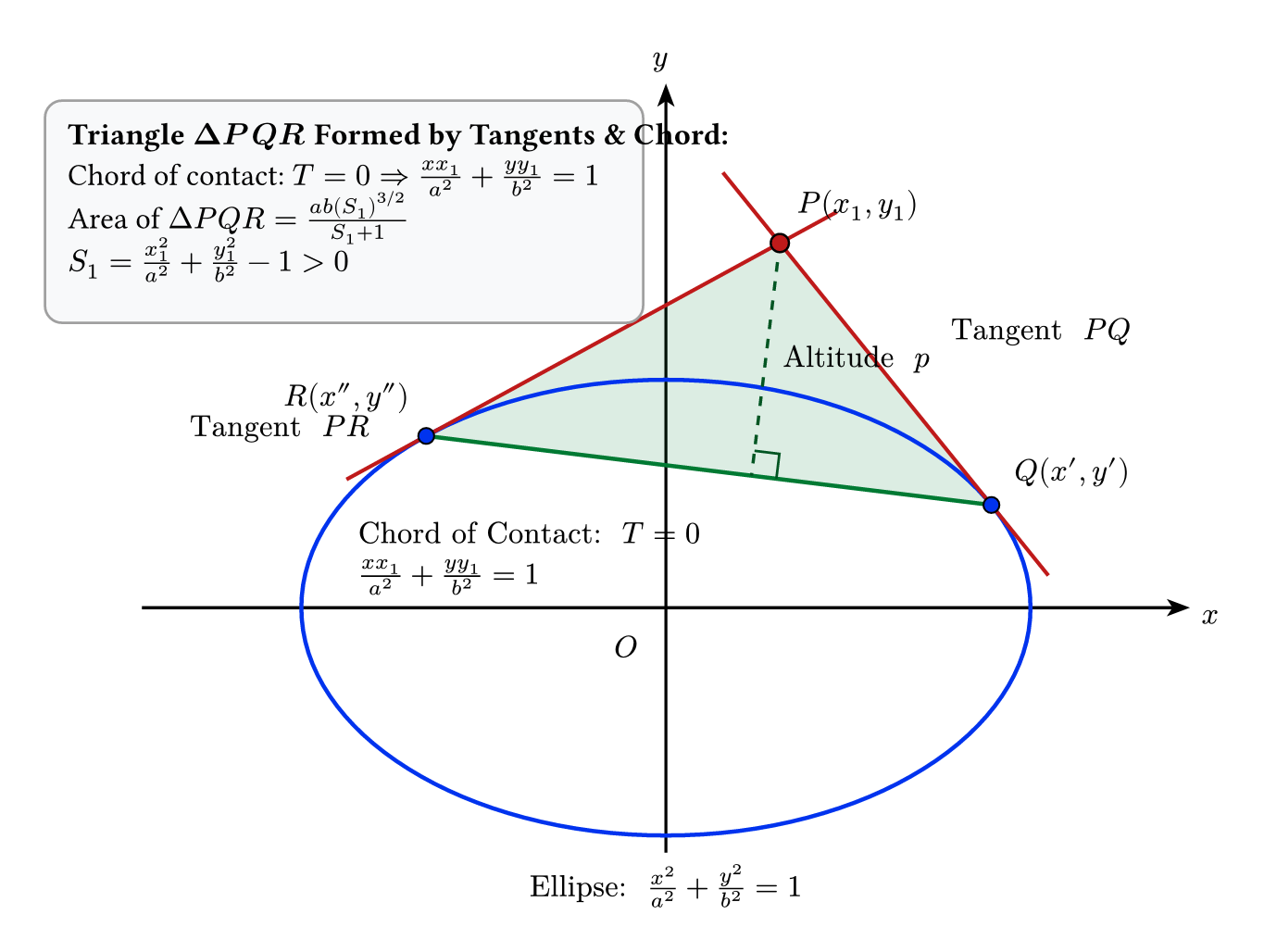
Let tangents drawn from P(x1,y1)P(x_1, y_1) touch the ellipse at QQ and RR. Together with the external point PP, they form a triangle ΔPQR\Delta PQR.

The area of this triangle is given by the formula:

Area(ΔPQR)=ab(S1)3/2S1+1=ab(x12a2+y12b2−1)3/2x12a2+y12b2\text{Area}(\Delta PQR) = \frac{ab (S_1)^{3/2}}{S_1 + 1} = \frac{ab \left(\frac{x_1^2}{a^2} + \frac{y_1^2}{b^2} - 1\right)^{3/2}}{\frac{x_1^2}{a^2} + \frac{y_1^2}{b^2}}

Why this formula holds:

  • The perpendicular distance pp from P(x1,y1)P(x_1, y_1) to the chord of contact T=0T = 0 is proportional to S1x12a4+y12b4\frac{S_1}{\sqrt{\frac{x_1^2}{a^4} + \frac{y_1^2}{b^4}}}.
  • The length of the chord of contact QRQR is proportional to S1x12a4+y12b4\frac{\sqrt{S_1}}{\sqrt{\frac{x_1^2}{a^4} + \frac{y_1^2}{b^4}}}.
  • Multiplying 12×base×height\frac{1}{2} \times \text{base} \times \text{height} simplifies directly to the expression above.

Notice that if PP approaches the ellipse boundary, S1→0S_1 \to 0, and the area of the triangle shrinks to zero, as expected.

Triangle Formed by Pair of Tangents and Chord of Contact


2. Length of the Chord of Contact§

The length of the chord of contact QRQR joining the two points of contact from P(x1,y1)P(x_1, y_1) is:

Length(QR)=2abb2x12+a2y12S1(b4x12+a4y12)\text{Length}(QR) = \frac{2ab}{b^2 x_1^2 + a^2 y_1^2} \sqrt{S_1 \left(b^4 x_1^2 + a^4 y_1^2\right)}

3. Focal Chord of Contact: Focus-Directrix Duality§

What happens if the chord of contact QRQR passes through one of the foci of the ellipse?

Let the chord of contact pass through the right focus S(ae,0)S(ae, 0).

Since S(ae,0)S(ae, 0) lies on the chord of contact xx1a2+yy1b2=1\frac{x x_1}{a^2} + \frac{y y_1}{b^2} = 1, its coordinates must satisfy the equation:

(ae)x1a2+(0)y1b2=1\frac{(ae) x_1}{a^2} + \frac{(0) y_1}{b^2} = 1 ex1a=1  ⟹  x1=ae\frac{e x_1}{a} = 1 \implies x_1 = \frac{a}{e}

Similarly, if the chord of contact passes through the left focus S′(−ae,0)S'(-ae, 0):

x1=−aex_1 = -\frac{a}{e}

This establishes a fundamental duality theorem:

  • If the chord of contact of tangents drawn from PP passes through a focus of the ellipse, the point PP must lie on the corresponding directrix (x=±a/ex = \pm a/e).
  • Conversely, if tangents are drawn from any point on a directrix to the ellipse, their chord of contact always passes through the corresponding focus.

4. Chord of Contact Subtending a Right Angle at the Center§

Let tangents be drawn from P(x1,y1)P(x_1, y_1) to the ellipse x2a2+y2b2=1\frac{x^2}{a^2} + \frac{y^2}{b^2} = 1. What is the locus of PP if the chord of contact QRQR subtends a right angle (90∘90^\circ) at the center of the ellipse (0,0)(0, 0)?

Derivation via Homogenization:

The equation of the ellipse is:

x2a2+y2b2=1⋯(1)\frac{x^2}{a^2} + \frac{y^2}{b^2} = 1 \qquad \cdots (1)

The equation of the chord of contact QRQR is:

xx1a2+yy1b2=1⋯(2)\frac{x x_1}{a^2} + \frac{y y_1}{b^2} = 1 \qquad \cdots (2)

To find the combined equation of the two straight lines OQOQ and OROR joining the origin (0,0)(0, 0) to the intersection points of the line and the ellipse, make equation (1) homogeneous of degree 22 using equation (2):

x2a2+y2b2=(xx1a2+yy1b2)2\frac{x^2}{a^2} + \frac{y^2}{b^2} = \left(\frac{x x_1}{a^2} + \frac{y y_1}{b^2}\right)^2

Expanding the right-hand side:

x2a2+y2b2=x2x12a4+2xx1yy1a2b2+y2y12b4\frac{x^2}{a^2} + \frac{y^2}{b^2} = \frac{x^2 x_1^2}{a^4} + 2\frac{x x_1 y y_1}{a^2 b^2} + \frac{y^2 y_1^2}{b^4}

Grouping the terms into standard second-degree homogeneous form:

(1a2−x12a4)x2−2x1y1a2b2xy+(1b2−y12b4)y2=0\left(\frac{1}{a^2} - \frac{x_1^2}{a^4}\right)x^2 - \frac{2x_1 y_1}{a^2 b^2} xy + \left(\frac{1}{b^2} - \frac{y_1^2}{b^4}\right)y^2 = 0

This equation represents the pair of lines OQOQ and OROR.

For these two lines to be mutually perpendicular, the sum of the coefficients of x2x^2 and y2y^2 must vanish:

(1a2−x12a4)+(1b2−y12b4)=0\left(\frac{1}{a^2} - \frac{x_1^2}{a^4}\right) + \left(\frac{1}{b^2} - \frac{y_1^2}{b^4}\right) = 0 x12a4+y12b4=1a2+1b2\frac{x_1^2}{a^4} + \frac{y_1^2}{b^4} = \frac{1}{a^2} + \frac{1}{b^2}

Replacing (x1,y1)(x_1, y_1) with (x,y)(x, y), the required locus is the concentric ellipse:

x2a4+y2b4=1a2+1b2\frac{x^2}{a^4} + \frac{y^2}{b^4} = \frac{1}{a^2} + \frac{1}{b^2}

Further Worked Examples§

Example 3: Verifying Tangents from the Director Circle§

Consider the ellipse:

x216+y29=1\frac{x^2}{16} + \frac{y^2}{9} = 1
  1. Find the equation of its director circle.
  2. Verify that the tangents drawn from the point P(4,3)P(4, 3) on the director circle are mutually perpendicular.

Solution:

Step 1: Equation of the director circle

Here a2=16a^2 = 16 and b2=9b^2 = 9.

The equation of the director circle is:

x2+y2=a2+b2=16+9=25x^2 + y^2 = a^2 + b^2 = 16 + 9 = 25 x2+y2=25x^2 + y^2 = 25

Notice that the point P(4,3)P(4, 3) satisfies 42+32=254^2 + 3^2 = 25, so PP lies on the director circle.

Step 2: Find the slopes of tangents from P(4,3)P(4, 3)

Using the slope quadratic equation (x12−a2)m2−2x1y1m+(y12−b2)=0(x_1^2 - a^2)m^2 - 2x_1 y_1 m + (y_1^2 - b^2) = 0:

  • x12−a2=42−16=0x_1^2 - a^2 = 4^2 - 16 = 0
  • −2x1y1=−2(4)(3)=−24-2x_1 y_1 = -2(4)(3) = -24
  • y12−b2=32−9=0y_1^2 - b^2 = 3^2 - 9 = 0

Notice that both the m2m^2 coefficient and the constant term vanish!

The equation simplifies to:

−24m=0  ⟹  m1=0-24m = 0 \implies m_1 = 0

Since the m2m^2 coefficient is zero, the second root is infinite:

m2→∞m_2 \to \infty

Step 3: Identify the two tangents and their angle

  • First Tangent: With slope m1=0m_1 = 0 (a horizontal line) passing through (4,3)(4, 3), the equation is y=3y = 3. This is the horizontal tangent to the ellipse at its upper vertex (0,3)(0, 3).
  • Second Tangent: With undefined slope m2→∞m_2 \to \infty (a vertical line) passing through (4,3)(4, 3), the equation is x=4x = 4. This is the vertical tangent to the ellipse at its right vertex (4,0)(4, 0).

Since one line is horizontal (y=3y = 3) and the other is vertical (x=4x = 4), the angle between them is precisely 90∘90^\circ.


Example 4: Finding the Angle Between Tangents via the Combined Equation§

Find the combined equation of the pair of tangents drawn from the point P(2,3)P(2, 3) to the ellipse:

x23+y22=1\frac{x^2}{3} + \frac{y^2}{2} = 1

and determine the acute angle between them.

Solution:

Step 1: Evaluate SS, S1S_1, and TT

For the ellipse 2x2+3y2−6=02x^2 + 3y^2 - 6 = 0:

S=2x2+3y2−6S = 2x^2 + 3y^2 - 6

At P(2,3)P(2, 3):

S1=2(22)+3(32)−6=8+27−6=29S_1 = 2(2^2) + 3(3^2) - 6 = 8 + 27 - 6 = 29

The mixed expression TT is:

T=2x(2)+3y(3)−6=4x+9y−6T = 2x(2) + 3y(3) - 6 = 4x + 9y - 6

Step 2: Apply the combined equation SS1=T2SS_1 = T^2

(2x2+3y2−6)(29)=(4x+9y−6)2(2x^2 + 3y^2 - 6)(29) = (4x + 9y - 6)^2

Expand both sides:

Left-hand side:

58x2+87y2−17458x^2 + 87y^2 - 174

Right-hand side:

(4x+9y−6)2=16x2+81y2+36+72xy−48x−108y(4x + 9y - 6)^2 = 16x^2 + 81y^2 + 36 + 72xy - 48x - 108y

Bring all terms to the left-hand side:

(58−16)x2−72xy+(87−81)y2+48x+108y−(174+36)=0(58 - 16)x^2 - 72xy + (87 - 81)y^2 + 48x + 108y - (174 + 36) = 0 42x2−72xy+6y2+48x+108y−210=042x^2 - 72xy + 6y^2 + 48x + 108y - 210 = 0

Divide the entire equation by 66:

7x2−12xy+y2+8x+18y−35=07x^2 - 12xy + y^2 + 8x + 18y - 35 = 0

This is the combined Cartesian equation of the pair of tangents.

Step 3: Calculate the angle between the tangents

Comparing with Ax2+2Hxy+By2+⋯=0A x^2 + 2H xy + B y^2 + \dots = 0:

A=7,2H=−12  ⟹  H=−6,B=1A = 7, \qquad 2H = -12 \implies H = -6, \qquad B = 1

Using the pair of straight lines angle formula:

tan⁡θ=2H2−AB∣A+B∣=2(−6)2−(7)(1)∣7+1∣=236−78=2298=294\tan\theta = \frac{2\sqrt{H^2 - AB}}{|A + B|} = \frac{2\sqrt{(-6)^2 - (7)(1)}}{|7 + 1|} = \frac{2\sqrt{36 - 7}}{8} = \frac{2\sqrt{29}}{8} = \frac{\sqrt{29}}{4}

Therefore, the acute angle between the tangents is:

θ=tan⁡−1(294)\theta = \tan^{-1}\left(\frac{\sqrt{29}}{4}\right)

Example 5: Finding the Chord of Contact and Its Length§

Tangents are drawn from the point P(4,3)P(4, 3) to the ellipse:

x28+y24=1\frac{x^2}{8} + \frac{y^2}{4} = 1
  1. Find the equation of the chord of contact.
  2. Find the coordinates of the contact points.
  3. Calculate the length of the chord of contact.

Solution:

Step 1: Equation of the chord of contact

Using T=0T = 0 with P(x1,y1)=(4,3)P(x_1, y_1) = (4, 3), a2=8a^2 = 8, b2=4b^2 = 4:

x(4)8+y(3)4=1\frac{x(4)}{8} + \frac{y(3)}{4} = 1 x2+3y4=1\frac{x}{2} + \frac{3y}{4} = 1

Multiply throughout by 44:

2x+3y=4  ⟹  2x+3y−4=02x + 3y = 4 \implies 2x + 3y - 4 = 0

Step 2: Find the points of contact

Express xx from the chord equation:

x=4−3y2=2−32yx = \frac{4 - 3y}{2} = 2 - \frac{3}{2}y

Substitute this into the ellipse equation x28+y24=1  ⟺  x2+2y2=8\frac{x^2}{8} + \frac{y^2}{4} = 1 \iff x^2 + 2y^2 = 8:

(2−32y)2+2y2=8\left(2 - \frac{3}{2}y\right)^2 + 2y^2 = 8 4−6y+94y2+2y2=84 - 6y + \frac{9}{4}y^2 + 2y^2 = 8

Multiply by 44:

16−24y+9y2+8y2=3216 - 24y + 9y^2 + 8y^2 = 32 17y2−24y−16=017y^2 - 24y - 16 = 0

Using the quadratic formula for yy:

y=24±(−24)2−4(17)(−16)2(17)=24±576+108834=24±166434=24±82634=12±42617y = \frac{24 \pm \sqrt{(-24)^2 - 4(17)(-16)}}{2(17)} = \frac{24 \pm \sqrt{576 + 1088}}{34} = \frac{24 \pm \sqrt{1664}}{34} = \frac{24 \pm 8\sqrt{26}}{34} = \frac{12 \pm 4\sqrt{26}}{17}

The corresponding xx-coordinates are obtained from x=2−32yx = 2 - \frac{3}{2}y.

Step 3: Length of the chord of contact

The length of a segment on the line 2x+3y=42x + 3y = 4 is related to the difference in yy-coordinates:

L=(x1′−x2′)2+(y1′−y2′)2L = \sqrt{(x_1' - x_2')^2 + (y_1' - y_2')^2}

Since x1′−x2′=−32(y1′−y2′)x_1' - x_2' = -\frac{3}{2}(y_1' - y_2'):

L=(−32)2+1⋅∣y1′−y2′∣=134⋅∣y1′−y2′∣=132∣y1′−y2′∣L = \sqrt{\left(-\frac{3}{2}\right)^2 + 1} \cdot |y_1' - y_2'| = \sqrt{\frac{13}{4}} \cdot |y_1' - y_2'| = \frac{\sqrt{13}}{2} |y_1' - y_2'|

From the roots:

∣y1′−y2′∣=82634=42617|y_1' - y_2'| = \frac{8\sqrt{26}}{34} = \frac{4\sqrt{26}}{17}

Therefore:

L=132⋅42617=213⋅13⋅217=2(13)217=26217L = \frac{\sqrt{13}}{2} \cdot \frac{4\sqrt{26}}{17} = \frac{2 \sqrt{13} \cdot \sqrt{13} \cdot \sqrt{2}}{17} = \frac{2(13)\sqrt{2}}{17} = \frac{26\sqrt{2}}{17}

Example 6: The Inverse Problem — Finding the External Point§

A straight line 3x−2y=63x - 2y = 6 is the chord of contact of tangents drawn from an external point PP to the ellipse:

3x2+4y2=123x^2 + 4y^2 = 12

Find the coordinates of PP.

Solution:

Step 1: Put the ellipse in standard form

Divide 3x2+4y2=123x^2 + 4y^2 = 12 by 1212:

x24+y23=1\frac{x^2}{4} + \frac{y^2}{3} = 1

Here a2=4a^2 = 4 and b2=3b^2 = 3.

Step 2: Write the theoretical equation of the chord of contact

Let P(x1,y1)P(x_1, y_1) be the unknown external point. Its chord of contact is:

xx14+yy13=1\frac{x x_1}{4} + \frac{y y_1}{3} = 1 (x14)x+(y13)y=1\left(\frac{x_1}{4}\right)x + \left(\frac{y_1}{3}\right)y = 1

Step 3: Compare with the given line

Rewrite the given line 3x−2y=63x - 2y = 6 in intercept form having constant term 11:

36x−26y=1  ⟹  12x−13y=1\frac{3}{6}x - \frac{2}{6}y = 1 \implies \frac{1}{2}x - \frac{1}{3}y = 1

Comparing coefficients:

x14=12  ⟹  x1=4×12=2\frac{x_1}{4} = \frac{1}{2} \implies x_1 = 4 \times \frac{1}{2} = 2 y13=−13  ⟹  y1=3×(−13)=−1\frac{y_1}{3} = -\frac{1}{3} \implies y_1 = 3 \times \left(-\frac{1}{3}\right) = -1

Therefore, the external point is:

P(2,−1)P(2, -1)

Step 4: Check if PP lies outside the ellipse

S1=224+(−1)23−1=1+13−1=13>0S_1 = \frac{2^2}{4} + \frac{(-1)^2}{3} - 1 = 1 + \frac{1}{3} - 1 = \frac{1}{3} > 0

Since S1>0S_1 > 0, P(2,−1)P(2, -1) lies strictly outside the ellipse, confirming that two real tangents can be drawn from PP to produce this chord of contact.


Example 7: Area of the Triangle Formed by Tangents and Chord§

Tangents are drawn from the point P(3,4)P(3, 4) to the ellipse:

x29+y24=1\frac{x^2}{9} + \frac{y^2}{4} = 1

Find the area of the triangle formed by these two tangents and their chord of contact.

Solution:

Step 1: Identify parameters and compute S1S_1

Here a2=9  ⟹  a=3a^2 = 9 \implies a = 3, and b2=4  ⟹  b=2b^2 = 4 \implies b = 2.

The point is P(x1,y1)=(3,4)P(x_1, y_1) = (3, 4).

S1=x12a2+y12b2−1=329+424−1=1+4−1=4S_1 = \frac{x_1^2}{a^2} + \frac{y_1^2}{b^2} - 1 = \frac{3^2}{9} + \frac{4^2}{4} - 1 = 1 + 4 - 1 = 4

Notice that S1=4>0S_1 = 4 > 0, so PP lies outside the ellipse.

Step 2: Apply the triangle area formula

Area=ab(S1)3/2S1+1\text{Area} = \frac{ab (S_1)^{3/2}}{S_1 + 1}

Substitute a=3a = 3, b=2b = 2, and S1=4S_1 = 4:

Area=(3)(2)(4)3/24+1=6×85=485=9.6 sq units\text{Area} = \frac{(3)(2)(4)^{3/2}}{4 + 1} = \frac{6 \times 8}{5} = \frac{48}{5} = 9.6 \text{ sq units}

Example 8: Locus of Points Where Tangents are Inclined at a Fixed Angle§

Find the locus of a point from which tangents drawn to the ellipse x2a2+y2b2=1\frac{x^2}{a^2} + \frac{y^2}{b^2} = 1 are inclined at a constant angle α\alpha.

Solution:

Let the point be P(x1,y1)P(x_1, y_1).

The acute angle θ\theta between the tangents drawn from P(x1,y1)P(x_1, y_1) satisfies:

tan⁡θ=2abS1∣x12+y12−(a2+b2)∣\tan\theta = \frac{2ab\sqrt{S_1}}{|x_1^2 + y_1^2 - (a^2 + b^2)|}

Given that the angle between the tangents is α\alpha, we set θ=α\theta = \alpha:

tan⁡α=2abx12a2+y12b2−1∣x12+y12−(a2+b2)∣\tan\alpha = \frac{2ab\sqrt{\frac{x_1^2}{a^2} + \frac{y_1^2}{b^2} - 1}}{|x_1^2 + y_1^2 - (a^2 + b^2)|}

Square both sides to eliminate the square root and absolute value:

tan⁡2α=4a2b2(x12a2+y12b2−1)[x12+y12−(a2+b2)]2\tan^2\alpha = \frac{4a^2 b^2 \left(\frac{x_1^2}{a^2} + \frac{y_1^2}{b^2} - 1\right)}{\left[x_1^2 + y_1^2 - (a^2 + b^2)\right]^2} [x12+y12−(a2+b2)]2tan⁡2α=4a2b2(x12a2+y12b2−1)\left[x_1^2 + y_1^2 - (a^2 + b^2)\right]^2 \tan^2\alpha = 4a^2 b^2 \left(\frac{x_1^2}{a^2} + \frac{y_1^2}{b^2} - 1\right)

Alternatively, dividing by tan⁡2α\tan^2\alpha gives the form using cot⁡2α\cot^2\alpha:

[x12+y12−(a2+b2)]2cot⁡2α=4(b2x12+a2y12−a2b2)\left[x_1^2 + y_1^2 - (a^2 + b^2)\right]^2 \cot^2\alpha = 4 \left(b^2 x_1^2 + a^2 y_1^2 - a^2 b^2\right)

Replacing (x1,y1)(x_1, y_1) with (x,y)(x, y), the required locus is:

[x2+y2−(a2+b2)]2cot⁡2α=4(b2x2+a2y2−a2b2)\left[x^2 + y^2 - (a^2 + b^2)\right]^2 \cot^2\alpha = 4 \left(b^2 x^2 + a^2 y^2 - a^2 b^2\right)

Notice that when α=90∘\alpha = 90^\circ, cot⁡90∘=0\cot 90^\circ = 0, so the left-hand side vanishes, leaving:

x2+y2−(a2+b2)=0  ⟹  x2+y2=a2+b2x^2 + y^2 - (a^2 + b^2) = 0 \implies x^2 + y^2 = a^2 + b^2

which once again confirms the equation of the Director Circle.


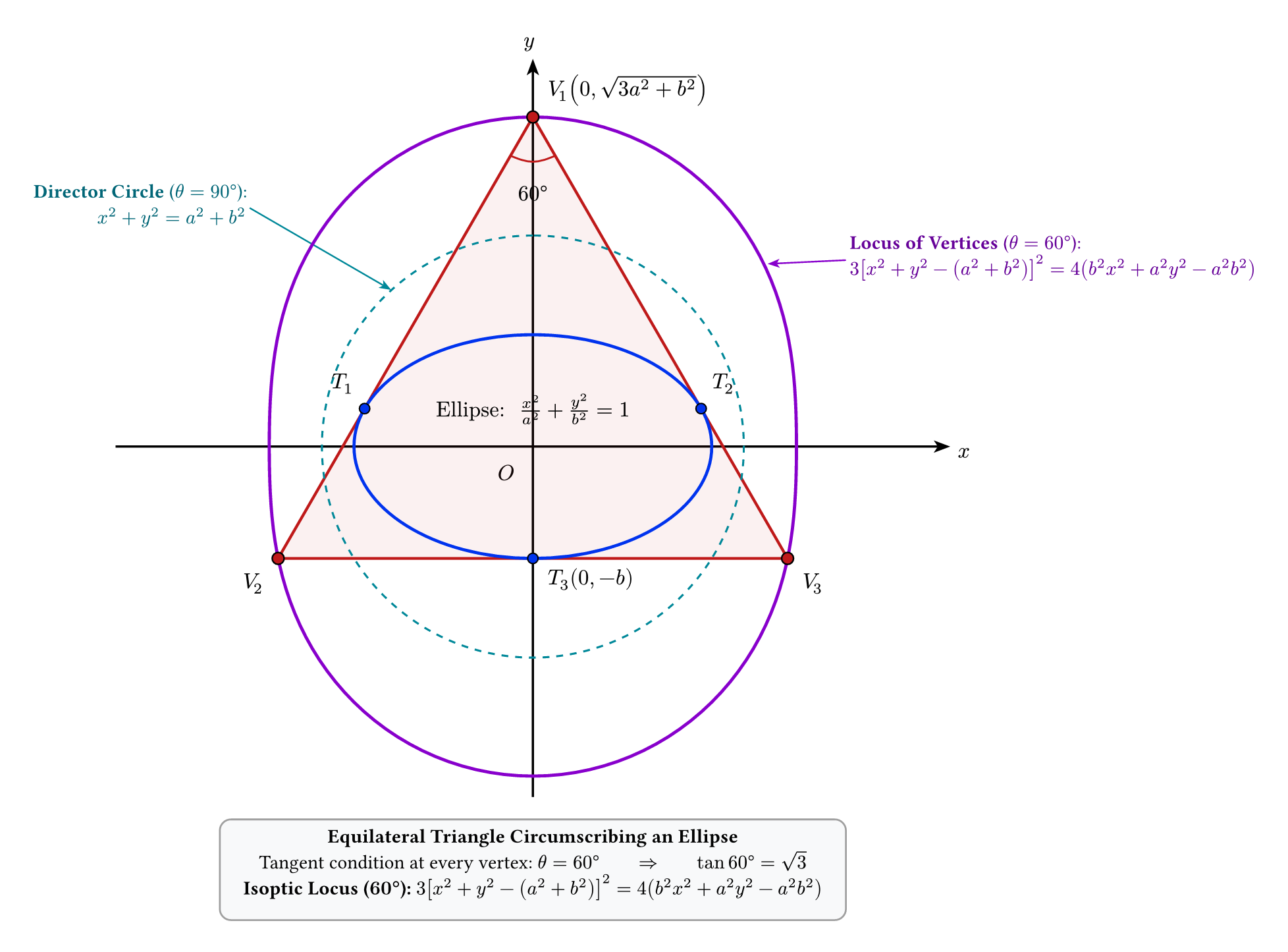
Example 9: Locus of the Vertices of an Equilateral Triangle Circumscribing an Ellipse§

An equilateral triangle circumscribes the standard ellipse:

x2a2+y2b2=1\frac{x^2}{a^2} + \frac{y^2}{b^2} = 1

Find the equation of the locus of its vertices.

Solution:

Step 1: Understand the geometric condition

When an equilateral triangle circumscribes an ellipse, each of its three straight sides is tangent to the ellipse.

In any equilateral triangle, all three interior angles are equal:

θ=60∘  ⟹  tan⁡60∘=3\theta = 60^\circ \implies \tan 60^\circ = \sqrt{3}

At each vertex P(x1,y1)P(x_1, y_1) of the triangle, two of the circumscribing sides meet. Since these sides are tangents to the ellipse drawn from PP, the angle between the pair of tangents from every vertex must be precisely 60∘60^\circ.

Step 2: Apply the angle formula between tangents

Recall the formula for the angle θ\theta between the pair of tangents drawn from any external point P(x1,y1)P(x_1, y_1) to the ellipse:

tan⁡θ=2abS1∣x12+y12−(a2+b2)∣\tan\theta = \frac{2ab\sqrt{S_1}}{|x_1^2 + y_1^2 - (a^2 + b^2)|}

where S1=x12a2+y12b2−1S_1 = \frac{x_1^2}{a^2} + \frac{y_1^2}{b^2} - 1.

Setting θ=60∘\theta = 60^\circ gives:

3=2abx12a2+y12b2−1∣x12+y12−(a2+b2)∣\sqrt{3} = \frac{2ab\sqrt{\frac{x_1^2}{a^2} + \frac{y_1^2}{b^2} - 1}}{|x_1^2 + y_1^2 - (a^2 + b^2)|}

Step 3: Square both sides and eliminate fractions

Squaring both sides eliminates the square root in the numerator and the absolute value in the denominator:

3=4a2b2(x12a2+y12b2−1)[x12+y12−(a2+b2)]23 = \frac{4a^2 b^2 \left(\frac{x_1^2}{a^2} + \frac{y_1^2}{b^2} - 1\right)}{\left[x_1^2 + y_1^2 - (a^2 + b^2)\right]^2}

Multiply both sides by [x12+y12−(a2+b2)]2\left[x_1^2 + y_1^2 - (a^2 + b^2)\right]^2:

3[x12+y12−(a2+b2)]2=4a2b2(x12a2+y12b2−1)3\left[x_1^2 + y_1^2 - (a^2 + b^2)\right]^2 = 4a^2 b^2 \left(\frac{x_1^2}{a^2} + \frac{y_1^2}{b^2} - 1\right)

Expand the right-hand side:

4a2b2(x12a2+y12b2−1)=4(b2x12+a2y12−a2b2)4a^2 b^2 \left(\frac{x_1^2}{a^2} + \frac{y_1^2}{b^2} - 1\right) = 4\left(b^2 x_1^2 + a^2 y_1^2 - a^2 b^2\right)

Therefore:

3[x12+y12−(a2+b2)]2=4(b2x12+a2y12−a2b2)3\left[x_1^2 + y_1^2 - (a^2 + b^2)\right]^2 = 4\left(b^2 x_1^2 + a^2 y_1^2 - a^2 b^2\right)

Step 4: State the locus equation

Replacing (x1,y1)(x_1, y_1) with the running coordinates (x,y)(x, y), the locus of the vertices is:

3[x2+y2−(a2+b2)]2=4(b2x2+a2y2−a2b2)3\left[x^2 + y^2 - (a^2 + b^2)\right]^2 = 4\left(b^2 x^2 + a^2 y^2 - a^2 b^2\right)

Geometric Insights: The Isoptic Curve§

Equilateral Triangle Circumscribing an Ellipse

This locus is an algebraic curve of degree 4 (a quartic curve), known geometrically as an isoptic curve (the locus of points from which a given curve is seen under a constant angle).

1. Comparison with the Director Circle:

For θ=90∘\theta = 90^\circ, the tangents are perpendicular, and the locus is the familiar director circle:

x2+y2=a2+b2x^2 + y^2 = a^2 + b^2

Because 60∘<90∘60^\circ < 90^\circ, viewing the ellipse under the smaller angle of 60∘60^\circ requires standing further away from the curve. As shown in the figure, the 60∘60^\circ locus curve encloses both the ellipse and its director circle everywhere.

2. The Special Case of a Circle (a=ba = b):

If the ellipse becomes a circle of radius aa (b=ab = a), substitute b=ab = a into the locus equation:

3[x2+y2−2a2]2=4(a2x2+a2y2−a4)3\left[x^2 + y^2 - 2a^2\right]^2 = 4\left(a^2 x^2 + a^2 y^2 - a^4\right) 3[x2+y2−2a2]2=4a2(x2+y2−a2)3\left[x^2 + y^2 - 2a^2\right]^2 = 4a^2\left(x^2 + y^2 - a^2\right)

Let r2=x2+y2r^2 = x^2 + y^2, where rr is the distance from the origin:

3(r2−2a2)2=4a2(r2−a2)3(r^2 - 2a^2)^2 = 4a^2(r^2 - a^2) 3(r4−4a2r2+4a4)=4a2r2−4a43(r^4 - 4a^2 r^2 + 4a^4) = 4a^2 r^2 - 4a^4 3r4−12a2r2+12a4=4a2r2−4a43r^4 - 12a^2 r^2 + 12a^4 = 4a^2 r^2 - 4a^4 3r4−16a2r2+16a4=03r^4 - 16a^2 r^2 + 16a^4 = 0

Factorizing this quadratic in r2r^2:

(r2−4a2)(3r2−4a2)=0(r^2 - 4a^2)(3r^2 - 4a^2) = 0

Since the vertices of the circumscribing equilateral triangle lie outside the director circle (r>a2r > a\sqrt{2}), we select the root:

r2=4a2  ⟹  r=2ar^2 = 4a^2 \implies r = 2a

This yields the concentric circle:

x2+y2=4a2=(2a)2x^2 + y^2 = 4a^2 = (2a)^2

This matches the standard Euclidean theorem: the circumradius RR of an equilateral triangle circumscribing an incircle of radius rin=ar_{\text{in}} = a is exactly:

R=2rin=2aR = 2r_{\text{in}} = 2a

3. Direct Verification with a Specific Triangle:

Consider an equilateral triangle whose horizontal base is tangent to the ellipse at the bottom vertex T3(0,−b)T_3(0, -b), so its base line is y=−by = -b.

The two inclined sides must have slopes m=±tan⁡60∘=±3m = \pm\tan 60^\circ = \pm\sqrt{3}. Tangents to the upper half of the ellipse with slopes ±3\pm\sqrt{3} are:

y=3x+3a2+b2y = \sqrt{3}x + \sqrt{3a^2 + b^2} y=−3x+3a2+b2y = -\sqrt{3}x + \sqrt{3a^2 + b^2}

These two tangent lines intersect at the top vertex:

V1(0,  3a2+b2)V_1\left(0, \; \sqrt{3a^2 + b^2}\right)

Let us verify that V1V_1 satisfies our locus equation:

At V1V_1, x=0x = 0 and y2=3a2+b2y^2 = 3a^2 + b^2, so x2+y2=3a2+b2x^2 + y^2 = 3a^2 + b^2:

LHS=3[(3a2+b2)−(a2+b2)]2=3(2a2)2=3(4a4)=12a4\text{LHS} = 3\left[(3a^2 + b^2) - (a^2 + b^2)\right]^2 = 3\left(2a^2\right)^2 = 3(4a^4) = 12a^4 RHS=4[b2(0)+a2(3a2+b2)−a2b2]=4[3a4]=12a4\text{RHS} = 4\left[b^2(0) + a^2(3a^2 + b^2) - a^2 b^2\right] = 4\left[3a^4\right] = 12a^4

Since LHS=RHS\text{LHS} = \text{RHS}, vertex V1V_1 lies precisely on the locus.

Similarly, intersecting the base line y=−by = -b with the two inclined tangents yields the other two base vertices:

V2(−b+3a2+b23,  −b),V3(b+3a2+b23,  −b)V_2\left(-\frac{b + \sqrt{3a^2 + b^2}}{\sqrt{3}}, \; -b\right), \qquad V_3\left(\frac{b + \sqrt{3a^2 + b^2}}{\sqrt{3}}, \; -b\right)

Substituting the coordinates of V2V_2 and V3V_3 into the locus equation also yields identical equality on both sides, confirming that all three vertices of the circumscribing equilateral triangle lie on this locus curve.

Section 8 of 13 · Ellipse

Mark this section complete when you have worked through its proofs.