Introduction§
In the previous chapters, we analyzed tangents, normals, and chords of contact. In all those cases, the line was determined by a point lying either on the curve (point of contact) or outside the curve (point from which tangents are drawn).
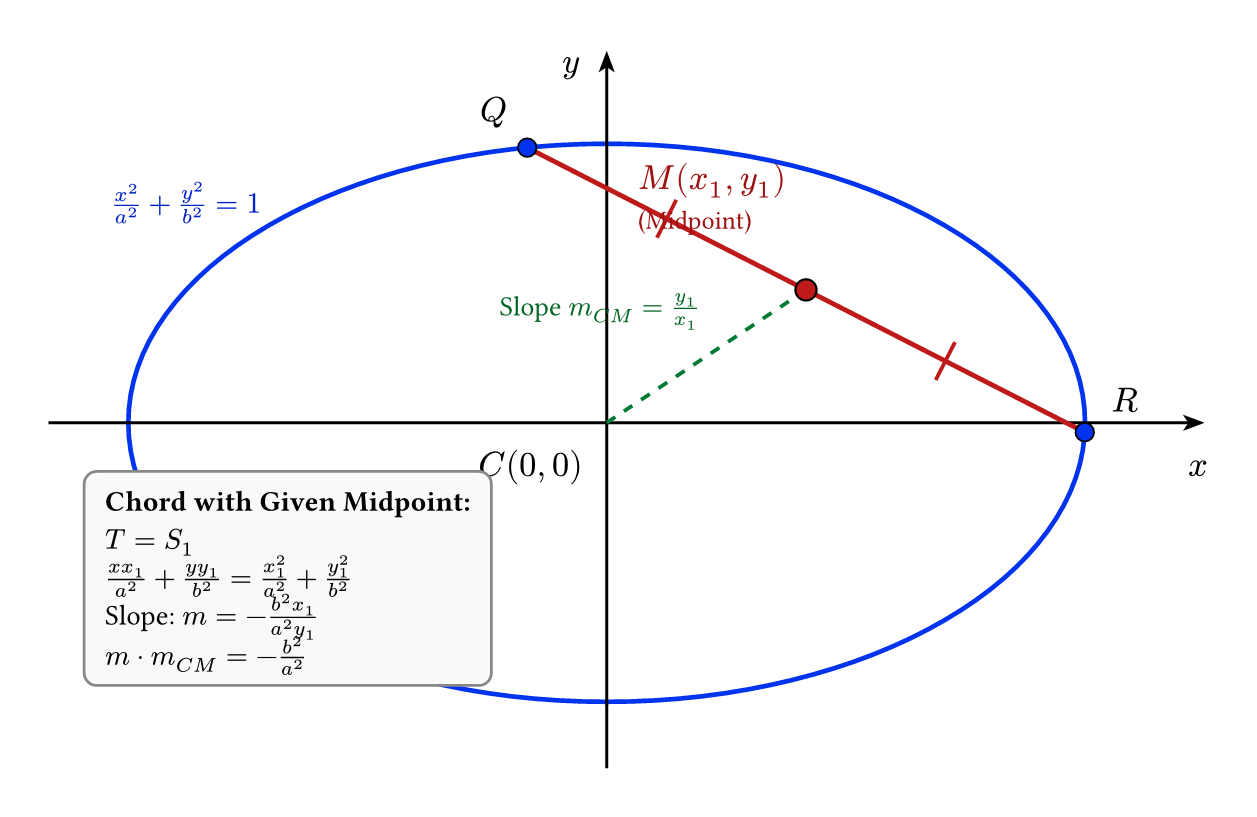
Now, we investigate what happens when a point M ( x 1 , y 1 ) M(x_1, y_1) M ( x 1 , y 1 ) inside the ellipse. If we draw various straight lines through M M M M M M midpoint .
Understanding chords with a given midpoint unlocks one of the most elegant geometric structures of the ellipse:
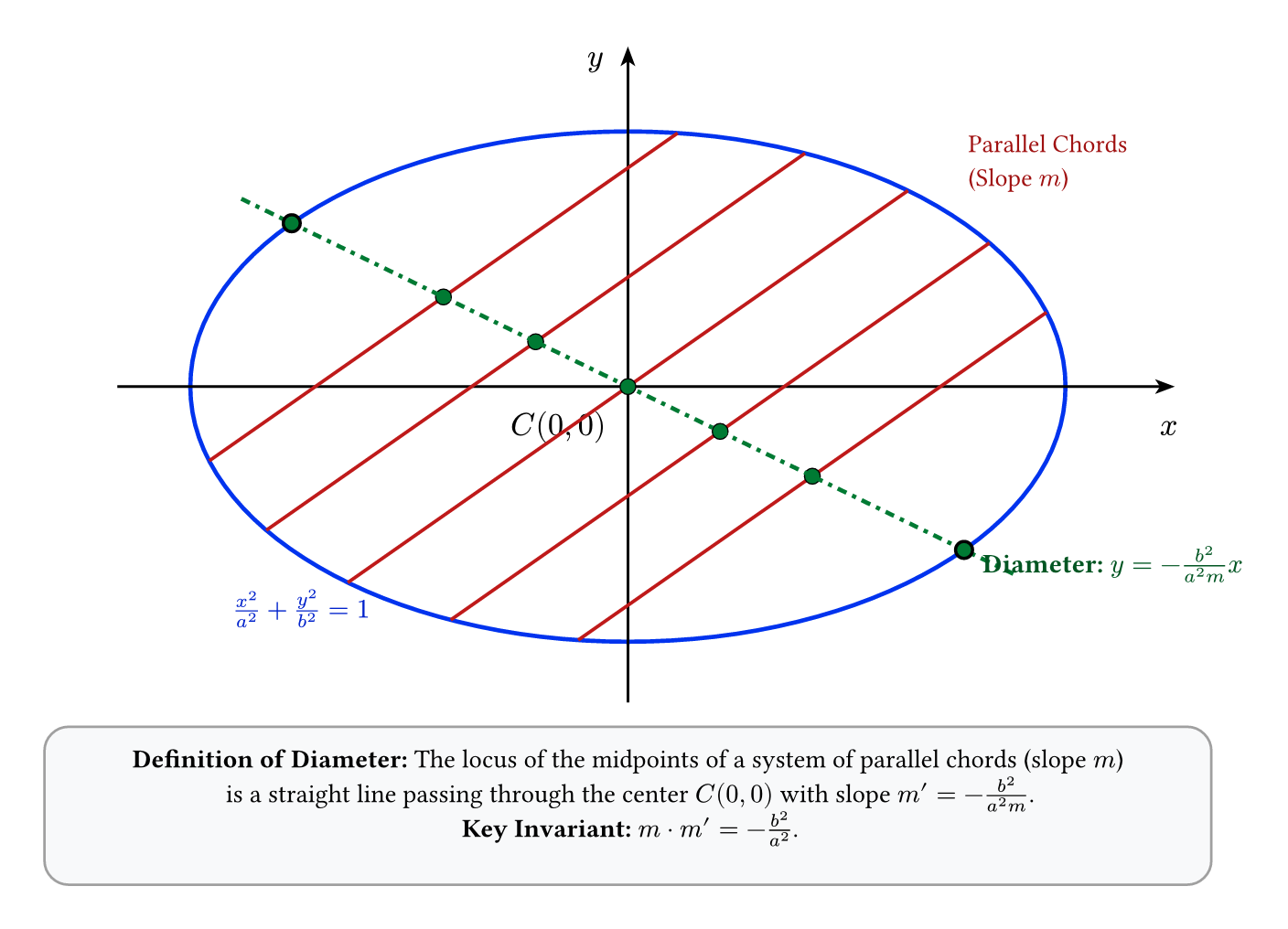
When we collect the midpoints of a whole family of parallel chords, they line up along a straight line passing through the center called a diameter .
When two diameters are paired such that each bisects chords parallel to the other, they are called conjugate diameters .
Let us develop these concepts step by step.
Chord with a Given Midpoint§
Consider the standard ellipse:
x 2 a 2 + y 2 b 2 = 1 ( a > b > 0 ) \frac{x^2}{a^2} + \frac{y^2}{b^2} = 1 \qquad (a > b > 0) a 2 x 2 + b 2 y 2 = 1 ( a > b > 0 ) Let M ( x 1 , y 1 ) M(x_1, y_1) M ( x 1 , y 1 ) Q R QR QR M ( x 1 , y 1 ) M(x_1, y_1) M ( x 1 , y 1 )
Derivation using Chord Endpoints§
Let the endpoints of the chord be Q ( x ′ , y ′ ) Q(x', y') Q ( x ′ , y ′ ) R ( x ′ ′ , y ′ ′ ) R(x'', y'') R ( x ′′ , y ′′ )
Since both Q Q Q R R R
( x ′ ) 2 a 2 + ( y ′ ) 2 b 2 = 1 ⋯ ( 1 ) \frac{(x')^2}{a^2} + \frac{(y')^2}{b^2} = 1 \qquad \cdots (1) a 2 ( x ′ ) 2 + b 2 ( y ′ ) 2 = 1 ⋯ ( 1 ) ( x ′ ′ ) 2 a 2 + ( y ′ ′ ) 2 b 2 = 1 ⋯ ( 2 ) \frac{(x'')^2}{a^2} + \frac{(y'')^2}{b^2} = 1 \qquad \cdots (2) a 2 ( x ′′ ) 2 + b 2 ( y ′′ ) 2 = 1 ⋯ ( 2 ) Subtracting equation (1) from equation (2):
( x ′ ′ ) 2 − ( x ′ ) 2 a 2 + ( y ′ ′ ) 2 − ( y ′ ) 2 b 2 = 0 \frac{(x'')^2 - (x')^2}{a^2} + \frac{(y'')^2 - (y')^2}{b^2} = 0 a 2 ( x ′′ ) 2 − ( x ′ ) 2 + b 2 ( y ′′ ) 2 − ( y ′ ) 2 = 0 Factor each numerator using the difference of squares:
( x ′ ′ − x ′ ) ( x ′ ′ + x ′ ) a 2 + ( y ′ ′ − y ′ ) ( y ′ ′ + y ′ ) b 2 = 0 \frac{(x'' - x')(x'' + x')}{a^2} + \frac{(y'' - y')(y'' + y')}{b^2} = 0 a 2 ( x ′′ − x ′ ) ( x ′′ + x ′ ) + b 2 ( y ′′ − y ′ ) ( y ′′ + y ′ ) = 0 Rearranging the terms:
( y ′ ′ − y ′ ) ( y ′ ′ + y ′ ) b 2 = − ( x ′ ′ − x ′ ) ( x ′ ′ + x ′ ) a 2 \frac{(y'' - y')(y'' + y')}{b^2} = -\frac{(x'' - x')(x'' + x')}{a^2} b 2 ( y ′′ − y ′ ) ( y ′′ + y ′ ) = − a 2 ( x ′′ − x ′ ) ( x ′′ + x ′ ) y ′ ′ − y ′ x ′ ′ − x ′ ⋅ y ′ ′ + y ′ b 2 = − x ′ ′ + x ′ a 2 \frac{y'' - y'}{x'' - x'} \cdot \frac{y'' + y'}{b^2} = -\frac{x'' + x'}{a^2} x ′′ − x ′ y ′′ − y ′ ⋅ b 2 y ′′ + y ′ = − a 2 x ′′ + x ′ Now, since M ( x 1 , y 1 ) M(x_1, y_1) M ( x 1 , y 1 ) Q R QR QR
x ′ + x ′ ′ 2 = x 1 ⟹ x ′ + x ′ ′ = 2 x 1 \frac{x' + x''}{2} = x_1 \implies x' + x'' = 2x_1 2 x ′ + x ′′ = x 1 ⟹ x ′ + x ′′ = 2 x 1 y ′ + y ′ ′ 2 = y 1 ⟹ y ′ + y ′ ′ = 2 y 1 \frac{y' + y''}{2} = y_1 \implies y' + y'' = 2y_1 2 y ′ + y ′′ = y 1 ⟹ y ′ + y ′′ = 2 y 1 The slope of the chord Q R QR QR m = y ′ ′ − y ′ x ′ ′ − x ′ m = \frac{y'' - y'}{x'' - x'} m = x ′′ − x ′ y ′′ − y ′
m ⋅ 2 y 1 b 2 = − 2 x 1 a 2 m \cdot \frac{2y_1}{b^2} = -\frac{2x_1}{a^2} m ⋅ b 2 2 y 1 = − a 2 2 x 1 Dividing both sides by 2 gives the slope of the chord bisected at ( x 1 , y 1 ) (x_1, y_1) ( x 1 , y 1 )
m = − b 2 x 1 a 2 y 1 m = -\frac{b^2 x_1}{a^2 y_1} m = − a 2 y 1 b 2 x 1 Now, write the equation of the line passing through M ( x 1 , y 1 ) M(x_1, y_1) M ( x 1 , y 1 ) m m m
y − y 1 = m ( x − x 1 ) ⟹ y − y 1 = − b 2 x 1 a 2 y 1 ( x − x 1 ) y - y_1 = m(x - x_1) \implies y - y_1 = -\frac{b^2 x_1}{a^2 y_1}(x - x_1) y − y 1 = m ( x − x 1 ) ⟹ y − y 1 = − a 2 y 1 b 2 x 1 ( x − x 1 ) Multiply both sides by y 1 b 2 \frac{y_1}{b^2} b 2 y 1
y 1 ( y − y 1 ) b 2 = − x 1 ( x − x 1 ) a 2 \frac{y_1(y - y_1)}{b^2} = -\frac{x_1(x - x_1)}{a^2} b 2 y 1 ( y − y 1 ) = − a 2 x 1 ( x − x 1 ) y y 1 − y 1 2 b 2 = − x x 1 − x 1 2 a 2 \frac{y y_1 - y_1^2}{b^2} = -\frac{x x_1 - x_1^2}{a^2} b 2 y y 1 − y 1 2 = − a 2 x x 1 − x 1 2 Rearranging the variables to the left-hand side and the constants to the right-hand side:
x x 1 a 2 + y y 1 b 2 = x 1 2 a 2 + y 1 2 b 2 \frac{x x_1}{a^2} + \frac{y y_1}{b^2} = \frac{x_1^2}{a^2} + \frac{y_1^2}{b^2} a 2 x x 1 + b 2 y y 1 = a 2 x 1 2 + b 2 y 1 2 Subtracting 1 1 1
( x x 1 a 2 + y y 1 b 2 − 1 ) = ( x 1 2 a 2 + y 1 2 b 2 − 1 ) \left(\frac{x x_1}{a^2} + \frac{y y_1}{b^2} - 1\right) = \left(\frac{x_1^2}{a^2} + \frac{y_1^2}{b^2} - 1\right) ( a 2 x x 1 + b 2 y y 1 − 1 ) = ( a 2 x 1 2 + b 2 y 1 2 − 1 ) Using the standard notations T = x x 1 a 2 + y y 1 b 2 − 1 T = \frac{x x_1}{a^2} + \frac{y y_1}{b^2} - 1 T = a 2 x x 1 + b 2 y y 1 − 1 S 1 = x 1 2 a 2 + y 1 2 b 2 − 1 S_1 = \frac{x_1^2}{a^2} + \frac{y_1^2}{b^2} - 1 S 1 = a 2 x 1 2 + b 2 y 1 2 − 1
T = S 1 T = S_1 T = S 1 1. Relation with the Center Line (C M C M C M
The slope of the line segment joining the center C ( 0 , 0 ) C(0, 0) C ( 0 , 0 ) M ( x 1 , y 1 ) M(x_1, y_1) M ( x 1 , y 1 )
m C M = y 1 x 1 m_{CM} = \frac{y_1}{x_1} m C M = x 1 y 1 Multiplying the slope of the chord m m m m C M m_{CM} m C M
m ⋅ m C M = ( − b 2 x 1 a 2 y 1 ) ( y 1 x 1 ) = − b 2 a 2 m \cdot m_{CM} = \left(-\frac{b^2 x_1}{a^2 y_1}\right)\left(\frac{y_1}{x_1}\right) = -\frac{b^2}{a^2} m ⋅ m C M = ( − a 2 y 1 b 2 x 1 ) ( x 1 y 1 ) = − a 2 b 2 This product is constant for any chord in a given ellipse.
2. Condition for a Real Chord:
For the chord to intersect the ellipse in two distinct real points, the midpoint M ( x 1 , y 1 ) M(x_1, y_1) M ( x 1 , y 1 ) inside the ellipse:
S 1 = x 1 2 a 2 + y 1 2 b 2 − 1 < 0 S_1 = \frac{x_1^2}{a^2} + \frac{y_1^2}{b^2} - 1 < 0 S 1 = a 2 x 1 2 + b 2 y 1 2 − 1 < 0 If S 1 = 0 S_1 = 0 S 1 = 0 M M M M M M T = 0 T = 0 T = 0 S 1 > 0 S_1 > 0 S 1 > 0 M M M
Example 1: Finding a Chord Bisected at a Given Point§
Find the equation of the chord of the ellipse x 2 36 + y 2 9 = 1 \frac{x^2}{36} + \frac{y^2}{9} = 1 36 x 2 + 9 y 2 = 1 M ( 2 , 1 ) M(2, 1) M ( 2 , 1 )
Solution:
Step 1: Check the position of M ( 2 , 1 ) M(2, 1) M ( 2 , 1 )
S 1 = 2 2 36 + 1 2 9 − 1 = 4 36 + 4 36 − 1 = 8 36 − 1 = − 7 9 < 0 S_1 = \frac{2^2}{36} + \frac{1^2}{9} - 1 = \frac{4}{36} + \frac{4}{36} - 1 = \frac{8}{36} - 1 = -\frac{7}{9} < 0 S 1 = 36 2 2 + 9 1 2 − 1 = 36 4 + 36 4 − 1 = 36 8 − 1 = − 9 7 < 0 Since S 1 < 0 S_1 < 0 S 1 < 0 ( 2 , 1 ) (2, 1) ( 2 , 1 )
Step 2: Apply the formula T = S 1 T = S_1 T = S 1
x ( 2 ) 36 + y ( 1 ) 9 = 2 2 36 + 1 2 9 \frac{x(2)}{36} + \frac{y(1)}{9} = \frac{2^2}{36} + \frac{1^2}{9} 36 x ( 2 ) + 9 y ( 1 ) = 36 2 2 + 9 1 2 x 18 + y 9 = 4 36 + 1 9 = 1 9 + 1 9 = 2 9 \frac{x}{18} + \frac{y}{9} = \frac{4}{36} + \frac{1}{9} = \frac{1}{9} + \frac{1}{9} = \frac{2}{9} 18 x + 9 y = 36 4 + 9 1 = 9 1 + 9 1 = 9 2 Multiplying the entire equation by 18 18 18
x + 2 y = 4 ⟹ x + 2 y − 4 = 0 x + 2y = 4 \implies x + 2y - 4 = 0 x + 2 y = 4 ⟹ x + 2 y − 4 = 0 Example 2: Locus of Midpoints of Chords Passing Through a Fixed Point§
Find the locus of the midpoints of all chords of the ellipse x 2 a 2 + y 2 b 2 = 1 \frac{x^2}{a^2} + \frac{y^2}{b^2} = 1 a 2 x 2 + b 2 y 2 = 1 ( h , k ) (h, k) ( h , k )
Solution:
Step 1: Write the equation of the chord with midpoint ( x 1 , y 1 ) (x_1, y_1) ( x 1 , y 1 )
Using T = S 1 T = S_1 T = S 1 ( x 1 , y 1 ) (x_1, y_1) ( x 1 , y 1 )
x x 1 a 2 + y y 1 b 2 = x 1 2 a 2 + y 1 2 b 2 \frac{x x_1}{a^2} + \frac{y y_1}{b^2} = \frac{x_1^2}{a^2} + \frac{y_1^2}{b^2} a 2 x x 1 + b 2 y y 1 = a 2 x 1 2 + b 2 y 1 2 Step 2: Impose the condition that the chord passes through ( h , k ) (h, k) ( h , k )
Substitute x = h x = h x = h y = k y = k y = k
h x 1 a 2 + k y 1 b 2 = x 1 2 a 2 + y 1 2 b 2 \frac{h x_1}{a^2} + \frac{k y_1}{b^2} = \frac{x_1^2}{a^2} + \frac{y_1^2}{b^2} a 2 h x 1 + b 2 k y 1 = a 2 x 1 2 + b 2 y 1 2 Step 3: Replace ( x 1 , y 1 ) (x_1, y_1) ( x 1 , y 1 ) ( x , y ) (x, y) ( x , y )
x 2 a 2 + y 2 b 2 = h x a 2 + k y b 2 \frac{x^2}{a^2} + \frac{y^2}{b^2} = \frac{h x}{a^2} + \frac{k y}{b^2} a 2 x 2 + b 2 y 2 = a 2 h x + b 2 k y Rearranging into standard second-degree form:
x 2 − h x a 2 + y 2 − k y b 2 = 0 ⟺ ( x − h 2 ) 2 a 2 + ( y − k 2 ) 2 b 2 = h 2 4 a 2 + k 2 4 b 2 \frac{x^2 - h x}{a^2} + \frac{y^2 - k y}{b^2} = 0 \iff \frac{\left(x - \frac{h}{2}\right)^2}{a^2} + \frac{\left(y - \frac{k}{2}\right)^2}{b^2} = \frac{h^2}{4a^2} + \frac{k^2}{4b^2} a 2 x 2 − h x + b 2 y 2 − k y = 0 ⟺ a 2 ( x − 2 h ) 2 + b 2 ( y − 2 k ) 2 = 4 a 2 h 2 + 4 b 2 k 2 This locus is another ellipse centered at ( h 2 , k 2 ) \left(\frac{h}{2}, \frac{k}{2}\right) ( 2 h , 2 k ) ( 0 , 0 ) (0, 0) ( 0 , 0 ) ( h , k ) (h, k) ( h , k )
(Special Case: If the fixed point is the focus ( a e , 0 ) (ae, 0) ( a e , 0 ) x 2 a 2 + y 2 b 2 = e x a \frac{x^2}{a^2} + \frac{y^2}{b^2} = \frac{e x}{a} a 2 x 2 + b 2 y 2 = a e x
Parallel Chords and the Definition of a Diameter§
In elementary geometry, a diameter of a circle is defined as any chord passing through the center, which always bisects all parallel chords perpendicular to it.
For an ellipse, the situation is more general and interesting.
Definition of a Diameter§
Consider a family of parallel chords of the ellipse x 2 a 2 + y 2 b 2 = 1 \frac{x^2}{a^2} + \frac{y^2}{b^2} = 1 a 2 x 2 + b 2 y 2 = 1 m m m
y = m x + c ( c varies ) y = m x + c \qquad (c \text{ varies}) y = m x + c ( c varies ) Let M ( x 1 , y 1 ) M(x_1, y_1) M ( x 1 , y 1 ) ( x 1 , y 1 ) (x_1, y_1) ( x 1 , y 1 )
m = − b 2 x 1 a 2 y 1 m = -\frac{b^2 x_1}{a^2 y_1} m = − a 2 y 1 b 2 x 1 Rearranging this formula to express y 1 y_1 y 1 x 1 x_1 x 1
y 1 = − ( b 2 a 2 m ) x 1 y_1 = -\left(\frac{b^2}{a^2 m}\right)x_1 y 1 = − ( a 2 m b 2 ) x 1 Replacing ( x 1 , y 1 ) (x_1, y_1) ( x 1 , y 1 ) ( x , y ) (x, y) ( x , y )
y = − ( b 2 a 2 m ) x y = -\left(\frac{b^2}{a^2 m}\right)x y = − ( a 2 m b 2 ) x Notice two fundamental facts about this equation:
It is a straight line of degree 1.
It has no constant term (c = 0 c = 0 c = 0 always passes through the center C ( 0 , 0 ) C(0, 0) C ( 0 , 0 )
Therefore, we have the formal definition:
Definition of a Diameter:
The locus of the midpoints of a system of parallel chords of an ellipse is a straight line passing through the center of the ellipse. This chord passing through the center is called a diameter .
Slope of the Diameter§
If the parallel chords have slope m m m m ′ m' m ′
m ′ = − b 2 a 2 m ⟺ m ⋅ m ′ = − b 2 a 2 m' = -\frac{b^2}{a^2 m} \iff m \cdot m' = -\frac{b^2}{a^2} m ′ = − a 2 m b 2 ⟺ m ⋅ m ′ = − a 2 b 2
For a circle (a = b a = b a = b m ⋅ m ′ = − 1 m \cdot m' = -1 m ⋅ m ′ = − 1
For an ellipse (a ≠ b a \neq b a = b m ⋅ m ′ = − b 2 a 2 ≠ − 1 m \cdot m' = -\frac{b^2}{a^2} \neq -1 m ⋅ m ′ = − a 2 b 2 = − 1 not perpendicular to the chords it bisects, unless the chords are parallel to the major axis (m = 0 ⟹ m ′ = ∞ m = 0 \implies m' = \infty m = 0 ⟹ m ′ = ∞ m = ∞ ⟹ m ′ = 0 m = \infty \implies m' = 0 m = ∞ ⟹ m ′ = 0
Conjugate Diameters§
Now consider the reciprocal question:
What happens if we take a new system of parallel chords, this time parallel to the diameter y = m ′ x y = m' x y = m ′ x
The slope of these new chords is m ′ m' m ′ m ′ ′ m'' m ′′
m ′ ′ = − b 2 a 2 m ′ m'' = -\frac{b^2}{a^2 m'} m ′′ = − a 2 m ′ b 2 Substituting m ′ = − b 2 a 2 m m' = -\frac{b^2}{a^2 m} m ′ = − a 2 m b 2
m ′ ′ = − b 2 a 2 ( − b 2 a 2 m ) = m m'' = -\frac{b^2}{a^2 \left(-\frac{b^2}{a^2 m}\right)} = m m ′′ = − a 2 ( − a 2 m b 2 ) b 2 = m The diameter bisecting chords parallel to the second diameter is precisely the first diameter!
Each diameter bisects all chords parallel to the other.
Definition of Conjugate Diameters:
Two diameters of an ellipse are called conjugate diameters if each bisects all chords parallel to the other.
Condition for Two Diameters to be Conjugate§
If two diameters y = m 1 x y = m_1 x y = m 1 x y = m 2 x y = m_2 x y = m 2 x
m 1 m 2 = − b 2 a 2 m_1 m_2 = -\frac{b^2}{a^2} m 1 m 2 = − a 2 b 2 The major axis (y = 0 y = 0 y = 0 0 0 0 x = 0 x = 0 x = 0 ∞ \infty ∞ principal conjugate axes .
Let P C P ′ P C P' P C P ′ D C D ′ D C D' D C D ′ x 2 a 2 + y 2 b 2 = 1 \frac{x^2}{a^2} + \frac{y^2}{b^2} = 1 a 2 x 2 + b 2 y 2 = 1
Relation Between Eccentric Angles§
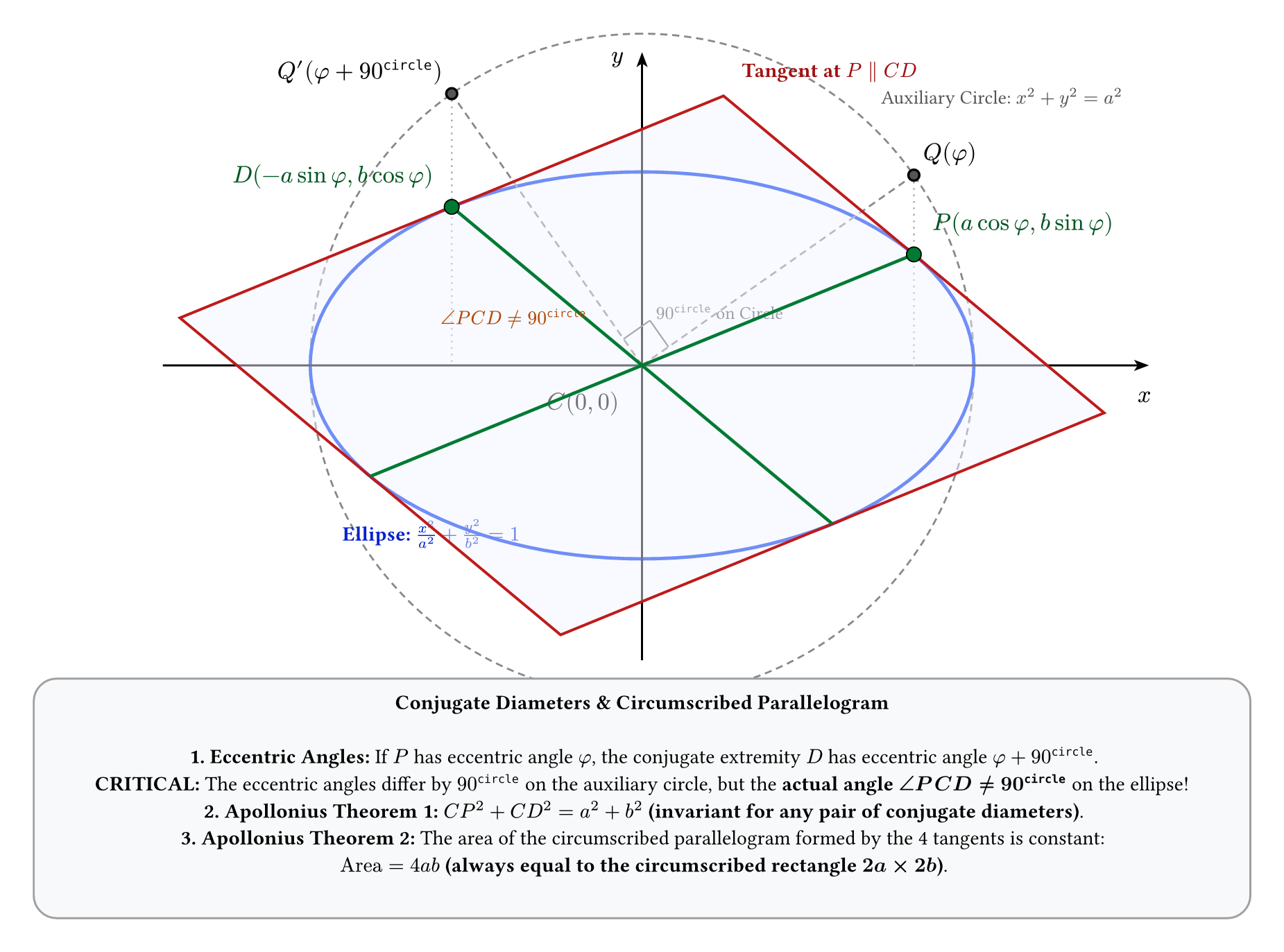
Let P P P ϕ \phi ϕ P P P
P ( a cos ϕ , b sin ϕ ) P(a\cos\phi, \; b\sin\phi) P ( a cos ϕ , b sin ϕ ) The slope of the diameter C P C P C P C ( 0 , 0 ) C(0, 0) C ( 0 , 0 ) P P P
m 1 = b sin ϕ − 0 a cos ϕ − 0 = b a tan ϕ m_1 = \frac{b\sin\phi - 0}{a\cos\phi - 0} = \frac{b}{a}\tan\phi m 1 = a cos ϕ − 0 b sin ϕ − 0 = a b tan ϕ Since the diameter C D C D C D C P C P C P m 2 m_2 m 2 m 1 m 2 = − b 2 a 2 m_1 m_2 = -\frac{b^2}{a^2} m 1 m 2 = − a 2 b 2
( b a tan ϕ ) m 2 = − b 2 a 2 ⟹ m 2 = − b a cot ϕ \left(\frac{b}{a}\tan\phi\right) m_2 = -\frac{b^2}{a^2} \implies m_2 = -\frac{b}{a}\cot\phi ( a b tan ϕ ) m 2 = − a 2 b 2 ⟹ m 2 = − a b cot ϕ Using the trigonometric identity − cot ϕ = tan ( ϕ + π 2 ) -\cot\phi = \tan\left(\phi + \frac{\pi}{2}\right) − cot ϕ = tan ( ϕ + 2 π )
m 2 = b a tan ( ϕ + π 2 ) m_2 = \frac{b}{a}\tan\left(\phi + \frac{\pi}{2}\right) m 2 = a b tan ( ϕ + 2 π ) Therefore, if the eccentric angle of P P P ϕ \phi ϕ D D D
ϕ ′ = ϕ + π 2 ( or ϕ − π 2 ) \phi' = \phi + \frac{\pi}{2} \qquad \left(\text{or } \phi - \frac{\pi}{2}\right) ϕ ′ = ϕ + 2 π ( or ϕ − 2 π ) Substituting ϕ + π 2 \phi + \frac{\pi}{2} ϕ + 2 π D D D
x D = a cos ( ϕ + π 2 ) = − a sin ϕ x_D = a\cos\left(\phi + \frac{\pi}{2}\right) = -a\sin\phi x D = a cos ( ϕ + 2 π ) = − a sin ϕ y D = b sin ( ϕ + π 2 ) = b cos ϕ y_D = b\sin\left(\phi + \frac{\pi}{2}\right) = b\cos\phi y D = b sin ( ϕ + 2 π ) = b cos ϕ Thus, the extremities of a pair of semi-conjugate diameters are:
P ( a cos ϕ , b sin ϕ ) and D ( − a sin ϕ , b cos ϕ ) P(a\cos\phi, \; b\sin\phi) \qquad \text{and} \qquad D(-a\sin\phi, \; b\cos\phi) P ( a cos ϕ , b sin ϕ ) and D ( − a sin ϕ , b cos ϕ ) The opposite extremities are P ′ ( − a cos ϕ , − b sin ϕ ) P'(-a\cos\phi, -b\sin\phi) P ′ ( − a cos ϕ , − b sin ϕ ) D ′ ( a sin ϕ , − b cos ϕ ) D'(a\sin\phi, -b\cos\phi) D ′ ( a sin ϕ , − b cos ϕ )
Essential Geometric Distinction: Eccentric Angle vs Actual Angle§
[!WARNING] Common Misconception
The difference between the eccentric angles of P P P D D D 90 ∘ 90^\circ 9 0 ∘ π 2 \frac{\pi}{2} 2 π
However, the actual geometric angle between the lines C P C P C P C D C D C D 90 ∘ 90^\circ 9 0 ∘
Let us verify why:
The eccentric angle ϕ \phi ϕ auxiliary circle x 2 + y 2 = a 2 x^2 + y^2 = a^2 x 2 + y 2 = a 2
On the auxiliary circle, the radii C Q C Q C Q C Q ′ C Q' C Q ′ ∠ Q C Q ′ = 90 ∘ \angle Q C Q' = 90^\circ ∠ QC Q ′ = 9 0 ∘
But on the ellipse, the y y y b a \frac{b}{a} a b
The actual angle θ = ∠ P C D \theta = \angle P C D θ = ∠ P C D C P C P C P C D C D C D
tan θ = ∣ m 2 − m 1 1 + m 1 m 2 ∣ = ∣ − b a cot ϕ − b a tan ϕ 1 − b 2 a 2 ∣ = b a ( tan ϕ + cot ϕ ) 1 − b 2 a 2 = 2 a b ( a 2 − b 2 ) sin 2 ϕ \tan\theta = \left|\frac{m_2 - m_1}{1 + m_1 m_2}\right| = \left|\frac{-\frac{b}{a}\cot\phi - \frac{b}{a}\tan\phi}{1 - \frac{b^2}{a^2}}\right| = \frac{\frac{b}{a}(\tan\phi + \cot\phi)}{1 - \frac{b^2}{a^2}} = \frac{2ab}{(a^2 - b^2)\sin 2\phi} tan θ = 1 + m 1 m 2 m 2 − m 1 = 1 − a 2 b 2 − a b cot ϕ − a b tan ϕ = 1 − a 2 b 2 a b ( tan ϕ + cot ϕ ) = ( a 2 − b 2 ) sin 2 ϕ 2 ab Since a ≠ b a \neq b a = b ( a 2 − b 2 ) sin 2 ϕ (a^2 - b^2)\sin 2\phi ( a 2 − b 2 ) sin 2 ϕ tan θ ≠ ∞ \tan\theta \neq \infty tan θ = ∞ θ ≠ 90 ∘ \theta \neq 90^\circ θ = 9 0 ∘
Important Properties and Invariant Theorems§
Conjugate diameters satisfy several classical theorems discovered by the ancient geometer Apollonius.
Property 1: Sum of Squares of Conjugate Semi-Diameters is Constant§
Apollonius's First Theorem:
For any pair of conjugate semi-diameters C P C P C P C D C D C D
C P 2 + C D 2 = a 2 + b 2 C P^2 + C D^2 = a^2 + b^2 C P 2 + C D 2 = a 2 + b 2
Proof:
Using the coordinates P ( a cos ϕ , b sin ϕ ) P(a\cos\phi, b\sin\phi) P ( a cos ϕ , b sin ϕ ) D ( − a sin ϕ , b cos ϕ ) D(-a\sin\phi, b\cos\phi) D ( − a sin ϕ , b cos ϕ )
C P 2 = ( a cos ϕ ) 2 + ( b sin ϕ ) 2 = a 2 cos 2 ϕ + b 2 sin 2 ϕ C P^2 = (a\cos\phi)^2 + (b\sin\phi)^2 = a^2\cos^2\phi + b^2\sin^2\phi C P 2 = ( a cos ϕ ) 2 + ( b sin ϕ ) 2 = a 2 cos 2 ϕ + b 2 sin 2 ϕ C D 2 = ( − a sin ϕ ) 2 + ( b cos ϕ ) 2 = a 2 sin 2 ϕ + b 2 cos 2 ϕ C D^2 = (-a\sin\phi)^2 + (b\cos\phi)^2 = a^2\sin^2\phi + b^2\cos^2\phi C D 2 = ( − a sin ϕ ) 2 + ( b cos ϕ ) 2 = a 2 sin 2 ϕ + b 2 cos 2 ϕ Adding the two equations:
C P 2 + C D 2 = a 2 ( cos 2 ϕ + sin 2 ϕ ) + b 2 ( sin 2 ϕ + cos 2 ϕ ) C P^2 + C D^2 = a^2(\cos^2\phi + \sin^2\phi) + b^2(\sin^2\phi + \cos^2\phi) C P 2 + C D 2 = a 2 ( cos 2 ϕ + sin 2 ϕ ) + b 2 ( sin 2 ϕ + cos 2 ϕ ) Since cos 2 ϕ + sin 2 ϕ = 1 \cos^2\phi + \sin^2\phi = 1 cos 2 ϕ + sin 2 ϕ = 1
C P 2 + C D 2 = a 2 ( 1 ) + b 2 ( 1 ) = a 2 + b 2 C P^2 + C D^2 = a^2(1) + b^2(1) = a^2 + b^2 C P 2 + C D 2 = a 2 ( 1 ) + b 2 ( 1 ) = a 2 + b 2 Even as P P P C P C P C P C D C D C D
Property 2: Tangents at the Ends of One Diameter are Parallel to the Conjugate Diameter§
The equation of the tangent at P ( a cos ϕ , b sin ϕ ) P(a\cos\phi, b\sin\phi) P ( a cos ϕ , b sin ϕ )
x cos ϕ a + y sin ϕ b = 1 \frac{x\cos\phi}{a} + \frac{y\sin\phi}{b} = 1 a x cos ϕ + b y sin ϕ = 1 The slope of this tangent line is:
m tangent at P = − cos ϕ / a sin ϕ / b = − b a cot ϕ m_{\text{tangent at } P} = -\frac{\cos\phi/a}{\sin\phi/b} = -\frac{b}{a}\cot\phi m tangent at P = − sin ϕ / b cos ϕ / a = − a b cot ϕ Notice that this is identical to the slope m 2 m_2 m 2 C D C D C D
Therefore:
The tangents at the extremities P P P P ′ P' P ′ P C P ′ P C P' P C P ′ D C D ′ D C D' D C D ′
Similarly, the tangents at D D D D ′ D' D ′ P C P ′ P C P' P C P ′
Property 3: Area of the Circumscribed Parallelogram is Constant§
Apollonius's Second Theorem:
The area of the parallelogram formed by the tangents drawn at the ends of any pair of conjugate diameters is constant and equal to 4 a b 4ab 4 ab
Proof:
The tangents drawn at the four extremities P , P ′ , D , D ′ P, P', D, D' P , P ′ , D , D ′
The center C ( 0 , 0 ) C(0, 0) C ( 0 , 0 )
Consider Δ C P D \Delta C P D Δ C P D C ( 0 , 0 ) C(0, 0) C ( 0 , 0 ) P ( a cos ϕ , b sin ϕ ) P(a\cos\phi, b\sin\phi) P ( a cos ϕ , b sin ϕ ) D ( − a sin ϕ , b cos ϕ ) D(-a\sin\phi, b\cos\phi) D ( − a sin ϕ , b cos ϕ )
Area ( Δ C P D ) = 1 2 ∣ x P y D − x D y P ∣ \text{Area}(\Delta C P D) = \frac{1}{2}|x_P y_D - x_D y_P| Area ( Δ C P D ) = 2 1 ∣ x P y D − x D y P ∣ Substitute the coordinates:
Area ( Δ C P D ) = 1 2 ∣ ( a cos ϕ ) ( b cos ϕ ) − ( − a sin ϕ ) ( b sin ϕ ) ∣ = 1 2 ∣ a b cos 2 ϕ + a b sin 2 ϕ ∣ \text{Area}(\Delta C P D) = \frac{1}{2}|(a\cos\phi)(b\cos\phi) - (-a\sin\phi)(b\sin\phi)| = \frac{1}{2}|ab\cos^2\phi + ab\sin^2\phi| Area ( Δ C P D ) = 2 1 ∣ ( a cos ϕ ) ( b cos ϕ ) − ( − a sin ϕ ) ( b sin ϕ ) ∣ = 2 1 ∣ ab cos 2 ϕ + ab sin 2 ϕ ∣ Area ( Δ C P D ) = 1 2 a b ( cos 2 ϕ + sin 2 ϕ ) = 1 2 a b \text{Area}(\Delta C P D) = \frac{1}{2}ab(\cos^2\phi + \sin^2\phi) = \frac{1}{2}ab Area ( Δ C P D ) = 2 1 ab ( cos 2 ϕ + sin 2 ϕ ) = 2 1 ab The total area of the parallelogram is four times the area of Δ C P D \Delta C P D Δ C P D Δ C P D \Delta C P D Δ C P D
Area of Parallelogram = 4 × ( 2 × Area ( Δ C P D ) ) = 4 a b \text{Area of Parallelogram} = 4 \times (2 \times \text{Area}(\Delta C P D)) = 4ab Area of Parallelogram = 4 × ( 2 × Area ( Δ C P D )) = 4 ab Thus, no matter which pair of conjugate diameters is chosen, the area of the circumscribed parallelogram is always 4 a b 4ab 4 ab
Property 4: Product of Focal Distances in Terms of Conjugate Diameters§
For any point P ( a cos ϕ , b sin ϕ ) P(a\cos\phi, b\sin\phi) P ( a cos ϕ , b sin ϕ )
S P = a − e a cos ϕ = a ( 1 − e cos ϕ ) S P = a - e a\cos\phi = a(1 - e\cos\phi) S P = a − e a cos ϕ = a ( 1 − e cos ϕ ) S ′ P = a + e a cos ϕ = a ( 1 + e cos ϕ ) S' P = a + e a\cos\phi = a(1 + e\cos\phi) S ′ P = a + e a cos ϕ = a ( 1 + e cos ϕ ) Multiplying the two focal distances:
S P ⋅ S ′ P = a 2 ( 1 − e 2 cos 2 ϕ ) = a 2 − a 2 e 2 cos 2 ϕ S P \cdot S' P = a^2(1 - e^2\cos^2\phi) = a^2 - a^2 e^2\cos^2\phi S P ⋅ S ′ P = a 2 ( 1 − e 2 cos 2 ϕ ) = a 2 − a 2 e 2 cos 2 ϕ Substitute a 2 e 2 = a 2 − b 2 a^2 e^2 = a^2 - b^2 a 2 e 2 = a 2 − b 2
S P ⋅ S ′ P = a 2 − ( a 2 − b 2 ) cos 2 ϕ = a 2 ( 1 − cos 2 ϕ ) + b 2 cos 2 ϕ = a 2 sin 2 ϕ + b 2 cos 2 ϕ S P \cdot S' P = a^2 - (a^2 - b^2)\cos^2\phi = a^2(1 - \cos^2\phi) + b^2\cos^2\phi = a^2\sin^2\phi + b^2\cos^2\phi S P ⋅ S ′ P = a 2 − ( a 2 − b 2 ) cos 2 ϕ = a 2 ( 1 − cos 2 ϕ ) + b 2 cos 2 ϕ = a 2 sin 2 ϕ + b 2 cos 2 ϕ Looking at the length of the conjugate semi-diameter C D C D C D
C D 2 = ( − a sin ϕ ) 2 + ( b cos ϕ ) 2 = a 2 sin 2 ϕ + b 2 cos 2 ϕ C D^2 = (-a\sin\phi)^2 + (b\cos\phi)^2 = a^2\sin^2\phi + b^2\cos^2\phi C D 2 = ( − a sin ϕ ) 2 + ( b cos ϕ ) 2 = a 2 sin 2 ϕ + b 2 cos 2 ϕ Therefore:
C D 2 = S P ⋅ S ′ P ⟺ C D = S P ⋅ S ′ P C D^2 = S P \cdot S' P \iff C D = \sqrt{S P \cdot S' P} C D 2 = S P ⋅ S ′ P ⟺ C D = S P ⋅ S ′ P The length of the semi-diameter C D C D C D C P C P C P geometric mean of the focal distances of P P P
Property 5: Equi-Conjugate Diameters§
When a pair of conjugate semi-diameters have equal lengths (C P = C D C P = C D C P = C D equi-conjugate diameters .
Setting C P 2 = C D 2 C P^2 = C D^2 C P 2 = C D 2
a 2 cos 2 ϕ + b 2 sin 2 ϕ = a 2 sin 2 ϕ + b 2 cos 2 ϕ a^2\cos^2\phi + b^2\sin^2\phi = a^2\sin^2\phi + b^2\cos^2\phi a 2 cos 2 ϕ + b 2 sin 2 ϕ = a 2 sin 2 ϕ + b 2 cos 2 ϕ ( a 2 − b 2 ) cos 2 ϕ − ( a 2 − b 2 ) sin 2 ϕ = 0 ⟹ ( a 2 − b 2 ) ( cos 2 ϕ − sin 2 ϕ ) = 0 (a^2 - b^2)\cos^2\phi - (a^2 - b^2)\sin^2\phi = 0 \implies (a^2 - b^2)(\cos^2\phi - \sin^2\phi) = 0 ( a 2 − b 2 ) cos 2 ϕ − ( a 2 − b 2 ) sin 2 ϕ = 0 ⟹ ( a 2 − b 2 ) ( cos 2 ϕ − sin 2 ϕ ) = 0 Since a ≠ b a \neq b a = b
cos 2 ϕ = 0 ⟹ 2 ϕ = π 2 , 3 π 2 ⟹ ϕ = π 4 , 3 π 4 \cos 2\phi = 0 \implies 2\phi = \frac{\pi}{2}, \frac{3\pi}{2} \implies \phi = \frac{\pi}{4}, \frac{3\pi}{4} cos 2 ϕ = 0 ⟹ 2 ϕ = 2 π , 2 3 π ⟹ ϕ = 4 π , 4 3 π Substituting ϕ = π 4 = 45 ∘ \phi = \frac{\pi}{4} = 45^\circ ϕ = 4 π = 4 5 ∘
1. Length of Equi-Conjugate Diameters:
Using Apollonius's First Theorem C P 2 + C D 2 = a 2 + b 2 C P^2 + C D^2 = a^2 + b^2 C P 2 + C D 2 = a 2 + b 2
2 C P 2 = a 2 + b 2 ⟹ C P = C D = a 2 + b 2 2 2 C P^2 = a^2 + b^2 \implies C P = C D = \sqrt{\frac{a^2 + b^2}{2}} 2 C P 2 = a 2 + b 2 ⟹ C P = C D = 2 a 2 + b 2 2. Equations of Equi-Conjugate Diameters:
At ϕ = 45 ∘ \phi = 45^\circ ϕ = 4 5 ∘ C P C P C P m 1 = b a tan 45 ∘ = b a m_1 = \frac{b}{a}\tan 45^\circ = \frac{b}{a} m 1 = a b tan 4 5 ∘ = a b C D C D C D m 2 = − b a cot 45 ∘ = − b a m_2 = -\frac{b}{a}\cot 45^\circ = -\frac{b}{a} m 2 = − a b cot 4 5 ∘ = − a b
Thus, the equations of the equi-conjugate diameters are:
y = b a x and y = − b a x ⟺ x 2 a 2 − y 2 b 2 = 0 y = \frac{b}{a}x \qquad \text{and} \qquad y = -\frac{b}{a}x \iff \frac{x^2}{a^2} - \frac{y^2}{b^2} = 0 y = a b x and y = − a b x ⟺ a 2 x 2 − b 2 y 2 = 0 These are precisely the diagonals of the rectangle circumscribing the ellipse!
Worked Examples§
Example 3: Finding the Conjugate Diameter§
For the ellipse x 2 16 + y 2 4 = 1 \frac{x^2}{16} + \frac{y^2}{4} = 1 16 x 2 + 4 y 2 = 1 y = 1 4 x y = \frac{1}{4}x y = 4 1 x
Solution:
Step 1: Find the slope of the conjugate diameter
Here a 2 = 16 a^2 = 16 a 2 = 16 b 2 = 4 b^2 = 4 b 2 = 4 m 1 = 1 4 m_1 = \frac{1}{4} m 1 = 4 1
Using the conjugacy condition m 1 m 2 = − b 2 a 2 m_1 m_2 = -\frac{b^2}{a^2} m 1 m 2 = − a 2 b 2
( 1 4 ) m 2 = − 4 16 = − 1 4 ⟹ m 2 = − 1 \left(\frac{1}{4}\right) m_2 = -\frac{4}{16} = -\frac{1}{4} \implies m_2 = -1 ( 4 1 ) m 2 = − 16 4 = − 4 1 ⟹ m 2 = − 1 So the equation of the conjugate diameter is:
y = − x ⟺ x + y = 0 y = -x \iff x + y = 0 y = − x ⟺ x + y = 0 Step 2: Find extremities of the first diameter (y = 1 4 x y = \frac{1}{4}x y = 4 1 x
Substitute y = x 4 y = \frac{x}{4} y = 4 x x 2 16 + y 2 4 = 1 \frac{x^2}{16} + \frac{y^2}{4} = 1 16 x 2 + 4 y 2 = 1
x 2 16 + x 2 / 16 4 = 1 ⟹ x 2 16 + x 2 64 = 1 ⟹ 5 x 2 64 = 1 ⟹ x = ± 8 5 \frac{x^2}{16} + \frac{x^2/16}{4} = 1 \implies \frac{x^2}{16} + \frac{x^2}{64} = 1 \implies \frac{5x^2}{64} = 1 \implies x = \pm \frac{8}{\sqrt{5}} 16 x 2 + 4 x 2 /16 = 1 ⟹ 16 x 2 + 64 x 2 = 1 ⟹ 64 5 x 2 = 1 ⟹ x = ± 5 8 Corresponding y = x 4 = ± 2 5 y = \frac{x}{4} = \pm \frac{2}{\sqrt{5}} y = 4 x = ± 5 2
Extremities of the first diameter:
P ( 8 5 , 2 5 ) and P ′ ( − 8 5 , − 2 5 ) P\left(\frac{8}{\sqrt{5}}, \; \frac{2}{\sqrt{5}}\right) \qquad \text{and} \qquad P'\left(-\frac{8}{\sqrt{5}}, \; -\frac{2}{\sqrt{5}}\right) P ( 5 8 , 5 2 ) and P ′ ( − 5 8 , − 5 2 ) Step 3: Find extremities of the conjugate diameter (y = − x y = -x y = − x
Substitute y = − x y = -x y = − x x 2 16 + y 2 4 = 1 \frac{x^2}{16} + \frac{y^2}{4} = 1 16 x 2 + 4 y 2 = 1
x 2 16 + x 2 4 = 1 ⟹ 5 x 2 16 = 1 ⟹ x = ± 4 5 \frac{x^2}{16} + \frac{x^2}{4} = 1 \implies \frac{5x^2}{16} = 1 \implies x = \pm \frac{4}{\sqrt{5}} 16 x 2 + 4 x 2 = 1 ⟹ 16 5 x 2 = 1 ⟹ x = ± 5 4 Since y = − x y = -x y = − x x = − 4 5 x = -\frac{4}{\sqrt{5}} x = − 5 4 y = 4 5 y = \frac{4}{\sqrt{5}} y = 5 4
Extremities of the conjugate diameter:
D ( − 4 5 , 4 5 ) and D ′ ( 4 5 , − 4 5 ) D\left(-\frac{4}{\sqrt{5}}, \; \frac{4}{\sqrt{5}}\right) \qquad \text{and} \qquad D'\left(\frac{4}{\sqrt{5}}, \; -\frac{4}{\sqrt{5}}\right) D ( − 5 4 , 5 4 ) and D ′ ( 5 4 , − 5 4 ) Step 4: Verify Apollonius's First Theorem
C P 2 = ( 8 5 ) 2 + ( 2 5 ) 2 = 64 + 4 5 = 68 5 C P^2 = \left(\frac{8}{\sqrt{5}}\right)^2 + \left(\frac{2}{\sqrt{5}}\right)^2 = \frac{64 + 4}{5} = \frac{68}{5} C P 2 = ( 5 8 ) 2 + ( 5 2 ) 2 = 5 64 + 4 = 5 68 C D 2 = ( − 4 5 ) 2 + ( 4 5 ) 2 = 16 + 16 5 = 32 5 C D^2 = \left(-\frac{4}{\sqrt{5}}\right)^2 + \left(\frac{4}{\sqrt{5}}\right)^2 = \frac{16 + 16}{5} = \frac{32}{5} C D 2 = ( − 5 4 ) 2 + ( 5 4 ) 2 = 5 16 + 16 = 5 32 C P 2 + C D 2 = 68 + 32 5 = 100 5 = 20 C P^2 + C D^2 = \frac{68 + 32}{5} = \frac{100}{5} = 20 C P 2 + C D 2 = 5 68 + 32 = 5 100 = 20 Since a 2 + b 2 = 16 + 4 = 20 a^2 + b^2 = 16 + 4 = 20 a 2 + b 2 = 16 + 4 = 20
Show that the area of Δ C P D \Delta C P D Δ C P D C P C P C P C D C D C D P P P D D D
Solution:
Let the eccentric angles of P P P D D D ϕ \phi ϕ ϕ + 90 ∘ \phi + 90^\circ ϕ + 9 0 ∘
P = ( a cos ϕ , b sin ϕ ) , D = ( − a sin ϕ , b cos ϕ ) , C = ( 0 , 0 ) P = (a\cos\phi, \; b\sin\phi), \qquad D = (-a\sin\phi, \; b\cos\phi), \qquad C = (0, 0) P = ( a cos ϕ , b sin ϕ ) , D = ( − a sin ϕ , b cos ϕ ) , C = ( 0 , 0 ) Using the coordinate formula for the area of a triangle with one vertex at the origin:
Area ( Δ C P D ) = 1 2 ∣ x 1 y 2 − x 2 y 1 ∣ \text{Area}(\Delta C P D) = \frac{1}{2}|x_1 y_2 - x_2 y_1| Area ( Δ C P D ) = 2 1 ∣ x 1 y 2 − x 2 y 1 ∣ Area ( Δ C P D ) = 1 2 ∣ ( a cos ϕ ) ( b cos ϕ ) − ( − a sin ϕ ) ( b sin ϕ ) ∣ = 1 2 a b ∣ cos 2 ϕ + sin 2 ϕ ∣ = 1 2 a b \text{Area}(\Delta C P D) = \frac{1}{2}|(a\cos\phi)(b\cos\phi) - (-a\sin\phi)(b\sin\phi)| = \frac{1}{2}ab|\cos^2\phi + \sin^2\phi| = \frac{1}{2}ab Area ( Δ C P D ) = 2 1 ∣ ( a cos ϕ ) ( b cos ϕ ) − ( − a sin ϕ ) ( b sin ϕ ) ∣ = 2 1 ab ∣ cos 2 ϕ + sin 2 ϕ ∣ = 2 1 ab This area is completely constant and equals 1 2 a b \frac{1}{2}ab 2 1 ab 2 a × 2 b 2a \times 2b 2 a × 2 b
Example 5: Locus of the Midpoint of Chord PD§
As P P P D D D P D P D P D
Solution:
Step 1: Write the coordinates of the midpoint M ( h , k ) M(h, k) M ( h , k )
P = ( a cos ϕ , b sin ϕ ) and D = ( − a sin ϕ , b cos ϕ ) P = (a\cos\phi, \; b\sin\phi) \qquad \text{and} \qquad D = (-a\sin\phi, \; b\cos\phi) P = ( a cos ϕ , b sin ϕ ) and D = ( − a sin ϕ , b cos ϕ ) The midpoint M ( h , k ) M(h, k) M ( h , k )
h = a cos ϕ − a sin ϕ 2 ⟹ 2 h a = cos ϕ − sin ϕ h = \frac{a\cos\phi - a\sin\phi}{2} \implies \frac{2h}{a} = \cos\phi - \sin\phi h = 2 a cos ϕ − a sin ϕ ⟹ a 2 h = cos ϕ − sin ϕ k = b sin ϕ + b cos ϕ 2 ⟹ 2 k b = cos ϕ + sin ϕ k = \frac{b\sin\phi + b\cos\phi}{2} \implies \frac{2k}{b} = \cos\phi + \sin\phi k = 2 b sin ϕ + b cos ϕ ⟹ b 2 k = cos ϕ + sin ϕ Step 2: Eliminate the parameter ϕ \phi ϕ
Square and add both equations:
( 2 h a ) 2 + ( 2 k b ) 2 = ( cos ϕ − sin ϕ ) 2 + ( cos ϕ + sin ϕ ) 2 \left(\frac{2h}{a}\right)^2 + \left(\frac{2k}{b}\right)^2 = (\cos\phi - \sin\phi)^2 + (\cos\phi + \sin\phi)^2 ( a 2 h ) 2 + ( b 2 k ) 2 = ( cos ϕ − sin ϕ ) 2 + ( cos ϕ + sin ϕ ) 2 Expand the right-hand side:
4 h 2 a 2 + 4 k 2 b 2 = ( cos 2 ϕ − 2 sin ϕ cos ϕ + sin 2 ϕ ) + ( cos 2 ϕ + 2 sin ϕ cos ϕ + sin 2 ϕ ) \frac{4h^2}{a^2} + \frac{4k^2}{b^2} = (\cos^2\phi - 2\sin\phi\cos\phi + \sin^2\phi) + (\cos^2\phi + 2\sin\phi\cos\phi + \sin^2\phi) a 2 4 h 2 + b 2 4 k 2 = ( cos 2 ϕ − 2 sin ϕ cos ϕ + sin 2 ϕ ) + ( cos 2 ϕ + 2 sin ϕ cos ϕ + sin 2 ϕ ) Notice that the cross terms cancel:
4 h 2 a 2 + 4 k 2 b 2 = 2 ( cos 2 ϕ + sin 2 ϕ ) = 2 \frac{4h^2}{a^2} + \frac{4k^2}{b^2} = 2(\cos^2\phi + \sin^2\phi) = 2 a 2 4 h 2 + b 2 4 k 2 = 2 ( cos 2 ϕ + sin 2 ϕ ) = 2 Divide both sides by 4 4 4
h 2 a 2 + k 2 b 2 = 1 2 \frac{h^2}{a^2} + \frac{k^2}{b^2} = \frac{1}{2} a 2 h 2 + b 2 k 2 = 2 1 Step 3: Replace ( h , k ) (h, k) ( h , k ) ( x , y ) (x, y) ( x , y )
x 2 a 2 + y 2 b 2 = 1 2 \frac{x^2}{a^2} + \frac{y^2}{b^2} = \frac{1}{2} a 2 x 2 + b 2 y 2 = 2 1 The locus of the midpoint of P D P D P D 1 2 \frac{1}{\sqrt{2}} 2 1
Example 6: Locus of the Point of Intersection of Tangents at P and D§
Find the locus of the point of intersection of the tangents drawn at the extremities P P P D D D x 2 a 2 + y 2 b 2 = 1 \frac{x^2}{a^2} + \frac{y^2}{b^2} = 1 a 2 x 2 + b 2 y 2 = 1
Solution:
Step 1: Write the equations of the tangents at P P P D D D
Tangent at P ( a cos ϕ , b sin ϕ ) P(a\cos\phi, b\sin\phi) P ( a cos ϕ , b sin ϕ )
x cos ϕ a + y sin ϕ b = 1 ⋯ ( 1 ) \frac{x\cos\phi}{a} + \frac{y\sin\phi}{b} = 1 \qquad \cdots (1) a x cos ϕ + b y sin ϕ = 1 ⋯ ( 1 ) Tangent at D ( − a sin ϕ , b cos ϕ ) D(-a\sin\phi, b\cos\phi) D ( − a sin ϕ , b cos ϕ )
− x sin ϕ a + y cos ϕ b = 1 ⋯ ( 2 ) -\frac{x\sin\phi}{a} + \frac{y\cos\phi}{b} = 1 \qquad \cdots (2) − a x sin ϕ + b y cos ϕ = 1 ⋯ ( 2 ) Step 2: Eliminate ϕ \phi ϕ
Let ( h , k ) (h, k) ( h , k )
h cos ϕ a + k sin ϕ b = 1 \frac{h\cos\phi}{a} + \frac{k\sin\phi}{b} = 1 a h cos ϕ + b k sin ϕ = 1 − h sin ϕ a + k cos ϕ b = 1 -\frac{h\sin\phi}{a} + \frac{k\cos\phi}{b} = 1 − a h sin ϕ + b k cos ϕ = 1 Squaring and adding both equations:
( h cos ϕ a + k sin ϕ b ) 2 + ( − h sin ϕ a + k cos ϕ b ) 2 = 1 2 + 1 2 = 2 \left(\frac{h\cos\phi}{a} + \frac{k\sin\phi}{b}\right)^2 + \left(-\frac{h\sin\phi}{a} + \frac{k\cos\phi}{b}\right)^2 = 1^2 + 1^2 = 2 ( a h cos ϕ + b k sin ϕ ) 2 + ( − a h sin ϕ + b k cos ϕ ) 2 = 1 2 + 1 2 = 2 Expand the left-hand side:
h 2 cos 2 ϕ a 2 + 2 h k sin ϕ cos ϕ a b + k 2 sin 2 ϕ b 2 + h 2 sin 2 ϕ a 2 − 2 h k sin ϕ cos ϕ a b + k 2 cos 2 ϕ b 2 = 2 \frac{h^2\cos^2\phi}{a^2} + \frac{2hk\sin\phi\cos\phi}{ab} + \frac{k^2\sin^2\phi}{b^2} + \frac{h^2\sin^2\phi}{a^2} - \frac{2hk\sin\phi\cos\phi}{ab} + \frac{k^2\cos^2\phi}{b^2} = 2 a 2 h 2 cos 2 ϕ + ab 2 hk sin ϕ cos ϕ + b 2 k 2 sin 2 ϕ + a 2 h 2 sin 2 ϕ − ab 2 hk sin ϕ cos ϕ + b 2 k 2 cos 2 ϕ = 2 The cross terms cancel, giving:
h 2 a 2 ( cos 2 ϕ + sin 2 ϕ ) + k 2 b 2 ( sin 2 ϕ + cos 2 ϕ ) = 2 \frac{h^2}{a^2}(\cos^2\phi + \sin^2\phi) + \frac{k^2}{b^2}(\sin^2\phi + \cos^2\phi) = 2 a 2 h 2 ( cos 2 ϕ + sin 2 ϕ ) + b 2 k 2 ( sin 2 ϕ + cos 2 ϕ ) = 2 h 2 a 2 + k 2 b 2 = 2 \frac{h^2}{a^2} + \frac{k^2}{b^2} = 2 a 2 h 2 + b 2 k 2 = 2 Step 3: Replace ( h , k ) (h, k) ( h , k ) ( x , y ) (x, y) ( x , y )
x 2 a 2 + y 2 b 2 = 2 \frac{x^2}{a^2} + \frac{y^2}{b^2} = 2 a 2 x 2 + b 2 y 2 = 2 The locus is a concentric and similar ellipse with axes enlarged by 2 \sqrt{2} 2
Example 7: Locus of Midpoints of Chords Subtending a Right Angle at the Center§
Find the locus of the midpoints of chords of the ellipse x 2 a 2 + y 2 b 2 = 1 \frac{x^2}{a^2} + \frac{y^2}{b^2} = 1 a 2 x 2 + b 2 y 2 = 1 90 ∘ 90^\circ 9 0 ∘ ( 0 , 0 ) (0, 0) ( 0 , 0 )
Solution:
Step 1: Write the chord with midpoint ( h , k ) (h, k) ( h , k )
Using T = S 1 T = S_1 T = S 1
h x a 2 + k y b 2 = h 2 a 2 + k 2 b 2 \frac{hx}{a^2} + \frac{ky}{b^2} = \frac{h^2}{a^2} + \frac{k^2}{b^2} a 2 h x + b 2 k y = a 2 h 2 + b 2 k 2 Let λ = h 2 a 2 + k 2 b 2 \lambda = \frac{h^2}{a^2} + \frac{k^2}{b^2} λ = a 2 h 2 + b 2 k 2
h x a 2 + k y b 2 λ = 1 \frac{\frac{hx}{a^2} + \frac{ky}{b^2}}{\lambda} = 1 λ a 2 h x + b 2 k y = 1 Step 2: Homogenize the ellipse equation to find the pair of lines from the origin
The ellipse equation is:
x 2 a 2 + y 2 b 2 = 1 \frac{x^2}{a^2} + \frac{y^2}{b^2} = 1 a 2 x 2 + b 2 y 2 = 1 Make it homogeneous of degree 2 using the chord:
x 2 a 2 + y 2 b 2 = ( h x a 2 + k y b 2 λ ) 2 \frac{x^2}{a^2} + \frac{y^2}{b^2} = \left(\frac{\frac{hx}{a^2} + \frac{ky}{b^2}}{\lambda}\right)^2 a 2 x 2 + b 2 y 2 = ( λ a 2 h x + b 2 k y ) 2 Multiply through by λ 2 \lambda^2 λ 2
λ 2 ( x 2 a 2 + y 2 b 2 ) = ( h x a 2 + k y b 2 ) 2 \lambda^2\left(\frac{x^2}{a^2} + \frac{y^2}{b^2}\right) = \left(\frac{hx}{a^2} + \frac{ky}{b^2}\right)^2 λ 2 ( a 2 x 2 + b 2 y 2 ) = ( a 2 h x + b 2 k y ) 2 Expand the right-hand side:
λ 2 ( x 2 a 2 + y 2 b 2 ) = h 2 x 2 a 4 + 2 h k x y a 2 b 2 + k 2 y 2 b 4 \lambda^2\left(\frac{x^2}{a^2} + \frac{y^2}{b^2}\right) = \frac{h^2 x^2}{a^4} + \frac{2hk xy}{a^2 b^2} + \frac{k^2 y^2}{b^4} λ 2 ( a 2 x 2 + b 2 y 2 ) = a 4 h 2 x 2 + a 2 b 2 2 hk x y + b 4 k 2 y 2 Group terms into A x 2 + 2 H x y + B y 2 = 0 A x^2 + 2H xy + B y^2 = 0 A x 2 + 2 H x y + B y 2 = 0
( λ 2 a 2 − h 2 a 4 ) x 2 − 2 h k a 2 b 2 x y + ( λ 2 b 2 − k 2 b 4 ) y 2 = 0 \left(\frac{\lambda^2}{a^2} - \frac{h^2}{a^4}\right)x^2 - \frac{2hk}{a^2 b^2}xy + \left(\frac{\lambda^2}{b^2} - \frac{k^2}{b^4}\right)y^2 = 0 ( a 2 λ 2 − a 4 h 2 ) x 2 − a 2 b 2 2 hk x y + ( b 2 λ 2 − b 4 k 2 ) y 2 = 0 Step 3: Impose the right-angle condition (A + B = 0 A + B = 0 A + B = 0
Two lines represented by A x 2 + 2 H x y + B y 2 = 0 A x^2 + 2H xy + B y^2 = 0 A x 2 + 2 H x y + B y 2 = 0 Coefficient of x 2 + Coefficient of y 2 = 0 \text{Coefficient of } x^2 + \text{Coefficient of } y^2 = 0 Coefficient of x 2 + Coefficient of y 2 = 0
( λ 2 a 2 − h 2 a 4 ) + ( λ 2 b 2 − k 2 b 4 ) = 0 \left(\frac{\lambda^2}{a^2} - \frac{h^2}{a^4}\right) + \left(\frac{\lambda^2}{b^2} - \frac{k^2}{b^4}\right) = 0 ( a 2 λ 2 − a 4 h 2 ) + ( b 2 λ 2 − b 4 k 2 ) = 0 λ 2 ( 1 a 2 + 1 b 2 ) = h 2 a 4 + k 2 b 4 \lambda^2\left(\frac{1}{a^2} + \frac{1}{b^2}\right) = \frac{h^2}{a^4} + \frac{k^2}{b^4} λ 2 ( a 2 1 + b 2 1 ) = a 4 h 2 + b 4 k 2 Substitute back λ = h 2 a 2 + k 2 b 2 \lambda = \frac{h^2}{a^2} + \frac{k^2}{b^2} λ = a 2 h 2 + b 2 k 2
( h 2 a 2 + k 2 b 2 ) 2 ( 1 a 2 + 1 b 2 ) = h 2 a 4 + k 2 b 4 \left(\frac{h^2}{a^2} + \frac{k^2}{b^2}\right)^2\left(\frac{1}{a^2} + \frac{1}{b^2}\right) = \frac{h^2}{a^4} + \frac{k^2}{b^4} ( a 2 h 2 + b 2 k 2 ) 2 ( a 2 1 + b 2 1 ) = a 4 h 2 + b 4 k 2 Step 4: Replace ( h , k ) (h, k) ( h , k ) ( x , y ) (x, y) ( x , y )
( x 2 a 2 + y 2 b 2 ) 2 ( 1 a 2 + 1 b 2 ) = x 2 a 4 + y 2 b 4 \left(\frac{x^2}{a^2} + \frac{y^2}{b^2}\right)^2\left(\frac{1}{a^2} + \frac{1}{b^2}\right) = \frac{x^2}{a^4} + \frac{y^2}{b^4} ( a 2 x 2 + b 2 y 2 ) 2 ( a 2 1 + b 2 1 ) = a 4 x 2 + b 4 y 2 This is the required equation of the locus.
Example 8: Tangents at Extremities of Conjugate Diameters and Eccentric Angles§
Let P P P D D D x 2 a 2 + y 2 b 2 = 1 \frac{x^2}{a^2} + \frac{y^2}{b^2} = 1 a 2 x 2 + b 2 y 2 = 1 P P P C D C D C D F F F
P F ⋅ C D = a b P F \cdot C D = a b P F ⋅ C D = ab Solution:
Step 1: Write the coordinates of P P P C D C D C D
Let P = ( a cos ϕ , b sin ϕ ) P = (a\cos\phi, b\sin\phi) P = ( a cos ϕ , b sin ϕ ) D = ( − a sin ϕ , b cos ϕ ) D = (-a\sin\phi, b\cos\phi) D = ( − a sin ϕ , b cos ϕ )
The conjugate diameter C D C D C D ( 0 , 0 ) (0, 0) ( 0 , 0 ) D ( − a sin ϕ , b cos ϕ ) D(-a\sin\phi, b\cos\phi) D ( − a sin ϕ , b cos ϕ )
y − 0 = b cos ϕ − a sin ϕ ( x − 0 ) ⟹ x cos ϕ a + y sin ϕ b = 0 ⟹ b x cos ϕ + a y sin ϕ = 0 y - 0 = \frac{b\cos\phi}{-a\sin\phi}(x - 0) \implies \frac{x\cos\phi}{a} + \frac{y\sin\phi}{b} = 0 \implies b x\cos\phi + a y\sin\phi = 0 y − 0 = − a sin ϕ b cos ϕ ( x − 0 ) ⟹ a x cos ϕ + b y sin ϕ = 0 ⟹ b x cos ϕ + a y sin ϕ = 0 Step 2: Understand the length P F P F P F
The normal at P P P P P P
Since the tangent at P P P C D C D C D P P P perpendicular to the line C D C D C D
Therefore, the segment P F P F P F perpendicular distance from the point P ( a cos ϕ , b sin ϕ ) P(a\cos\phi, b\sin\phi) P ( a cos ϕ , b sin ϕ ) C D C D C D
P F = ∣ b ( a cos ϕ ) cos ϕ + a ( b sin ϕ ) sin ϕ ∣ ( b cos ϕ ) 2 + ( a sin ϕ ) 2 = ∣ a b cos 2 ϕ + a b sin 2 ϕ ∣ a 2 sin 2 ϕ + b 2 cos 2 ϕ = a b a 2 sin 2 ϕ + b 2 cos 2 ϕ P F = \frac{|b(a\cos\phi)\cos\phi + a(b\sin\phi)\sin\phi|}{\sqrt{(b\cos\phi)^2 + (a\sin\phi)^2}} = \frac{|ab\cos^2\phi + ab\sin^2\phi|}{\sqrt{a^2\sin^2\phi + b^2\cos^2\phi}} = \frac{ab}{\sqrt{a^2\sin^2\phi + b^2\cos^2\phi}} P F = ( b cos ϕ ) 2 + ( a sin ϕ ) 2 ∣ b ( a cos ϕ ) cos ϕ + a ( b sin ϕ ) sin ϕ ∣ = a 2 sin 2 ϕ + b 2 cos 2 ϕ ∣ ab cos 2 ϕ + ab sin 2 ϕ ∣ = a 2 sin 2 ϕ + b 2 cos 2 ϕ ab Step 3: Multiply by C D C D C D
The length of the semi-diameter C D C D C D
C D = ( − a sin ϕ ) 2 + ( b cos ϕ ) 2 = a 2 sin 2 ϕ + b 2 cos 2 ϕ C D = \sqrt{(-a\sin\phi)^2 + (b\cos\phi)^2} = \sqrt{a^2\sin^2\phi + b^2\cos^2\phi} C D = ( − a sin ϕ ) 2 + ( b cos ϕ ) 2 = a 2 sin 2 ϕ + b 2 cos 2 ϕ Multiplying P F P F P F C D C D C D
P F ⋅ C D = ( a b a 2 sin 2 ϕ + b 2 cos 2 ϕ ) ⋅ a 2 sin 2 ϕ + b 2 cos 2 ϕ = a b P F \cdot C D = \left(\frac{ab}{\sqrt{a^2\sin^2\phi + b^2\cos^2\phi}}\right) \cdot \sqrt{a^2\sin^2\phi + b^2\cos^2\phi} = ab P F ⋅ C D = ( a 2 sin 2 ϕ + b 2 cos 2 ϕ ab ) ⋅ a 2 sin 2 ϕ + b 2 cos 2 ϕ = ab This completes the proof!
Summary of Key Results§
Concept
Formula / Property
Geometric Meaning
Chord with Given Midpoint T = S 1 ⟺ x x 1 a 2 + y y 1 b 2 = x 1 2 a 2 + y 1 2 b 2 T = S_1 \iff \frac{xx_1}{a^2} + \frac{yy_1}{b^2} = \frac{x_1^2}{a^2} + \frac{y_1^2}{b^2} T = S 1 ⟺ a 2 x x 1 + b 2 y y 1 = a 2 x 1 2 + b 2 y 1 2 Valid only for interior points (S 1 < 0 S_1 < 0 S 1 < 0
Slope of Bisected Chord m = − b 2 x 1 a 2 y 1 ⟹ m ⋅ m C M = − b 2 a 2 m = -\frac{b^2 x_1}{a^2 y_1} \implies m \cdot m_{CM} = -\frac{b^2}{a^2} m = − a 2 y 1 b 2 x 1 ⟹ m ⋅ m C M = − a 2 b 2 Product of slopes of chord and center segment is constant
Diameter of Ellipse y = − ( b 2 a 2 m ) x y = -\left(\frac{b^2}{a^2 m}\right)x y = − ( a 2 m b 2 ) x Locus of midpoints of parallel chords of slope m m m
Conjugacy Condition m 1 m 2 = − b 2 a 2 m_1 m_2 = -\frac{b^2}{a^2} m 1 m 2 = − a 2 b 2 Each diameter bisects all chords parallel to the other
Conjugate Extremities P ( a cos ϕ , b sin ϕ ) P(a\cos\phi, b\sin\phi) P ( a cos ϕ , b sin ϕ ) D ( − a sin ϕ , b cos ϕ ) D(-a\sin\phi, b\cos\phi) D ( − a sin ϕ , b cos ϕ ) Eccentric angles differ by 90 ∘ 90^\circ 9 0 ∘ Δ ϕ = π 2 \Delta\phi = \frac{\pi}{2} Δ ϕ = 2 π ∠ P C D ≠ 90 ∘ \angle PCD \neq 90^\circ ∠ P C D = 9 0 ∘
Apollonius Theorem 1 C P 2 + C D 2 = a 2 + b 2 CP^2 + CD^2 = a^2 + b^2 C P 2 + C D 2 = a 2 + b 2 Sum of squares of conjugate semi-diameters is invariant
Apollonius Theorem 2 Area of Parallelogram = 4 a b \text{Area of Parallelogram} = 4ab Area of Parallelogram = 4 ab Area formed by 4 tangents at extremities is constant
Geometric Mean C D = S P ⋅ S ′ P CD = \sqrt{SP \cdot S'P} C D = S P ⋅ S ′ P Conjugate semi-diameter is the geometric mean of focal distances
Equi-Conjugate Diameters y = ± b a x y = \pm\frac{b}{a}x y = ± a b x a 2 + b 2 2 \sqrt{\frac{a^2 + b^2}{2}} 2 a 2 + b 2 Diameters where C P = C D CP = CD C P = C D ϕ = 45 ∘ , 135 ∘ \phi = 45^\circ, 135^\circ ϕ = 4 5 ∘ , 13 5 ∘
Tangent Intersection Locus x 2 a 2 + y 2 b 2 = 2 \frac{x^2}{a^2} + \frac{y^2}{b^2} = 2 a 2 x 2 + b 2 y 2 = 2 Locus of intersection of tangents at P P P D D D