MatheramaMatherama
← Ellipse
Ellipse·Section 2·17 min read

Transformation of Ellipse

In the previous tutorial, we derived the standard equation of an ellipse whose center is at the origin and whose major axis lies along the xx-axis:

x2a2+y2b2=1(a>b>0)\frac{x^2}{a^2} + \frac{y^2}{b^2} = 1 \quad (a > b > 0)

In general geometric and physical problems, an ellipse does not always present itself in this orientation or position. The major axis may lie along the yy-axis (a vertical ellipse), or the center may be shifted away from the origin to an arbitrary point (h,k)(h, k), or both.

Understanding how the equation changes under these geometric transformations—and how to extract the key geometric attributes (center, foci, vertices, directrices, and latera recta) from any transformed equation—is fundamental to coordinate geometry.


The Vertical Ellipse§

Consider the equation:

x2a2+y2b2=1where b>a>0\frac{x^2}{a^2} + \frac{y^2}{b^2} = 1 \quad \text{where } b > a > 0

At first glance, this algebraic equation appears identical in form to the horizontal ellipse. However, the condition b>ab > a fundamentally alters the geometric roles of the two axes: the major axis now stretches vertically along the yy-axis, while the minor axis lies horizontally along the xx-axis.

Derivation from the Focus-Directrix Definition§

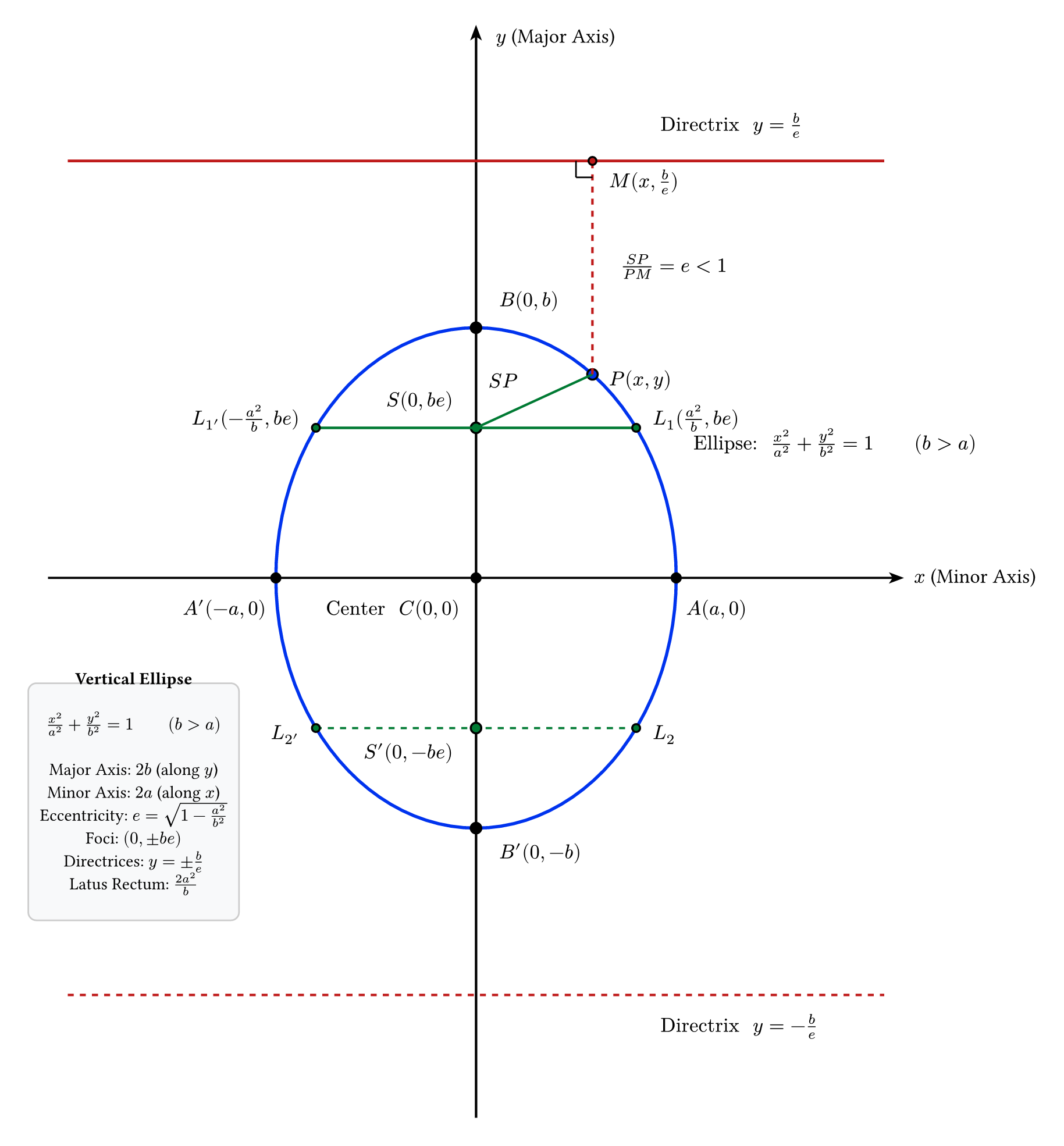
To understand why the axes swap roles when b>ab > a, let us construct the curve directly from the focus-directrix definition.

Let the focus be placed on the positive yy-axis at S(0,be)S(0, be), where 0<e<10 < e < 1, and let the corresponding directrix be the horizontal line:

y=bey = \frac{b}{e}

Let P(x,y)P(x, y) be any point on the ellipse. The distance of PP from the focus SS is:

SP=x2+(y−be)2SP = \sqrt{x^2 + (y - be)^2}

The perpendicular distance PMPM from P(x,y)P(x, y) to the directrix y−be=0y - \frac{b}{e} = 0 is:

PM=∣y−be∣PM = \left| y - \frac{b}{e} \right|

By definition of the ellipse, SP=e⋅PMSP = e \cdot PM. Squaring both sides:

SP2=e2⋅PM2SP^2 = e^2 \cdot PM^2 x2+(y−be)2=e2(y−be)2x^2 + (y - be)^2 = e^2 \left(y - \frac{b}{e}\right)^2

Expanding both sides:

x2+y2−2bey+b2e2=e2(y2−2bey+b2e2)x^2 + y^2 - 2bey + b^2 e^2 = e^2 \left(y^2 - \frac{2b}{e}y + \frac{b^2}{e^2}\right) x2+y2−2bey+b2e2=e2y2−2bey+b2x^2 + y^2 - 2bey + b^2 e^2 = e^2 y^2 - 2bey + b^2

Cancel the cross-term −2bey-2bey from both sides:

x2+y2−e2y2=b2−b2e2x^2 + y^2 - e^2 y^2 = b^2 - b^2 e^2 x2+y2(1−e2)=b2(1−e2)x^2 + y^2(1 - e^2) = b^2(1 - e^2)

Dividing both sides by b2(1−e2)b^2(1 - e^2):

x2b2(1−e2)+y2b2=1\frac{x^2}{b^2(1 - e^2)} + \frac{y^2}{b^2} = 1

Since 0<e<10 < e < 1, the quantity 1−e21 - e^2 is positive and less than 11. Therefore, b2(1−e2)<b2b^2(1 - e^2) < b^2.

Defining a positive constant aa by:

a2=b2(1−e2)ora=b1−e2a^2 = b^2(1 - e^2) \quad \text{or} \quad a = b\sqrt{1 - e^2}

we obtain:

x2a2+y2b2=1with a<b\frac{x^2}{a^2} + \frac{y^2}{b^2} = 1 \quad \text{with } a < b

This confirms that the equation x2a2+y2b2=1\frac{x^2}{a^2} + \frac{y^2}{b^2} = 1 represents an ellipse with its major axis along the yy-axis whenever the denominator of y2y^2 exceeds the denominator of x2x^2.


Anatomy of the Vertical Ellipse§

Vertical Ellipse Anatomy

Let x2a2+y2b2=1\frac{x^2}{a^2} + \frac{y^2}{b^2} = 1 with b>ab > a. The geometric features are derived as follows:

Major and Minor Axes§

Setting x=0x = 0 yields y2b2=1  ⟹  y=±b\frac{y^2}{b^2} = 1 \implies y = \pm b. The curve intersects the yy-axis at the points:

B(0,b)andB′(0,−b)B(0, b) \quad \text{and} \quad B'(0, -b)

The segment B′BB'B is called the major axis. Its length is:

Length of Major Axis=2b\text{Length of Major Axis} = 2b

The equation of the major axis is x=0x = 0 (the yy-axis).

Setting y=0y = 0 yields x2a2=1  ⟹  x=±a\frac{x^2}{a^2} = 1 \implies x = \pm a. The curve intersects the xx-axis at the points:

A(a,0)andA′(−a,0)A(a, 0) \quad \text{and} \quad A'(-a, 0)

The segment A′AA'A is called the minor axis. Its length is:

Length of Minor Axis=2a\text{Length of Minor Axis} = 2a

The equation of the minor axis is y=0y = 0 (the xx-axis).

Since b>ab > a, the major axis is vertical and the minor axis is horizontal.

Center and Vertices§

The point of intersection of the major and minor axes is the center of the ellipse:

C(0,0)C(0, 0)

The endpoints of the major axis are the principal vertices:

B(0,b)andB′(0,−b)B(0, b) \quad \text{and} \quad B'(0, -b)

The endpoints of the minor axis are:

A(a,0)andA′(−a,0)A(a, 0) \quad \text{and} \quad A'(-a, 0)

Eccentricity§

From the relation a2=b2(1−e2)a^2 = b^2(1 - e^2), we solve for ee:

1−e2=a2b2  ⟹  e2=1−a2b21 - e^2 = \frac{a^2}{b^2} \implies e^2 = 1 - \frac{a^2}{b^2} e=1−a2b2=b2−a2be = \sqrt{1 - \frac{a^2}{b^2}} = \frac{\sqrt{b^2 - a^2}}{b}

Notice the structural rule:

e=1−minor semi-axis2major semi-axis2=1−(smaller denominator)(larger denominator)e = \sqrt{1 - \frac{\text{minor semi-axis}^2}{\text{major semi-axis}^2}} = \sqrt{1 - \frac{(\text{smaller denominator})}{(\text{larger denominator})}}

Foci§

The two foci lie on the major axis (the yy-axis) at a distance bebe from the center:

S(0,be)andS′(0,−be)S(0, be) \quad \text{and} \quad S'(0, -be)

The distance between the two foci is:

SS′=2beSS' = 2be

Directrices§

The two directrices are straight lines perpendicular to the major axis (horizontal lines parallel to the xx-axis) at a distance be\frac{b}{e} from the center:

y=beandy=−bey = \frac{b}{e} \quad \text{and} \quad y = -\frac{b}{e}

The distance between the two directrices is:

Distance between directrices=2be\text{Distance between directrices} = \frac{2b}{e}

Latus Rectum§

A latus rectum is a focal chord perpendicular to the major axis. For a vertical ellipse, the major axis is the yy-axis, so the latera recta are horizontal line segments parallel to the xx-axis passing through the foci S(0,be)S(0, be) and S′(0,−be)S'(0, -be).

To find the coordinates of the extremities of the latus rectum through S(0,be)S(0, be), substitute y=bey = be into the equation of the ellipse:

x2a2+(be)2b2=1\frac{x^2}{a^2} + \frac{(be)^2}{b^2} = 1 x2a2+e2=1  ⟹  x2a2=1−e2\frac{x^2}{a^2} + e^2 = 1 \implies \frac{x^2}{a^2} = 1 - e^2

Since a2=b2(1−e2)a^2 = b^2(1 - e^2), we have 1−e2=a2b21 - e^2 = \frac{a^2}{b^2}. Substituting this:

x2a2=a2b2  ⟹  x2=a4b2  ⟹  x=±a2b\frac{x^2}{a^2} = \frac{a^2}{b^2} \implies x^2 = \frac{a^4}{b^2} \implies x = \pm \frac{a^2}{b}

Thus, the extremities of the latus rectum passing through S(0,be)S(0, be) are:

L1(a2b,be)andL1′(−a2b,be)L_1\left(\frac{a^2}{b}, be\right) \quad \text{and} \quad L_1'\left(-\frac{a^2}{b}, be\right)

Similarly, for the focus S′(0,−be)S'(0, -be), substituting y=−bey = -be yields the extremities:

L2(a2b,−be)andL2′(−a2b,−be)L_2\left(\frac{a^2}{b}, -be\right) \quad \text{and} \quad L_2'\left(-\frac{a^2}{b}, -be\right)

The length of each latus rectum is the horizontal distance between its extremities:

Length of Latus Rectum=a2b−(−a2b)=2a2b\text{Length of Latus Rectum} = \frac{a^2}{b} - \left(-\frac{a^2}{b}\right) = \frac{2a^2}{b}

The semi-latus rectum ll is:

l=a2bl = \frac{a^2}{b}

In general terms:

Length of Latus Rectum=2(semi-minor axis)2semi-major axis=2(smaller denominator)larger denominator\text{Length of Latus Rectum} = \frac{2(\text{semi-minor axis})^2}{\text{semi-major axis}} = \frac{2(\text{smaller denominator})}{\sqrt{\text{larger denominator}}}

Focal Distances of a Point§

Let P(x1,y1)P(x_1, y_1) be any point on the vertical ellipse x2a2+y2b2=1\frac{x^2}{a^2} + \frac{y^2}{b^2} = 1 (b>ab > a).

Let MM and M′M' be the feet of the perpendiculars from P(x1,y1)P(x_1, y_1) onto the directrices y=bey = \frac{b}{e} and y=−bey = -\frac{b}{e}, respectively.

Distance to the upper focus S(0,be)S(0, be):

By the focus-directrix definition:

SP=e⋅PMSP = e \cdot PM

Since PP lies on the ellipse, −b≤y1≤b<be-b \le y_1 \le b < \frac{b}{e}, so the distance PMPM is:

PM=be−y1PM = \frac{b}{e} - y_1

Therefore:

SP=e(be−y1)=b−ey1SP = e\left(\frac{b}{e} - y_1\right) = b - ey_1

Distance to the lower focus S′(0,−be)S'(0, -be):

By the focus-directrix definition:

S′P=e⋅PM′S'P = e \cdot PM'

Since y1≥−b>−bey_1 \ge -b > -\frac{b}{e}, the distance PM′PM' is:

PM′=y1−(−be)=be+y1PM' = y_1 - \left(-\frac{b}{e}\right) = \frac{b}{e} + y_1

Therefore:

S′P=e(be+y1)=b+ey1S'P = e\left(\frac{b}{e} + y_1\right) = b + ey_1

Sum of Focal Distances:

Adding the two focal distances:

SP+S′P=(b−ey1)+(b+ey1)=2bSP + S'P = (b - ey_1) + (b + ey_1) = 2b

The sum of the distances of any point on the vertical ellipse from its two foci is constant and equals the length of the major axis (2b2b).


Comparison: Horizontal vs. Vertical Ellipse§

The following table summarizes the correspondence between the horizontal ellipse (a>ba > b) and the vertical ellipse (b>ab > a) for the standard equation:

x2a2+y2b2=1\frac{x^2}{a^2} + \frac{y^2}{b^2} = 1
Attribute Horizontal Ellipse (a>ba > b) Vertical Ellipse (b>ab > a)
Major Axis Along xx-axis (y=0y = 0), length =2a= 2a Along yy-axis (x=0x = 0), length =2b= 2b
Minor Axis Along yy-axis (x=0x = 0), length =2b= 2b Along xx-axis (y=0y = 0), length =2a= 2a
Center (0,0)(0, 0) (0,0)(0, 0)
Vertices on Major Axis (±a,0)(\pm a, 0) (0,±b)(0, \pm b)
Vertices on Minor Axis (0,±b)(0, \pm b) (±a,0)(\pm a, 0)
Fundamental Relation b2=a2(1−e2)b^2 = a^2(1 - e^2) a2=b2(1−e2)a^2 = b^2(1 - e^2)
Eccentricity ee 1−b2a2=a2−b2a\sqrt{1 - \frac{b^2}{a^2}} = \frac{\sqrt{a^2 - b^2}}{a} 1−a2b2=b2−a2b\sqrt{1 - \frac{a^2}{b^2}} = \frac{\sqrt{b^2 - a^2}}{b}
Foci (±ae,0)(\pm ae, 0) (0,±be)(0, \pm be)
Distance between Foci 2ae2ae 2be2be
Equations of Directrices x=±aex = \pm \frac{a}{e} y=±bey = \pm \frac{b}{e}
Distance between Directrices 2ae\frac{2a}{e} 2be\frac{2b}{e}
Length of Latus Rectum 2b2a\frac{2b^2}{a} 2a2b\frac{2a^2}{b}
Extremities of Latus Rectum (±ae,±b2a)\left(\pm ae, \pm \frac{b^2}{a}\right) (±a2b,±be)\left(\pm \frac{a^2}{b}, \pm be\right)
Focal Distances of P(x1,y1)P(x_1, y_1) a∓ex1a \mp ex_1 b∓ey1b \mp ey_1
Sum of Focal Distances SP+S′P=2aSP + S'P = 2a SP+S′P=2bSP + S'P = 2b

The Universal Rule for Ellipses at the Origin§

To avoid confusion between letters aa and bb, memorize the universal geometric principle:

  • Orientation: In the equation x2α+y2β=1\frac{x^2}{\alpha} + \frac{y^2}{\beta} = 1, the larger denominator is the square of the semi-major axis. Its corresponding variable identifies whether the major axis is horizontal (along xx) or vertical (along yy).
  • Minor Axis: The smaller denominator is the square of the semi-minor axis.
  • Eccentricity: The eccentricity is determined entirely by the ratio of denominators:
e=1−smaller denominatorlarger denominatore = \sqrt{1 - \frac{\text{smaller denominator}}{\text{larger denominator}}}
  • Foci and Directrices: The foci and major vertices lie along the coordinate axis associated with the larger denominator, while the directrices are perpendicular to it.
  • Latus Rectum: The length of each latus rectum depends only on the semi-axes:
Length=2×(smaller denominator)larger denominator\text{Length} = \frac{2 \times (\text{smaller denominator})}{\sqrt{\text{larger denominator}}}

Translation of Axes: Ellipse with Displaced Center§

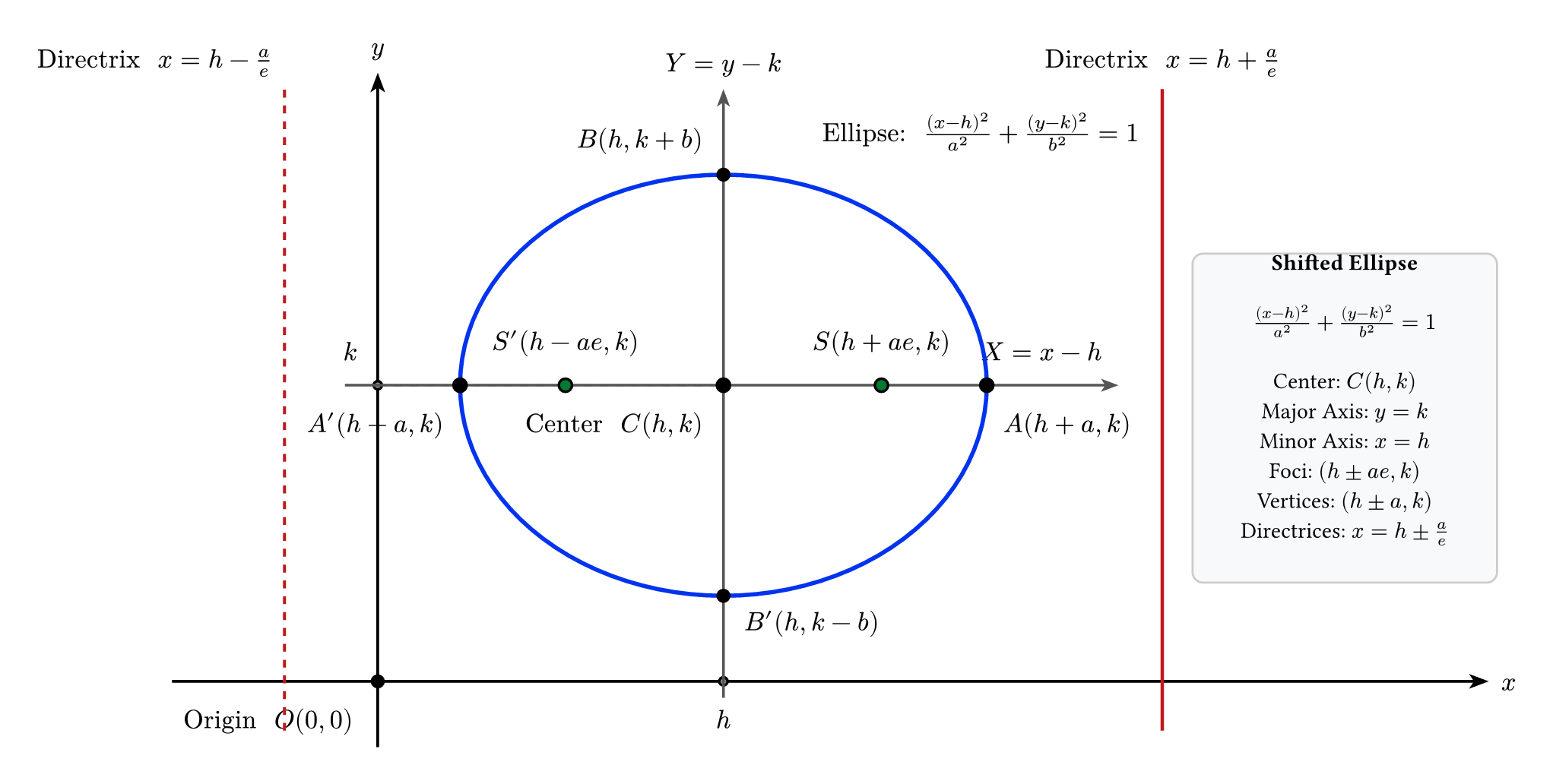
When an ellipse has its major and minor axes parallel to the coordinate axes, but its center is shifted from the origin (0,0)(0, 0) to an arbitrary point C(h,k)C(h, k), its equation undergoes a translation.

Shifted Ellipse

The Translation Transformation§

Let a new coordinate system (X,Y)(X, Y) be established with its origin at C(h,k)C(h, k), such that the XX-axis and YY-axis are parallel to the original xx-axis and yy-axis, respectively.

If a point has coordinates (x,y)(x, y) in the original system and (X,Y)(X, Y) in the new system, the transformation equations are:

x=X+h  ⟹  X=x−hx = X + h \implies X = x - h y=Y+k  ⟹  Y=y−ky = Y + k \implies Y = y - k

In the new (X,Y)(X, Y) frame, the center of the ellipse is at the origin (0,0)(0, 0).

Horizontal Ellipse with Displaced Center§

If the major axis is parallel to the xx-axis, the equation in the (X,Y)(X, Y) system is:

X2a2+Y2b2=1(a>b)\frac{X^2}{a^2} + \frac{Y^2}{b^2} = 1 \quad (a > b)

Substituting X=x−hX = x - h and Y=y−kY = y - k, the equation in original coordinates is:

(x−h)2a2+(y−k)2b2=1(a>b)\frac{(x - h)^2}{a^2} + \frac{(y - k)^2}{b^2} = 1 \quad (a > b)

Translating each geometric feature from (X,Y)(X, Y) to (x,y)(x, y) by adding hh to XX and kk to YY:

  • Center: (h,k)(h, k)
  • Major Axis: The line Y=0  ⟹  y=kY = 0 \implies y = k, with length 2a2a.
  • Minor Axis: The line X=0  ⟹  x=hX = 0 \implies x = h, with length 2b2b.
  • Vertices: (h±a,k)(h \pm a, k) and (h,k±b)(h, k \pm b)
  • Foci: (h±ae,k)(h \pm ae, k)
  • Directrices: X=±ae  ⟹  x−h=±ae  ⟹  x=h±aeX = \pm \frac{a}{e} \implies x - h = \pm \frac{a}{e} \implies x = h \pm \frac{a}{e}
  • Latera Recta Equations: x=h±aex = h \pm ae
  • Length of Latus Rectum: 2b2a\frac{2b^2}{a}

Vertical Ellipse with Displaced Center§

If the major axis is parallel to the yy-axis, the equation in the (X,Y)(X, Y) system is:

X2a2+Y2b2=1(b>a)\frac{X^2}{a^2} + \frac{Y^2}{b^2} = 1 \quad (b > a)

Substituting X=x−hX = x - h and Y=y−kY = y - k:

(x−h)2a2+(y−k)2b2=1(b>a)\frac{(x - h)^2}{a^2} + \frac{(y - k)^2}{b^2} = 1 \quad (b > a)

The geometric features in original coordinates are:

  • Center: (h,k)(h, k)
  • Major Axis: The line X=0  ⟹  x=hX = 0 \implies x = h, with length 2b2b.
  • Minor Axis: The line Y=0  ⟹  y=kY = 0 \implies y = k, with length 2a2a.
  • Vertices: (h,k±b)(h, k \pm b) and (h±a,k)(h \pm a, k)
  • Foci: (h,k±be)(h, k \pm be)
  • Directrices: Y=±be  ⟹  y−k=±be  ⟹  y=k±beY = \pm \frac{b}{e} \implies y - k = \pm \frac{b}{e} \implies y = k \pm \frac{b}{e}
  • Latera Recta Equations: y=k±bey = k \pm be
  • Length of Latus Rectum: 2a2b\frac{2a^2}{b}

Reduction of General Second-Degree Equation to Standard Form§

A general second-degree equation of the form:

Ax2+By2+2gx+2fy+c=0Ax^2 + By^2 + 2gx + 2fy + c = 0

represents an ellipse with axes parallel to the coordinate axes if and only if:

  1. Both quadratic coefficients AA and BB have the same sign (conventionally positive, A>0,B>0A > 0, B > 0).
  2. A≠BA \ne B (if A=BA = B, the equation represents a circle or degenerate circle).
  3. The cross-term xyxy is absent (which ensures that the axes of the ellipse are parallel to the coordinate axes).

The Method of Completing Squares§

To convert Ax2+By2+2gx+2fy+c=0Ax^2 + By^2 + 2gx + 2fy + c = 0 into standard form:

Group terms in xx and yy:

A(x2+2gAx)+B(y2+2fBy)=−cA\left(x^2 + \frac{2g}{A}x\right) + B\left(y^2 + \frac{2f}{B}y\right) = -c

Complete the square for each variable:

A[(x+gA)2−g2A2]+B[(y+fB)2−f2B2]=−cA\left[\left(x + \frac{g}{A}\right)^2 - \frac{g^2}{A^2}\right] + B\left[\left(y + \frac{f}{B}\right)^2 - \frac{f^2}{B^2}\right] = -c A(x+gA)2+B(y+fB)2=g2A+f2B−cA\left(x + \frac{g}{A}\right)^2 + B\left(y + \frac{f}{B}\right)^2 = \frac{g^2}{A} + \frac{f^2}{B} - c

Let the right-hand side be denoted by Δ′\Delta':

Δ′=g2A+f2B−c\Delta' = \frac{g^2}{A} + \frac{f^2}{B} - c

Three distinct geometric possibilities arise depending on the sign of Δ′\Delta':

Case 1: Δ′>0\Delta' > 0 (Real Ellipse)

Dividing through by Δ′\Delta':

(x+gA)2Δ′A+(y+fB)2Δ′B=1\frac{\left(x + \frac{g}{A}\right)^2}{\frac{\Delta'}{A}} + \frac{\left(y + \frac{f}{B}\right)^2}{\frac{\Delta'}{B}} = 1

This is the standard translated ellipse (x−h)2α+(y−k)2β=1\frac{(x - h)^2}{\alpha} + \frac{(y - k)^2}{\beta} = 1 with center:

(h,k)=(−gA,−fB)(h, k) = \left(-\frac{g}{A}, -\frac{f}{B}\right)
  • If Δ′A>Δ′B\frac{\Delta'}{A} > \frac{\Delta'}{B} (which occurs when A<BA < B), the major axis is horizontal.
  • If Δ′B>Δ′A\frac{\Delta'}{B} > \frac{\Delta'}{A} (which occurs when B<AB < A), the major axis is vertical.

Case 2: Δ′=0\Delta' = 0 (Point Ellipse)

The equation becomes:

A(x+gA)2+B(y+fB)2=0A\left(x + \frac{g}{A}\right)^2 + B\left(y + \frac{f}{B}\right)^2 = 0

Since A>0A > 0 and B>0B > 0, the sum of two non-negative terms can only equal zero when each term is independently zero:

x+gA=0andy+fB=0x + \frac{g}{A} = 0 \quad \text{and} \quad y + \frac{f}{B} = 0

This represents a single real point (−gA,−fB)\left(-\frac{g}{A}, -\frac{f}{B}\right), also called a degenerate or point ellipse.

Case 3: Δ′<0\Delta' < 0 (Empty Set / Imaginary Ellipse)

The sum of non-negative terms A(x+gA)2+B(y+fB)2A\left(x + \frac{g}{A}\right)^2 + B\left(y + \frac{f}{B}\right)^2 cannot equal a strictly negative quantity for any real coordinates (x,y)(x, y). No real points satisfy the equation.


Rotation of Axes: The General Ellipse§

When an ellipse is rotated such that its axes are not parallel to the coordinate axes, a non-zero cross-term 2hxy2hxy appears in the general second-degree equation:

ax2+2hxy+by2+2gx+2fy+c=0ax^2 + 2hxy + by^2 + 2gx + 2fy + c = 0

From the general theory of conic sections, this equation represents an ellipse if and only if:

Δ=abc+2fgh−af2−bg2−ch2≠0andh2−ab<0\Delta = abc + 2fgh - af^2 - bg^2 - ch^2 \ne 0 \quad \text{and} \quad h^2 - ab < 0

To eliminate the xyxy-term and reduce the equation to standard form, the coordinate axes must be rotated through an angle θ\theta given by:

tan⁡2θ=2ha−b(a≠b)\tan 2\theta = \frac{2h}{a - b} \quad (a \ne b)

or θ=45∘\theta = 45^\circ if a=ba = b.

The study of rotated ellipses demonstrates that the eccentricity and lengths of axes are intrinsic geometric invariants of the curve, independent of the orientation of the reference frame.


Illustrative Examples§

Example 1: Analysis of a Pure Vertical Ellipse§

Problem. For the ellipse 25x2+9y2=22525x^2 + 9y^2 = 225, determine:

  1. The lengths of the major and minor axes.
  2. The coordinates of the vertices.
  3. The eccentricity.
  4. The coordinates of the foci.
  5. The equations of the directrices.
  6. The length of the latus rectum.

Solution. Divide both sides by 225225:

25x2225+9y2225=1  ⟹  x29+y225=1\frac{25x^2}{225} + \frac{9y^2}{225} = 1 \implies \frac{x^2}{9} + \frac{y^2}{25} = 1

Compare this with x2a2+y2b2=1\frac{x^2}{a^2} + \frac{y^2}{b^2} = 1:

a2=9  ⟹  a=3a^2 = 9 \implies a = 3 b2=25  ⟹  b=5b^2 = 25 \implies b = 5

Since b>ab > a (25>925 > 9), this is a vertical ellipse whose major axis lies along the yy-axis.

Lengths of Axes:

  • Semi-major axis b=5  ⟹  Length of Major Axis=2b=10b = 5 \implies \text{Length of Major Axis} = 2b = 10.
  • Semi-minor axis a=3  ⟹  Length of Minor Axis=2a=6a = 3 \implies \text{Length of Minor Axis} = 2a = 6.

Vertices:

  • Vertices on major axis (yy-axis): B(0,±b)=(0,±5)B(0, \pm b) = (0, \pm 5).
  • Vertices on minor axis (xx-axis): A(±a,0)=(±3,0)A(\pm a, 0) = (\pm 3, 0).

Eccentricity:

e=1−a2b2=1−925=1625=45e = \sqrt{1 - \frac{a^2}{b^2}} = \sqrt{1 - \frac{9}{25}} = \sqrt{\frac{16}{25}} = \frac{4}{5}

Foci: The foci lie on the yy-axis at (0,±be)(0, \pm be):

be=5⋅45=4be = 5 \cdot \frac{4}{5} = 4

The foci are S(0,4)S(0, 4) and S′(0,−4)S'(0, -4).

Directrices: The directrices are horizontal lines:

y=±be=±54/5=±254y = \pm \frac{b}{e} = \pm \frac{5}{4/5} = \pm \frac{25}{4}

Length of Latus Rectum:

Length=2a2b=2(9)5=185\text{Length} = \frac{2a^2}{b} = \frac{2(9)}{5} = \frac{18}{5}

Example 2: Determining Orientation and Attributes§

Problem. Find the eccentricity, foci, and length of latus rectum for the ellipse 4x2+y2=164x^2 + y^2 = 16.

Solution. Dividing by 1616:

x24+y216=1\frac{x^2}{4} + \frac{y^2}{16} = 1

Here the denominator of y2y^2 (1616) is greater than the denominator of x2x^2 (44).

Therefore, the ellipse is vertical with:

a2=4  ⟹  a=2a^2 = 4 \implies a = 2 b2=16  ⟹  b=4b^2 = 16 \implies b = 4

Eccentricity:

e=1−a2b2=1−416=1216=32e = \sqrt{1 - \frac{a^2}{b^2}} = \sqrt{1 - \frac{4}{16}} = \sqrt{\frac{12}{16}} = \frac{\sqrt{3}}{2}

Foci:

be=4⋅32=23be = 4 \cdot \frac{\sqrt{3}}{2} = 2\sqrt{3}

The foci are (0,±23)(0, \pm 2\sqrt{3}).

Length of Latus Rectum:

Length=2a2b=2(4)4=2\text{Length} = \frac{2a^2}{b} = \frac{2(4)}{4} = 2

Example 3: Shifted Vertical Ellipse via Completing Squares§

Problem. Analyze the curve given by 9x2+4y2−18x+16y−11=09x^2 + 4y^2 - 18x + 16y - 11 = 0. Find its center, vertices, foci, eccentricity, equations of directrices, and length of latus rectum.

Solution. Group terms in xx and yy:

9(x2−2x)+4(y2+4y)=119(x^2 - 2x) + 4(y^2 + 4y) = 11

Complete the squares:

9[(x−1)2−1]+4[(y+2)2−4]=119\left[(x - 1)^2 - 1\right] + 4\left[(y + 2)^2 - 4\right] = 11 9(x−1)2−9+4(y+2)2−16=119(x - 1)^2 - 9 + 4(y + 2)^2 - 16 = 11 9(x−1)2+4(y+2)2=369(x - 1)^2 + 4(y + 2)^2 = 36

Divide through by 3636:

(x−1)24+(y+2)29=1\frac{(x - 1)^2}{4} + \frac{(y + 2)^2}{9} = 1

Let X=x−1X = x - 1 and Y=y+2Y = y + 2. The equation becomes:

X24+Y29=1\frac{X^2}{4} + \frac{Y^2}{9} = 1

Here a2=4  ⟹  a=2a^2 = 4 \implies a = 2, and b2=9  ⟹  b=3b^2 = 9 \implies b = 3.

Since b>ab > a, this is a vertical ellipse in the (X,Y)(X, Y) coordinate frame.

Center:

In the (X,Y)(X, Y) system, the center is (0,0)(0, 0):

X=0  ⟹  x−1=0  ⟹  x=1X = 0 \implies x - 1 = 0 \implies x = 1 Y=0  ⟹  y+2=0  ⟹  y=−2Y = 0 \implies y + 2 = 0 \implies y = -2

The center in original coordinates is C(1,−2)C(1, -2).

Eccentricity:

e=1−a2b2=1−49=53e = \sqrt{1 - \frac{a^2}{b^2}} = \sqrt{1 - \frac{4}{9}} = \frac{\sqrt{5}}{3}

Vertices: In (X,Y)(X, Y), the major vertices are (0,±b)=(0,±3)(0, \pm b) = (0, \pm 3):

  • X=0  ⟹  x=1X = 0 \implies x = 1
  • Y=3  ⟹  y+2=3  ⟹  y=1  ⟹  (1,1)Y = 3 \implies y + 2 = 3 \implies y = 1 \implies (1, 1)
  • Y=−3  ⟹  y+2=−3  ⟹  y=−5  ⟹  (1,−5)Y = -3 \implies y + 2 = -3 \implies y = -5 \implies (1, -5)

The major vertices are (1,1)(1, 1) and (1,−5)(1, -5).

The minor vertices are (±a,0)=(±2,0)(\pm a, 0) = (\pm 2, 0):

  • X=2  ⟹  x=3,Y=0  ⟹  y=−2  ⟹  (3,−2)X = 2 \implies x = 3, \quad Y = 0 \implies y = -2 \implies (3, -2)
  • X=−2  ⟹  x=−1,Y=0  ⟹  y=−2  ⟹  (−1,−2)X = -2 \implies x = -1, \quad Y = 0 \implies y = -2 \implies (-1, -2)

Foci: In (X,Y)(X, Y), the foci are (0,±be)(0, \pm be):

be=3⋅53=5be = 3 \cdot \frac{\sqrt{5}}{3} = \sqrt{5}

Thus X=0  ⟹  x=1X = 0 \implies x = 1, and Y=±5  ⟹  y=−2±5Y = \pm \sqrt{5} \implies y = -2 \pm \sqrt{5}.

The foci are (1,−2+5)(1, -2 + \sqrt{5}) and (1,−2−5)(1, -2 - \sqrt{5}).

Directrices: In (X,Y)(X, Y), the directrices are Y=±beY = \pm \frac{b}{e}:

be=35/3=95\frac{b}{e} = \frac{3}{\sqrt{5}/3} = \frac{9}{\sqrt{5}} y+2=±95  ⟹  y=−2±955y + 2 = \pm \frac{9}{\sqrt{5}} \implies y = -2 \pm \frac{9\sqrt{5}}{5}

Length of Latus Rectum:

Length=2a2b=2(4)3=83\text{Length} = \frac{2a^2}{b} = \frac{2(4)}{3} = \frac{8}{3}

Example 4: Constructing the Equation from Geometric Data§

Problem. Find the equation of the ellipse whose axes are parallel to the coordinate axes, center is at (2,−1)(2, -1), one vertex is at (2,4)(2, 4), and eccentricity is 23\frac{2}{3}.

Solution. The center is C(2,−1)C(2, -1) and a vertex is V(2,4)V(2, 4).

Notice that both the center and the vertex share the same xx-coordinate (x=2x = 2). Therefore, the line joining them is vertical:

x=2x = 2

This line is the major axis of the ellipse. Consequently, this is a vertical ellipse with center (h,k)=(2,−1)(h, k) = (2, -1).

The distance from the center to the vertex gives the semi-major axis bb:

b=∣4−(−1)∣=5  ⟹  b2=25b = |4 - (-1)| = 5 \implies b^2 = 25

Given e=23e = \frac{2}{3}, compute a2a^2 using a2=b2(1−e2)a^2 = b^2(1 - e^2):

a2=25(1−49)=25⋅59=1259a^2 = 25\left(1 - \frac{4}{9}\right) = 25 \cdot \frac{5}{9} = \frac{125}{9}

The equation of the shifted vertical ellipse is:

(x−h)2a2+(y−k)2b2=1\frac{(x - h)^2}{a^2} + \frac{(y - k)^2}{b^2} = 1

Substituting h=2h = 2, k=−1k = -1, a2=1259a^2 = \frac{125}{9}, and b2=25b^2 = 25:

(x−2)2125/9+(y+1)225=1\frac{(x - 2)^2}{125/9} + \frac{(y + 1)^2}{25} = 1 9(x−2)2125+(y+1)225=1\frac{9(x - 2)^2}{125} + \frac{(y + 1)^2}{25} = 1

Multiplying through by 125125:

9(x−2)2+5(y+1)2=1259(x - 2)^2 + 5(y + 1)^2 = 125

Expanding:

9(x2−4x+4)+5(y2+2y+1)=1259(x^2 - 4x + 4) + 5(y^2 + 2y + 1) = 125 9x2−36x+36+5y2+10y+5=1259x^2 - 36x + 36 + 5y^2 + 10y + 5 = 125 9x2+5y2−36x+10y−84=09x^2 + 5y^2 - 36x + 10y - 84 = 0

Summary of Key Transformation Principles§

Transformation Type Standard Form Identification Rule
Horizontal Ellipse x2a2+y2b2=1\frac{x^2}{a^2} + \frac{y^2}{b^2} = 1 (a>ba > b) Denominator of x2>x^2 > Denominator of y2y^2; foci on xx-axis
Vertical Ellipse x2a2+y2b2=1\frac{x^2}{a^2} + \frac{y^2}{b^2} = 1 (b>ab > a) Denominator of y2>y^2 > Denominator of x2x^2; foci on yy-axis
Shifted Horizontal (x−h)2a2+(y−k)2b2=1\frac{(x - h)^2}{a^2} + \frac{(y - k)^2}{b^2} = 1 (a>ba > b) Center at (h,k)(h, k); major axis horizontal line y=ky = k
Shifted Vertical (x−h)2a2+(y−k)2b2=1\frac{(x - h)^2}{a^2} + \frac{(y - k)^2}{b^2} = 1 (b>ab > a) Center at (h,k)(h, k); major axis vertical line x=hx = h
General Parallel Form Ax2+By2+2gx+2fy+c=0Ax^2 + By^2 + 2gx + 2fy + c = 0 A,B>0A, B > 0, A≠BA \ne B, no xyxy-term; complete squares
Section 2 of 13 · Ellipse

Mark this section complete when you have worked through its proofs.