MatheramaMatherama
← Parabola
Parabola·Section 14·22 min read

Intersection of a Circle and a Parabola

When a straight line intersects a parabola, it does so in at most two points. When a circle intersects a parabola, both curves are described by equations of the second degree in xx and yy.

Eliminating one of the variables between their two equations leads to a polynomial equation of degree 4. Therefore, a circle and a parabola can intersect in at most four points:

2×2=4 points2 \times 2 = 4 \text{ points}

These four points of intersection (which may be real and distinct, coincident, or complex) satisfy several simple and elegant geometric properties:

  • The sum of their ordinates (yy-coordinates) is always zero.
  • Their centroid always lies on the axis of the parabola.
  • Any two common chords joining them are equally inclined to the axis of symmetry.

Studying the intersection of a circle and a parabola also connects two important topics: co-normal points (which occur when the circle passes through the vertex of the parabola) and the circle of curvature (which occurs when three of the intersection points merge into one).


Algebraic Formulation of the Intersection§

Consider the standard parabola:

y2=4axy^2 = 4ax

with its vertex at the origin O(0,0)O(0, 0) and its axis along the xx-axis (y=0y = 0).

Let the general equation of a circle in the Cartesian plane be:

x2+y2+2gx+2fy+c=0x^2 + y^2 + 2gx + 2fy + c = 0

having its center at C(−g,−f)C(-g, -f) and radius R=g2+f2−cR = \sqrt{g^2 + f^2 - c}.

To determine the points common to both curves, we can eliminate either xx or the parametric variable tt.


Cartesian Formulation§

From the equation of the parabola, expressing xx in terms of yy:

x=y24ax = \frac{y^2}{4a}

Substituting this expression into the equation of the circle:

(y24a)2+y2+2g(y24a)+2fy+c=0\left(\frac{y^2}{4a}\right)^2 + y^2 + 2g\left(\frac{y^2}{4a}\right) + 2fy + c = 0

Expanding the squared term:

y416a2+y2+2gy24a+2fy+c=0\frac{y^4}{16a^2} + y^2 + \frac{2gy^2}{4a} + 2fy + c = 0

Multiplying the entire equation by 16a216a^2 to clear fractions:

y4+16a2y2+8agy2+32a2fy+16a2c=0y^4 + 16a^2 y^2 + 8agy^2 + 32a^2fy + 16a^2c = 0

Grouping terms by powers of yy:

y4+(16a2+8ag)y2+32a2fy+16a2c=0y^4 + (16a^2 + 8ag)y^2 + 32a^2fy + 16a^2c = 0

This is a polynomial equation of degree 4 in yy. Therefore, it has four roots: y1,y2,y3,y4y_1, y_2, y_3, y_4.

For each real root yiy_i, the corresponding xx-coordinate is given by the equation of the parabola:

xi=yi24ax_i = \frac{y_i^2}{4a}

Parametric Formulation§

The parametric representation of any point on the parabola y2=4axy^2 = 4ax is:

x=at2,y=2atx = at^2, \quad y = 2at

where tt is a real parameter.

Substituting these parametric coordinates directly into the circle equation x2+y2+2gx+2fy+c=0x^2 + y^2 + 2gx + 2fy + c = 0:

(at2)2+(2at)2+2g(at2)+2f(2at)+c=0(at^2)^2 + (2at)^2 + 2g(at^2) + 2f(2at) + c = 0

Expanding each term:

a2t4+4a2t2+2agt2+4aft+c=0a^2 t^4 + 4a^2 t^2 + 2ag t^2 + 4af t + c = 0

Factoring out t2t^2:

a2t4+(4a2+2ag)t2+4aft+c=0a^2 t^4 + (4a^2 + 2ag)t^2 + 4af t + c = 0

Since a≠0a \neq 0 for a non-degenerate parabola, we divide through by a2a^2:

t4+(4+2ga)t2+4fat+ca2=0t^4 + \left(4 + \frac{2g}{a}\right)t^2 + \frac{4f}{a} t + \frac{c}{a^2} = 0

This is a quartic equation in tt. Its four roots t1,t2,t3,t4t_1, t_2, t_3, t_4 give the parameters of the four points of intersection P1,P2,P3,P4P_1, P_2, P_3, P_4.


Fundamental Properties of Four Concyclic Points§

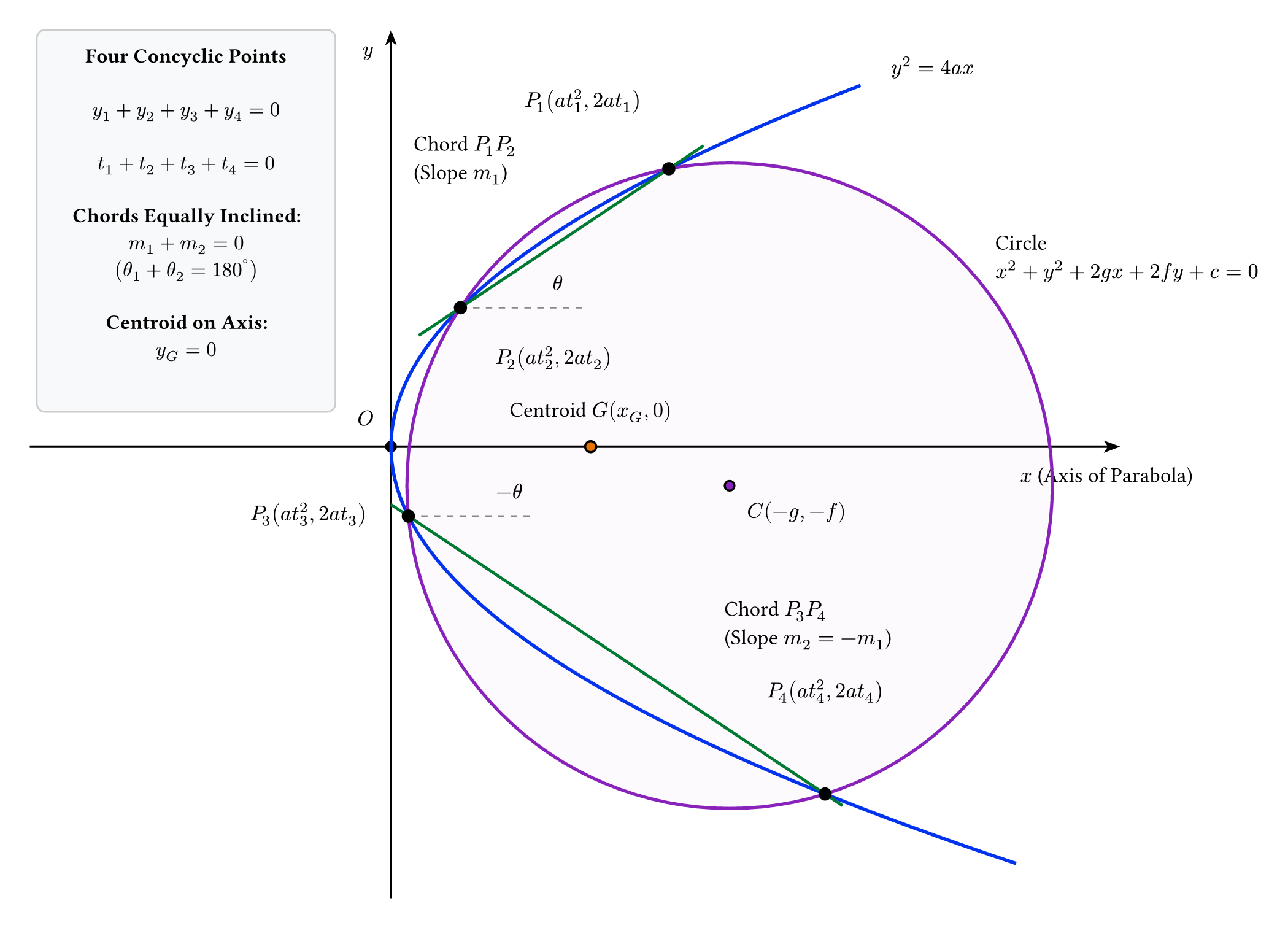
Points that lie on a common circle are called concyclic. When four points on a parabola are concyclic, their coordinates obey three fundamental geometric laws.

Four Concyclic Points on a Parabola


The Sum of the Ordinates is Zero§

Observe the quartic equation in yy:

y4+0⋅y3+(16a2+8ag)y2+32a2fy+16a2c=0y^4 + 0 \cdot y^3 + (16a^2 + 8ag)y^2 + 32a^2fy + 16a^2c = 0

The cubic term y3y^3 is absent; its coefficient is identically zero.

From the relation between the roots and coefficients of a polynomial equation:

y1+y2+y3+y4=−coefficient of y3coefficient of y4=−01=0y_1 + y_2 + y_3 + y_4 = -\frac{\text{coefficient of } y^3}{\text{coefficient of } y^4} = -\frac{0}{1} = 0

Similarly, in the parametric quartic equation:

t4+0⋅t3+(4+2ga)t2+4fat+ca2=0t^4 + 0 \cdot t^3 + \left(4 + \frac{2g}{a}\right)t^2 + \frac{4f}{a} t + \frac{c}{a^2} = 0

The coefficient of t3t^3 is identically zero. Therefore:

t1+t2+t3+t4=0t_1 + t_2 + t_3 + t_4 = 0

This gives the fundamental condition for four concyclic points on a parabola:

∑i=14yi=0and∑i=14ti=0\sum_{i=1}^4 y_i = 0 \quad \text{and} \quad \sum_{i=1}^4 t_i = 0

This condition carries an immediate geometric consequence: all four points of intersection can never lie on the same side of the axis of the parabola. If three intersection points lie above the axis (y>0y > 0), the fourth point must necessarily lie below the axis (y<0y < 0), and its distance from the axis equals the sum of the distances of the other three.


The Centroid of the Four Points Lies on the Axis§

Let P1,P2,P3,P4P_1, P_2, P_3, P_4 be the four concyclic points. The coordinates of their centroid G(xG,yG)G(x_G, y_G) are the arithmetic means of their coordinates:

xG=x1+x2+x3+x44,yG=y1+y2+y3+y44x_G = \frac{x_1 + x_2 + x_3 + x_4}{4}, \quad y_G = \frac{y_1 + y_2 + y_3 + y_4}{4}

Since the sum of the ordinates is zero:

yG=04=0y_G = \frac{0}{4} = 0

The centroid of four concyclic points on a parabola always lies on the axis of the parabola.

Now consider the xx-coordinate of the centroid. In terms of the parameters:

xG=a(t12+t22+t32+t42)4x_G = \frac{a(t_1^2 + t_2^2 + t_3^2 + t_4^2)}{4}

Recall the standard algebraic expansion for the sum of squares:

∑i=14ti2=(∑i=14ti)2−2∑1≤i<j≤4titj\sum_{i=1}^4 t_i^2 = \left(\sum_{i=1}^4 t_i\right)^2 - 2 \sum_{1 \le i < j \le 4} t_i t_j

Using the relations between roots and coefficients for the quartic in tt:

∑i=14ti=0\sum_{i=1}^4 t_i = 0 ∑1≤i<j≤4titj=4+2ga\sum_{1 \le i < j \le 4} t_i t_j = 4 + \frac{2g}{a}

Substituting these values:

∑i=14ti2=02−2(4+2ga)=−2(4+2ga)\sum_{i=1}^4 t_i^2 = 0^2 - 2\left(4 + \frac{2g}{a}\right) = -2\left(4 + \frac{2g}{a}\right)

Now compute xGx_G:

xG=a4[−2(4+2ga)]=−a2(4+2ga)=−(2a+g)x_G = \frac{a}{4}\left[-2\left(4 + \frac{2g}{a}\right)\right] = -\frac{a}{2}\left(4 + \frac{2g}{a}\right) = -(2a + g)

Recall that the center of the circle x2+y2+2gx+2fy+c=0x^2 + y^2 + 2gx + 2fy + c = 0 is C(−g,−f)C(-g, -f). The xx-coordinate of the circle's center is xC=−gx_C = -g.

Therefore:

xG=xC−2ax_G = x_C - 2a

The xx-coordinate of the centroid of the four intersection points depends solely on the xx-coordinate of the center of the circle and the parameter aa of the parabola. It is entirely independent of ff (the vertical position of the circle) and cc (the radius of the circle).


Common Chords are Equally Inclined to the Axis§

Let the four concyclic points be paired to form chords of the parabola. Consider the two chords P1P2P_1 P_2 and P3P4P_3 P_4.

The slope of the chord connecting any two points P1(at12,2at1)P_1(at_1^2, 2at_1) and P2(at22,2at2)P_2(at_2^2, 2at_2) on the parabola is:

m1=2at1−2at2at12−at22=2a(t1−t2)a(t1−t2)(t1+t2)=2t1+t2m_1 = \frac{2at_1 - 2at_2}{at_1^2 - at_2^2} = \frac{2a(t_1 - t_2)}{a(t_1 - t_2)(t_1 + t_2)} = \frac{2}{t_1 + t_2}

Similarly, the slope of the chord P3P4P_3 P_4 is:

m2=2t3+t4m_2 = \frac{2}{t_3 + t_4}

Because the four points are concyclic:

t1+t2+t3+t4=0  ⟹  t3+t4=−(t1+t2)t_1 + t_2 + t_3 + t_4 = 0 \implies t_3 + t_4 = -(t_1 + t_2)

Substituting this relation into the slope m2m_2:

m2=2−(t1+t2)=−2t1+t2=−m1m_2 = \frac{2}{-(t_1 + t_2)} = -\frac{2}{t_1 + t_2} = -m_1

Therefore:

m1+m2=0m_1 + m_2 = 0

Let θ1\theta_1 and θ2\theta_2 be the angles of inclination that the chords P1P2P_1 P_2 and P3P4P_3 P_4 make with the positive direction of the xx-axis. Since m1=tan⁡θ1m_1 = \tan \theta_1 and m2=tan⁡θ2m_2 = \tan \theta_2:

tan⁡θ1+tan⁡θ2=0  ⟹  tan⁡θ2=−tan⁡θ1=tan⁡(180∘−θ1)\tan \theta_1 + \tan \theta_2 = 0 \implies \tan \theta_2 = -\tan \theta_1 = \tan(180^\circ - \theta_1)

Assuming neither chord is perpendicular to the axis:

θ1+θ2=180∘orθ2=−θ1\theta_1 + \theta_2 = 180^\circ \quad \text{or} \quad \theta_2 = -\theta_1

The common chords P1P2P_1 P_2 and P3P4P_3 P_4 are equally inclined to the axis of the parabola.

This equal-inclination property holds for all three ways of pairing the four points into common chords:

  • Chords P1P2P_1 P_2 and P3P4P_3 P_4: m(P1P2)+m(P3P4)=0m(P_1 P_2) + m(P_3 P_4) = 0
  • Chords P1P3P_1 P_3 and P2P4P_2 P_4: m(P1P3)+m(P2P4)=0m(P_1 P_3) + m(P_2 P_4) = 0
  • Chords P1P4P_1 P_4 and P2P3P_2 P_3: m(P1P4)+m(P2P3)=0m(P_1 P_4) + m(P_2 P_3) = 0

This theorem provides an immediate geometric criterion to test whether four points on a parabola are concyclic: join them in pairs. If the chords of any pair make supplementary angles with the axis of symmetry, all four points lie on a circle.


Finding the Fourth Point of Intersection§

If a circle intersects a parabola at three known points P1(t1),P2(t2),P3(t3)P_1(t_1), P_2(t_2), P_3(t_3), the parameter of the fourth point of intersection P4(t4)P_4(t_4) is uniquely determined by:

t4=−(t1+t2+t3)t_4 = -(t_1 + t_2 + t_3)

In terms of Cartesian coordinates, if the ordinates of three intersection points are y1,y2,y3y_1, y_2, y_3, the ordinate of the fourth point is:

y4=−(y1+y2+y3)y_4 = -(y_1 + y_2 + y_3)

Once y4y_4 is known, its abscissa is x4=y424ax_4 = \frac{y_4^2}{4a}.


Circle Passing Through the Vertex and Three Co-normal Points§

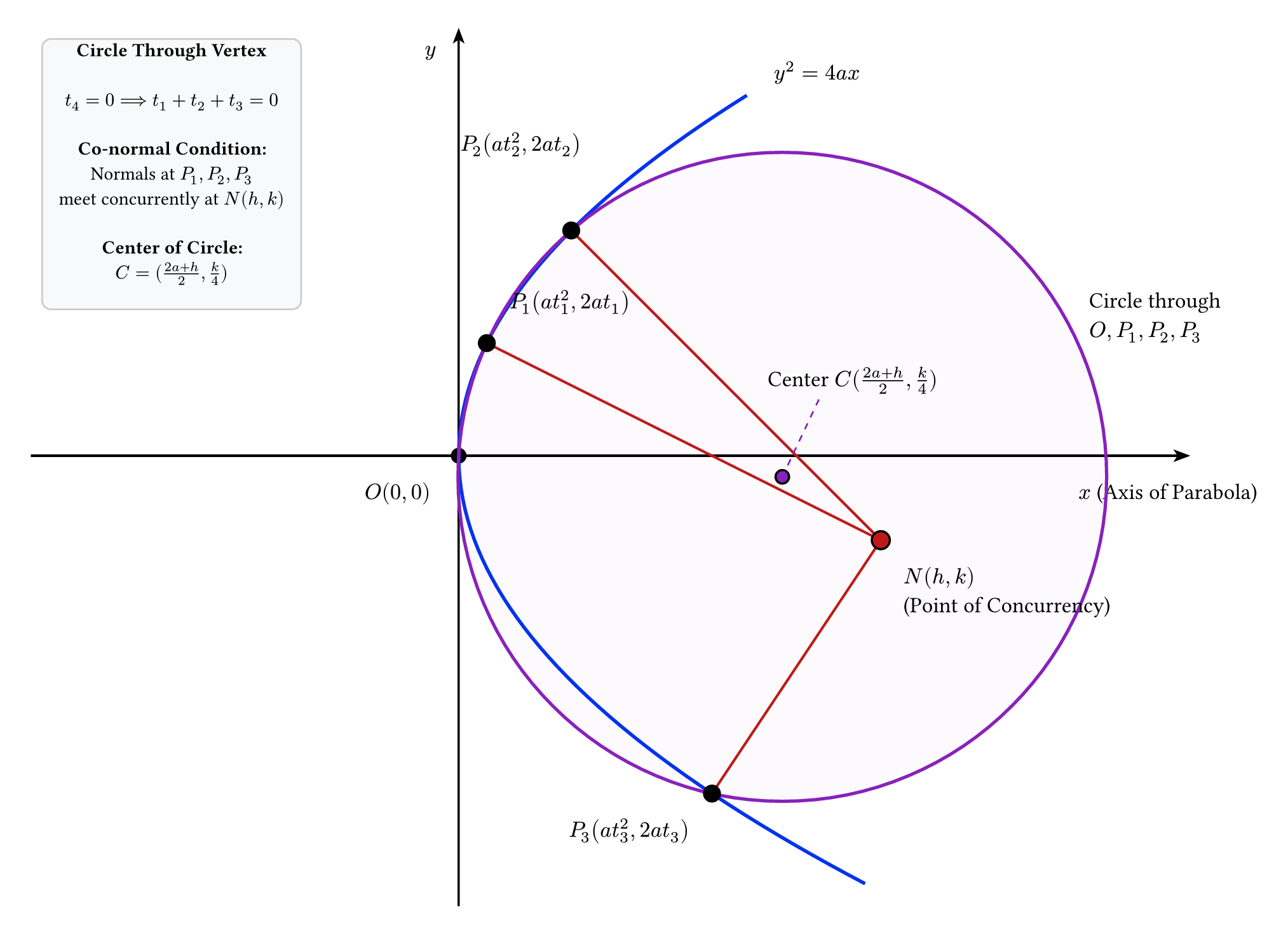
A particularly beautiful theorem arises when the circle passes through the vertex of the parabola.

Circle Passing Through the Vertex and Three Co-normal Points


Connection to Co-normal Points§

Let the circle pass through the vertex O(0,0)O(0, 0) of the parabola y2=4axy^2 = 4ax. Because the vertex is one of the four intersection points, its parameter is:

t4=0t_4 = 0

Substituting t4=0t_4 = 0 into the invariant ∑i=14ti=0\sum_{i=1}^4 t_i = 0:

t1+t2+t3+0=0  ⟹  t1+t2+t3=0t_1 + t_2 + t_3 + 0 = 0 \implies t_1 + t_2 + t_3 = 0

In the study of normals to a parabola, three points P1,P2,P3P_1, P_2, P_3 are called co-normal if the normals drawn to the parabola at these three points meet concurrently at a single point N(h,k)N(h, k).

The equation of the normal at any point (at2,2at)(at^2, 2at) is:

y+tx=2at+at3y + tx = 2at + at^3

If this normal passes through the point N(h,k)N(h, k):

k+th=2at+at3  ⟹  at3+(2a−h)t−k=0k + th = 2at + at^3 \implies at^3 + (2a - h)t - k = 0

Dividing by aa:

t3+(2a−ha)t−ka=0t^3 + \left(\frac{2a - h}{a}\right)t - \frac{k}{a} = 0

The sum of the roots of this cubic equation is:

t1+t2+t3=−01=0t_1 + t_2 + t_3 = -\frac{0}{1} = 0

The condition for three points on a parabola to be co-normal is identically t1+t2+t3=0t_1 + t_2 + t_3 = 0.

Therefore, any circle passing through the vertex of a parabola and two co-normal points must also pass through the third co-normal point. The vertex and the three co-normal points form a concyclic set of four points.


Equation and Center of the Circle§

Because the circle passes through O(0,0)O(0, 0), its constant term is c=0c = 0. Its equation is:

x2+y2+2gx+2fy=0x^2 + y^2 + 2gx + 2fy = 0

Substituting x=at2,y=2atx = at^2, y = 2at with c=0c = 0:

a2t4+(4a2+2ag)t2+4aft=0a^2 t^4 + (4a^2 + 2ag)t^2 + 4af t = 0

Factoring out tt (corresponding to the vertex t=0t = 0):

a2t3+(4a2+2ag)t+4af=0a^2 t^3 + (4a^2 + 2ag)t + 4af = 0

Dividing by a2a^2:

t3+(4+2ga)t+4fa=0t^3 + \left(4 + \frac{2g}{a}\right)t + \frac{4f}{a} = 0

This cubic equation must have the same roots t1,t2,t3t_1, t_2, t_3 as the co-normal cubic equation:

t3+(2a−ha)t−ka=0t^3 + \left(\frac{2a - h}{a}\right)t - \frac{k}{a} = 0

Equating corresponding coefficients:

Equating the coefficient of tt:

4+2ga=2a−ha  ⟹  4a+2g=2a−h4 + \frac{2g}{a} = \frac{2a - h}{a} \implies 4a + 2g = 2a - h 2g=−(2a+h)  ⟹  g=−2a+h22g = -(2a + h) \implies g = -\frac{2a + h}{2}

Equating the constant term:

4fa=−ka  ⟹  4f=−k\frac{4f}{a} = -\frac{k}{a} \implies 4f = -k 2f=−k2  ⟹  f=−k42f = -\frac{k}{2} \implies f = -\frac{k}{4}

Substituting 2g=−(2a+h)2g = -(2a + h) and 2f=−k/22f = -k/2 into the circle equation:

x2+y2−(2a+h)x−k2y=0x^2 + y^2 - (2a + h)x - \frac{k}{2}y = 0

The coordinates of the center C(−g,−f)C(-g, -f) of this circle are:

C=(2a+h2,k4)C = \left(\frac{2a + h}{2}, \frac{k}{4}\right)

The radius RR of the circle is:

R=g2+f2=(2a+h2)2+(k4)2R = \sqrt{g^2 + f^2} = \sqrt{\left(\frac{2a + h}{2}\right)^2 + \left(\frac{k}{4}\right)^2}

Locus of the Center of the Circle§

Suppose the point of concurrency of the normals N(h,k)N(h, k) lies on the parabola itself, so that k2=4ahk^2 = 4ah. What is the locus of the center C(xC,yC)C(x_C, y_C) of the circle passing through the vertex and the three co-normal points?

From the center coordinates:

xC=2a+h2  ⟹  h=2xC−2ax_C = \frac{2a + h}{2} \implies h = 2x_C - 2a yC=k4  ⟹  k=4yCy_C = \frac{k}{4} \implies k = 4y_C

Substitute these expressions into the parabola condition k2=4ahk^2 = 4ah:

(4yC)2=4a(2xC−2a)(4y_C)^2 = 4a(2x_C - 2a) 16yC2=8a(xC−a)16y_C^2 = 8a(x_C - a)

Dividing both sides by 8:

2yC2=a(xC−a)2y_C^2 = a(x_C - a)

Replacing (xC,yC)(x_C, y_C) with running coordinates (x,y)(x, y), the locus of the center of the circle is:

2y2=a(x−a)2y^2 = a(x - a)

This locus is another parabola having its vertex at (a,0)(a, 0) and its latus rectum equal to a/2a/2.


The Circle of Curvature (Osculating Circle)§

When two points of intersection of a circle and a parabola coincide (t1=t2t_1 = t_2), the circle touches the parabola at that point (simple tangency).

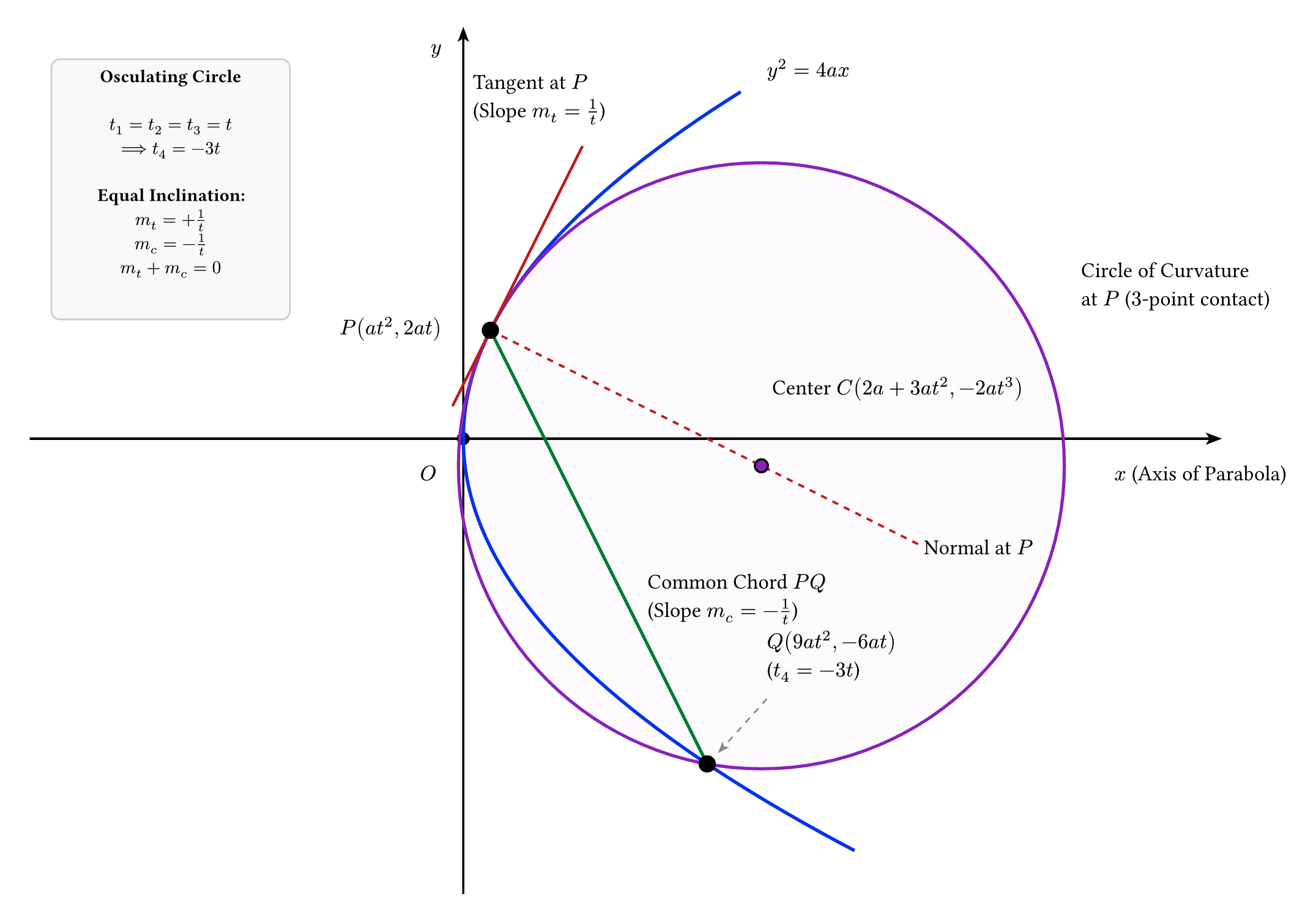
When three points of intersection merge into a single point (t1=t2=t3=tt_1 = t_2 = t_3 = t), the circle fits the curve even more closely: it shares the same point, the same tangent line, and the same rate of turning (curvature). This circle is known as the circle of curvature (or osculating circle) at PP.

Circle of Curvature to a Parabola


The Fourth Point of Intersection§

Let three intersection points coalesce at the point P(at2,2at)P(at^2, 2at), so that t1=t2=t3=tt_1 = t_2 = t_3 = t.

Because the sum of all four parameters must equal zero:

t1+t2+t3+t4=0t_1 + t_2 + t_3 + t_4 = 0 t+t+t+t4=0  ⟹  3t+t4=0t + t + t + t_4 = 0 \implies 3t + t_4 = 0 t4=−3tt_4 = -3t

The circle of curvature at any point P(at2,2at)P(at^2, 2at) intersects the parabola again at a single fourth point QQ:

Q=(a(−3t)2,2a(−3t))=(9at2,−6at)Q = \left(a(-3t)^2, 2a(-3t)\right) = (9at^2, -6at)

Equal Inclination of the Tangent and the Common Chord§

The chord joining the point of contact P(t)P(t) to the fourth intersection point Q(−3t)Q(-3t) is the common chord of the circle of curvature and the parabola.

The slope of the common chord PQPQ is:

mc=2t+t4=2t+(−3t)=2−2t=−1tm_c = \frac{2}{t + t_4} = \frac{2}{t + (-3t)} = \frac{2}{-2t} = -\frac{1}{t}

Recall that the equation of the tangent line at P(at2,2at)P(at^2, 2at) is ty=x+at2ty = x + at^2, which has slope:

mt=1tm_t = \frac{1}{t}

Comparing the two slopes:

mt+mc=1t+(−1t)=0  ⟹  mc=−mtm_t + m_c = \frac{1}{t} + \left(-\frac{1}{t}\right) = 0 \implies m_c = -m_t

The common chord of the circle of curvature and the tangent line at the point of contact are equally inclined to the axis of the parabola.

If the tangent line makes an angle θ\theta with the xx-axis, the common chord PQPQ makes an angle of 180∘−θ180^\circ - \theta (or −θ-\theta).


Length of the Common Chord§

The distance between the point of contact P(at2,2at)P(at^2, 2at) and the fourth point of intersection Q(9at2,−6at)Q(9at^2, -6at) is:

PQ=(9at2−at2)2+(−6at−2at)2PQ = \sqrt{(9at^2 - at^2)^2 + (-6at - 2at)^2} PQ=(8at2)2+(−8at)2=64a2t4+64a2t2PQ = \sqrt{(8at^2)^2 + (-8at)^2} = \sqrt{64a^2 t^4 + 64a^2 t^2}

Factoring out 64a2t264a^2 t^2:

PQ=8a∣t∣1+t2PQ = 8a|t|\sqrt{1 + t^2}

Center and Radius of Curvature§

The center CC of the circle of curvature is called the center of curvature, and its radius ρ\rho is the radius of curvature.

Because the circle of curvature touches the parabola at PP, its center CC must lie on the normal line to the parabola at PP.

In coordinate geometry, the coordinates of the center of curvature C(xC,yC)C(x_C, y_C) at P(at2,2at)P(at^2, 2at) are given by:

xC=2a+3at2,yC=−2at3x_C = 2a + 3at^2, \quad y_C = -2at^3

The radius of curvature ρ\rho is the distance from CC to PP:

ρ=2a(1+t2)3/2\rho = 2a(1 + t^2)^{3/2}

Circle of Curvature at the Vertex§

At the vertex O(0,0)O(0, 0), the parameter is t=0t = 0.

Substituting t=0t = 0:

t4=−3(0)=0t_4 = -3(0) = 0

All four points of intersection coincide at the origin (t1=t2=t3=t4=0t_1 = t_2 = t_3 = t_4 = 0), giving a 4-point contact with the parabola.

The coordinates of the center of curvature at t=0t = 0 are:

xC=2a+3a(0)2=2a,yC=−2a(0)3=0x_C = 2a + 3a(0)^2 = 2a, \quad y_C = -2a(0)^3 = 0

The radius of curvature is:

ρ=2a(1+0)3/2=2a\rho = 2a(1 + 0)^{3/2} = 2a

The equation of the circle of curvature at the vertex is:

(x−2a)2+(y−0)2=(2a)2(x - 2a)^2 + (y - 0)^2 = (2a)^2 x2−4ax+4a2+y2=4a2x^2 - 4ax + 4a^2 + y^2 = 4a^2 x2+y2−4ax=0x^2 + y^2 - 4ax = 0

This circle has its center at (2a,0)(2a, 0), touches the yy-axis (the tangent at the vertex) at the origin, and passes through the point (4a,0)(4a, 0).


Illustrative Examples§

Example 1: Finding the Fourth Concyclic Point§

Problem. A circle intersects the parabola y2=4xy^2 = 4x at three points whose ordinates are 22, 44, and −10-10. Find the coordinates of the fourth point of intersection and verify the concyclic condition.

Solution. Here, the parabola is y2=4xy^2 = 4x, so 4a=4  ⟹  a=14a = 4 \implies a = 1.

The ordinates of the three given points are y1=2y_1 = 2, y2=4y_2 = 4, and y3=−10y_3 = -10.

For any four concyclic points on a parabola, the sum of their ordinates must equal zero:

y1+y2+y3+y4=0y_1 + y_2 + y_3 + y_4 = 0

Substituting the given values:

2+4+(−10)+y4=0  ⟹  −4+y4=0  ⟹  y4=42 + 4 + (-10) + y_4 = 0 \implies -4 + y_4 = 0 \implies y_4 = 4

Now compute the xx-coordinate of the fourth point:

x4=y424a=424(1)=164=4x_4 = \frac{y_4^2}{4a} = \frac{4^2}{4(1)} = \frac{16}{4} = 4

Therefore, the fourth point of intersection is (4,4)(4, 4).

Notice that y4=4y_4 = 4 is identical to y2=4y_2 = 4. This indicates that two of the four intersection points coincide at (4,4)(4, 4), meaning the circle is tangent to the parabola at the point (4,4)(4, 4) and intersects it transversely at (1,2)(1, 2) and (25,−10)(25, -10).


Example 2: Common Chords and Equal Inclination§

Problem. A circle intersects the parabola y2=8xy^2 = 8x at four points P1,P2,P3,P4P_1, P_2, P_3, P_4 corresponding to parameters t1=1t_1 = 1, t2=3t_2 = 3, t3=−2t_3 = -2, and t4=−2t_4 = -2. Show that the chords P1P2P_1 P_2 and P3P4P_3 P_4 are equally inclined to the axis of the parabola.

Solution. For the parabola y2=8xy^2 = 8x, 4a=8  ⟹  a=24a = 8 \implies a = 2.

The parameters are t1=1t_1 = 1, t2=3t_2 = 3, t3=−2t_3 = -2, and t4=−2t_4 = -2.

First, verify the concyclic invariant:

t1+t2+t3+t4=1+3+(−2)+(−2)=0t_1 + t_2 + t_3 + t_4 = 1 + 3 + (-2) + (-2) = 0

The slope of chord P1P2P_1 P_2 is:

m1=2t1+t2=21+3=24=12m_1 = \frac{2}{t_1 + t_2} = \frac{2}{1 + 3} = \frac{2}{4} = \frac{1}{2}

The slope of chord P3P4P_3 P_4 (which here represents the tangent at t=−2t = -2 since t3=t4t_3 = t_4) is:

m2=2t3+t4=2−2+(−2)=2−4=−12m_2 = \frac{2}{t_3 + t_4} = \frac{2}{-2 + (-2)} = \frac{2}{-4} = -\frac{1}{2}

The sum of the slopes is:

m1+m2=12+(−12)=0m_1 + m_2 = \frac{1}{2} + \left(-\frac{1}{2}\right) = 0

Let θ1\theta_1 and θ2\theta_2 be the inclinations with the xx-axis:

tan⁡θ1=12,tan⁡θ2=−12=−tan⁡θ1\tan \theta_1 = \frac{1}{2}, \quad \tan \theta_2 = -\frac{1}{2} = -\tan \theta_1

Hence θ1+θ2=180∘\theta_1 + \theta_2 = 180^\circ. The two chords are equally inclined to the axis of symmetry of the parabola.


Example 3: Circle Through Vertex and Three Co-normal Points§

Problem. The normals at three points of the parabola y2=4xy^2 = 4x meet at the point N(11,−6)N(11, -6). Find the equation of the circle passing through the vertex of the parabola and these three co-normal points, and find its center and radius.

Solution. The parabola is y2=4xy^2 = 4x, so a=1a = 1.

The point of concurrency of the normals is (h,k)=(11,−6)(h, k) = (11, -6).

The circle passing through the vertex O(0,0)O(0, 0) and the three co-normal points has the standard equation:

x2+y2−(2a+h)x−k2y=0x^2 + y^2 - (2a + h)x - \frac{k}{2}y = 0

Substituting a=1a = 1, h=11h = 11, and k=−6k = -6:

2a+h=2(1)+11=132a + h = 2(1) + 11 = 13 k2=−62=−3\frac{k}{2} = \frac{-6}{2} = -3

Substituting these values into the equation:

x2+y2−13x−(−3)y=0  ⟹  x2+y2−13x+3y=0x^2 + y^2 - 13x - (-3)y = 0 \implies x^2 + y^2 - 13x + 3y = 0

The center CC of this circle is:

C=(2a+h2,k4)=(132,−64)=(132,−32)C = \left(\frac{2a + h}{2}, \frac{k}{4}\right) = \left(\frac{13}{2}, \frac{-6}{4}\right) = \left(\frac{13}{2}, -\frac{3}{2}\right)

The radius RR of the circle is:

R=(132)2+(−32)2=1694+94=1784=1782R = \sqrt{\left(\frac{13}{2}\right)^2 + \left(-\frac{3}{2}\right)^2} = \sqrt{\frac{169}{4} + \frac{9}{4}} = \sqrt{\frac{178}{4}} = \frac{\sqrt{178}}{2}

Example 4: Circle of Curvature at a Point§

Problem. Find the coordinates of the fourth point of intersection of the parabola y2=4xy^2 = 4x with the circle of curvature at the point P(1,2)P(1, 2). Also find the length of the common chord.

Solution. For y2=4xy^2 = 4x, a=1a = 1.

The point P(1,2)P(1, 2) has parametric coordinates (at2,2at)=(t2,2t)(at^2, 2at) = (t^2, 2t).

Comparing coordinates:

2t=2  ⟹  t=12t = 2 \implies t = 1

At a point with parameter tt, the fourth point of intersection QQ of the circle of curvature has parameter:

t4=−3t=−3(1)=−3t_4 = -3t = -3(1) = -3

The coordinates of QQ are:

xQ=at42=1⋅(−3)2=9x_Q = a t_4^2 = 1 \cdot (-3)^2 = 9 yQ=2at4=2(1)(−3)=−6y_Q = 2a t_4 = 2(1)(-3) = -6

Therefore, the fourth point of intersection is Q(9,−6)Q(9, -6).

The length of the common chord PQPQ can be calculated using the distance formula or the parametric formula:

PQ=8a∣t∣1+t2=8(1)∣1∣1+12=82PQ = 8a|t|\sqrt{1 + t^2} = 8(1)|1|\sqrt{1 + 1^2} = 8\sqrt{2}

Verifying with the Cartesian distance between P(1,2)P(1, 2) and Q(9,−6)Q(9, -6):

PQ=(9−1)2+(−6−2)2=82+(−8)2=64+64=128=82PQ = \sqrt{(9 - 1)^2 + (-6 - 2)^2} = \sqrt{8^2 + (-8)^2} = \sqrt{64 + 64} = \sqrt{128} = 8\sqrt{2}

Both methods yield 828\sqrt{2}.


Solved Problems§

Problem 1: Parabola and Circle Intersecting in Four Points§

Problem. A circle touches the parabola y2=4axy^2 = 4ax at the point P(at2,2at)P(at^2, 2at) and cuts it at the points Q(at12,2at1)Q(at_1^2, 2at_1) and R(at22,2at2)R(at_2^2, 2at_2). Prove that the chord QRQR always passes through a fixed point on the axis of the parabola, and determine its coordinates.

Solution. Because the circle touches the parabola at P(at2,2at)P(at^2, 2at), two of the four intersection points coincide at PP. Therefore, the four parameters of intersection are:

t,t,t1,t2t, \quad t, \quad t_1, \quad t_2

Applying the concyclic invariant ∑ti=0\sum t_i = 0:

t+t+t1+t2=0  ⟹  2t+t1+t2=0t + t + t_1 + t_2 = 0 \implies 2t + t_1 + t_2 = 0 t1+t2=−2tt_1 + t_2 = -2t

The equation of the chord QRQR passing through Q(at12,2at1)Q(at_1^2, 2at_1) and R(at22,2at2)R(at_2^2, 2at_2) is:

y(t1+t2)−2x−2at1t2=0y(t_1 + t_2) - 2x - 2a t_1 t_2 = 0

We are given that the circle touches at P(t)P(t) and passes through QQ and RR. The slope of chord QRQR is:

mQR=2t1+t2=2−2t=−1tm_{QR} = \frac{2}{t_1 + t_2} = \frac{2}{-2t} = -\frac{1}{t}

The slope of the tangent at P(t)P(t) is mt=1/tm_t = 1/t.

Thus mQR+mt=0m_{QR} + m_t = 0. The chord QRQR is parallel to the normal chord or equally inclined.

Now consider the point where the chord QRQR intersects the axis of the parabola (y=0y = 0). Setting y=0y = 0 in the chord equation:

−2x−2at1t2=0  ⟹  x=−at1t2-2x - 2a t_1 t_2 = 0 \implies x = -a t_1 t_2

If the circle is the circle of curvature (so three points coalesce and t1=tt_1 = t), then t2=−3tt_2 = -3t, giving t1t2=−3t2t_1 t_2 = -3t^2, and x=3at2x = 3at^2.

In general, whenever two intersection points coincide at P(t)P(t), the chord joining the other two intersections satisfies t1+t2=−2tt_1 + t_2 = -2t, so its slope is always −1/t-1/t, which is the negative of the slope of the tangent at PP.


Problem 2: Center Locus for Common Chords Meeting on the Axis§

Problem. A circle and the parabola y2=4axy^2 = 4ax intersect at four points P1,P2,P3,P4P_1, P_2, P_3, P_4. If the common chords P1P2P_1 P_2 and P3P4P_3 P_4 intersect at a point on the axis of the parabola, prove that the center of the circle must lie on the axis of the parabola (f=0f = 0).

Solution. Let the four intersection points have parameters t1,t2,t3,t4t_1, t_2, t_3, t_4. Since they are concyclic:

t1+t2+t3+t4=0t_1 + t_2 + t_3 + t_4 = 0

The equation of the chord P1P2P_1 P_2 is:

y(t1+t2)=2(x+at1t2)y(t_1 + t_2) = 2(x + a t_1 t_2)

The chord P1P2P_1 P_2 intersects the axis of the parabola (y=0y = 0) at:

2(x+at1t2)=0  ⟹  x=−at1t22(x + a t_1 t_2) = 0 \implies x = -a t_1 t_2

Similarly, the equation of the chord P3P4P_3 P_4 is:

y(t3+t4)=2(x+at3t4)y(t_3 + t_4) = 2(x + a t_3 t_4)

The chord P3P4P_3 P_4 intersects the axis (y=0y = 0) at:

x=−at3t4x = -a t_3 t_4

We are given that both chords intersect at the same point on the axis. Therefore, their xx-intercepts must be equal:

−at1t2=−at3t4  ⟹  t1t2=t3t4-a t_1 t_2 = -a t_3 t_4 \implies t_1 t_2 = t_3 t_4

Now recall the parametric quartic equation for concyclic points:

t4+(4+2ga)t2+4fat+ca2=0t^4 + \left(4 + \frac{2g}{a}\right)t^2 + \frac{4f}{a} t + \frac{c}{a^2} = 0

By Vieta's formulas, the coefficient of tt gives the sum of the products of roots taken three at a time:

∑1≤i<j<k≤4titjtk=−4fa\sum_{1 \le i < j < k \le 4} t_i t_j t_k = -\frac{4f}{a}

Expanding this symmetric sum:

t1t2t3+t1t2t4+t1t3t4+t2t3t4=−4fat_1 t_2 t_3 + t_1 t_2 t_4 + t_1 t_3 t_4 + t_2 t_3 t_4 = -\frac{4f}{a}

Grouping terms:

t1t2(t3+t4)+t3t4(t1+t2)=−4fat_1 t_2(t_3 + t_4) + t_3 t_4(t_1 + t_2) = -\frac{4f}{a}

Since t1t2=t3t4t_1 t_2 = t_3 t_4, substitute t3t4=t1t2t_3 t_4 = t_1 t_2:

t1t2(t3+t4)+t1t2(t1+t2)=−4fat_1 t_2(t_3 + t_4) + t_1 t_2(t_1 + t_2) = -\frac{4f}{a}

Factoring out t1t2t_1 t_2:

t1t2(t1+t2+t3+t4)=−4fat_1 t_2(t_1 + t_2 + t_3 + t_4) = -\frac{4f}{a}

Because the four points are concyclic, t1+t2+t3+t4=0t_1 + t_2 + t_3 + t_4 = 0. Therefore:

t1t2(0)=−4fa  ⟹  −4fa=0  ⟹  f=0t_1 t_2(0) = -\frac{4f}{a} \implies -\frac{4f}{a} = 0 \implies f = 0

The center of the circle is C(−g,−f)=(−g,0)C(-g, -f) = (-g, 0), which lies on the xx-axis (the axis of the parabola).


Problem 3: Common Chords of a Fixed Circle and Parabola§

Problem. A circle has its center at (h,0)(h, 0) and radius rr. It intersects the parabola y2=4axy^2 = 4ax at four real points. Show that the algebraic sum of the slopes of the tangents drawn to the parabola at these four points is zero.

Solution. Let the four points of intersection have parameters t1,t2,t3,t4t_1, t_2, t_3, t_4.

The equation of the circle centered at (h,0)(h, 0) with radius rr is:

(x−h)2+y2=r2  ⟹  x2+y2−2hx+(h2−r2)=0(x - h)^2 + y^2 = r^2 \implies x^2 + y^2 - 2hx + (h^2 - r^2) = 0

Comparing this with the general circle equation x2+y2+2gx+2fy+c=0x^2 + y^2 + 2gx + 2fy + c = 0:

2g=−2h  ⟹  g=−h,f=0,c=h2−r22g = -2h \implies g = -h, \quad f = 0, \quad c = h^2 - r^2

The four points of intersection lie on the parabola y2=4axy^2 = 4ax, so their parameters satisfy the concyclic condition:

t1+t2+t3+t4=0t_1 + t_2 + t_3 + t_4 = 0

The slope of the tangent to the parabola at any point with parameter tit_i is:

mi=1tim_i = \frac{1}{t_i}

The sum of the slopes of the tangents is:

∑i=14mi=1t1+1t2+1t3+1t4=t2t3t4+t1t3t4+t1t2t4+t1t2t3t1t2t3t4\sum_{i=1}^4 m_i = \frac{1}{t_1} + \frac{1}{t_2} + \frac{1}{t_3} + \frac{1}{t_4} = \frac{t_2 t_3 t_4 + t_1 t_3 t_4 + t_1 t_2 t_4 + t_1 t_2 t_3}{t_1 t_2 t_3 t_4}

From the quartic equation in tt:

∑titjtk=−4fa\sum t_i t_j t_k = -\frac{4f}{a}

Since the circle center lies on the xx-axis, f=0f = 0. Therefore:

∑titjtk=−4(0)a=0\sum t_i t_j t_k = -\frac{4(0)}{a} = 0

Hence:

∑i=14mi=0t1t2t3t4=0\sum_{i=1}^4 m_i = \frac{0}{t_1 t_2 t_3 t_4} = 0

The algebraic sum of the slopes of the tangents at the four intersection points is zero.


Problem 4: Circle of Curvature at the End of the Latus Rectum§

Problem. Find the equation of the circle of curvature to the parabola y2=4axy^2 = 4ax at an extremity of the latus rectum L(a,2a)L(a, 2a). Find its radius, center of curvature, and the coordinates of the fourth point where it intersects the parabola.

Solution. The point L(a,2a)L(a, 2a) corresponds to:

(at2,2at)=(a,2a)  ⟹  t=1(at^2, 2at) = (a, 2a) \implies t = 1

Center of Curvature:

Substitute t=1t = 1 into the formulas for the center of curvature:

xC=2a+3at2=2a+3a(1)2=5ax_C = 2a + 3at^2 = 2a + 3a(1)^2 = 5a yC=−2at3=−2a(1)3=−2ay_C = -2at^3 = -2a(1)^3 = -2a

The center of curvature is C(5a,−2a)C(5a, -2a).

Radius of Curvature:

Substitute t=1t = 1 into the radius formula:

ρ=2a(1+t2)3/2=2a(1+12)3/2=2a(2)3/2=2a(22)=4a2\rho = 2a(1 + t^2)^{3/2} = 2a(1 + 1^2)^{3/2} = 2a(2)^{3/2} = 2a(2\sqrt{2}) = 4a\sqrt{2}

Equation of the Circle of Curvature:

(x−5a)2+(y−(−2a))2=(4a2)2(x - 5a)^2 + (y - (-2a))^2 = (4a\sqrt{2})^2 (x−5a)2+(y+2a)2=32a2(x - 5a)^2 + (y + 2a)^2 = 32a^2

Expanding:

x2−10ax+25a2+y2+4ay+4a2=32a2x^2 - 10ax + 25a^2 + y^2 + 4ay + 4a^2 = 32a^2 x2+y2−10ax+4ay−3a2=0x^2 + y^2 - 10ax + 4ay - 3a^2 = 0

Fourth Point of Intersection:

The fourth intersection point QQ has parameter:

t4=−3t=−3(1)=−3t_4 = -3t = -3(1) = -3

Its coordinates are:

xQ=a(−3)2=9ax_Q = a(-3)^2 = 9a yQ=2a(−3)=−6ay_Q = 2a(-3) = -6a

The fourth point of intersection is Q(9a,−6a)Q(9a, -6a).


Problem 5: Algebraic Sum of Distances from Common Points to Any Line§

Problem. If a circle intersects the parabola y2=4axy^2 = 4ax in four points P1,P2,P3,P4P_1, P_2, P_3, P_4, prove that the sum of the algebraic distances of these four points from the axis of the parabola is zero, and that the sum of the squares of their distances from the axis depends only on the focal parameter aa and the center of the circle.

Solution. The distance of any point Pi(xi,yi)P_i(x_i, y_i) from the axis of the parabola (y=0y = 0) is simply its ordinate yiy_i.

As established by the absent y3y^3 term in the quartic intersection equation:

∑i=14yi=y1+y2+y3+y4=0\sum_{i=1}^4 y_i = y_1 + y_2 + y_3 + y_4 = 0

Now consider the sum of the squares of the distances from the axis:

∑i=14yi2=y12+y22+y32+y42\sum_{i=1}^4 y_i^2 = y_1^2 + y_2^2 + y_3^2 + y_4^2

Using the algebraic identity for sum of squares:

∑i=14yi2=(∑i=14yi)2−2∑1≤i<j≤4yiyj\sum_{i=1}^4 y_i^2 = \left(\sum_{i=1}^4 y_i\right)^2 - 2 \sum_{1 \le i < j \le 4} y_i y_j

From the Cartesian quartic equation:

y4+(16a2+8ag)y2+32a2fy+16a2c=0y^4 + (16a^2 + 8ag)y^2 + 32a^2fy + 16a^2c = 0

By Vieta's relations:

∑i=14yi=0\sum_{i=1}^4 y_i = 0 ∑1≤i<j≤4yiyj=16a2+8ag\sum_{1 \le i < j \le 4} y_i y_j = 16a^2 + 8ag

Substituting these values:

∑i=14yi2=02−2(16a2+8ag)=−32a2−16ag=−16a(2a+g)\sum_{i=1}^4 y_i^2 = 0^2 - 2(16a^2 + 8ag) = -32a^2 - 16ag = -16a(2a + g)

Recall that the center of the circle is C(−g,−f)C(-g, -f), so xC=−g  ⟹  g=−xCx_C = -g \implies g = -x_C.

Substituting g=−xCg = -x_C:

∑i=14yi2=−16a(2a−xC)=16a(xC−2a)\sum_{i=1}^4 y_i^2 = -16a(2a - x_C) = 16a(x_C - 2a)

This sum of squares depends exclusively on the parameter aa of the parabola and the abscissa xCx_C of the center of the circle. It is completely independent of the vertical position of the circle (ff) and its radius (cc).


Summary of Key Results§

Property / Concept Algebraic Formula / Condition Geometric Meaning
Quartic in yy y4+(16a2+8ag)y2+32a2fy+16a2c=0y^4 + (16a^2 + 8ag)y^2 + 32a^2fy + 16a^2c = 0 Yields the four ordinates of intersection
Quartic in tt t4+(4+2ga)t2+4fat+ca2=0t^4 + \left(4 + \frac{2g}{a}\right)t^2 + \frac{4f}{a}t + \frac{c}{a^2} = 0 Yields the four parameters of intersection
Sum of Ordinates y1+y2+y3+y4=0y_1 + y_2 + y_3 + y_4 = 0 Points are distributed symmetrically about the axis
Sum of Parameters t1+t2+t3+t4=0t_1 + t_2 + t_3 + t_4 = 0 Characteristic invariant of concyclic points
Centroid of 4 Points yG=0,xG=xC−2ay_G = 0, \quad x_G = x_C - 2a Centroid always lies on the axis of the parabola
Common Chords m1+m2=0  ⟹  θ1+θ2=180∘m_1 + m_2 = 0 \implies \theta_1 + \theta_2 = 180^\circ Chords are equally inclined to the axis of the parabola
Fourth Point Formula t4=−(t1+t2+t3)t_4 = -(t_1 + t_2 + t_3) Fourth intersection determined by the first three
Circle Through Vertex t1+t2+t3=0t_1 + t_2 + t_3 = 0 Circle through vertex passes through 3 co-normal points
Co-normal Circle Center C=(2a+h2,k4)C = \left(\frac{2a + h}{2}, \frac{k}{4}\right) Center of circle through vertex and co-normal points
Co-normal Circle Equation x2+y2−(2a+h)x−k2y=0x^2 + y^2 - (2a + h)x - \frac{k}{2}y = 0 Circle through origin and normals concurrent at (h,k)(h, k)
Osculating Circle (4th point) t4=−3t  ⟹  Q(9at2,−6at)t_4 = -3t \implies Q(9at^2, -6at) Circle of curvature meets parabola again at t4=−3tt_4 = -3t
Chord of Curvature mc=−1/t,PQ=8a∥t∥1+t2m_c = -1/t, \quad PQ = 8a\|t\|\sqrt{1 + t^2} Common chord equally inclined to tangent at contact
Center of Curvature xC=2a+3at2,yC=−2at3x_C = 2a + 3at^2, \quad y_C = -2at^3 Center of the osculating circle at P(at2,2at)P(at^2, 2at)
Radius of Curvature ρ=2a(1+t2)3/2\rho = 2a(1 + t^2)^{3/2} Radius of the osculating circle at P(at2,2at)P(at^2, 2at)
Osculating Circle at Vertex x2+y2−4ax=0x^2 + y^2 - 4ax = 0 4-point contact at origin, center (2a,0)(2a, 0), radius 2a2a
Section 14 of 14 · Parabola

Mark this section complete when you have worked through its proofs.