Equation of the Chord Joining Two Points on a Parabola§
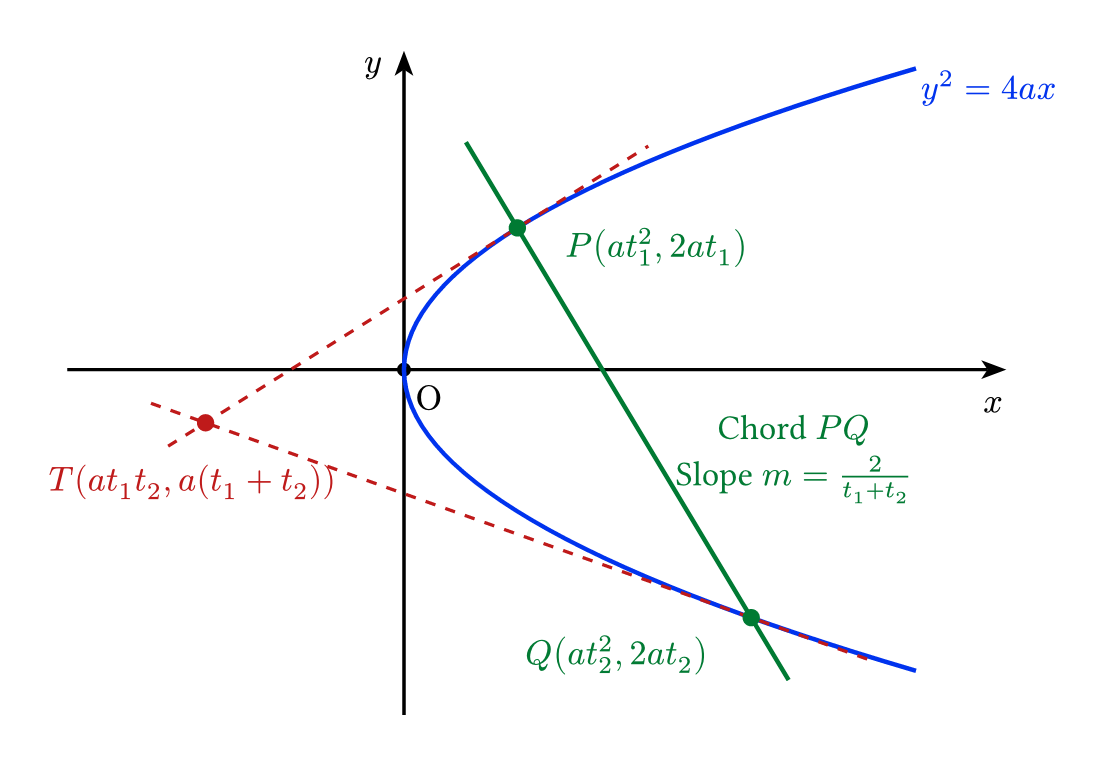
Let P(at12,2at1) and Q(at22,2at2) be any two distinct points on the standard parabola y2=4ax, with parameters t1 and t2 respectively (t1=t2). The straight line segment joining P and Q is called a chord of the parabola.
Using the two-point slope formula m=x2−x1y2−y1, the slope of the chord PQ is:
m=at22−at122at2−2at1
Factoring 2a from the numerator and a(t2−t1)(t2+t1) from the denominator yields:
m=a(t2−t1)(t2+t1)2a(t2−t1)
Since P and Q are distinct points (t1=t2), we can cancel the non-zero factor a(t2−t1) to obtain a remarkably simple formula for the slope of the chord:
Now that we know the slope of the chord is m=t1+t22 and that it passes through the point P(at12,2at1), we can write its equation using the point-slope form y−y1=m(x−x1):
y−2at1=t1+t22(x−at12)
Multiplying both sides by (t1+t2) to clear the denominator gives:
y(t1+t2)−2at1(t1+t2)=2(x−at12)
Expanding both sides:
y(t1+t2)−2at12−2at1t2=2x−2at12
Canceling the −2at12 term from both sides, we arrive at the standard equation of the chord joining the points t1 and t2:
y(t1+t2)=2x+2at1t2
By following the exact same procedure for the other standard orientations of the parabola (for instance, swapping x and y for the upward-opening parabola x2=4ay gives 2y=x(t1+t2)−2at1t2), we obtain the following summary:
1. Length of the Chord Intercepted by a Straight Line§
Suppose a straight line y=mx+c intersects the standard parabola y2=4ax at two distinct points P(x1,y1) and Q(x2,y2). We wish to find the length L=PQ of the chord intercepted by the parabola on this line.
By the distance formula, the length of the segment PQ is:
L=(x1−x2)2+(y1−y2)2⋯(1)
Since both points P(x1,y1) and Q(x2,y2) lie on the line y=mx+c, their coordinates satisfy:
y1=mx1+candy2=mx2+c
Subtracting the second equation from the first gives the relation between the differences of coordinates along a line of slope m:
y1−y2=m(x1−x2)
Substituting y1−y2=m(x1−x2) into equation (1), we can factor out (x1−x2)2 from under the radical:
Canceling 4m2c2 in the numerator and factoring out 16a gives:
(x1−x2)2=m416a2−16amc=m416a(a−mc)
Taking the non-negative square root of both sides:
∣x1−x2∣=m24a(a−mc)
Finally, substituting this expression for ∣x1−x2∣ into equation (2), L=∣x1−x2∣1+m2, we obtain the formula for the length of the chord intercepted by y=mx+c on y2=4ax:
If the endpoints of a chord on the parabola y2=4ax are given in parametric form as P(at12,2at1) and Q(at22,2at2), we can also express the length of the chord directly in terms of t1 and t2:
PQ=(at12−at22)2+(2at1−2at2)2
Using t12−t22=(t1−t2)(t1+t2), we factor a2(t1−t2)2 from both terms inside the square root:
Point of Intersection of Tangents at the Endpoints of a Chord§
Suppose we draw the tangent lines to the parabola y2=4ax at the two endpoints P(at12,2at1) and Q(at22,2at2) of the chord PQ. Let these two tangents intersect at the point T(x,y).
From our earlier study of tangents in parametric form, the equations of the tangents at t1 and t2 are:
t1y=x+at12⋯(1)t2y=x+at22⋯(2)
To find the coordinates of their point of intersection T(x,y), we solve equations (1) and (2) simultaneously. Subtracting equation (2) from equation (1) eliminates x:
(t1−t2)y=a(t12−t22)
Factoring the right-hand side as a(t1−t2)(t1+t2):
(t1−t2)y=a(t1−t2)(t1+t2)
Since t1=t2, we divide both sides by (t1−t2) to obtain the y-coordinate:
y=a(t1+t2)
Next, we substitute y=a(t1+t2) back into equation (1) to find x:
t1[a(t1+t2)]=x+at12at12+at1t2=x+at12
Canceling at12 from both sides gives the x-coordinate:
x=at1t2
Thus, the point of intersection of the tangents drawn at the points t1 and t2 on the parabola y2=4ax is:
T(at1t2,a(t1+t2))
Point of Intersection of Normals at the Endpoints of a Chord§
In a similar manner, let us find the point of intersection N(x,y) of the normals drawn to the parabola y2=4ax at the points P(at12,2at1) and Q(at22,2at2).
The equations of the normals at t1 and t2 in parametric form are:
y+t1x=2at1+at13⋯(1)y+t2x=2at2+at23⋯(2)
Subtracting equation (2) from equation (1) eliminates y:
(t1−t2)x=2a(t1−t2)+a(t13−t23)
Using the algebraic identity t13−t23=(t1−t2)(t12+t1t2+t22), we can factor (t1−t2) from the entire right-hand side:
(t1−t2)x=(t1−t2)[2a+a(t12+t1t2+t22)]
Since the points are distinct (t1=t2), dividing both sides by (t1−t2) gives the x-coordinate of the point of intersection:
x=2a+a(t12+t1t2+t22)
To find the y-coordinate, we substitute this expression for x back into equation (1):
y=2at1+at13−t1[2a+a(t12+t1t2+t22)]
Expanding the brackets on the right-hand side:
y=2at1+at13−2at1−at13−at12t2−at1t22
Notice that the terms 2at1 and at13 cancel out completely, leaving:
y=−at12t2−at1t22=−at1t2(t1+t2)
Therefore, the point of intersection of the normals at t1 and t2 is:
Property 1: Tangents at the Extremities of a Focal Chord Intersect at Right Angles on the Directrix
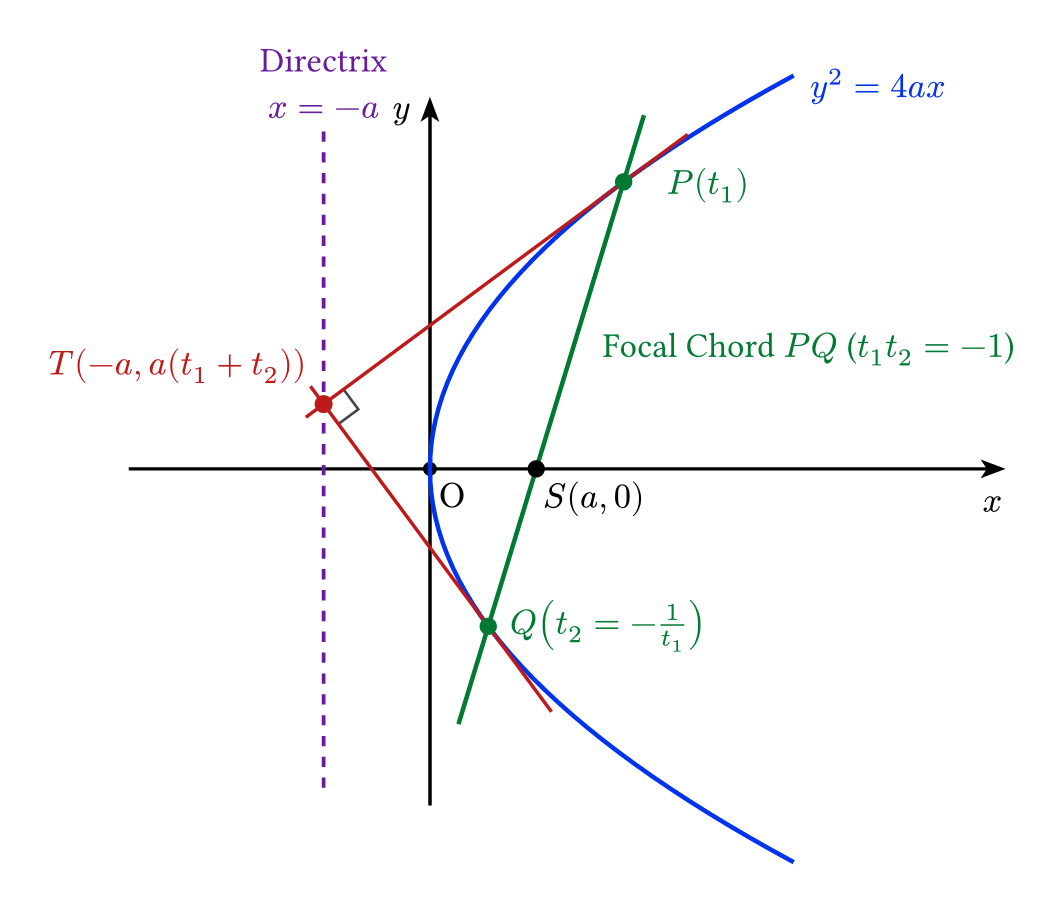
Let P(t1) and Q(t2) be the extremities of a focal chord of the parabola y2=4ax, so that:
t1t2=−1
1. The tangents are mutually perpendicular:
The slope of the tangent at P(t1) is m1=t11, and the slope of the tangent at Q(t2) is m2=t21. Taking the product of their slopes:
m1m2=(t11)(t21)=t1t21=−11=−1
Since m1m2=−1, the tangents at the extremities of any focal chord intersect at a right angle (90∘).
2. Their point of intersection lies on the directrix:
We established earlier that the tangents at t1 and t2 intersect at the point:
T(at1t2,a(t1+t2))
Substituting the focal chord condition t1t2=−1 into the x-coordinate gives:
x=a(−1)=−a
Thus, the point of intersection is T(−a,a(t1+t2)). Since its x-coordinate is always −a, the point of intersection lies strictly on the line x=−a, which is the directrix of the parabola.
(Converse: Since the locus of the point of intersection of mutually perpendicular tangents to a parabola is its directrix, the directrix is called the director circle of the parabola.)
Property 2: Ray from Focus to Intersection of Tangents is Perpendicular to the Chord
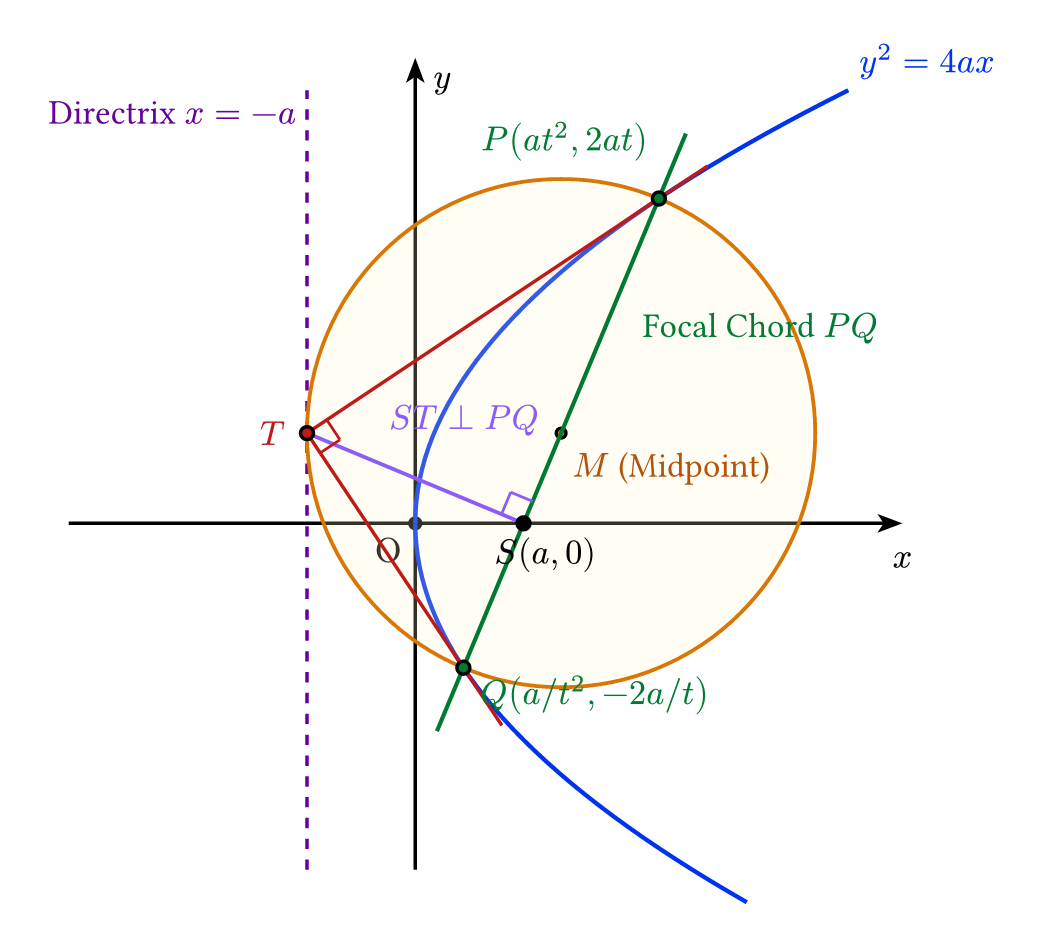
Let T(−a,a(t−t1)) be the point of intersection of the tangents drawn at the extremities P(at2,2at) and Q(t2a,−t2a) of a focal chord passing through the focus S(a,0).
The slope of the straight line joining the focus S(a,0) to the intersection point T(−a,a(t−t1)) is:
mST=−a−aa(t−t1)−0=−2aa(t−t1)=−21(t−t1)
At the same time, the slope of the focal chord PQ joining P(t) and Q(−t1) is:
mPQ=t+(−t1)2=t−t12
Multiplying the two slopes:
mST⋅mPQ=[−21(t−t1)][t−t12]=−1
Since the product of their slopes is −1, the straight line joining the focus to the intersection of the tangents is always perpendicular to the focal chord:
ST⊥PQ
In the right-angled triangle △PTQ (with hypotenuse PQ and right angle at T), the segment ST represents the altitude drawn from the right-angled vertex T to the hypotenuse PQ.
Property 3: Circle on a Focal Chord as Diameter Touches the Directrix
Let P(at2,2at) and Q(t2a,−t2a) be the endpoints of a focal chord. The midpoint M of PQ, which serves as the center of the circle described on PQ as diameter, has coordinates:
M(2at2+t2a,22at−t2a)=M(2a(t2+t21),a(t−t1))
The radius R of this circle is half the length of the focal chord PQ=a(t+t1)2:
R=2PQ=2a(t+t1)2=2a(t2+2+t21)
Now consider the perpendicular distance d from the center M to the vertical directrix x+a=0 (i.e., x=−a):
d=xM−(−a)=2a(t2+t21)+a=2a(t2+2+t21)
Notice that d=R. Because the perpendicular distance from the center M to the line x=−a equals the radius of the circle, the circle described on any focal chord as diameter touches the directrix of the parabola.
Furthermore, because the tangents at P and Q meet at T(−a,a(t−t1)) at a right angle (∠PTQ=90∘), the point T must lie on the circle by the converse of Thales's theorem. Since the x-coordinate of T is −a and its y-coordinate equals yM=a(t−t1), the segment MT is horizontal and perpendicular to the vertical directrix. Therefore, the circle touches the directrix precisely at the intersection point of the tangents T.
Property 4: Circle on a Focal Radius as Diameter Touches the Tangent at the Vertex
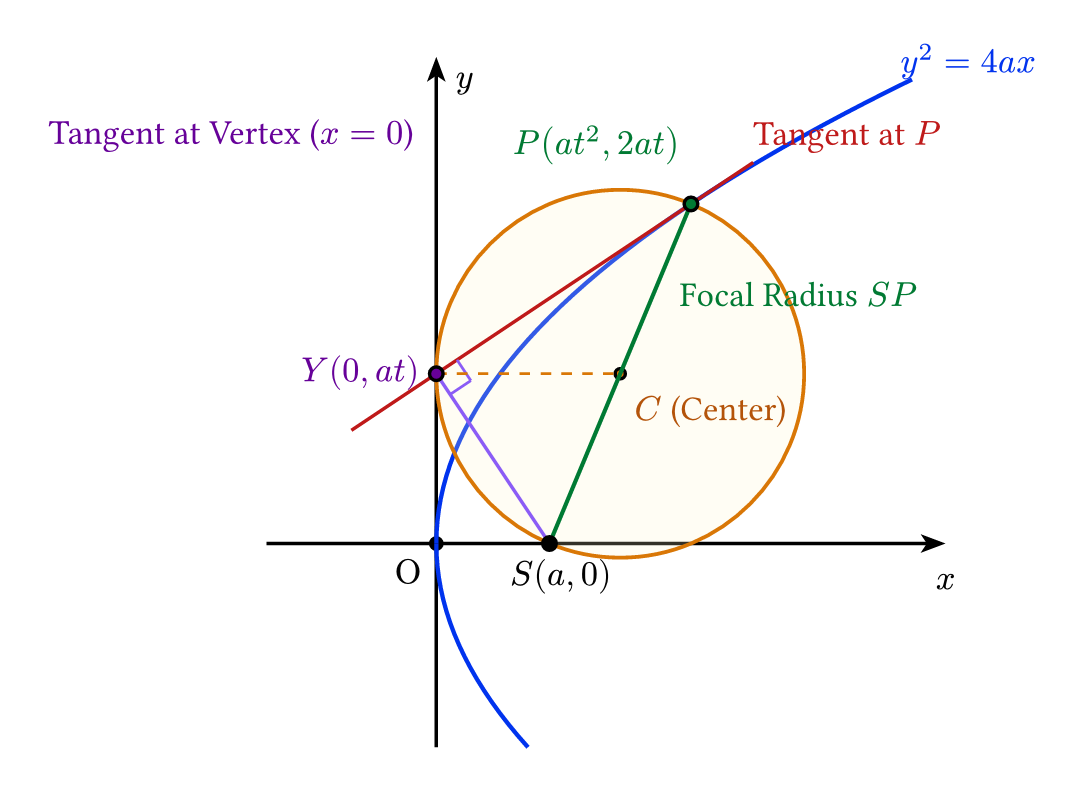
Let P(at2,2at) be any point on the parabola y2=4ax, and let S(a,0) be the focus. The focal distance of P is:
SP=xP+a=at2+a=a(t2+1)
The midpoint C of the focal segment SP has coordinates:
C(2at2+a,22at+0)=C(2a(t2+1),at)
The radius R of the circle described on SP as diameter is:
R=2SP=2a(t2+1)
The perpendicular distance from the center C to the tangent at the vertex (y-axis, x=0) is simply the x-coordinate of C:
d=xC−0=2a(t2+1)=R
Because the distance from the center to the y-axis equals the radius R, the circle described on any focal radius SP as diameter touches the tangent at the vertex (y-axis).
The point of contact with the y-axis is obtained by setting x=0 in the equation of the tangent at P, ty=x+at2, which yields:
Y(0,at)
The segment SY joining the focus S(a,0) to Y(0,at) has slope:
mSY=0−aat−0=−t
Since the slope of the tangent at P is mtangent=t1, we have mSY⋅mtangent=(−t)(t1)=−1. Thus, SY is the perpendicular drawn from the focus to the tangent at P, establishing that ∠SYP=90∘. Hence, Y lies on the circle, and the horizontal segment CY is perpendicular to the y-axis, confirming that Y(0,at) is the exact point of tangency.
Property 5: Length of a Focal Chord and Its Inclination to the Axis
Let P(at2,2at) and Q(t2a,−t2a) be the extremities of a focal chord passing through the focus S(a,0).
By the focal distance property, the distance of any point on the parabola from the focus S(a,0) equals its perpendicular distance from the directrix x+a=0:
Focal distance of P:
SP=x1+a=at2+a=a(t2+1)
Focal distance of Q:
SQ=x2+a=t2a+a=a(t21+1)
Since S lies between P and Q on the focal chord, the total length PQ is the sum of the two focal segments:
PQ=SP+SQ=a(t2+1+1+t21)=a(t2+2+t21)PQ=a(t+t1)2
Length in Terms of Inclination to the Axis:
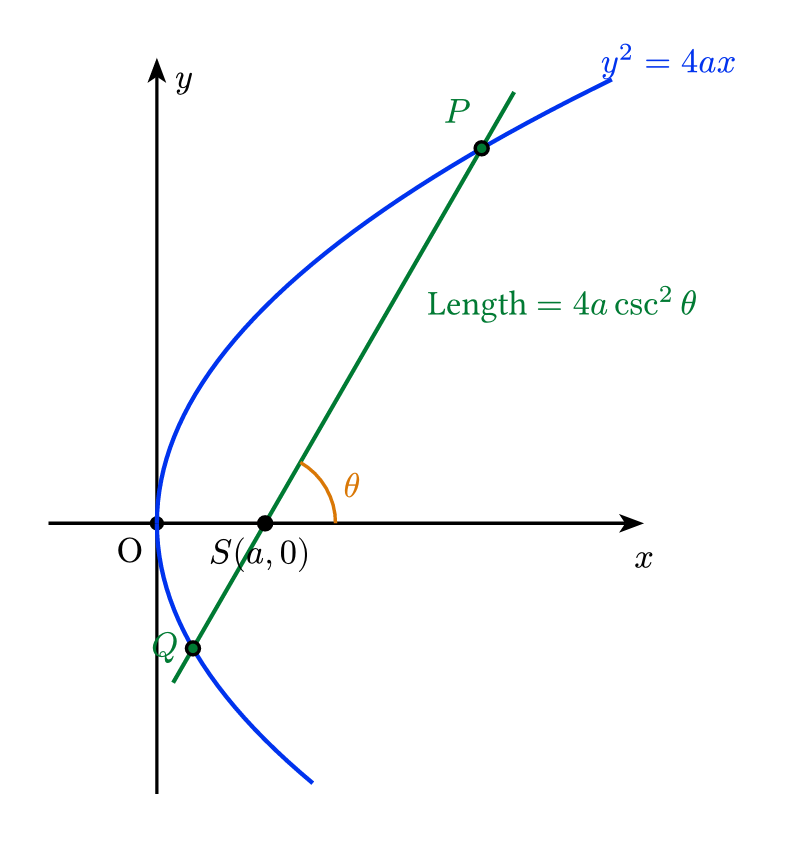
Let the focal chord make an angle θ (0<θ<π, θ=0) with the positive direction of the axis of the parabola (x-axis). The slope of the focal chord joining P(t) and Q(−t1) is:
m=tanθ=t−t12
Solving for (t−t1):
t−t1=tanθ2=2cotθ
Using the algebraic identity (t+t1)2=(t−t1)2+4:
(t+t1)2=(2cotθ)2+4=4cot2θ+4=4(1+cot2θ)=4csc2θ
Substituting this into the parametric length expression PQ=a(t+t1)2 gives:
PQ=4acsc2θ=sin2θ4a
Minimum Length of a Focal Chord:
Since sin2θ≤1 for all real θ, the value of 4acsc2θ attains its minimum when sin2θ=1, which occurs when θ=90∘ (or t=±1). In that case:
PQmin=4a(1)=4a
This confirms that the latus rectum (which is perpendicular to the axis of the parabola) is the shortest focal chord.
Property 6: Semi-Latus Rectum is the Harmonic Mean of Focal Segments
For any focal chord PQ passing through the focus S, the lengths of the two focal segments are SP=a(t2+1) and SQ=t2a(t2+1). Taking the sum of their reciprocals:
SP1+SQ1=a(t2+1)1+a(t2+1)t2=a(t2+1)1+t2=a1
Multiplying both sides by 2, the harmonic mean of the two focal segments is:
H.M. of SP and SQ=SP1+SQ12=2a
Thus, the semi-latus rectum (2a) of a parabola is the harmonic mean of the two segments of any focal chord.
Property 7: Angle Subtended by a Focal Chord at the Vertex
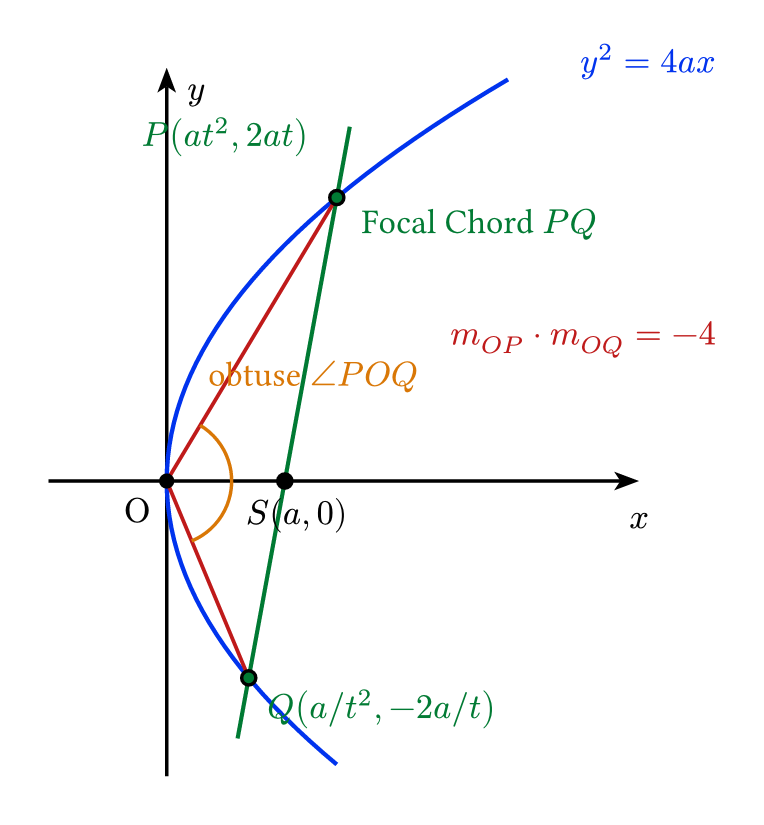
Let O(0,0) be the vertex of the parabola y2=4ax, and let P(at2,2at) and Q(t2a,−t2a) be the extremities of any focal chord.
The slopes of the straight lines OP and OQ joining the vertex to the chord extremities are:
mOP=at2−02at−0=t2mOQ=t2a−0−t2a−0=−2t
Multiplying these two slopes together:
mOP⋅mOQ=(t2)(−2t)=−4
Because the product of their slopes is a negative constant (−4), the segments OP and OQ always lie on opposite sides of the axis of the parabola. Furthermore, because mOP⋅mOQ=−4<0 and does not equal −1, the angle ∠POQ subtended by the chord at the vertex is always obtuse:
The minimum angle occurs when t=±1 (the latus rectum), where tan(∠POQ)=34, corresponding to ∠POQ=2arctan2≈126.87∘. For all other focal chords, ∠POQ is even larger, approaching 180∘ as ∣t∣→∞ or ∣t∣→0.
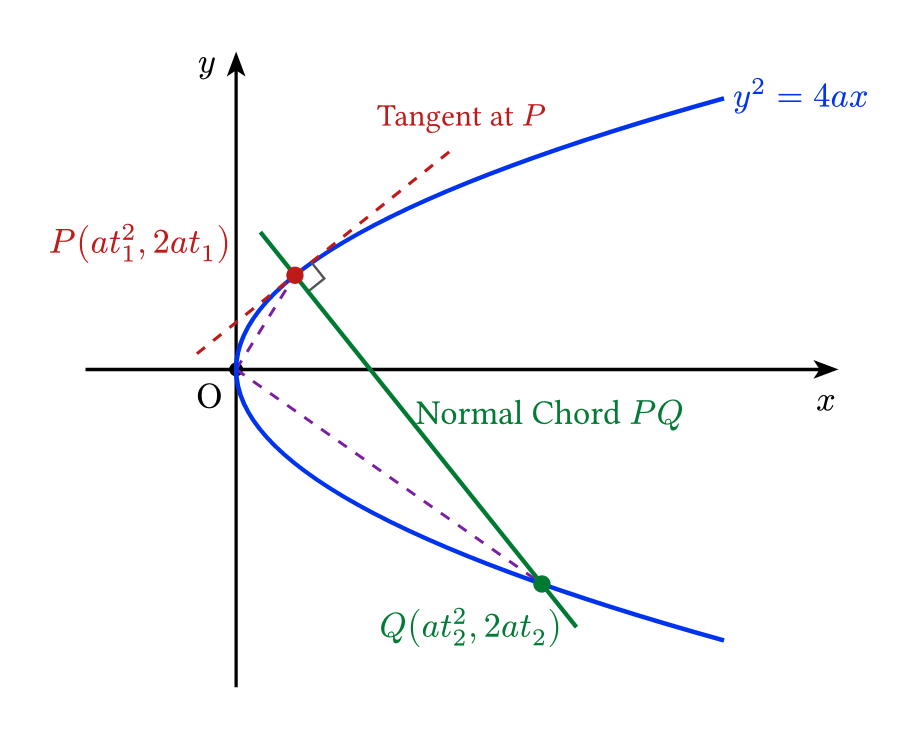
A chord of a parabola that is normal to the curve at one of its endpoints is called a normal chord.
Finding the Other Endpoint When One Endpoint is Known§
Suppose the normal drawn to the parabola y2=4ax at a known point P(at12,2at1) is extended to meet the parabola again at another point Q(at22,2at2). We wish to express the parameter t2 of the second endpoint in terms of the known parameter t1.
We can derive this fundamental relation in two ways.
Method 1: By Equating the Slope of the Chord and the Slope of the Normal
Since PQ is a chord joining the points P(t1) and Q(t2) on the parabola, its slope is given by our chord slope formula:
mchord=t1+t22
At the same time, the line PQ is the normal to the parabola at the point P(t1), so its slope is:
mnormal=−t1
Since both expressions represent the slope of the exact same line PQ, we equate them:
t1+t22=−t1
Dividing by −t1 (where t1=0) and solving for t2:
t1+t2=−t12t2=−t1−t12
Method 2: By Substituting the Second Endpoint into the Equation of the Normal
The equation of the normal to y2=4ax at P(at12,2at1) is:
y+t1x=2at1+at13
Since this normal passes through Q(at22,2at2), the coordinates of Q must satisfy its equation:
2at2+t1(at22)=2at1+at13
Grouping corresponding terms on the left-hand side:
2a(t2−t1)+at1(t22−t12)=0
Factoring a(t2−t1) from both terms:
a(t2−t1)[2+t1(t2+t1)]=0
Since P and Q are distinct points (t2=t1) and a=0, we divide by a(t2−t1):
Property 1: Direction and Position of the Second Endpoint
From the relation t1t2=−t12−2, observe that for any real non-zero t1:
t1t2≤−2<0
This reveals three important geometric facts:
t1 and t2 always have opposite signs (t1t2<0): If P(t1) lies on the upper branch of the parabola (t1>0), the normal at P always crosses the axis of the parabola and meets the curve again at Q(t2) on the lower branch (t2<0), and vice versa.
The normal at the vertex (t1=0) does not meet the curve again: At the vertex (0,0), the normal is the x-axis itself (y=0), which is the axis of symmetry and never intersects the parabola at a second point.
Q(t2) is always farther from the vertex than P(t1): Since ∣t2∣=∣t1∣+∣t1∣2>∣t1∣, we always have at22>at12.
Property 2: Normal Chord Subtending a Right Angle at the Vertex
Suppose the normal chord PQ (drawn as normal at P(t1)) subtends a right angle (90∘) at the vertex O(0,0) of the parabola.
The slope of the line OP joining (0,0) to P(at12,2at1) is:
mOP=at122at1=t12
Similarly, the slope of the line OQ joining (0,0) to Q(at22,2at2) is:
mOQ=t22
For ∠POQ=90∘, the lines OP and OQ must be mutually perpendicular (mOP⋅mOQ=−1):
(t12)(t22)=−1⟹t1t2=−4
Note that t1t2=−4 is the general condition for any chord PQ to subtend a right angle at the vertex.
Now, because PQ is also a normal chord at P(t1), we substitute t1t2=−t12−2:
−t12−2=−4⟹t12=2⟹t1=±2
Thus, the normal at P(t1) subtends a right angle at the vertex if and only if t1=±2, i.e., at the points (2a,±22a).
Property 3: Length of a Normal Chord and the Shortest Normal Chord
From our earlier formula for the length of a parametric chord joining P(t1) and Q(t2), we have:
PQ=a∣t2−t1∣(t1+t2)2+4
For a normal chord at P(t1), we substitute t2=−t1−t12:
t1+t2=−t12
t2−t1=−2t1−t12=−t12(t12+1)
Substituting these two expressions into our length formula gives: