
The Position of a Line Relative to a Parabola
When we consider a line and a parabola drawn on a plane, their geometric relationship can only be one of three possibilities:
- The line passes by without meeting the parabola at all.
- The line touches the parabola at exactly one point (a tangent).
- The line cuts through the parabola at two distinct points (a secant).
The central question is, how can we determine which of these scenarios applies for any given line and parabola?
You might recall that we solved this very problem for a circle. Our method was beautifully geometric: we compared the perpendicular distance from the circle's center to the line with the length of the radius. This simple comparison gave us a definitive answer.
However, a parabola has no center and no radius. The convenient geometric tools we used for the circle are not available to us here. We need a different approach. Lacking a purely geometric path, we turn to the power of algebra.
The strategy is to solve the equations of the line and the parabola simultaneously. The number of real solutions we find will correspond directly to the number of intersection points, thereby revealing the geometric nature of their interaction.
Position of Line wrt the Standard Parabola§
Let the standard equation of the parabola be:
And let the equation of a line be:
To find their common points, we substitute the expression for from the line's equation into that of the parabola:
Expanding this expression yields a quadratic equation in the variable :
The number of real roots of this quadratic equation corresponds directly to the number of intersection points. The nature of these roots is governed by the discriminant, .
For the quadratic above, we have:
The discriminant is therefore:
The sign of this discriminant definitively tells us which of the three cases we are dealing with.
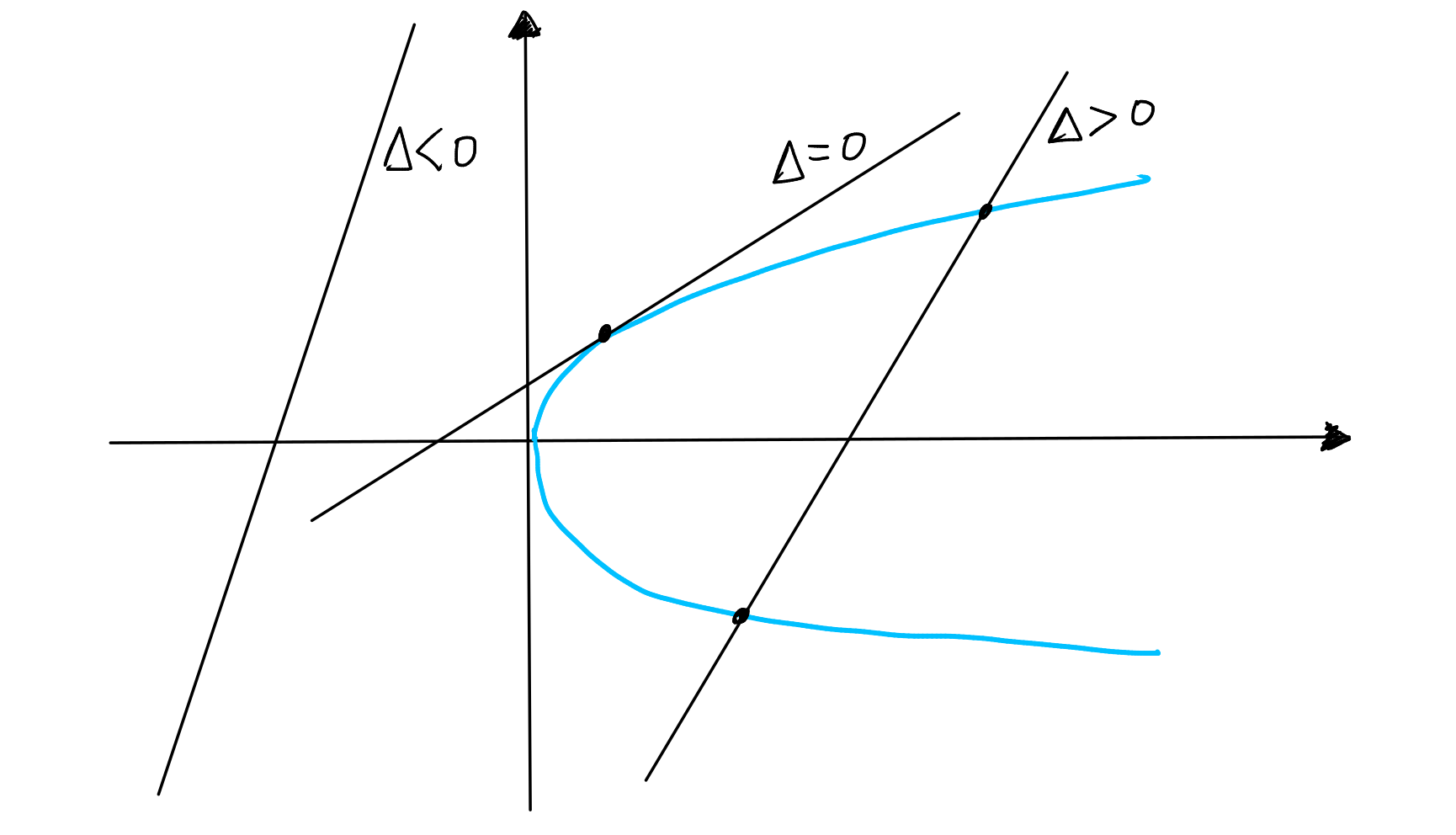
Analysis of Cases
Case I: The Line is a Secant ()
If , the quadratic equation has two distinct real roots. This signifies that the line intersects the parabola at two distinct points.
- Condition: (assuming )
Case II: The Line is a Tangent ()
If , the quadratic equation has exactly one real root (a repeated root). This signifies that the line touches the parabola at a single point.
- Condition:
This gives the fundamental condition of tangency:
Case III: The Line Does Not Intersect ()
If , the quadratic equation has no real roots. This signifies that the line and the parabola have no points in common.
- Condition: (assuming )
Summary of Conditions
| Condition (for ) | Discriminant | Geometric Interpretation |
|---|---|---|
| The line is a secant. | ||
| The line is a tangent. | ||
| The line does not intersect the parabola. |
Conditions of Tangency for All Standard Forms§
The "discriminant method" is a universal tool for finding the conditions of tangency. By applying the same logic to the other standard parabolic forms, we can derive their respective conditions.
The Left-Handed Parabola:
For this parabola, the process is nearly identical to the right-handed case. We invite the reader to verify this as a valuable exercise.
Challenge for the Reader: ✍️
- Substitute into the equation .
- Arrange the result into a quadratic equation in .
- Set the discriminant () of this quadratic to zero.
- Solve for in terms of and .
By following these steps, you will arrive at the condition of tangency:
Notice that the only difference is a sign change, reflecting the parabola's new orientation.
The Upward-Opening Parabola:
Here, the variable that is squared has changed, so our substitution is slightly different.
Given the parabola and the line .
-
Substitute for in the parabola's equation:
-
Form the quadratic in :
-
Set the discriminant to zero ():
- , ,
-
Solve for c:
- Assuming , we divide by to get the condition of tangency:
The Downward-Opening Parabola:
Following an identical derivation for the downward-opening parabola, which involves substituting into , we find a similar result, again with a sign change.
The condition for the line to be tangent to the parabola is:
Summary of Tangency Conditions
This gives us a complete reference for the line to be tangent to any standard parabola.
| Parabola Equation | Condition of Tangency |
|---|---|
Theorem: Equation of a Tangent in Slope-Form§
The equation of a tangent line with a given slope to the parabola is given by:
Proof:
We have already established that a line of the form is tangent to the parabola if and only if it satisfies the condition of tangency, which is .
By substituting this specific value of back into the line's equation, we directly obtain the equation of the tangent line.
Thus, for any non-zero slope , there is exactly one line with that slope that is tangent to the parabola.
Extension to Shifted Parabolas§
This theorem can be elegantly extended to a parabola whose vertex has been shifted from the origin to a new point .
Consider the parabola .
We can introduce a new coordinate system such that its origin is at . The transformations are:
In this new system, the parabola's equation is simply . From our theorem, the tangent to this parabola is:
Now, we translate this equation back into our original coordinate system by substituting the transformation equations:
This is the equation of the tangent to the shifted parabola. The logic is that the shape of the parabola and the slope of the tangent are unaffected by the shift; only their positions change.
Summary of Tangents in Slope-Form
The same principles can be applied to all four orientations of a shifted parabola. The results are summarized below.
| Parabola Equation | Equation of the Tangent (Slope-Form) |
|---|---|
Mark this section complete when you have worked through its proofs.