Properties of Tangents, Normals, and the Reflection Property
The geometry of the parabola possesses an extraordinary degree of elegance that distinguishes it among all conic sections. While its algebraic formulations provide powerful computational tools, its deeper geometric character is revealed in the interplay between its tangents, normals, focal radii, and directrix.
In this chapter, we explore these geometric properties. We examine the fundamental triangle formed by the tangent, the normal, and the principal axis, establishing the classic equidistance relation and the constancy of the subnormal. We then analyze the foot of the perpendicular dropped from the focus onto any tangent, prove the triangle congruence that shows the directrix is the locus of the reflections of the focus across all tangents, and transition to the celebrated optical reflection property. Finally, we provide complete analytical proofs for the classic theorems governing the circumcircle and orthocenter of triangles formed by three tangents.
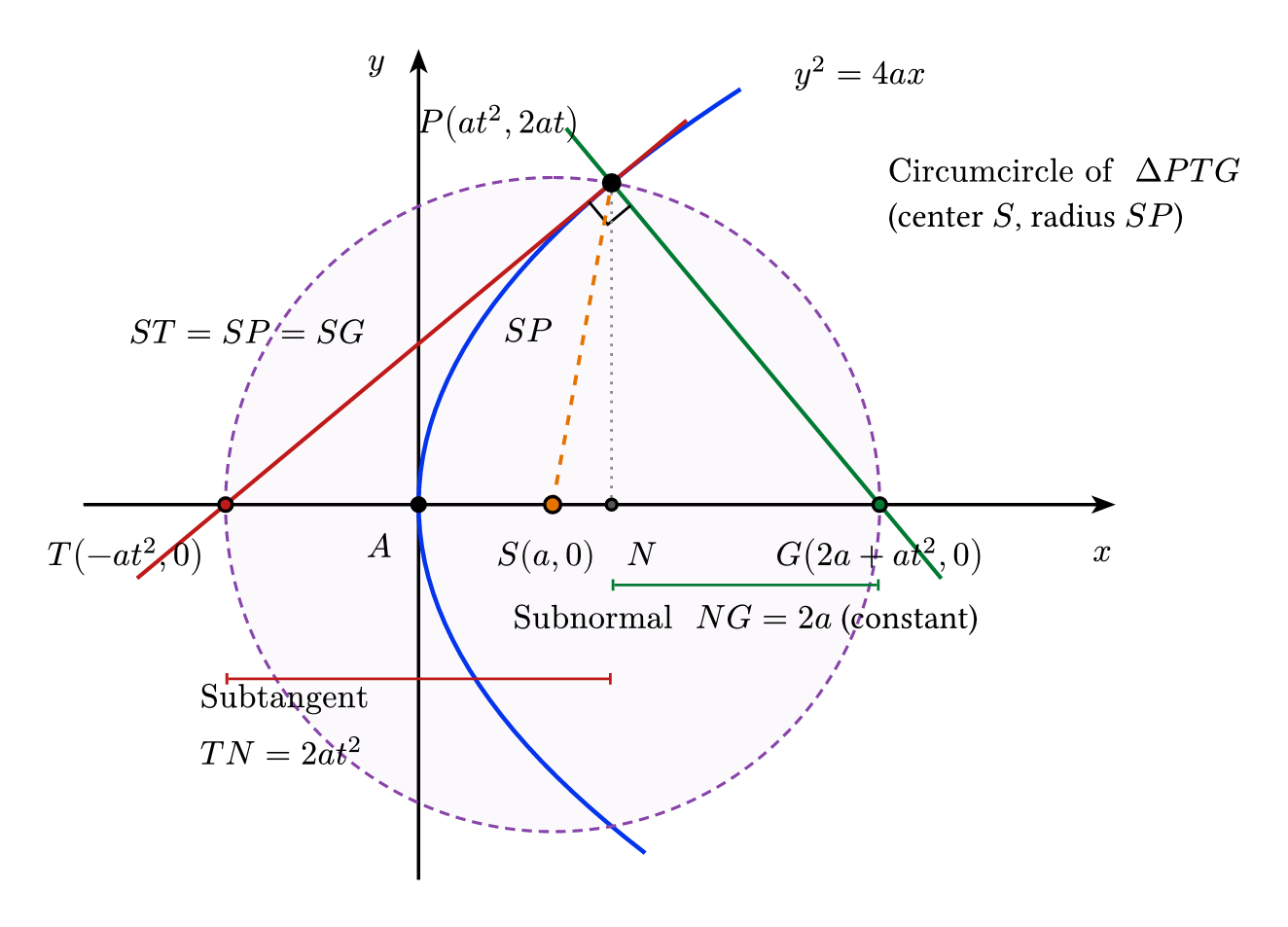
The equation of the tangent line to the parabola at the point P(at2,2at) is:
ty=x+at2
Setting y=0 to determine where the tangent intersects the principal axis (the x-axis), we obtain x=−at2. Let this point of intersection be denoted by T:
T(−at2,0)
The equation of the normal line to the parabola at P(at2,2at) is:
y−2at=−t(x−at2)⟹y+tx=2at+at3
Setting y=0 to find where the normal intersects the principal axis gives tx=2at+at3, which yields x=2a+at2. Let this point of intersection be denoted by G:
G(2a+at2,0)
Furthermore, let N be the foot of the perpendicular drawn from the point of contact P(at2,2at) onto the principal axis:
Now consider the distance from the focus S(a,0) to the tangent intercept T(−at2,0):
ST=∣a−(−at2)∣=a(1+t2)
Next, consider the distance from the focus S(a,0) to the normal intercept G(2a+at2,0):
SG=∣(2a+at2)−a∣=a(1+t2)
Comparing these three distances establishes the classic theorem:
For any point P on a parabola, the distance from the focus to the point of contact, the distance from the focus to the intersection of the tangent with the axis, and the distance from the focus to the intersection of the normal with the axis are all equal:
This equality yields immediate geometric deductions:
Isosceles Triangles:
In triangle △STP, since ST=SP, the triangle is isosceles. Therefore:
∠SPT=∠STP
Similarly, in triangle △SPG, since SP=SG, the triangle is isosceles:
∠SPG=∠SGP
Bisection of the Hypotenuse:
Because the tangent and normal at P are mutually perpendicular, triangle △PTG is a right-angled triangle with the right angle at P (∠TPG=90∘). The segment TG on the axis serves as the hypotenuse. The midpoint of TG has coordinates:
(2−at2+(2a+at2),20+0)=(a,0)=S
Thus, the focus S is precisely the midpoint of the hypotenuse TG.
The Circumcircle of the Triangle:
In any right-angled triangle, the circumcenter is the midpoint of the hypotenuse, and the circumradius equals half the hypotenuse. Because S is the midpoint of TG and ST=SG=SP=a(1+t2), the circumcircle of the right-angled triangle △PTG has its center at the focus S(a,0) and passes through P,T, and G.
The projections of the tangent and normal segments onto the principal axis are known as the subtangent and subnormal:
Subtangent (TN):
The subtangent is the directed distance between the tangent intercept T and the foot of the ordinate N:
TN=xN−xT=at2−(−at2)=2at2=2xP
Notice that the origin A(0,0), which is the vertex of the parabola, lies midway between T(−at2,0) and N(at2,0):
TA=AN=at2
Therefore, the subtangent is always bisected at the vertex of the parabola.
Subnormal (NG):
The subnormal is the directed distance between the foot of the ordinate N and the normal intercept G:
NG=xG−xN=(2a+at2)−at2=2a
Remarkably, the value 2a is completely free of the parameter t. It is a constant for every single point on the parabola:
The subnormal of a parabola is constant and equal to the semi-latus rectum 2a.
Foot of Perpendicular from Focus and the Directrix Reflection§
We now turn our attention to the perpendicular dropped from the focus onto any tangent line, and the relationship between this perpendicular and the directrix.
The Foot of the Perpendicular on the Tangent at the Vertex§
Let the tangent line at P(at2,2at) be:
x−ty+at2=0
Its slope is mT=t1. The straight line passing through the focus S(a,0) perpendicular to this tangent has slope m⊥=−t. Its equation is:
y−0=−t(x−a)⟹tx+y=at
To find the point of intersection Y of the tangent and this perpendicular line, we solve the two linear equations simultaneously:
x−ty=−at2
tx+y=at
Multiplying the second equation by t and adding it to the first:
(1+t2)x=−at2+at2=0⟹x=0
Substituting x=0 into tx+y=at yields y=at. Therefore, the foot of the perpendicular is:
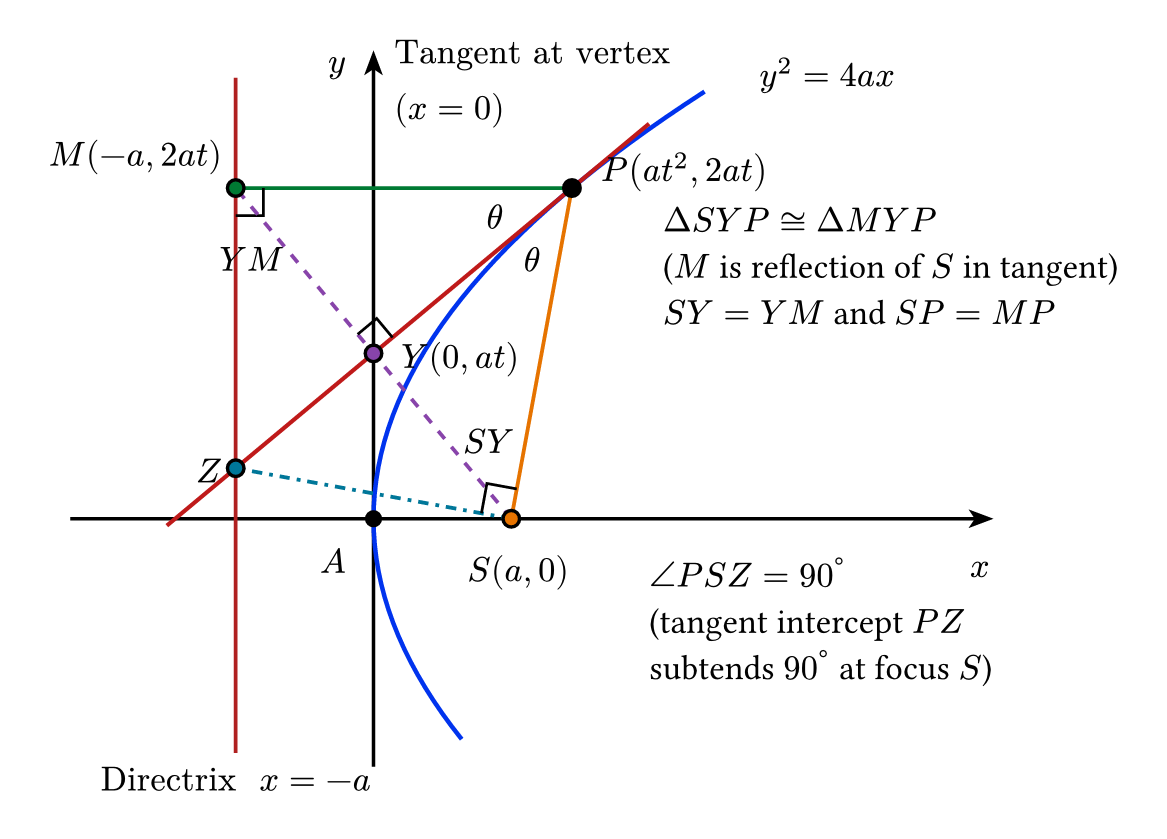
Y(0,at)
Because the line x=0 is the tangent to the parabola at its vertex A(0,0), we arrive at the theorem:
The foot of the perpendicular drawn from the focus of a parabola onto any tangent lies on the tangent at the vertex.
We also compute the distance SY:
SY=(0−a)2+(at−0)2=a2+a2t2=a1+t2
Squaring this distance:
SY2=a2(1+t2)=a⋅a(1+t2)=SA⋅SP
where SA=a is the distance from the focus to the vertex. Thus, the length of the perpendicular from the focus onto any tangent is the geometric mean between the focal distance of the vertex and the focal distance of the point of contact.
Congruence of Triangles and the Reflection of the Focus§
Let M be the foot of the perpendicular drawn from the point of contact P(at2,2at) onto the directrix x=−a:
M(−a,2at)
Consider the line segment connecting the focus S(a,0) and the directrix foot M(−a,2at). The midpoint of SM has coordinates:
(2a+(−a),20+2at)=(0,at)=Y
Thus, the midpoint of the segment SM is none other than the point Y, which lies on the tangent line.
Moreover, the slope of the line SM is:
mSM=−a−a2at−0=−2a2at=−t
Since the slope of the tangent at P is t1, the product of their slopes is:
mT⋅mSM=(t1)(−t)=−1
Therefore, the segment SM is strictly perpendicular to the tangent line at Y.
Now examine the two right-angled triangles △SYP and △MYP:
PY is a common side.
∠SYP=∠MYP=90∘, since SM⊥PY.
SY=YM, because Y is the midpoint of SM.
By the side-angle-side congruence criterion:
△SYP≅△MYP
From this congruence, two profound geometric conclusions follow:
The Directrix Reflection Theorem:
Because SM⊥PY and SY=YM, the point M is the exact mirror image (reflection) of the focus S across the tangent line PY. Since M was defined as the foot of the perpendicular on the directrix, M lies on the line x=−a.
The reflection of the focus of a parabola in any tangent line always lies on the directrix.
Angle Bisection by the Tangent:
From the congruence of the triangles, the corresponding angles are equal:
∠SPY=∠MPY
The line PM is parallel to the principal axis of the parabola (both being perpendicular to the directrix). Hence, the tangent at any point bisects the angle between the focal radius SP and the line through P parallel to the axis.
Because the normal PG is perpendicular to the tangent PT, the normal bisects the supplementary angle formed by SP and the extension of MP.
Right Angle Subtended at the Focus by the Tangent Intercept§
Let the tangent at P(at2,2at) intersect the directrix x=−a at the point Z.
Substituting x=−a into the equation of the tangent x−ty+at2=0:
−a−ty+at2=0⟹ty=a(t2−1)⟹y=ta(t2−1)
Thus, the coordinates of Z are:
Z(−a,ta(t2−1))
We now evaluate the slopes of the segments SP and SZ meeting at the focus S(a,0):
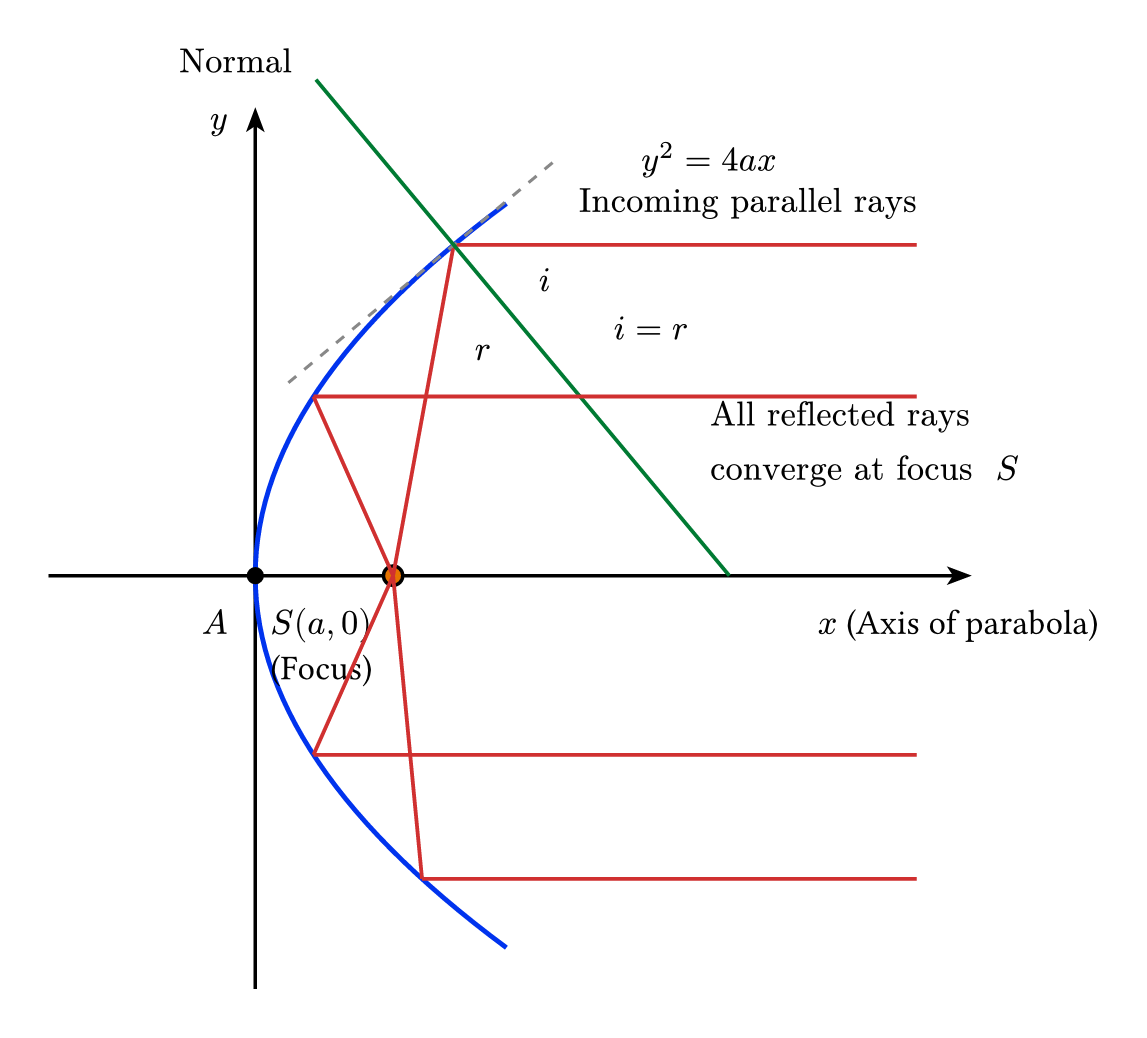
According to the physical law of specular reflection, when a ray of light strikes a smooth reflective curve at a point P, the angle of incidence equals the angle of reflection, where both angles are measured with respect to the normal line at P. Equivalently, the incoming ray and the reflected ray make equal angles with the tangent line at P.
Let an incident ray travel parallel to the principal axis of the parabola towards the vertex, moving along the line MP extended (where M is on the directrix). The ray strikes the interior concave surface of the parabola at P.
Let KP denote the incoming ray, so that K,P, and M all lie on the same straight line parallel to the axis.
By vertically opposite angles, the angle that the incoming ray KP makes with the tangent line at P is equal to ∠MPY.
Furthermore, we proved via triangle congruence that the tangent line bisects ∠SPM:
∠MPY=∠SPY
Therefore, the angle between the incoming ray and the tangent equals the angle between the reflected ray heading towards S and the tangent:
∠KPT=∠SPY
With respect to the normal PG, which is perpendicular to the tangent:
∠incidence (i)=∠reflection (r)
This establishes the optical theorem:
Every ray of light traveling parallel to the principal axis of a parabola reflects off the parabolic surface and converges precisely at the focus.
This mathematical property underpins vital everyday technologies:
Automotive Headlights and Searchlights: Placing a high-intensity bulb at the focus of a parabolic reflector produces a powerful, non-diverging beam of light directed straight ahead.
Satellite Dishes and Radio Telescopes: Parallel radio waves arriving from distant geostationary satellites or interstellar sources bounce off the dish and concentrate their energy at the receiver located at the focus.
Solar Concentrators: Sunlight arriving in parallel rays is concentrated at the focal point of a large parabolic trough or dish, generating temperatures sufficient to boil water or drive Stirling heat engines.
Parabolic Microphones: Sound waves traveling parallel to the axis reflect into a sensitive directional microphone placed at the focal point, enabling high-fidelity audio capture from long distances.
When three distinct tangents are drawn to a parabola, they form a triangle whose circumcircle and orthocenter obey two remarkable theorems.
Theorem: The Circumcircle of Three Tangents Passes Through the Focus§
Let P(at12,2at1), Q(at22,2at2), and R(at32,2at3) be three distinct points on the parabola y2=4ax.
The tangents drawn at these three points intersect pairwise to form a triangle △T1T2T3. Using the standard formulas for the intersection of two tangents, the vertices of the triangle are:
Because the coefficients of x2 and y2 are equal to 1 and there is no xy term, this equation represents a circle.
To confirm that this is the circumcircle of △T1T2T3, we verify that the vertex T3(at1t2,a(t1+t2)) satisfies the equation. Substituting x=at1t2 and y=a(t1+t2):
Thus, T3 lies on the circle. By the complete cyclic symmetry of the equation with respect to t1,t2, and t3, the vertices T1 and T2 must also lie on this circle. Therefore, this equation represents the unique circumcircle of triangle △T1T2T3.
Now we test whether the focus S(a,0) lies on this circumcircle. Substituting x=a and y=0:
The coordinates of the focus satisfy the equation identically, completing the proof.
Theorem: The Orthocenter of Three Tangents Lies on the Directrix§
We now examine the orthocenter (the point of concurrency of the altitudes) of the triangle formed by three tangents.
The orthocenter of the triangle formed by any three tangents to a parabola lies on the directrix of the parabola.
Proof
Consider the three sides of triangle △T1T2T3, which are the tangents to the parabola at P,Q, and R:
Side T2T3 (tangent at P): x−t1y+at12=0, having slope m1=t11.
Side T3T1 (tangent at Q): x−t2y+at22=0, having slope m2=t21.
Side T1T2 (tangent at R): x−t3y+at32=0, having slope m3=t31.
Now we determine the equations of the altitudes:
Altitude from T1 perpendicular to side T2T3:
The side T2T3 has slope t11, so the altitude perpendicular to it has slope −t1. This altitude passes through the opposite vertex T1(at2t3,a(t2+t3)):
y−a(t2+t3)=−t1(x−at2t3)
Expanding and rearranging:
y+t1x=a(t2+t3+t1t2t3)
Altitude from T2 perpendicular to side T3T1:
The side T3T1 has slope t21, so the altitude perpendicular to it has slope −t2. This altitude passes through the opposite vertex T2(at3t1,a(t3+t1)):
y−a(t3+t1)=−t2(x−at3t1)
Expanding and rearranging:
y+t2x=a(t3+t1+t1t2t3)
The orthocenter H(xH,yH) is the point of intersection of these altitudes. Subtracting the second altitude equation from the first:
(t1−t2)x=a(t2−t1)=−a(t1−t2)
Since the three tangents are distinct, t1=t2. Dividing both sides by t1−t2:
x=−a
Because x=−a is precisely the equation of the directrix of the parabola, the x-coordinate of the orthocenter is always −a, regardless of the parameters t1,t2,t3.
Substituting x=−a back into the first altitude equation yields the y-coordinate: