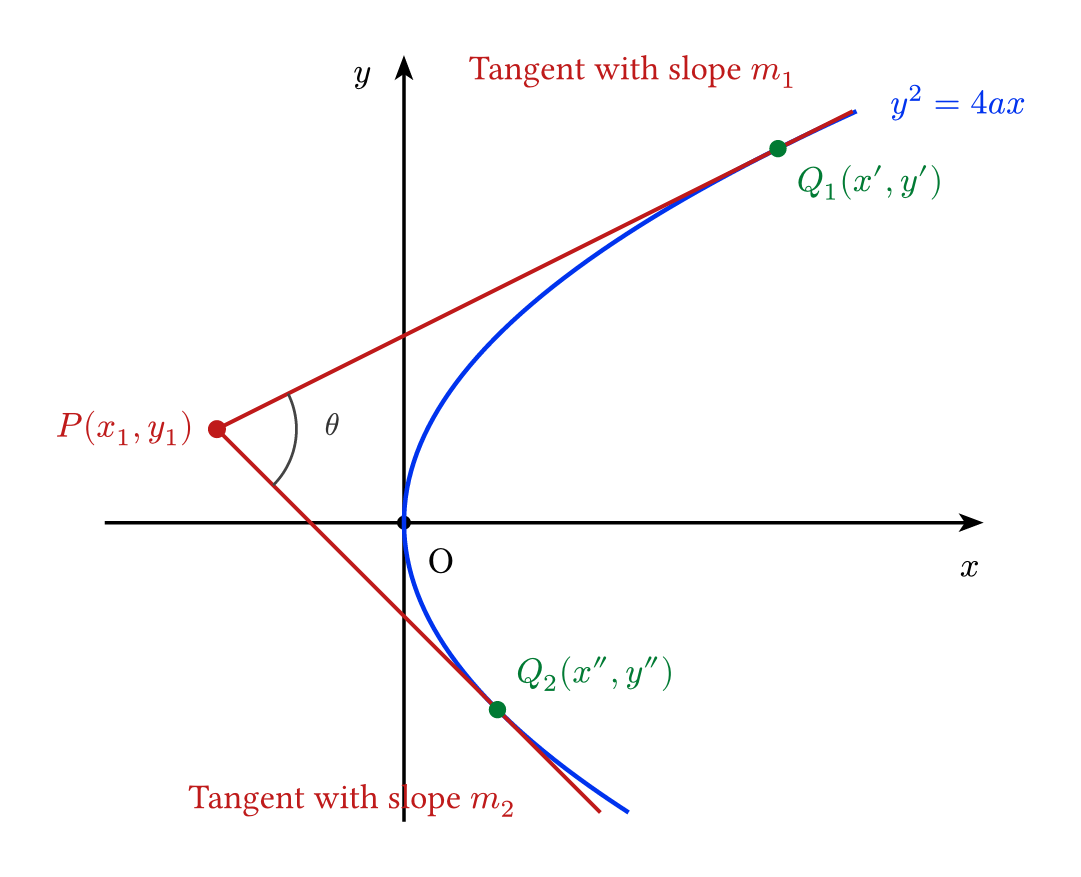
Let P(x1,y1) be a point lying outside the standard parabola y2=4ax. From any such external point, exactly two real and distinct tangents can be drawn to the curve.
The equation of any tangent to the parabola y2=4ax having a non-zero slope m is given in slope-form by:
y=mx+ma
If this tangent passes through the point P(x1,y1), the coordinates of P must satisfy the line equation:
y1=mx1+ma
Clearing the fraction by multiplying throughout by m and rearranging the terms in descending powers of m, we obtain:
x1m2−y1m+a=0⋯(1)
This is a quadratic equation in m. Its two roots, m1 and m2, represent the slopes of the two tangents that can be drawn from the point P(x1,y1) to the parabola.
By Vieta's relations, the sum and product of these slopes are:
The nature of the tangents drawn from P(x1,y1) is governed by the discriminant Δ of equation (1):
Δ=(−y1)2−4(x1)(a)=y12−4ax1
The quantity y12−4ax1 is denoted by S1 in standard notation for the conic S≡y2−4ax=0:
Two Real and Distinct Tangents (S1>0):
When y12−4ax1>0, the roots m1 and m2 are real and unequal. The point P(x1,y1) lies in the exterior of the parabola, and two distinct tangents can be drawn through it.
One Tangent / Coincident Tangents (S1=0):
When y12−4ax1=0, the roots are real and coincident (m1=m2=2x1y1). The point P(x1,y1) lies on the parabola itself, and the two tangents coincide into the unique tangent at P.
Imaginary Tangents (S1<0):
When y12−4ax1<0, the roots m1 and m2 are complex conjugates. The point P(x1,y1) lies in the interior of the parabola, and no real tangent can be drawn through it.
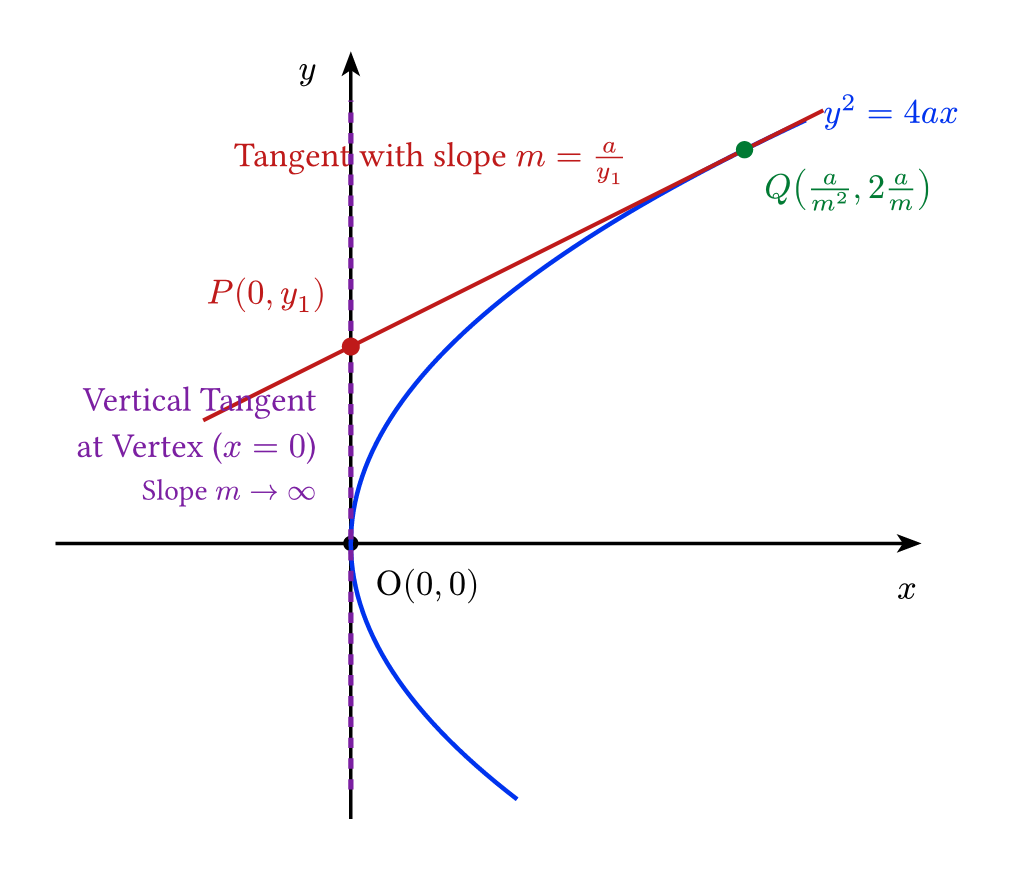
Geometrically, the y-axis (x=0) is the tangent to the parabola at the vertex (0,0). Since P(0,y1) lies on the y-axis, the line x=0 is itself a tangent passing through P. Because this line is vertical, its slope is infinite (m→∞), which explains the apparent disappearance of the second root from the finite quadratic.
Therefore, from any point P(0,y1) on the y-axis (y1=0), the two tangents to y2=4ax are:
When the two tangents drawn from P(x1,y1) are mutually perpendicular, θ=90∘, so tanθ→∞. Consequently, the denominator in the expression for tanθ must vanish:
1+m1m2=0⟹m1m2=−1
Substituting m1m2=x1a gives:
x1a=−1⟹x1=−ax1+a=0
This establishes the following fundamental theorem:
Rather than determining the slopes m1 and m2 individually, we can obtain a single second-degree Cartesian equation that represents both tangents drawn from an external point P(x1,y1) to the parabola y2=4ax.
Let R(x,y) be any arbitrary point lying on either of the two tangents drawn from P(x1,y1) to the parabola.
Any point dividing the straight line segment PR in the ratio k:1 has coordinates given by the section formula:
(k+1kx+x1,k+1ky+y1)
If this dividing point lies on the parabola y2=4ax, its coordinates must satisfy the parabola's equation:
(k+1ky+y1)2=4a(k+1kx+x1)
Multiplying throughout by (k+1)2 eliminates the denominators:
For the line PR to be a tangent to the parabola, the two points in which the line meets the curve must coincide. Consequently, the quadratic equation in k must have equal roots, which occurs if and only if its discriminant vanishes:
(2T)2−4(S)(S1)=04T2−4SS1=0SS1=T2
Written out in full Cartesian coordinates, the combined equation of the pair of tangents is:
(y2−4ax)(y12−4ax1)=[yy1−2a(x+x1)]2
This single quadratic equation in x and y represents the pair of straight lines that touch the parabola and pass through P(x1,y1).
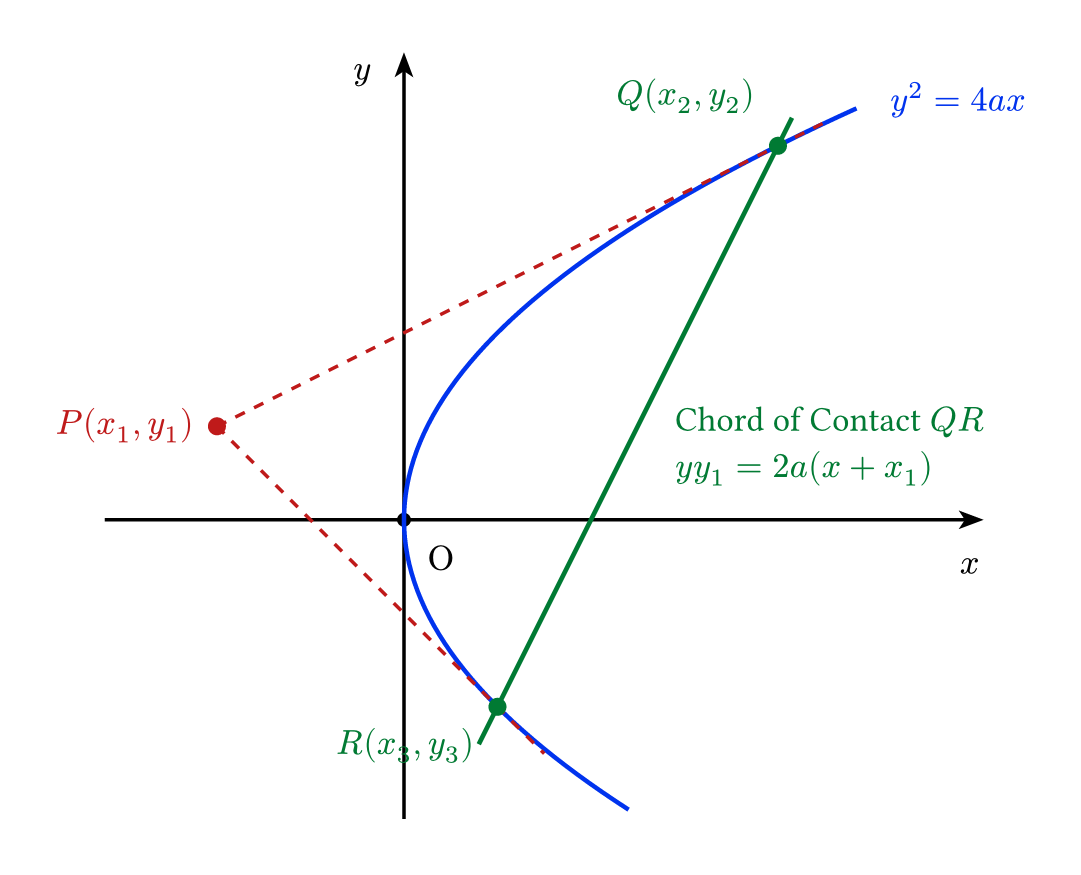
Let P(x1,y1) be an external point to the parabola y2=4ax. From P, two tangents can be drawn to the curve. Let these tangents touch the parabola at the points Q(x2,y2) and R(x3,y3).
The straight line segment joining these two points of contact, Q and R, is called the chord of contact of tangents drawn from the point P(x1,y1).
The equation of the tangent to the parabola y2=4ax at the point of contact Q(x2,y2) is:
yy2=2a(x+x2)⋯(1)
Since this tangent passes through the external point P(x1,y1), the coordinates of P must satisfy equation (1):
y1y2=2a(x1+x2)⋯(2)
In exactly the same manner, the equation of the tangent to the parabola at the point of contact R(x3,y3) is:
yy3=2a(x+x3)⋯(3)
Since this tangent also passes through the external point P(x1,y1), the coordinates of P must satisfy equation (3):
y1y3=2a(x1+x3)⋯(4)
Now, consider the relation:
yy1=2a(x+x1)⋯(5)
Observe two fundamental properties of equation (5):
It represents a straight line: Equation (5) is of the first degree in the running coordinates x and y.
It passes through both points Q and R:
If we substitute the coordinates of Q(x2,y2) into equation (5), we obtain y2y1=2a(x2+x1), which is identically true by virtue of relation (2). Hence, the point Q(x2,y2) lies on the line (5).
If we substitute the coordinates of R(x3,y3) into equation (5), we obtain y3y1=2a(x3+x1), which is identically true by virtue of relation (4). Hence, the point R(x3,y3) also lies on the line (5).
Since equation (5) represents a straight line and is satisfied by both points of contact Q(x2,y2) and R(x3,y3), by the fundamental geometric axiom that only one straight line can pass through two distinct points, equation (5) must be the equation of the chord of contact QR.
Thus, the equation of the chord of contact of tangents drawn from P(x1,y1) to the parabola y2=4ax is:
yy1=2a(x+x1)
Using the standard notation T≡yy1−2a(x+x1), this result is expressed compactly as:
The equation of the chord of contact can also be derived with great simplicity by representing the points of contact in parametric coordinates.
Let the tangents drawn from the external point P(x1,y1) touch the parabola y2=4ax at the points Q(at12,2at1) and R(at22,2at2), where t1 and t2 are the corresponding parameters.
Recall that the point of intersection of two tangents drawn at the parametric points t1 and t2 to the parabola y2=4ax has coordinates:
P(at1t2,a(t1+t2))
Since the tangents intersect at the given point P(x1,y1), equating the coordinates gives:
Now, the chord of contact QR is simply the chord joining the two points Q(t1) and R(t2) on the parabola. As established in our study of chords, the equation of the chord joining t1 and t2 is:
y(t1+t2)=2x+2at1t2
Substituting the values of (t1+t2) and t1t2 from relations (A) and (B) into this chord equation:
Following an identical argument for the other standard orientations of the parabola, the equation of the chord of contact from an external point P(x1,y1) is summarized below:
Equation of Parabola
Equation of Chord of Contact (T=0)
y2=4ax
yy1=2a(x+x1)
y2=−4ax
yy1=−2a(x+x1)
x2=4ay
xx1=2a(y+y1)
x2=−4ay
xx1=−2a(y+y1)
Illustrative Example: Equation and Points of Contact of a Chord of Contact§
Let P(x1,y1) be an external point to the parabola y2=4ax, and let Q(at12,2at1) and R(at22,2at2) be the points of contact of the tangents drawn from P.
As proved earlier, the external point has coordinates:
x1=at1t2andy1=a(t1+t2)
The distance between the two points of contact Q(t1) and R(t2) is given in parametric form by:
QR=a∣t1−t2∣(t1+t2)2+4
We can express this length directly in terms of the Cartesian coordinates (x1,y1) of the external point P:
Multiplying these two expressions together yields the Cartesian formula for the length of the chord of contact:
QR=ay12−4ax1y12+4a2=aS1y12+4a2
Area of the Triangle Formed by a Pair of Tangents and Their Chord of Contact§
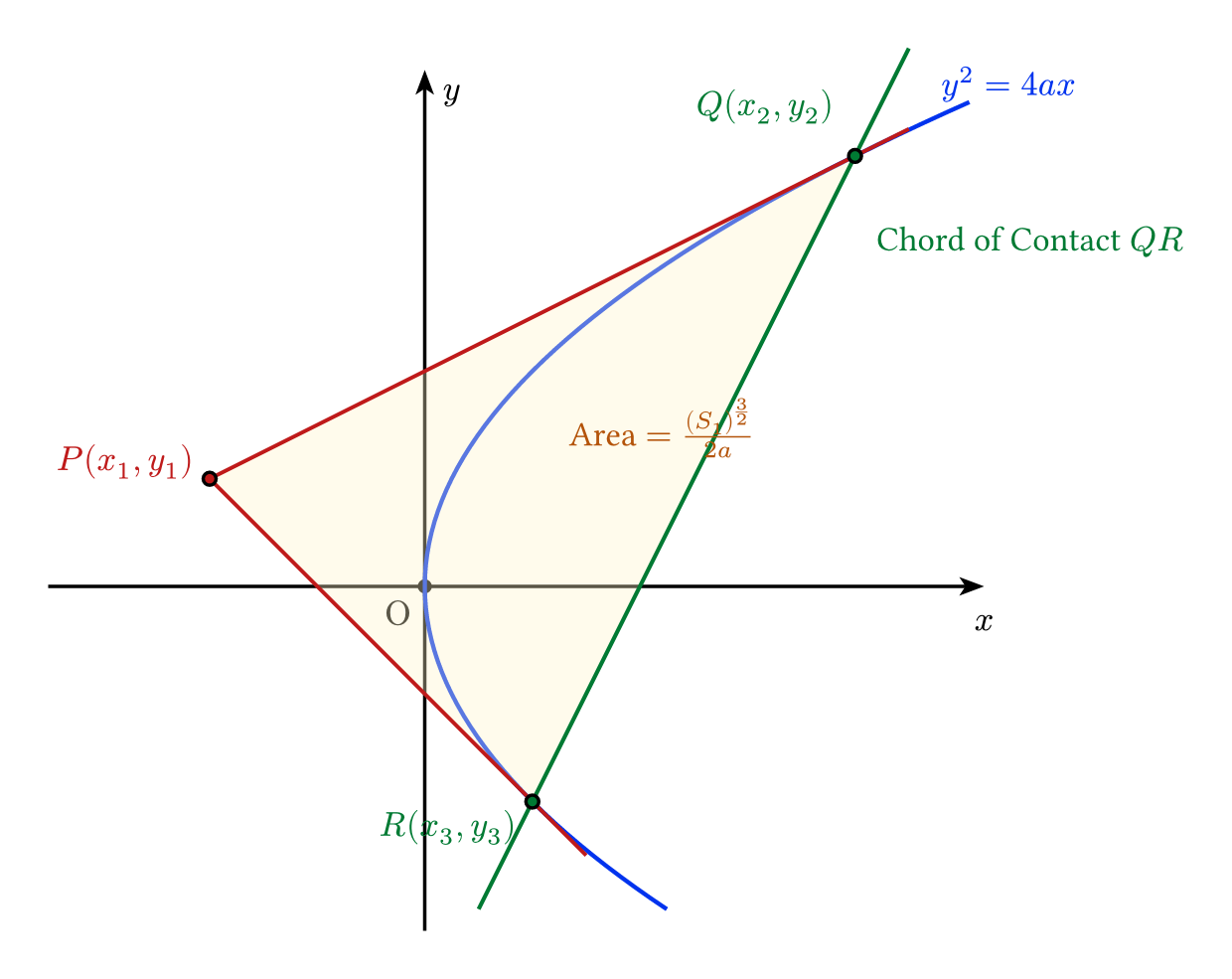
When two tangents are drawn from an external point P(x1,y1) to the parabola y2=4ax, touching the curve at Q(at12,2at1) and R(at22,2at2), the three points enclose a triangle △PQR.
Using the coordinate formula for the area of a triangle with vertices P(at1t2,a(t1+t2)), Q(at12,2at1), and R(at22,2at2):
This formula shows that the area depends solely on the value of S1 at the external point and the focal parameter a.
Ratio of Areas for Triangles Formed by Three Tangents§
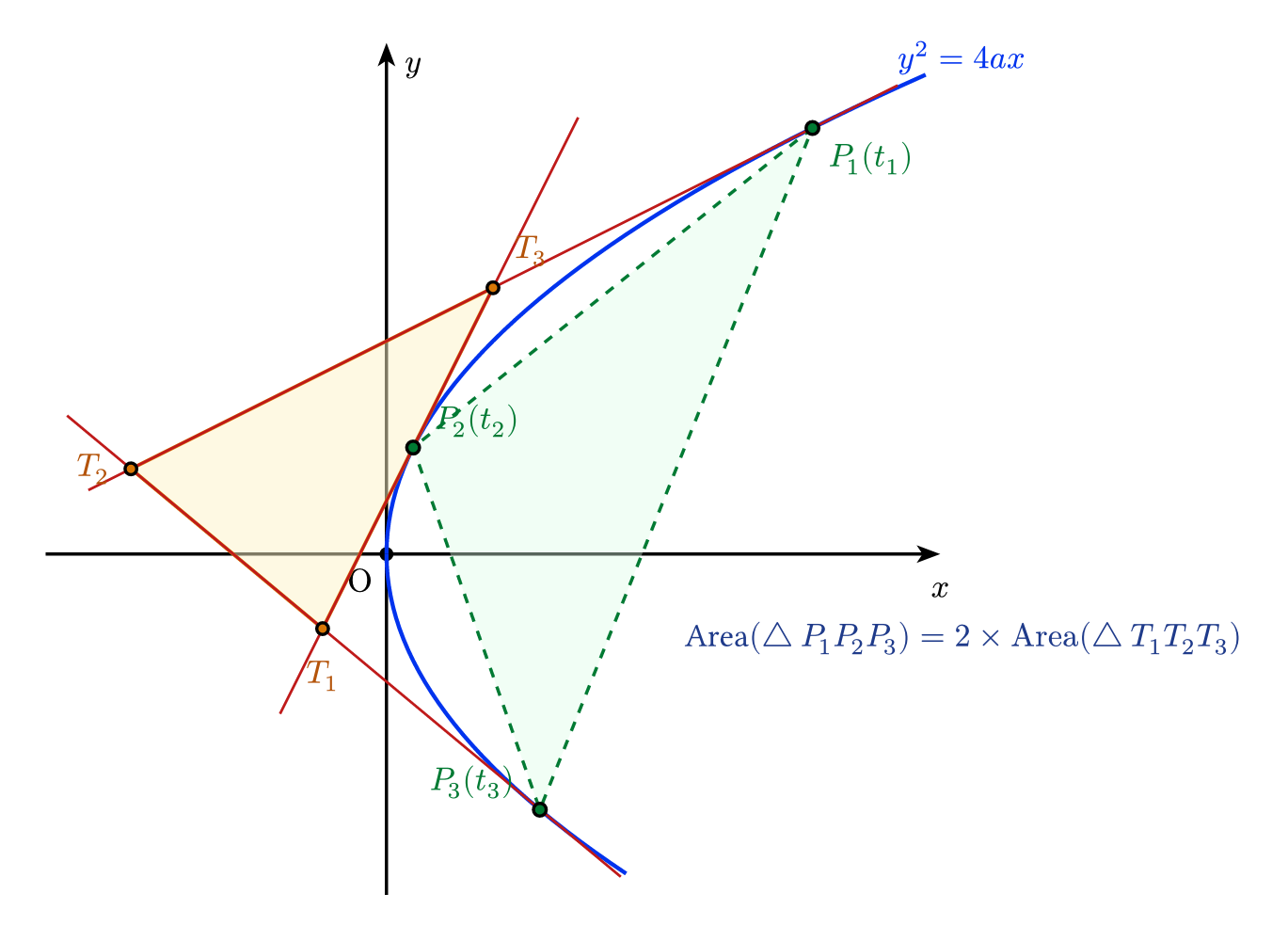
A classical and remarkable theorem connects the area of the triangle formed by any three tangents to a parabola with the area of the triangle formed by their three points of contact.
Let P1(at12,2at1), P2(at22,2at2), and P3(at32,2at3) be three distinct points on the parabola y2=4ax. The tangents drawn at these points taken pairwise intersect at three vertices:
T3(at1t2,a(t1+t2)) (intersection of tangents at P1 and P2)
T1(at2t3,a(t2+t3)) (intersection of tangents at P2 and P3)
T2(at3t1,a(t3+t1)) (intersection of tangents at P3 and P1)
Let ΔP denote the area of the triangle formed by the points of contact △P1P2P3, and let ΔT denote the area of the triangle formed by the tangents △T1T2T3.
Area of the triangle of contact points (ΔP):
Using the standard determinant formula for the area of a triangle:
Evaluating this standard Vandermonde-type determinant:
ΔP=a2∣(t1−t2)(t2−t3)(t3−t1)∣
Area of the triangle of tangents (ΔT):
The coordinates of the vertices of △T1T2T3 are T1(at2t3,a(t2+t3)), T2(at3t1,a(t3+t1)), and T3(at1t2,a(t1+t2)). Its area is given by:
The area of the triangle formed by three points of contact on a parabola is always exactly twice the area of the triangle formed by the tangents drawn at those three points.
Focal Properties of a Pair of Tangents: Similarity of Triangles§
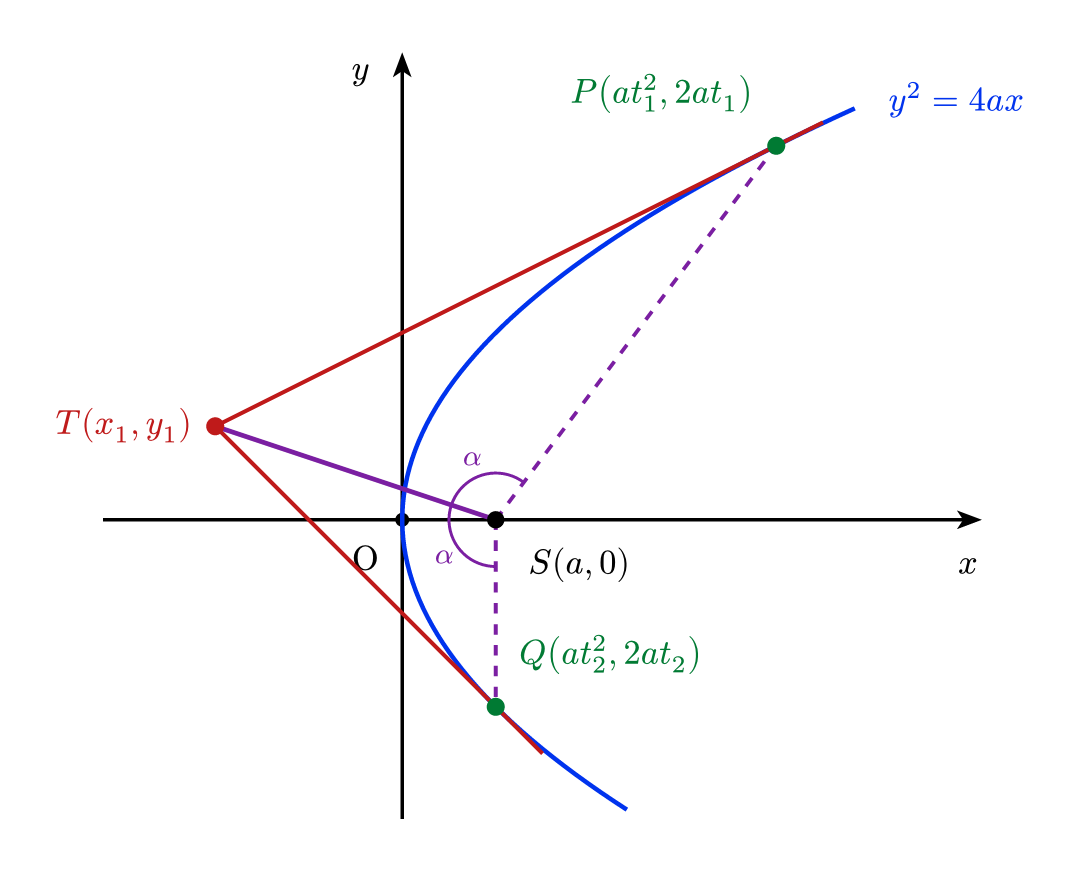
A fundamental geometric result in coordinate geometry concerns the configuration formed by two tangents drawn from an external point to a parabola and the straight lines connecting their points of contact and their intersection to the focus.
Let TP and TQ be two tangents drawn from an external point T(x1,y1) to the standard parabola y2=4ax, touching the curve at the points P(at12,2at1) and Q(at22,2at2) respectively. Let S(a,0) be the focus of the parabola.
As established previously, the point of intersection T of the tangents at P(t1) and Q(t2) has coordinates:
T(at1t2,a(t1+t2))
We now analyze the geometric relations between the four points S, P, Q, and T.
By the focal distance property of the parabola, the distance of any point on the curve from the focus equals its distance from the directrix x+a=0. For points P and Q, their focal distances are:
Recognizing a(1+t12)=SP and a(1+t22)=SQ, we arrive at the fundamental relation:
ST2=SP⋅SQST=SP⋅SQ
This proves that the distance of the intersection point of two tangents from the focus is the geometric mean between the focal distances of their points of contact.
Dividing these two expressions gives the ratio of the squared lengths of the tangents:
TQ2TP2=a(t1−t2)2⋅SQa(t1−t2)2⋅SP=SQSP
Taking square roots:
TQTP=SQSP
The lengths of the two tangents drawn from any point to a parabola are proportional to the square roots of the focal distances of their points of contact.
From the similarity of triangles △STP and △SQT, several vital geometrical theorems follow directly:
Tangents subtend equal angles at the focus:
Since corresponding angles in similar triangles are equal, the angles at the vertex S are equal:
∠PST=∠TSQ
The straight line joining the focus to the intersection of two tangents bisects the angle subtended by their chord of contact at the focus. In other words, the two tangents drawn from any point subtend equal angles at the focus.
Angle correspondences:
The remaining pairs of corresponding angles are equal:
∠SPT=∠STQand∠STP=∠SQT
Geometric mean relation:
ST2=SP⋅SQ
Circumcircle property:
If three tangents are drawn to a parabola, the circumcircle of the triangle formed by them passes through the focus of the parabola.