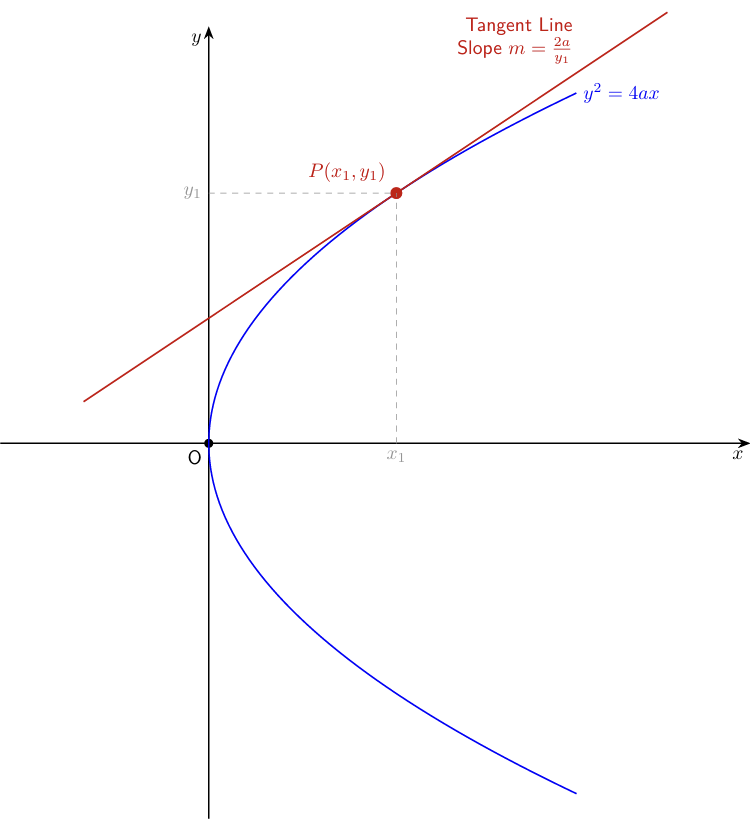
Equation of Tangent to a Standard Parabola at a Given Point§
Let P(x1,y1) be a point lying on the parabola whose standard equation is y2=4ax. We wish to find the equation of the tangent line to the curve at this specific point.
To determine the slope of the tangent line, we first differentiate the equation of the parabola with respect to x. Applying the chain rule to the left side yields:
dxd(y2)=dxd(4ax)2ydxdy=4a
Solving for the derivative, we find the general expression for the slope at any point (x,y) on the curve:
dxdy=y2a
The slope m of the tangent specifically at the point P(x1,y1) is found by substituting the y-coordinate of our point into this derivative:
m=y12a
Now, recall the point-slope form for the equation of a straight line: y−y1=m(x−x1). Substituting our point P(x1,y1) and the calculated slope m, the equation of the tangent becomes:
y−y1=y12a(x−x1)
To simplify this equation, we multiply both sides by y1 to eliminate the denominator:
yy1−y12=2a(x−x1)yy1−y12=2ax−2ax1
At this stage, we utilize a crucial piece of information: because the point P(x1,y1) lies on the parabola, its coordinates must satisfy the parabola's original equation. Therefore, we know that:
y12=4ax1
We can substitute this value of 4ax1 in place of y12 in our tangent equation:
yy1−4ax1=2ax−2ax1
Adding 4ax1 to both sides to isolate the yy1 term gives:
yy1=2ax−2ax1+4ax1yy1=2ax+2ax1
Finally, factoring out 2a on the right side provides the standard, symmetric form of the equation. Thus, the equation of the tangent to the parabola y2=4ax at the point (x1,y1) is:
yy1=2a(x+x1)
By applying the exact same calculus-based procedure—differentiating the equation to find the slope and utilizing the point-slope form—we can readily derive the equations of the tangents for the other standard orientations of the parabola at a given point (x1,y1).
These results are summarized in the following table:
Equation of Parabola
Point of Tangency
Equation of Tangent
y2=4ax
(x1,y1)
yy1=2a(x+x1)
y2=−4ax
(x1,y1)
yy1=−2a(x+x1)
x2=4ay
(x1,y1)
xx1=2a(y+y1)
x2=−4ay
(x1,y1)
xx1=−2a(y+y1)
Did you notice a pattern in these derivations? There is a remarkable and systematic symmetry in how the equation of the curve transforms into the equation of its tangent. For instance, in the equation y2=4ax, which can be written as y⋅y=2a(2x), replacing one y with y1 and 2x with (x+x1) directly yields the tangent equation yy1=2a(x+x1).
This observation leads to a powerful mathematical shortcut. To write the equation of the tangent to a conic section at a point (x1,y1) that lies strictly on the curve, one can bypass the process of differentiation entirely by applying a standard set of substitutions to the original equation of the curve:
Replace x2 with xx1
Replace y2 with yy1
Replace x with 2x+x1
Replace y with 2y+y1
Replace xy with 2xy1+x1y
Leave any constant term c unchanged.
This elegant rule is not merely a convenient coincidence for standard parabolas; it is a fundamental property valid for any general conic section.
Consider the general equation of a second-degree curve, which can represent a circle, parabola, ellipse, or hyperbola depending on its coefficients:
ax2+2hxy+by2+2gx+2fy+c=0
By applying the substitution rules directly to this general equation, we obtain the universal equation for the tangent line at the point (x1,y1):
Simplifying this expression yields the standard form of the tangent for any general conic:
axx1+h(xy1+x1y)+byy1+g(x+x1)+f(y+y1)+c=0
Often, the expression on the left side of this equation is denoted by the symbol T. Thus, the equation of the tangent at a point (x1,y1) on the curve is compactly written as T=0. This rule provides an immediate, algebraic method for finding tangents without the need for explicitly computing derivatives.
As we have previously seen, any point on the standard parabola y2=4ax can be conveniently represented by the parametric coordinates (at2,2at), where t is the parameter. We will now determine the equation of the tangent line at this general point "t".
To find the equation of the tangent, we first need its slope, m=dxdy. Since our coordinates are given parametrically, we apply the chain rule for parametric differentiation:
dxdy=dtdxdtdy
Differentiating the parametric equations x=at2 and y=2at with respect to t yields:
dtdx=2atdtdy=2a
Substituting these into our slope formula, we get:
m=dxdy=2at2a=t1
The Geometric Significance of the Parameter 't'
This remarkably simple derivative, m=t1, reveals the precise geometric (and physical) significance of the parameter t. The value of t at any point on the parabola is exactly the reciprocal of the slope of the tangent line at that point.
Because t=m1, knowing the parameter of a point immediately gives us the direction of the tangent line. Conversely, if we are looking for a point on the parabola where the tangent has a specific slope m, we immediately know that the point corresponds to the parameter t=m1.
Deriving the Equation
Now that we have the slope m=t1 and the point (at2,2at), we can use the point-slope form of a linear equation, y−y1=m(x−x1), to find the equation of the tangent:
y−2at=t1(x−at2)
Multiplying the entire equation by t to clear the fraction gives:
ty−2at2=x−at2
Adding 2at2 to both sides yields the standard parametric equation of the tangent:
ty=x+at2
Alternatively, by dividing the equation by t, we can express the tangent in the explicit slope-intercept form (y=mx+c):
y=tx+at
This form clearly displays the slope t1 and the y-intercept at.
(Note: We can also derive this result instantly using our T=0 substitution rule. If we take the Cartesian tangent equation yy1=2a(x+x1) and substitute x1=at2 and y1=2at, we get y(2at)=2a(x+at2). Canceling 2a from both sides immediately leaves us with ty=x+at2, confirming our calculus-based derivation.)
Similarly, we can write the equation of the tangent to the other standard parabolas in parametric form as:
Equation of Parabola
Parametric Point
Equation of Tangent
y2=4ax
(at2,2at)
ty=x+at2
y2=−4ax
(−at2,2at)
−ty=x+at2 or ty=−x−at2
x2=4ay
(2at,at2)
tx=y+at2
x2=−4ay
(2at,−at2)
−tx=y+at2 or tx=−y−at2
Parametric form of tangent for shifted parabolas
Consider a right-handed parabola with vertex shifted to the point (h,k). Its standard equation is:
(y−k)2=4a(x−h)
The parametric coordinates of any point P on this parabola can be expressed as:
(h+at2,k+2at)
The equation of the tangent at this point is:
(y−k)t=(x−h)+at2
Similarly, for other shifted parabolas, the equation of the tangent can be written as:
Equation of Parabola
Parametric Point
Equation of Tangent
(y−k)2=4a(x−h)
(h+at2,k+2at)
(y−k)t=(x−h)+at2
(y−k)2=−4a(x−h)
(h−at2,k+2at)
(y−k)t=−(x−h)+at2 or (y−k)t=(h−x)+at2
(x−h)2=4a(y−k)
(h+2at,k+at2)
(x−h)t=(y−k)+at2
(x−h)2=−4a(y−k)
(h+2at,k−at2)
(x−h)t=−(y−k)+at2 or (x−h)t=(k−y)+at2
Note that the equation of the tangent to the shifted parabola is similar to the equation of the tangent to the standard parabola. The only difference is that the equation of the tangent to the shifted parabola is in terms of (x−h) and (y−k) instead of x and y.
Section 6 of 14 · Parabola
Mark this section complete when you have worked through its proofs.
Type any topic, theorem, or concept to jump directly to the section.