MatheramaMatherama
← Parabola
Parabola·Section 12·29 min read

Co-normal Points and Normals to a Parabola

When investigating tangents to a conic section from an external point, algebraic analysis leads to a quadratic equation, confirming that from any point outside the curve, exactly two tangents can be drawn. When the same inquiry is directed toward normals, a fundamentally richer structure emerges. The condition that a normal to a parabola passes through a specified point (h,k)(h, k) produces a cubic equation in the slope or parameter of the normal.

Because every cubic polynomial with real coefficients has at least one real root and at most three real roots, it follows that from any point in the plane, at least one and at most three normals can be drawn to a parabola. When three distinct normals exist, their feet on the parabola are known as co-normal points. The geometric relationships connecting these points, their centroid, their circumcircle, and the conditions under which normals meet on the curve or at an axis point form one of the most elegant chapters of classical coordinate geometry.


The Cubic Equation of Normals§

Consider the standard parabola:

y2=4axy^2 = 4ax

having its vertex at O(0,0)O(0, 0), focus at S(a,0)S(a, 0), and the xx-axis as its principal axis of symmetry.

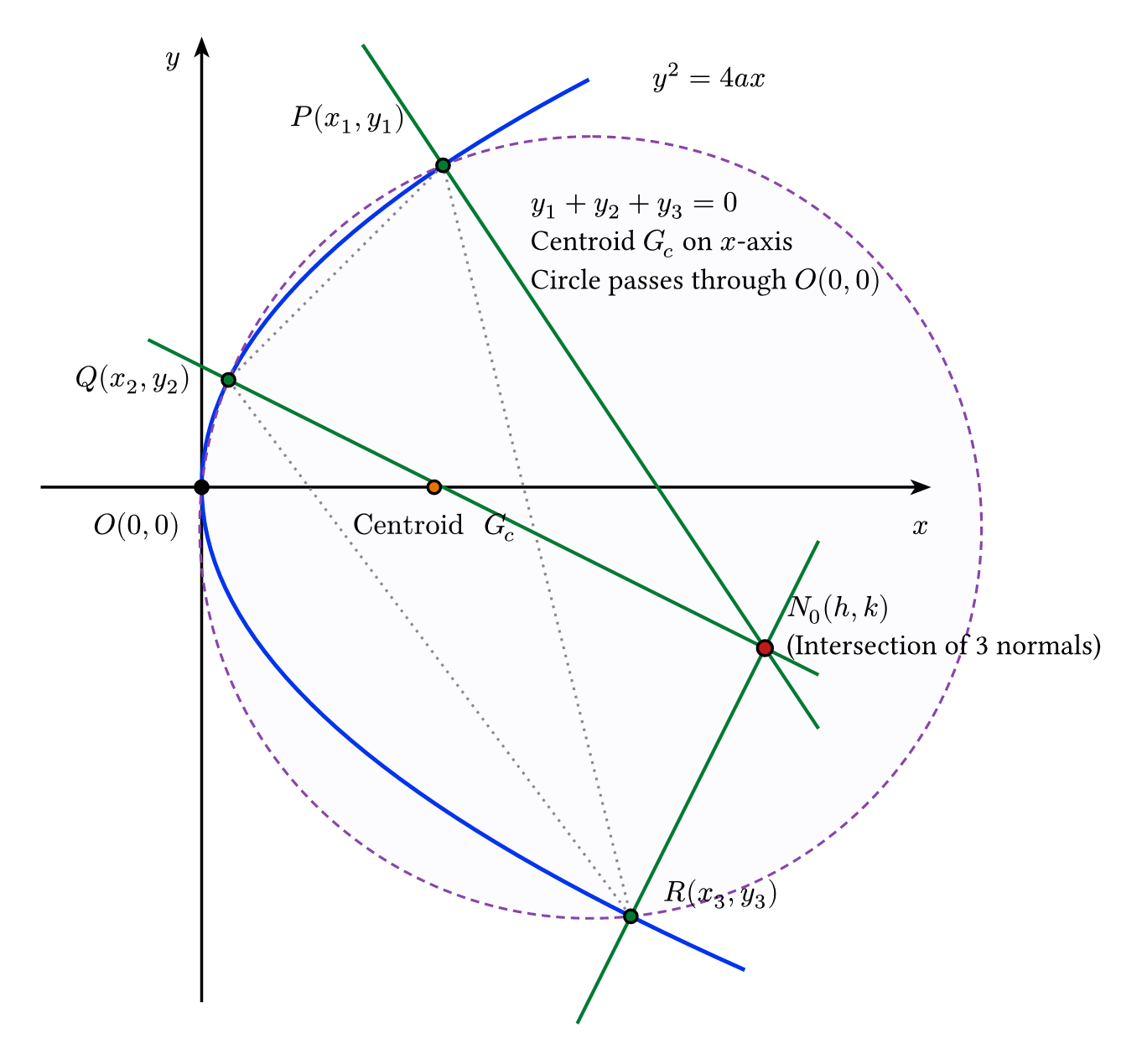
Three Normals and Co-normal Points

Slope Form Formulation§

Let mm denote the slope of a normal to the parabola. As established in the study of normal lines, the equation of the normal in terms of its slope mm is:

y=mx−2am−am3y = mx - 2am - am^3

The point of contact on the parabola, which constitutes the foot of this normal, is uniquely determined by the slope:

(am2,−2am)\left(am^2, -2am\right)

Suppose this normal line passes through a given point N0(h,k)N_0(h, k) in the plane. Substituting x=hx = h and y=ky = k into the normal equation yields:

k=mh−2am−am3k = mh - 2am - am^3

Rearranging this into standard polynomial form with descending powers of mm, we obtain the fundamental cubic equation of normals:

am3+(2a−h)m+k=0am^3 + (2a - h)m + k = 0

Dividing by the leading coefficient a≠0a \neq 0, the equation can be expressed as:

m3+(2a−ha)m+ka=0m^3 + \left(\frac{2a - h}{a}\right)m + \frac{k}{a} = 0

Because this is a polynomial equation of degree three with real coefficients, the Fundamental Theorem of Algebra guarantees three roots in the complex field. Complex roots of real polynomials always occur in conjugate pairs. Consequently, the equation has either:

  1. Three distinct real roots, corresponding to three distinct real normals drawn from (h,k)(h, k) to the parabola.
  2. One real root and two equal real roots, corresponding to one distinct normal and one repeated normal line (a normal that is tangent to the locus of intersection points).
  3. One real root and two complex conjugate roots, in which case exactly one real normal can be drawn from (h,k)(h, k).

In all cases, from any point in the plane, at least one real normal can always be drawn to a parabola.

Parametric Formulation§

Alternatively, let the foot of the normal be represented in standard parametric coordinates:

P(at2,2at)P\left(at^2, 2at\right)

The tangent line at P(t)P(t) has slope mT=1tm_T = \frac{1}{t}. Because the normal line is perpendicular to the tangent, its slope is:

m=−1mT=−tm = -\frac{1}{m_T} = -t

The equation of the normal at the parametric point tt is:

y−2at=−t(x−at2)  ⟹  y+tx=2at+at3y - 2at = -t(x - at^2) \implies y + tx = 2at + at^3

If this normal passes through the given point N0(h,k)N_0(h, k), substituting x=hx = h and y=ky = k produces:

k+th=2at+at3k + th = 2at + at^3

Rearranging in powers of tt, we obtain the cubic equation in the parameter tt:

at3+(2a−h)t−k=0at^3 + (2a - h)t - k = 0

Notice that this cubic equation in tt is directly related to the cubic equation in mm by the substitution t=−mt = -m. The three roots t1,t2,t3t_1, t_2, t_3 are simply the negatives of the three slopes m1,m2,m3m_1, m_2, m_3:

ti=−mi,i∈{1,2,3}t_i = -m_i, \quad i \in \{1, 2, 3\}

The three corresponding feet on the parabola are given directly by:

Pi(ati2,2ati)=(ami2,−2ami)P_i\left(at_i^2, 2at_i\right) = \left(am_i^2, -2am_i\right)

Fundamental Properties of Co-normal Points§

Let m1,m2,m3m_1, m_2, m_3 be the three roots of the cubic equation:

am3+(2a−h)m+k=0am^3 + (2a - h)m + k = 0

and let t1,t2,t3t_1, t_2, t_3 be the roots of the corresponding parametric cubic:

at3+(2a−h)t−k=0at^3 + (2a - h)t - k = 0

Applying Vieta's formulas to these cubics reveals several invariant geometric properties.

Vieta's Relations§

Because the coefficient of m2m^2 in the cubic is identically zero, the elementary symmetric polynomials of the slopes satisfy:

∑mi=m1+m2+m3=0\sum m_i = m_1 + m_2 + m_3 = 0 ∑m1m2=m1m2+m2m3+m3m1=2a−ha\sum m_1 m_2 = m_1 m_2 + m_2 m_3 + m_3 m_1 = \frac{2a - h}{a} m1m2m3=−kam_1 m_2 m_3 = -\frac{k}{a}

Similarly, for the parametric roots t1,t2,t3t_1, t_2, t_3:

∑ti=t1+t2+t3=0\sum t_i = t_1 + t_2 + t_3 = 0 ∑t1t2=t1t2+t2t3+t3t1=2a−ha\sum t_1 t_2 = t_1 t_2 + t_2 t_3 + t_3 t_1 = \frac{2a - h}{a} t1t2t3=kat_1 t_2 t_3 = \frac{k}{a}

The Sum of the Ordinates is Zero§

Let P(x1,y1)P(x_1, y_1), Q(x2,y2)Q(x_2, y_2), and R(x3,y3)R(x_3, y_3) denote the three co-normal points. The ordinate of each foot is given by yi=−2ami=2atiy_i = -2am_i = 2at_i.

Computing the algebraic sum of the three ordinates:

y1+y2+y3=−2a(m1+m2+m3)=2a(t1+t2+t3)y_1 + y_2 + y_3 = -2a(m_1 + m_2 + m_3) = 2a(t_1 + t_2 + t_3)

Since the sum of the roots is zero, we obtain the invariant result:

y1+y2+y3=0y_1 + y_2 + y_3 = 0

The algebraic sum of the ordinates of the feet of three normals drawn from any point in the plane to a parabola is identically zero.

The Centroid of Co-normal Points Lies on the Axis§

Consider the triangle formed by the three co-normal points P(x1,y1)P(x_1, y_1), Q(x2,y2)Q(x_2, y_2), and R(x3,y3)R(x_3, y_3). Let Gc(xG,yG)G_c(x_G, y_G) denote its centroid.

The yy-coordinate of the centroid is:

yG=y1+y2+y33=03=0y_G = \frac{y_1 + y_2 + y_3}{3} = \frac{0}{3} = 0

Because its ordinate is zero, the centroid of the three co-normal points always lies on the principal axis of the parabola (the xx-axis).

To determine the abscissa xGx_G, we compute the sum of the xx-coordinates:

x1+x2+x3=a(t12+t22+t32)x_1 + x_2 + x_3 = a\left(t_1^2 + t_2^2 + t_3^2\right)

Using the algebraic identity:

(t1+t2+t3)2=(t12+t22+t32)+2(t1t2+t2t3+t3t1)\left(t_1 + t_2 + t_3\right)^2 = \left(t_1^2 + t_2^2 + t_3^2\right) + 2\left(t_1 t_2 + t_2 t_3 + t_3 t_1\right)

and substituting t1+t2+t3=0t_1 + t_2 + t_3 = 0, we find:

t12+t22+t32=−2∑t1t2=−2(2a−ha)=2(h−2a)at_1^2 + t_2^2 + t_3^2 = -2\sum t_1 t_2 = -2\left(\frac{2a - h}{a}\right) = \frac{2(h - 2a)}{a}

Substituting this sum into the expression for the centroid's abscissa gives:

xG=x1+x2+x33=a⋅2(h−2a)a3=2(h−2a)3x_G = \frac{x_1 + x_2 + x_3}{3} = \frac{a \cdot \frac{2(h - 2a)}{a}}{3} = \frac{2(h - 2a)}{3}

The centroid of the triangle formed by the feet of three normals drawn from the point (h,k)(h, k) to the parabola y2=4axy^2 = 4ax is:

Gc(2(h−2a)3,0)G_c\left(\frac{2(h - 2a)}{3}, 0\right)

Notice that the position of the centroid along the axis depends solely on the abscissa hh of the point from which the normals are drawn, and is completely independent of its ordinate kk.


Illustrative Example: Computing Co-normal Points and Their Centroid§

Problem. Three normals are drawn from the point N0(9,6)N_0(9, 6) to the parabola y2=4xy^2 = 4x. Determine the slopes of these normals, the coordinates of the three co-normal points, and verify that the algebraic sum of their ordinates is zero and their centroid lies on the axis.

Solution. Comparing y2=4xy^2 = 4x with the standard form y2=4axy^2 = 4ax gives a=1a = 1. The point of concurrency is (h,k)=(9,6)(h, k) = (9, 6).

The cubic equation for the slopes of the normals is:

am3+(2a−h)m+k=0  ⟹  m3+(2−9)m+6=0  ⟹  m3−7m+6=0am^3 + (2a - h)m + k = 0 \implies m^3 + (2 - 9)m + 6 = 0 \implies m^3 - 7m + 6 = 0

Factoring this cubic polynomial:

m3−m−6m+6=m(m2−1)−6(m−1)=(m−1)(m2+m−6)=(m−1)(m−2)(m+3)=0m^3 - m - 6m + 6 = m(m^2 - 1) - 6(m - 1) = (m - 1)(m^2 + m - 6) = (m - 1)(m - 2)(m + 3) = 0

The three slopes are:

m1=1,m2=2,m3=−3m_1 = 1, \quad m_2 = 2, \quad m_3 = -3

Verifying the sum of slopes:

m1+m2+m3=1+2+(−3)=0m_1 + m_2 + m_3 = 1 + 2 + (-3) = 0

The foot of each normal is given by the formula (am2,−2am)=(m2,−2m)\left(am^2, -2am\right) = \left(m^2, -2m\right):

P=(12,−2(1))=(1,−2)P = \left(1^2, -2(1)\right) = (1, -2) Q=(22,−2(2))=(4,−4)Q = \left(2^2, -2(2)\right) = (4, -4) R=((−3)2,−2(−3))=(9,6)R = \left((-3)^2, -2(-3)\right) = (9, 6)

Notice that the third foot R(9,6)R(9, 6) coincides with the point of concurrency N0(9,6)N_0(9, 6), meaning that the normal at RR passes through RR itself (the normal is orthogonal to the tangent at RR).

Summing the ordinates of the three feet:

y1+y2+y3=−2+(−4)+6=0y_1 + y_2 + y_3 = -2 + (-4) + 6 = 0

Computing the centroid Gc(xG,yG)G_c(x_G, y_G) of △PQR\triangle PQR:

xG=1+4+93=143x_G = \frac{1 + 4 + 9}{3} = \frac{14}{3} yG=−2+(−4)+63=0y_G = \frac{-2 + (-4) + 6}{3} = 0

Using the theoretical formula:

xG=2(h−2a)3=2(9−2)3=143x_G = \frac{2(h - 2a)}{3} = \frac{2(9 - 2)}{3} = \frac{14}{3}

The computed coordinates match the theoretical predictions.


Normals from a Point on the Axis§

A particularly illuminating special case occurs when the point from which the normals are drawn lies directly on the axis of symmetry of the parabola.

Let the point be B(b,0)B(b, 0), so that h=bh = b and k=0k = 0.

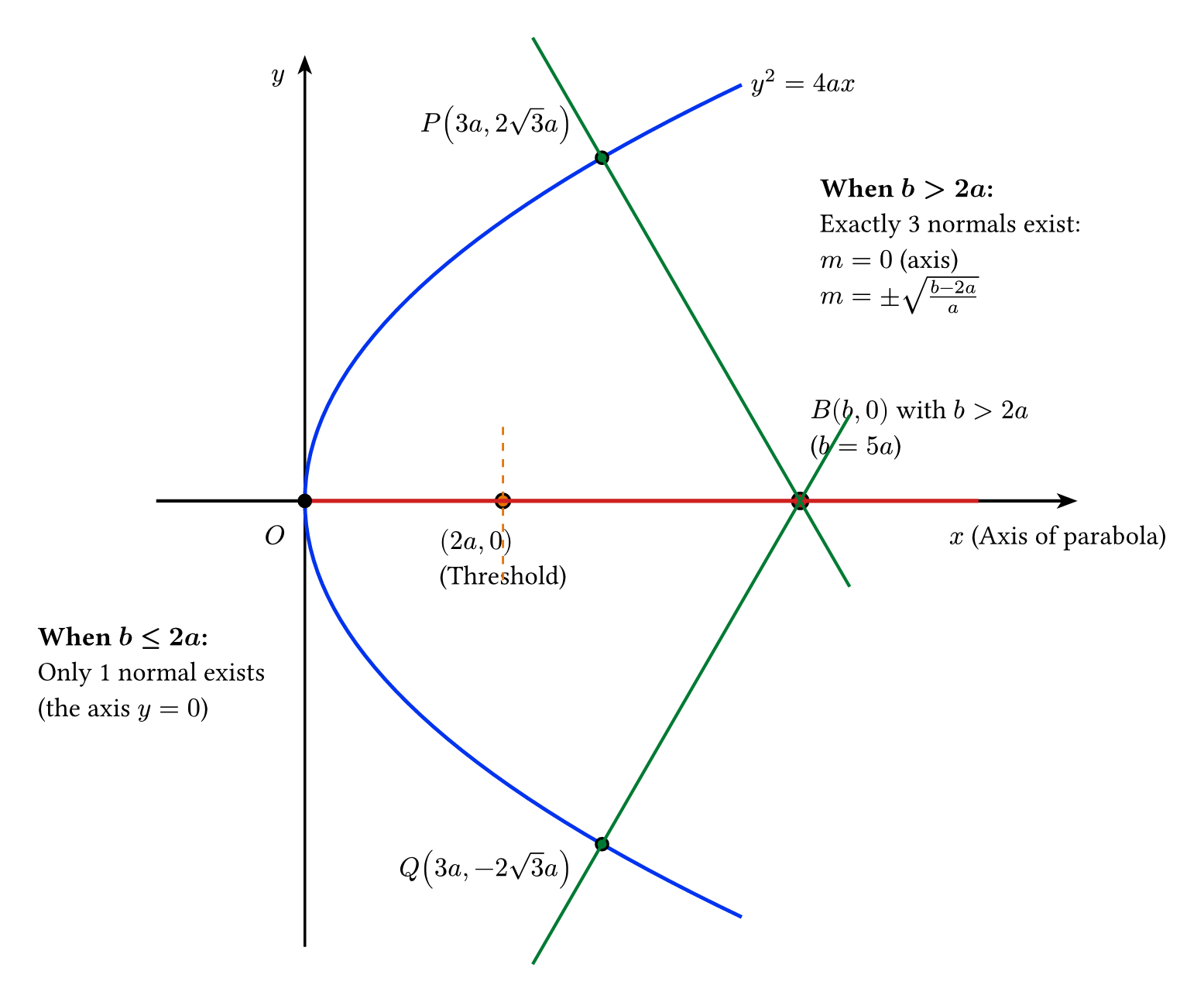
Normals from an Axis Point

Derivation of the Existence Condition§

Substituting h=bh = b and k=0k = 0 into the cubic equation of slopes gives:

am3+(2a−b)m=0am^3 + (2a - b)m = 0

Factoring out mm:

m(am2+2a−b)=0m\left(am^2 + 2a - b\right) = 0

This factorized form reveals two separate factors:

The root m=0m = 0: This root always exists for every real value of bb. The normal corresponding to m=0m = 0 is:

y=0⋅x−0=0y = 0 \cdot x - 0 = 0

which is the xx-axis itself. The foot of this normal is the vertex O(0,0)O(0, 0). Because the tangent at the vertex is the yy-axis (x=0x = 0), the principal axis (y=0y = 0) is perpendicular to it, confirming that the axis of the parabola is always a normal line.

The quadratic factor am2+2a−b=0am^2 + 2a - b = 0: Solving for m2m^2:

m2=b−2aam^2 = \frac{b - 2a}{a}

The nature of the remaining two normals depends entirely on the sign of b−2ab - 2a:

Case 1: b>2ab > 2a. The quantity b−2aa\frac{b - 2a}{a} is strictly positive. Therefore, m2>0m^2 > 0 yields two distinct, non-zero, real slopes:

m=±b−2aam = \pm \sqrt{\frac{b - 2a}{a}}

Combined with m=0m = 0, there exist exactly three distinct real normals drawn from (b,0)(b, 0) to the parabola.

Case 2: b=2ab = 2a. The quantity b−2aa=0\frac{b - 2a}{a} = 0, so m2=0m^2 = 0. All three roots of the cubic collapse into m=0m = 0. Only one distinct real normal exists (the axis itself), occurring with multiplicity three.

Case 3: b<2ab < 2a. The quantity b−2aa<0\frac{b - 2a}{a} < 0, so m2<0m^2 < 0. The roots for mm are purely imaginary conjugate numbers. Consequently, there are no oblique real normals, and only one real normal (the axis y=0y = 0) can be drawn.

Theorem (Three Normals from an Axis Point)
From a point (b,0)(b, 0) on the axis of the parabola y2=4axy^2 = 4ax, three distinct real normals can be drawn if and only if:

b>2ab > 2a

If b≤2ab \le 2a, only one real normal can be drawn from (b,0)(b, 0) to the parabola, which is the axis of symmetry itself.

The point (2a,0)(2a, 0) serves as the critical threshold on the axis. It is located at twice the focal distance from the vertex. No point on the axis between the vertex and (2a,0)(2a, 0), nor any point to the left of the vertex, can emit more than one real normal.

Coordinates of the Feet of the Oblique Normals§

When b>2ab > 2a, let the two oblique normals have slopes m=±b−2aam = \pm \sqrt{\frac{b - 2a}{a}}. The feet of these normals on the parabola are:

x=am2=a(b−2aa)=b−2ax = am^2 = a\left(\frac{b - 2a}{a}\right) = b - 2a y=−2am=∓2ab−2aa=∓2a(b−2a)y = -2am = \mp 2a \sqrt{\frac{b - 2a}{a}} = \mp 2\sqrt{a(b - 2a)}

Both oblique feet share the identical abscissa x=b−2ax = b - 2a. Therefore, the chord joining the feet of the two oblique normals drawn from an axis point is perpendicular to the axis of the parabola.


Illustrative Example: Angle Between Oblique Normals from an Axis Point§

Problem. Normals are drawn from the point (5a,0)(5a, 0) on the axis to the parabola y2=4axy^2 = 4ax. Find the equations of the three normals, their feet on the curve, and determine the angle between the two oblique normals.

Solution. Here, the point on the axis is (b,0)=(5a,0)(b, 0) = (5a, 0), so b=5ab = 5a. Because 5a>2a5a > 2a, three distinct real normals exist.

The cubic equation for the slopes is:

am3+(2a−5a)m=0  ⟹  am3−3am=0  ⟹  am(m2−3)=0am^3 + (2a - 5a)m = 0 \implies am^3 - 3am = 0 \implies am(m^2 - 3) = 0

The three slopes are:

m1=0,m2=3,m3=−3m_1 = 0, \quad m_2 = \sqrt{3}, \quad m_3 = -\sqrt{3}

The equations of the three normals are:

For m1=0m_1 = 0, we have y=0y = 0 (the axis of the parabola), with foot O(0,0)O(0, 0).

For m2=3m_2 = \sqrt{3}, using y=mx−2am−am3y = mx - 2am - am^3:

y=3x−2a(3)−a(33)=3x−53a  ⟹  3x−y−53a=0y = \sqrt{3}x - 2a(\sqrt{3}) - a(3\sqrt{3}) = \sqrt{3}x - 5\sqrt{3}a \implies \sqrt{3}x - y - 5\sqrt{3}a = 0

The foot is (a(3)2,−2a(3))=(3a,−23a)\left(a(\sqrt{3})^2, -2a(\sqrt{3})\right) = (3a, -2\sqrt{3}a).

For m3=−3m_3 = -\sqrt{3}:

y=−3x−2a(−3)−a(−33)=−3x+53a  ⟹  3x+y−53a=0y = -\sqrt{3}x - 2a(-\sqrt{3}) - a(-3\sqrt{3}) = -\sqrt{3}x + 5\sqrt{3}a \implies \sqrt{3}x + y - 5\sqrt{3}a = 0

The foot is (3a,23a)(3a, 2\sqrt{3}a).

Let θ\theta denote the acute angle between the two oblique normals with slopes m2=3m_2 = \sqrt{3} and m3=−3m_3 = -\sqrt{3}:

tan⁡θ=∣m2−m31+m2m3∣=∣3−(−3)1+(3)(−3)∣=∣231−3∣=∣23−2∣=3\tan \theta = \left|\frac{m_2 - m_3}{1 + m_2 m_3}\right| = \left|\frac{\sqrt{3} - (-\sqrt{3})}{1 + (\sqrt{3})(-\sqrt{3})}\right| = \left|\frac{2\sqrt{3}}{1 - 3}\right| = \left|\frac{2\sqrt{3}}{-2}\right| = \sqrt{3}

Therefore, the angle between the two oblique normals is:

θ=π3=60∘\theta = \frac{\pi}{3} = 60^\circ

The Boundary Curve for Three Real Normals§

Having established that three distinct real normals can be drawn from an axis point (b,0)(b, 0) if and only if b>2ab > 2a, we now extend this analysis to determine the exact geometric region in the entire xyxy-plane from which three distinct real normals can be drawn.

Consider a general point (h,k)(h, k) not restricted to the axis. The cubic equation governing the slopes of the normals is:

f(m)=m3+pm+q=0f(m) = m^3 + pm + q = 0

where:

p=2a−ha,q=kap = \frac{2a - h}{a}, \quad q = \frac{k}{a}

The Discriminant Condition§

For a cubic polynomial of the form m3+pm+q=0m^3 + pm + q = 0 to possess three distinct real roots, two conditions must be satisfied:

Existence of local extrema: The derivative f′(m)=3m2+pf'(m) = 3m^2 + p must have two distinct real roots, which requires p<0p < 0:

p<0  ⟹  2a−ha<0  ⟹  h>2ap < 0 \implies \frac{2a - h}{a} < 0 \implies h > 2a

This confirms that no point with abscissa h≤2ah \le 2a can ever emit three distinct real normals.

Opposite signs of local extrema: The polynomial values at the local maximum and minimum must have opposite signs, which is equivalent to requiring that the cubic polynomial discriminant be strictly positive:

Δcubic=−(4p3+27q2)>0  ⟹  27q2<−4p3\Delta_{\text{cubic}} = -\left(4p^3 + 27q^2\right) > 0 \implies 27q^2 < -4p^3

Substituting p=2a−hap = \frac{2a - h}{a} and q=kaq = \frac{k}{a} into this inequality:

27(ka)2<−4(2a−ha)3=4(h−2aa)327\left(\frac{k}{a}\right)^2 < -4\left(\frac{2a - h}{a}\right)^3 = 4\left(\frac{h - 2a}{a}\right)^3

Multiplying both sides by the positive quantity a3a^3:

27ak2<4(h−2a)327 a k^2 < 4(h - 2a)^3

Replacing the coordinates of the test point (h,k)(h, k) with current coordinates (x,y)(x, y), we obtain the condition for three distinct real normals:

27ay2<4(x−2a)327 a y^2 < 4(x - 2a)^3

Geometric Character of the Region§

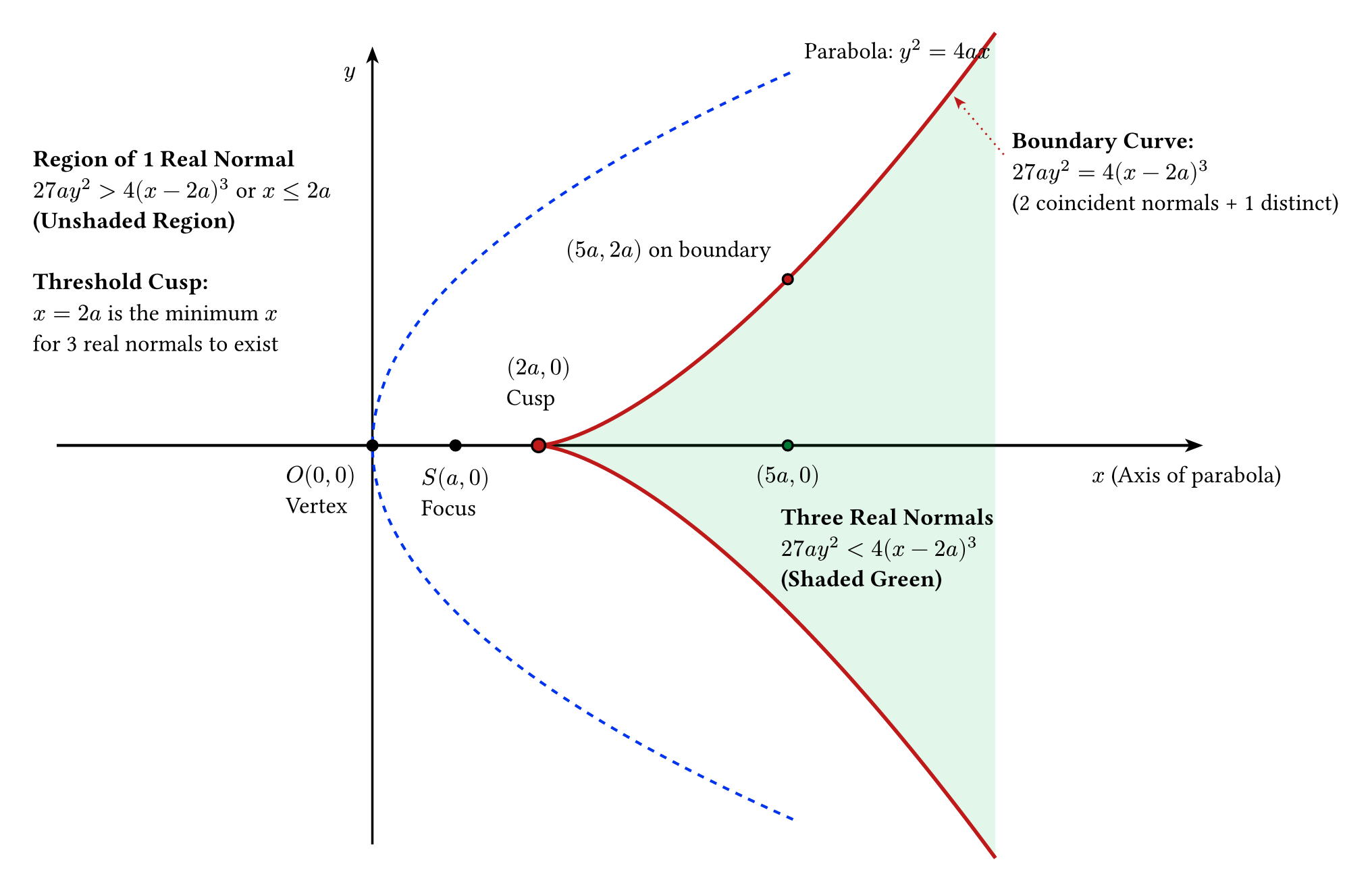
Boundary Curve for Three Real Normals

The equation defining the boundary of this region is:

27ay2=4(x−2a)327 a y^2 = 4(x - 2a)^3

This boundary curve is a semicubical parabola with the following distinctive geometric characteristics:

  • Cusp at the threshold point: Setting y=0y = 0 yields x=2ax = 2a. The curve originates at the critical threshold point (2a,0)(2a, 0) on the axis, where it possesses a sharp cusp pointing toward the vertex of the parabola.
  • Symmetry: The curve is symmetric about the principal axis of the parabola, as replacing yy with −y-y leaves the equation invariant.
  • Orientation: For real values of yy, we must have (x−2a)3≥0(x - 2a)^3 \ge 0, which restricts the entire curve to the right half-plane x≥2ax \ge 2a.

This boundary curve partitions the plane into three distinct regions:

  1. The interior region (27ay2<4(x−2a)327 a y^2 < 4(x - 2a)^3): From every point lying strictly within the convex region enclosed by the two branches of the curve (to the right of the cusp), exactly three distinct real normals can be drawn to the parabola.
  2. The boundary curve (27ay2=4(x−2a)327 a y^2 = 4(x - 2a)^3): From every point lying directly on the curve, the cubic has a repeated root. Two of the three normals coincide, resulting in one distinct normal and one repeated normal. At the cusp (2a,0)(2a, 0) itself, all three normals coincide with the axis y=0y = 0.
  3. The exterior region (27ay2>4(x−2a)327 a y^2 > 4(x - 2a)^3, or x≤2ax \le 2a): From every point outside the boundary curve, the cubic has one real root and two complex conjugate roots. Consequently, only one real normal can be drawn to the parabola.

Illustrative Example: Determining the Number of Real Normals§

Problem. Determine the number of real normals that can be drawn to the parabola y2=4xy^2 = 4x from each of the following points: (a) A(1,3)A(1, 3), (b) B(5,2)B(5, 2), (c) C(8,42)C(8, 4\sqrt{2}), and (d) D(3,1)D(3, 1).

Solution. For the parabola y2=4xy^2 = 4x, we have 4a=4  ⟹  a=14a = 4 \implies a = 1. The threshold abscissa is 2a=22a = 2.

The boundary condition is determined by evaluating the quantity:

E(x,y)=27ay2−4(x−2a)3=27y2−4(x−2)3E(x, y) = 27 a y^2 - 4(x - 2a)^3 = 27y^2 - 4(x - 2)^3

Evaluating each point:

Point A(1,3)A(1, 3): The abscissa is x=1≤2a=2x = 1 \le 2a = 2. Because x<2ax < 2a, the point lies to the left of the cusp line. Therefore, only 1 real normal can be drawn.

Point B(5,2)B(5, 2): The coordinates give x=5x = 5 and y=2y = 2. Evaluating EE:

E(5,2)=27(2)2−4(5−2)3=27(4)−4(27)=108−108=0E(5, 2) = 27(2)^2 - 4(5 - 2)^3 = 27(4) - 4(27) = 108 - 108 = 0

Because E(5,2)=0E(5, 2) = 0, the point BB lies directly on the boundary curve. Therefore, 2 coincident normals and 1 distinct normal (effectively 2 distinct real normals) can be drawn.

Point C(8,42)C(8, 4\sqrt{2}): Here x=8x = 8 and y=42y = 4\sqrt{2}:

E(8,42)=27(32)−4(8−2)3=864−4(216)=864−864=0E\left(8, 4\sqrt{2}\right) = 27(32) - 4(8 - 2)^3 = 864 - 4(216) = 864 - 864 = 0

The point CC also lies on the boundary curve, yielding 2 coincident normals and 1 distinct normal.

Point D(3,1)D(3, 1): Here x=3>2x = 3 > 2 and y=1y = 1:

E(3,1)=27(1)2−4(3−2)3=27−4(1)=23>0E(3, 1) = 27(1)^2 - 4(3 - 2)^3 = 27 - 4(1) = 23 > 0

Because E(3,1)>0E(3, 1) > 0, the point lies in the exterior region where 27ay2>4(x−2a)327ay^2 > 4(x - 2a)^3. Therefore, only 1 real normal can be drawn.


Circle of Maximum Radius and the Collision of Intersections§

An important geometric application connecting normal theory with coordinate geometry concerns finding the circle centered on the axis that touches a parabola, or equivalently, determining the shortest distance from an axis point to the curve.

Consider a circle centered at C(h,0)C(h, 0) on the axis of the parabola y2=4axy^2 = 4ax, with radius rr:

(x−h)2+y2=r2(x - h)^2 + y^2 = r^2

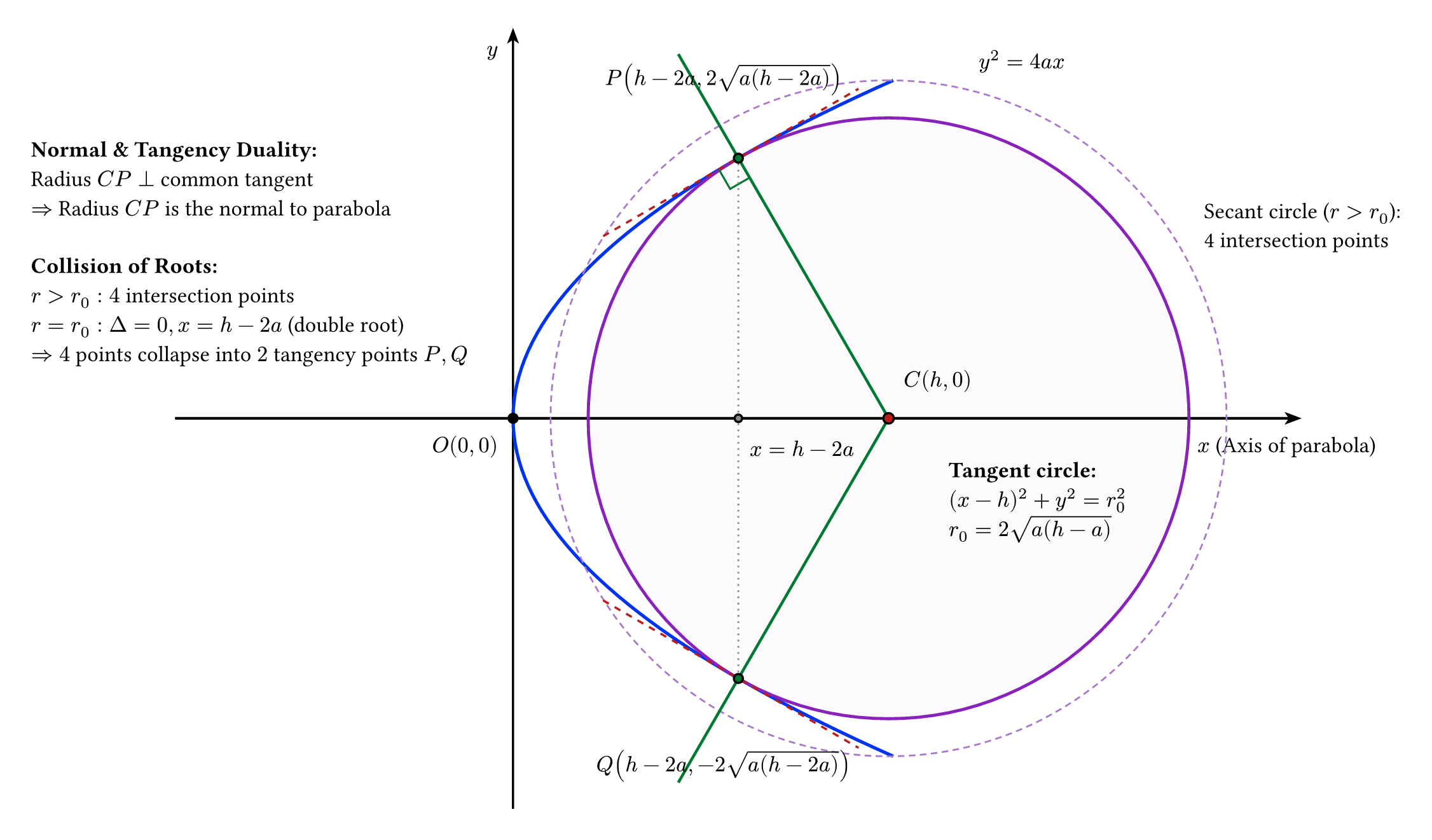
Circle and Parabola Tangency via Normals

Perspective 1: Quadratic Equation Theory and the Collision of Roots§

To find the intersection of the circle with the parabola, substitute y2=4axy^2 = 4ax into the equation of the circle:

(x−h)2+4ax=r2(x - h)^2 + 4ax = r^2

Expanding and collecting like terms in powers of xx:

x2−2hx+h2+4ax−r2=0  ⟹  x2−2(h−2a)x+(h2−r2)=0x^2 - 2hx + h^2 + 4ax - r^2 = 0 \implies x^2 - 2(h - 2a)x + \left(h^2 - r^2\right) = 0

This is a quadratic equation in the abscissa xx. For any real, positive root xx, the parabola provides two symmetric values of yy:

y=±2axy = \pm 2\sqrt{ax}

Consequently: If the quadratic equation has two distinct positive real roots x1x_1 and x2x_2, each root yields two ordinates, producing four distinct points of intersection between the circle and the parabola.

As the radius rr of the circle decreases, the circle contracts. The two roots x1x_1 and x2x_2 move toward each other along the axis. When the radius reaches a critical threshold r0r_0, the two roots collide and merge into a single double root.

At this exact moment of collision, the discriminant of the quadratic equation vanishes:

Δ=[−2(h−2a)]2−4(1)(h2−r2)=0\Delta = [-2(h - 2a)]^2 - 4(1)\left(h^2 - r^2\right) = 0

Dividing by 4:

(h−2a)2−(h2−r2)=0  ⟹  h2−4ah+4a2−h2+r2=0(h - 2a)^2 - \left(h^2 - r^2\right) = 0 \implies h^2 - 4ah + 4a^2 - h^2 + r^2 = 0

Solving for r2r^2:

r2=4ah−4a2=4a(h−a)r^2 = 4ah - 4a^2 = 4a(h - a) r0=2a(h−a)r_0 = 2\sqrt{a(h - a)}

When r=r0r = r_0, the discriminant is zero, and the quadratic equation possesses the unique double root:

x=2(h−2a)2=h−2ax = \frac{2(h - 2a)}{2} = h - 2a

At this double abscissa, the four intersection points have collapsed in symmetric pairs into two distinct points of tangency PP and QQ:

P=(h−2a,2a(h−2a)),Q=(h−2a,−2a(h−2a))P = \left(h - 2a, 2\sqrt{a(h - 2a)}\right), \quad Q = \left(h - 2a, -2\sqrt{a(h - 2a)}\right)

For these points to be real and distinct from the vertex, the double root must satisfy x>0x > 0, which requires:

h−2a>0  ⟹  h>2ah - 2a > 0 \implies h > 2a

This requirement matches the condition for the existence of oblique normals from (h,0)(h, 0).

If h≤2ah \le 2a, the quadratic equation cannot have a positive double root. In that case, as the circle expands from the center (h,0)(h, 0), it first contacts the parabola at the vertex O(0,0)O(0, 0), where the radius is simply r=hr = h.

Perspective 2: Normal Theory and Shortest Distance§

The geometric principle governing smooth curves states that at any point where two curves are tangent, they share a common tangent line and a common normal line.

For any circle, the normal line at any point on its circumference passes through its center. Therefore, if a circle centered at C(h,0)C(h, 0) touches the parabola at a point PP, the line segment CPCP must simultaneously be a radius of the circle and the normal line to the parabola at PP.

Let PP be parameterized as (at2,2at)\left(at^2, 2at\right). The equation of the normal to the parabola at PP is:

y+tx=2at+at3y + tx = 2at + at^3

Because this normal must pass through the circle's center C(h,0)C(h, 0), we substitute x=hx = h and y=0y = 0:

th=2at+at3  ⟹  t(at2+2a−h)=0th = 2at + at^3 \implies t\left(at^2 + 2a - h\right) = 0

Excluding the axis root t=0t = 0 (which corresponds to contact at the vertex), the oblique contact points satisfy:

at2+2a−h=0  ⟹  at2=h−2a  ⟹  x=h−2aat^2 + 2a - h = 0 \implies at^2 = h - 2a \implies x = h - 2a

This is identical to the double root derived from the quadratic discriminant.

The radius of the circle is the Euclidean distance from C(h,0)C(h, 0) to P(at2,2at)P\left(at^2, 2at\right):

r2=(x−h)2+y2=(h−2a−h)2+4ax=(−2a)2+4a(h−2a)=4a2+4ah−8a2=4a(h−a)r^2 = (x - h)^2 + y^2 = (h - 2a - h)^2 + 4ax = (-2a)^2 + 4a(h - 2a) = 4a^2 + 4ah - 8a^2 = 4a(h - a) r=2a(h−a)r = 2\sqrt{a(h - a)}

The normal line interpretation confirms that the radius vector of the tangent circle is the normal to the parabola, and the collision of roots in algebra corresponds to the geometric contact of the curves.


Illustrative Example: Largest Circle Contained Inside a Parabola§

Problem. A circle is centered at C(6,0)C(6, 0) on the axis of the parabola y2=4xy^2 = 4x. Find the radius of the circle when it is tangent to the parabola, the coordinates of the points of contact, and verify the result using both the quadratic discriminant and normal line methods.

Solution. For y2=4xy^2 = 4x, we have a=1a = 1. The center is C(h,0)=(6,0)C(h, 0) = (6, 0), so h=6h = 6. Notice that h=6>2a=2h = 6 > 2a = 2, so symmetric oblique points of contact exist.

Method 1: Quadratic Discriminant Method.
The equation of the circle is (x−6)2+y2=r2(x - 6)^2 + y^2 = r^2. Substituting y2=4xy^2 = 4x:

(x−6)2+4x=r2  ⟹  x2−12x+36+4x−r2=0  ⟹  x2−8x+(36−r2)=0(x - 6)^2 + 4x = r^2 \implies x^2 - 12x + 36 + 4x - r^2 = 0 \implies x^2 - 8x + (36 - r^2) = 0

For tangency, the four intersection points collapse into two points of contact, requiring a single double root for xx. Setting the discriminant to zero:

Δ=(−8)2−4(1)(36−r2)=0  ⟹  64−144+4r2=0  ⟹  4r2=80  ⟹  r2=20\Delta = (-8)^2 - 4(1)(36 - r^2) = 0 \implies 64 - 144 + 4r^2 = 0 \implies 4r^2 = 80 \implies r^2 = 20 r=20=25r = \sqrt{20} = 2\sqrt{5}

The double root for the abscissa is:

x=−−82(1)=4x = -\frac{-8}{2(1)} = 4

The ordinates are:

y2=4x=4(4)=16  ⟹  y=±4y^2 = 4x = 4(4) = 16 \implies y = \pm 4

The points of contact are P(4,4)P(4, 4) and Q(4,−4)Q(4, -4).

Method 2: Normal Line Method.
The normal to y2=4xy^2 = 4x at P(t2,2t)P(t^2, 2t) is y+tx=2t+t3y + tx = 2t + t^3. Passing through C(6,0)C(6, 0):

6t=2t+t3  ⟹  t3−4t=0  ⟹  t(t2−4)=06t = 2t + t^3 \implies t^3 - 4t = 0 \implies t(t^2 - 4) = 0

For the oblique normals, t=±2t = \pm 2.

The feet on the parabola are:

  • For t=2t = 2: P(22,2(2))=(4,4)P(2^2, 2(2)) = (4, 4).
  • For t=−2t = -2: Q((−2)2,2(−2))=(4,−4)Q((-2)^2, 2(-2)) = (4, -4).

The radius is the normal distance from C(6,0)C(6, 0) to P(4,4)P(4, 4):

r=CP=(4−6)2+(4−0)2=(−2)2+42=4+16=20=25r = CP = \sqrt{(4 - 6)^2 + (4 - 0)^2} = \sqrt{(-2)^2 + 4^2} = \sqrt{4 + 16} = \sqrt{20} = 2\sqrt{5}

Both methods yield identical results.


Condition for Normals to Intersect on the Parabola§

An intriguing question in parabola geometry is: under what conditions can two normals to a parabola intersect at a third point that also lies on the parabola?

Let P(at12,2at1)P\left(at_1^2, 2at_1\right) and Q(at22,2at2)Q\left(at_2^2, 2at_2\right) be two distinct points on the parabola y2=4axy^2 = 4ax with t1≠t2t_1 \neq t_2.

Suppose the normals at PP and QQ intersect at a point R(at32,2at3)R\left(at_3^2, 2at_3\right) that also lies on the parabola.

Derivation of the Condition§

Recall the property of normal chords: the normal to the parabola at a parametric point tt intersects the parabola again at a point with parameter t′t', where:

t′=−t−2tt' = -t - \frac{2}{t}

Because the normal at P(t1)P(t_1) passes through R(t3)R(t_3), the parameter t3t_3 must satisfy:

t3=−t1−2t1t_3 = -t_1 - \frac{2}{t_1}

Similarly, because the normal at Q(t2)Q(t_2) also passes through R(t3)R(t_3), the parameter t3t_3 must simultaneously satisfy:

t3=−t2−2t2t_3 = -t_2 - \frac{2}{t_2}

Equating these two expressions for t3t_3:

−t1−2t1=−t2−2t2-t_1 - \frac{2}{t_1} = -t_2 - \frac{2}{t_2}

Rearranging terms:

(t2−t1)+(2t2−2t1)=0  ⟹  (t2−t1)+2(t1−t2)t1t2=0(t_2 - t_1) + \left(\frac{2}{t_2} - \frac{2}{t_1}\right) = 0 \implies (t_2 - t_1) + \frac{2(t_1 - t_2)}{t_1 t_2} = 0

Factoring out (t2−t1)(t_2 - t_1):

(t2−t1)(1−2t1t2)=0(t_2 - t_1)\left(1 - \frac{2}{t_1 t_2}\right) = 0

Because PP and QQ are distinct points, t1≠t2t_1 \neq t_2, so t2−t1≠0t_2 - t_1 \neq 0. Dividing by t2−t1t_2 - t_1 yields the condition:

1−2t1t2=0  ⟹  t1t2=21 - \frac{2}{t_1 t_2} = 0 \implies t_1 t_2 = 2

Theorem (Normals Meeting on the Parabola)
The normals at two distinct points P(t1)P(t_1) and Q(t2)Q(t_2) on the parabola y2=4axy^2 = 4ax intersect at a point on the parabola itself if and only if:

t1t2=2t_1 t_2 = 2

Geometric Consequences§

The condition t1t2=2t_1 t_2 = 2 gives rise to two geometric properties:

1. Chord PQPQ Passes Through a Fixed Point

The equation of the chord joining P(t1)P(t_1) and Q(t2)Q(t_2) is:

y(t1+t2)=2x+2at1t2y(t_1 + t_2) = 2x + 2a t_1 t_2

Substituting t1t2=2t_1 t_2 = 2:

y(t1+t2)=2x+4a=2(x+2a)y(t_1 + t_2) = 2x + 4a = 2(x + 2a)

To find where this chord intersects the principal axis, set y=0y = 0:

2(x+2a)=0  ⟹  x=−2a2(x + 2a) = 0 \implies x = -2a

The chord joining the feet of two normals that intersect on the parabola always passes through the fixed point (−2a,0)(-2a, 0) on the axis of the parabola.

2. Minimum Abscissa of the Intersection Point

The parameter t3t_3 of the meeting point RR is related to t1t_1 and t2t_2 by:

t3=−t1−2t1=−t1−t2=−(t1+t2)t_3 = -t_1 - \frac{2}{t_1} = -t_1 - t_2 = -(t_1 + t_2)

Squaring both sides:

t32=(t1+t2)2=(t1−t2)2+4t1t2t_3^2 = (t_1 + t_2)^2 = (t_1 - t_2)^2 + 4t_1 t_2

Substituting t1t2=2t_1 t_2 = 2:

t32=(t1−t2)2+8t_3^2 = (t_1 - t_2)^2 + 8

Because PP and QQ are distinct real points, (t1−t2)2>0(t_1 - t_2)^2 > 0. Therefore:

t32>8t_3^2 > 8

The abscissa of the intersection point RR on the parabola is:

xR=at32>8ax_R = a t_3^2 > 8a

Two normals to a parabola can intersect on the parabola itself only at points whose abscissa is strictly greater than 8a8a.


Illustrative Example: Locus of the Midpoint of Chord PQPQ§

Problem. Normals at P(t1)P(t_1) and Q(t2)Q(t_2) to the parabola y2=4axy^2 = 4ax intersect at a point on the parabola. Find the locus of the midpoint of the chord PQPQ.

Solution. Let M(h0,k0)M(h_0, k_0) denote the midpoint of the chord joining P(at12,2at1)P\left(at_1^2, 2at_1\right) and Q(at22,2at2)Q\left(at_2^2, 2at_2\right).

The coordinates of MM are:

h0=a(t12+t22)2h_0 = \frac{a\left(t_1^2 + t_2^2\right)}{2} k0=2at1+2at22=a(t1+t2)  ⟹  t1+t2=k0ak_0 = \frac{2at_1 + 2at_2}{2} = a(t_1 + t_2) \implies t_1 + t_2 = \frac{k_0}{a}

Expressing t12+t22t_1^2 + t_2^2 in terms of the sum and product:

t12+t22=(t1+t2)2−2t1t2t_1^2 + t_2^2 = (t_1 + t_2)^2 - 2t_1 t_2

Because the normals at PP and QQ intersect on the parabola, the parameters satisfy t1t2=2t_1 t_2 = 2. Substituting this relation:

t12+t22=(k0a)2−2(2)=k02a2−4t_1^2 + t_2^2 = \left(\frac{k_0}{a}\right)^2 - 2(2) = \frac{k_0^2}{a^2} - 4

Substituting this into the expression for h0h_0:

h0=a2(k02a2−4)=k02−4a22ah_0 = \frac{a}{2}\left(\frac{k_0^2}{a^2} - 4\right) = \frac{k_0^2 - 4a^2}{2a}

Multiplying both sides by 2a2a:

2ah0=k02−4a2  ⟹  k02=2ah0+4a2=2a(h0+2a)2a h_0 = k_0^2 - 4a^2 \implies k_0^2 = 2a h_0 + 4a^2 = 2a(h_0 + 2a)

Replacing (h0,k0)(h_0, k_0) with current coordinates (x,y)(x, y), the locus of the midpoint is:

y2=2a(x+2a)y^2 = 2a(x + 2a)

This locus is an identical parabola shifted to the left, having its vertex at (−2a,0)(-2a, 0) and latus rectum equal to 2a2a.


Circumcircle of Three Co-normal Points§

When three distinct normals can be drawn from a point (h,k)(h, k) to the parabola y2=4axy^2 = 4ax, their feet P(t1)P(t_1), Q(t2)Q(t_2), and R(t3)R(t_3) define a triangle. The circumcircle of this triangle possesses remarkable properties.

Derivation of the Circumcircle Equation§

Let the equation of any circle in the Cartesian plane be written in general form:

x2+y2+2gx+2fy+c=0x^2 + y^2 + 2gx + 2fy + c = 0

To determine the points where this circle intersects the parabola y2=4axy^2 = 4ax, substitute the parametric coordinates x=at2x = at^2 and y=2aty = 2at:

(at2)2+(2at)2+2g(at2)+2f(2at)+c=0\left(at^2\right)^2 + (2at)^2 + 2g\left(at^2\right) + 2f(2at) + c = 0

Expanding and ordering by descending powers of tt:

a2t4+(4a2+2ga)t2+4fat+c=0a^2 t^4 + \left(4a^2 + 2ga\right)t^2 + 4fat + c = 0

This is a quartic equation in tt. By Vieta's formulas, the sum of the four roots t1,t2,t3,t4t_1, t_2, t_3, t_4 is given by the coefficient of t3t^3, which is zero:

t1+t2+t3+t4=0t_1 + t_2 + t_3 + t_4 = 0

Now, suppose three of these intersection points t1,t2,t3t_1, t_2, t_3 are the co-normal points corresponding to normals drawn from (h,k)(h, k).

As established earlier, the sum of the parameters of three co-normal points is identically zero:

t1+t2+t3=0t_1 + t_2 + t_3 = 0

Substituting this into the sum of the four roots:

0+t4=0  ⟹  t4=00 + t_4 = 0 \implies t_4 = 0

The parameter t4=0t_4 = 0 corresponds to the point:

(x,y)=(a(0)2,2a(0))=(0,0)(x, y) = \left(a(0)^2, 2a(0)\right) = (0, 0)

which is the vertex of the parabola.

Because t=0t = 0 is a root of the quartic, substituting t=0t = 0 into the equation gives:

c=0c = 0

Theorem (Circumcircle Passes Through the Vertex)
The circumcircle of any three co-normal points on a parabola always passes through the vertex of the parabola.

Coefficients of the Circumcircle§

With c=0c = 0 and t4=0t_4 = 0, we find the coefficients gg and ff by applying Vieta's formulas to the remaining relations of the quartic.

For the sum of products taken two at a time:

∑1≤i<j≤4titj=4a2+2gaa2=4+2ga\sum_{1 \le i < j \le 4} t_i t_j = \frac{4a^2 + 2ga}{a^2} = 4 + \frac{2g}{a}

Since t4=0t_4 = 0, all products involving t4t_4 vanish, leaving:

∑1≤i<j≤3titj=t1t2+t2t3+t3t1=4+2ga\sum_{1 \le i < j \le 3} t_i t_j = t_1 t_2 + t_2 t_3 + t_3 t_1 = 4 + \frac{2g}{a}

From the cubic equation of co-normal points, we know:

t1t2+t2t3+t3t1=2a−hat_1 t_2 + t_2 t_3 + t_3 t_1 = \frac{2a - h}{a}

Equating these two expressions:

4+2ga=2a−ha  ⟹  2ga=2a−h−4aa=−(h+2a)a4 + \frac{2g}{a} = \frac{2a - h}{a} \implies \frac{2g}{a} = \frac{2a - h - 4a}{a} = \frac{-(h + 2a)}{a}

Multiplying by aa:

2g=−(h+2a)2g = -(h + 2a)

For the sum of products taken three at a time:

t1t2t3+t4(t1t2+t2t3+t3t1)=−4faa2=−4fat_1 t_2 t_3 + t_4(t_1 t_2 + t_2 t_3 + t_3 t_1) = -\frac{4fa}{a^2} = -\frac{4f}{a}

Since t4=0t_4 = 0:

t1t2t3=−4fat_1 t_2 t_3 = -\frac{4f}{a}

From the cubic equation of co-normal points:

t1t2t3=kat_1 t_2 t_3 = \frac{k}{a}

Equating:

ka=−4fa  ⟹  4f=−k  ⟹  2f=−k2\frac{k}{a} = -\frac{4f}{a} \implies 4f = -k \implies 2f = -\frac{k}{2}

Substituting 2g=−(h+2a)2g = -(h + 2a), 2f=−k22f = -\frac{k}{2}, and c=0c = 0 into the general equation of the circle yields the circumcircle equation:

x2+y2−(h+2a)x−k2y=0x^2 + y^2 - (h + 2a)x - \frac{k}{2}y = 0

Properties of the Circumcircle§

Center of the circumcircle:

Ccirc=(−g,−f)=(h+2a2,k4)C_{\text{circ}} = \left(-g, -f\right) = \left(\frac{h + 2a}{2}, \frac{k}{4}\right)

Radius of the circumcircle: Since the circle passes through the origin (0,0)(0, 0), its radius RR is simply the distance from the center to the origin:

R2=g2+f2=(h+2a2)2+(k4)2R^2 = g^2 + f^2 = \left(\frac{h + 2a}{2}\right)^2 + \left(\frac{k}{4}\right)^2

Solved Examples§

Example 1: Locus of Points Emitting Two Mutually Perpendicular Normals§

Problem. Find the locus of a point from which two of the three normals drawn to the parabola y2=4axy^2 = 4ax are mutually perpendicular.

Solution. Let the point be (h,k)(h, k), and let the slopes of the three normals drawn from (h,k)(h, k) be m1,m2,m3m_1, m_2, m_3.

These slopes are the roots of the cubic equation:

am3+(2a−h)m+k=0am^3 + (2a - h)m + k = 0

By Vieta's formulas:

m1+m2+m3=0m_1 + m_2 + m_3 = 0 m1m2+m2m3+m3m1=2a−ham_1 m_2 + m_2 m_3 + m_3 m_1 = \frac{2a - h}{a} m1m2m3=−kam_1 m_2 m_3 = -\frac{k}{a}

Suppose two of the normals are perpendicular:

m1m2=−1m_1 m_2 = -1

Substituting m1m2=−1m_1 m_2 = -1 into the product of roots:

(−1)m3=−ka  ⟹  m3=ka(-1)m_3 = -\frac{k}{a} \implies m_3 = \frac{k}{a}

Because m3m_3 is a root of the cubic equation, it must satisfy am33+(2a−h)m3+k=0am_3^3 + (2a - h)m_3 + k = 0:

a(ka)3+(2a−h)(ka)+k=0a\left(\frac{k}{a}\right)^3 + (2a - h)\left(\frac{k}{a}\right) + k = 0

Assuming k≠0k \neq 0 (the normals are not symmetric about the axis), divide both sides by kk:

k2a2+2a−ha+1=0\frac{k^2}{a^2} + \frac{2a - h}{a} + 1 = 0

Multiplying through by aa:

k2a+(2a−h)+a=0  ⟹  k2a+3a−h=0  ⟹  k2=a(h−3a)\frac{k^2}{a} + (2a - h) + a = 0 \implies \frac{k^2}{a} + 3a - h = 0 \implies k^2 = a(h - 3a)

Replacing (h,k)(h, k) with (x,y)(x, y), the required locus is:

y2=a(x−3a)y^2 = a(x - 3a)

This locus is itself a parabola with vertex at (3a,0)(3a, 0), axis along y=0y = 0, and latus rectum equal to aa.


Example 2: Locus When Normals Have Slopes in the Ratio 2:12:1§

Problem. Find the locus of the point (h,k)(h, k) if the slopes of two of the three normals drawn from it to y2=4axy^2 = 4ax are in the ratio 2:12:1.

Solution. Let the slopes be m1,m2,m3m_1, m_2, m_3 with m1=2m2m_1 = 2m_2.

From the sum of roots:

m1+m2+m3=0  ⟹  2m2+m2+m3=0  ⟹  m3=−3m2m_1 + m_2 + m_3 = 0 \implies 2m_2 + m_2 + m_3 = 0 \implies m_3 = -3m_2

Now, using the sum of products taken two at a time:

m1m2+m2m3+m3m1=2a−ham_1 m_2 + m_2 m_3 + m_3 m_1 = \frac{2a - h}{a}

Substituting m1=2m2m_1 = 2m_2 and m3=−3m2m_3 = -3m_2:

(2m2)(m2)+(m2)(−3m2)+(−3m2)(2m2)=2a−ha(2m_2)(m_2) + (m_2)(-3m_2) + (-3m_2)(2m_2) = \frac{2a - h}{a} 2m22−3m22−6m22=2a−ha  ⟹  −7m22=2a−ha  ⟹  m22=h−2a7a2m_2^2 - 3m_2^2 - 6m_2^2 = \frac{2a - h}{a} \implies -7m_2^2 = \frac{2a - h}{a} \implies m_2^2 = \frac{h - 2a}{7a}

Next, using the product of the three roots:

m1m2m3=−ka  ⟹  (2m2)(m2)(−3m2)=−ka  ⟹  −6m23=−ka  ⟹  m23=k6am_1 m_2 m_3 = -\frac{k}{a} \implies (2m_2)(m_2)(-3m_2) = -\frac{k}{a} \implies -6m_2^3 = -\frac{k}{a} \implies m_2^3 = \frac{k}{6a}

To eliminate m2m_2, square the expression for m23m_2^3 and cube the expression for m22m_2^2:

(m23)2=(m22)3  ⟹  (k6a)2=(h−2a7a)3\left(m_2^3\right)^2 = \left(m_2^2\right)^3 \implies \left(\frac{k}{6a}\right)^2 = \left(\frac{h - 2a}{7a}\right)^3

Simplifying:

k236a2=(h−2a)3343a3  ⟹  343ak2=36(h−2a)3\frac{k^2}{36a^2} = \frac{(h - 2a)^3}{343a^3} \implies 343 a k^2 = 36(h - 2a)^3

Replacing (h,k)(h, k) with current coordinates (x,y)(x, y), the locus is:

343ay2=36(x−2a)3343 a y^2 = 36(x - 2a)^3

Example 3: Area of the Triangle Formed by Three Co-normal Points§

Problem. Show that the area Δ\Delta of the triangle formed by three co-normal points P(t1)P(t_1), Q(t2)Q(t_2), and R(t3)R(t_3) on the parabola y2=4axy^2 = 4ax is given by:

Δ=a22∣(t1−t2)(t2−t3)(t3−t1)∣\Delta = \frac{a^2}{2}\left|(t_1 - t_2)(t_2 - t_3)(t_3 - t_1)\right|

Solution. The coordinates of the three points are (at12,2at1)\left(at_1^2, 2at_1\right), (at22,2at2)\left(at_2^2, 2at_2\right), and (at32,2at3)\left(at_3^2, 2at_3\right).

The area of △PQR\triangle PQR is given by the coordinate determinant:

Δ=12∣det⁡(at122at11at222at21at322at31)∣\Delta = \frac{1}{2}\left|\det \begin{pmatrix} at_1^2 & 2at_1 & 1 \\ at_2^2 & 2at_2 & 1 \\ at_3^2 & 2at_3 & 1 \end{pmatrix}\right|

Factoring out aa from the first column and 2a2a from the second column:

Δ=12⋅a⋅2a∣det⁡(t12t11t22t21t32t31)∣=a2∣det⁡(1t1t121t2t221t3t32)∣\Delta = \frac{1}{2} \cdot a \cdot 2a \left|\det \begin{pmatrix} t_1^2 & t_1 & 1 \\ t_2^2 & t_2 & 1 \\ t_3^2 & t_3 & 1 \end{pmatrix}\right| = a^2 \left|\det \begin{pmatrix} 1 & t_1 & t_1^2 \\ 1 & t_2 & t_2^2 \\ 1 & t_3 & t_3^2 \end{pmatrix}\right|

This is the standard Vandermonde determinant of order 3:

det⁡(1t1t121t2t221t3t32)=(t1−t2)(t2−t3)(t3−t1)\det \begin{pmatrix} 1 & t_1 & t_1^2 \\ 1 & t_2 & t_2^2 \\ 1 & t_3 & t_3^2 \end{pmatrix} = (t_1 - t_2)(t_2 - t_3)(t_3 - t_1)

Taking absolute values:

Δ=a2∣(t1−t2)(t2−t3)(t3−t1)∣\Delta = a^2 \left|(t_1 - t_2)(t_2 - t_3)(t_3 - t_1)\right|

Wait, let's verify the factor of 1/21/2: The standard formula for the area of a triangle with vertices (xi,yi)(x_i, y_i) is:

Area=12∣x1(y2−y3)+x2(y3−y1)+x3(y1−y2)∣\text{Area} = \frac{1}{2}\left|x_1(y_2 - y_3) + x_2(y_3 - y_1) + x_3(y_1 - y_2)\right|

Here:

12det⁡(at122at11at222at21at322at31)=12⋅a⋅2a⋅(t1−t2)(t2−t3)(t3−t1)=a2(t1−t2)(t2−t3)(t3−t1)\frac{1}{2}\det \begin{pmatrix} at_1^2 & 2at_1 & 1 \\ at_2^2 & 2at_2 & 1 \\ at_3^2 & 2at_3 & 1 \end{pmatrix} = \frac{1}{2} \cdot a \cdot 2a \cdot (t_1 - t_2)(t_2 - t_3)(t_3 - t_1) = a^2 (t_1 - t_2)(t_2 - t_3)(t_3 - t_1)

Thus, the exact area is:

Δ=a2∣(t1−t2)(t2−t3)(t3−t1)∣\Delta = a^2 \left|(t_1 - t_2)(t_2 - t_3)(t_3 - t_1)\right|

Example 4: Circle Touching Parabola at the Ends of Latus Rectum§

Problem. Find the center and radius of the circle that has its center on the axis of y2=4axy^2 = 4ax and touches the parabola at the extremities of its latus rectum.

Solution. The extremities of the latus rectum of y2=4axy^2 = 4ax are L(a,2a)L(a, 2a) and L′(a,−2a)L'(a, -2a).

At the point of contact L(a,2a)L(a, 2a), the radius of the circle must lie along the normal to the parabola.

The parametric coordinate of L(a,2a)L(a, 2a) is t=1t = 1 (since at2=a  ⟹  t=1at^2 = a \implies t = 1).

The equation of the normal to y2=4axy^2 = 4ax at t=1t = 1 is:

y+tx=2at+at3  ⟹  y+x=2a(1)+a(1)3=3a  ⟹  x+y=3ay + tx = 2at + at^3 \implies y + x = 2a(1) + a(1)^3 = 3a \implies x + y = 3a

Because the center of the circle lies on the axis of the parabola (y=0y = 0), setting y=0y = 0 in the normal equation gives:

x=3ax = 3a

Thus, the center of the circle is C(3a,0)C(3a, 0).

The radius RR is the distance from C(3a,0)C(3a, 0) to L(a,2a)L(a, 2a):

R2=(a−3a)2+(2a−0)2=(−2a)2+(2a)2=4a2+4a2=8a2R^2 = (a - 3a)^2 + (2a - 0)^2 = (-2a)^2 + (2a)^2 = 4a^2 + 4a^2 = 8a^2 R=22aR = 2\sqrt{2}a

Notice that this result agrees with our earlier general formula: for contact at abscissa x=h−2ax = h - 2a, we have a=h−2a  ⟹  h=3aa = h - 2a \implies h = 3a. The radius is r0=2a(h−a)=2a(3a−a)=22a2=22ar_0 = 2\sqrt{a(h - a)} = 2\sqrt{a(3a - a)} = 2\sqrt{2a^2} = 2\sqrt{2}a.

The equation of the circle is:

(x−3a)2+y2=8a2  ⟹  x2+y2−6ax+a2=0(x - 3a)^2 + y^2 = 8a^2 \implies x^2 + y^2 - 6ax + a^2 = 0

Summary of Key Results§

Property / Quantity Algebraic Condition / Formula Geometric Meaning
Cubic Equation in mm am3+(2a−h)m+k=0am^3 + (2a - h)m + k = 0 Yields slopes of normals drawn from (h,k)(h, k)
Cubic Equation in tt at3+(2a−h)t−k=0at^3 + (2a - h)t - k = 0 Yields parameters of feet of normals (ti=−mit_i = -m_i)
Foot of Normal (am2,−2am)=(at2,2at)\left(am^2, -2am\right) = \left(at^2, 2at\right) Exact coordinates of each co-normal point
Sum of Slopes / Parameters ∑mi=0,∑ti=0\sum m_i = 0, \quad \sum t_i = 0 Due to the absence of degree-2 term
Sum of Ordinates y1+y2+y3=0y_1 + y_2 + y_3 = 0 Algebraic sum of ordinates is always zero
Centroid of Co-normal Points Gc(2(h−2a)3,0)G_c\left(\frac{2(h - 2a)}{3}, 0\right) Always lies on the axis of the parabola
Normals from Axis Point (b,0)(b, 0) b>2a  ⟹  3b > 2a \implies 3 normals; b≤2a  ⟹  1b \le 2a \implies 1 normal Threshold point on axis is (2a,0)(2a, 0)
Oblique Feet from (b,0)(b, 0) x=b−2a,y=∓2a(b−2a)x = b - 2a, \quad y = \mp 2\sqrt{a(b - 2a)} Chord connecting oblique feet is perpendicular to axis
Boundary Curve for 3 Normals 27ay2≤4(x−2a)327 a y^2 \le 4(x - 2a)^3 Region to the right of cusp (2a,0)(2a, 0) admits 3 real normals
Circle-Parabola Tangency r=2a(h−a)r = 2\sqrt{a(h - a)} with x=h−2ax = h - 2a Δ=0\Delta = 0 collapses 4 intersections into 2 contact points
Normals Meeting on Parabola t1t2=2t_1 t_2 = 2 Chord PQPQ passes through (−2a,0)(-2a, 0); xR>8ax_R > 8a
Circumcircle of Co-normal Points x2+y2−(h+2a)x−k2y=0x^2 + y^2 - (h + 2a)x - \frac{k}{2}y = 0 Circle always passes through vertex O(0,0)O(0, 0)
Section 12 of 14 · Parabola

Mark this section complete when you have worked through its proofs.