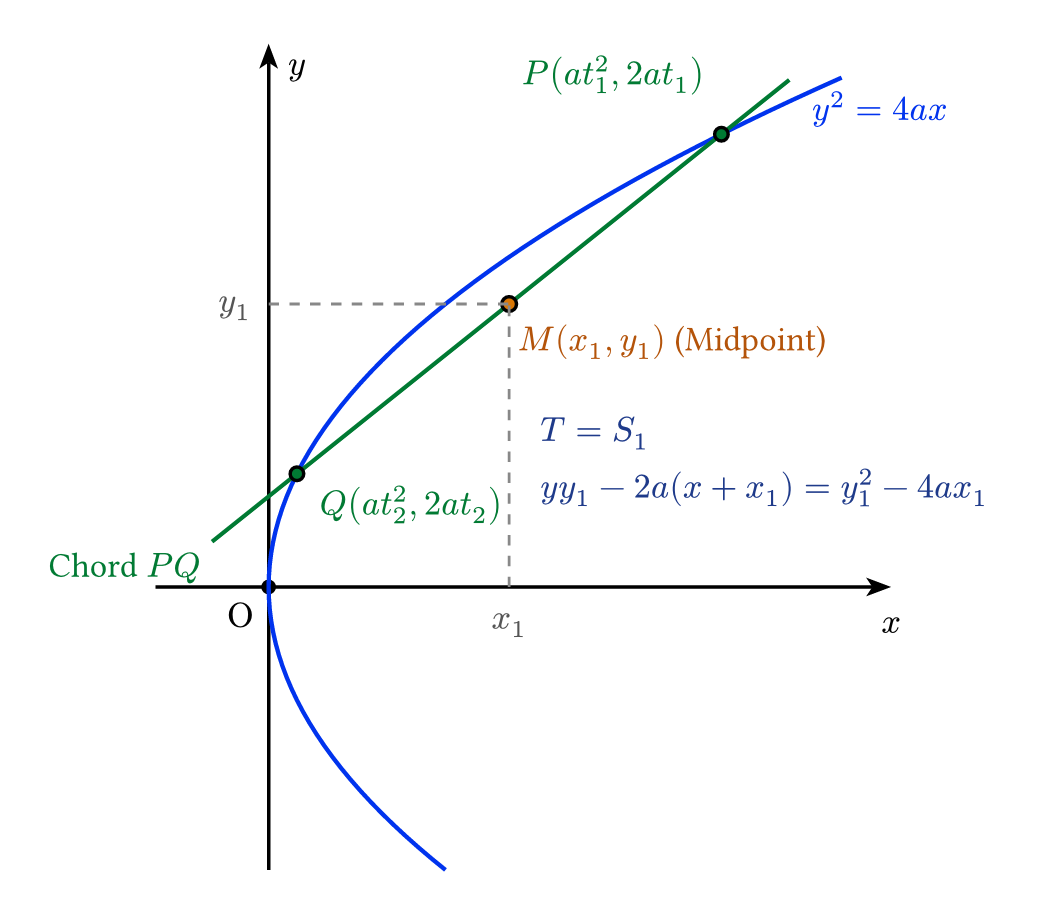
When a straight line intersects a parabola at two distinct points, the segment connecting those points forms a secant chord. In many geometric and analytical investigations, we are not directly given the coordinates of the two endpoints; instead, we are given the coordinates of the chord's midpoint, or a geometric condition constraining the chords of a parallel family.
In this chapter, we develop the equation of a chord in terms of the coordinates of its midpoint using the parametric representation of the parabola. We then present the comparison method for determining the midpoint of a given chord line, examine the geometry of systems of parallel chords, and explore the diameter of the parabola along with its fundamental tangency and bisection properties.
Equation of a Chord with a Given Midpoint§
Consider the standard parabola:
y 2 = 4 a x y^2 = 4ax y 2 = 4 a x Let P ( a t 1 2 , 2 a t 1 ) P(at_1^2, 2at_1) P ( a t 1 2 , 2 a t 1 ) Q ( a t 2 2 , 2 a t 2 ) Q(at_2^2, 2at_2) Q ( a t 2 2 , 2 a t 2 ) P Q PQ P Q
Parametric Derivation of the Chord Equation§
The slope of the secant line passing through P P P Q Q Q
m = 2 a t 2 − 2 a t 1 a t 2 2 − a t 1 2 = 2 a ( t 2 − t 1 ) a ( t 2 − t 1 ) ( t 1 + t 2 ) = 2 t 1 + t 2 m = \frac{2at_2 - 2at_1}{at_2^2 - at_1^2} = \frac{2a(t_2 - t_1)}{a(t_2 - t_1)(t_1 + t_2)} = \frac{2}{t_1 + t_2} m = a t 2 2 − a t 1 2 2 a t 2 − 2 a t 1 = a ( t 2 − t 1 ) ( t 1 + t 2 ) 2 a ( t 2 − t 1 ) = t 1 + t 2 2 Using the point-slope form with the point P ( a t 1 2 , 2 a t 1 ) P(at_1^2, 2at_1) P ( a t 1 2 , 2 a t 1 ) P Q PQ P Q
y − 2 a t 1 = 2 t 1 + t 2 ( x − a t 1 2 ) y - 2at_1 = \frac{2}{t_1 + t_2}(x - at_1^2) y − 2 a t 1 = t 1 + t 2 2 ( x − a t 1 2 ) Clearing fractions by multiplying both sides by t 1 + t 2 t_1 + t_2 t 1 + t 2
y ( t 1 + t 2 ) − 2 a t 1 ( t 1 + t 2 ) = 2 x − 2 a t 1 2 y(t_1 + t_2) - 2at_1(t_1 + t_2) = 2x - 2at_1^2 y ( t 1 + t 2 ) − 2 a t 1 ( t 1 + t 2 ) = 2 x − 2 a t 1 2 Expanding and rearranging the terms:
y ( t 1 + t 2 ) − 2 a t 1 2 − 2 a t 1 t 2 = 2 x − 2 a t 1 2 ⟹ y ( t 1 + t 2 ) − 2 x = 2 a t 1 t 2 y(t_1 + t_2) - 2at_1^2 - 2at_1 t_2 = 2x - 2at_1^2 \implies y(t_1 + t_2) - 2x = 2at_1 t_2 y ( t 1 + t 2 ) − 2 a t 1 2 − 2 a t 1 t 2 = 2 x − 2 a t 1 2 ⟹ y ( t 1 + t 2 ) − 2 x = 2 a t 1 t 2 Now let M ( x 1 , y 1 ) M(x_1, y_1) M ( x 1 , y 1 ) P Q PQ P Q
x 1 = a t 1 2 + a t 2 2 2 = a ( t 1 2 + t 2 2 ) 2 , y 1 = 2 a t 1 + 2 a t 2 2 = a ( t 1 + t 2 ) x_1 = \frac{at_1^2 + at_2^2}{2} = \frac{a(t_1^2 + t_2^2)}{2}, \qquad y_1 = \frac{2at_1 + 2at_2}{2} = a(t_1 + t_2) x 1 = 2 a t 1 2 + a t 2 2 = 2 a ( t 1 2 + t 2 2 ) , y 1 = 2 2 a t 1 + 2 a t 2 = a ( t 1 + t 2 ) From the relation for y 1 y_1 y 1
t 1 + t 2 = y 1 a t_1 + t_2 = \frac{y_1}{a} t 1 + t 2 = a y 1 To express the product t 1 t 2 t_1 t_2 t 1 t 2 ( x 1 , y 1 ) (x_1, y_1) ( x 1 , y 1 ) ( t 1 + t 2 ) 2 − ( t 1 2 + t 2 2 ) = 2 t 1 t 2 (t_1 + t_2)^2 - (t_1^2 + t_2^2) = 2t_1 t_2 ( t 1 + t 2 ) 2 − ( t 1 2 + t 2 2 ) = 2 t 1 t 2 t 1 + t 2 = y 1 a t_1 + t_2 = \frac{y_1}{a} t 1 + t 2 = a y 1 t 1 2 + t 2 2 = 2 x 1 a t_1^2 + t_2^2 = \frac{2x_1}{a} t 1 2 + t 2 2 = a 2 x 1
( y 1 a ) 2 − 2 x 1 a = 2 t 1 t 2 ⟹ y 1 2 − 2 a x 1 a 2 = 2 t 1 t 2 \left(\frac{y_1}{a}\right)^2 - \frac{2x_1}{a} = 2t_1 t_2 \implies \frac{y_1^2 - 2ax_1}{a^2} = 2t_1 t_2 ( a y 1 ) 2 − a 2 x 1 = 2 t 1 t 2 ⟹ a 2 y 1 2 − 2 a x 1 = 2 t 1 t 2 Multiplying through by a a a
2 a t 1 t 2 = y 1 2 − 2 a x 1 a 2at_1 t_2 = \frac{y_1^2 - 2ax_1}{a} 2 a t 1 t 2 = a y 1 2 − 2 a x 1 We now substitute t 1 + t 2 = y 1 a t_1 + t_2 = \frac{y_1}{a} t 1 + t 2 = a y 1 2 a t 1 t 2 = y 1 2 − 2 a x 1 a 2at_1 t_2 = \frac{y_1^2 - 2ax_1}{a} 2 a t 1 t 2 = a y 1 2 − 2 a x 1 y ( t 1 + t 2 ) − 2 x = 2 a t 1 t 2 y(t_1 + t_2) - 2x = 2at_1 t_2 y ( t 1 + t 2 ) − 2 x = 2 a t 1 t 2
y ( y 1 a ) − 2 x = y 1 2 − 2 a x 1 a y\left(\frac{y_1}{a}\right) - 2x = \frac{y_1^2 - 2ax_1}{a} y ( a y 1 ) − 2 x = a y 1 2 − 2 a x 1 Multiplying both sides of the equation by a a a
y y 1 − 2 a x = y 1 2 − 2 a x 1 y y_1 - 2ax = y_1^2 - 2ax_1 y y 1 − 2 a x = y 1 2 − 2 a x 1 To write this in standard notation, we subtract 2 a x 1 2ax_1 2 a x 1
y y 1 − 2 a ( x + x 1 ) = y 1 2 − 4 a x 1 y y_1 - 2a(x + x_1) = y_1^2 - 4ax_1 y y 1 − 2 a ( x + x 1 ) = y 1 2 − 4 a x 1 Recalling the standard notation for conics with respect to a point ( x 1 , y 1 ) (x_1, y_1) ( x 1 , y 1 )
T ≡ y y 1 − 2 a ( x + x 1 ) , S 1 ≡ y 1 2 − 4 a x 1 T \equiv y y_1 - 2a(x + x_1), \qquad S_1 \equiv y_1^2 - 4ax_1 T ≡ y y 1 − 2 a ( x + x 1 ) , S 1 ≡ y 1 2 − 4 a x 1 The equation of the chord of the parabola y 2 = 4 a x y^2 = 4ax y 2 = 4 a x M ( x 1 , y 1 ) M(x_1, y_1) M ( x 1 , y 1 )
T = S 1 T = S_1 T = S 1 Condition of Existence of a Real Chord§
For the chord to intersect the parabola at two distinct real points P P P Q Q Q M ( x 1 , y 1 ) M(x_1, y_1) M ( x 1 , y 1 )
Recall that for any point ( x 1 , y 1 ) (x_1, y_1) ( x 1 , y 1 ) S 1 = y 1 2 − 4 a x 1 S_1 = y_1^2 - 4ax_1 S 1 = y 1 2 − 4 a x 1
If S 1 < 0 S_1 < 0 S 1 < 0 M ( x 1 , y 1 ) M(x_1, y_1) M ( x 1 , y 1 )
If S 1 = 0 S_1 = 0 S 1 = 0 M ( x 1 , y 1 ) M(x_1, y_1) M ( x 1 , y 1 ) M M M T = 0 T = 0 T = 0
If S 1 > 0 S_1 > 0 S 1 > 0 M ( x 1 , y 1 ) M(x_1, y_1) M ( x 1 , y 1 ) M M M M M M
Therefore, a real chord with midpoint M ( x 1 , y 1 ) M(x_1, y_1) M ( x 1 , y 1 )
S 1 < 0 ⟺ y 1 2 − 4 a x 1 < 0 S_1 < 0 \iff y_1^2 - 4ax_1 < 0 S 1 < 0 ⟺ y 1 2 − 4 a x 1 < 0 Slope of the Chord in Terms of Midpoint Coordinates§
From the chord equation y y 1 − 2 a x = y 1 2 − 2 a x 1 y y_1 - 2ax = y_1^2 - 2ax_1 y y 1 − 2 a x = y 1 2 − 2 a x 1 y y y x x x
y = 2 a y 1 x + y 1 2 − 2 a x 1 y 1 y = \frac{2a}{y_1}x + \frac{y_1^2 - 2ax_1}{y_1} y = y 1 2 a x + y 1 y 1 2 − 2 a x 1 Comparing this with the slope-intercept form y = m x + c y = mx + c y = m x + c m m m ( x 1 , y 1 ) (x_1, y_1) ( x 1 , y 1 )
m = 2 a y 1 m = \frac{2a}{y_1} m = y 1 2 a This formula reveals a fundamental geometric fact: the slope of a chord of a parabola depends exclusively on the ordinate y 1 y_1 y 1 x 1 x_1 x 1
Find the equation of the chord of the parabola y 2 = 8 x y^2 = 8x y 2 = 8 x ( 2 , 3 ) (2, 3) ( 2 , 3 )
Solution:
Comparing y 2 = 8 x y^2 = 8x y 2 = 8 x y 2 = 4 a x y^2 = 4ax y 2 = 4 a x 4 a = 8 4a = 8 4 a = 8 a = 2 a = 2 a = 2
The proposed midpoint is ( x 1 , y 1 ) = ( 2 , 3 ) (x_1, y_1) = (2, 3) ( x 1 , y 1 ) = ( 2 , 3 )
S 1 = y 1 2 − 8 x 1 = 3 2 − 8 ( 2 ) = 9 − 16 = − 7 S_1 = y_1^2 - 8x_1 = 3^2 - 8(2) = 9 - 16 = -7 S 1 = y 1 2 − 8 x 1 = 3 2 − 8 ( 2 ) = 9 − 16 = − 7 Since S 1 = − 7 < 0 S_1 = -7 < 0 S 1 = − 7 < 0
Using the midpoint chord formula T = S 1 T = S_1 T = S 1 T = y y 1 − 4 ( x + x 1 ) T = y y_1 - 4(x + x_1) T = y y 1 − 4 ( x + x 1 )
y ( 3 ) − 4 ( x + 2 ) = − 7 y(3) - 4(x + 2) = -7 y ( 3 ) − 4 ( x + 2 ) = − 7 Expanding the terms:
3 y − 4 x − 8 = − 7 ⟹ 4 x − 3 y + 1 = 0 3y - 4x - 8 = -7 \implies 4x - 3y + 1 = 0 3 y − 4 x − 8 = − 7 ⟹ 4 x − 3 y + 1 = 0 Thus, the equation of the chord is 4 x − 3 y + 1 = 0 4x - 3y + 1 = 0 4 x − 3 y + 1 = 0
Determine the length of the chord of the parabola y 2 = 4 x y^2 = 4x y 2 = 4 x ( 2 , 1 ) (2, 1) ( 2 , 1 )
Solution:
Here 4 a = 4 4a = 4 4 a = 4 a = 1 a = 1 a = 1 ( x 1 , y 1 ) = ( 2 , 1 ) (x_1, y_1) = (2, 1) ( x 1 , y 1 ) = ( 2 , 1 )
Checking the existence condition:
S 1 = 1 2 − 4 ( 2 ) = − 7 < 0 S_1 = 1^2 - 4(2) = -7 < 0 S 1 = 1 2 − 4 ( 2 ) = − 7 < 0 The slope of the chord is:
m = 2 a y 1 = 2 ( 1 ) 1 = 2 m = \frac{2a}{y_1} = \frac{2(1)}{1} = 2 m = y 1 2 a = 1 2 ( 1 ) = 2 Using the point-slope form with midpoint ( 2 , 1 ) (2, 1) ( 2 , 1 )
y − 1 = 2 ( x − 2 ) ⟹ y = 2 x − 3 ⟹ 2 x = y + 3 y - 1 = 2(x - 2) \implies y = 2x - 3 \implies 2x = y + 3 y − 1 = 2 ( x − 2 ) ⟹ y = 2 x − 3 ⟹ 2 x = y + 3 Multiplying by 2 2 2 4 x = 2 y + 6 4x = 2y + 6 4 x = 2 y + 6 y 2 = 4 x y^2 = 4x y 2 = 4 x
y 2 = 2 y + 6 ⟹ y 2 − 2 y − 6 = 0 y^2 = 2y + 6 \implies y^2 - 2y - 6 = 0 y 2 = 2 y + 6 ⟹ y 2 − 2 y − 6 = 0 Let the endpoints of the chord be P ( x A , y A ) P(x_A, y_A) P ( x A , y A ) Q ( x B , y B ) Q(x_B, y_B) Q ( x B , y B ) y A y_A y A y B y_B y B
y A + y B = 2 , y A y B = − 6 y_A + y_B = 2, \qquad y_A y_B = -6 y A + y B = 2 , y A y B = − 6 The difference between the ordinates is:
∣ y A − y B ∣ = ( y A + y B ) 2 − 4 y A y B = 2 2 − 4 ( − 6 ) = 4 + 24 = 28 = 2 7 |y_A - y_B| = \sqrt{(y_A + y_B)^2 - 4y_A y_B} = \sqrt{2^2 - 4(-6)} = \sqrt{4 + 24} = \sqrt{28} = 2\sqrt{7} ∣ y A − y B ∣ = ( y A + y B ) 2 − 4 y A y B = 2 2 − 4 ( − 6 ) = 4 + 24 = 28 = 2 7 Since the chord line satisfies x − 2 = 1 2 ( y − 1 ) x - 2 = \frac{1}{2}(y - 1) x − 2 = 2 1 ( y − 1 )
∣ x A − x B ∣ = 1 2 ∣ y A − y B ∣ = 1 2 ( 2 7 ) = 7 |x_A - x_B| = \frac{1}{2}|y_A - y_B| = \frac{1}{2}(2\sqrt{7}) = \sqrt{7} ∣ x A − x B ∣ = 2 1 ∣ y A − y B ∣ = 2 1 ( 2 7 ) = 7 The length of the chord P Q PQ P Q
P Q = ( x A − x B ) 2 + ( y A − y B ) 2 = ( 7 ) 2 + ( 2 7 ) 2 = 7 + 28 = 35 PQ = \sqrt{(x_A - x_B)^2 + (y_A - y_B)^2} = \sqrt{(\sqrt{7})^2 + (2\sqrt{7})^2} = \sqrt{7 + 28} = \sqrt{35} P Q = ( x A − x B ) 2 + ( y A − y B ) 2 = ( 7 ) 2 + ( 2 7 ) 2 = 7 + 28 = 35 Hence, the length of the chord is 35 \sqrt{35} 35
Finding the Midpoint of a Chord by the Comparison Method§
When the equation of a chord is already known in the general linear form l x + m y + n = 0 lx + my + n = 0 l x + m y + n = 0
Analytical Procedure§
Let the given chord of the parabola y 2 = 4 a x y^2 = 4ax y 2 = 4 a x
l x + m y + n = 0 lx + my + n = 0 l x + m y + n = 0 Assume that the coordinates of the unknown midpoint are M ( x 1 , y 1 ) M(x_1, y_1) M ( x 1 , y 1 ) ( x 1 , y 1 ) (x_1, y_1) ( x 1 , y 1 ) T = S 1 T = S_1 T = S 1
y y 1 − 2 a ( x + x 1 ) = y 1 2 − 4 a x 1 y y_1 - 2a(x + x_1) = y_1^2 - 4ax_1 y y 1 − 2 a ( x + x 1 ) = y 1 2 − 4 a x 1 Rearranging this into the standard linear form A x + B y + C = 0 Ax + By + C = 0 A x + B y + C = 0
− 2 a x + y 1 y − ( y 1 2 − 2 a x 1 ) = 0 -2ax + y_1 y - (y_1^2 - 2ax_1) = 0 − 2 a x + y 1 y − ( y 1 2 − 2 a x 1 ) = 0 Because this line represents the exact same chord as l x + m y + n = 0 lx + my + n = 0 l x + m y + n = 0
− 2 a l = y 1 m = − ( y 1 2 − 2 a x 1 ) n \frac{-2a}{l} = \frac{y_1}{m} = \frac{-(y_1^2 - 2ax_1)}{n} l − 2 a = m y 1 = n − ( y 1 2 − 2 a x 1 ) From the equality of the first two ratios:
y 1 = − 2 a m l y_1 = -\frac{2am}{l} y 1 = − l 2 am Next, equating the first and third ratios:
− 2 a l = 2 a x 1 − y 1 2 n ⟹ 2 a x 1 − y 1 2 = − 2 a n l \frac{-2a}{l} = \frac{2ax_1 - y_1^2}{n} \implies 2ax_1 - y_1^2 = -\frac{2an}{l} l − 2 a = n 2 a x 1 − y 1 2 ⟹ 2 a x 1 − y 1 2 = − l 2 an Solving for 2 a x 1 2ax_1 2 a x 1
2 a x 1 = y 1 2 − 2 a n l 2ax_1 = y_1^2 - \frac{2an}{l} 2 a x 1 = y 1 2 − l 2 an Substituting the expression y 1 = − 2 a m l y_1 = -\frac{2am}{l} y 1 = − l 2 am
2 a x 1 = ( − 2 a m l ) 2 − 2 a n l = 4 a 2 m 2 l 2 − 2 a n l = 2 a ( 2 a m 2 − n l ) l 2 2ax_1 = \left(-\frac{2am}{l}\right)^2 - \frac{2an}{l} = \frac{4a^2 m^2}{l^2} - \frac{2an}{l} = \frac{2a(2am^2 - nl)}{l^2} 2 a x 1 = ( − l 2 am ) 2 − l 2 an = l 2 4 a 2 m 2 − l 2 an = l 2 2 a ( 2 a m 2 − n l ) Dividing both sides by 2 a 2a 2 a
x 1 = 2 a m 2 − n l l 2 x_1 = \frac{2am^2 - nl}{l^2} x 1 = l 2 2 a m 2 − n l Thus, the coordinates of the midpoint M ( x 1 , y 1 ) M(x_1, y_1) M ( x 1 , y 1 )
M ( 2 a m 2 − n l l 2 , − 2 a m l ) M\left(\frac{2am^2 - nl}{l^2}, -\frac{2am}{l}\right) M ( l 2 2 a m 2 − n l , − l 2 am ) Find the midpoint of the chord 2 x − y − 4 = 0 2x - y - 4 = 0 2 x − y − 4 = 0 y 2 = 4 x y^2 = 4x y 2 = 4 x
Solution:
Comparing y 2 = 4 x y^2 = 4x y 2 = 4 x y 2 = 4 a x y^2 = 4ax y 2 = 4 a x a = 1 a = 1 a = 1
2 x − y − 4 = 0 2x - y - 4 = 0 2 x − y − 4 = 0 Let the unknown midpoint be M ( x 1 , y 1 ) M(x_1, y_1) M ( x 1 , y 1 ) ( x 1 , y 1 ) (x_1, y_1) ( x 1 , y 1 )
T = S 1 ⟹ y y 1 − 2 ( x + x 1 ) = y 1 2 − 4 x 1 ⟹ − 2 x + y 1 y − ( y 1 2 − 2 x 1 ) = 0 T = S_1 \implies y y_1 - 2(x + x_1) = y_1^2 - 4x_1 \implies -2x + y_1 y - (y_1^2 - 2x_1) = 0 T = S 1 ⟹ y y 1 − 2 ( x + x 1 ) = y 1 2 − 4 x 1 ⟹ − 2 x + y 1 y − ( y 1 2 − 2 x 1 ) = 0 Comparing the coefficients of this line with the given line 2 x − y − 4 = 0 2x - y - 4 = 0 2 x − y − 4 = 0
− 2 2 = y 1 − 1 = − ( y 1 2 − 2 x 1 ) − 4 \frac{-2}{2} = \frac{y_1}{-1} = \frac{-(y_1^2 - 2x_1)}{-4} 2 − 2 = − 1 y 1 = − 4 − ( y 1 2 − 2 x 1 ) The first ratio evaluates to − 1 -1 − 1 − 1 -1 − 1
y 1 − 1 = − 1 ⟹ y 1 = 1 \frac{y_1}{-1} = -1 \implies y_1 = 1 − 1 y 1 = − 1 ⟹ y 1 = 1 y 1 2 − 2 x 1 4 = − 1 ⟹ y 1 2 − 2 x 1 = − 4 \frac{y_1^2 - 2x_1}{4} = -1 \implies y_1^2 - 2x_1 = -4 4 y 1 2 − 2 x 1 = − 1 ⟹ y 1 2 − 2 x 1 = − 4 Substituting y 1 = 1 y_1 = 1 y 1 = 1
1 2 − 2 x 1 = − 4 ⟹ 2 x 1 = 5 ⟹ x 1 = 5 2 1^2 - 2x_1 = -4 \implies 2x_1 = 5 \implies x_1 = \frac{5}{2} 1 2 − 2 x 1 = − 4 ⟹ 2 x 1 = 5 ⟹ x 1 = 2 5 To ensure this represents a valid interior midpoint, we evaluate S 1 S_1 S 1
S 1 = y 1 2 − 4 x 1 = 1 2 − 4 ( 5 2 ) = 1 − 10 = − 9 < 0 S_1 = y_1^2 - 4x_1 = 1^2 - 4\left(\frac{5}{2}\right) = 1 - 10 = -9 < 0 S 1 = y 1 2 − 4 x 1 = 1 2 − 4 ( 2 5 ) = 1 − 10 = − 9 < 0 Since S 1 < 0 S_1 < 0 S 1 < 0 ( 5 2 , 1 ) \left(\frac{5}{2}, 1\right) ( 2 5 , 1 )
System of Parallel Chords and the Diameter§
Now consider a family of parallel chords of the parabola y 2 = 4 a x y^2 = 4ax y 2 = 4 a x m ≠ 0 m \neq 0 m = 0
Every line in this family can be represented by the equation:
y = m x + c y = mx + c y = m x + c where m m m c c c
Locus of Midpoints of Parallel Chords§
Let M ( h , k ) M(h, k) M ( h , k ) M M M m m m
m = 2 a k ⟹ k = 2 a m m = \frac{2a}{k} \implies k = \frac{2a}{m} m = k 2 a ⟹ k = m 2 a Notice that the ordinate k k k m m m a a a c c c
Replacing ( h , k ) (h, k) ( h , k ) ( x , y ) (x, y) ( x , y ) m m m
y = 2 a m y = \frac{2a}{m} y = m 2 a Definition of Diameter§
In coordinate geometry, the diameter of a conic section is defined as the locus of the midpoints of a system of parallel chords.
For the parabola y 2 = 4 a x y^2 = 4ax y 2 = 4 a x
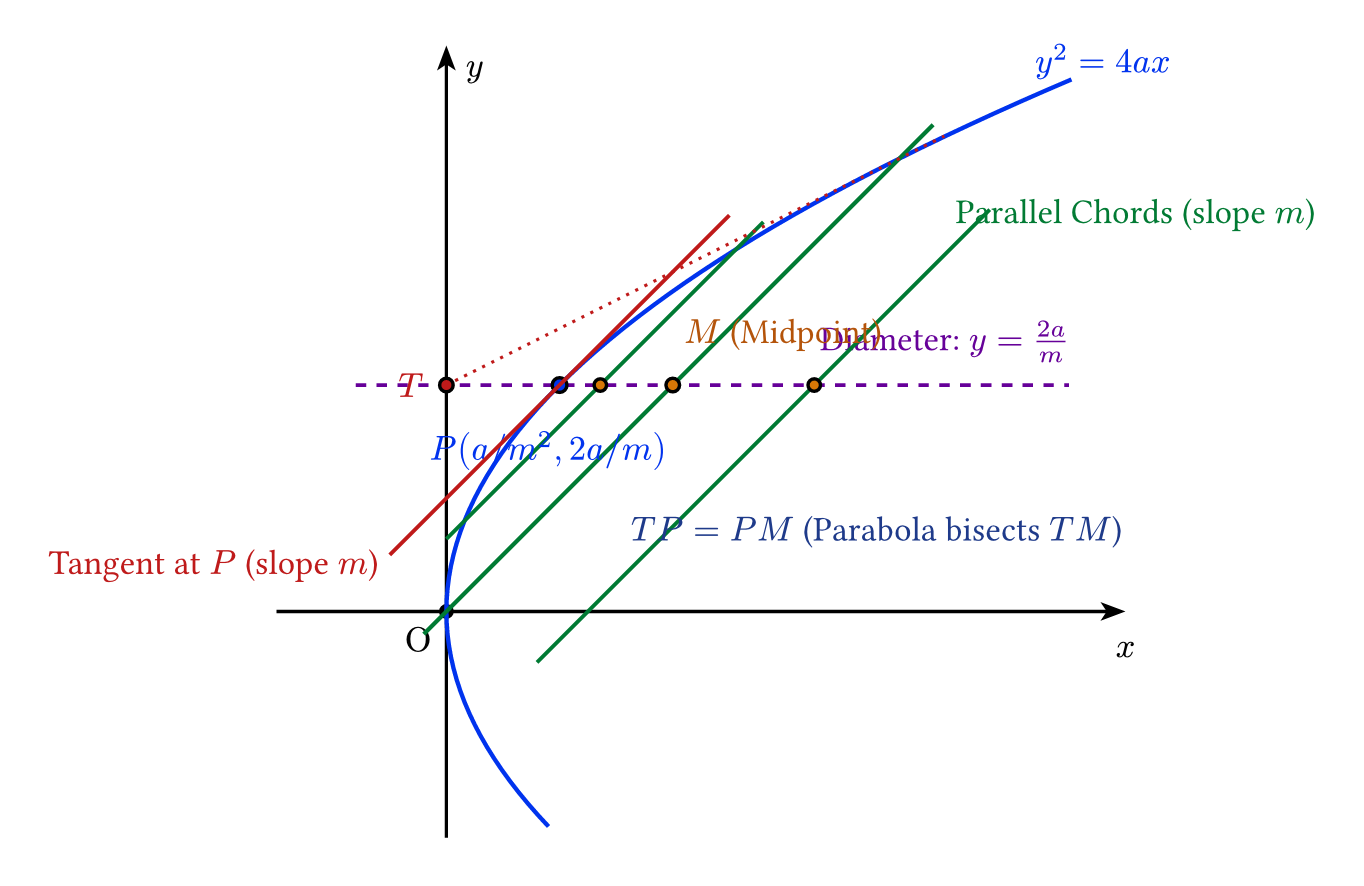
The diameter corresponding to chords of slope m m m y = 2 a m y = \frac{2a}{m} y = m 2 a
Because this line has a constant ordinate, every diameter of a standard parabola is parallel to its principal axis (the x x x
Conversely, every line parallel to the axis of a parabola bisects a family of parallel chords. If the line is y = k y = k y = k m = 2 a k m = \frac{2a}{k} m = k 2 a
Find the equation of the diameter of the parabola y 2 = 12 x y^2 = 12x y 2 = 12 x 45 ∘ 45^\circ 4 5 ∘ x x x
Solution:
For the parabola y 2 = 12 x y^2 = 12x y 2 = 12 x y 2 = 4 a x y^2 = 4ax y 2 = 4 a x 4 a = 12 4a = 12 4 a = 12 a = 3 a = 3 a = 3
The inclination of the chords is θ = 45 ∘ \theta = 45^\circ θ = 4 5 ∘
m = tan 45 ∘ = 1 m = \tan 45^\circ = 1 m = tan 4 5 ∘ = 1 The equation of the diameter bisecting chords of slope m m m
y = 2 a m = 2 ( 3 ) 1 = 6 y = \frac{2a}{m} = \frac{2(3)}{1} = 6 y = m 2 a = 1 2 ( 3 ) = 6 Thus, the required diameter is the horizontal line y = 6 y = 6 y = 6
Fundamental Properties of the Diameter§
The diameter of a parabola exhibits three interconnected geometric properties involving the extremity of the diameter, the tangents at the chord endpoints, and the bisection of the intercepting diameter segment.
Property 1: Tangent at the Extremity of a Diameter§
The diameter y = 2 a m y = \frac{2a}{m} y = m 2 a y 2 = 4 a x y^2 = 4ax y 2 = 4 a x P P P
Substituting y = 2 a m y = \frac{2a}{m} y = m 2 a
( 2 a m ) 2 = 4 a x ⟹ 4 a 2 m 2 = 4 a x ⟹ x = a m 2 \left(\frac{2a}{m}\right)^2 = 4ax \implies \frac{4a^2}{m^2} = 4ax \implies x = \frac{a}{m^2} ( m 2 a ) 2 = 4 a x ⟹ m 2 4 a 2 = 4 a x ⟹ x = m 2 a Hence, the extremity of the diameter on the parabola is:
P ( a m 2 , 2 a m ) P\left(\frac{a}{m^2}, \frac{2a}{m}\right) P ( m 2 a , m 2 a ) In parametric form, this corresponds to the parameter t = 1 m t = \frac{1}{m} t = m 1 x = a t 2 = a ( 1 / m ) 2 x = at^2 = a(1/m)^2 x = a t 2 = a ( 1/ m ) 2 y = 2 a t = 2 a ( 1 / m ) y = 2at = 2a(1/m) y = 2 a t = 2 a ( 1/ m )
The equation of the tangent line to the parabola at P P P
y y 1 = 2 a ( x + x 1 ) ⟹ y ( 2 a m ) = 2 a ( x + a m 2 ) y y_1 = 2a(x + x_1) \implies y\left(\frac{2a}{m}\right) = 2a\left(x + \frac{a}{m^2}\right) y y 1 = 2 a ( x + x 1 ) ⟹ y ( m 2 a ) = 2 a ( x + m 2 a ) Dividing both sides by 2 a m \frac{2a}{m} m 2 a
y = m ( x + a m 2 ) = m x + a m y = m\left(x + \frac{a}{m^2}\right) = mx + \frac{a}{m} y = m ( x + m 2 a ) = m x + m a The slope of this tangent line is precisely m m m
The tangent drawn at the extremity of any diameter of a parabola is parallel to the system of chords bisected by that diameter.
Property 2: Intersection of Tangents at the Extremities of a Chord§
Let Q ( a t 1 2 , 2 a t 1 ) Q(at_1^2, 2at_1) Q ( a t 1 2 , 2 a t 1 ) R ( a t 2 2 , 2 a t 2 ) R(at_2^2, 2at_2) R ( a t 2 2 , 2 a t 2 ) m m m
Since the slope of the chord Q R QR QR m m m
2 t 1 + t 2 = m ⟹ t 1 + t 2 = 2 m \frac{2}{t_1 + t_2} = m \implies t_1 + t_2 = \frac{2}{m} t 1 + t 2 2 = m ⟹ t 1 + t 2 = m 2 Let T ( x T , y T ) T(x_T, y_T) T ( x T , y T ) Q Q Q R R R
x T = a t 1 t 2 , y T = a ( t 1 + t 2 ) x_T = at_1 t_2, \qquad y_T = a(t_1 + t_2) x T = a t 1 t 2 , y T = a ( t 1 + t 2 ) Substituting t 1 + t 2 = 2 m t_1 + t_2 = \frac{2}{m} t 1 + t 2 = m 2 y T y_T y T
y T = a ( 2 m ) = 2 a m y_T = a\left(\frac{2}{m}\right) = \frac{2a}{m} y T = a ( m 2 ) = m 2 a Notice that y T y_T y T y = 2 a m y = \frac{2a}{m} y = m 2 a
The tangents drawn at the extremities of any chord of a parallel system intersect at a point that lies on the diameter bisecting that system.
Property 3: The Parabola Bisector Property§
Consider the three collinear points lying along the diameter y = 2 a m y = \frac{2a}{m} y = m 2 a
The point of intersection of the tangents at the chord endpoints, T ( x T , y T ) T(x_T, y_T) T ( x T , y T )
The extremity of the diameter on the parabola, P ( x P , y P ) P(x_P, y_P) P ( x P , y P )
The midpoint of the chord, M ( x M , y M ) M(x_M, y_M) M ( x M , y M )
All three points share the same ordinate:
y T = y P = y M = 2 a m y_T = y_P = y_M = \frac{2a}{m} y T = y P = y M = m 2 a Let us analyze their abscissae:
x T = a t 1 t 2 x_T = at_1 t_2 x T = a t 1 t 2 x P = a m 2 = a ( t 1 + t 2 2 ) 2 = a ( t 1 + t 2 ) 2 4 x_P = \frac{a}{m^2} = a\left(\frac{t_1 + t_2}{2}\right)^2 = \frac{a(t_1 + t_2)^2}{4} x P = m 2 a = a ( 2 t 1 + t 2 ) 2 = 4 a ( t 1 + t 2 ) 2 x M = a t 1 2 + a t 2 2 2 = a ( t 1 2 + t 2 2 ) 2 x_M = \frac{at_1^2 + at_2^2}{2} = \frac{a(t_1^2 + t_2^2)}{2} x M = 2 a t 1 2 + a t 2 2 = 2 a ( t 1 2 + t 2 2 ) We evaluate the directed segment T P = x P − x T TP = x_P - x_T T P = x P − x T
x P − x T = a ( t 1 + t 2 ) 2 4 − a t 1 t 2 = a ( t 1 2 + 2 t 1 t 2 + t 2 2 − 4 t 1 t 2 ) 4 = a ( t 1 − t 2 ) 2 4 x_P - x_T = \frac{a(t_1 + t_2)^2}{4} - at_1 t_2 = \frac{a(t_1^2 + 2t_1 t_2 + t_2^2 - 4t_1 t_2)}{4} = \frac{a(t_1 - t_2)^2}{4} x P − x T = 4 a ( t 1 + t 2 ) 2 − a t 1 t 2 = 4 a ( t 1 2 + 2 t 1 t 2 + t 2 2 − 4 t 1 t 2 ) = 4 a ( t 1 − t 2 ) 2 Next, we evaluate the directed segment P M = x M − x P PM = x_M - x_P P M = x M − x P
x M − x P = a ( t 1 2 + t 2 2 ) 2 − a ( t 1 + t 2 ) 2 4 = 2 a ( t 1 2 + t 2 2 ) − a ( t 1 2 + 2 t 1 t 2 + t 2 2 ) 4 = a ( t 1 − t 2 ) 2 4 x_M - x_P = \frac{a(t_1^2 + t_2^2)}{2} - \frac{a(t_1 + t_2)^2}{4} = \frac{2a(t_1^2 + t_2^2) - a(t_1^2 + 2t_1 t_2 + t_2^2)}{4} = \frac{a(t_1 - t_2)^2}{4} x M − x P = 2 a ( t 1 2 + t 2 2 ) − 4 a ( t 1 + t 2 ) 2 = 4 2 a ( t 1 2 + t 2 2 ) − a ( t 1 2 + 2 t 1 t 2 + t 2 2 ) = 4 a ( t 1 − t 2 ) 2 Comparing the two expressions:
x P − x T = x M − x P ⟺ T P = P M x_P - x_T = x_M - x_P \iff TP = PM x P − x T = x M − x P ⟺ T P = P M This leads to the bisection theorem:
The segment of a diameter intercepted between a chord and the point of intersection of the tangents at its ends is bisected by the parabola at the extremity of the diameter.
Equivalently, the point P P P T M TM T M
Consider the parabola y 2 = 8 x y^2 = 8x y 2 = 8 x Q ( 2 , 4 ) Q(2, 4) Q ( 2 , 4 ) R ( 8 , − 8 ) R(8, -8) R ( 8 , − 8 )
Determine the slope m m m Find the coordinates of the midpoint M M M P P P T T T Verify that T P = P M TP = PM T P = P M Solution:
For y 2 = 8 x y^2 = 8x y 2 = 8 x a = 2 a = 2 a = 2
The coordinates of the endpoints are Q ( 2 , 4 ) Q(2, 4) Q ( 2 , 4 ) R ( 8 , − 8 ) R(8, -8) R ( 8 , − 8 ) Q R QR QR
m = − 8 − 4 8 − 2 = − 12 6 = − 2 m = \frac{-8 - 4}{8 - 2} = \frac{-12}{6} = -2 m = 8 − 2 − 8 − 4 = 6 − 12 = − 2 The equation of the diameter corresponding to chords of slope m = − 2 m = -2 m = − 2
y = 2 a m = 2 ( 2 ) − 2 = − 2 y = \frac{2a}{m} = \frac{2(2)}{-2} = -2 y = m 2 a = − 2 2 ( 2 ) = − 2 Now we calculate the three key points:
Midpoint M M M
x M = 2 + 8 2 = 5 , y M = 4 + ( − 8 ) 2 = − 2 ⟹ M ( 5 , − 2 ) x_M = \frac{2 + 8}{2} = 5, \qquad y_M = \frac{4 + (-8)}{2} = -2 \implies M(5, -2) x M = 2 2 + 8 = 5 , y M = 2 4 + ( − 8 ) = − 2 ⟹ M ( 5 , − 2 ) Extremity P P P
Substituting y = − 2 y = -2 y = − 2 y 2 = 8 x y^2 = 8x y 2 = 8 x
( − 2 ) 2 = 8 x ⟹ 4 = 8 x ⟹ x P = 1 2 ⟹ P ( 1 2 , − 2 ) (-2)^2 = 8x \implies 4 = 8x \implies x_P = \frac{1}{2} \implies P\left(\frac{1}{2}, -2\right) ( − 2 ) 2 = 8 x ⟹ 4 = 8 x ⟹ x P = 2 1 ⟹ P ( 2 1 , − 2 ) Intersection of tangents T T T
The parametric values for Q Q Q R R R 2 a t = y 2at = y 2 a t = y
t 1 = y Q 2 a = 4 4 = 1 , t 2 = y R 2 a = − 8 4 = − 2 t_1 = \frac{y_Q}{2a} = \frac{4}{4} = 1, \qquad t_2 = \frac{y_R}{2a} = \frac{-8}{4} = -2 t 1 = 2 a y Q = 4 4 = 1 , t 2 = 2 a y R = 4 − 8 = − 2 The intersection point T T T
x T = a t 1 t 2 = 2 ( 1 ) ( − 2 ) = − 4 , y T = a ( t 1 + t 2 ) = 2 ( 1 − 2 ) = − 2 ⟹ T ( − 4 , − 2 ) x_T = at_1 t_2 = 2(1)(-2) = -4, \qquad y_T = a(t_1 + t_2) = 2(1 - 2) = -2 \implies T(-4, -2) x T = a t 1 t 2 = 2 ( 1 ) ( − 2 ) = − 4 , y T = a ( t 1 + t 2 ) = 2 ( 1 − 2 ) = − 2 ⟹ T ( − 4 , − 2 ) All three points lie on the line y = − 2 y = -2 y = − 2
T P = x P − x T = 1 2 − ( − 4 ) = 9 2 TP = x_P - x_T = \frac{1}{2} - (-4) = \frac{9}{2} T P = x P − x T = 2 1 − ( − 4 ) = 2 9 P M = x M − x P = 5 − 1 2 = 9 2 PM = x_M - x_P = 5 - \frac{1}{2} = \frac{9}{2} P M = x M − x P = 5 − 2 1 = 2 9 Since T P = P M = 9 2 TP = PM = \frac{9}{2} T P = P M = 2 9 T M TM T M P P P
Solved Examples§
The following problems demonstrate how the equation of a chord with a given midpoint and the properties of diameters are applied to solve locus and geometric problems.
Find the locus of the midpoints of the focal chords of the parabola y 2 = 4 a x y^2 = 4ax y 2 = 4 a x
Solution:
Let M ( h , k ) M(h, k) M ( h , k ) y 2 = 4 a x y^2 = 4ax y 2 = 4 a x
The equation of the chord having midpoint ( h , k ) (h, k) ( h , k ) T = S 1 T = S_1 T = S 1
k y − 2 a ( x + h ) = k 2 − 4 a h ⟹ k y − 2 a x = k 2 − 2 a h ky - 2a(x + h) = k^2 - 4ah \implies ky - 2ax = k^2 - 2ah k y − 2 a ( x + h ) = k 2 − 4 ah ⟹ k y − 2 a x = k 2 − 2 ah Since the chord is a focal chord, it must pass through the focus S ( a , 0 ) S(a, 0) S ( a , 0 ) x = a x = a x = a y = 0 y = 0 y = 0
k ( 0 ) − 2 a ( a ) = k 2 − 2 a h ⟹ − 2 a 2 = k 2 − 2 a h k(0) - 2a(a) = k^2 - 2ah \implies -2a^2 = k^2 - 2ah k ( 0 ) − 2 a ( a ) = k 2 − 2 ah ⟹ − 2 a 2 = k 2 − 2 ah Rearranging this relation:
k 2 = 2 a h − 2 a 2 = 2 a ( h − a ) k^2 = 2ah - 2a^2 = 2a(h - a) k 2 = 2 ah − 2 a 2 = 2 a ( h − a ) Replacing ( h , k ) (h, k) ( h , k ) ( x , y ) (x, y) ( x , y )
y 2 = 2 a ( x − a ) y^2 = 2a(x - a) y 2 = 2 a ( x − a ) This locus is another parabola having:
Vertex at ( a , 0 ) (a, 0) ( a , 0 ) Axis along the line y = 0 y = 0 y = 0 x x x Latus rectum of length 2 a 2a 2 a Find the locus of the midpoints of the chords of the parabola y 2 = 4 a x y^2 = 4ax y 2 = 4 a x
Solution:
Let M ( h , k ) M(h, k) M ( h , k )
T = S 1 ⟹ k y − 2 a x = k 2 − 2 a h T = S_1 \implies ky - 2ax = k^2 - 2ah T = S 1 ⟹ k y − 2 a x = k 2 − 2 ah Since M M M k 2 − 2 a h ≠ 0 k^2 - 2ah \neq 0 k 2 − 2 ah = 0
k y − 2 a x k 2 − 2 a h = 1 \frac{ky - 2ax}{k^2 - 2ah} = 1 k 2 − 2 ah k y − 2 a x = 1 To find the lines connecting the vertex ( 0 , 0 ) (0, 0) ( 0 , 0 ) y 2 = 4 a x y^2 = 4ax y 2 = 4 a x
y 2 − 4 a x ( 1 ) = 0 ⟹ y 2 − 4 a x ( k y − 2 a x k 2 − 2 a h ) = 0 y^2 - 4ax(1) = 0 \implies y^2 - 4ax\left(\frac{ky - 2ax}{k^2 - 2ah}\right) = 0 y 2 − 4 a x ( 1 ) = 0 ⟹ y 2 − 4 a x ( k 2 − 2 ah k y − 2 a x ) = 0 Multiplying by k 2 − 2 a h k^2 - 2ah k 2 − 2 ah
( k 2 − 2 a h ) y 2 − 4 a k x y + 8 a 2 x 2 = 0 (k^2 - 2ah)y^2 - 4akxy + 8a^2 x^2 = 0 ( k 2 − 2 ah ) y 2 − 4 ak x y + 8 a 2 x 2 = 0 8 a 2 x 2 − 4 a k x y + ( k 2 − 2 a h ) y 2 = 0 8a^2 x^2 - 4akxy + (k^2 - 2ah)y^2 = 0 8 a 2 x 2 − 4 ak x y + ( k 2 − 2 ah ) y 2 = 0 This homogeneous equation represents a pair of straight lines through the origin ( 0 , 0 ) (0, 0) ( 0 , 0 ) x 2 x^2 x 2 y 2 y^2 y 2
Coefficient of x 2 + Coefficient of y 2 = 0 \text{Coefficient of } x^2 + \text{Coefficient of } y^2 = 0 Coefficient of x 2 + Coefficient of y 2 = 0 8 a 2 + ( k 2 − 2 a h ) = 0 8a^2 + (k^2 - 2ah) = 0 8 a 2 + ( k 2 − 2 ah ) = 0 Rearranging the equation:
k 2 = 2 a h − 8 a 2 = 2 a ( h − 4 a ) k^2 = 2ah - 8a^2 = 2a(h - 4a) k 2 = 2 ah − 8 a 2 = 2 a ( h − 4 a ) Replacing ( h , k ) (h, k) ( h , k ) ( x , y ) (x, y) ( x , y )
y 2 = 2 a ( x − 4 a ) y^2 = 2a(x - 4a) y 2 = 2 a ( x − 4 a ) This is a parabola with vertex at ( 4 a , 0 ) (4a, 0) ( 4 a , 0 ) 2 a 2a 2 a
Find the locus of the midpoints of chords of the parabola y 2 = 4 a x y^2 = 4ax y 2 = 4 a x ( x 0 , y 0 ) (x_0, y_0) ( x 0 , y 0 )
Solution:
Let M ( h , k ) M(h, k) M ( h , k ) ( x 0 , y 0 ) (x_0, y_0) ( x 0 , y 0 )
The equation of the chord with midpoint ( h , k ) (h, k) ( h , k )
T = S 1 ⟹ k y − 2 a ( x + h ) = k 2 − 4 a h ⟹ k y − 2 a x = k 2 − 2 a h T = S_1 \implies ky - 2a(x + h) = k^2 - 4ah \implies ky - 2ax = k^2 - 2ah T = S 1 ⟹ k y − 2 a ( x + h ) = k 2 − 4 ah ⟹ k y − 2 a x = k 2 − 2 ah Since this chord passes through the fixed point ( x 0 , y 0 ) (x_0, y_0) ( x 0 , y 0 ) ( x 0 , y 0 ) (x_0, y_0) ( x 0 , y 0 )
k y 0 − 2 a x 0 = k 2 − 2 a h k y_0 - 2a x_0 = k^2 - 2ah k y 0 − 2 a x 0 = k 2 − 2 ah Rearranging the terms:
k 2 − y 0 k = 2 a ( h − x 0 ) k^2 - y_0 k = 2a(h - x_0) k 2 − y 0 k = 2 a ( h − x 0 ) Replacing ( h , k ) (h, k) ( h , k ) ( x , y ) (x, y) ( x , y )
y 2 − y 0 y = 2 a ( x − x 0 ) y^2 - y_0 y = 2a(x - x_0) y 2 − y 0 y = 2 a ( x − x 0 ) Completing the square in y y y
( y − y 0 2 ) 2 − y 0 2 4 = 2 a ( x − x 0 ) ⟹ ( y − y 0 2 ) 2 = 2 a ( x − x 0 + y 0 2 8 a ) \left(y - \frac{y_0}{2}\right)^2 - \frac{y_0^2}{4} = 2a(x - x_0) \implies \left(y - \frac{y_0}{2}\right)^2 = 2a\left(x - x_0 + \frac{y_0^2}{8a}\right) ( y − 2 y 0 ) 2 − 4 y 0 2 = 2 a ( x − x 0 ) ⟹ ( y − 2 y 0 ) 2 = 2 a ( x − x 0 + 8 a y 0 2 ) This represents a parabola whose axis is parallel to the x x x ( x 0 − y 0 2 8 a , y 0 2 ) \left(x_0 - \frac{y_0^2}{8a}, \frac{y_0}{2}\right) ( x 0 − 8 a y 0 2 , 2 y 0 ) 2 a 2a 2 a
Notice that when the fixed point is the origin ( 0 , 0 ) (0, 0) ( 0 , 0 ) x 0 = 0 x_0 = 0 x 0 = 0 y 0 = 0 y_0 = 0 y 0 = 0 y 2 = 2 a x y^2 = 2ax y 2 = 2 a x
Find the locus of the midpoints of chords of the parabola y 2 = 4 a x y^2 = 4ax y 2 = 4 a x 2 l 2l 2 l
Solution:
Let the endpoints of the chord be P ( a t 1 2 , 2 a t 1 ) P(at_1^2, 2at_1) P ( a t 1 2 , 2 a t 1 ) Q ( a t 2 2 , 2 a t 2 ) Q(at_2^2, 2at_2) Q ( a t 2 2 , 2 a t 2 ) M ( h , k ) M(h, k) M ( h , k )
From the coordinates of the midpoint:
k = a ( t 1 + t 2 ) ⟹ t 1 + t 2 = k a k = a(t_1 + t_2) \implies t_1 + t_2 = \frac{k}{a} k = a ( t 1 + t 2 ) ⟹ t 1 + t 2 = a k h = a ( t 1 2 + t 2 2 ) 2 = a 2 [ ( t 1 + t 2 ) 2 − 2 t 1 t 2 ] = a 2 [ k 2 a 2 − 2 t 1 t 2 ] h = \frac{a(t_1^2 + t_2^2)}{2} = \frac{a}{2}\left[(t_1 + t_2)^2 - 2t_1 t_2\right] = \frac{a}{2}\left[\frac{k^2}{a^2} - 2t_1 t_2\right] h = 2 a ( t 1 2 + t 2 2 ) = 2 a [ ( t 1 + t 2 ) 2 − 2 t 1 t 2 ] = 2 a [ a 2 k 2 − 2 t 1 t 2 ] Solving for 2 t 1 t 2 2t_1 t_2 2 t 1 t 2
2 h a = k 2 a 2 − 2 t 1 t 2 ⟹ 2 t 1 t 2 = k 2 − 2 a h a 2 \frac{2h}{a} = \frac{k^2}{a^2} - 2t_1 t_2 \implies 2t_1 t_2 = \frac{k^2 - 2ah}{a^2} a 2 h = a 2 k 2 − 2 t 1 t 2 ⟹ 2 t 1 t 2 = a 2 k 2 − 2 ah Now we express ( t 1 − t 2 ) 2 (t_1 - t_2)^2 ( t 1 − t 2 ) 2 h h h k k k
( t 1 − t 2 ) 2 = ( t 1 + t 2 ) 2 − 4 t 1 t 2 = k 2 a 2 − 2 ( k 2 − 2 a h a 2 ) = 4 a h − k 2 a 2 (t_1 - t_2)^2 = (t_1 + t_2)^2 - 4t_1 t_2 = \frac{k^2}{a^2} - 2\left(\frac{k^2 - 2ah}{a^2}\right) = \frac{4ah - k^2}{a^2} ( t 1 − t 2 ) 2 = ( t 1 + t 2 ) 2 − 4 t 1 t 2 = a 2 k 2 − 2 ( a 2 k 2 − 2 ah ) = a 2 4 ah − k 2 The square of the distance between P P P Q Q Q
P Q 2 = ( a t 1 2 − a t 2 2 ) 2 + ( 2 a t 1 − 2 a t 2 ) 2 = a 2 ( t 1 − t 2 ) 2 ( t 1 + t 2 ) 2 + 4 a 2 ( t 1 − t 2 ) 2 PQ^2 = (at_1^2 - at_2^2)^2 + (2at_1 - 2at_2)^2 = a^2(t_1 - t_2)^2(t_1 + t_2)^2 + 4a^2(t_1 - t_2)^2 P Q 2 = ( a t 1 2 − a t 2 2 ) 2 + ( 2 a t 1 − 2 a t 2 ) 2 = a 2 ( t 1 − t 2 ) 2 ( t 1 + t 2 ) 2 + 4 a 2 ( t 1 − t 2 ) 2 Factoring out a 2 ( t 1 − t 2 ) 2 a^2(t_1 - t_2)^2 a 2 ( t 1 − t 2 ) 2
P Q 2 = a 2 ( t 1 − t 2 ) 2 [ ( t 1 + t 2 ) 2 + 4 ] PQ^2 = a^2(t_1 - t_2)^2 \left[(t_1 + t_2)^2 + 4\right] P Q 2 = a 2 ( t 1 − t 2 ) 2 [ ( t 1 + t 2 ) 2 + 4 ] Given that P Q = 2 l PQ = 2l P Q = 2 l P Q 2 = 4 l 2 PQ^2 = 4l^2 P Q 2 = 4 l 2 ( t 1 − t 2 ) 2 = 4 a h − k 2 a 2 (t_1 - t_2)^2 = \frac{4ah - k^2}{a^2} ( t 1 − t 2 ) 2 = a 2 4 ah − k 2 t 1 + t 2 = k a t_1 + t_2 = \frac{k}{a} t 1 + t 2 = a k
4 l 2 = a 2 ( 4 a h − k 2 a 2 ) ( k 2 a 2 + 4 ) = ( 4 a h − k 2 ) ( k 2 + 4 a 2 a 2 ) 4l^2 = a^2 \left(\frac{4ah - k^2}{a^2}\right)\left(\frac{k^2}{a^2} + 4\right) = (4ah - k^2)\left(\frac{k^2 + 4a^2}{a^2}\right) 4 l 2 = a 2 ( a 2 4 ah − k 2 ) ( a 2 k 2 + 4 ) = ( 4 ah − k 2 ) ( a 2 k 2 + 4 a 2 ) Multiplying both sides by a 2 a^2 a 2
( 4 a h − k 2 ) ( k 2 + 4 a 2 ) = 4 a 2 l 2 (4ah - k^2)(k^2 + 4a^2) = 4a^2 l^2 ( 4 ah − k 2 ) ( k 2 + 4 a 2 ) = 4 a 2 l 2 Replacing ( h , k ) (h, k) ( h , k ) ( x , y ) (x, y) ( x , y )
( 4 a x − y 2 ) ( y 2 + 4 a 2 ) = 4 a 2 l 2 (4ax - y^2)(y^2 + 4a^2) = 4a^2 l^2 ( 4 a x − y 2 ) ( y 2 + 4 a 2 ) = 4 a 2 l 2 Rewriting with S 1 = y 2 − 4 a x S_1 = y^2 - 4ax S 1 = y 2 − 4 a x
( y 2 − 4 a x ) ( y 2 + 4 a 2 ) + 4 a 2 l 2 = 0 (y^2 - 4ax)(y^2 + 4a^2) + 4a^2 l^2 = 0 ( y 2 − 4 a x ) ( y 2 + 4 a 2 ) + 4 a 2 l 2 = 0 Since 4 a 2 l 2 > 0 4a^2 l^2 > 0 4 a 2 l 2 > 0 y 2 + 4 a 2 > 0 y^2 + 4a^2 > 0 y 2 + 4 a 2 > 0 4 a x − y 2 > 0 4ax - y^2 > 0 4 a x − y 2 > 0 y 2 − 4 a x < 0 y^2 - 4ax < 0 y 2 − 4 a x < 0
Summary of Results§
Concept
Equation / Formula
Notes
Chord with Midpoint ( x 1 , y 1 ) (x_1, y_1) ( x 1 , y 1 ) T = S 1 ⟺ y y 1 − 2 a ( x + x 1 ) = y 1 2 − 4 a x 1 T = S_1 \iff y y_1 - 2a(x + x_1) = y_1^2 - 4ax_1 T = S 1 ⟺ y y 1 − 2 a ( x + x 1 ) = y 1 2 − 4 a x 1 Real chord requires S 1 < 0 S_1 < 0 S 1 < 0
Slope of Bisected Chord m = 2 a y 1 m = \frac{2a}{y_1} m = y 1 2 a Depends only on the midpoint ordinate y 1 y_1 y 1
Comparison Method − 2 a l = y 1 m = − ( y 1 2 − 2 a x 1 ) n \frac{-2a}{l} = \frac{y_1}{m} = \frac{-(y_1^2 - 2ax_1)}{n} l − 2 a = m y 1 = n − ( y 1 2 − 2 a x 1 ) For given line l x + m y + n = 0 lx + my + n = 0 l x + m y + n = 0
Diameter of Parabola y = 2 a m y = \frac{2a}{m} y = m 2 a Parallel to axis of parabola
Extremity of Diameter P ( a m 2 , 2 a m ) P\left(\frac{a}{m^2}, \frac{2a}{m}\right) P ( m 2 a , m 2 a ) Point of tangency parallel to chords
Tangents Intersection T ( a t 1 t 2 , 2 a m ) T\left(at_1 t_2, \frac{2a}{m}\right) T ( a t 1 t 2 , m 2 a ) Lies on the diameter of the chord
Parabola Bisection Property T P = P M TP = PM T P = P M Parabola bisects segment between T T T M M M
Midpoints of Focal Chords y 2 = 2 a ( x − a ) y^2 = 2a(x - a) y 2 = 2 a ( x − a ) Parabola with vertex ( a , 0 ) (a, 0) ( a , 0 ) 2 a 2a 2 a
Midpoints of Right-Angled Chords y 2 = 2 a ( x − 4 a ) y^2 = 2a(x - 4a) y 2 = 2 a ( x − 4 a ) Subtends 90 ∘ 90^\circ 9 0 ∘ ( 0 , 0 ) (0, 0) ( 0 , 0 )
Midpoints of Chords through ( x 0 , y 0 ) (x_0, y_0) ( x 0 , y 0 ) y 2 − y 0 y = 2 a ( x − x 0 ) y^2 - y_0 y = 2a(x - x_0) y 2 − y 0 y = 2 a ( x − x 0 ) Parabola passing through ( 0 , 0 ) (0, 0) ( 0 , 0 ) ( x 0 , y 0 ) (x_0, y_0) ( x 0 , y 0 )