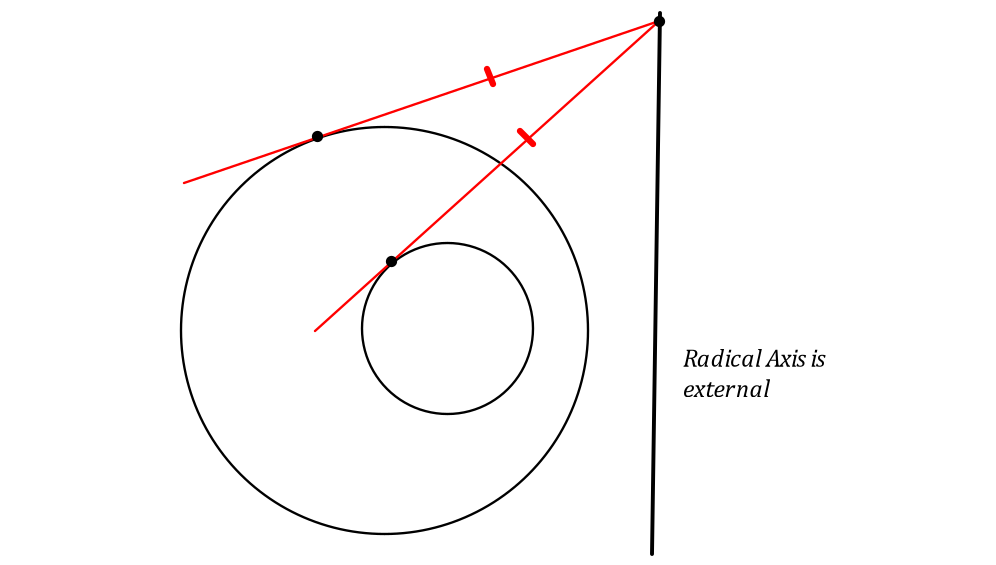
This is the equation of a straight line and is called the radical axis of the two circles.
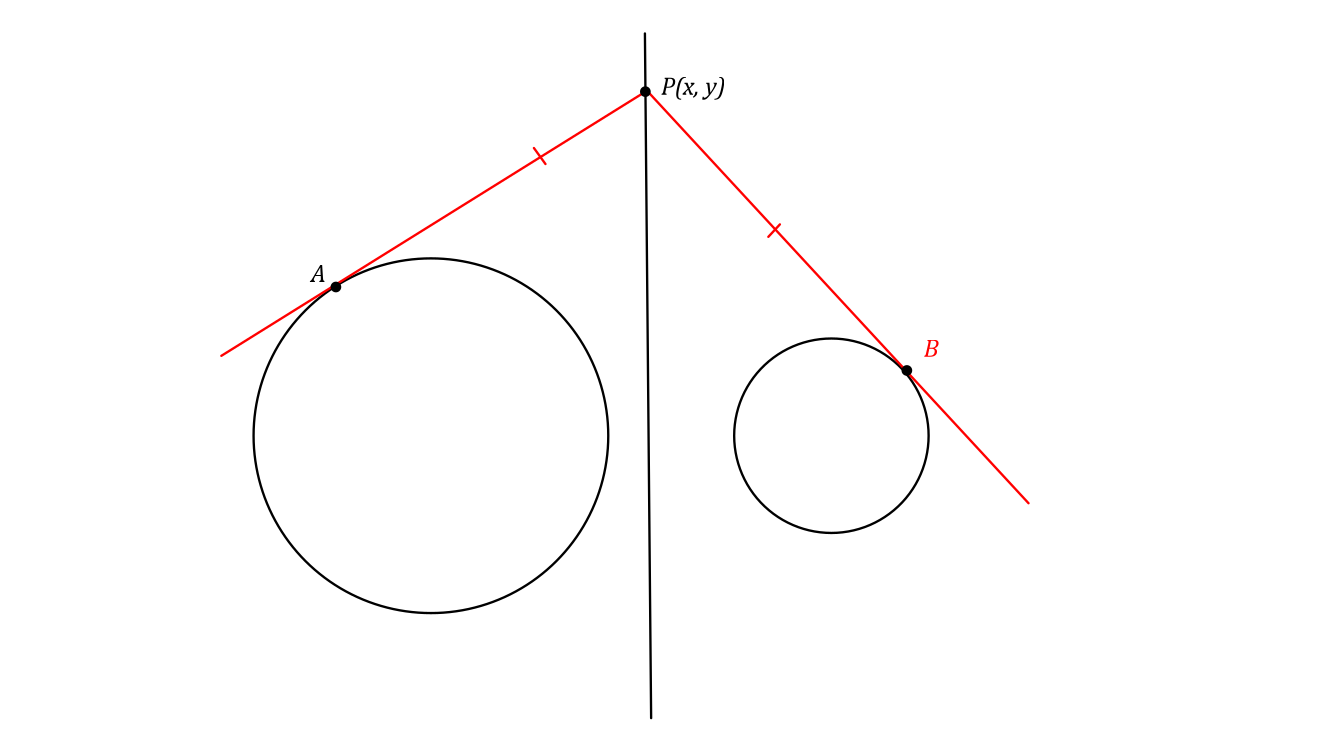
It has the important geometric property that it is the locus of all points from which tangents drawn to both circles are of equal length.
Given the two circles:
S1:x2+y2+4x+6y−1=0,S2:x2+y2+3x−2=0,
to find their radical axis, subtract the equations:
The radical axis is given by subtracting the two equations:
S1−S2=2(g1−g2)x+2(f1−f2)y+(c1−c2)=0.
This is the equation of a straight line. Its slope is given by:
slope of radical axis=−2(f1−f2)2(g1−g2)=−f1−f2g1−g2.
Now, consider the centers of the two circles. The center of S1 is (−g1,−f1), and the center of S2 is (−g2,−f2). The slope of the line joining the centers is:
be such that they are separated from each other—meaning they do not intersect and are not even touching.
The radical axis is defined as the locus of all points P(x,y) from which lengths of tangents drawn to both circles are equal. That is,
tangent length from P to S1=tangent length from P to S2.
Now assume the radical axis intersects one of the circles, say S1. Let the point of intersection be P. Since P lies on S1, the tangent from P to S1 has zero length:
tangent length to S1=0.
But P also lies on the radical axis, so the length of tangent to S2 from P must also be zero. That implies P lies on S2 as well. Hence, P is a common point of both circles, contradicting the assumption that the circles are disjoint.
Thus, we are forced to conclude:
The radical axis cannot intersect either circle.
Since it is a straight line perpendicular to the line joining the centers of the circles, and does not intersect either of them, it must lie entirely in between the two circles.
Therefore, when two circles are disjoint, the radical axis lies strictly between them and does not intersect either circle.
When two circles intersect or touch each other, the radical axis takes on a very specific geometric form:
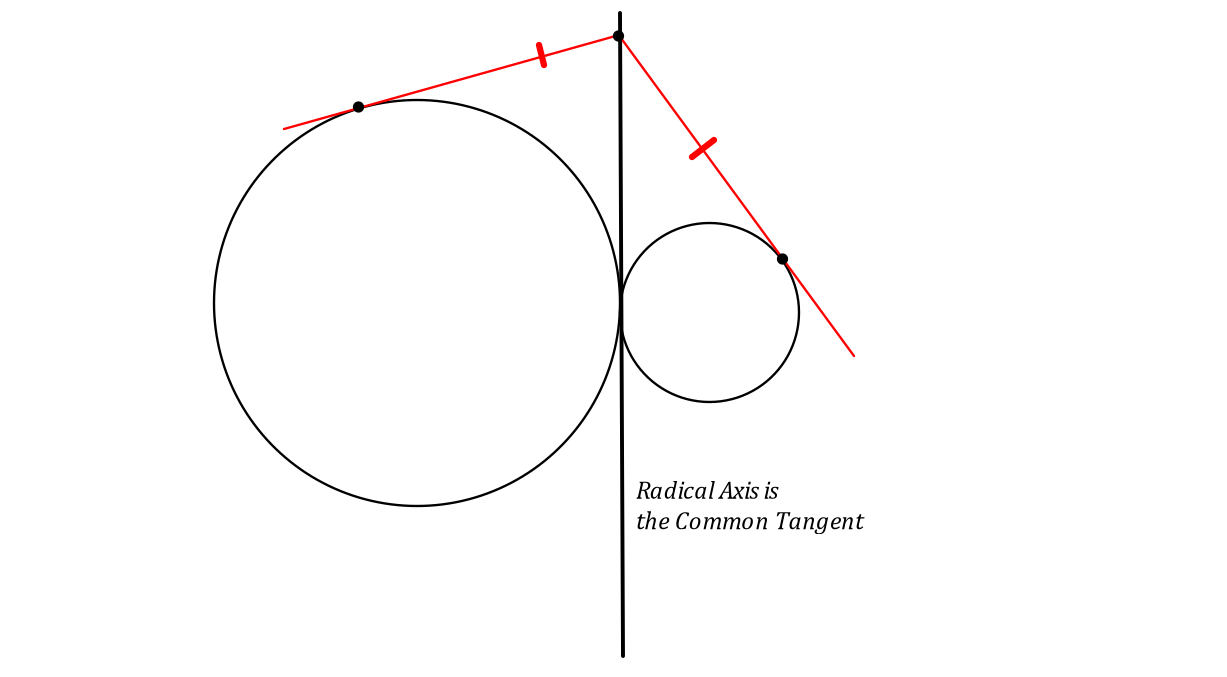
When two circles touch each other externally, the radical axis is the common tangent at their point of contact. This is immediately clear because the equation of the common tangent at the contact point is S1−S2=0, which is precisely the equation of the radical axis.
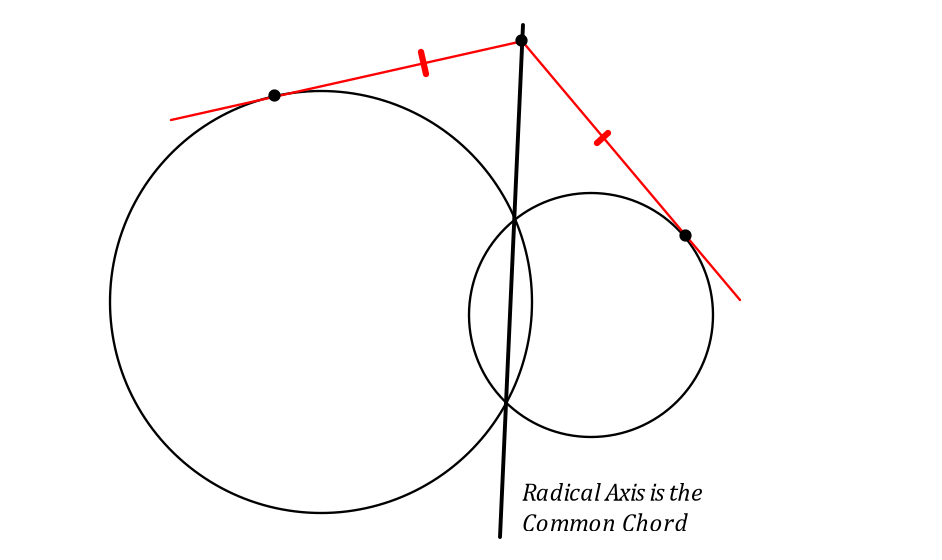
When the two circles intersect at two distinct points, the radical axis is the common chord joining the points of intersection. This chord clearly lies on both circles and its equation again is S1−S2=0, hence it is the radical axis.
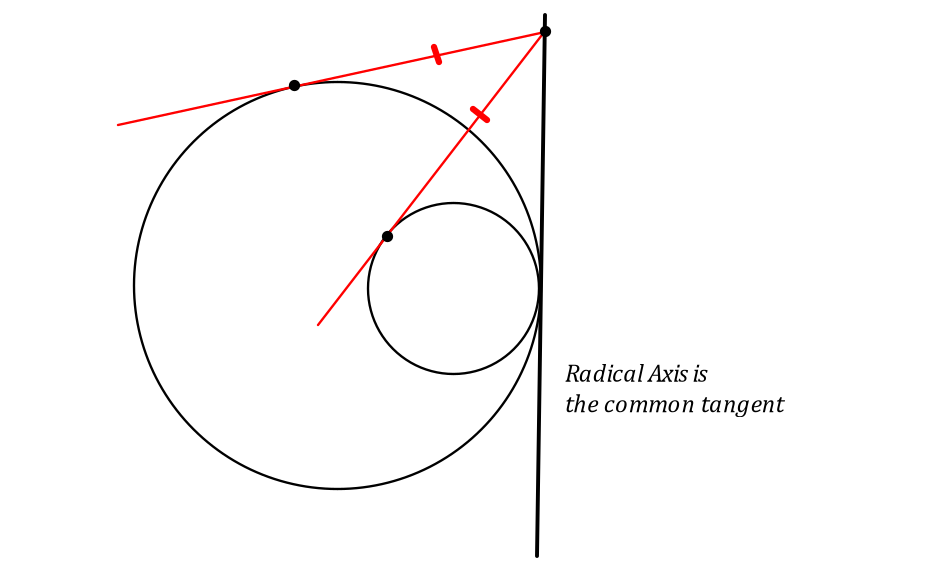
When the two circles touch each other internally, the radical axis is once again the common tangent at the point of contact. The equation of this tangent is S1−S2=0, and this shows that the radical axis and the common tangent are one and the same in this configuration too.
When one circle lies completely inside another without touching it, the two circles have no point in common, and all points on the smaller circle lie strictly within the interior of the larger one. In this case, the radical axis, defined by the equation S1−S2=0, lies entirely outside both circles.
Another powerful and geometric way to understand the radical axis is through orthogonality. Let two circles be given, and suppose P is a point on their radical axis. From P, draw tangents to the two circles, meeting them at points A and B respectively. Since P lies on the radical axis, the lengths of these tangents are equal, i.e., PA=PB. Now, construct a circle centered at P with radius equal to this common tangent length. This new circle passes through both A and B, and more importantly, it is orthogonal to each of the given circles: the tangents PA and PB from P are also radii of the new circle, and they meet the original circles at A and B perpendicularly. Thus, every point on the radical axis serves as the center of some circle orthogonal to both given circles. Hence, the radical axis can also be defined as the locus of centers of circles orthogonal to both given circles.
Let us now verify this definition algebraically. Let the two given circles be:
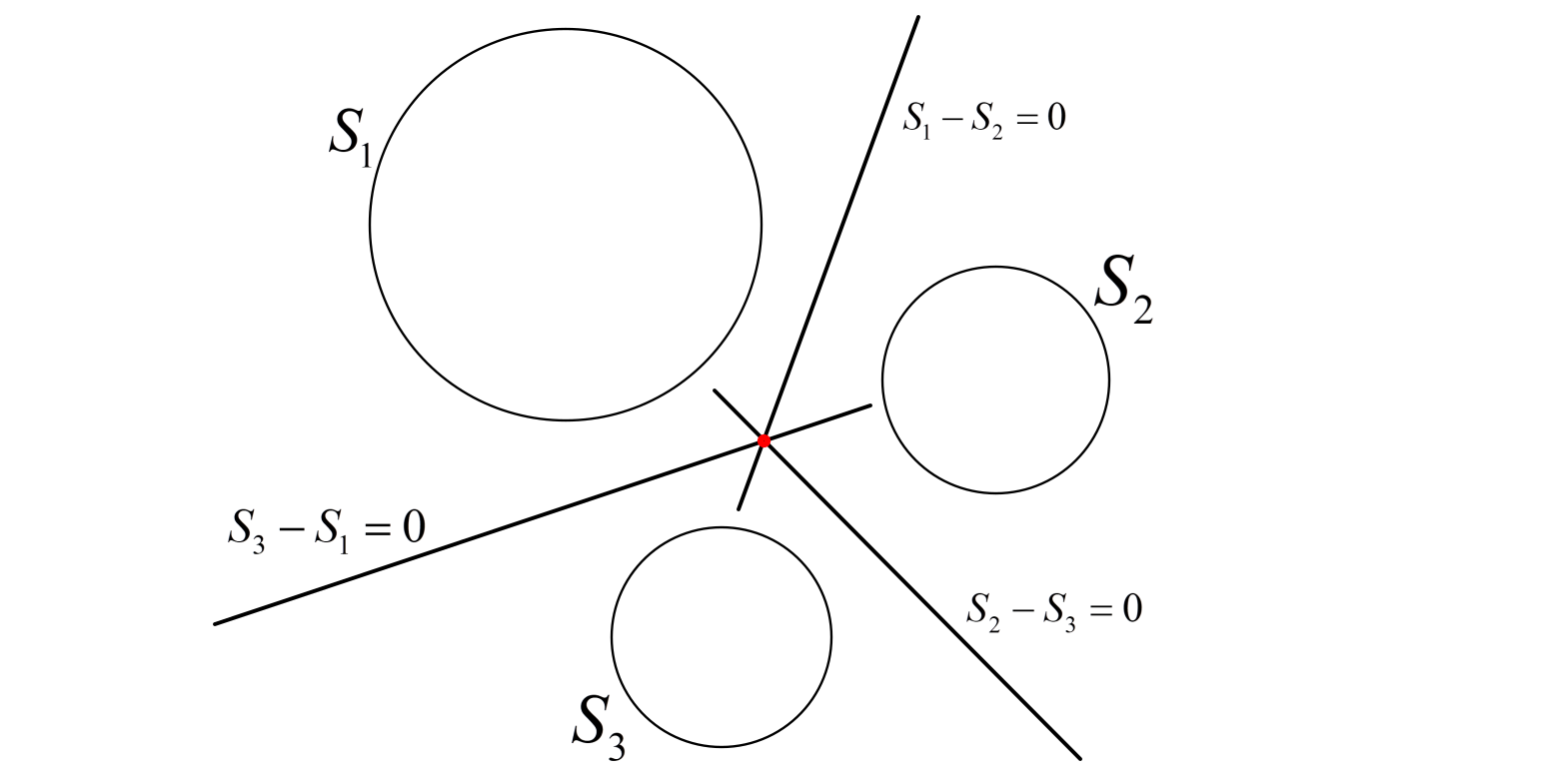
Consider three circles S1,S2,S3, whose centers are not collinear. Then each pair of circles determines a unique radical axis, which is a straight line defined by the locus of points from which the lengths of tangents to the two circles are equal.
Let the three radical axes be:
R1:S2−S3=0,R2:S3−S1=0,R3:S1−S2=0.
Observe that the equation of R3 is simply the sum of the equations of R1 and R2. That is,
R1+R2=(S2−S3)+(S3−S1)=S2−S1=R3.
Hence, these three lines cannot be parallel or form a triangle—they are concurrent. The point of concurrency of these three radical axes is called the radical centre. When centres of circles are collinear, then all radical axes are parallel and hence they cannot intersect in one common point and there will be no radical centre.
At the radical centre, the point lies on all three radical axes, so the length of the tangents drawn from this point to all three circles is the same. That is,
Tangents from radical centre to S1,S2,S3 all have equal length.
Furthermore, this point has a deeper geometric property: if we construct a circle centered at the radical centre with radius equal to the length of the tangent from this point to any of the three given circles, then this new circle will be orthogonal to all three circles. This follows from the fact that its radius meets each original circle tangentially at right angles, by construction.
Thus, the radical centre is not only the point of concurrency of the radical axes but also the unique point from which a single circle can be drawn orthogonal to all three given circles.
Section 12 of 12 · Circles
Mark this section complete when you have worked through its proofs.
Type any topic, theorem, or concept to jump directly to the section.