
Common Tangents
Common Tangents to Two Circles
A common tangent to two circles is a straight line that touches both circles. Depending on the relative positions of the circles, the number of such tangents can vary from zero to four. We classify all possible configurations as follows:
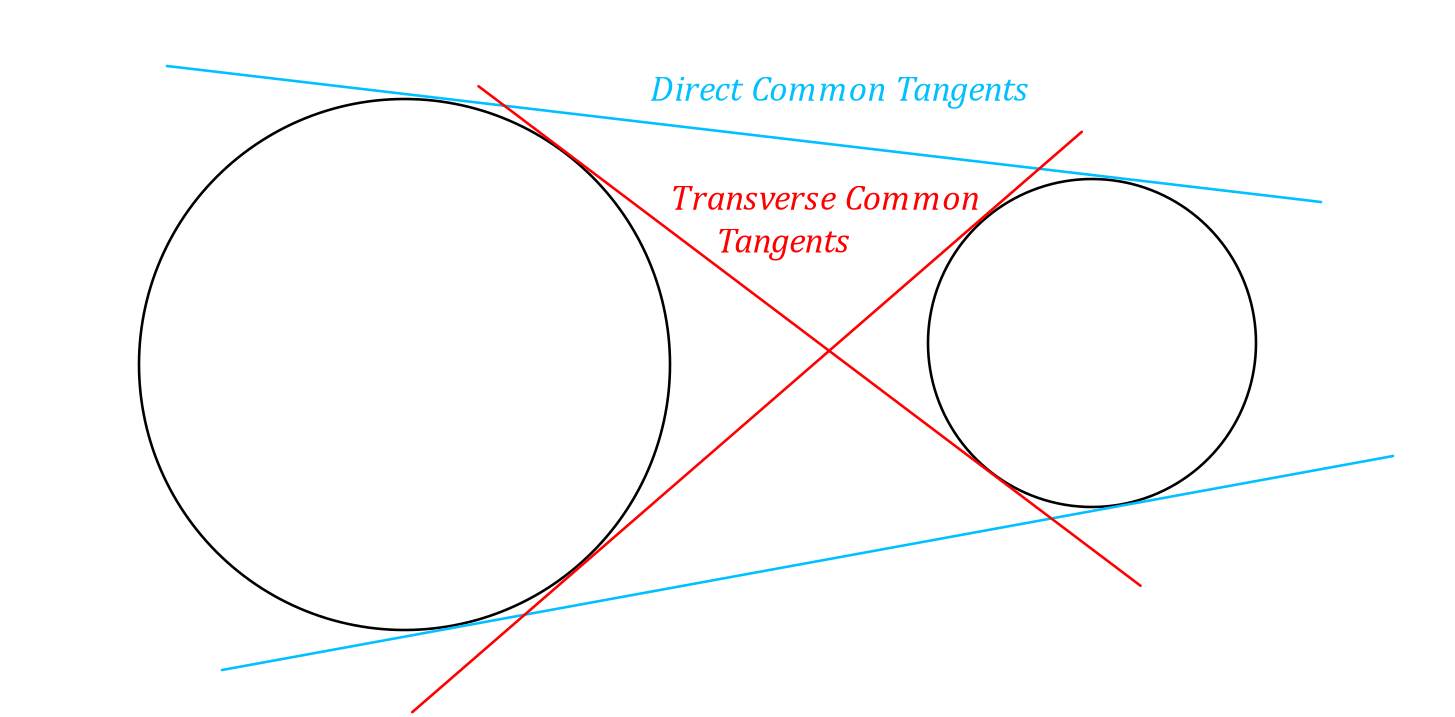
I. Circles External to Each Other
If the distance between their centres is greater than the sum of their radii:
then the circles lie completely outside each other and do not intersect. In this case, four common tangents are possible:
- Two direct (external) tangents, which do not intersect the segment joining the centres.
- Two transverse (internal) tangents, which intersect between the centres.
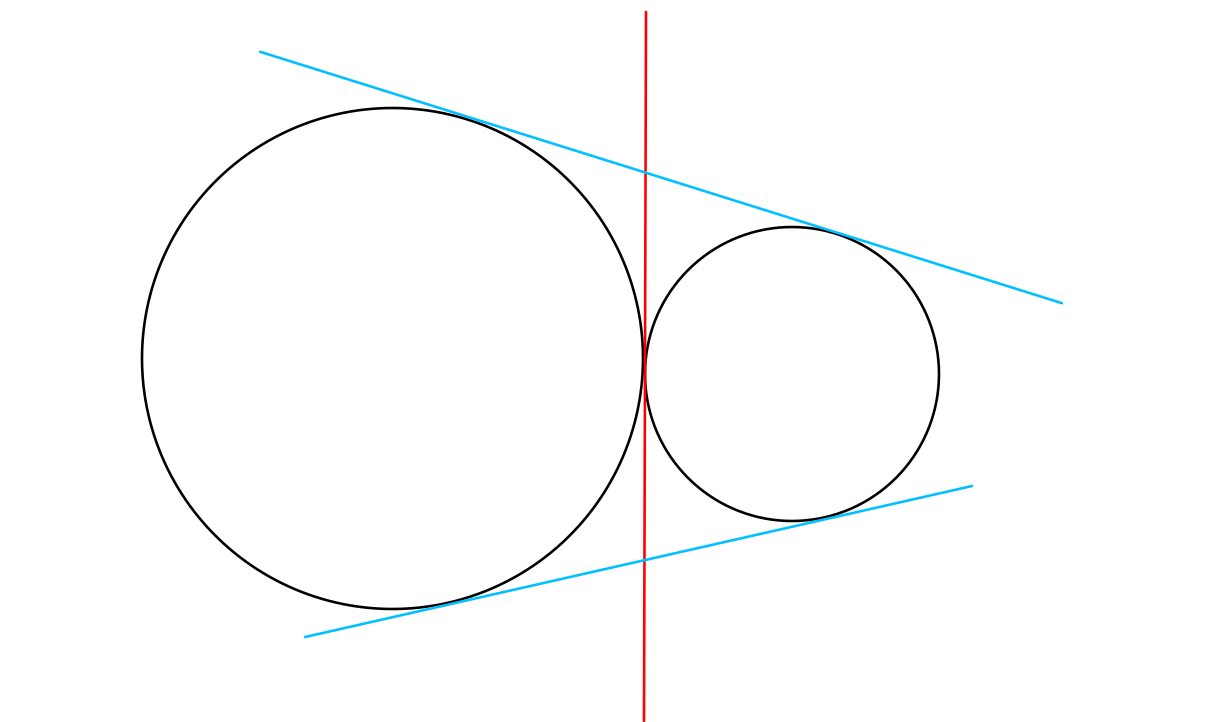
II. Circles Touching Each Other Externally
If the distance between centres is equal to the sum of radii:
the circles touch at a single point externally. Then, there are exactly three common tangents:
- Two direct tangents, as before.
- One transverse tangent, which now becomes common at the point of contact.
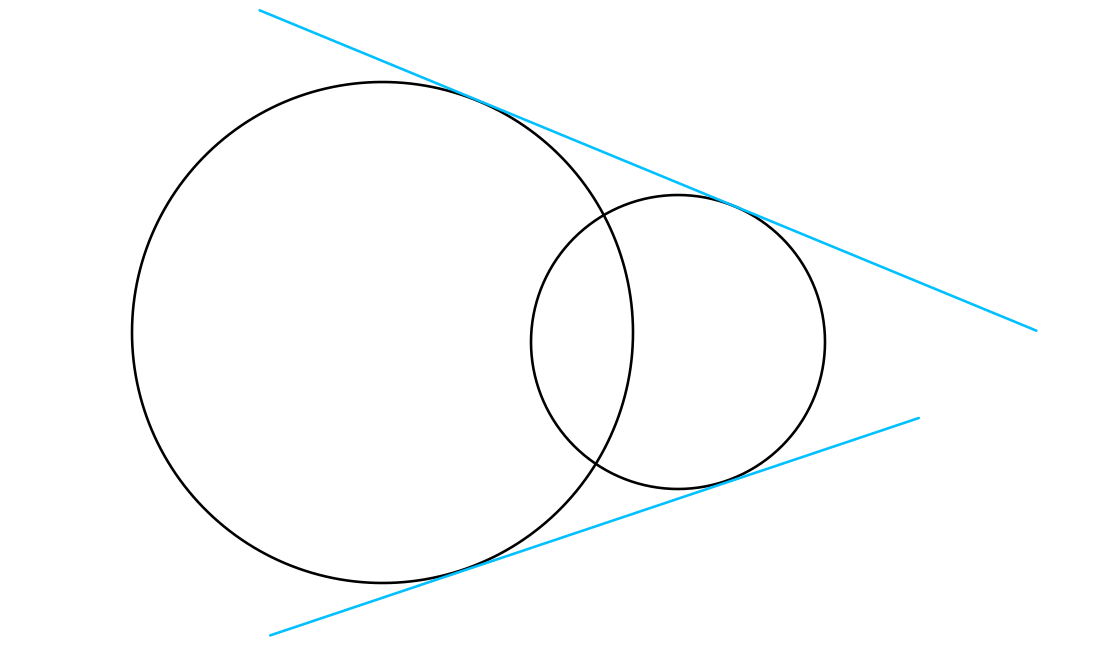
III. Circles Intersecting Each Other
If the distance between centres lies strictly between the sum and difference of radii:
then the circles intersect at two points. In this case, only two common tangents exist:
- These are the direct tangents, lying outside the segment joining the centres.
- No transverse tangents are possible, as they would intersect both circles, which already intersect.
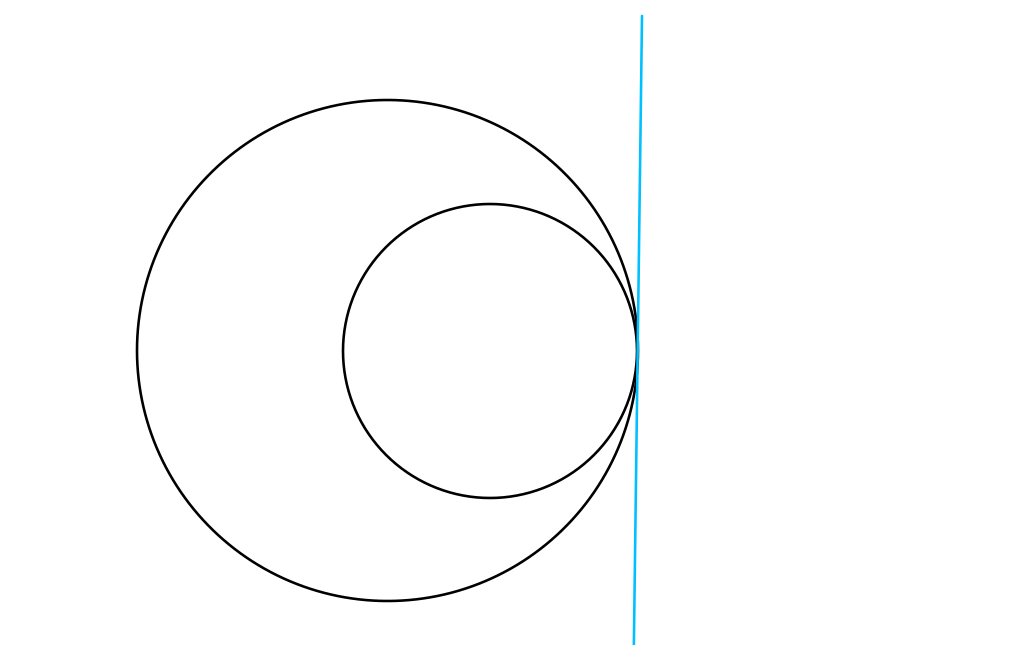
IV. Circles Touching Each Other Internally
If the distance between centres equals the absolute difference of radii:
then the circles touch internally at a single point. In this configuration, there is exactly one common tangent:
- Only one direct tangent exists at the point of contact.
- No transverse tangents are possible.
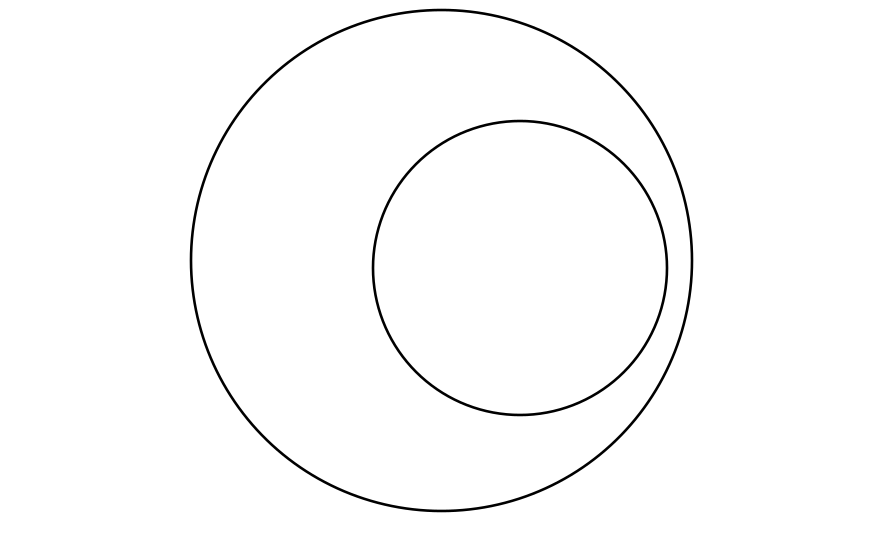
V. One Circle Lies Entirely Inside the Other
If the distance between centres is less than the absolute difference of radii:
then one circle lies completely inside the other, and they do not touch or intersect. In this case, there are no common tangents, as no line can touch both without intersecting the interior of one.
These are all the possible configurations. The number of common tangents in each case is summarized below:
Finding Equations of Common Tangents§
Our next objective is to learn how to find the equations of common tangents to two given circles. One straightforward but algebraically intense method is to assume the equation of the tangent in slope-intercept form:
Here, and are unknowns to be determined. Let the two given circles be and . For the line to be a tangent to both circles, it must satisfy the condition of tangency for each.
That is, we impose:
- Equation 1: is tangent to
- Equation 2: is tangent to
Solving this system gives values of and corresponding to the tangents. However, this process becomes algebraically heavy. When one eliminates a variable—say, —from the system, the resulting equation in is typically of degree four, reflecting the possible existence of four common tangents.
But a quartic equation is not easy to solve in general. The resulting expressions can be quite complex and impractical in most cases.
Instead of this purely algebraic approach, a more effective method uses geometrical insights into the relative positions of the circles. By doing this, we reduce the problem to solving quadratic equations, which are far more tractable and reveal the tangents more directly.
This geometrical approach to finding common tangents—especially the direct and transverse tangents—will be discussed next.
Direct Common Tangents§
Direct Common Tangents — Trivial Case: Equal Radii
Let two circles and have equal radii , and centres at and , respectively. Suppose the circles are positioned such that they have direct common tangents—this occurs when they are either externally apart, touching externally, or intersecting at two distinct points.
In this trivial case, where the radii are equal, the geometry becomes especially simple. The two direct common tangents are parallel to the line joining the centres , and lie at a perpendicular distance on either side of it.
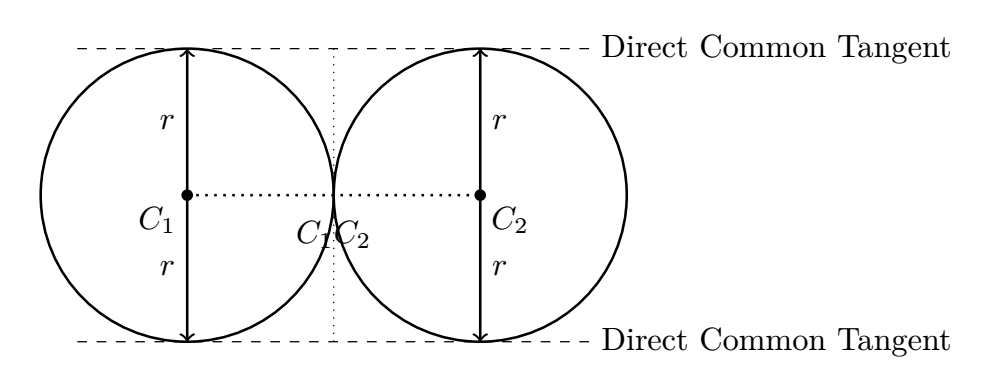
Suppose the equation of the line joining and is:
Then any line parallel to this one has the form:
To ensure that the distance between the two parallel lines is exactly , and each is at a distance from the centreline, the parameter must satisfy:
Hence, the equations of the direct common tangents are:
These two lines are symmetric about the line joining the centres and represent the required direct tangents.
Direct Common Tangents — Unequal Radii
When two circles and , with centres and , have unequal radii , the geometry of the direct common tangents changes.
The two direct common tangents are no longer parallel. Instead, they intersect at a fixed point , located on the side of the smaller circle. This point is called the center of similitude (or similarity), and it lies on the line joining the centres , extended externally.
Construction of Point
Let , and suppose one of the common tangents touches:
- at point
- at point
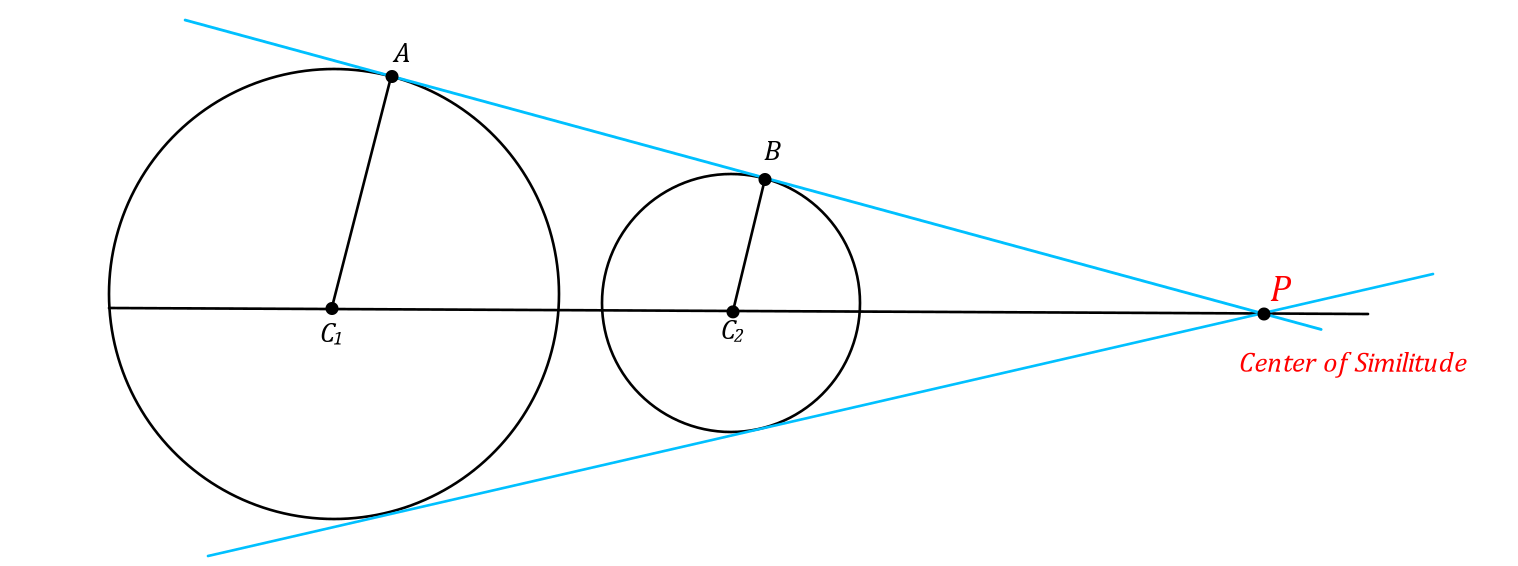
Then, since both and , the segments and are parallel. Now observe triangles and . These triangles are similar, since they share angle at and both have right angles at and .
By similarity:
This implies that point divides the segment externally in the ratio . Therefore, the coordinates of are given by the section formula:
Finding the Equations of the Tangents
Now suppose we have computed , and we wish to find the equations of the direct common tangents.
Let the slope of one of the tangents be . Then its equation is:
This line touches both circles. So, using the tangency condition for any one of the two circles (say ). This gives a single equation involving .
As a result, we obtain a quadratic equation in , whose two roots represent the slopes of the two direct common tangents. These slopes, together with point , yield the complete equations of the tangents.
This method avoids solving a quartic and uses geometrical insight to reduce the problem to solving a quadratic equation, which is algebraically more manageable.
Besides finding the equations of the direct common tangents, there are two other geometrically significant quantities we often wish to compute:
- The length of the direct common tangents
- The angle between the two direct tangents
Let us derive both precisely.
Angle Between the Direct Common Tangents
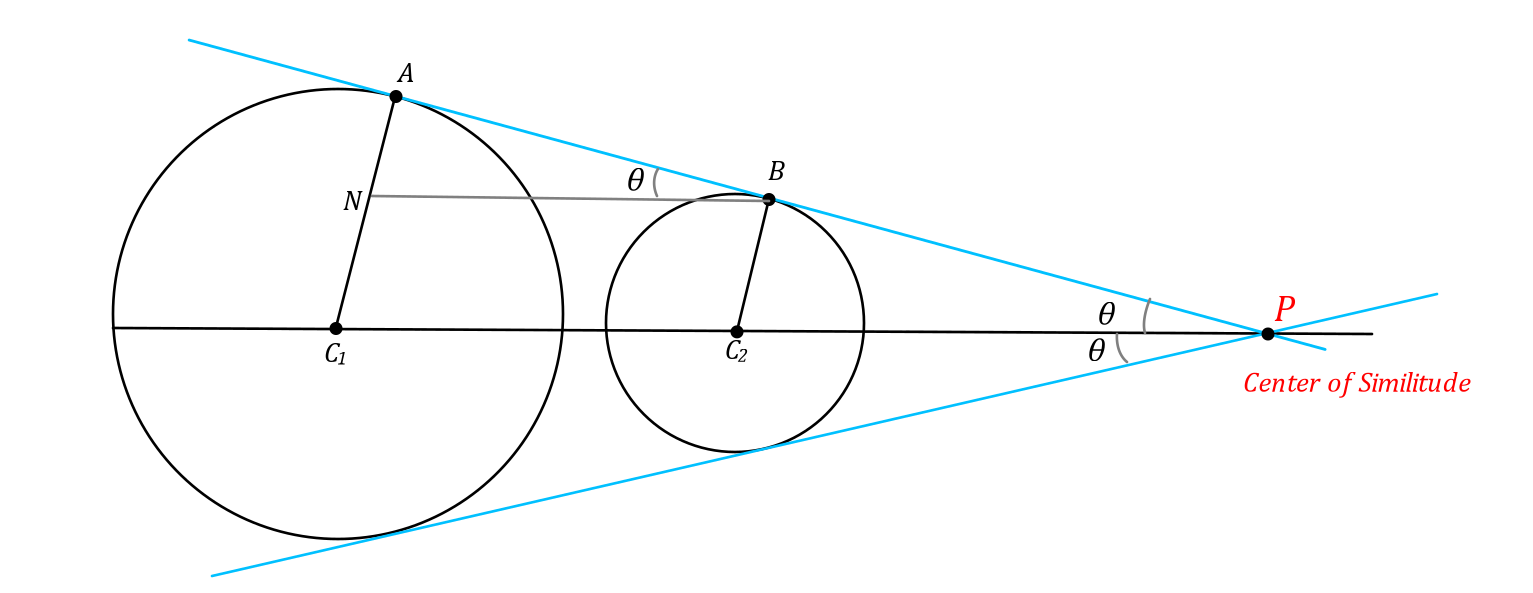
Let the point of intersection of the two direct tangents be , the center of similitude, constructed as before. Let one tangent touch:
- Circle (larger, radius ) at point
- Circle (smaller, radius ) at point
Let be the distance between the centres. Let the angle between the tangents be , so that:
Construct a line parallel to the line joining the centres , with point lying on segment . Then the quadrilateral is a parallelogram. Since opposite sides of a parallelogram are equal and parallel, we have:
Also,
Now consider triangle . This triangle is right-angled at . Since , and is a transversal, the angle is equal to , by the property of corresponding angles.
Thus, from triangle :
Hence,
Length of the Direct Common Tangents
From the same right triangle , apply the Pythagorean theorem to get:
Therefore, the length of the direct common tangent is:
This formula expresses the length of each direct common tangent in terms of the radii and distance between centres.
Transverse Tangents§
Consider two circles and with centres and , such that they are not external to each other. That is, the distance between centres satisfies:
In this case, there exist two transverse common tangents, and these tangents intersect at a point on the line segment , but internally. This point is called the center of similitude or center of similarity.
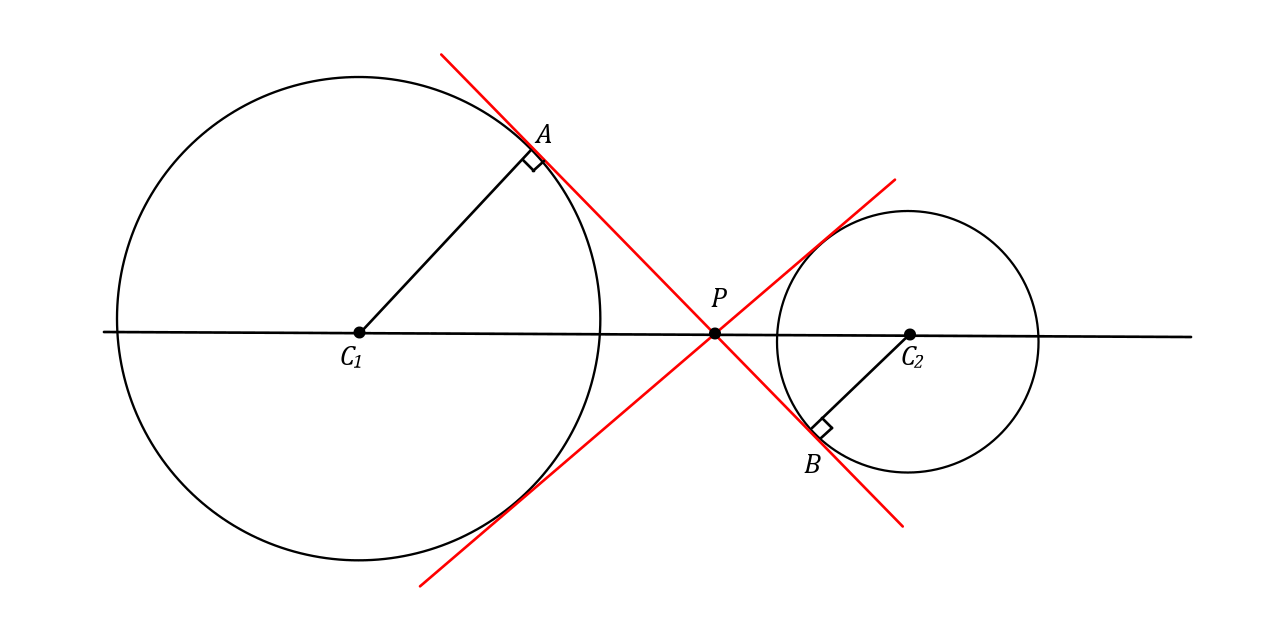
Suppose one of these transverse tangents touches:
- Circle at point
- Circle at point
Then in triangles and , note that because both are perpendicular to the same line . Therefore, the two triangles are similar.
By similarity:
Hence, point divides the segment internally in the ratio . Using the internal section formula, the coordinates of are given by:
Once the coordinates of are known, we proceed to find the equations of the transverse tangents using the same technique as before.
Let the slope of one of the tangents be . Then its equation is:
This line is tangent to both circles. So we apply the condition of tangency for any one circle—say, —to this line. Imposing the tangency condition yields a quadratic equation in , whose roots are the slopes of the two transverse tangents. These slopes, together with point , give the complete equations of both transverse tangents.
Again, we are interested in two more things: angles between tangents and their lengths.
Again assume that the angle between the two transverse tangents is . By symmetry, we can see that angle .
Do some construction: extend to a point . Draw a line parallel to the tangent . It can be easily seen that quadrilateral is a rectangle.
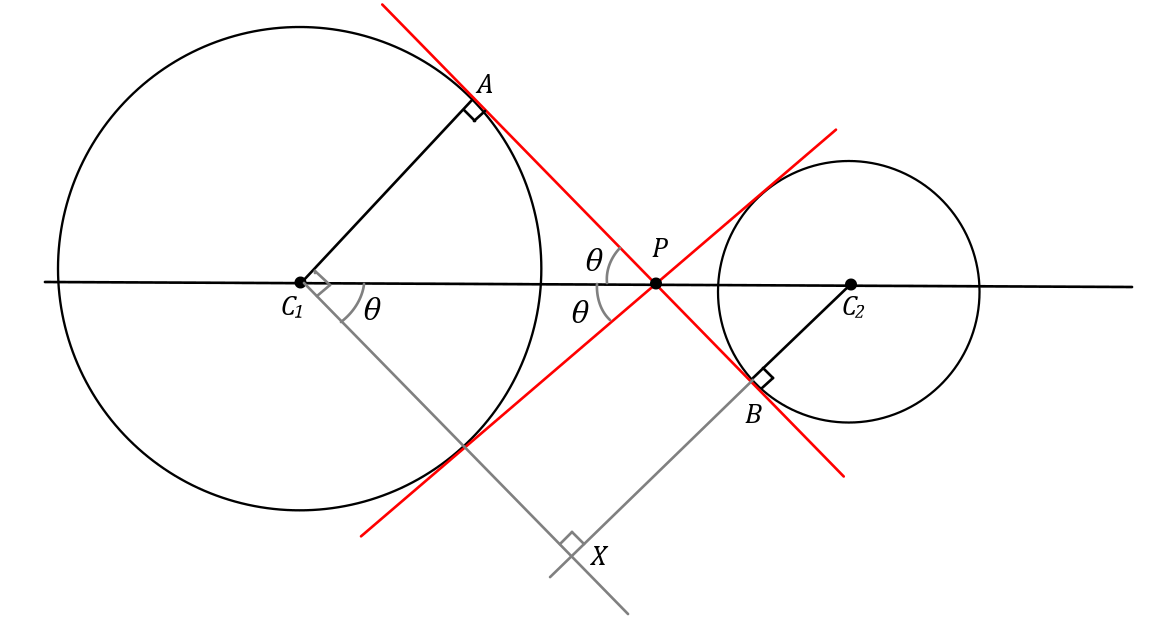
Now, since and is a transversal, angle .
Triangle is a right-angled triangle at . We can observe that:
- Therefore,
- Let
Thus, in triangle :
Also, by the Pythagorean Theorem, the length of the tangent segment is:
Limiting Cases§
When two circles are touching externally, imagine bringing them closer while maintaining tangency. As the distance between their centres decreases, the two transverse tangents become increasingly inclined toward each other. In the limiting case, when the circles just touch externally, the two transverse tangents merge into a single common tangent at the point of contact.
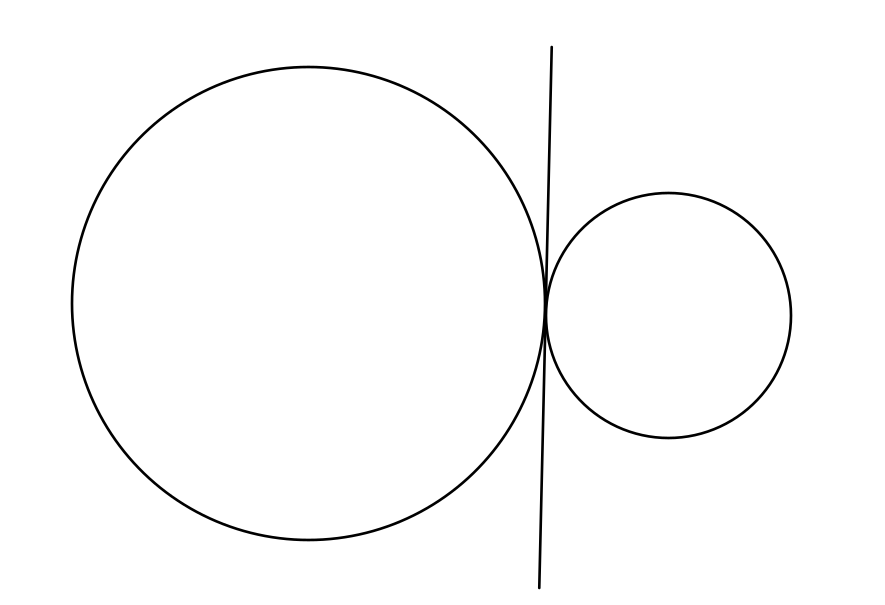
We already know that the equation of this common tangent is:
Now consider the opposite configuration. Suppose two circles intersect at two distinct points. As one circle moves further into the other, the direct tangents become more and more inclined. In the limiting case, when the circles touch internally, the two direct tangents also merge into a single tangent at the point of internal contact.
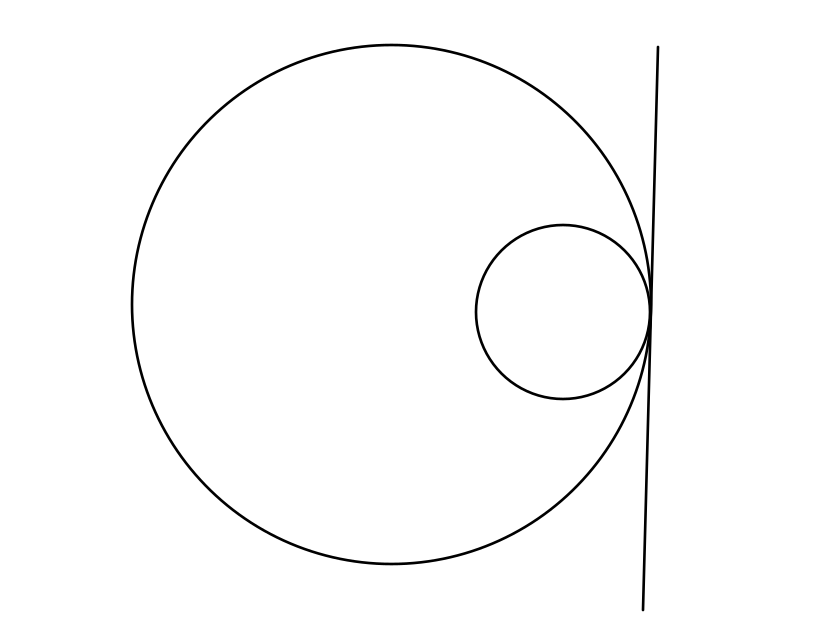
Again, the equation of this common internal tangent is:
Thus, in both cases—whether the circles touch externally or internally—the two distinct tangents (transverse or direct) merge into a single line in the limiting case, and the equation of that line is always:
Mark this section complete when you have worked through its proofs.