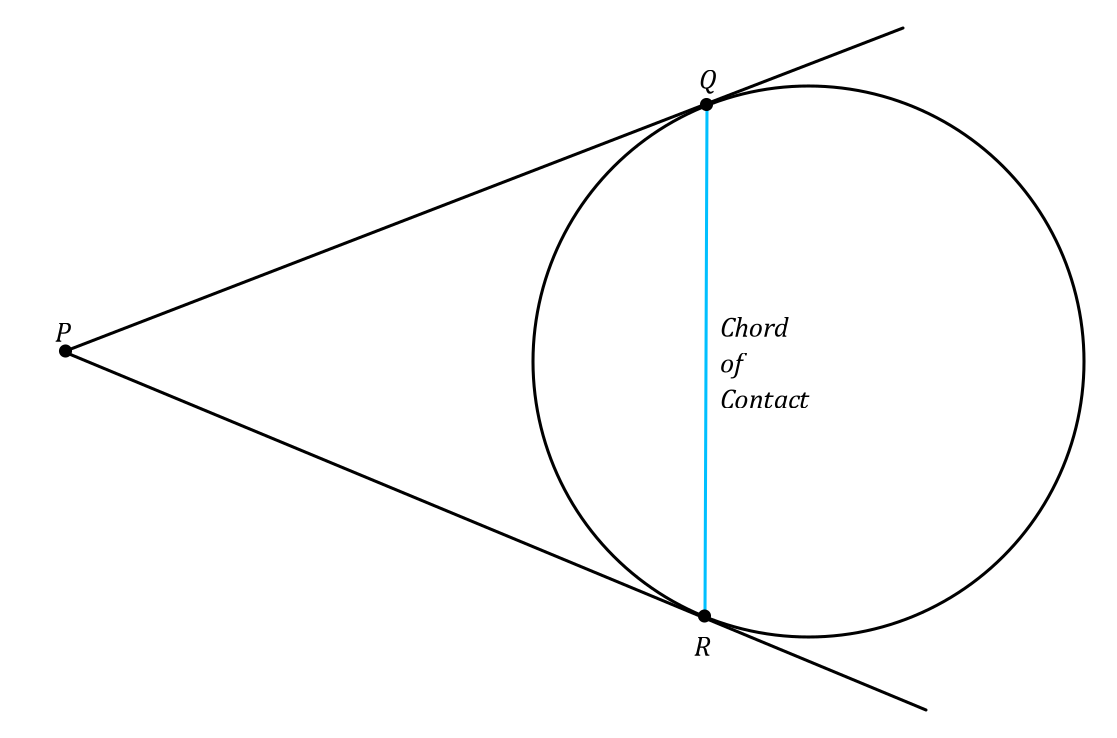
Suppose there is a point P(x1,y1) located outside a given circle. From geometry, it is well known that exactly two tangents can be drawn from such a point to the circle. Let these tangents touch the circle at points Q and R. These points of contact lie on the circle, and the lines PQ and PR are equal in length and meet at P, forming an angle between them. The line joining the points of contact, namely the segment QR, is called the chord of contact.
We are interested in many things here like length of these tangents, equation of these tangents, angle between these tangents, equation of chord of contact and many other things which arises out of this geommetry.
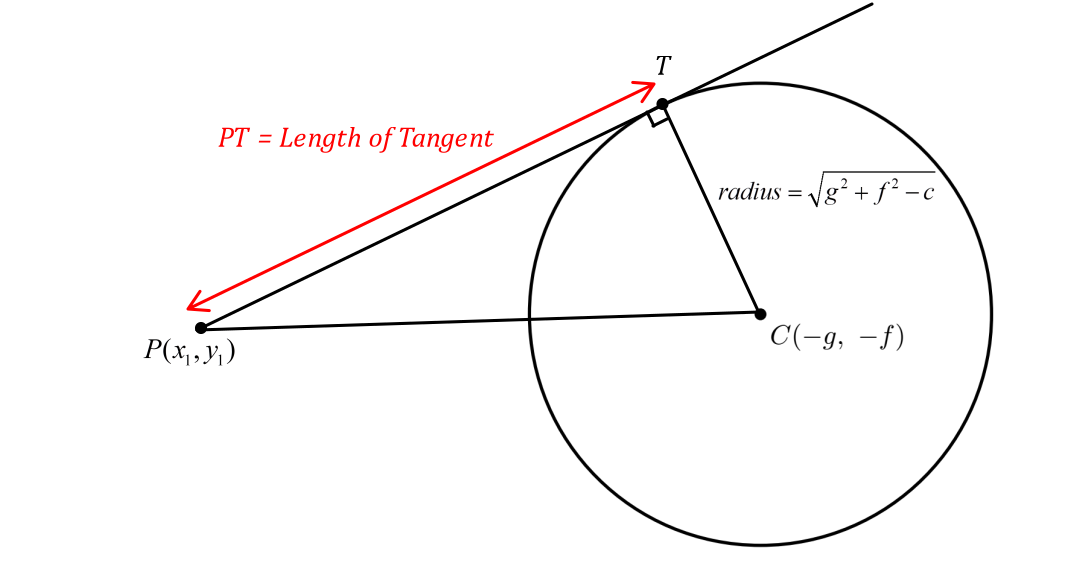
Let P(x1,y1) be a point located outside the circle
S:x2+y2+2gx+2fy+c=0.
Let C=(−g,−f) be the center of the circle, and let PT be a tangent drawn from point P to the circle, touching the circle at point T. Join the points P and C, forming triangle △PCT.
Since PT is a tangent to the circle and CT is the radius, the triangle PCT is a right-angled triangle at T. Thus, by the Pythagorean Theorem:
This expression is exactly the value obtained when we substitute the point (x1,y1) into the equation of the circle S, and evaluate its left-hand side:
S1=x12+y12+2gx1+2fy1+c.
We define this as S1, the value of the circle's expression at the point (x1,y1). Hence, the length of the tangent from point P to the circle is:
PT=S1,
provided S1>0, which is the condition for the point to lie outside the circle.
Equation of Pair of Tangents from a Point Outside a Circle§
Let P(x1,y1) be a point outside the circle. Let the circle be
x2+y2=a2,
which is centered at the origin and has radius a. We are interested in finding the equations of the tangents from P to the circle. Although geometry tells us there should be two such tangents when the point lies outside the circle, we do not assume this here. Instead, we let the algebra guide us.
Suppose the tangent from P has slope m. At this stage, we do not assume whether there are one or two such lines. The general equation of a line with slope m passing through point (x1,y1) is:
y−y1=m(x−x1)⟹y=mx+(y1−mx1).
This is a candidate tangent to the circle. To ensure that it is indeed a tangent, it must satisfy the condition of tangency with the circle. We apply the known condition of tangency for a line y=mx+c to the circle x2+y2=a2, which is:
c2=a2(1+m2).
Here, c=y1−mx1, so:
(y1−mx1)2=a2(1+m2).
Expanding both sides:
y12−2mx1y1+m2x12=a2+a2m2.
Group terms:
m2(x12−a2)−2x1y1m+(y12−a2)=0.
Thus, we arrive at a quadratic equation in m
(x12−a2)m2−2x1y1m+(y12−a2)=0.(1)
This equation determines the possible slopes m1 and m2 of the tangents from P(x1,y1) to the circle. Whether one or two real tangents exist depends on the discriminantΔ of this quadratic.
Now, since Δ>0 for two distinct real roots (i.e., two distinct tangents), this implies:
x12+y12−a2>0⟹x12+y12>a2,
which means that the point P lies outside the circle. This is exactly what geometry predicts. Hence, algebra agrees with the geometrical result.
Thus, the equation (1) yields the two slopes m1 and m2 of the tangents from point P to the circle. Once these slopes are known, the corresponding tangent lines can be written in the form:
Suppose from an external point P(x1,y1), two tangents are drawn to a circle, touching it at points Q and R. Then the chord QR, which joins the points of contact on the circle, is called the chord of contact of the point P with respect to the circle.
Let the equation of the circle be
x2+y2=a2,
with center at the origin and radius a. Our aim is to find the equation of the chord of contact QR.
A natural idea might be to:
Find the two tangents from P(x1,y1) to the circle.
Determine their respective points of contact Q(x2,y2) and R(x3,y3).
Use these two points to find the equation of the line joining them.
However, this approach is long and computationally intensive. Instead, we proceed more cleverly.
Let Q(x2,y2) and R(x3,y3) be the points where the tangents from P touch the circle. The tangent to the circle at any point (x,y) on the circle x2+y2=a2 is:
xx0+yy0=a2,
where (x0,y0) is the point of contact.
So, the tangent at Q(x2,y2) is:
xx2+yy2=a2(1)
and the tangent at R(x3,y3) is:
xx3+yy3=a2.(2)
Since both tangents pass through the external point P(x1,y1), point P must satisfy both (1) and (2). Hence:
x1x2+y1y2=a2(3)x1x3+y1y3=a2.(4)
Now consider the equation:
xx1+yy1=a2.(5)
At first glance, this looks like the equation of the tangent to the circle at (x1,y1), but since (x1,y1) does not lie on the circle, this is not a tangent.
However, observe that when we substitute (x2,y2) and (x3,y3) into (5), both equations (3) and (4) imply that:
x2x1+y2y1=a2,x3x1+y3y1=a2.
So both Q and R lie on the line (5). Hence, equation (5) passes through both Q and R, and therefore represents the chord of contact.
Thus, the equation of the chord of contact from point P(x1,y1) to the circle x2+y2=a2 is:
xx1+yy1=a2.
This equation has the same form as that of the tangent to the circle, but is interpreted differently when (x1,y1) lies outside the circle.
General Case:
For a circle of the form
x2+y2+2gx+2fy+c=0,
and an external point P(x1,y1), the equation of the chord of contact is:
xx1+yy1+g(x+x1)+f(y+y1)+c=0.
This is identical in form to the equation of tangent to the circle at (x1,y1), except that now (x1,y1) does not lie on the circle.
In short, the chord of contact from point P(x1,y1) to the circle S is denoted compactly by the equation:
T=0,
where T represents the tangent form evaluated at (x1,y1).
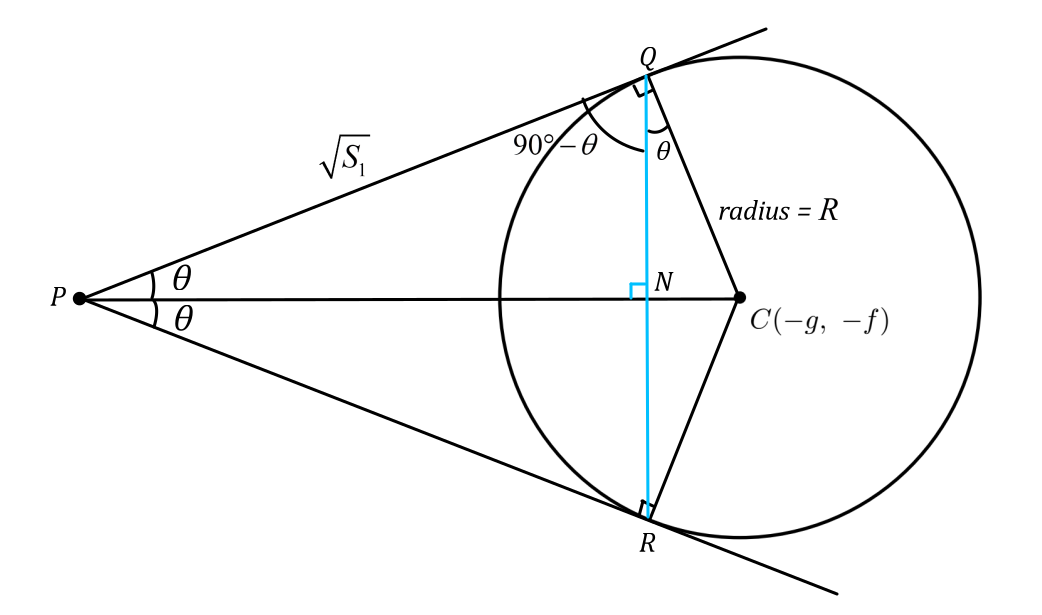
Let P(x1,y1) be a point outside a circle with center C and radius R. From P, draw two tangents PQ and PR to the circle, touching the circle at points Q and R, respectively. Let us now compute the angle between these two tangents.
To understand the configuration, join the center C to Q and R, and also join P to C. Draw chord QR and drop a perpendicular from C onto it, intersecting at point N. This construction is standard and arises frequently in probelms.
By symmetry and basic geometric reasoning, triangles △PQC and △PRC are congruent, since both share side PC, and the segments CQ=CR=R, and PQ=PR as tangents from the same external point. It follows that the angles ∠CPQ and ∠CPR are equal. Let each of these angles be θ. Then the total angle between the tangents is ∠QPR=2θ.
Now consider triangle △PQC. It is a right-angled triangle at Q, since the radius CQ is perpendicular to the tangent PQ. We know:
CQ=R, the radius.
PQ=length of the tangent=S1, where
S1=x12+y12+2gx1+2fy1+c,
when the general form of the circle is x2+y2+2gx+2fy+c=0. For the standard circle x2+y2=R2, we have:
This gives an exact expression for the angle between the pair of tangents drawn from a point P(x1,y1) to a circle of radius R, using only coordinate geometry and trigonometric identities.
Length of Chord of Contact
Using the same geometric setup as in the previous section, let P(x1,y1) be a point outside a circle centered at C with radius R. From P, two tangents PQ and PR are drawn to the circle, touching it at points Q and R, respectively. The line segment QR is the chord of contact.
We now aim to compute the length of this chord.
From the geometry, it can be seen that point N bisects QR, due to symmetry. Triangle △CNQ is a right-angled triangle at N, with:
∠NQC=θ, the angle between the radius CQ and the tangent PQ,
QC=R, the radius of the circle.
From elementary trigonometry:
QN=QC⋅cosθ=Rcosθ.
Since QR=2⋅QN, the length of the chord of contact is:
QR=2Rcosθ.(1)
From the earlier calculation in the triangle △PQC, we had:
tanθ=S1R,
where S1 is the value of the circle’s left-hand side evaluated at point P(x1,y1). Then,
cosθ=1+tan2θ1=1+S1R21=R2+S1S1.
Substitute this into (1):
QR=2R⋅R2+S1S1=R2+S12RS1.
This gives the exact length of the chord of contact drawn from point P(x1,y1) to a circle of radius R.
Some Observations About the Geometry of Tangents from an External Point§
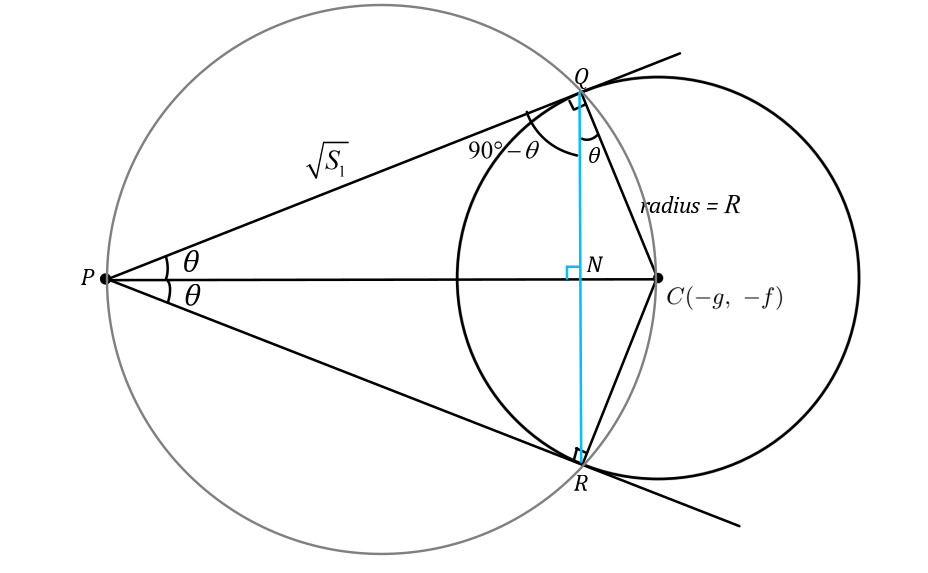
Let P be an external point from which two tangents PQ and PR are drawn to a circle with center C, and let Q and R be the respective points of contact. We have the following observations:
1. Cyclic Quadrilateral PQCR:
Note that both ∠PQC and ∠PRC are right angles since the radius of a circle is always perpendicular to the tangent at the point of contact. Therefore,
∠PQC+∠PRC=90∘+90∘=180∘.
This implies that quadrilateral PQCR is cyclic. That is, its four vertices lie on a common circle—there exists a unique circumcircle passing through all four points.
2. P and C are Diametrically Opposite:
Since both ∠PQC and ∠PRC are right angles, and they subtend the same arc QR, the line segment PC must be a diameter of the circumcircle of quadrilateral PQCR. Hence, points P and C are diametrically opposite on this new circle.
Let us now write the equation of this circumcircle.
3. Equation of the Circumcircle of PQCR:
If the points P and C are diametrically opposite on a circle, and the circle is centered at the midpoint of PC, then the circle can be written using the diameter form of a circle equation. If P=(x1,y1) and C=(−g,−f), then the equation of a circle with diameter PC is:
(x−x1)(x+g)+(y−y1)(y+f)=0.
This equation can also be interpreted as the circle that passes through the four points P,Q,C,R. In fact, the same circle is the circumcircle of all triangles formed by any three of the four points:
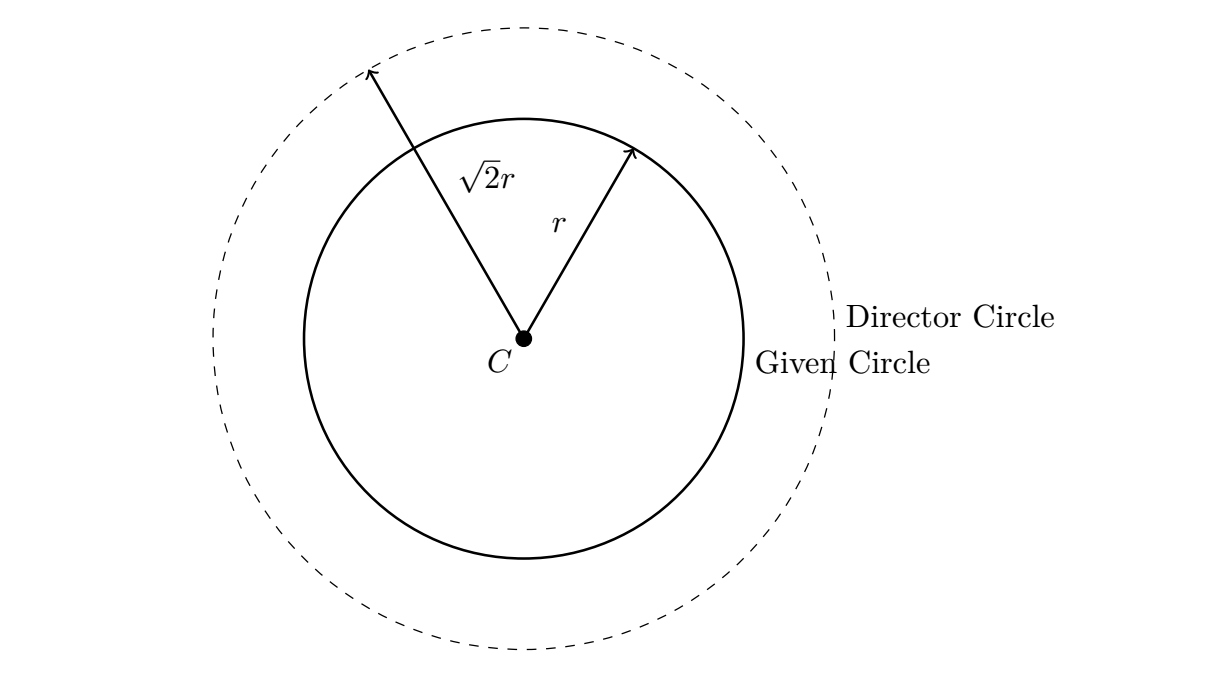
The director circle of a given circle is defined as the locus of a point from which two perpendicular tangents can be drawn to the given circle. That is, the angle between the pair of tangents from this point to the circle is 90∘.
Let the given circle have radius r and be centered at point C. Consider a point P outside the circle such that the two tangents drawn from P touch the circle at points Q and R, and these tangents are perpendicular. Then:
By definition, ∠QPR=90∘
Each tangent is perpendicular to the radius at the point of contact: ∠PQC=∠PRC=90∘
This implies that triangle △QCR is also right-angled at C, and CQ=CR=r
Hence, quadrilateral PQCR has all sides equal and all angles 90∘, so it is a square
Therefore, the point P lies on a circle of radius 2r, centered at C
Thus, the locus of point P is a circle with:
Same centre as the original circle
Radius 2r
This circle is called the director circle.
For example, consider the circle:
x2+y2=a2
The director circle has the same centre and radius (2)a and its equation is:
x2+y2=2a2
Section 7 of 12 · Circles
Mark this section complete when you have worked through its proofs.
Type any topic, theorem, or concept to jump directly to the section.