Equation of a Circle with given Centre and Radius§
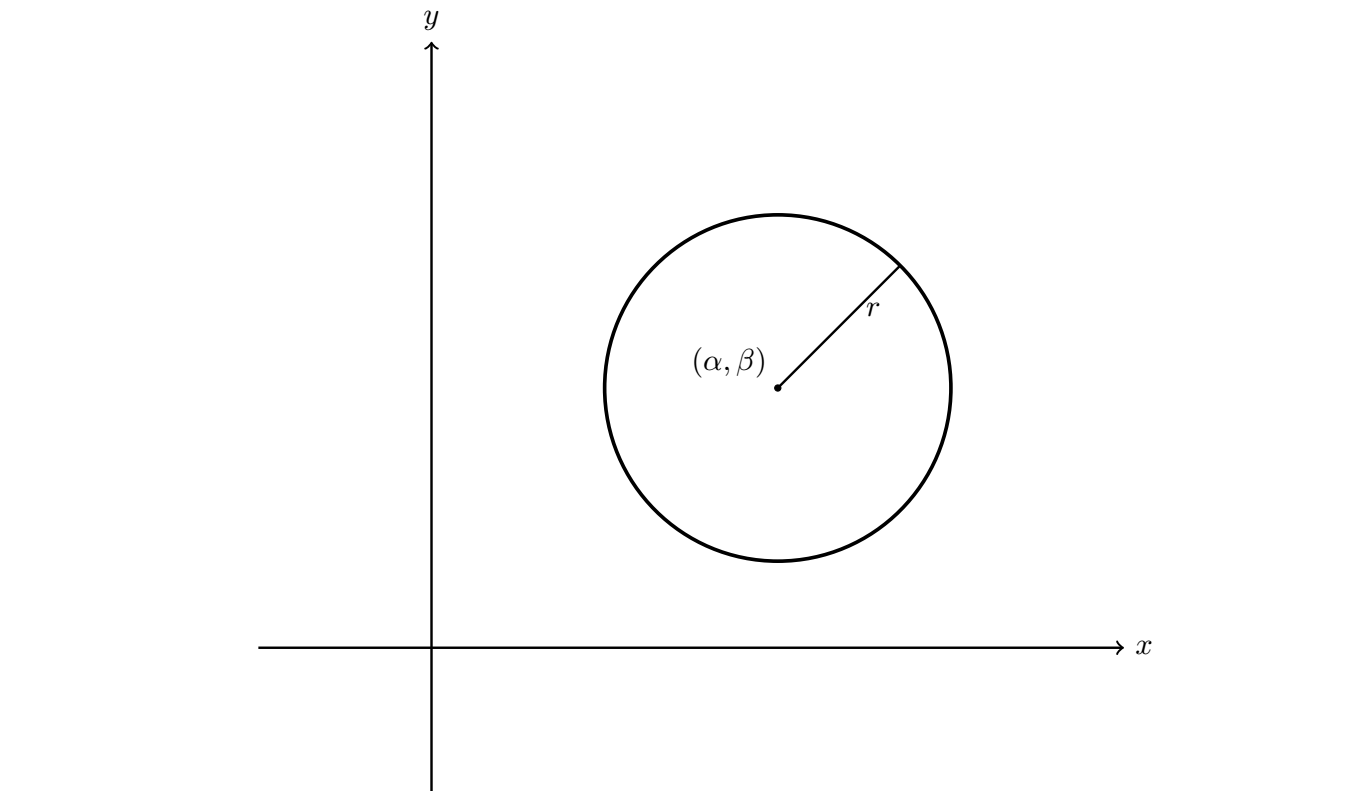
We begin by recalling the purpose of coordinate geometry—it expresses geometry algebraically, translating shapes into equations. Consider a circle lying in a plane. Let us introduce a Cartesian coordinate system in this plane.
Assume the circle has its center at point C and radius r. Let the coordinates of the center C be (α,β). Let P(x,y) be any point on the circle.
By the definition of a circle, every point P on the circle is at a constant distance r from the center C. That is,
CP=r
Using the distance formula between C(α,β) and P(x,y),
(x−α)2+(y−β)2=r
Squaring both sides,
(x−α)2+(y−β)2=r2
This is the required equation of a circle with center (α,β) and radius r. It encodes the entire geometry of the circle into a single algebraic expression.
For example: suppose the center of the circle is (2,−1) and the radius is 3. Then applying the general form
(x−α)2+(y−β)2=r2
with α=2, β=−1, and r=3, we get:
(x−2)2+(y+1)2=9
This is the required equation of the circle.
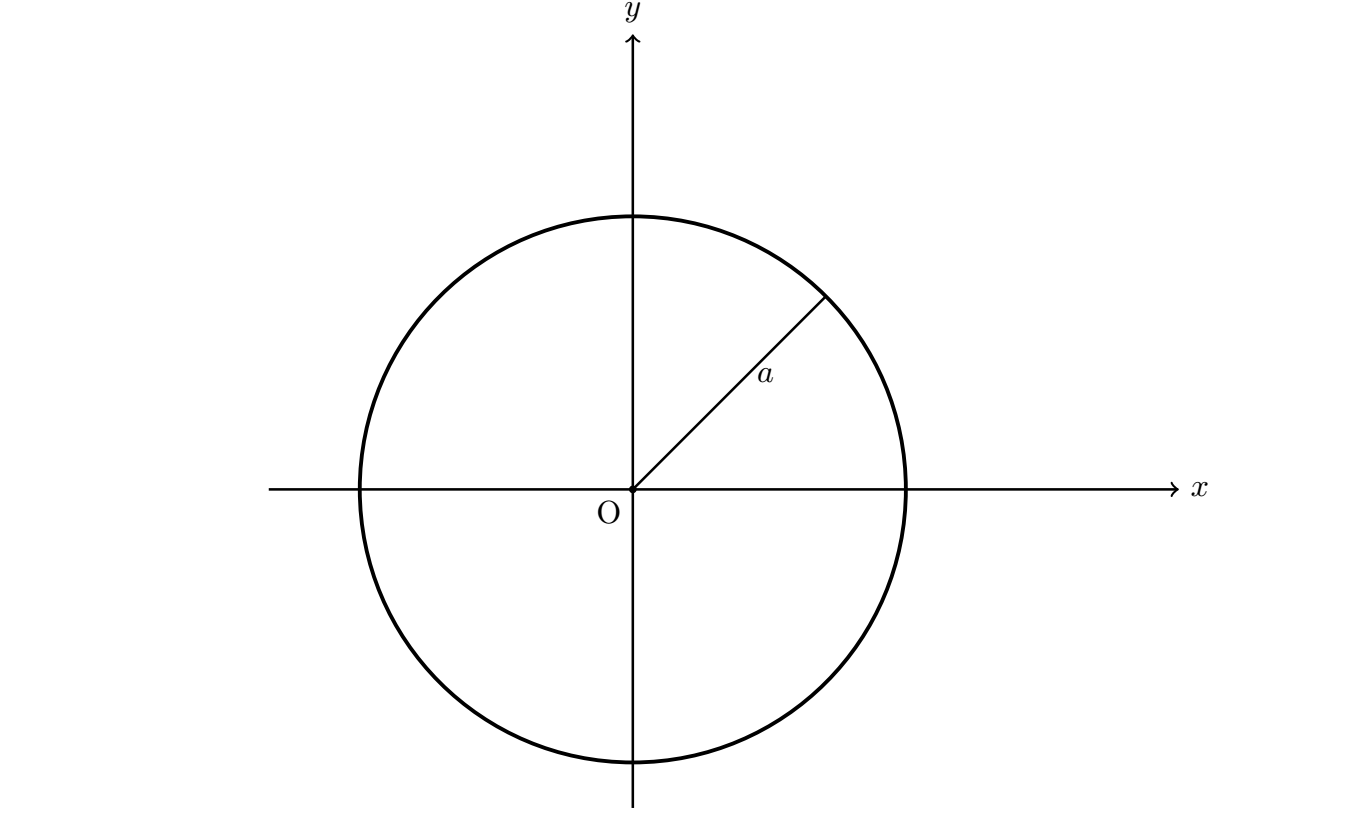
When the center of the circle is the origin, that is (0,0), and the radius is a, we substitute α=0, β=0, and r=a into the general form:
(x−α)2+(y−β)2=r2⟹(x−0)2+(y−0)2=a2⟹x2+y2=a2
This is the simplest and most symmetric form of the equation of a circle. It represents a circle centered at the origin with radius a.
Let us now work through some examples where the given geometric information helps us deduce α, β, and r, and then use these to write the equation of the circle.
Equation of a Circle When Two Diametrically Opposite Points Are Known§
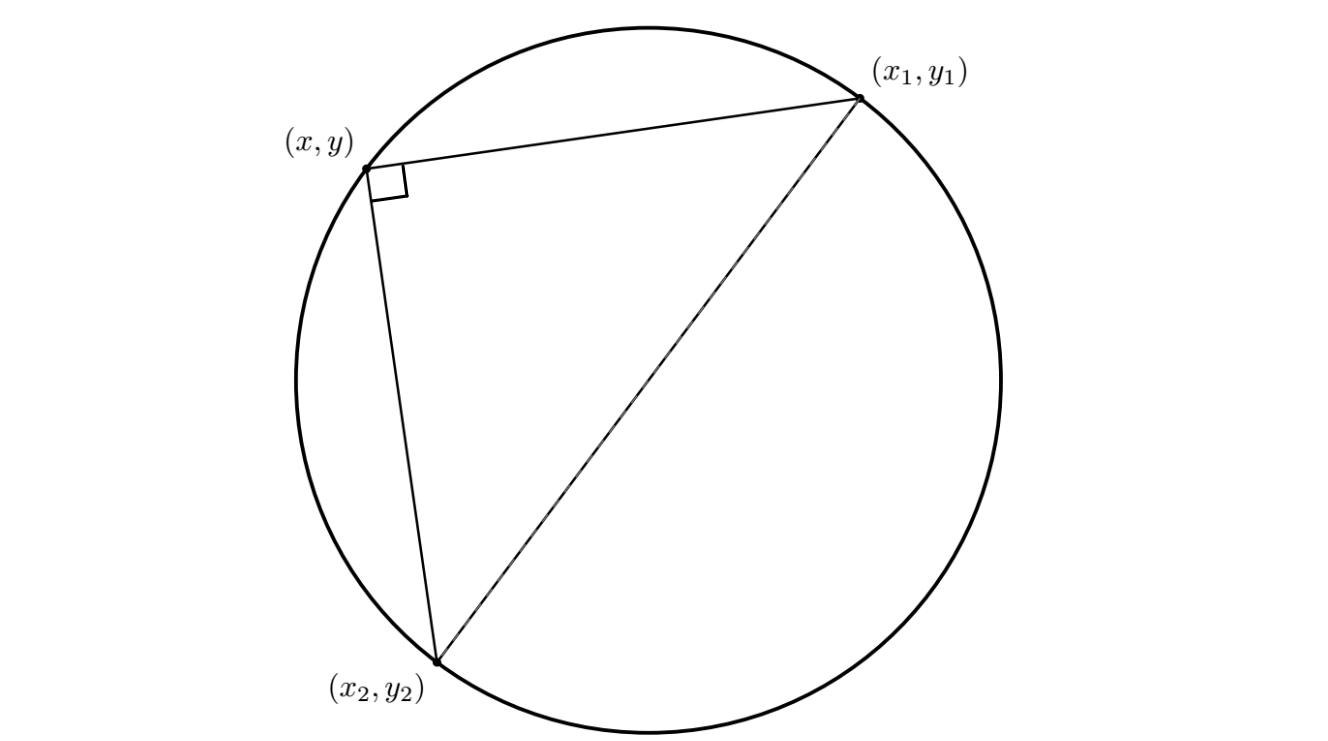
Let A(x1,y1) and B(x2,y2) be the endpoints of a diameter of a circle.
A naïve approach to find the equation is as follows:
Consider a circle with center (α,β) and radius r. Then its equation is:
(x−α)2+(y−β)2=r2
Expanding this:
x2−2αx+α2+y2−2βy+β2=r2⟹x2+y2−2αx−2βy+(α2+β2−r2)=0
This form involves:
Quadratic terms x2+y2,
Linear terms x and y,
A constant term.
So we claim that any equation of a circle can be written in the form:
x2+y2+2gx+2fy+c=0
The choice of coefficients as 2g and 2f rather than g and f is intentional, as it simplifies the formulas that follow—especially for the center and radius.
But here is an important caveat:
Not every equation of the form
x2+y2+2gx+2fy+c=0
represents a circle.
Let us determine the condition under which it does.
We rewrite the equation by completing the square:
(x2+2gx)+(y2+2fy)=−c
Add g2+f2 to both sides to complete the squares on the left:
we conclude that this equation represents a circle with
Center:(−g,−f)
Radius:r=g2+f2−c
But the square root is defined only ifg2+f2−c≥0.
Thus, the equation
x2+y2+2gx+2fy+c=0
represents a circle if and only if:
g2+f2−c≥0
and equality holds if and only if the circle reduces to a point. If g2+f2−c<0, the equation has no real solution and represents no real circle.
The case when
g2+f2−c=0
is rather peculiar. It means the radius of the circle is zero, so the equation becomes:
(x+g)2+(y+f)2=0
Now, since the sum of two squares is zero only when both squares are zero, this equation is satisfied by exactly one point:
x=−g,y=−f
Thus, the only solution to the equation is the single point (−g,−f), which is also the center of the circle. This degenerate case is called a point circle.
It is a limiting case of a circle where the entire geometry collapses to a single point, but algebraically it still satisfies the form of the general equation:
Consider a circle with center at (α,β) and radius r. Its equation is:
(x−α)2+(y−β)2=r2
We want to extract a parametric form of this equation—that is, a representation of all points on the circle in terms of a single real parameter. To do this, divide both sides of the equation by r2:
(rx−α)2+(ry−β)2=1
This resembles the identity:
cos2θ+sin2θ=1
Thus, define a real parameter θ such that
rx−α=cosθ,ry−β=sinθ
Solving for x and y, we obtain:
x=α+rcosθ,y=β+rsinθ
This is the required parametric form of the circle. Every point (x,y) lying on the circle can be expressed in this way for some θ∈R.
To interpret this parametrization geometrically, draw a horizontal line through the center of the circle, and let P be a point on the circle. Drop a perpendicular from P to this horizontal line, with foot at N. Let C denote the center of the circle.
The angle θ is the angle ∠PCN that the radius CP makes with the positive direction of the horizontal line (i.e., the x-axis). Then:
CN=rcosθ,PN=rsinθ
But in terms of coordinates, CN=x−α, and PN=y−β. Hence:
x−α=rcosθ,y−β=rsinθ
which confirms:
(x,y)=(α+rcosθ,β+rsinθ)
Therefore, every point on the circle can be expressed in this form for some real θ.
For example, consider the circle with center at the origin and radius a. Its equation is:
x2+y2=a2
Here, α=0, β=0, and r=a. Substituting into the parametric form, we obtain:
x=acosθ,y=asinθ
Thus, the point (x,y) lies on the circle if and only if it can be written as (acosθ,asinθ) for some θ∈R.
This parametrization traces the circle as θ varies over [0,2π], and repeats periodically as θ increases further.
In this form, the variable θ has a clear geometric interpretation: it is the angle between the positive x-axis and the radius vector from the origin to the point (x,y), measured in the counter-clockwise direction.
This parametric form is particularly useful in situations where we wish to introduce trigonometry into algebraic problems, especially when it makes conceptual and computational sense to do so. A common setting is in maximization and minimization problems involving points on a circle.
In such cases, trigonometric expressions are often easier to differentiate or manipulate than Cartesian expressions involving both x and y. Moreover, the parametric form transforms a problem with two variables—the abscissa and the ordinate—into a problem with only one variable, namely θ. This reduction in the number of unknowns simplifies both the reasoning and the calculation.
The advantage becomes clearer when we examine the following examples.
Section 2 of 12 · Circles
Mark this section complete when you have worked through its proofs.
Type any topic, theorem, or concept to jump directly to the section.