
Introduction
Definition§
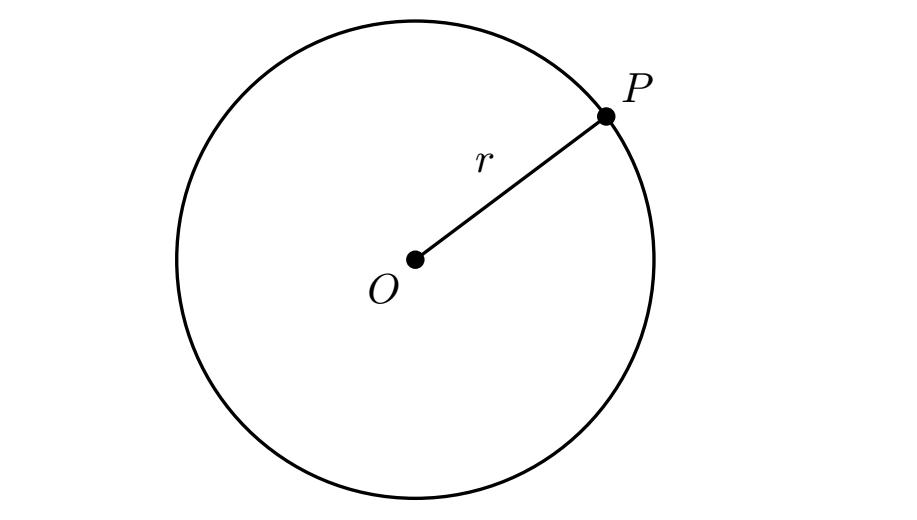
A circle is the locus of a point moving in a plane such that its distance from a fixed point remains constant.
Let the fixed point be (called the centre) and the constant distance be (called the radius). Then the set of all points such that
forms a circle.
Geometrical Properties of a Circle§
We will start by recalling some basic geometrical properties of a circle that you have already studied in earlier classes. Even though this chapter is mainly about coordinate geometry, these simple facts from geometry will be very helpful while solving problems.
For example, you may remember that the radius is always perpendicular to the tangent at the point of contact, or that the angle in a semicircle is always a right angle. Also, equal chords of a circle are equidistant from the centre and they subtend equal angles at the centre. These are simple ideas, but they make many coordinate geometry problems easier to solve.
So, before we go into equations and formulas, let us first revise these useful geometrical facts.
Theorems on Chord§
A chord of a circle is a line segment whose both endpoints lie on the circle.
Let and be two distinct points on a circle. Then the line segment is called a chord. If the chord passes through the centre of the circle, it becomes the diameter, which is the longest possible chord.
We now recall some fundamental theorems related to chords in a circle. These theorems are geometrical in nature but are very useful when solving coordinate geometry problems involving circles.
Theorem 1. Equal chords of a circle subtend equal angles at the centre.
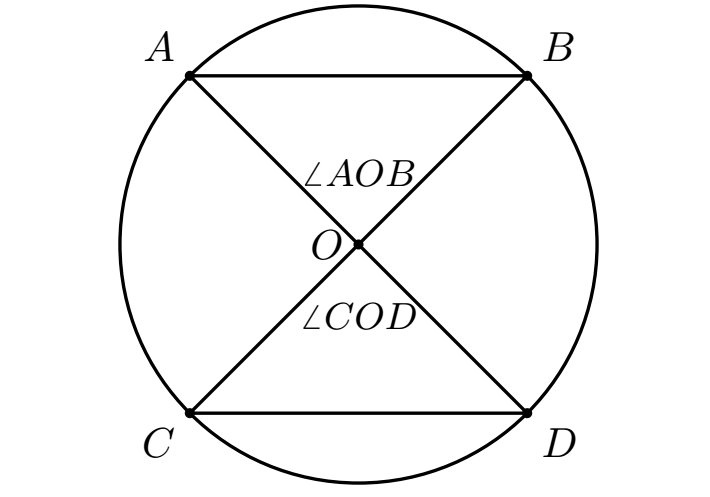
Let and be two chords of a circle such that . Then the angles subtended at the centre , namely and , are equal. That is,
The converse is also true: if two chords subtend equal angles at the centre, then the chords are equal in length.
Theorem 2. Equal chords are equidistant from the centre.
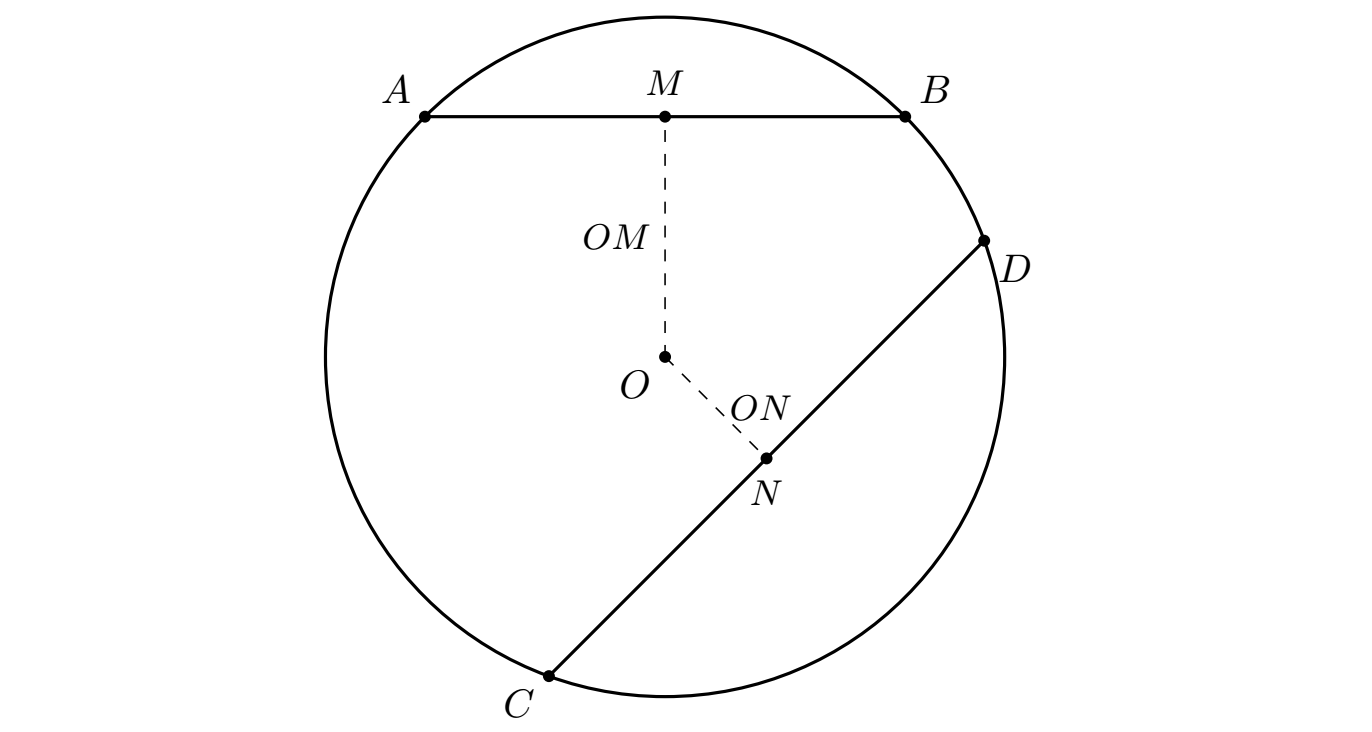
Let and be two chords such that . Let the perpendiculars from the centre to and meet the chords at points and respectively. Then,
Again, the converse is also true:
Here, the distance from the centre to a chord means the length of the perpendicular drawn from the centre to the chord.
Theorem 3. The perpendicular from the centre of a circle to a chord bisects the chord.
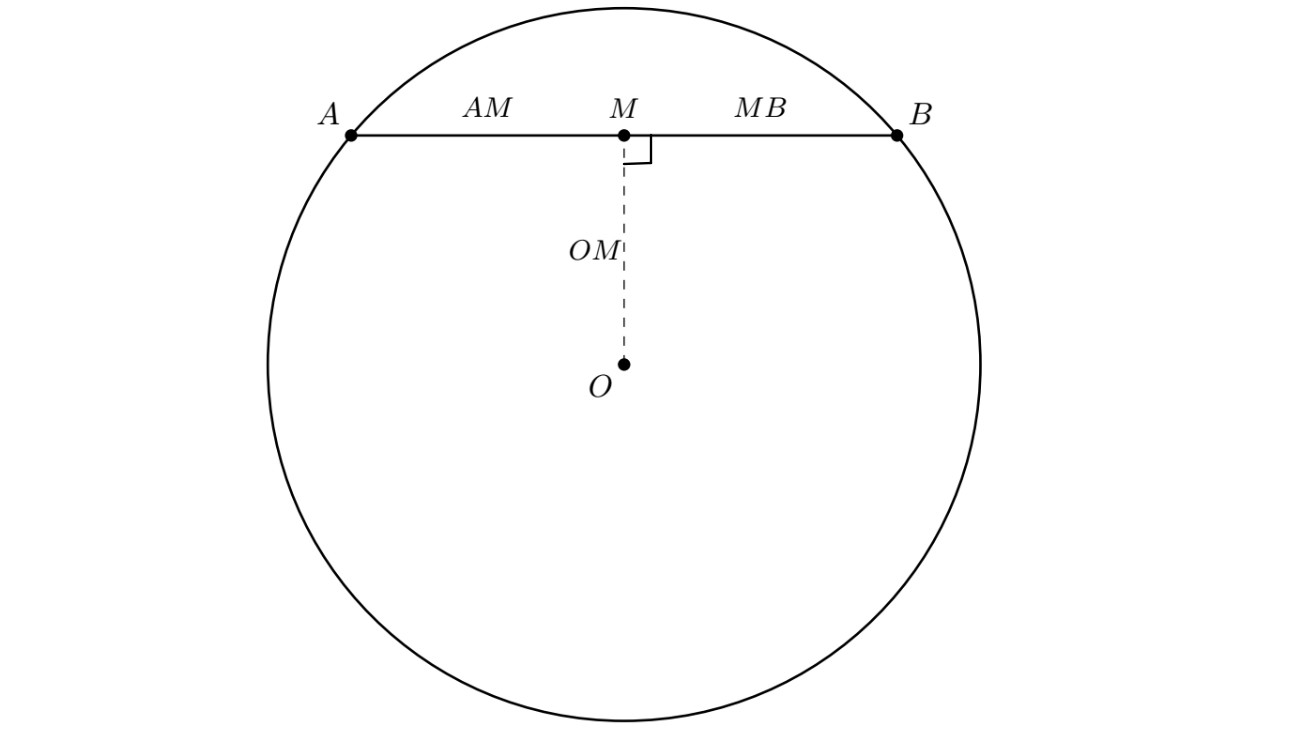
Let be any chord of a circle and let be the centre. Drop a perpendicular from the centre to the chord. Then,
Converse: If a line from the centre bisects a chord, then it is perpendicular to the chord.
Theorem 4. A chord which is not a diameter does not pass through the centre, and is always shorter than the diameter.
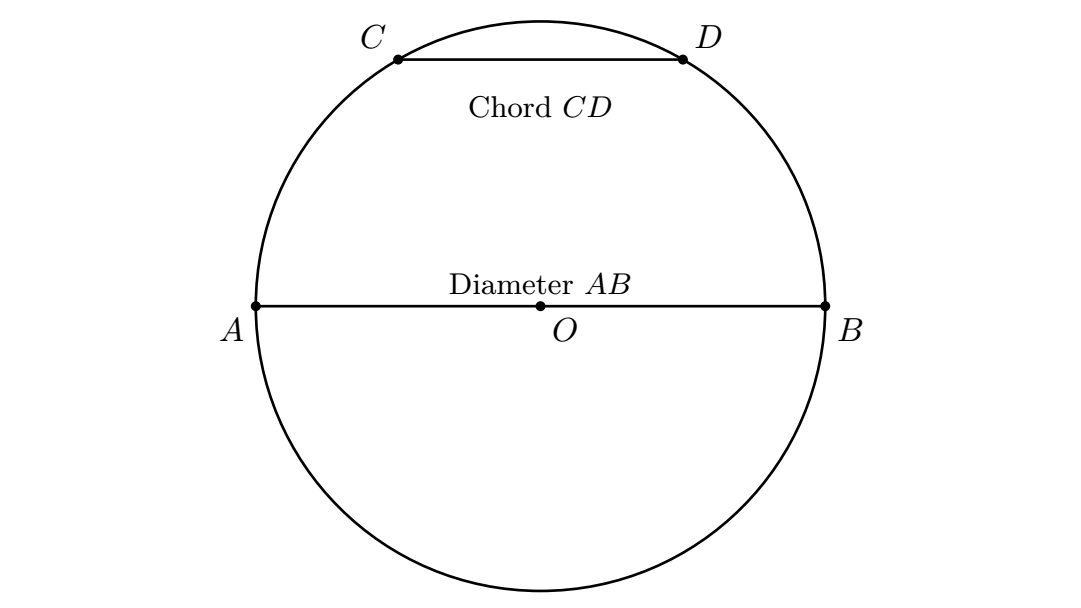
That is, the diameter is the longest chord possible in any circle.
Let be any chord, and be the diameter. Then:
and in that case, must pass through the centre, i.e., it is itself a diameter.
We now state and explain some important theorems on arcs of a circle. These results, though geometrical, are frequently used in problems involving angles and segments in both synthetic and coordinate geometry.
Theorems on Arcs and Angles§
An arc of a circle is a continuous portion of the circle between two distinct points. If and are two points on a circle, the arc joining them is denoted by .
There are two arcs between and :
– the minor arc , which is shorter, and
– the major arc , which is longer.
If is a diameter, the two arcs are equal and called semicircles.
Theorem 1. Equal arcs of a circle subtend equal angles at the centre.
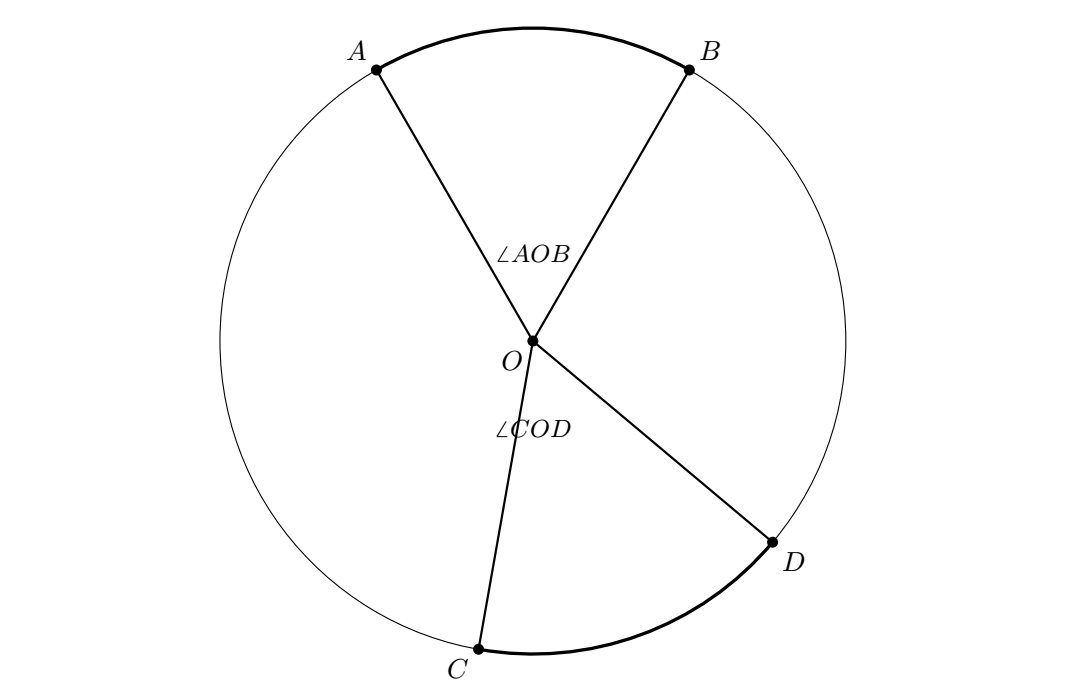
Let and be two equal arcs of a circle with centre . Then they subtend equal angles at the centre:
Converse: If two arcs subtend equal angles at the centre, then they are equal:
Theorem 2. Equal arcs of a circle are subtended by equal chords.
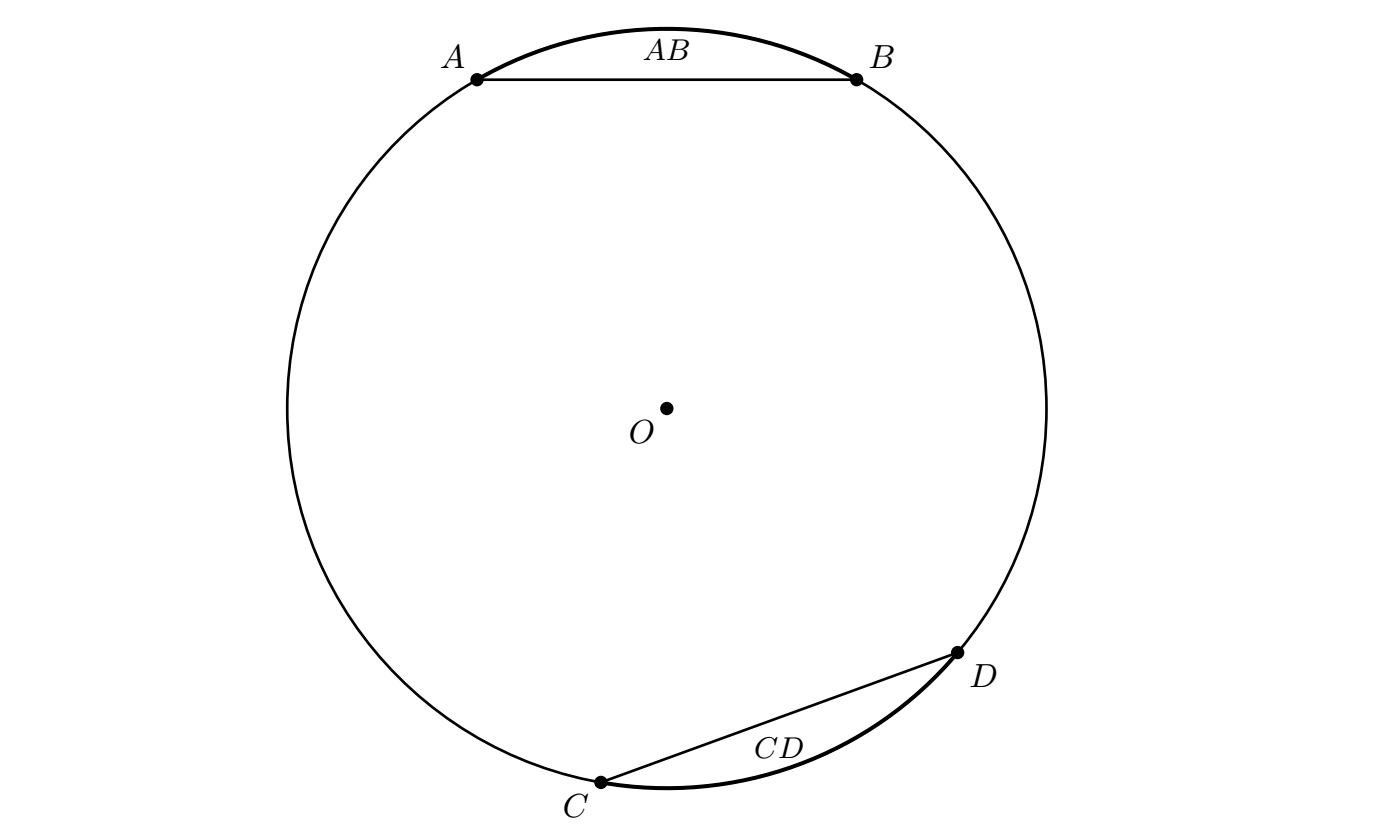
Let and be two equal arcs of a circle. Then their corresponding chords are equal:
Converse:
Theorem 3. In equal circles, arcs subtended by equal angles at the centre are equal.
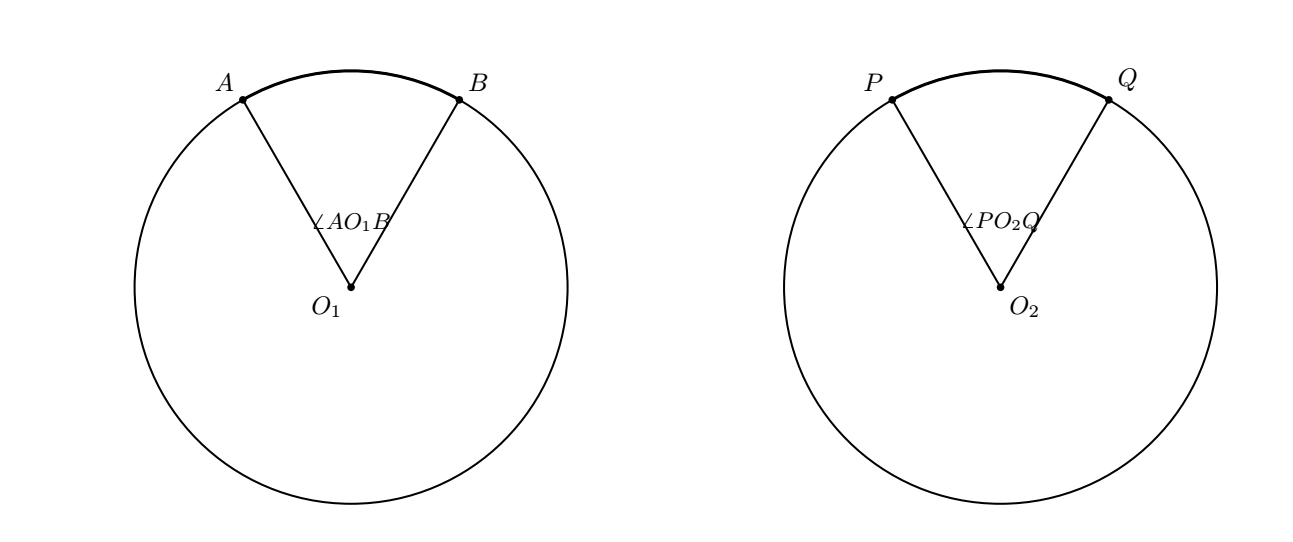
Let two circles have equal radii, and let and be equal angles subtended at the centres of the two circles. Then the corresponding arcs are equal:
Theorem 4. The angle subtended by an arc at the centre is twice the angle subtended by it at any point on the opposite arc.
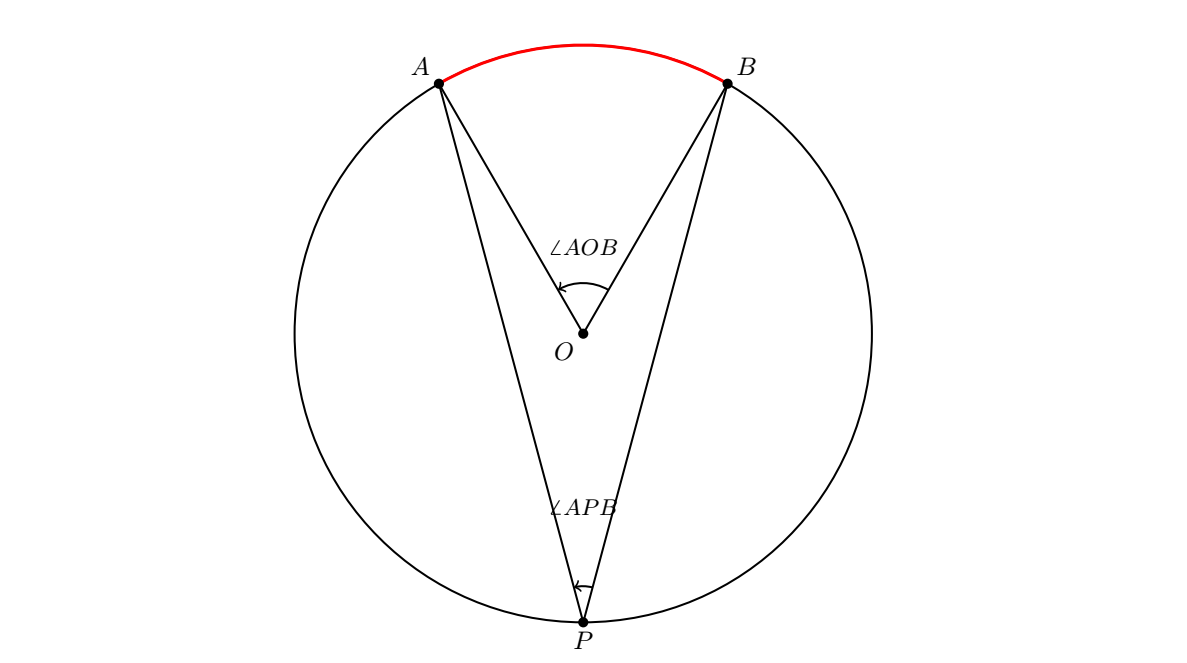
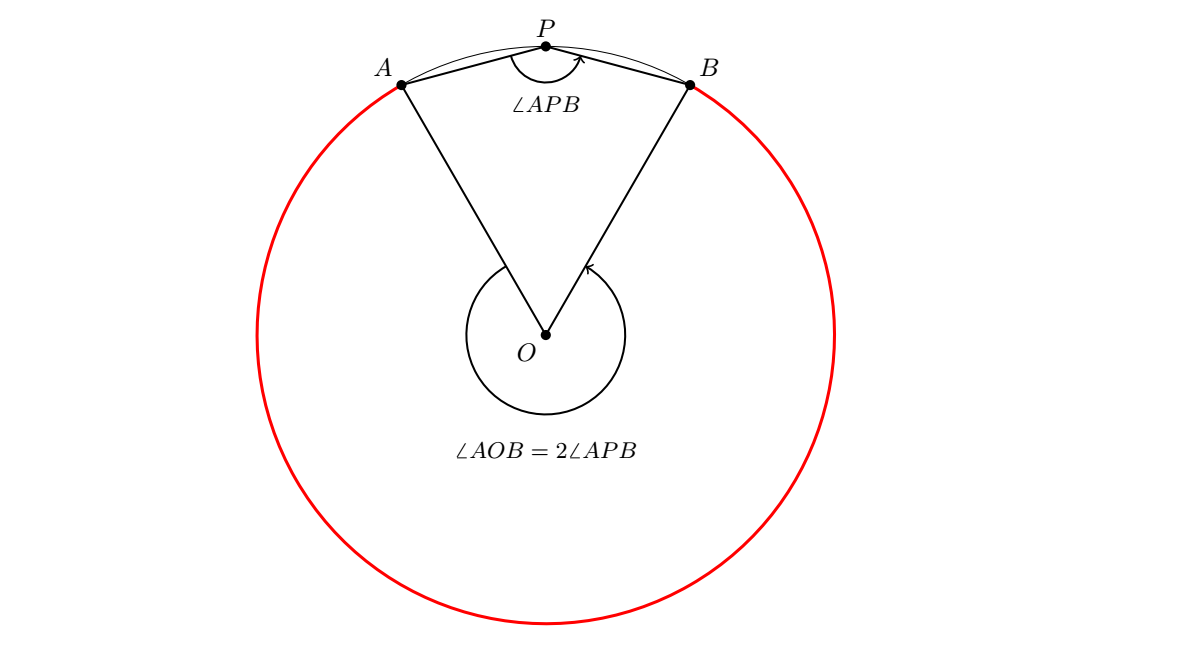
Let and be two points on a circle with centre , and let be a point on the circle lying on the arc opposite to . Then the angle subtended by arc at the centre is twice the angle it subtends at point :
This relation holds for all points on the circle lying on the arc opposite to .
Theorem 5. An arc of a circle subtends equal angles at all points on the circle lying on the opposite side of that arc.
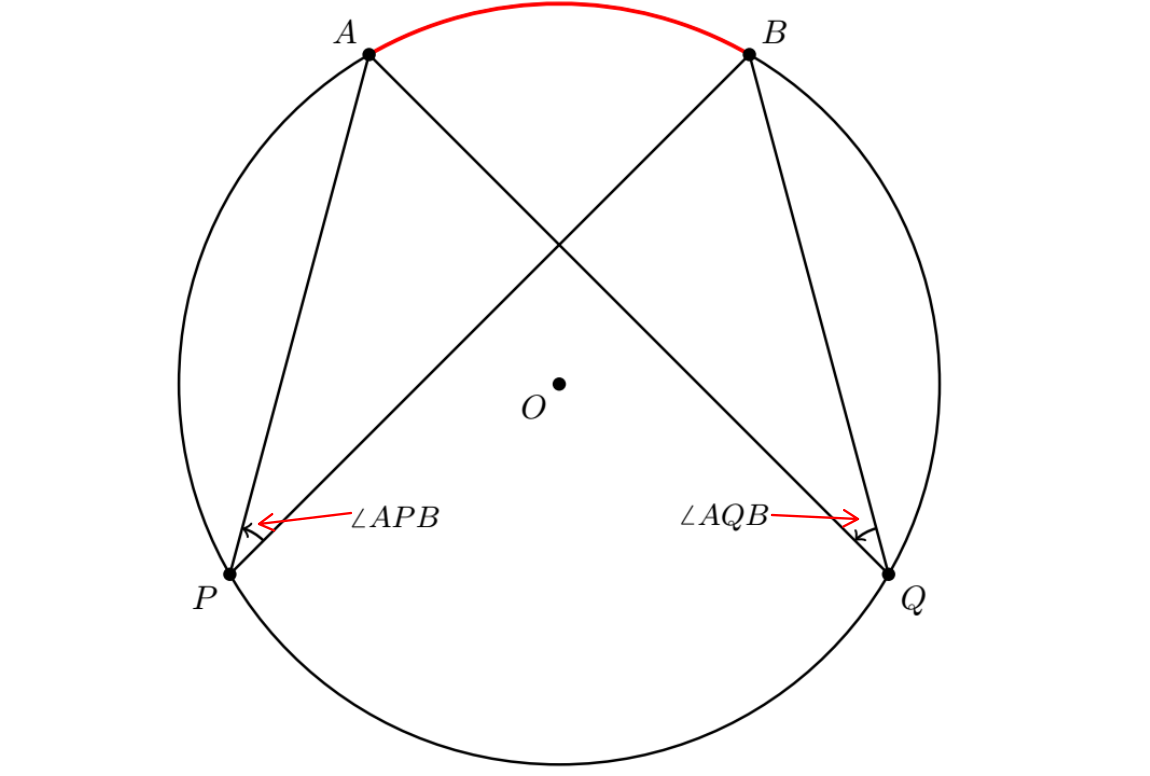
Let and be two points on a circle, and let and be any two points on the circle lying on the arc opposite to . Then:
Thus, the angle subtended by an arc at the circumference is constant as long as the point lies on the opposite arc.
Theorems on Tangent§
A tangent to a circle is a straight line that intersects the circle at exactly one point.
Let be a circle with centre , and let a line intersect the circle at a point . If is the only point of intersection, then is called a tangent to the circle at point , and is called the point of contact.
Theorem 1. The tangent at any point of a circle is perpendicular to the radius through the point of contact.
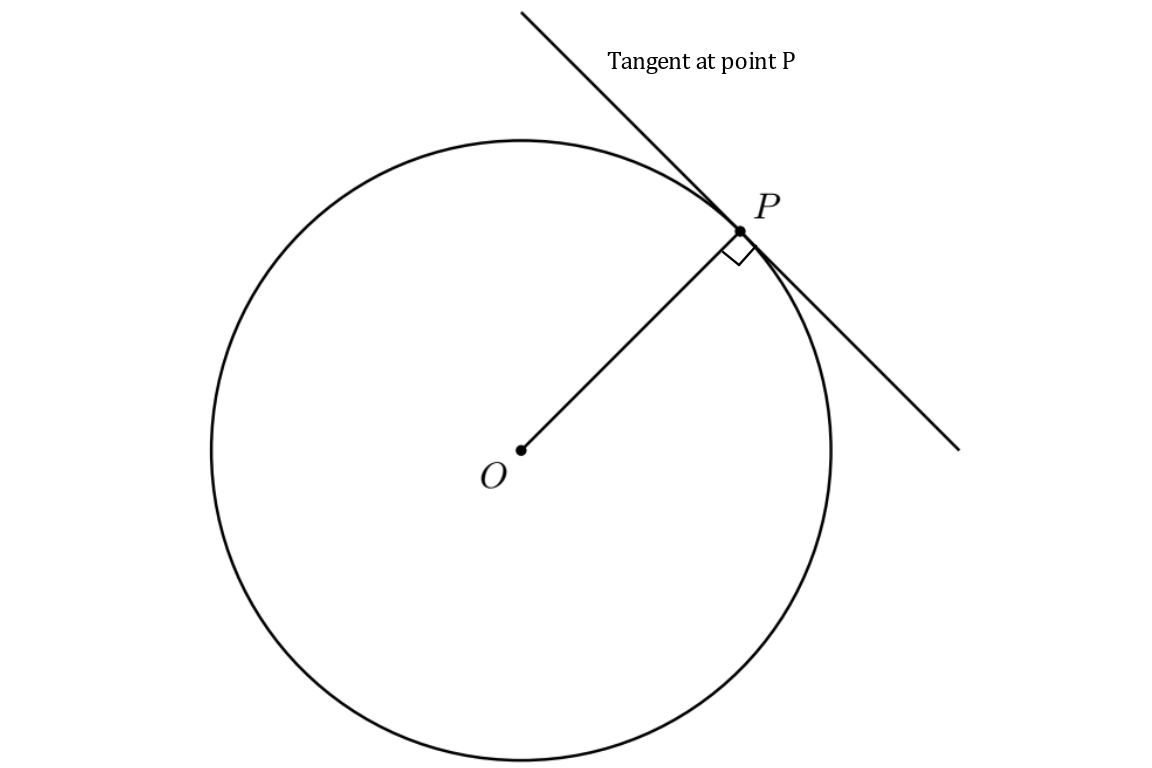
Let a tangent touch the circle at point , and let be the centre of the circle. Then:
That is, the radius is perpendicular to the tangent at the point of contact.
Theorem 2. The lengths of the two tangents drawn from an external point to a circle are equal.
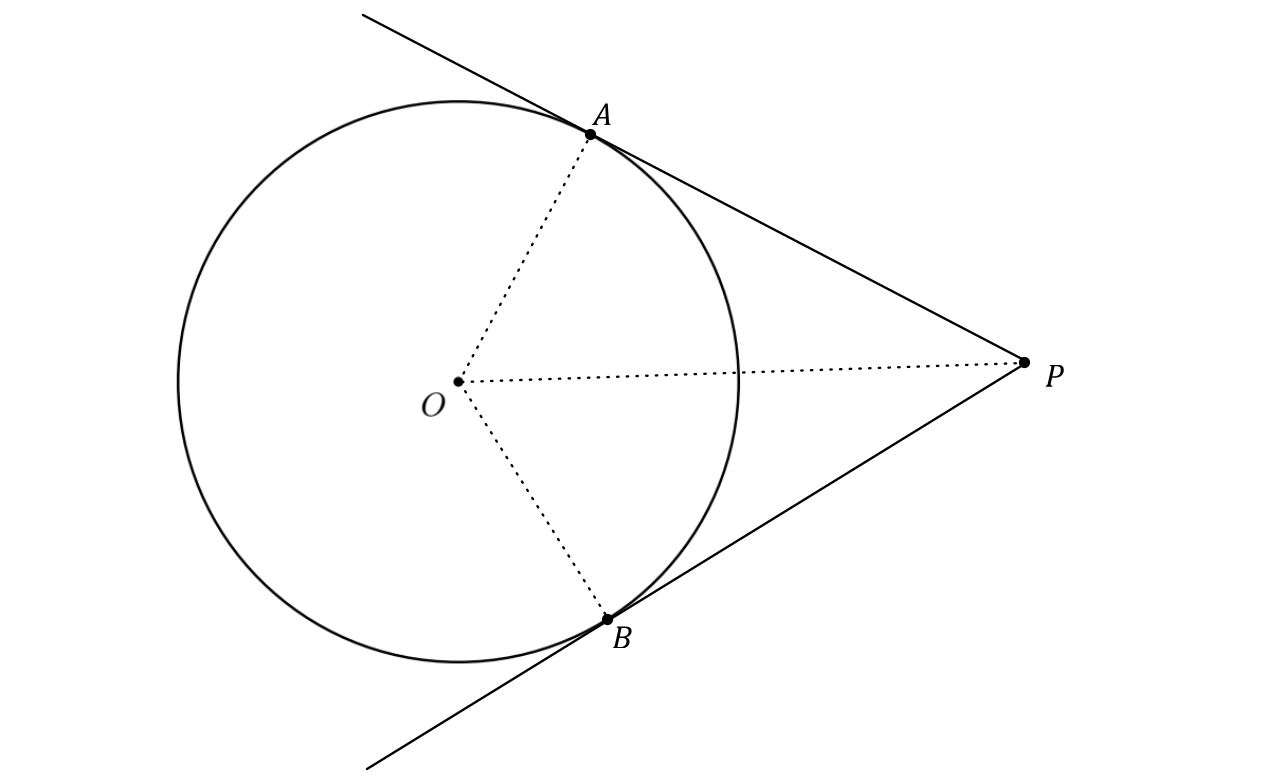
Let and be tangents drawn from an external point to a circle with centre , touching the circle at and . Then:
This result holds regardless of where the point lies, as long as it is outside the circle. The segment is then called the chord of contact, and the line is called the polar of with respect to the circle.
Theorem 3. The line joining an external point to the centre of the circle bisects the angle between the two tangents.
Let and be two tangents from an external point , and let be the centre of the circle. Then the line bisects the angle between and :
Equivalently, line is the angle bisector of .
Theorem 4. The angle between a chord and a tangent through one of its endpoints is equal to the angle in the alternate segment.
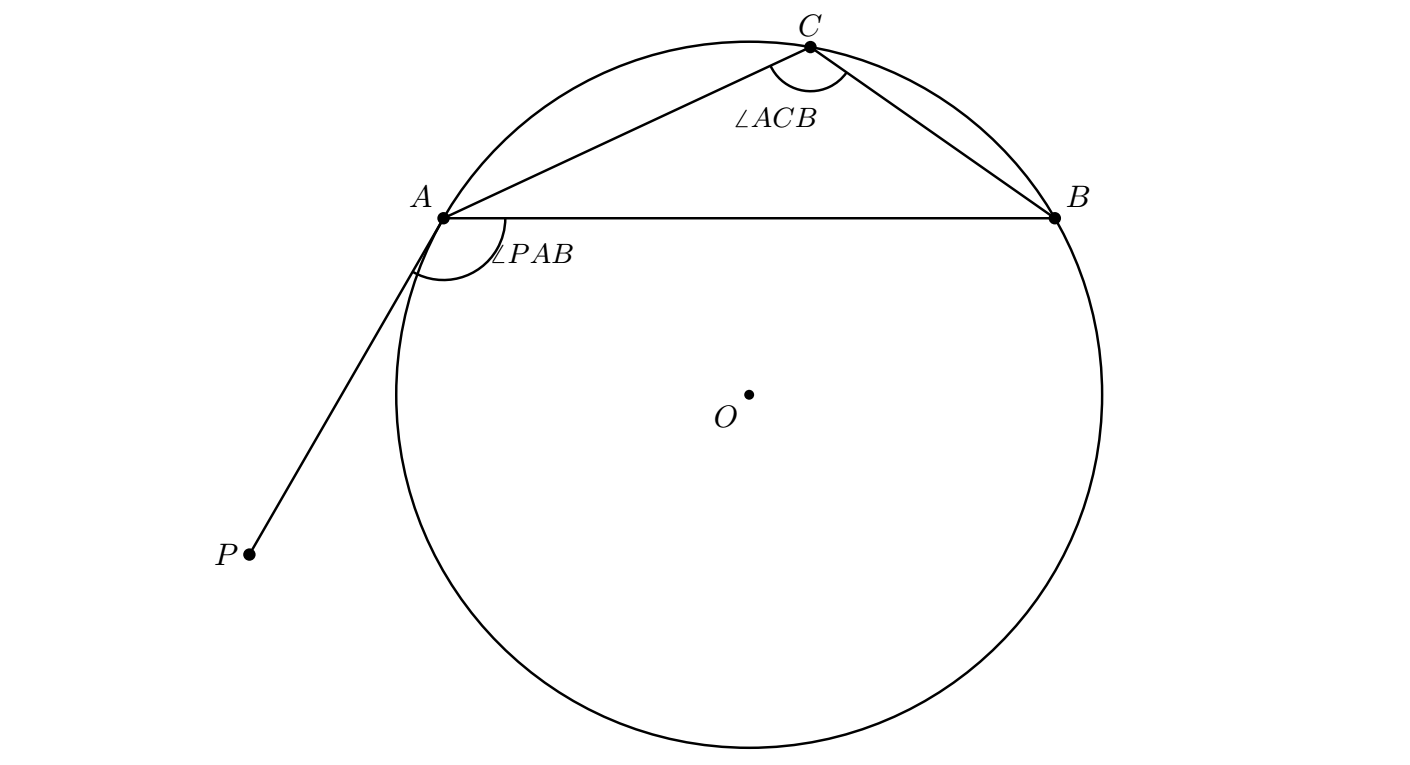
Let be a chord of a circle, and let the tangent at point meet a point outside the circle. Let be a point on the circle in the segment opposite to the tangent. Then:
This is called the Alternate Segment Theorem.
Tangent–Secant Theorem§
Let be a tangent drawn from an external point to a circle, touching the circle at point . Let a secant from the same point intersect the circle at points and , such that the order of points is ——. Then:
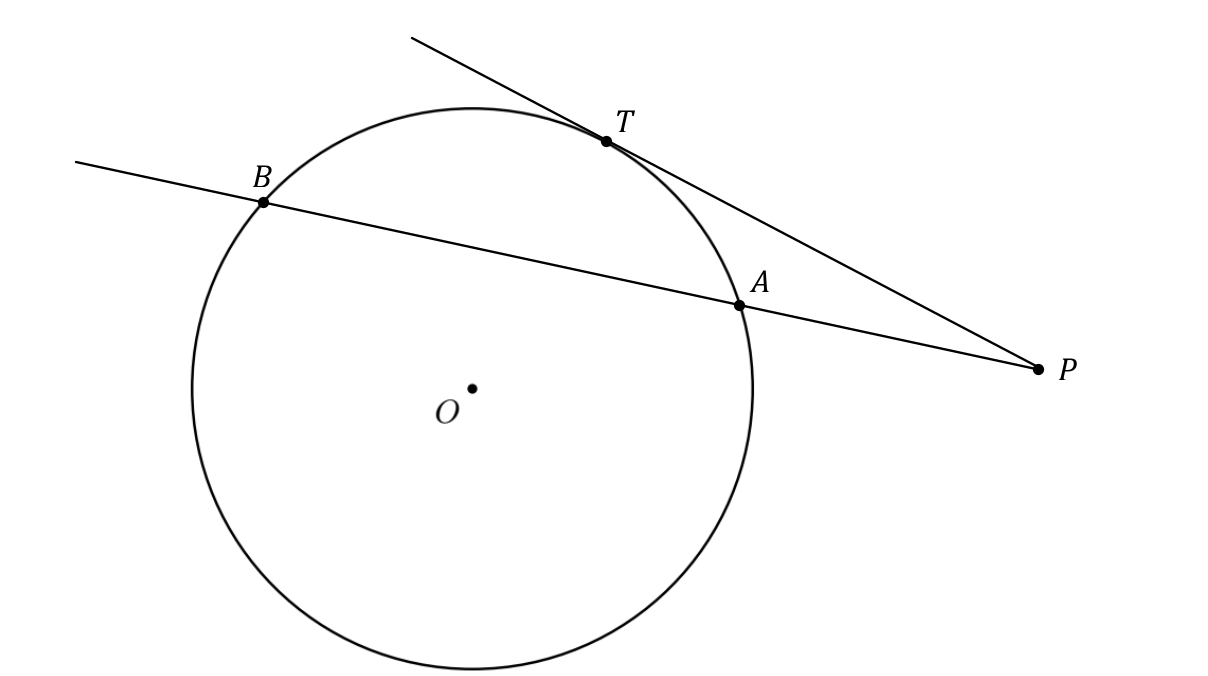
This relation connects the length of the tangent segment to the lengths of the secant segments.
Furthermore, let the centre of the circle be , and let be the radius of the circle. If the distance from the external point to the centre is , then it can also be shown that:
Secant–Secant Theorem§
Let a circle be given, and let a point lie either outside or inside the circle. Suppose two lines are drawn through , intersecting the circle at points and , and at points and , respectively. Then:
If lies outside the circle, then and are the lengths from to the two intersection points of one secant, and , are the lengths to the points on the other secant.
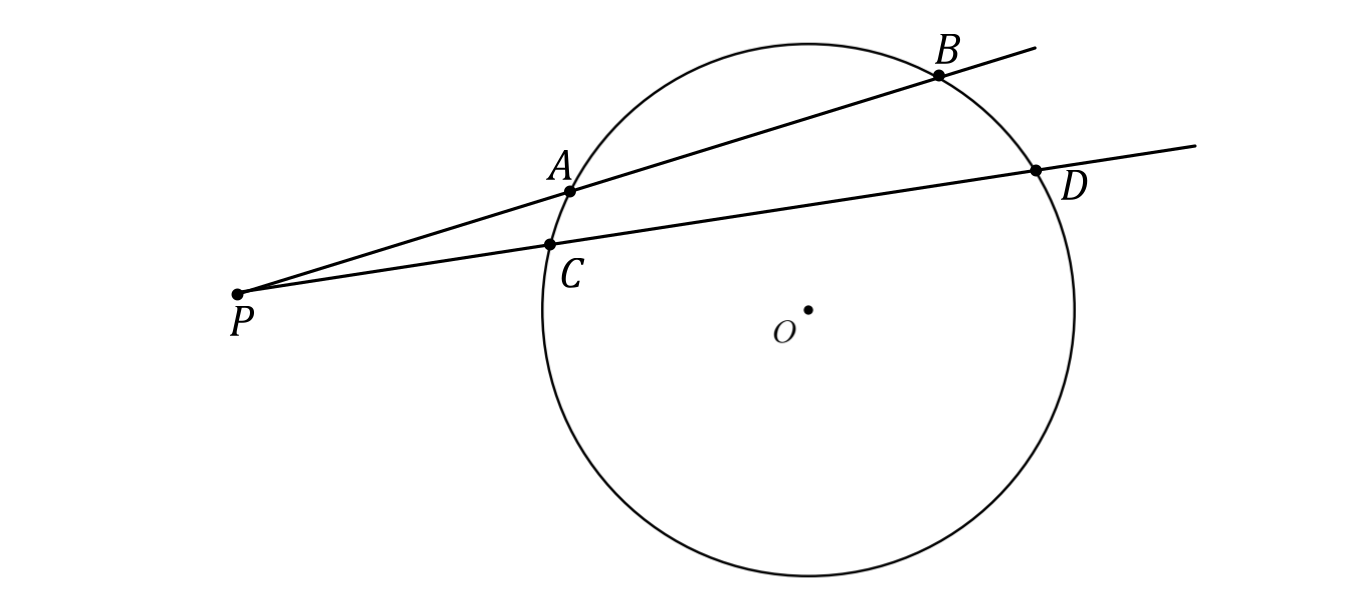
If lies inside the circle, the lines become intersecting chords, and the segments are measured along the two chords intersecting at inside the circle. The relation still holds:
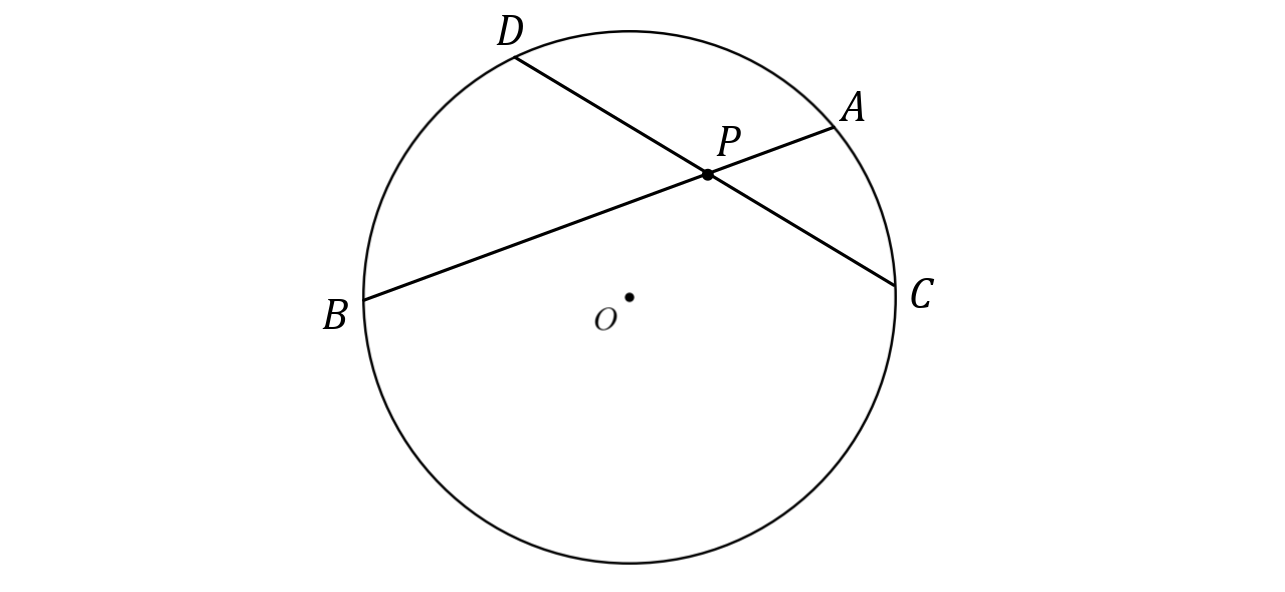
This theorem is a precise and symmetric identity relating the products of segment lengths determined by intersecting secants, and is independent of whether is inside or outside the circle.
It can be proven that the identity
can also be expressed in terms of the radius and the distance from the point to the centre of the circle.
If the point lies outside the circle, and the distance from to the centre is , with the circle having radius , then:
If the point lies inside the circle, then the relation becomes:
In both cases, the product of the lengths of the segments along any secant through depends only on the circle’s radius and the distance of point from its centre.
Length of Arc and Area of Sector§
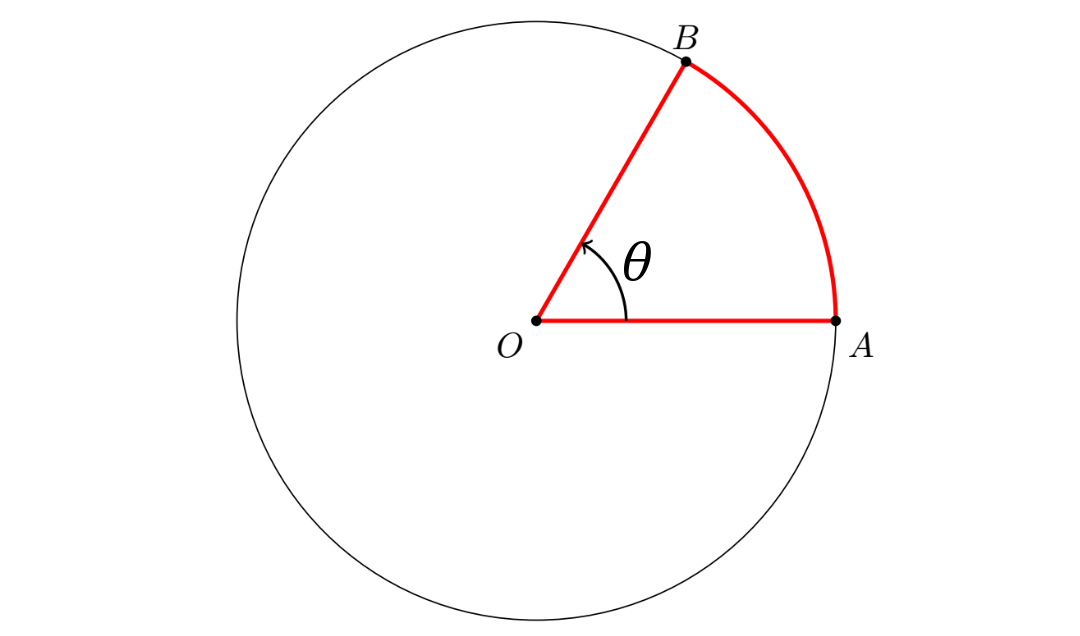
Let a circle have radius , and let an arc of the circle subtend an angle at the centre, where is measured in radians.
Then the length of the arc is given by:
The region enclosed by this arc and the two radii joining its endpoints to the centre is called a sector. The area of this sector is given by:
This formula for area is valid for all sectors, regardless of the size of , provided it is in radians.
In the special case when , the arc becomes the entire circle, and the sector becomes the full circular region. Substituting into the area formula yields:
which is the familiar formula for the area of a complete circle. Thus, both the arc length and sector area formulas are natural extensions of the full-circle case, scaled proportionally by the central angle .
Cyclic Quadrilateral§
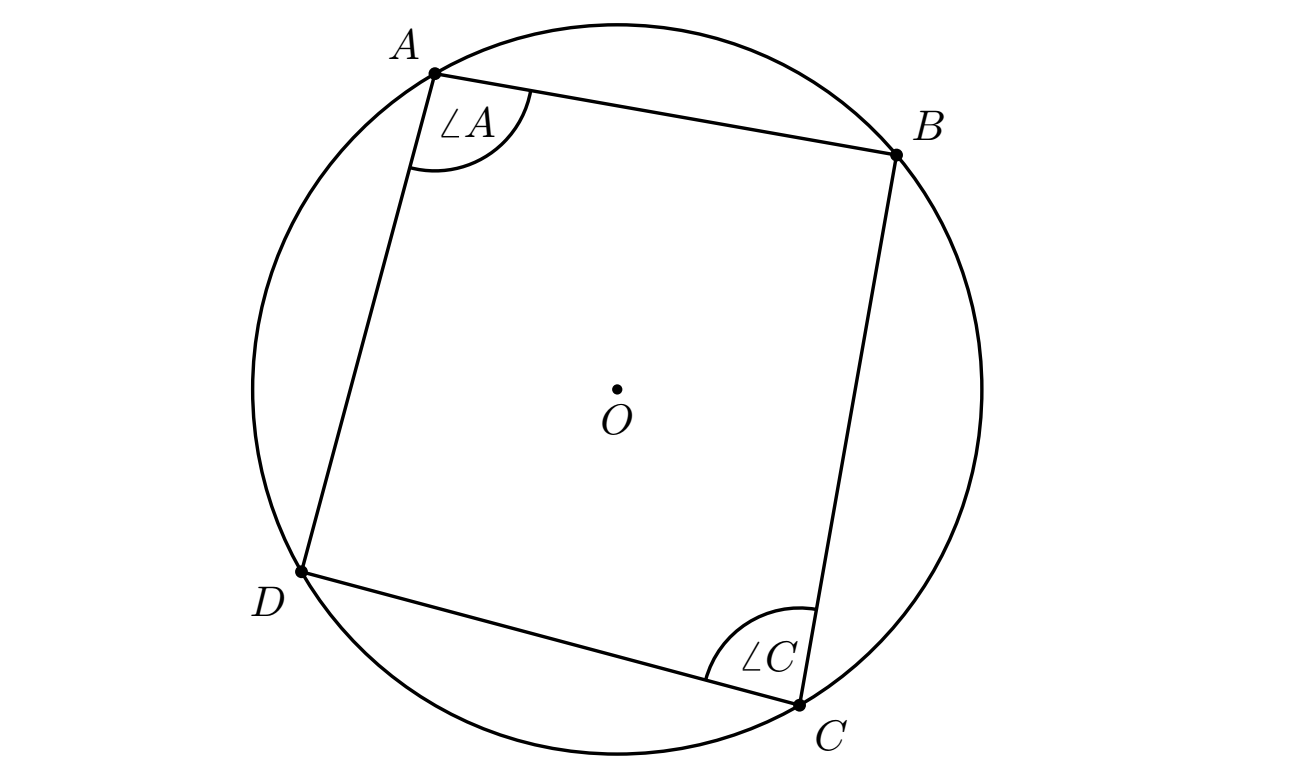
A cyclic quadrilateral is a quadrilateral whose all four vertices lie on a single circle. That is, a quadrilateral is cyclic if there exists a circle that passes through all four of its vertices. The circle is called the circumcircle of the quadrilateral.
Theorem 1 (Opposite Angle Sum)
In a cyclic quadrilateral, the sum of each pair of opposite angles is (or radians). That is,
This condition is both necessary and sufficient for a quadrilateral to be cyclic. That is if you want to prove that a quadrilatral is cyclic then use prove that the sum of opposite angles is .
Theorem 2 (Exterior Angle Property)
The exterior angle at any vertex of a cyclic quadrilateral is equal to the interior opposite angle. For example, if side is extended to point , then:
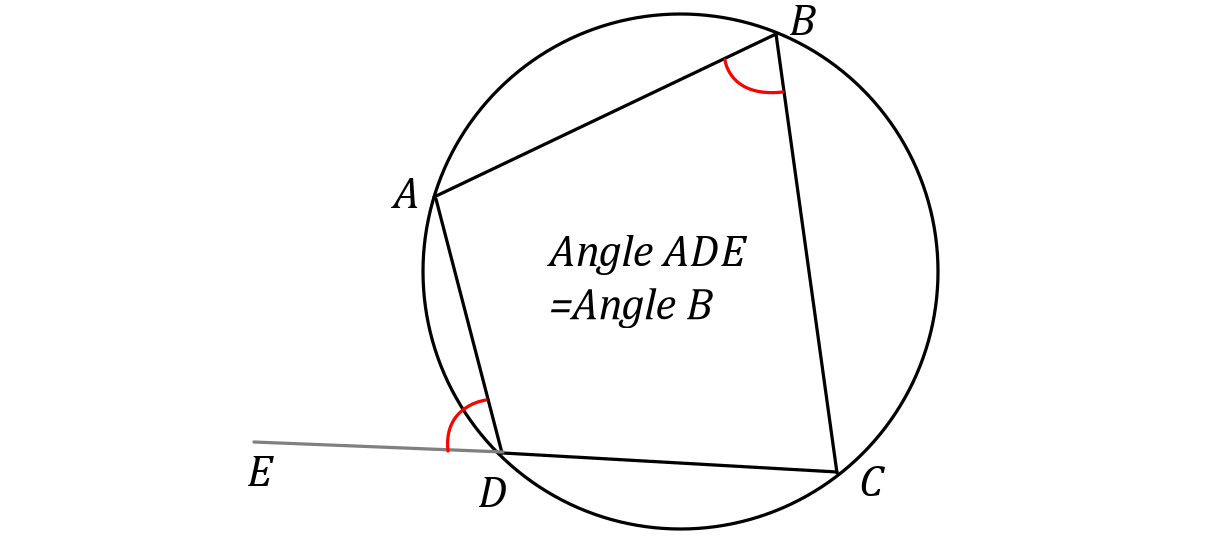
This follows directly from Theorem 1.
Theorem 3 (Angle Subtended by a Side)
In a cyclic quadrilateral, a given side subtends equal angles at the two opposite vertices. That is, for example,
That is the the angle subtended by at and are equal. This is true for all sides.
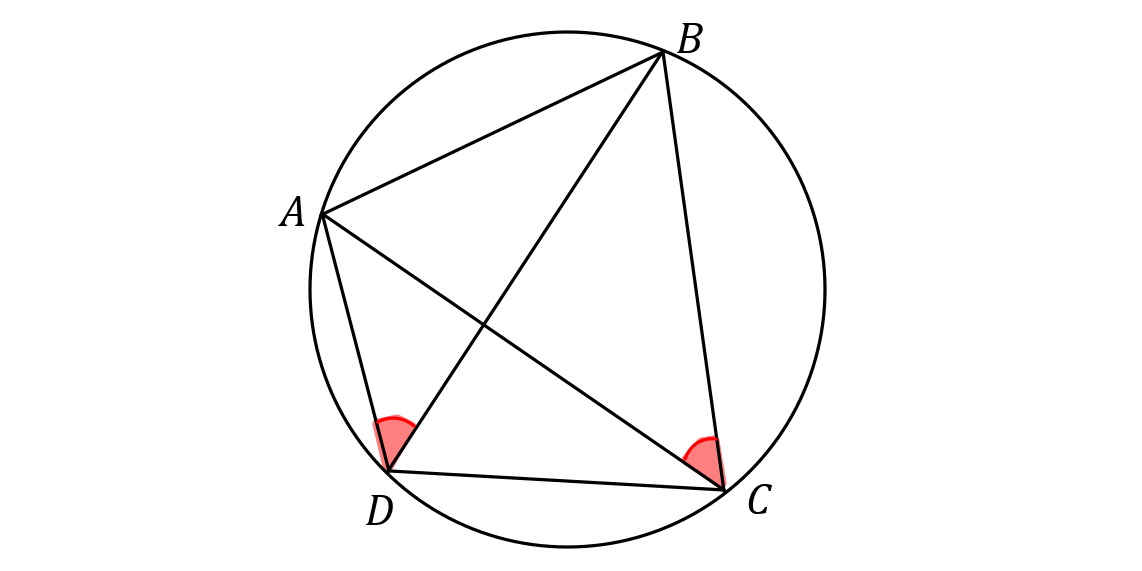
Theorem 4 (Converse of Equal Angle Subtending)
If in any quadrilateral, a side subtends equal angles at the two opposite vertices, then the quadrilateral is cyclic.
That is, for example, if:
then the points lie on a circle.
Theorem 5 (Angle Between Diagonals and Sides)
In a cyclic quadrilateral , if the diagonals and intersect at point , then:
and
This is a consequence of the equality of vertically opposite angles and the angle-in-the-same-segment property.
Theorem 6 (Cyclic Trapezium)
A trapezium is cyclic if and only if it is isosceles. That is, a trapezium with one pair of opposite sides parallel is cyclic if and only if the non-parallel sides are equal in length. Equivalently, the base angles are equal.
Mark this section complete when you have worked through its proofs.