
Location of Circle with respect to Axes
When presented with the equation of a circle, one should be readily able to determine its position relative to the coordinate axes. Indeed, analyzing the equation can quickly reveal critical geometric information: the circle may pass through the origin, be tangent to either the -axis or -axis, intersect both axes at distinct points, or perhaps remain entirely detached from one or both axes. These characteristics—whether a circle touches, intersects, or avoids the axes altogether—can be inferred directly by examining relationships among its center coordinates and radius. Thus, understanding these subtle yet important connections between algebraic expressions and geometric features enables one to visualize and locate circles precisely in the coordinate plane.
Circle passing through Origin§
Consider a circle represented by the general equation:
Suppose this circle passes through the origin . Substituting this point into the equation, we get:
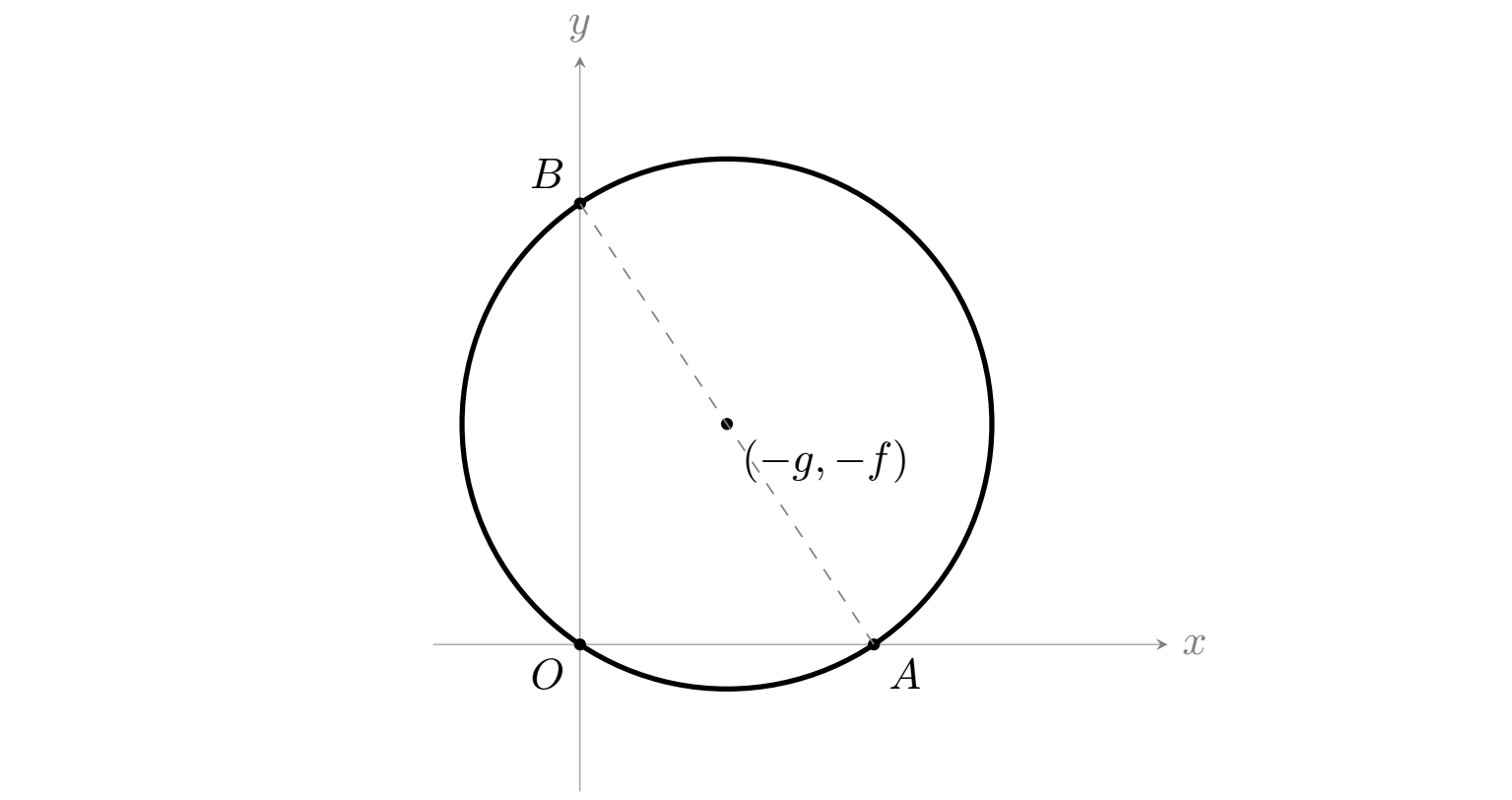
Thus, the condition that a circle passes through the origin immediately implies the constant term vanishes. Geometrically, this implies that the distance from the center to the origin equals precisely the radius of the circle. Indeed, verifying this algebraically, the radius of this circle is given by:
which is clearly equal to the distance from the center to the origin :
Now, consider the points of intersection of this circle with the axes. Suppose it intersects the -axis at a point and the -axis at a point . Since the axes intersect orthogonally at the origin , the angle subtended by the chord at is . According to the fundamental theorem regarding angles subtended by diameters, a chord subtending a right angle at the circumference of a circle must be the diameter. Hence, the chord is necessarily the diameter of the circle.
Thus, whenever a circle passes through the origin and intersects both axes, the line segment joining the axes' intercepts is invariably the diameter of that circle.
Circle Touching the -Axis§
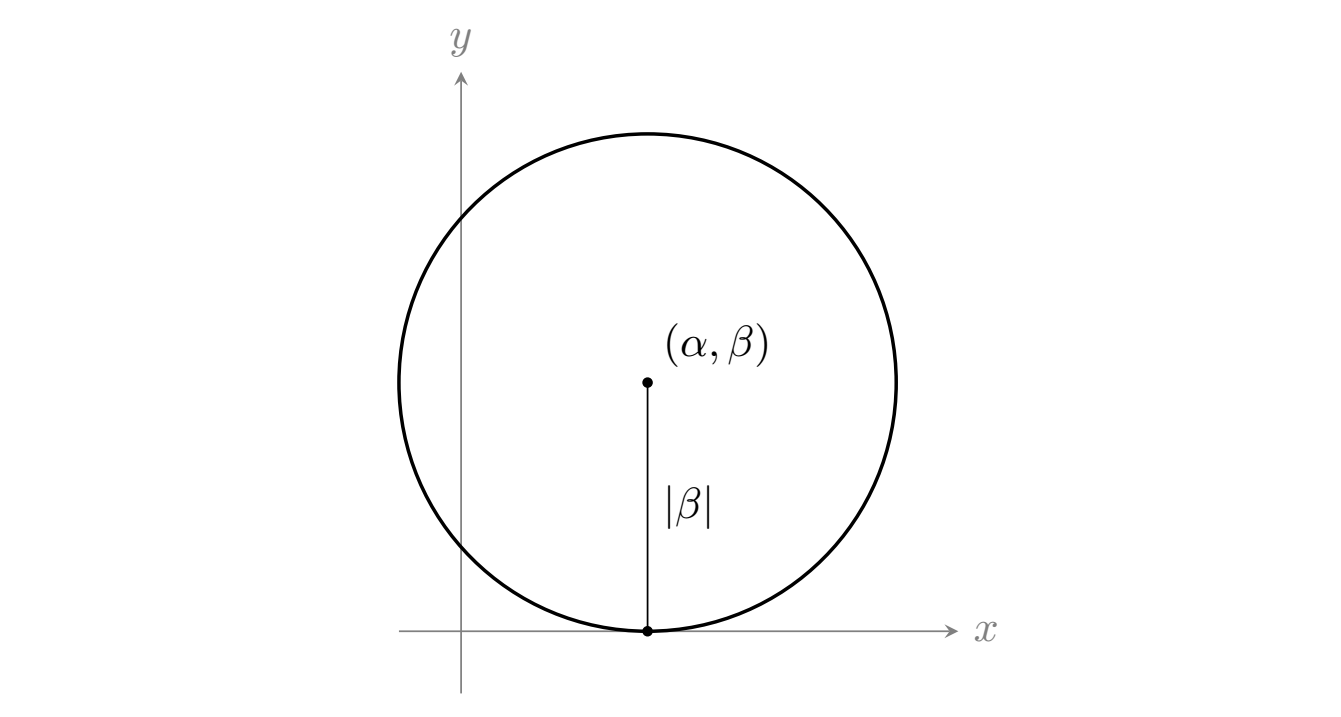
Consider a circle that touches (is tangent to) the -axis. When a circle touches the -axis, a clear geometric condition connects the center and radius of the circle. Let the circle have its center at the point and radius . Tangency implies that the distance from the center to the -axis must be exactly equal to the radius. Since this vertical distance is simply , we must therefore have:
(The absolute value is needed because the circle's center could be either above or below the -axis.)
Next, consider the algebraic form of the circle:
It is already known that this circle has center and radius:
Since the circle touches the -axis, we also have:
Equating the two expressions for , we get:
Squaring both sides gives the algebraic condition:
Thus, the exact algebraic condition for a circle to touch the -axis is:
For example, consider the circle given by the equation:
Here, comparing with the general form , we clearly identify:
Check the condition for tangency to the -axis, which is :
Since this condition is satisfied exactly, the given circle indeed touches the -axis.
Circle Touching the -Axis§
Analogously, if a circle touches the -axis, then the horizontal distance from its center to this axis equals its radius. Precisely, if the circle has center and radius , then we must have:
For a circle given by the general equation:
the algebraic condition for tangency to the -axis becomes:
Circle Touching Both Axes§
Consider a circle tangent simultaneously to both coordinate axes. In such a scenario, the center must be positioned in such a way that the distances from it to both the -axis and the -axis are equal to the radius. Therefore, we must have:
This condition implies a crucial relationship between the coordinates:
Moreover, the signs of and determine the quadrant in which the circle's center lies:
- In Quadrant I: , ,
- In Quadrant II: , ,
- In Quadrant III: , ,
- In Quadrant IV: , .
For a circle given algebraically by:
the simultaneous tangency to both axes yields a concise algebraic condition involving coefficients:
Circle Cutting the -Axis and the -Intercept§
Suppose our circle, given by
intersects the -axis at two points and . The segment , which lies on the -axis, is called the -intercept of the circle. We will see that there are two natural ways to determine the length of , one geometric and one algebraic, yet both yield the same final result.
First, recall that the center of the circle is and its radius is
For the circle to intersect the -axis in two distinct points, its center must lie at a distance from the -axis that is strictly less than the radius. Since the distance from to the -axis is , we require
Now let us calculate the length of x-intercept.
Geometric Perspective§
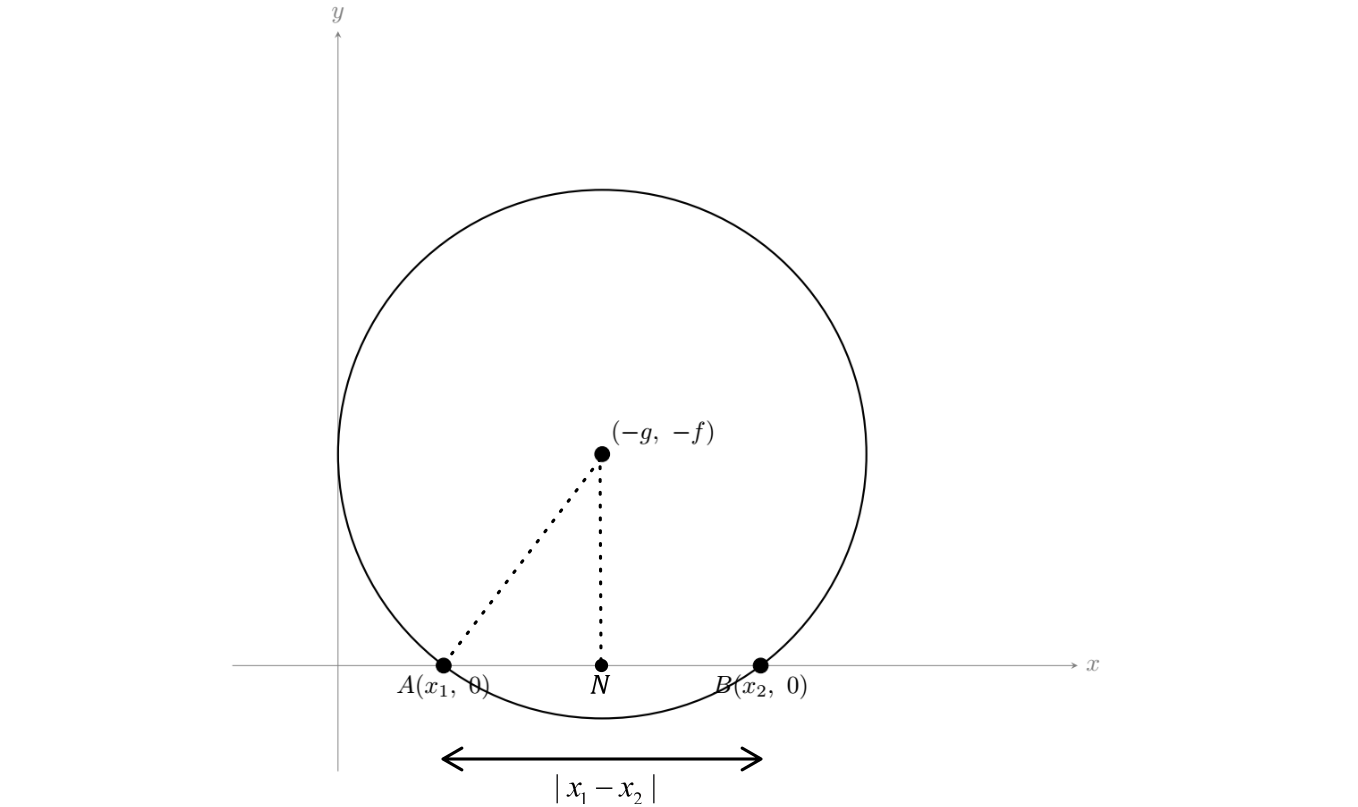
Let be the center , and let be the foot of the perpendicular from to the -axis. Then , and the radius . Because is perpendicular to and passes through the center, it bisects . In the right triangle , we apply the Pythagorean theorem:
Since bisects , it follows that .
Algebraic Perspective§
When the circle meets the -axis, we set . Substituting into the equation
gives a quadratic whose roots, say and , correspond to the -coordinates of and . By Vieta’s formulas:
The length of is simply . Using the standard identity for the difference of roots:
Thus, both the geometric and algebraic methods confirm that:
Moreover, this length is real and positive precisely when , which is exactly the condition ensuring that the circle truly cuts the -axis at two distinct points.
Circle Cutting the -Axis and the -Intercept§
Let the circle be given by:
Suppose this circle intersects the -axis at two distinct points and . The segment , which lies on the -axis, is called the -intercept of the circle. As in the case of the -intercept, the condition for the circle to cut the -axis is:
Under this condition, the length of the -intercept is given by:
This result can be obtained either geometrically (by dropping a perpendicular from the center to the -axis and applying the Pythagorean theorem) or algebraically (by setting and solving the resulting quadratic in ). Both approaches yield the same expression.
Circle Touching the -Axis at the Origin§
Suppose a circle touches the -axis at the origin. This situation imposes two distinct conditions on the equation of the circle:
-
Since the circle passes through the origin, the origin must satisfy the equation. Hence,
-
Since the circle is tangent to the -axis, the distance from its center to the -axis must equal the radius. This yields:
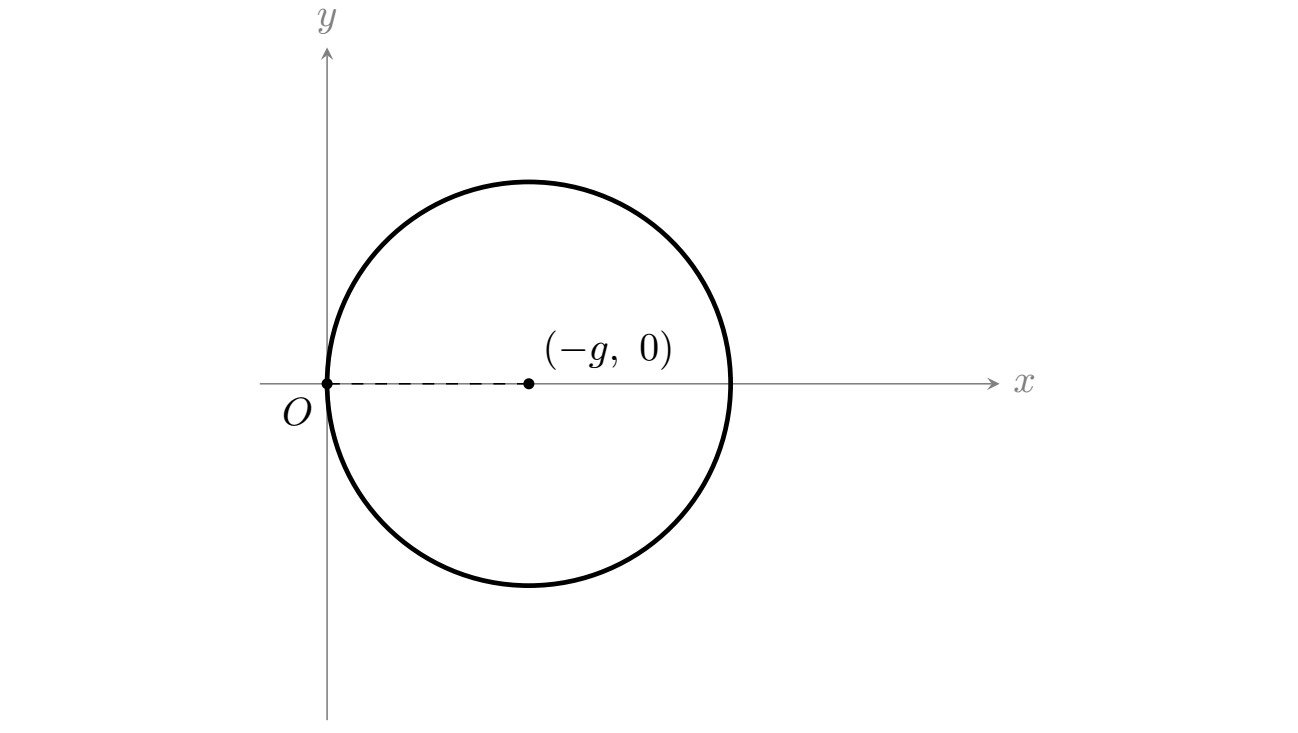
Combining both, we obtain:
Thus, the equation of such a circle reduces to:
The center of this circle is , which lies on the -axis. The radius is:
Hence, any circle that touches the -axis at the origin must have its center on the -axis, and its equation must be of the form:
Circle Touching the -Axis at the Origin§
Analogously, if a circle touches the -axis at the origin, then:
The equation of the circle becomes:
Its center lies at on the -axis, and the radius is:
Mark this section complete when you have worked through its proofs.