
Equation of a Chord with known midpoint
Chord of a Circle with Known Midpoint§
Let a circle be given by the equation
and suppose we are told that a chord of this circle has midpoint . We want to find the equation of this chord.
By the symmetry of the circle, and its fundamental geometry, we proceed as follows:
Join the center of the circle to the midpoint of the chord. Then, from classical geometry of the circle, this line is perpendicular to the chord. Hence, the slope of the chord is the negative reciprocal of the slope of .
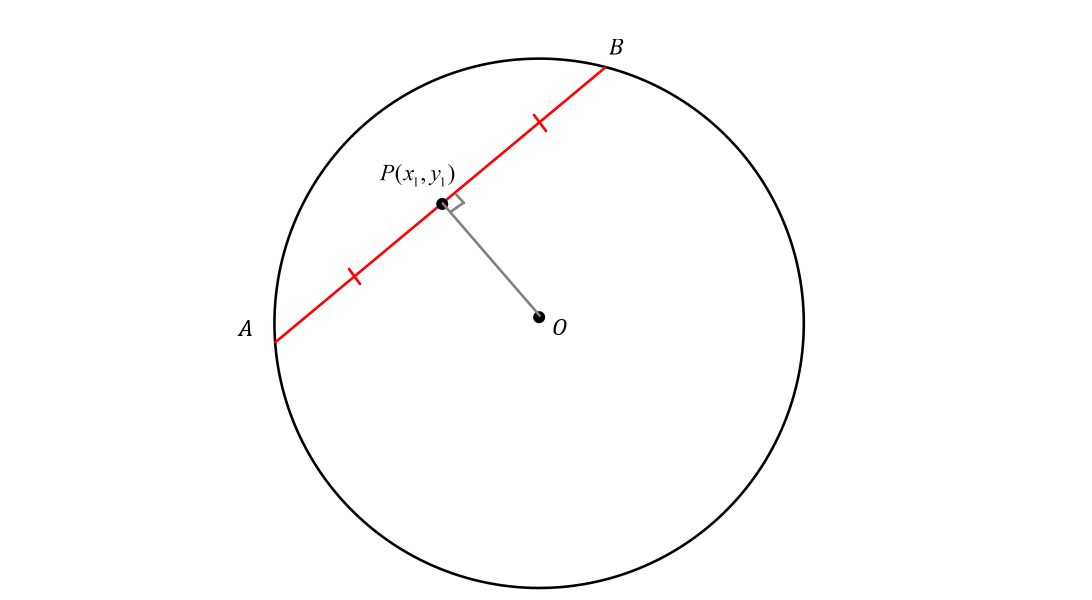
The slope of is:
so the slope of the chord is:
We now have the slope of the chord and a point through which it passes. Using point-slope form, the equation of the chord is:
Cross-multiplying:
Rewriting:
Now subtract from both sides:
On the left-hand side, the expression is the tangent form for the circle . On the right-hand side, the expression is the value of the circle at , denoted .
Thus, the required equation of the chord is:
This form generalizes beautifully. It says:
The equation of a chord of a circle, given its midpoint , is .
In case of a general circle this equation of the chord is .
Mark this section complete when you have worked through its proofs.