
Interaction of a Point with a Circle
When a point is near a circle, many interesting questions come up about how the point and the circle are related. First, we often want to know whether the point lies inside, outside, or on the circle. This depends on how far the point is from the center of the circle compared to the radius.
Next, we might ask: what is the shortest distance from the point to the circle? What is the longest distance from the point to the circle? These distances help us understand how close or far the point is from different parts of the circle.
There are also deeper ideas. One of them is the power of a point with respect to a circle. This gives us a number that tells us how the point is related to the circle in terms of distance. Another idea is the inverse point with respect to a circle, which comes from a special transformation in geometry called inversion.
In the sections ahead, we will carefully define and explain each of these ideas, using diagrams, formulas, and reasoning that make their meanings clear.
Relative Location of a Point with Respect to a Circle§
Suppose we are given a circle and a point in the plane. A natural question is whether the point lies inside the circle, on the circle, or outside it. While one could draw a diagram and check visually, this is not reliable or efficient. A better approach is to use algebra.
Let the equation of the circle be
and let the point be . The center of the circle is
We now measure the distance , the distance from the point to the center . This is given by
To determine the position of the point relative to the circle, we compare this distance with the radius :
- If , then the point lies inside the circle.
- If , then the point lies on the circle.
- If , then the point lies outside the circle.
To avoid square roots, we square both sides. For example, the point is inside the circle if and only if
Expanding the left side:
Cancelling from both sides, we get
This expression is obtained by substituting into the left-hand side of the circle's equation. We write this compactly as
where denotes the result of substituting into the circle equation (1).
Similarly, we can prove that when a point is outside then taking . For the point to be on the circle, the jpoint simply satisfies the circle.
Thus, we summarize:
This provides a direct algebraic test for the position of any point with respect to a given circle.
Every point that lies inside the circle, when substituted into the left-hand side of the circle's equation
gives a negative value. Conversely, every point outside the circle gives a positive value when substituted into the same expression. Points on the circle make the expression exactly zero.
This observation shows that the circle acts as a boundary between two distinct regions of the plane:
-
The set of all points for which
lies inside the circle.
-
The set of all points for which
lies outside the circle.
-
The set of all points for which
lies exactly on the circle.
Thus, the circle naturally divides the plane into two regions: an interior and an exterior, separated by the curve itself.
Power of a Point with Respect to a Circle§
Let a circle be given by the equation
and let be any point in the plane. The power of the point with respect to this circle is defined as the value obtained by substituting the coordinates of into the left-hand side of equation (1). That is, the power of is
This expression is denoted as , and we have already seen that:
However, the significance of this value goes beyond merely determining the location. It represents a quantity with geometric meaning.
Let the center of the circle be and the radius be
The distance from the point to the center is
Squaring both sides and comparing with , we define the power as:
Substituting (3) and (4) into (5), we get:
This confirms that both definitions (geometric and algebraic) agree:
Hence, the power of a point is equal to the difference between the square of its distance from the center and the square of the radius:
Power and Secant-Secant Theorem§
Let a point lie in the plane of a circle, and let two secants be drawn from it. Suppose one secant intersects the circle at points and , and the other at and . Then by the Secant–Secant Theorem, we have
From geometry, we know that when the point lies outside the circle, the product of the lengths of the segments from to the two points of intersection on any secant equals the square of the distance from to the center minus the square of the radius. That is,
But the right-hand side is precisely the definition of the power of the point with respect to the circle. Hence, when is outside the circle,
Now suppose the point lies inside the circle. Then the secants become chords intersecting inside the circle at , and the same product still holds by geometry:
However, in this case,
Thus, when the point lies inside the circle, the common product of the chord segments equals the negative of the power of the point. Both cases combine into the identity:
with the appropriate sign given by the position of relative to the circle.
Inversion with Respect to a Circle§
Let a fixed circle be given with center and radius . For any point , its inverse point with respect to this circle is defined by the condition
Let , so that the distance from to is . Then, by the definition of inversion,
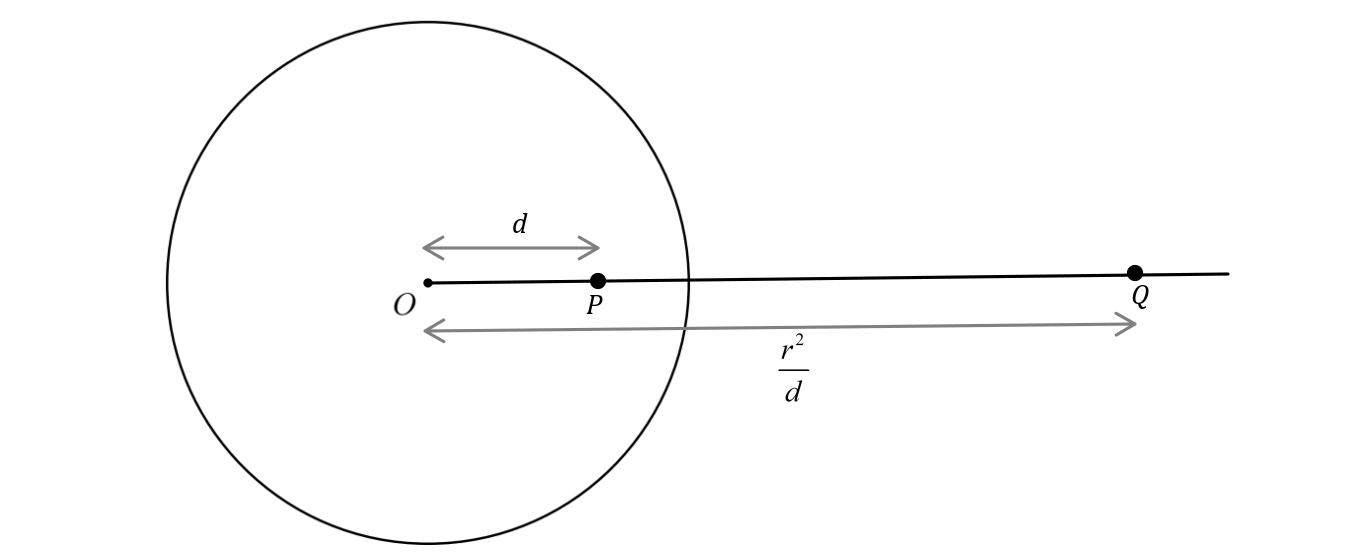
Hence, the inverse point lies on the same ray as , and its position is determined by the reciprocal relationship between and .
Suppose lies inside the circle. Then , and so
Since , it follows that , meaning that lies outside the circle.
Similarly, if lies outside the circle, then , so , hence , and therefore lies inside the circle.
If lies on the circle, then , and we have , so , and the inverse point coincides with itself. In this case, the point is invariant under inversion.
Now assume lies inside the circle, so . Then
This means that divides the segment internally in the ratio
On the other hand, if lies outside the circle, then , and now
So again divides the segment but externally, but now the ratio is
Thus, in all cases, the point divides the segment in the ratio
internally if lies inside the circle and externally if lies outside (as then the ratio becomes negative implying external division).
Let the circle be given by
whose center is the origin . Let be any point in the plane, distinct from , and let be the distance from the center to the point . Let be the inverse point of with respect to the given circle. By the definition of inversion,
From earlier reasoning, the point divides the segment in the ratio
Then, by the division formula, we write
where is the origin. Simplifying this gives
But since , we substitute to obtain
This is the explicit coordinate formula for the inverse point of with respect to the circle .
Inversion of a Line in a Circle§
Let the circle of inversion be
with center at the origin . Consider a vertical line
and let a point on this line be , where . Then lies on the given line, and its distance from the origin is
The inverse point of with respect to the circle is given by the inversion formula:
Let
We now square both expressions and add to eliminate :
From this, it follows that
Substitute this into equation (1):
Multiplying both sides by , we obtain the equation:
This is the equation of a circle. To write it in standard form, complete the square in :
Hence, the locus of inverse points is a circle with center
and radius
This circle passes through the origin, since setting satisfies equation (6).
Therefore, we have shown that when each point on the line is inverted with respect to the circle , the set of all inverse points traces out a circle that passes through the center of inversion. Hence:
The inversion of a straight line not passing through the center is a circle passing through the center.
A similar analysis shows the converse: the inversion of a circle passing through the center is a straight line not passing through the center, completing the duality between lines and circles under inversion.
Minimum and Maximum Distance of a Point from a Circle§
Let a circle be given with center and radius . Let be any fixed point in the plane, and let be any point on the circle. The distance varies as moves along the circle. We are interested in finding the minimum and maximum values of , that is, the shortest and longest distances from the point to any point on the circle.
Let be the distance from the point to the center of the circle. We consider two cases based on the location of relative to the circle.
Assume first that lies outside the circle, so that . Consider the straight line segment joining the center to the point . This line intersects the circle at exactly two points, say and . One of these points, , lies on the near side of the circle, toward ; the other, , lies on the far side. Since lies between and , the distance , which is the shortest possible distance from to the circle. Likewise, lies beyond the center in the direction of the line , so , which is the maximum.
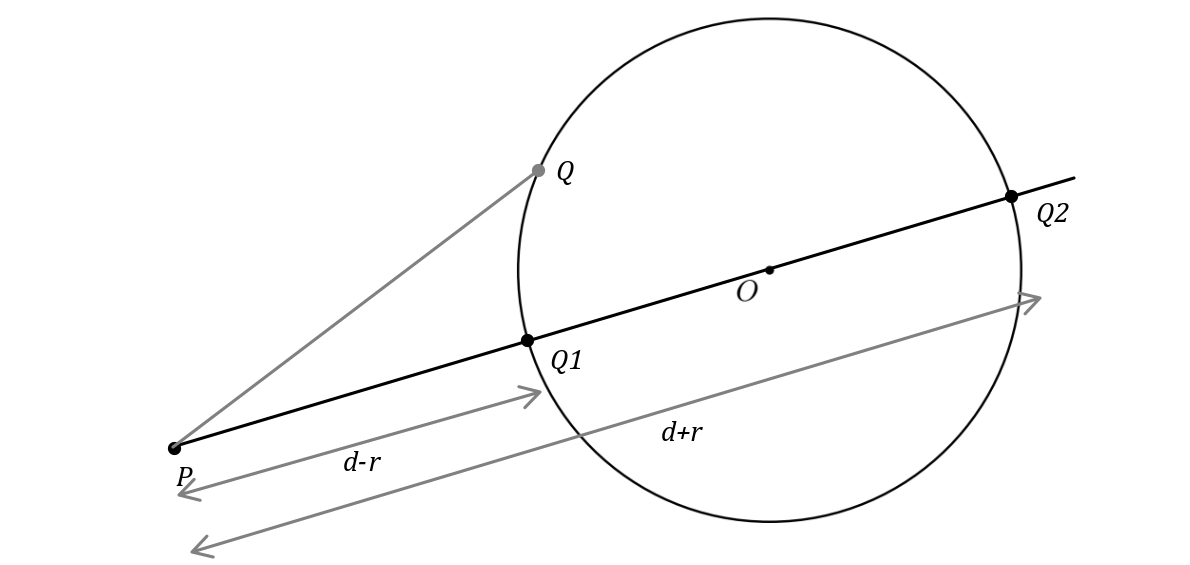
Hence, when is outside the circle:
Now consider the case when lies inside the circle, so . The same line intersects the circle at two points and again, this time lying outside the point in both directions. Still, the shortest distance from to any point on the circle is attained when , the point on the circle closest to along the line . This time:
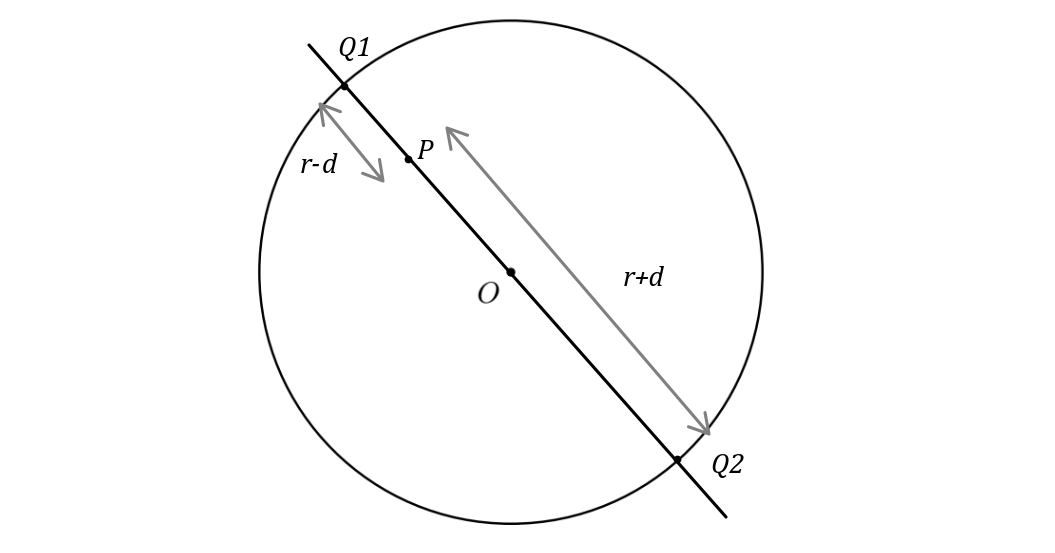
Thus, regardless of whether is inside or outside the circle, the minimum and maximum distances from the point to the circle are given by:
where . This expression holds uniformly, since it adjusts naturally to both and .
Mark this section complete when you have worked through its proofs.