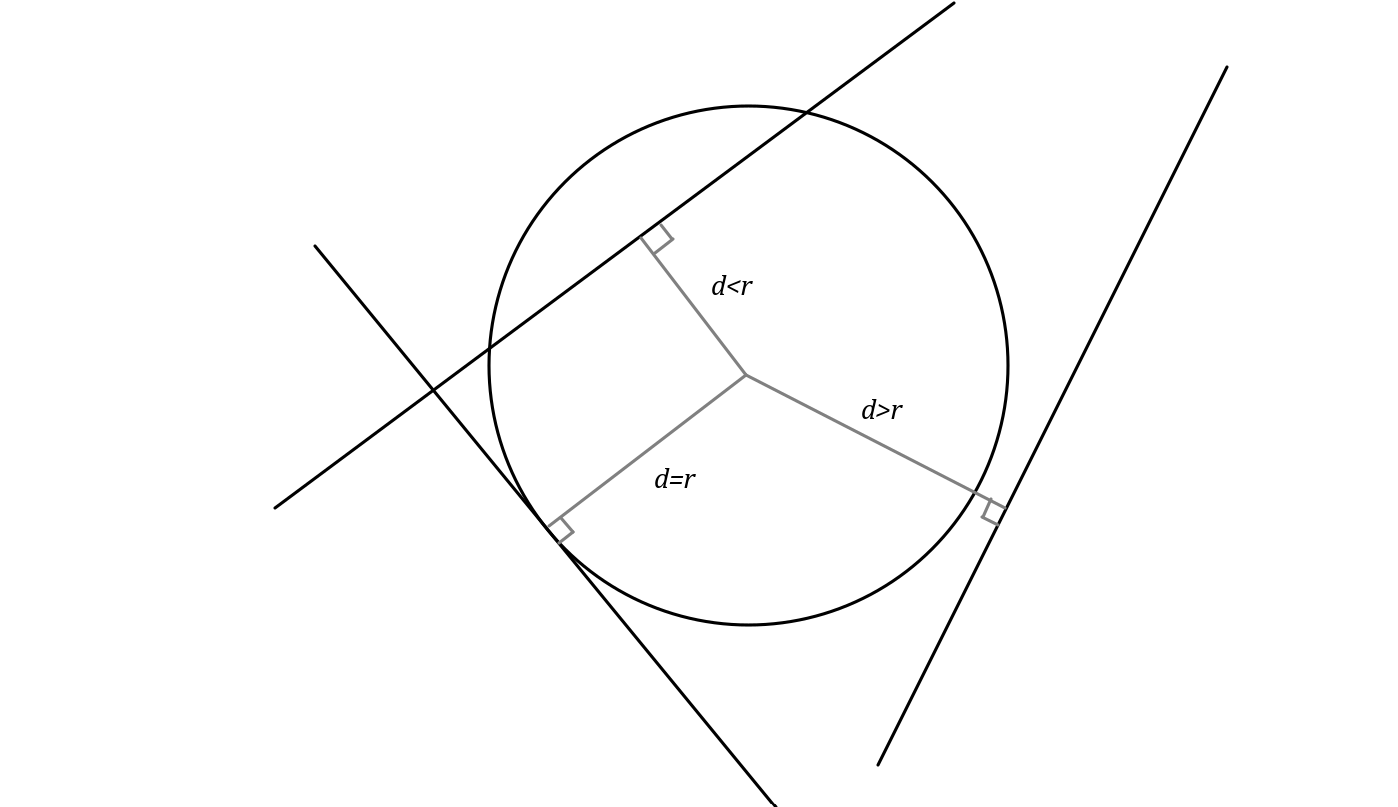
When a line is placed near a circle, there are exactly three ways it can interact with the circle:
Intersecting at two distinct points: The line crosses the circle at two separate points.
Touching at exactly one point: The line just "kisses" the circle, meeting it at exactly one point. This is called the condition of tangency, and such a line is called a tangent.
Not intersecting at all: The line completely misses the circle, not touching or intersecting it at any point.
How can we precisely determine this behavior without actually drawing the figure?
The key lies in measuring the perpendicular distance d from the center of the circle to the given line, and comparing this distance to the radius r of the circle.
Mathematically, we have three simple conditions:
d<rd=rd>r⟹Line intersects the circle at two distinct points.⟹Line is tangent to the circle (touches at exactly one point).⟹Line does not intersect or touch the circle at all.
Thus, by simply calculating the perpendicular distance from the circle’s center to the line and comparing it to the radius, we can determine the exact relationship between the line and the circle without the need for any drawing.
Consider a line with the general equation y=mx+c and a circle centered at the origin O(0,0) with equation x2+y2=a2.
To analyze how this line interacts with the given circle, we measure the perpendicular distance from the circle's center O(0,0) to the line y=mx+c. Recall that the perpendicular distance d from a point (x1,y1) to a line Ax+By+C=0 is given by:
d=A2+B2∣Ax1+By1+C∣
Here, we rewrite the given line in the form mx−y+c=0. Then, the perpendicular distance d from the center O(0,0) to the line mx−y+c=0 is:
d=m2+(−1)2∣m⋅0−1⋅0+c∣=1+m2∣c∣
We now distinguish three cases clearly based on comparing d and the radius a:
Case 1: Line intersects the circle at two distinct points
This occurs when the perpendicular distance is less than the radius a:
1+m2∣c∣<a
Squaring both sides gives a simpler condition:
1+m2c2<a2⟹c2<a2(1+m2)
Hence, the line cuts the circle at two distinct points if:
c2<a2(1+m2)
Case 2: Line is tangent to the circle
This scenario, called the condition for tangency, arises when the perpendicular distance from the center to the line equals exactly the radius a:
1+m2∣c∣=a
Squaring again, we have the simplified form known as the condition for tangency:
c2=a2(1+m2)
Case 3: Line does not intersect the circle at all
Finally, the line completely avoids the circle when the perpendicular distance is greater than the radius a:
where the center is (α,β) and the radius is a>0. We seek to find the equation of a line tangent to this circle, whose slope is specified to be m∈R.
We claim that the equation of such a tangent is
y−β=m(x−α)±a1+m2.
Proof:
Introduce new variables X=x−α,Y=y−β. This is a translation of the coordinate system, shifting the origin to the center of the circle. Under this transformation, the equation of the circle becomes
X2+Y2=a2.(1)
We now wish to find the equation of a line tangent to this circle with slope m in the new coordinates. Any line with slope m in the (X,Y)-plane has the form
Y=mX+c,(2)
where c∈R is the Y-intercept.
Using the condition for tangency:
1+m2∣c∣=a⟹∣c∣=a1+m2⟹c=±a1+m2.
Substituting this value into equation (2), we obtain the equations of the two tangents in the translated frame:
Y=mX±a1+m2.(3)
Now we revert back to the original coordinates by replacing X=x−α,Y=y−β. Substituting into (3) gives:
y−β=m(x−α)±a1+m2.
Hence, the required tangents to the original circle with given slope m are:
y−β=m(x−α)±a1+m2.
This completes the derivation.
Length of Chord Intercepted by a Line on a Circle§
Let a line y=mx+c intersect the circle
x2+y2=r2
at two distinct points A and B. The segment AB is the chord intercepted by the line on the circle. We aim to compute the length of this chord.
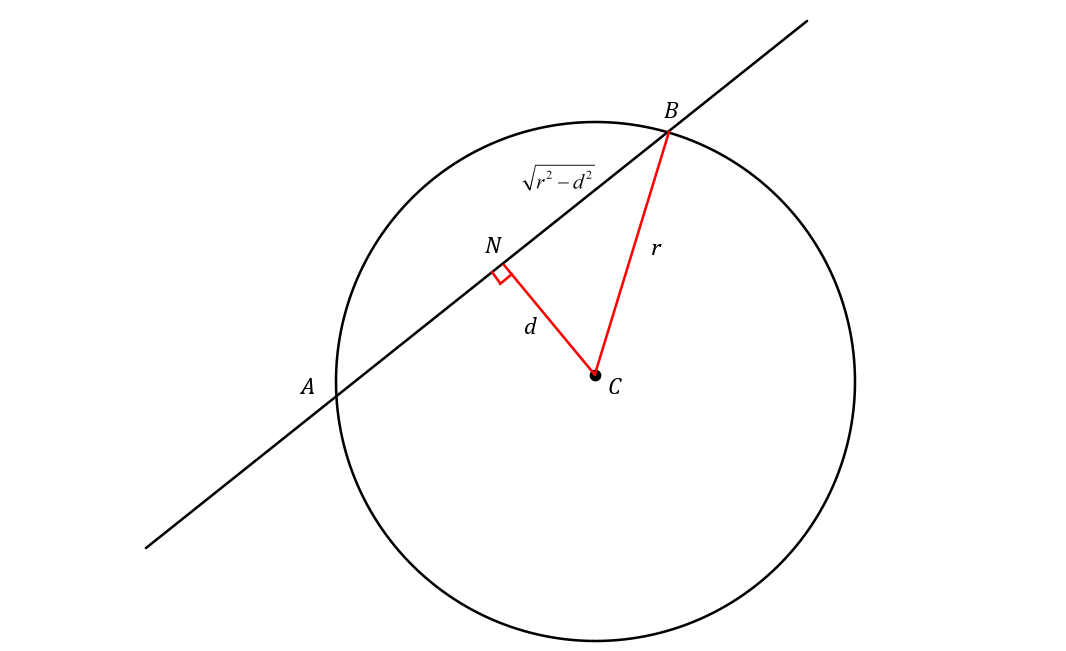
Let the center of the circle be C(0,0), and radius r. Drop a perpendicular from the center to the chord AB, meeting it at point N. Since the perpendicular from the center to any chord bisects the chord, we have:
AN=NBandAB=2⋅AN.
Let d be the perpendicular distance from the center C to the line y=mx+c. Then:
d=1+m2∣c∣.
In the right-angled triangle △CAN, with hypotenuse r and leg d, we apply the Pythagorean theorem:
AN2=r2−d2⟹AN=r2−d2.
Hence, the length of the chord is:
AB=2r2−d2.
This is a fundamental geometric result. It expresses the length of the intercepted chord in terms of the radius r of the circle and the perpendicular distance d from the center to the line. It is useful to remember:
Chord length=2r2−d2.
Section 5 of 12 · Circles
Mark this section complete when you have worked through its proofs.
Type any topic, theorem, or concept to jump directly to the section.