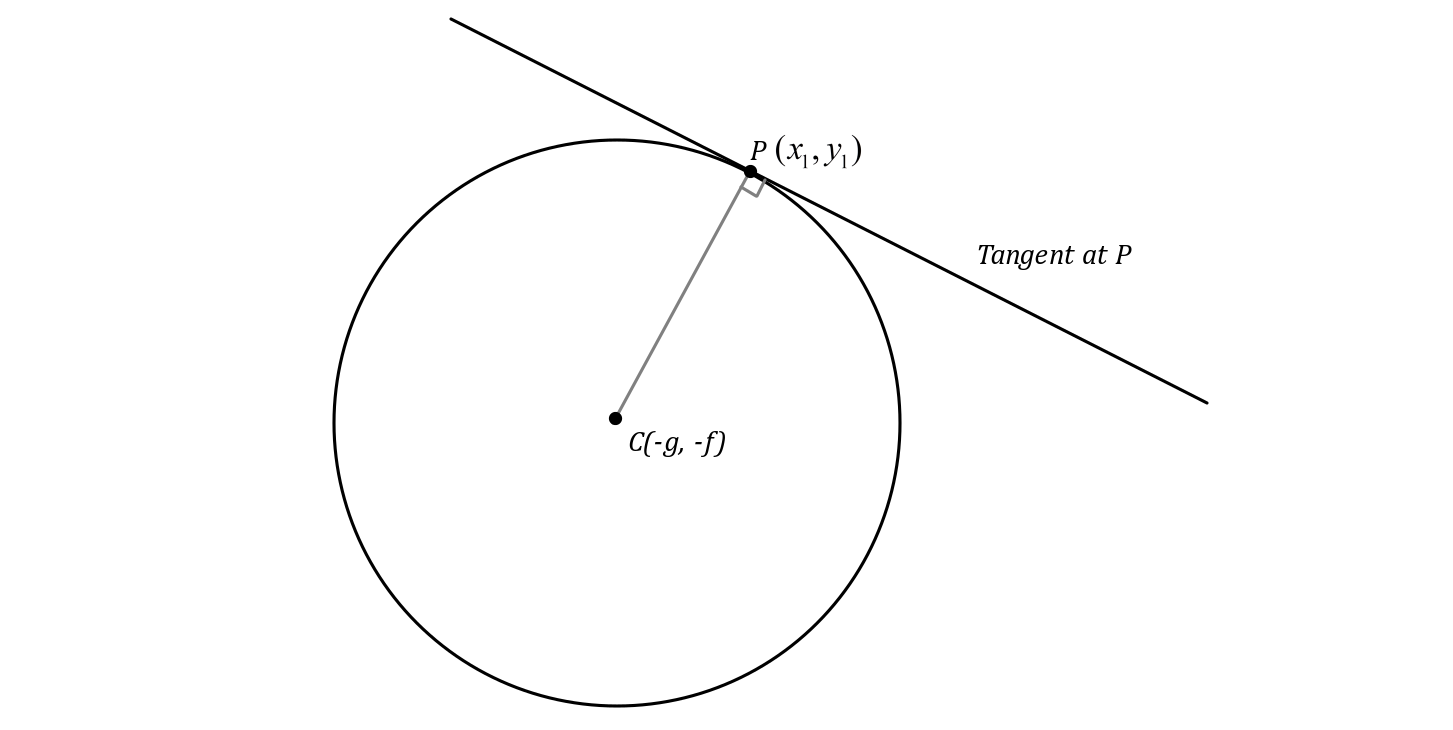
In the previous section, we found the equation of a tangent to a circle when the slope of the tangent was given. In this section, we determine the equation of the tangent to a circle at a given point lying on the circle. We also derive the equation of the normal, which is the line perpendicular to the tangent at that point and passes through it.
whose center is C=(−g,−f). Let P(x1,y1) be a point on the circle. Then P must satisfy the circle’s equation:
x12+y12+2gx1+2fy1+c=0.(1)
The tangent at point P is perpendicular to the radius CP, so we compute the slope of the radius CP. Since the coordinates of the center are (−g,−f), the slope of CP is
x1+gy1+f.
Then, the slope of the tangent (being the negative reciprocal) is
−y1+fx1+g.
Thus, the equation of the tangent at P(x1,y1) is the line passing through (x1,y1) with this slope:
The normal to a circle at a given point is the line perpendicular to the tangent at that point. But more simply, since the radius of the circle is always perpendicular to the tangent and lies along the line from the center to the point, the normal is just the line that joins the center of the circle to the point on the circle.
Suppose the equation of the circle is
x2+y2+2gx+2fy+c=0,
with center (−g,−f), and let (x1,y1) be a point on the circle.
Then the line passing through both (x1,y1) and the center (−g,−f) is the normal. Since we already know two points on it, the equation of the line is written using the section formula or directly using equal slopes of segments:
x1+gy1+f=x+gy+f.
This is the required equation of the normal. There is no need to simplify it further or write it in any other form.
Calculation of Point of Contact of a Tangent with a Circle§
When a line is tangent to a circle, we know it touches the circle at exactly one point. The condition of tangency tells us whether a line is tangent: for the standard circle
x2+y2=a2,
a line y=mx+c is a tangent if and only if
c2=a2(1+m2).
The question we now address is this:
If a given line is tangent to a circle, what is its point of contact with the circle?
There are multiple ways to find this point of contact.
Method 1: Intersection of Tangent and Normal
Let the center of the circle be C, and suppose the given tangent line L touches the circle at point P. Since the radius CP is perpendicular to the tangent, its slope is the negative reciprocal of the slope of the tangent. If the tangent has slope m, then the normal CP has slope −1/m. As CP passes through the center C, we can write its equation. The intersection of this normal with the tangent line gives the coordinates of the point of contact P.
This method is clean and geometrically motivated.
Method 2: Foot of the Perpendicular
From geometry, we know the point of contact P is the foot of the perpendicular from the center C onto the tangent line L. The formula for the foot of perpendicular from a point (x0,y0) to a line Ax+By+C=0 gives the coordinates of P directly and efficiently.
Method 3: Comparison Method (Algebraic)
This is an elegant algebraic method based on comparing the known tangent line with the general equation of the tangent to a circle at an unknown point.
Let the line be y=mx+c, and suppose it is a tangent to the circle
x2+y2=a2,
so that the condition of tangency holds:
c2=a2(1+m2).
Let the point of contact be (x1,y1). Then, since (x1,y1) lies on the circle, the equation of the tangent at that point is:
xx1+yy1=a2.(1)
The given line is:
y=mx+cor−mx+y−c=0.(2)
Equations (1) and (2) represent the same line (since both describe the same tangent), so they must be proportional. That is, their coefficients must satisfy:
−mx1=1y1=−c−a2.
Now solve:
x1=−ca2m,y1=ca2.
Therefore, the point of contact of the tangent y=mx+c with the circle x2+y2=a2 is:
(−ca2m,ca2).
This method is purely algebraic and uses the known form of the tangent at a point on the circle to force the point of contact by comparing coefficients.
Section 6 of 12 · Circles
Mark this section complete when you have worked through its proofs.
Type any topic, theorem, or concept to jump directly to the section.