When two circles are drawn close to each other, several interesting things can happen. They might cut each other at two points, touch each other at exactly one point, or not meet at all. In this section, we will study how two circles interact depending on how far apart they are and how big they are.
We will learn how to find out whether they intersect, and if they do, how they meet—at what angle, and whether they are orthogonal (i.e., meet at right angles). We will also look at important ideas like the common chord if they intersect, or common tangents if they don't. We will define and use the concept of the radical axis.
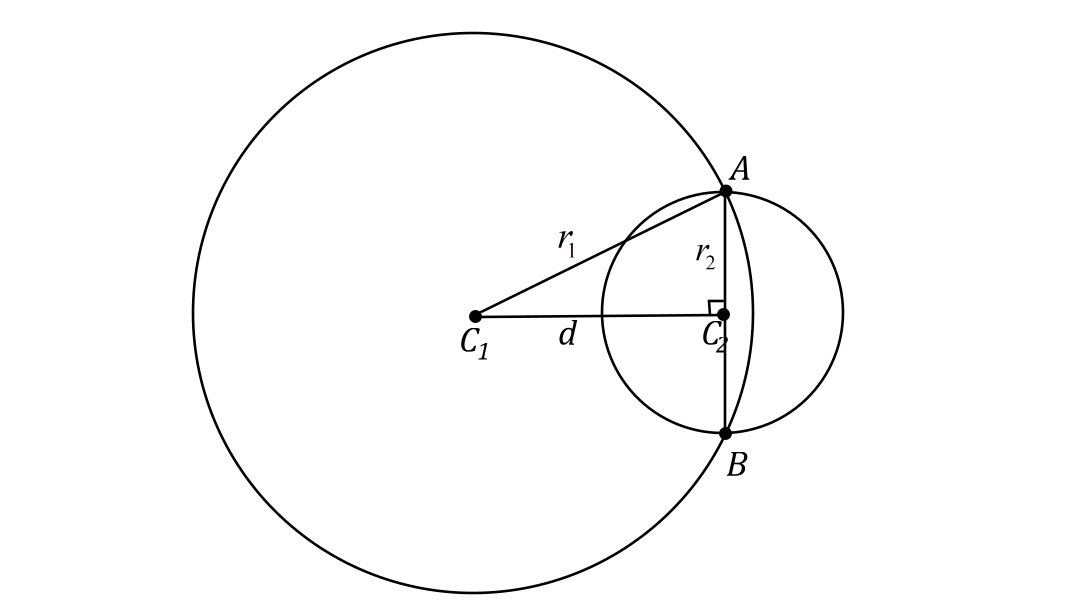
Here, C1(x1,y1) and C2(x2,y2) are the centres of the circles, and r1,r2 are their respective radii. The distance between the centres is denoted by
d=C1C2=(x2−x1)2+(y2−y1)2
This distance d, together with the sizes r1 and r2, determines the mutual position of the two circles. There are five possibilities:
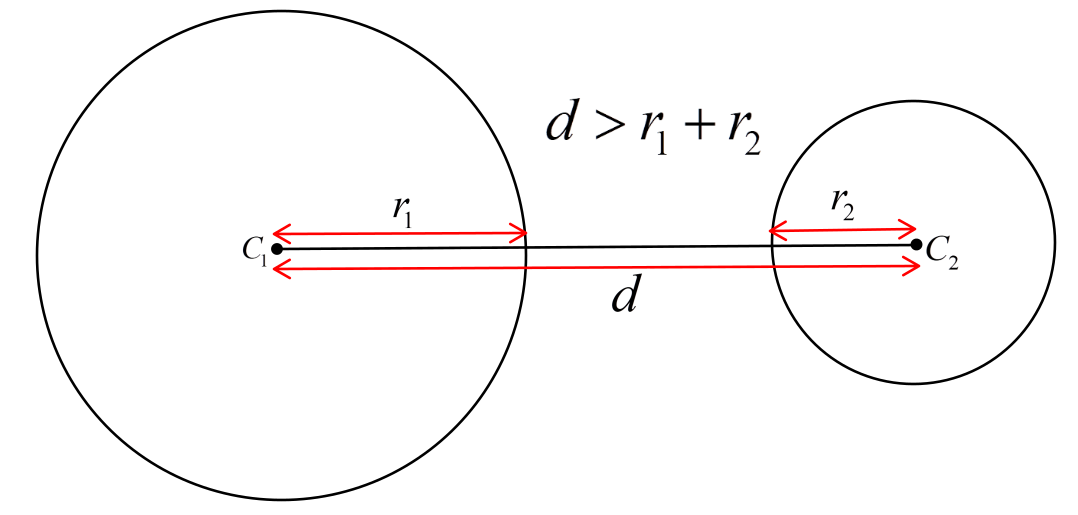
Case I: The circles are externally apart
When the distance between the centres is more than the sum of the radii:
d>r1+r2
The circles are far from each other and do not touch or intersect.
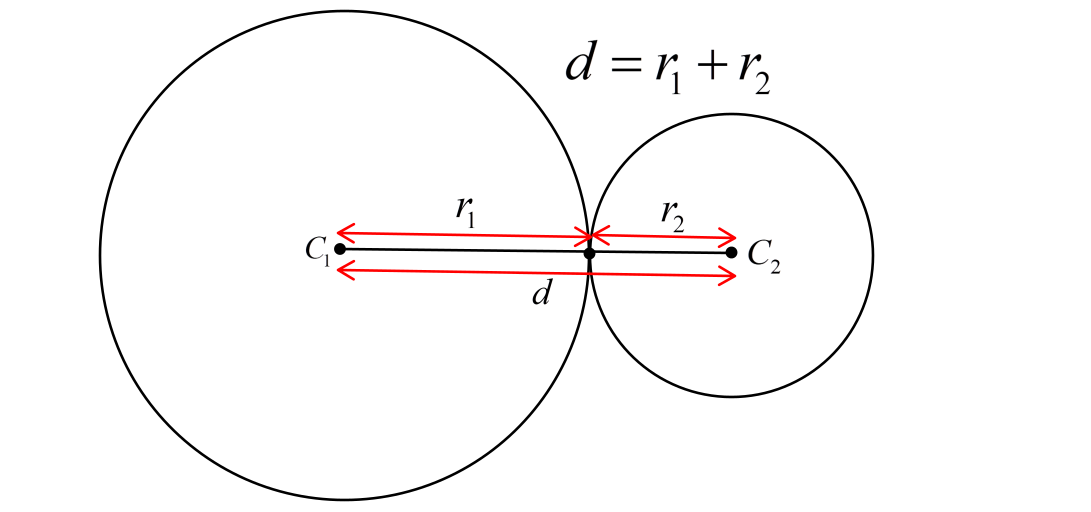
Case II: The circles touch each other externally
When the circles are brought closer so that they just touch at one point externally, then
d=r1+r2
The point of contact lies on the line joining the centres.
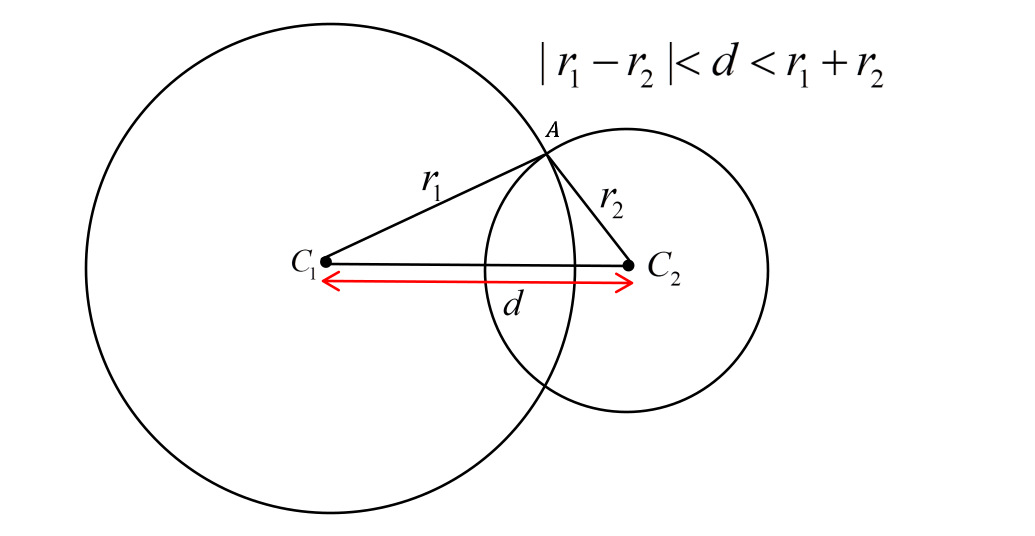
Case III: The circles intersect at two distinct points
In this case, the circles overlap partially. This happens when:
∣r1−r2∣<d<r1+r2
The condition d<r1+r2 ensures that the circles are close enough to interact, but we must also have d>∣r1−r2∣, else one circle may lie completely inside the other or touch it internally. The need for this second inequality becomes clearer when compared with the next two cases.
We can interpret this case from a different perspective—using triangle geometry.
Suppose the circles S1 and S2 intersect at two distinct points. Let A be one such point of intersection. Then the triangle △C1AC2 is formed, where C1A=r1 and C2A=r2. The side C1C2 is the distance between the centres, denoted by d.
Since △C1AC2 is a genuine triangle (i.e., not degenerate), the triangle inequality must hold for the three sides r1,r2,d:
r1+r2r1+dr2+d>d>r2>r1(1)(2)(3)
From inequalities (2) and (3), we get:
dd>r2−r1>r1−r2(4)(5)
Taken together, these imply:
d>∣r1−r2∣(6)
Combining this with inequality (1), we conclude that the necessary and sufficient condition for two circles to intersect at two distinct points is:
∣r1−r2∣<d<r1+r2
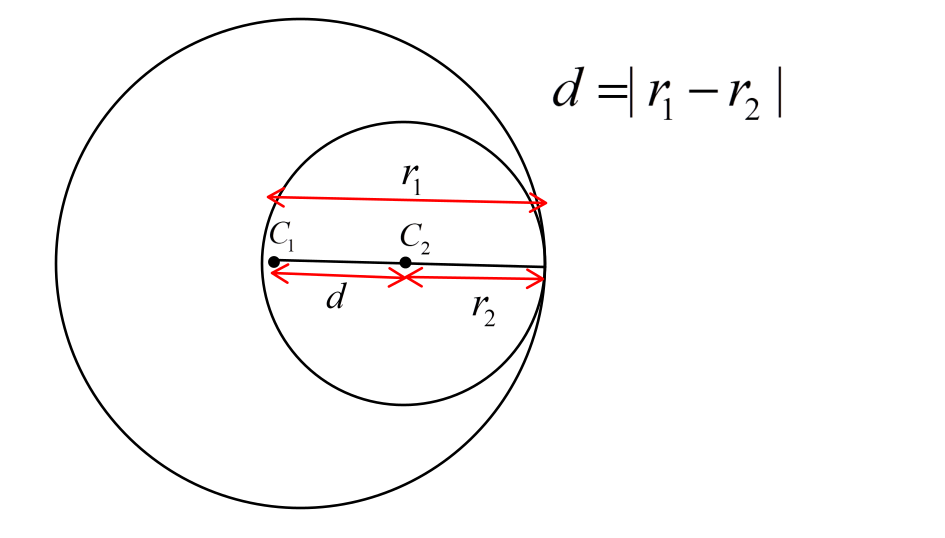
Case IV: The circles touch each other internally
Suppose without loss of generality that r1>r2. Then the smaller circle lies entirely within the larger and they touch at exactly one point. The centres lie on the same line through the point of contact, and
d=r1−r2or more generally,d=∣r1−r2∣
This is a limiting case just like Case II, but from the inside.
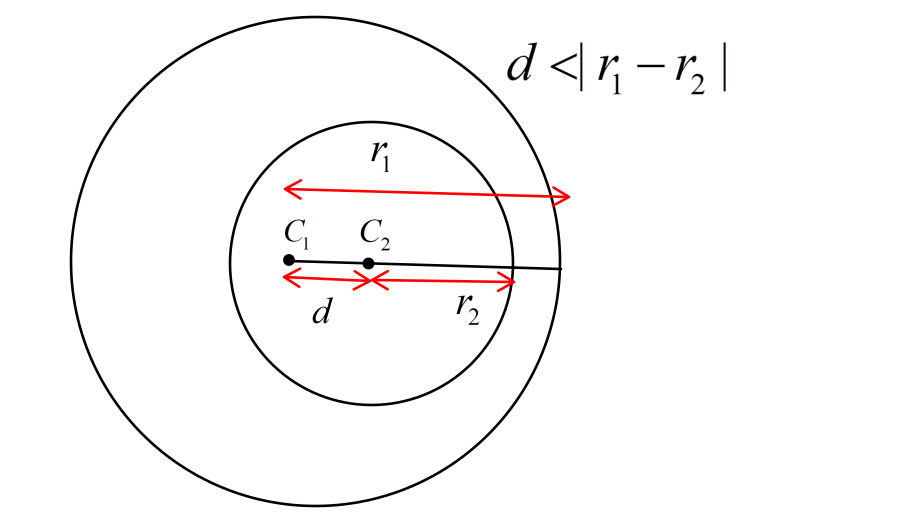
Case V: One circle lies completely inside the other
Now the circles do not touch and one is entirely inside the other. The distance between the centres is strictly less than the difference of the radii:
d<∣r1−r2∣
From these observations, we note that the condition d<r1+r2 alone is not enough to ensure that the circles intersect. It is satisfied in Cases III, IV, and V, but only in Case III do the circles actually intersect at two distinct points. Therefore, to ensure that circles cut each other,
When two circles intersect each other at two points, one natural question arises: at what angle do they intersect?
To recall, the angle of intersection of two curves at a common point is defined as the angle between their tangents drawn at that point. In general, for arbitrary curves, one standard method to compute this angle uses calculus: find the point of intersection, differentiate both curves to obtain the slopes m1 and m2 of the tangents at that point, and then apply the angle formula
tanθ=1+m1m2m1−m2
However, in the case of circles, this method becomes unnecessarily tedious. The calculation of intersection points and then the implicit differentiation of each circle, followed by finding slopes at points of intersection, introduces avoidable complexity.
Instead, we shall use a far more elegant and geometrical method for circles.
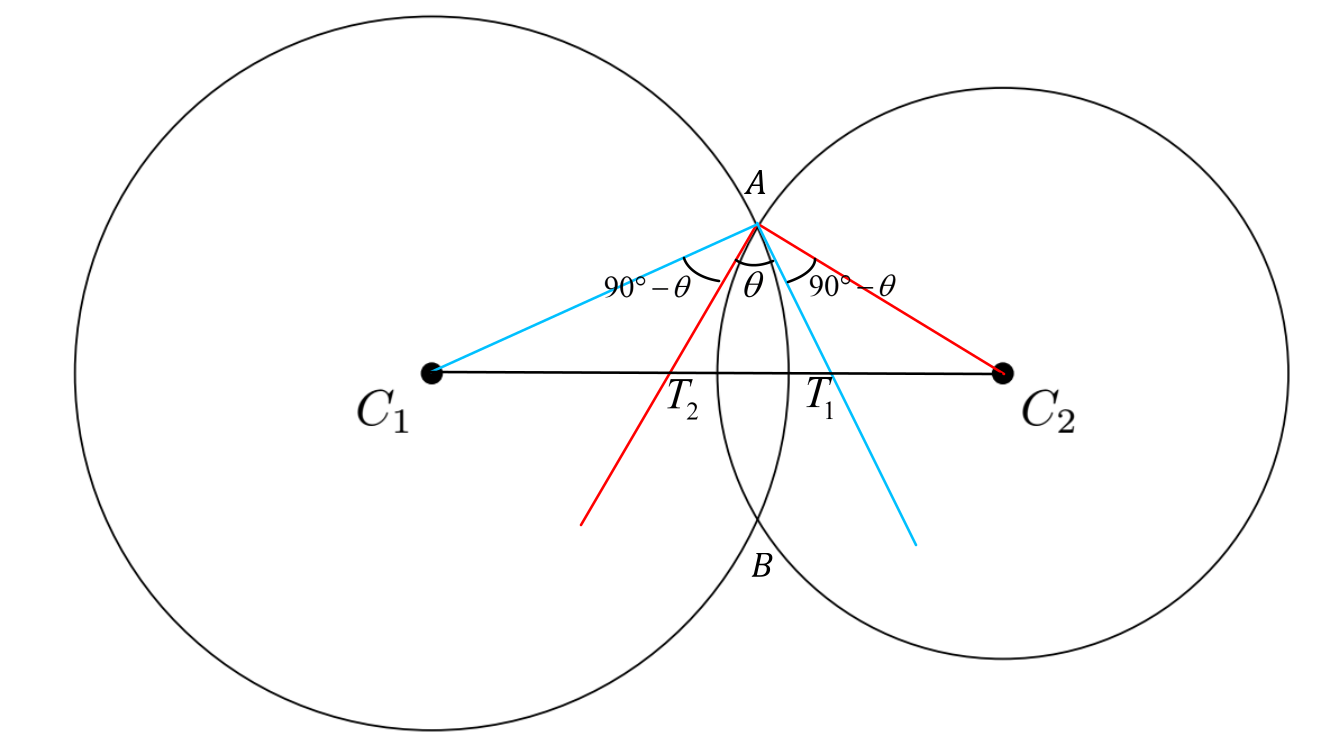
Suppose two circles S1 and S2 with centres C1 and C2, and radii r1 and r2, intersect at two distinct points A and B. Let the distance between their centres be denoted by d=C1C2. Due to symmetry, the angle of intersection is the same at both points A and B. We focus on point A.
Join the radii C1A and C2A. At point A, draw tangents to both circles, say AT1 and AT2, such that AT1 is tangent to S1 and AT2 is tangent to S2. Let θ be the angle between these two tangents. Then, by the geometry of a circle, each tangent is perpendicular to the radius drawn to the point of contact. Hence,
When two circles intersect orthogonally, the angle of intersection θ is 90∘. From the previous formula for angle of intersection:
cosθ=2r1r2d2−r12−r22
orthogonality implies θ=90∘⇒cosθ=0. Substituting:
2r1r2d2−r12−r22=0⟹d2=r12+r22
This gives a necessary and sufficient condition for orthogonality of intersecting circles in terms of their centres and radii.
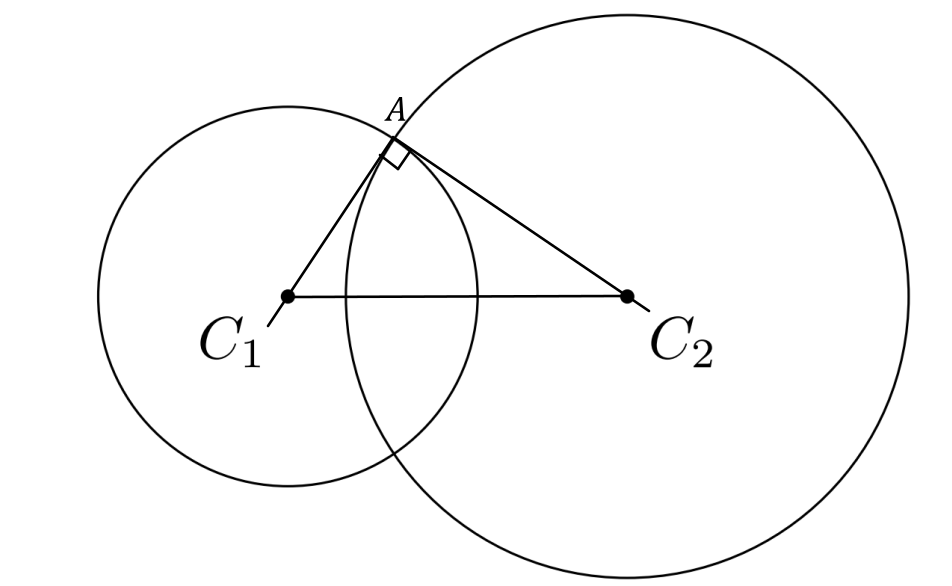
We can also see this geometrically. Let the circles S1 and S2 intersect orthogonally at point A. The tangent to S1 at A, say AT1, is perpendicular to radius C1A. But since the circles intersect orthogonally, it can be seen that this tangent is also normal to S2. Thus, AT1 must pass through C2. By the same logic, the tangent to S2 at A passes through C1. Therefore, triangle △C1AC2 is right-angled at A. By Pythagoras:
This is a linear equation and hence represents a straight line.
To confirm that this is indeed the line AB, observe the following:
The equation S1−S2=0 is a linear equation and hence represents a straight line.
Any point P lying on both circles must satisfy both S1=0 and S2=0. Subtracting, we find S1(P)−S2(P)=0, so P satisfies the equation S1−S2=0.
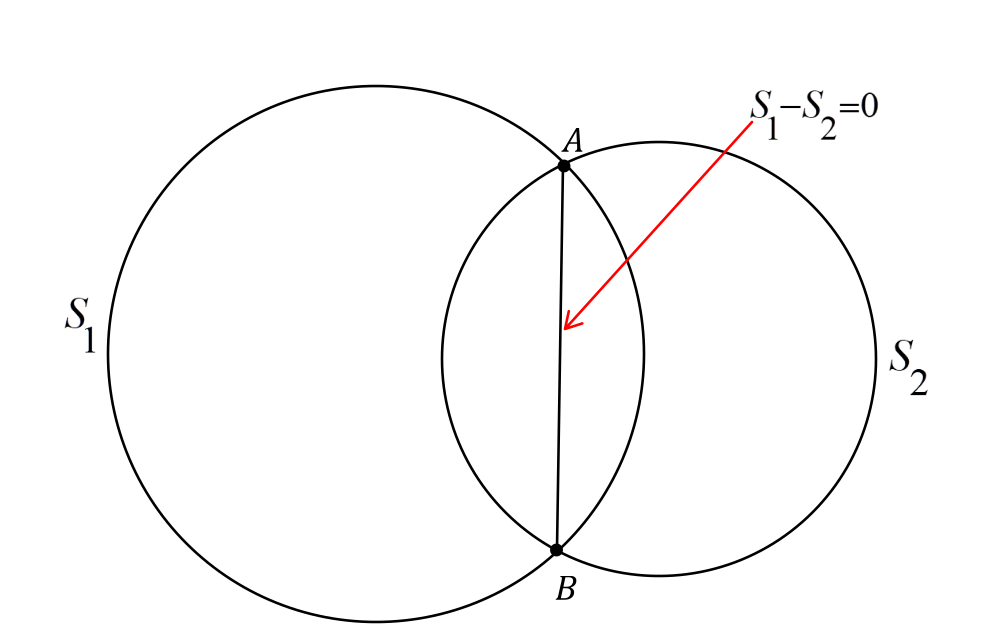
In particular, points A and B, the points of intersection, satisfy both S1=0 and S2=0, hence satisfy S1−S2=0.
Only one straight line passes through two distinct points A and B. Therefore, the line S1−S2=0 is precisely the common chord AB.
Length of the Common Chord of Two Intersecting Circles§
Let two circles intersect at points A and B. The segment AB, which lies on both circles, is called the common chord. To compute its length, we use the standard method of finding the length of a chord of a circle.
Suppose two circles S1 and S2 intersect at points A and B, with radii r1 and r2, and centres C1 and C2 respectively. Let the distance between the centres be d=C1C2. The common chord AB is bisected at right angles by the line joining the centres, so let N be the midpoint of AB, lying on both C1C2 and the chord.
By symmetry, AN=NB, so
AB=2AN
Now AN is the altitude from point A to base C1C2 in triangle △C1AC2. Hence, the area of triangle △C1AC2 is:
Area=21⋅C1C2⋅AN=21⋅d⋅AN⟹AN=d2(Area of △C1AC2)
Therefore,
AB=2AN=d4(Area of △C1AC2)
We now compute the area of triangle C1AC2 using Heron’s formula. The side lengths are:
By this, we mean that a circle S1bisects the circumference of another circle S2. That is, the two circles intersect each other at two points A and B, and the common chord AB divides the circumference of S2 into two equal arcs.
This condition implies that the chord AB, which is common to both circles, is a diameter of circle S2. Hence, the common chord passes through the centre of S2.
Let:
C1, C2 be the centres of S1, S2,
r1,r2 be their respective radii,
d=C1C2 be the distance between the centres.
Since AB is a chord of S1, the perpendicular dropped from its centre C1 to the chord will bisect it. And since AB is also a diameter of S2, the centre of S2, which is C2, lies on the chord and is its midpoint. Thus, the foot of the perpendicular from C1 to chord AB is C2.
Hence, triangle △C1AC2 is a right-angled triangle with the right angle at C2.
Therefore, by the Pythagorean Theorem:
C1A2=C2A2+C1C22⟹r12=r22+d2r12=r22+d2
This condition characterizes the case when one circle bisects another.
When two circles intersect at two distinct points A and B, the line segment AB is the common chord, and its equation is given by:
S1−S2=0
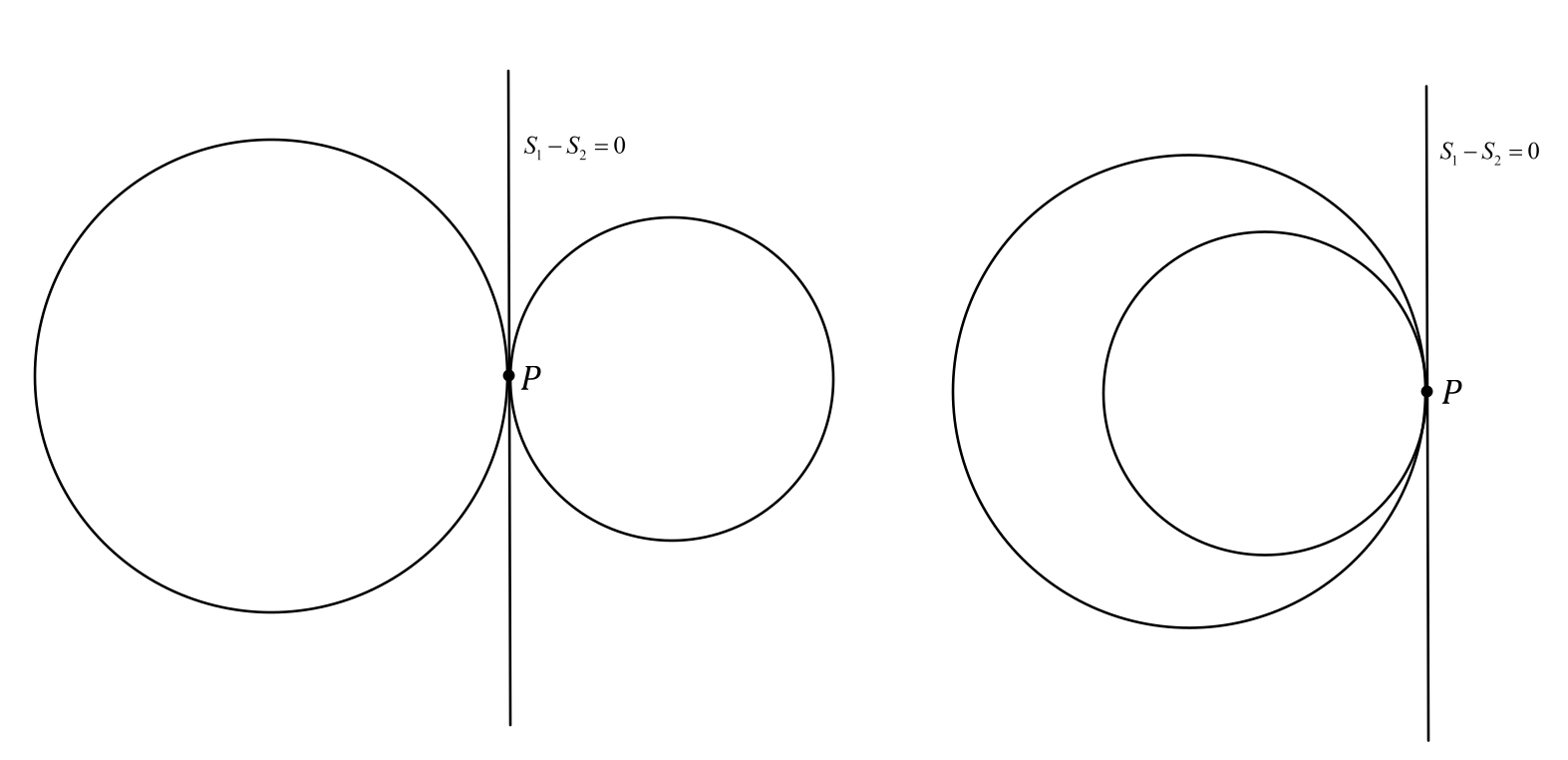
As the two circles gradually move apart, the points of intersection A and B begin to approach each other. The common chord AB becomes shorter and shorter. In the limiting case, when A and B coalesce into a single point P, the circles touch each other at exactly one point.
In this scenario, the common chord degenerates into a common tangent at the point of contact P. The equation
S1−S2=0
remains valid and now represents this common tangent. Thus, the common chord becomes the common tangent in the limiting case when the two points of intersection merge into one.
Hence, as the length of the common chord tends to zero, it transforms into the common tangent at the point where the two circles touch each other.
Section 9 of 12 · Circles
Mark this section complete when you have worked through its proofs.
Type any topic, theorem, or concept to jump directly to the section.