
Family of Circles
A family of curves in general is a set of curves satisfying some common property. All members of the family satisfy that same property. In our case, a family of circles is a set of circles satisfying some common property.
For example, consider the family of circles passing through the origin. Every member of this family passes through the origin.
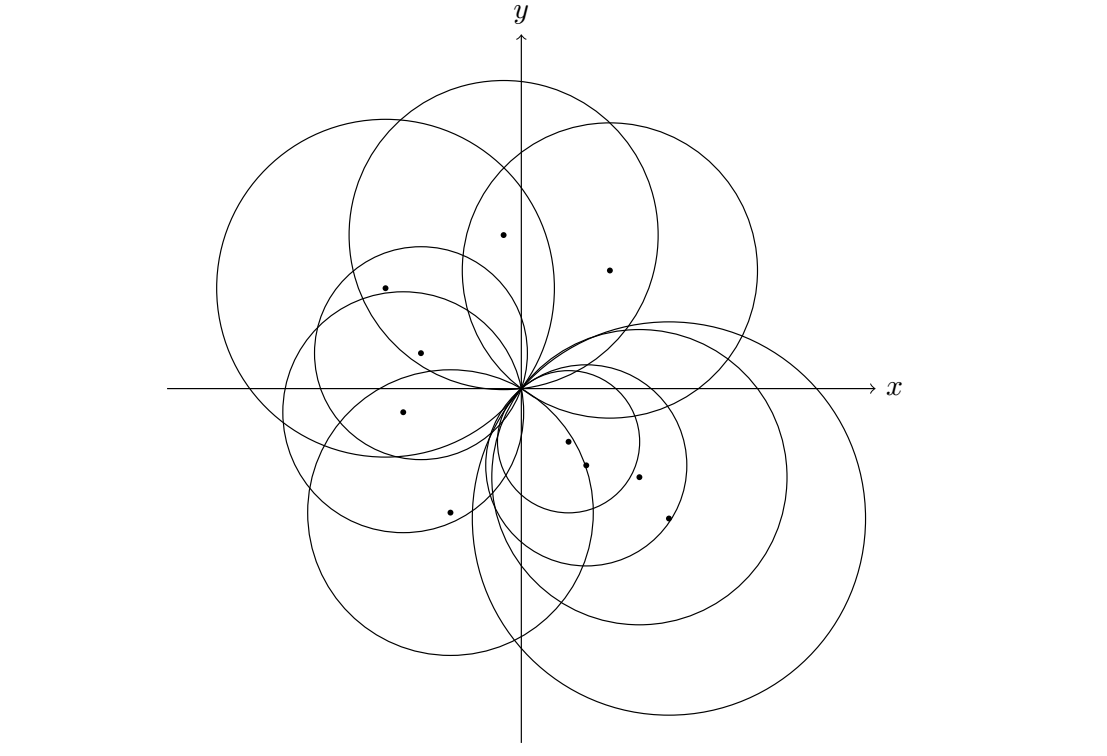
Consider an arbitrary member of this family. Its equation can be written as
Note that there is no constant term here, because any circle that passes through the origin must satisfy the condition that when , the equation holds. That is, the constant must vanish.
The centre of each such circle is . Different choices of and give different circles in the family. Thus, and are called parameters of the family.
Another example of a family: consider the family of circles touching the -axis at the origin. Every member of this family satisfies the common property that it touches the -axis exactly at the origin.
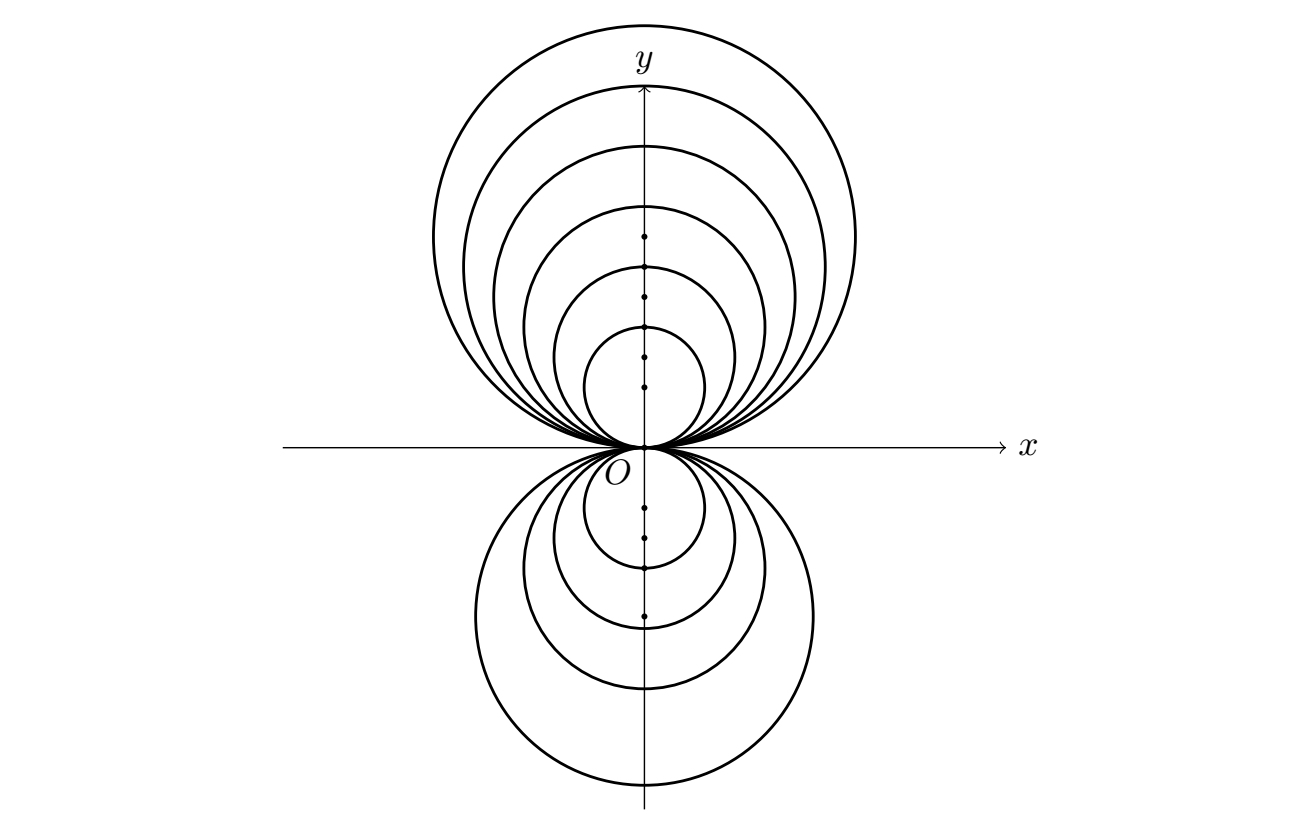
Take an arbitrary member of this family. Since it touches the -axis at the origin, its center must lie on the -axis, directly above or below the point of contact. Let the center be . Then the radius is , since the vertical distance from the center to the -axis is .
The equation of the circle becomes:
This expands to:
For each member of the family, the value of is different, hence serves as the parameter of the family. Since there is only one parameter involved, this is called a single-parameter family.
Family of circles passing through the intersection points of a fixed circle and a fixed line§
We are in this section interested in really important families that help us solve certain problems in a better and more systematic way. One of the most useful among these is the family of circles passing through the intersection points of a fixed circle and a fixed line.
Let us formalize this. Consider a fixed circle
and a fixed line
Suppose the line intersects the circle in two distinct points and . Then the family of all circles passing through both and is given by the equation:
That is,
This expands to:
which is clearly the equation of a circle for every real value of . Hence, we have a one-parameter family of circles.
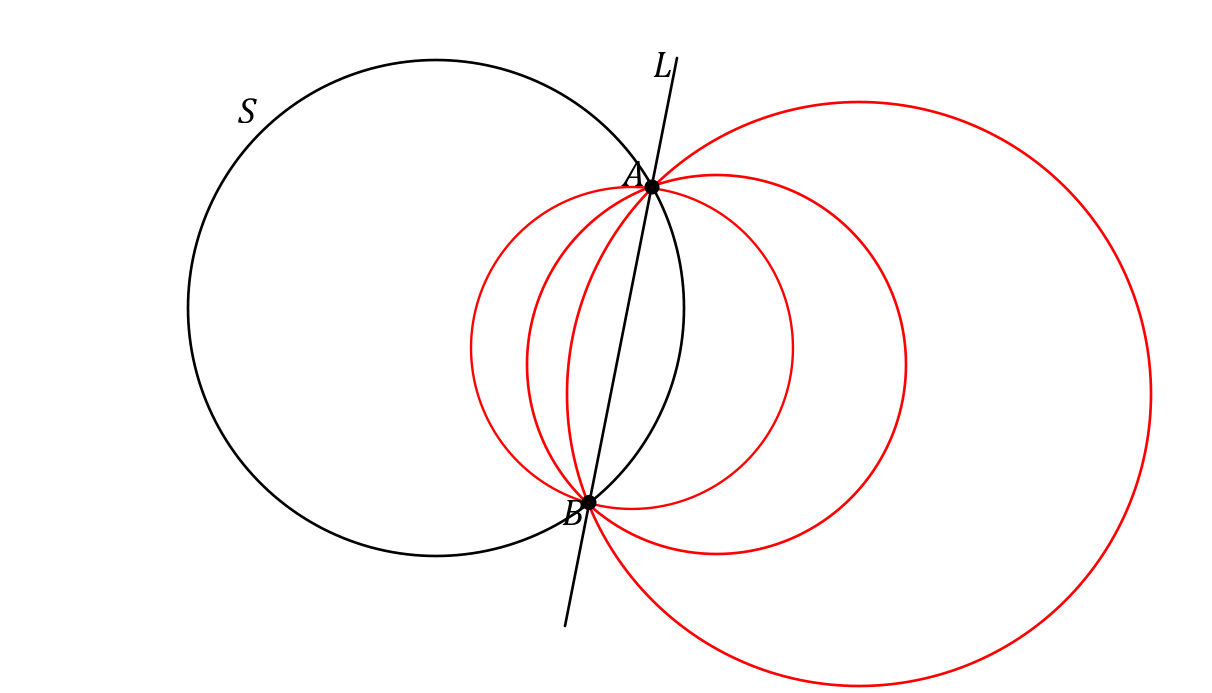
It may appear surprising that a linear combination of a circle and a line gives a circle. But the explanation is straightforward. The point , being a point of intersection of and , satisfies both equations. Hence,
for any . Similarly, also satisfies . Therefore, the curve
passes through both and for all . And for each , this is indeed a circle (since the quadratic form remains unchanged), and different values of yield different members of the family. Thus, this expression represents a family of circles passing through the fixed pair of points and .
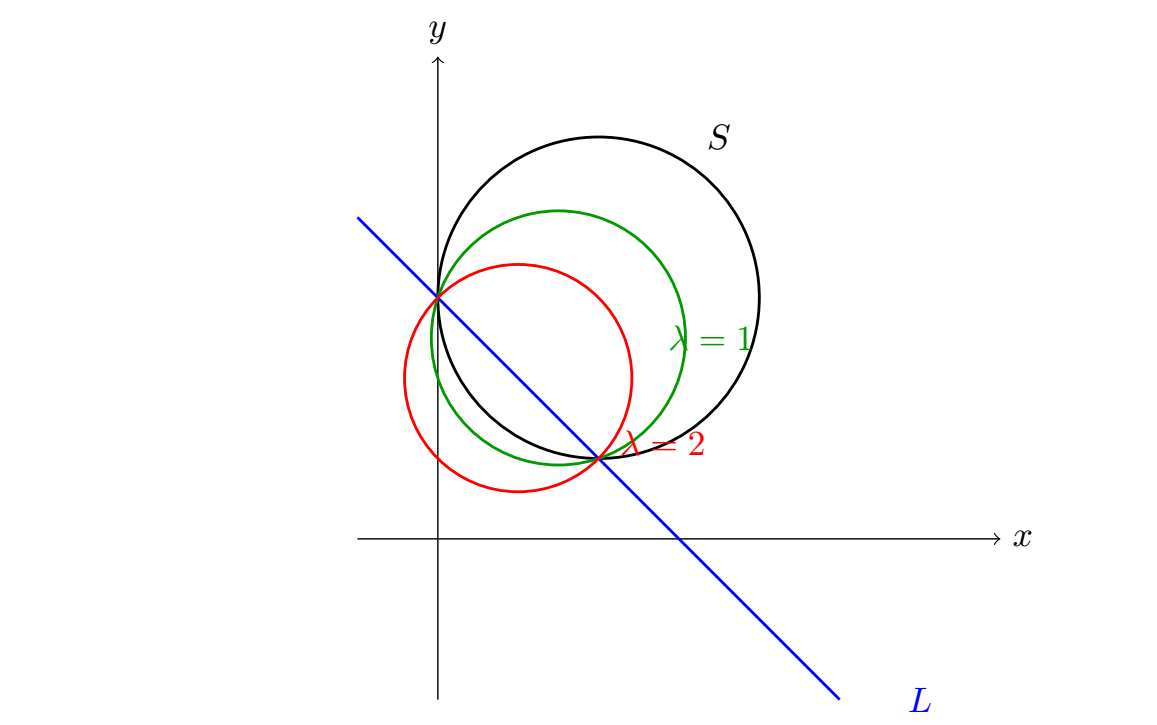
For example: consider a circle
and a line
The family of circles passing through the points of intersection of and is given by
That is,
This is the required family. We get different circles for different values of .
When , we get:
When , we get:
Each of these is a circle passing through the same two fixed points — namely the intersection points of and .
Usefulness of this family§
Let us first explore the usefulness of this family. Let us try to solve the following problem.
Problem:
Find the equation of a circle passing through the origin and also through the intersection points of the line
and the circle
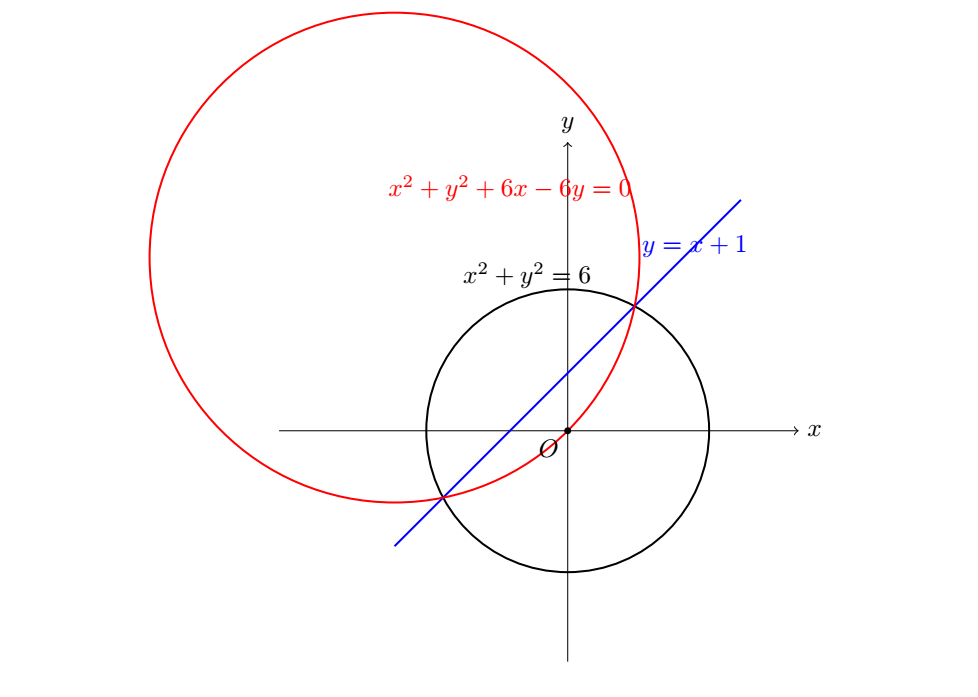
One naive approach is to first compute the points of intersection of and . Substituting into the circle’s equation:
This quadratic equation has irrational roots. Hence, the coordinates of the points and where the line and circle intersect are irrational. Though not incorrect, it becomes tedious to proceed further and find the equation of a circle passing through the origin and both these irrational points.
This is precisely where the power of the earlier concept comes in. Using the idea of a family of circles passing through the intersection points of a given line and a given circle, we avoid calculating these intersection points altogether.
We know that the family of circles passing through the intersection points of
is given by:
for some real parameter . This expression represents a family of circles passing through the two fixed points of intersection of the given line and the given circle. The require3d circle is member of this family for some value of the parameter .
To find the value of this parameter, we use the extra condition: the required circle also passes through the origin . Substituting into the general form:
Hence, the required circle has the equation:
This is the desired circle passing through the origin and through the points where the line intersects the circle , without having to compute those points explicitly.
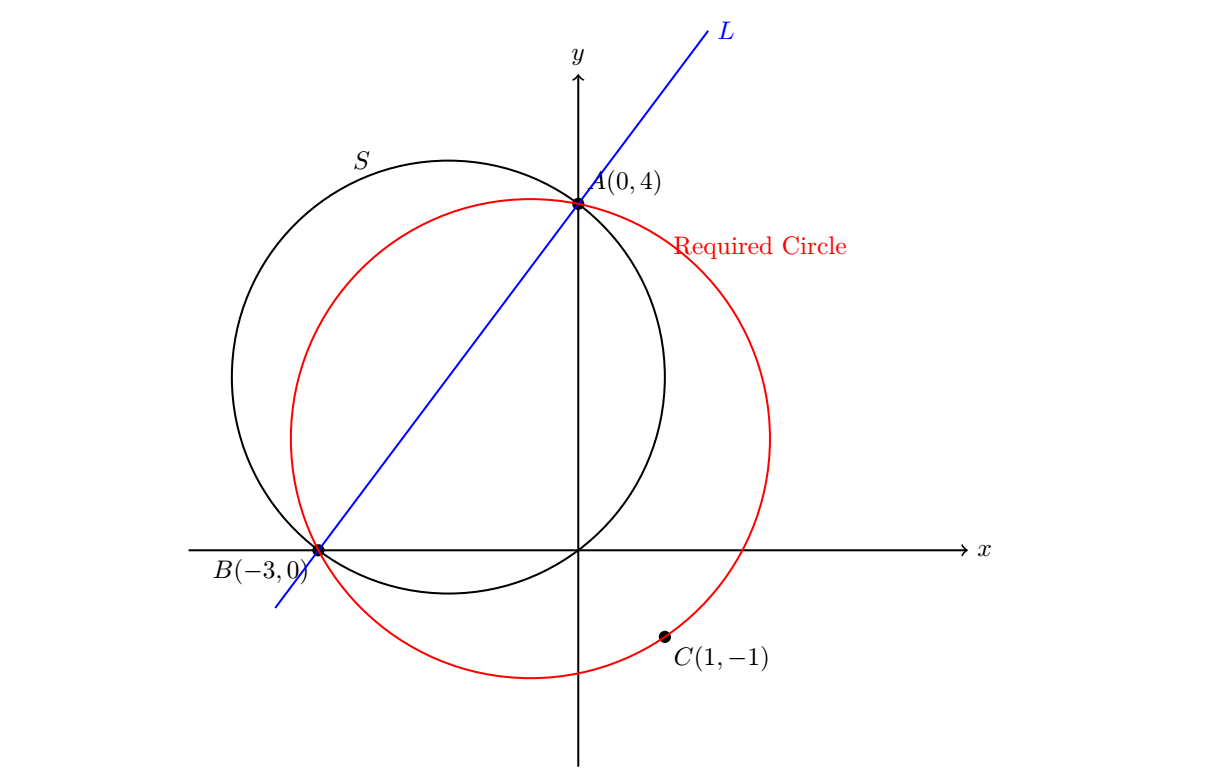
Take another example: find the equation of the circle passing through three points , , and the point .
To find the equation of this circle, we first find the equation of the circle with as diameter. The diameter endpoints are and , so the equation of the circle with diameter is:
Call this circle .
Next, the equation of the line is found using the two-point form. The slope is
Using point-slope form:
Call this line .
Then, and intersect at and . Observe that the required circle passing through , , and is a member of the family of circles passing through the fixed points of intersection of and . Therefore, the equation of the required circle is:
That is,
To find the corresponding , substitute point into the equation:
Hence, the required circle is:
Multiplying through by 19 for simplicity,
This is the required circle.
A Limiting Case§
A limiting case arises when we consider a circle and a line intersecting at two distinct points and . The family
then represents all circles passing through both and . As long as intersects at two points, the family remains a family of circles passing through these two distinct points.
Now imagine the line gradually moving such that the two points of intersection and approach each other. In the limiting case, becomes tangent to the circle , and the two points and coalesce into a single point — the point of tangency.
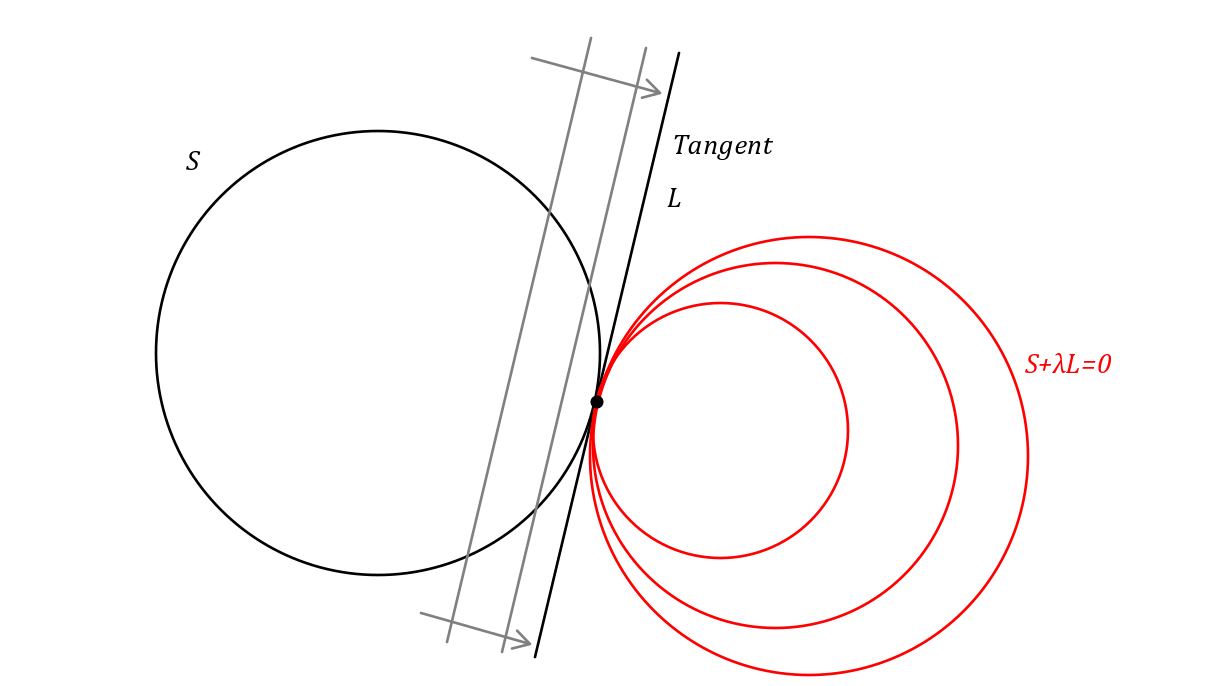
In this case, the family
becomes a family of circles that touch both and at their common point of contact. That is, each member of the family is tangent to both the circle and the line at the same point.
Thus, this limiting family describes all circles that are simultaneously tangent to and at their unique point of intersection. The concept smoothly transitions from circle through two fixed points to circle tangent at a fixed point, and the algebraic form still remains valid — now as a family of tangent circles in the limiting sense.
Family of Circles Passing Through the Intersection Points of Two Circles§
Consider two circles:
Suppose these two circles intersect at two distinct points and . Then the family of all circles passing through both and is given by the equation:
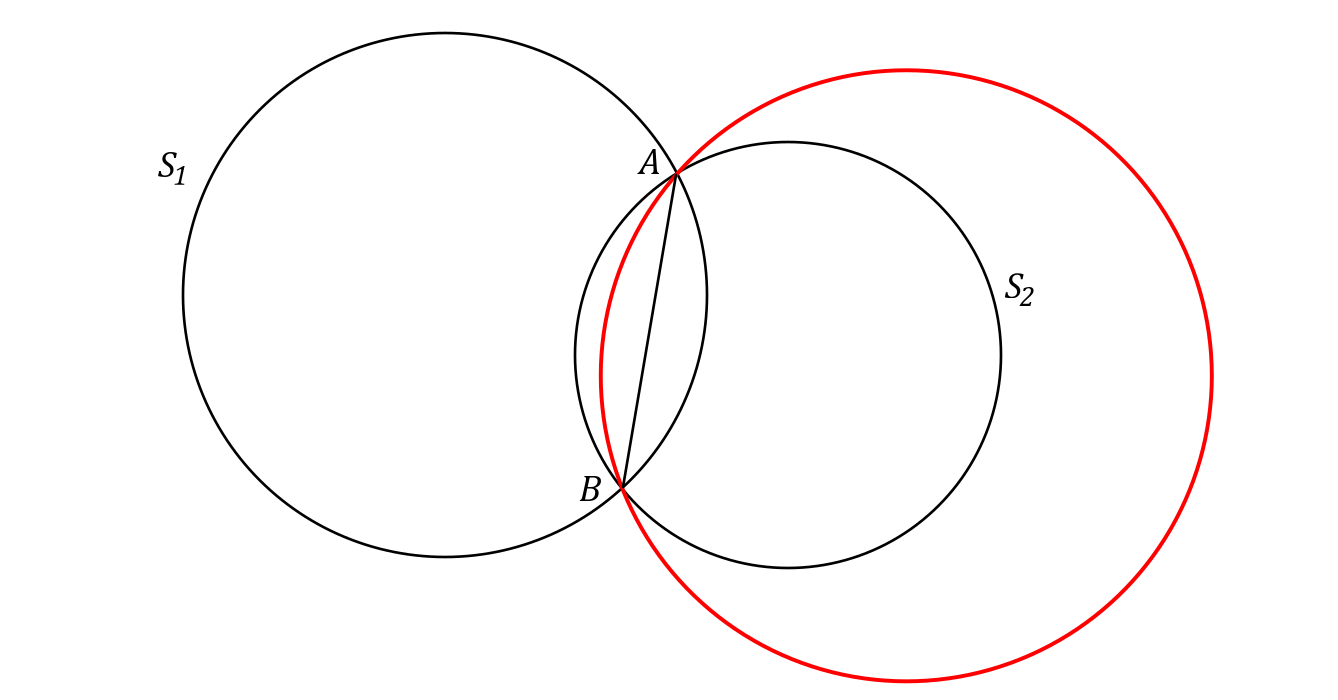
Explicitly, this becomes:
This is clearly a circle (for , else it degenerates), since the general form remains that of a second-degree equation in and with equal coefficients of and , and no -term.
Why does this pass through and ?
Since lies on both and , we have
Similarly, . Hence, every member of this family passes through both points and .
Thus, the expression
defines a one-parameter family of circles, each of which passes through the fixed intersection points and .
Another alternative form to write the equation of such a family is
This form is algebraically equivalent to the previous one, but often more convenient for computation.
To understand this, observe that the common chord of the two circles and is given by the equation:
This line passes through the intersection points and of the two circles.
Now consider the expression
This also represents the same family of circles passing through the fixed points and using the previous family of circle and line.
The advantage of using the form
is that the parameter appears only in the linear and constant terms, since contains no quadratic terms. This often simplifies computations, especially when one wants to impose an extra condition (like passing through a third point), since only linear terms and constants are involved in solving for .
Family of Circles Touching a Straight Line at a Given Point on the Line§
Let us consider a straight line
and a fixed point lying on it. We are interested in the family of all circles that touch the line at the point — that is, all circles tangent to the line at a fixed point on it.
The general equation of such a family is:
where is the parameter of the family.
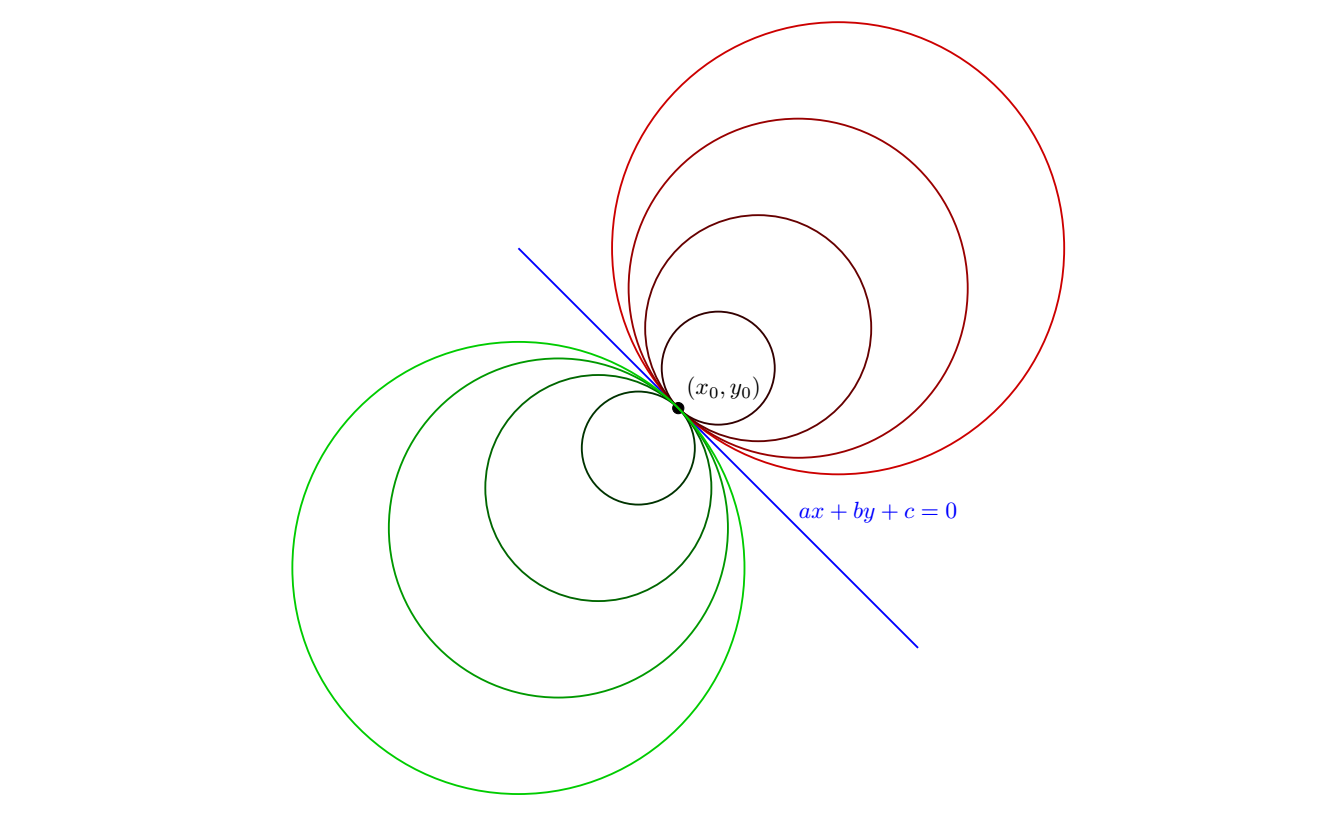
Justification:
Let us consider the standard circle
which is a circle centered at , and
as the line. Since , the circle and line intersect at that point.
The general family of circles passing through the point of intersection of the circle and line is given by:
Now consider the limiting case as . The circle becomes a point circle concentrated at , and the expression
becomes:
This now represents a family of circles all tangent to the line at the fixed point . Each member has its center lying off the line but positioned in such a way that the circle just touches the line at .
The parameter adjusts the position of the center and the radius accordingly, while maintaining the tangency condition at the fixed point.
Thus,
is the required one-parameter family of circles tangent to the line at the fixed point on it.
Family of Circles Passing Through Two Fixed Points§
Consider two distinct fixed points and . The family of all circles passing through both and is given by the equation:
This expression defines a one-parameter family of circles depending on .
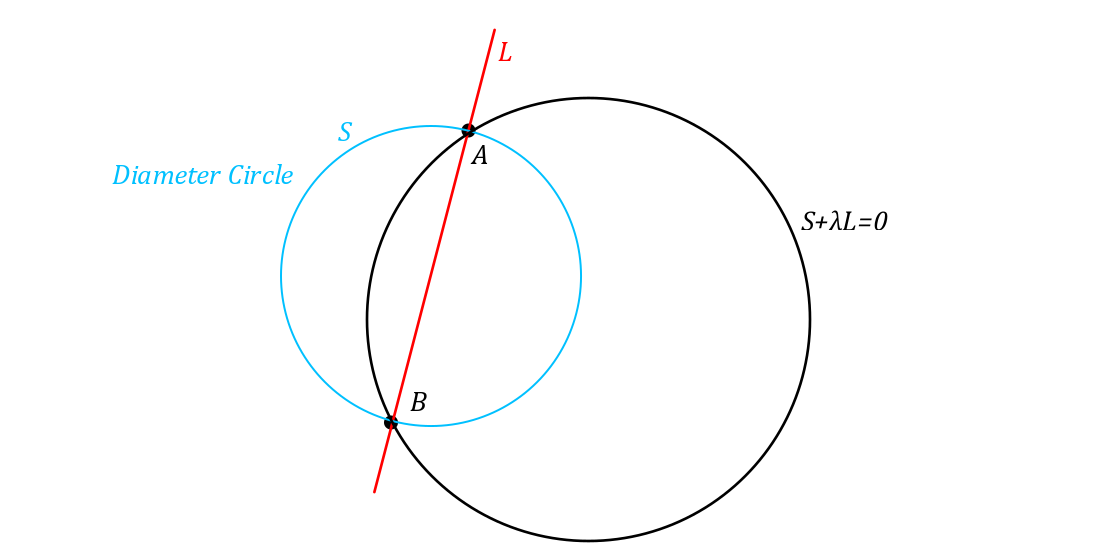
To understand why this represents the correct family, observe the following:
Let
This is the equation of the circle with segment as diameter.
Next, let
This determinant vanishes exactly when lies on the line passing through and . Hence, is the line written in determinant form.
Clearly, both and intersect exactly at points and . Therefore, the expression
describes a family of circles passing through the common intersection points of the circle and the line , which are the fixed points and .
This family is elegant because:
– The term gives the base circle with diameter ,
– The term introduces the flexibility to rotate and vary the family while maintaining passage through and ,
– The determinant form is algebraically convenient and geometrically meaningful.
Thus,
represents the required family of all circles through two fixed points and .
Mark this section complete when you have worked through its proofs.