MatheramaMatherama
← Straight Lines
Straight Lines·Section 8·6 min read

Optimization

The Shortest Path§

alt text

Consider a line LL with the equation:

ax+by+c=0a x + b y + c = 0

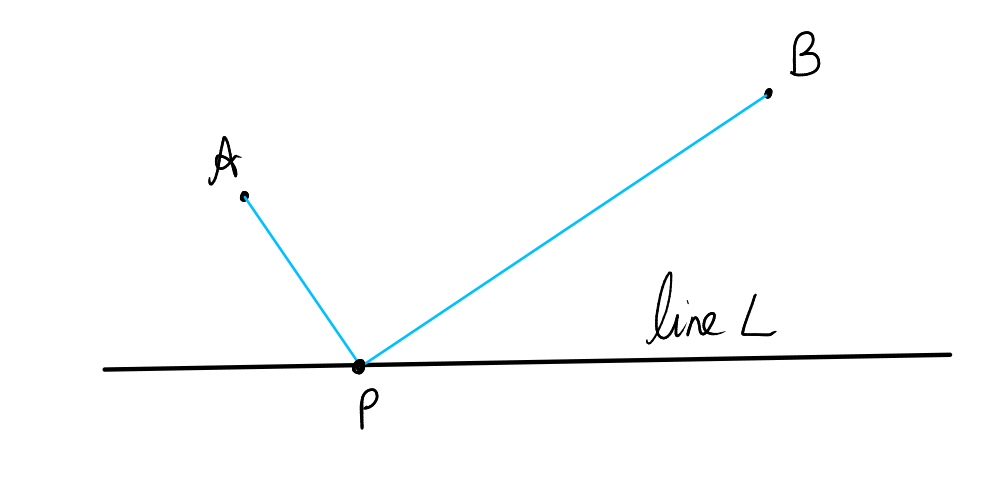
Suppose there are two points AA and BB on the same side of line LL. We wish to find a point PP on line LL such that the total distance AP+PBAP + PB is minimized. In simple words, we want to find the location of PP on LL such that the path from AA to BB via PP is the shortest.

Theorem: Given a line L:ax+by+c=0L: a x + b y + c = 0 and two points AA and BB on the same side of LL, the point PP on LL that minimizes the total distance AP+PBAP + PB is the intersection of LL with the line segment joining AA and the reflection B′B' of BB across LL.

Fermat's Principle:§

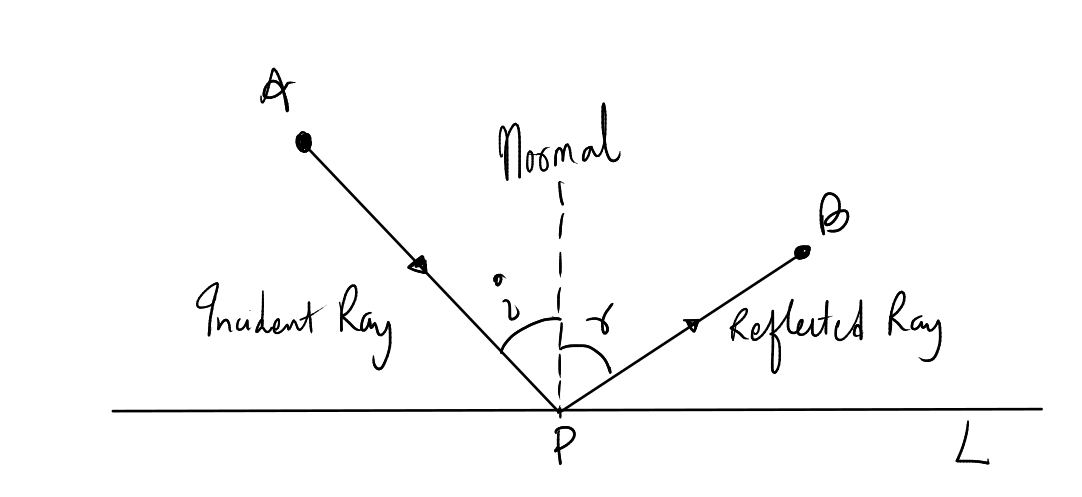
Fermat's principle states that the path taken by a ray of light between two points is the one that can be traversed in the least time.

If a ray of light starts from point AA and strikes a mirror LL at point PP to reach point BB, then point PP is such that the total distance AP+PBAP + PB is minimized. Thus, to minimize AP+PBAP + PB, we follow the path of light, ensuring it adheres to Fermat's principle of least time. This means the angles of incidence and reflection are equal, confirming that the path taken is indeed the shortest.

A ray reflection a mirror

Two Mirrors§

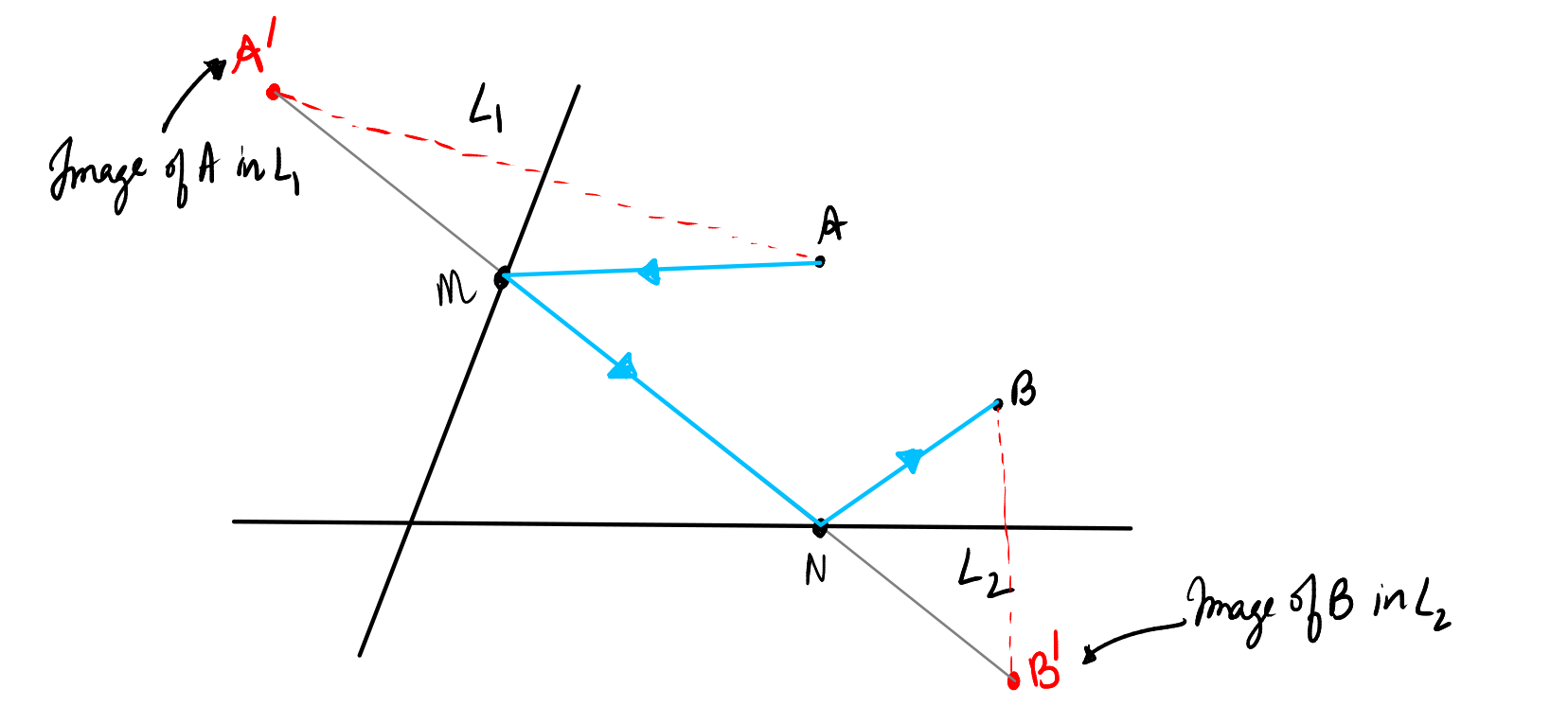
Two Mirrors shortest path

Consider two lines L1L_1 and L2L_2 intersecting at an acute angle. Let points AA and BB lie in the acute region formed by L1L_1 and L2L_2. We aim to determine the points MM on L1L_1 and NN on L2L_2 such that the total path length AM+MN+NBAM + MN + NB is minimized. This is equivalent to finding the shortest path from AA to BB via points MM on L1L_1 and NN on L2L_2.

To achieve this, we trace the path of light, which follows the principle of reflection. Reflect point AA across line L1L_1 to obtain its image A′A'. Similarly, reflect point BB across line L2L_2 to obtain its image B′B'. Draw a straight line connecting A′A' and B′B'. This line intersects L1L_1 at point MM and L2L_2 at point NN.

Thus, the points MM and NN where the line segment A′B′A'B' intersects L1L_1 and L2L_2, respectively, are the optimal locations that minimize the total path length AM+MN+NBAM + MN + NB.

Least Perimeter

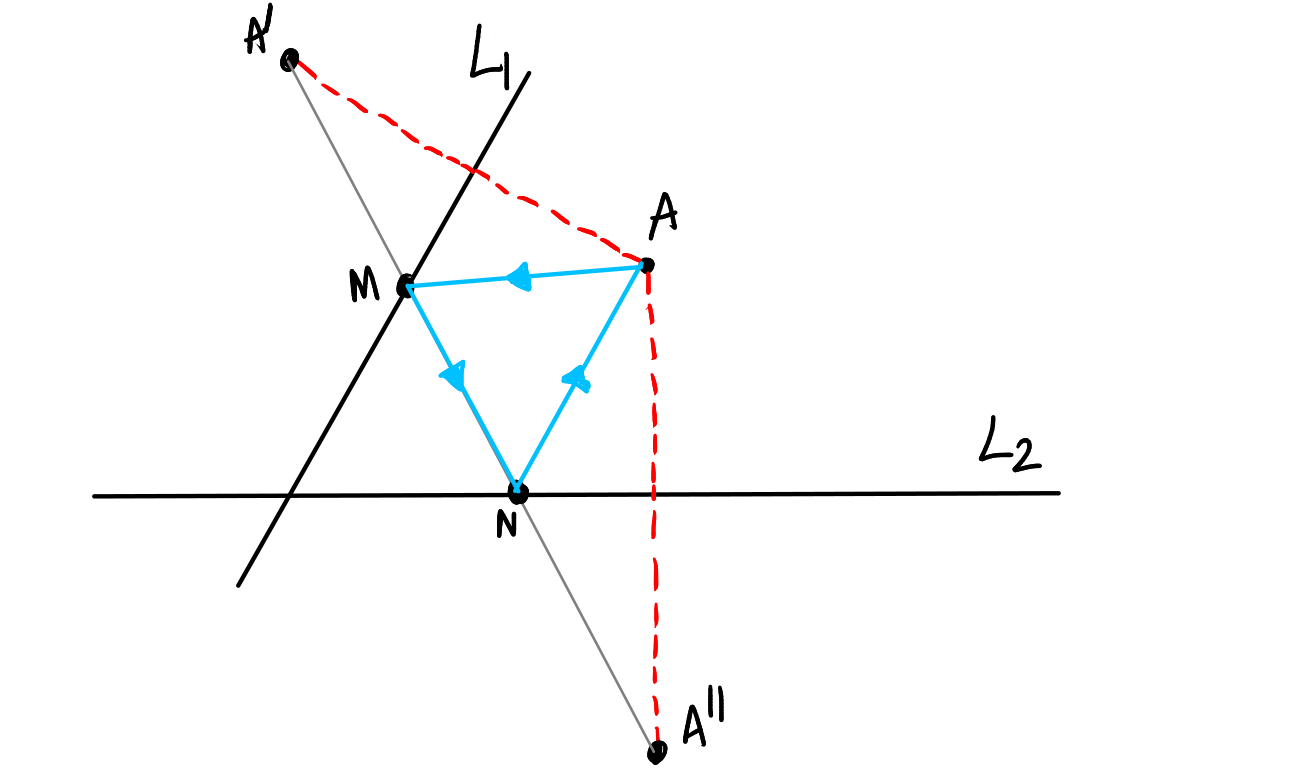
Given points AA and BB on the xx-axis and line y=2xy = 2x respectively, such that the perimeter of triangle ABCABC with C(3,4)C(3, 4) is minimized.

Solution:

We follow the light path. A ray of light starting from CC and coming back to CC after reflection from the xx-axis and y=2xy = 2x.

Step 1: Find the images of CC

The image of CC in the xx-axis is C′(3,−4)C'(3, -4).

For the image of CC in y=2xy = 2x, we use the reflection formula:

x−32=y−4−1=−2(6−4)5=−45\frac{x - 3}{2} = \frac{y - 4}{-1} = -\frac{2(6 - 4)}{5} = -\frac{4}{5}   ⟹  x−3=2(−45)=−85  ⟹  x=75\implies x - 3 = 2\left(-\frac{4}{5}\right) = -\frac{8}{5} \implies x = \frac{7}{5}   ⟹  y−4=−(−45)=45  ⟹  y=245\implies y - 4 = -\left(-\frac{4}{5}\right) = \frac{4}{5} \implies y = \frac{24}{5}

Thus, the image C′′C'' is (75,245)\left(\frac{7}{5}, \frac{24}{5}\right).

Step 2: Equation of the line joining C′C' and C′′C''

Using points C′(3,−4)C'(3, -4) and C′′(75,245)C''\left(\frac{7}{5}, \frac{24}{5}\right), the slope mm is:

m=245+475−3=245+20575−155=445−85=−112m = \frac{\frac{24}{5} + 4}{\frac{7}{5} - 3} = \frac{\frac{24}{5} + \frac{20}{5}}{\frac{7}{5} - \frac{15}{5}} = \frac{\frac{44}{5}}{-\frac{8}{5}} = -\frac{11}{2}

Thus, the equation of the line is:

y+4x−3=−112\frac{y + 4}{x - 3} = -\frac{11}{2}   ⟹  2(y+4)=−11(x−3)\implies 2(y + 4) = -11(x - 3)   ⟹  2y+8=−11x+33\implies 2y + 8 = -11x + 33   ⟹  11x+2y=25\implies 11x + 2y = 25

Step 3: Find intersection points AA and BB

For AA on the xx-axis (y=0y = 0):

11x+2(0)=2511x + 2(0) = 25   ⟹  x=2511  ⟹  A=(2511,0)\implies x = \frac{25}{11} \implies A = \left(\frac{25}{11}, 0\right)

For BB on the line y=2xy = 2x:

11x+2(2x)=2511x + 2(2x) = 25   ⟹  11x+4x=25\implies 11x + 4x = 25   ⟹  15x=25\implies 15x = 25   ⟹  x=53  ⟹  y=2x=103\implies x = \frac{5}{3} \implies y = 2x = \frac{10}{3}

Thus, B=(53,103)B = \left(\frac{5}{3}, \frac{10}{3}\right).

Therefore, the points AA and BB that minimize the perimeter of triangle ABCABC are A=(2511,0)A = \left(\frac{25}{11}, 0\right) and B=(53,103)B = \left(\frac{5}{3}, \frac{10}{3}\right).

Section 8 of 8 · Straight Lines

Mark this section complete when you have worked through its proofs.