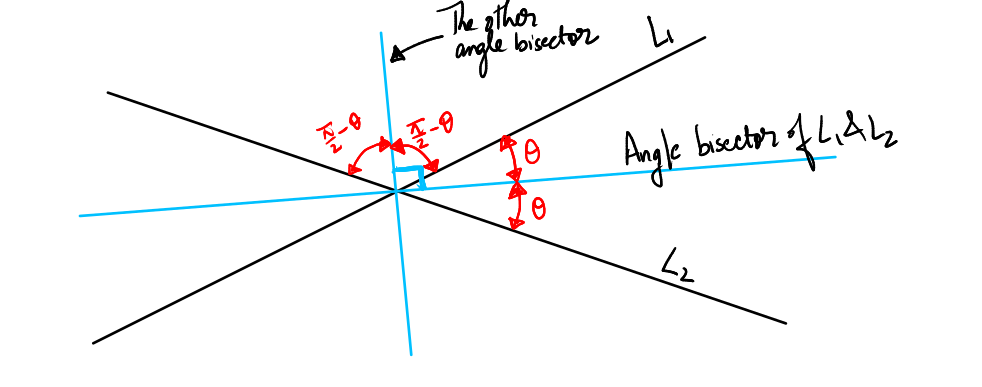
An angle bisector of L1 and L2 is a line that passes through the point P and divides the angle between L1 and L2 into two equal parts.
There are two angle bisectors for these lines: one that bisects the acute angle between L1 and L2, and another that bisects the obtuse angle, being perpendicular to the first.
The equations of the angle bisectors can be expressed as:
This formula captures both angle bisectors: the positive sign corresponds to one bisector, and the negative sign corresponds to the other bisector.
The accompanying diagram visually demonstrates the angle bisectors of L1 and L2. These bisectors intersect the lines at the point P and split the angles formed by the intersection into two equal angles, clearly illustrating their geometric properties.
From the formula for the angle bisectors, we obtain two equations. One corresponds to the acute angle bisector, and the other to the obtuse angle bisector. In problems, it is often necessary to determine which equation represents which bisector. Let us explore how to distinguish between them.
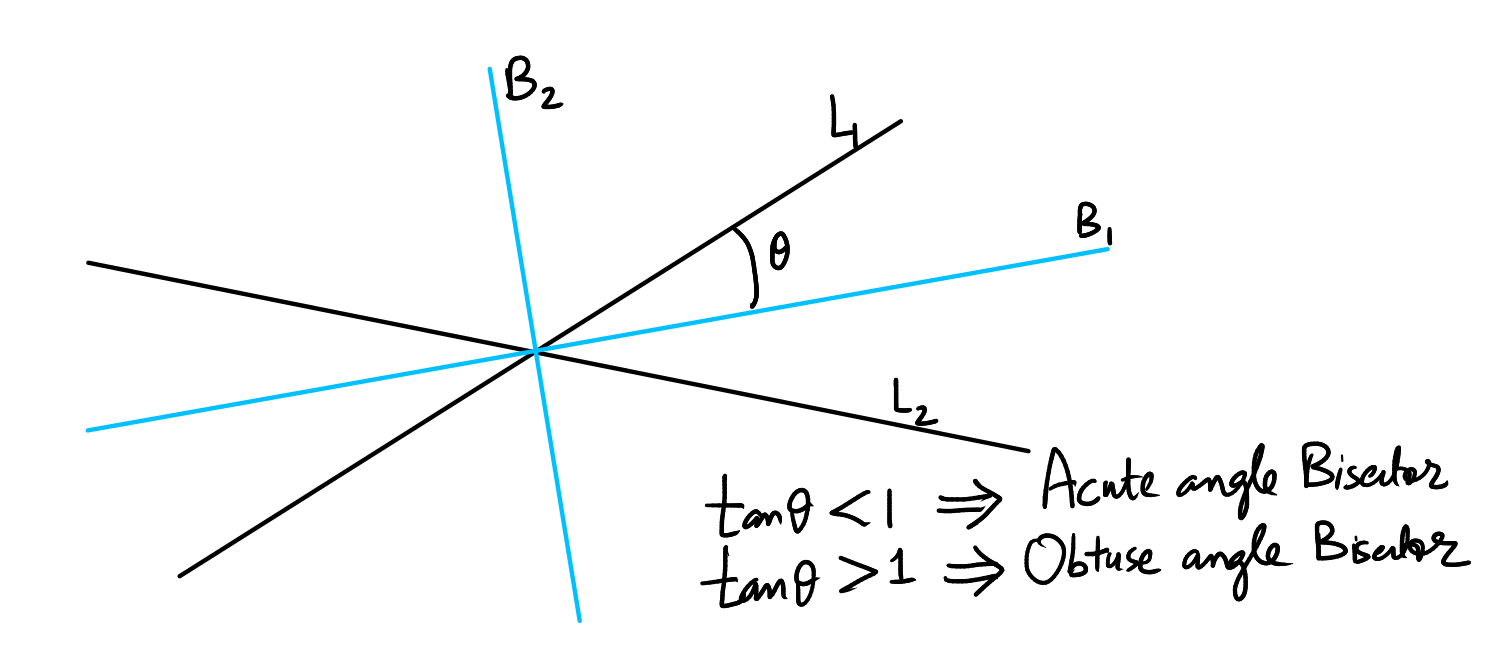
One simple method is based on the following idea: Let B1 and B2 be the bisectors of L1 and L2. Find the angle between any one of the bisectors and one of the lines, say B1 and L1.
If this angle is less than 45∘, then B1 must be the acute angle bisector, and correspondingly, B2 is the obtuse angle bisector. Conversely, if this angle is greater than 45∘, B1 is the obtuse angle bisector, and B2 is the acute angle bisector.
Since we typically calculate angles using the tangent formula, we can rephrase this method. If the tangent of the angle between B1 and L1 is less than 1, then B1 is the acute angle bisector. If the tangent is greater than 1, B1 is the obtuse angle bisector.
This approach provides a straightforward way to determine which bisector equation corresponds to the acute or obtuse angle bisector.
Location of the Origin with Respect to Two Intersecting Lines§
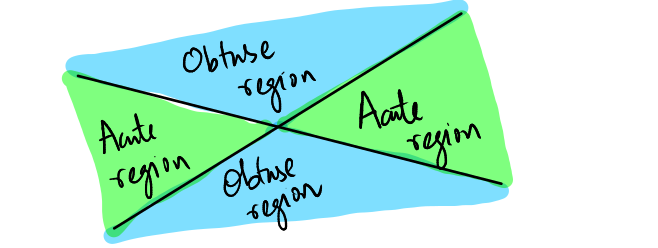
Two intersecting lines divide the Cartesian coordinate system into two distinct regions: the acute angle region and the obtuse angle region.
The acute angle region is formed by the smaller angle at the intersection of the two lines, while the obtuse angle region is formed by the larger angle. These regions are visually represented in the diagram below:
The acute angle regions are shaded in green.
The obtuse angle regions are shaded in blue.
Understanding the location of the origin within these regions is crucial for various geometric and algebraic analyses. In this section, we will explore how to determine whether the origin lies in the acute or obtuse region based on the equations of the intersecting lines.
To determine whether the origin lies in the acute or obtuse region formed by the intersection of two lines, consider the given lines:
L1:a1x+b1y+c1=0L2:a2x+b2y+c2=0
Assume that c1 and c2 are negative. If they are not you can always make them negative by multiplying equations with -1.
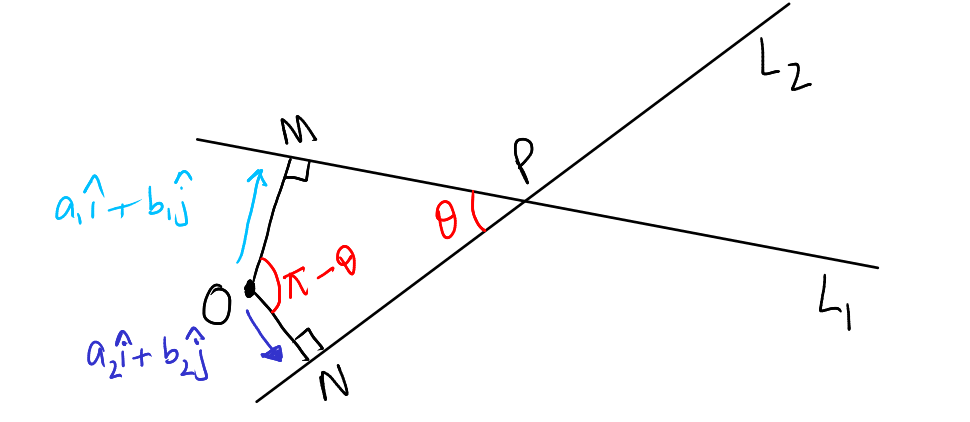
Suppose the origin lies in the acute region. To understand this, we can analyze the geometric configuration of the lines and their angle bisectors. Drop perpendiculars OM and ON from the origin O to the lines L1 and L2, respectively. Notice that the quadrilateral OMNP is cyclic because the sum of opposite angles ∠OMP and ∠ONP is 180∘.
This implies that if the angle ∠NMP=θ is acute, then the angle ∠NOM=π−θ is obtuse. This property is crucial in determining the relative position of the origin concerning the angle bisectors.
Next, we express the equations of the lines in vector form. The given equations a1x+b1y=−c1 and a2x+b2y=−c2 can be rewritten as dot products of vectors. Since c1<0 and c2<0, both equations have positive right-hand sides.
Given that θ is an acute angle, it follows that cos(θ)>0. Therefore, for cos(θ) to be positive:
a1a2+b1b2<0
From this analysis, we can conclude:
The origin lies in the acute region if a1a2+b1b2<0.
Conversely, the origin lies in the obtuse region if a1a2+b1b2>0.
This geometric and algebraic approach provides a clear method to determine the region in which the origin lies relative to the angle bisectors of the given lines.
Determining Whether the Origin Lies in the Acute or Obtuse Region§
Surprisingly, we can use the theory of location of origin to distinguish angle bisector equations.
We will decide whether the positive sign gives the acute angle bisector or the negative sign does.
Let B1 be the acute angle bisector, and let the origin O be in the acute region. Consider any point P(x,y) on the bisector B1. Since O and P are in the same region, they must lie on the same sides of both lines L1 and L2.
If P is in the other acute region, then O and P would be on opposite sides of L1 and L2. However, the same conclusions are reached, that if O and P are in the acute region, then:
Since P(x,y) lies on the bisector B1, and we have:
a1x+b1y+c1<0anda2x+b2y+c2<0
We can only take the positive sign and reject the negative sign because a number cannot equal a negative number.
Thus, we conclude that if a1a2+b1b2<0 (origin is in the acute region), then the positive sign gives the acute angle bisector, and the negative sign gives the obtuse angle bisector.
Similarly, if a1a2+b1b2>0, then the positive sign gives the obtuse angle bisector, and the negative sign gives the acute angle bisector.
When the coordinates of the vertices of a triangle are known, calculating the angle bisectors becomes a straightforward task.
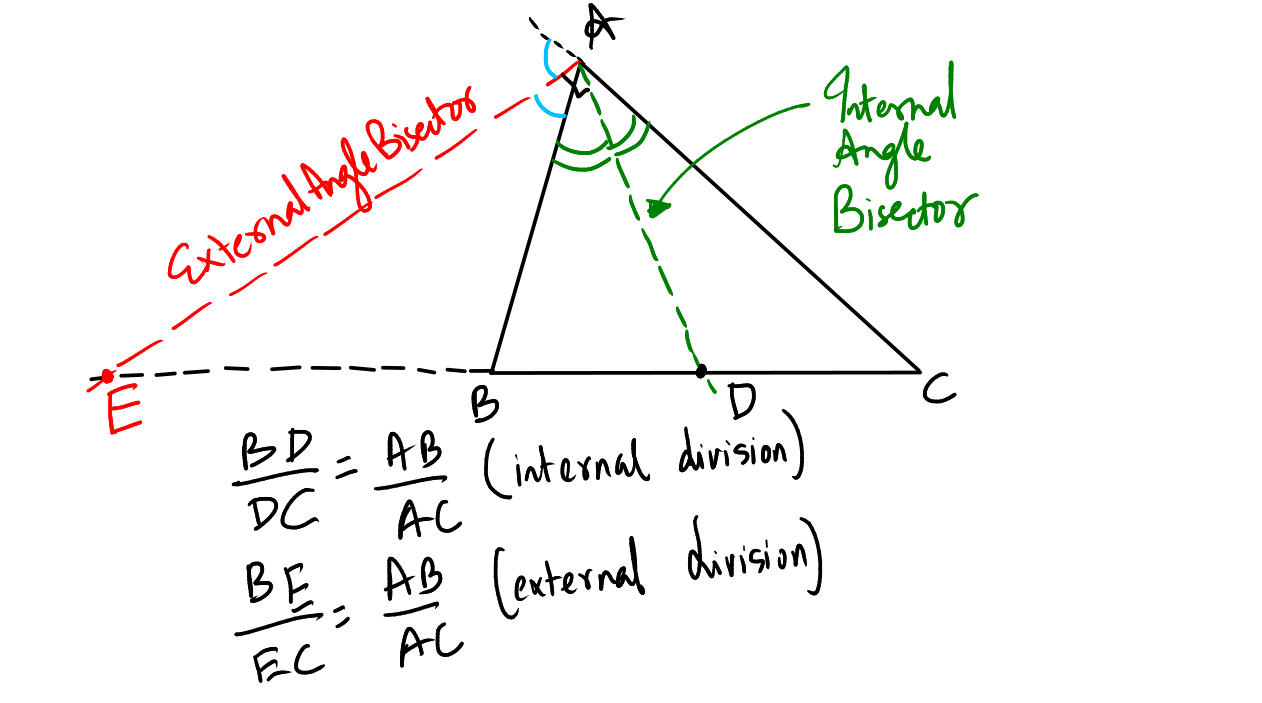
Consider a triangle ΔABC with known vertices A(x1,y1), B(x2,y2), and C(x3,y3). Using the angle bisector theorem, we can find points D and E, where the internal angle bisector of ∠A intersects the opposite side BC at D, and the external angle bisector of ∠A intersects BC at E.
By the angle bisector theorem, we know:
AD divides BC internally in the ratio ACABAE divides BC externally in the ratio ACAB
To find the coordinates of points D and E, we use the section formula. For point D, which divides BC internally, the coordinates can be calculated as:
D(AB+ACx2⋅AC+x3⋅AB,AB+ACy2⋅AC+y3⋅AB)
For point E, which divides BC externally, the coordinates are:
E(AC−ABx2⋅AC−x3⋅AB,AC−ABy2⋅AC−y3⋅AB)
Thus, using these coordinates, we can find the equations of the internal angle bisector AD and the external angle bisector AE.
Finding the Equation of the Reflected Ray in the Cartesian Coordinate System§
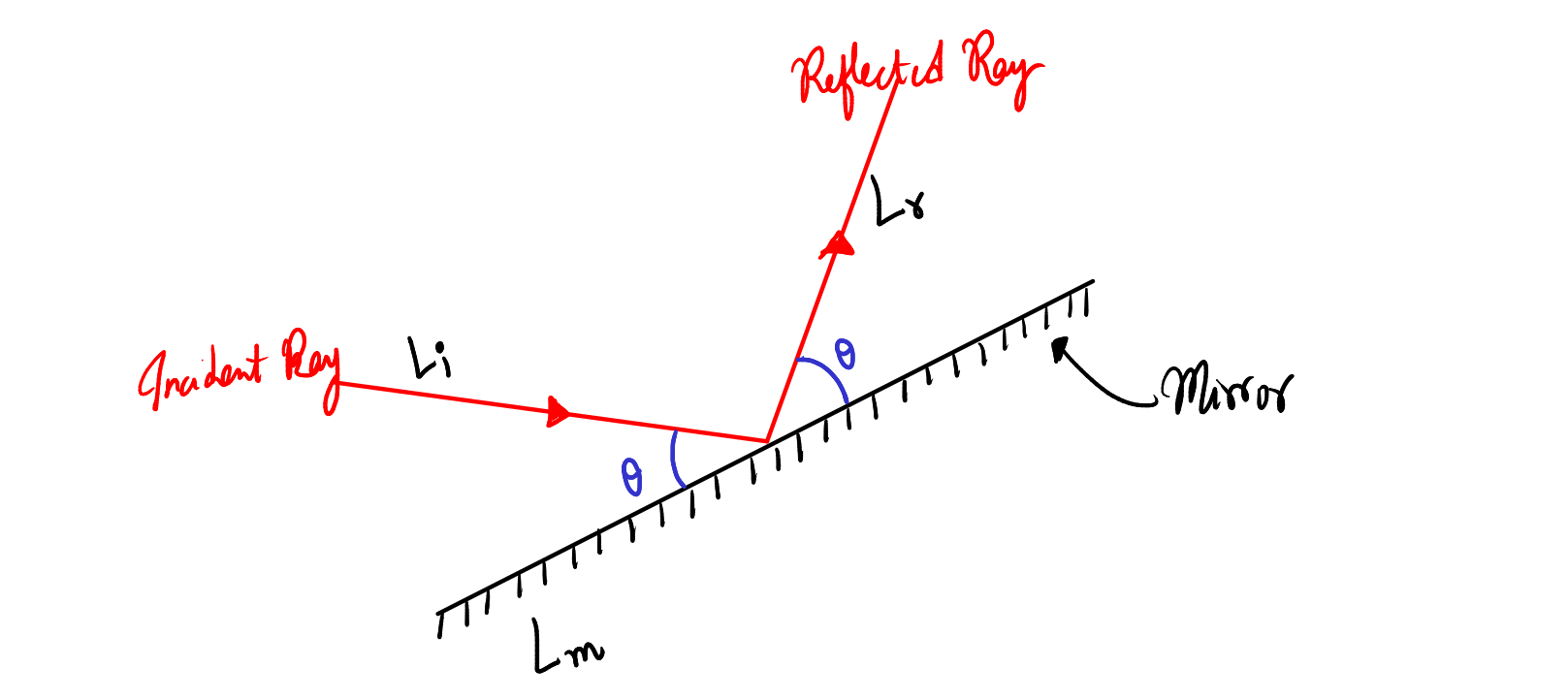
In the Cartesian coordinate system, when a ray of light strikes a mirror and gets reflected, the equation of the reflected ray can be determined using the laws of reflection and some basic geometric principles. Here, we outline the process to find the equation of the reflected ray given the equations of the mirror and the incident ray.
Steps to Find the Equation of the Reflected Ray
Identify the Mirror and the Incident Ray:
Suppose the equation of the mirror is given by:
Lm:amx+bmy+cm=0
and the equation of the incident ray is:
Li:aix+biy+ci=0
Find the Point of Incidence:
The point of incidence is where the incident ray intersects the mirror. This can be found by solving the system of linear equations:
{amx+bmy+cm=0aix+biy+ci=0
Solving these simultaneous equations will yield the coordinates (x0,y0) of the point of incidence.
Determine the Slopes:
Calculate the slopes of the mirror and the incident ray:
Slope of the mirror, mm:
mm=−bmam
Slope of the incident ray, mi:
mi=−biai
Use the Law of Reflection:
According to the law of reflection, the angle of incidence is equal to the angle of reflection. Therefore, the angle between the incident ray and the mirror is equal to the angle between the mirror and the reflected ray. Using the tangent of the angles formed between the lines, we can express this relationship as:
1+mimmmi−mm=1+mrmmmr−mm
where mr is the slope of the reflected ray.
Solve for the Slope of the Reflected Ray:
Rearrange the equation to solve for mr:
1+mrmmmr−mm=1+mimmmi−mm
This implies two possible solutions for mr, corresponding to the positive and negative cases of the absolute value. Select the appropriate mr that satisfies the geometric configuration.
Form the Equation of the Reflected Ray:
Once mr is determined, use the point-slope form to write the equation of the reflected ray passing through the point of incidence (x0,y0):
y−y0=mr(x−x0)
By following these steps, you can find the equation of the reflected ray in the Cartesian coordinate system.
Section 7 of 8 · Straight Lines
Mark this section complete when you have worked through its proofs.
Type any topic, theorem, or concept to jump directly to the section.