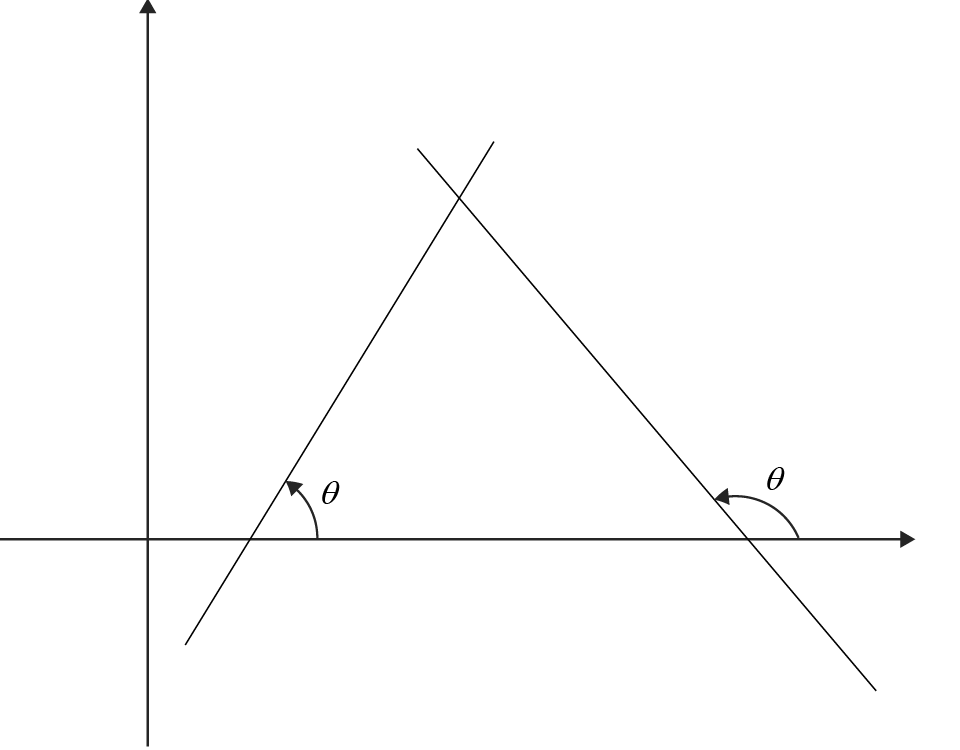
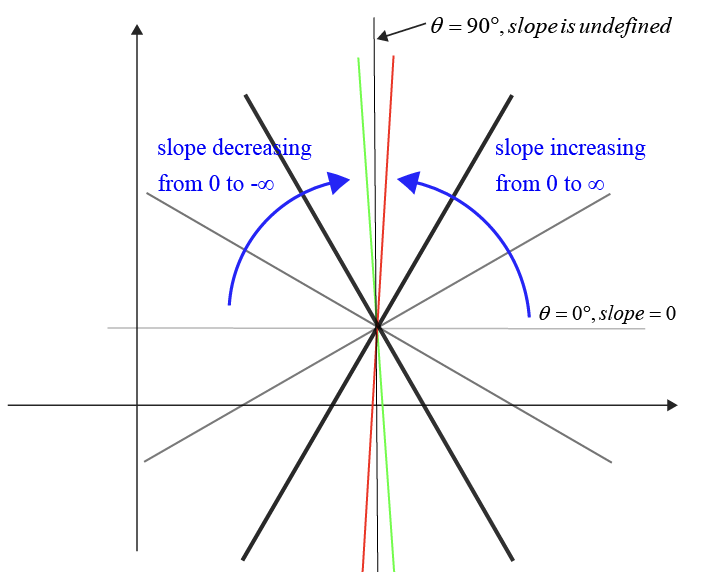
The inclination of a straight line is defined as the angle θ that the line forms with the positive x-axis, measured in the counterclockwise direction. The angle θ is confined within the range 0≤θ<π. For a horizontal line, the inclination is 0 as it lies along the x-axis. For a vertical line, the inclination is 2π, indicating a 90∘ angle from the x-axis, aligning with the positive y-axis.
The slope of a line in the Cartesian coordinate system is defined as the tangent of the inclination of the line. The inclination, θ, is the angle measured counterclockwise from the positive x-axis to the line. Thus, the slope m of the line is given by m=tan(θ).
The slope m of a line, defined as m=tan(θ) where θ is the inclination of the line with the positive x-axis, varies depending on the value of θ:
θ=0: When the angle of inclination is 0, the line is horizontal. Here, tan(0)=0, so the slope of the line is 0.
θ=2π: At θ=2π radians, the line is vertical. The tangent function is undefined at 2π, corresponding to an undefined slope for the vertical line.
θ is acute (0<θ<2π): For acute angles, tan(θ) yields a positive value, indicating a positive slope. This reflects a line rising from left to right.
θ is obtuse (2π<θ<π): For obtuse angles, tan(θ) yields a negative value, indicating a negative slope. This reflects a line falling from left to right.
Variation of Slope with Line Rotation in the Cartesian Coordinate System§
As a line rotates in the Cartesian coordinate system from an inclination θ=0 to θ=2π, the value of the slope m=tan(θ) undergoes a continuous transformation:
From θ=0 to θ=2π:
At θ=0, the line is horizontal, and the slope m is 0.
As θ increases from 0 to 2π, the line becomes steeper. The value of tan(θ) increases from 0 to positive infinity. Thus, the slope m increases continuously and becomes infinitely large as the line approaches vertical orientation at θ=2π, where tan(θ) is undefined due to verticality.
From θ=π to θ=2π:
At θ=π, the line is again horizontal, pointing in the negative direction of the x-axis, and the slope m is 0.
Decreasing θ from π back to 2π involves the line transitioning from a horizontal to a vertical orientation. As θ decreases to slightly less than π, the slope m remains 0 since it is still horizontal.
As θ further decreases towards 2π, the line tilts downwards, making the slope negative. The value of tan(θ) decreases from 0 to negative infinity as the line becomes a negative slope, getting infinitely steep as it approaches verticality at θ=2π from the left. Here, the slope again approaches negative infinity.
In both scenarios, as the line approaches vertical orientation (θ=2π), the slope approaches infinity in magnitude but differs in sign based on the direction of approach—positive as θ approaches 2π from 0 and negative as θ approaches 2π from π.
Slope of a line using coordinates of two points on the line§
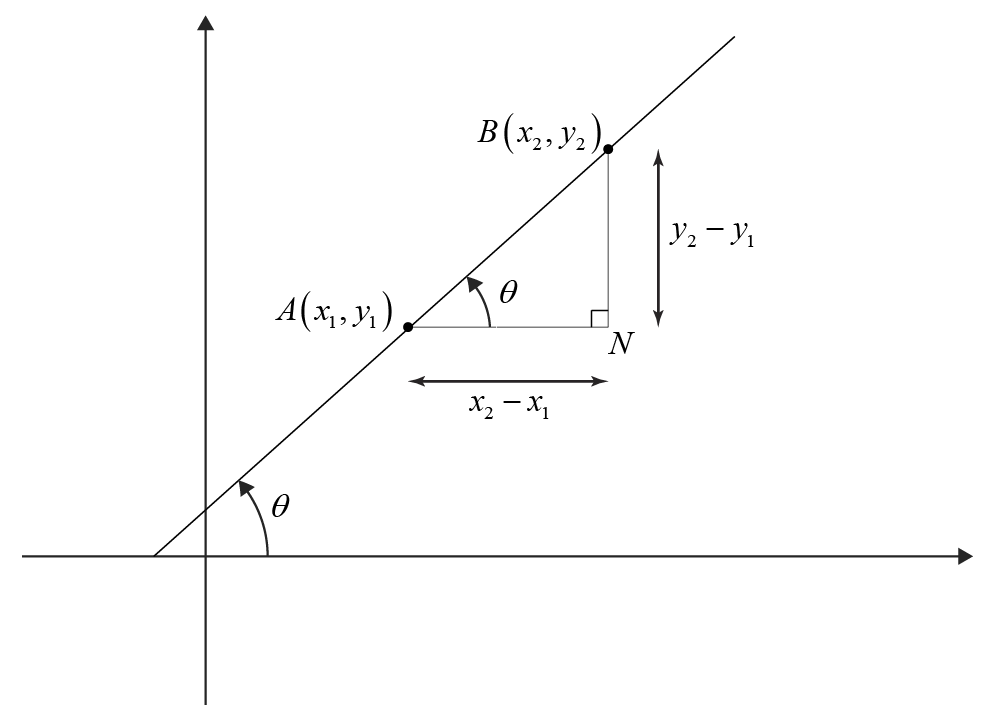
Consider a line in the Cartesian coordinate system. Let A and B be two points with known coordinates A(x1,y1) and B(x2,y2), respectively. The slope of the line, which quantifies its steepness, is the tangent of the angle of inclination θ that the line makes with the positive direction of the x-axis.
By constructing a right triangle ABN with the hypotenuse AB and BN perpendicular to the x-axis, the angle θ is formed at N. The vertical leg BN represents the change in y-coordinates, y2−y1, while the horizontal leg AN represents the change in x-coordinates, x2−x1.
The slope m of the line is defined as the ratio of the opposite to the adjacent side of the angle of inclination in triangle ABN, given by the relation m=tan(θ)=ANBN. Simplifying, we obtain the slope of the line as m=x2−x1y2−y1, providing a measure of the line's steepness in the coordinate plane.
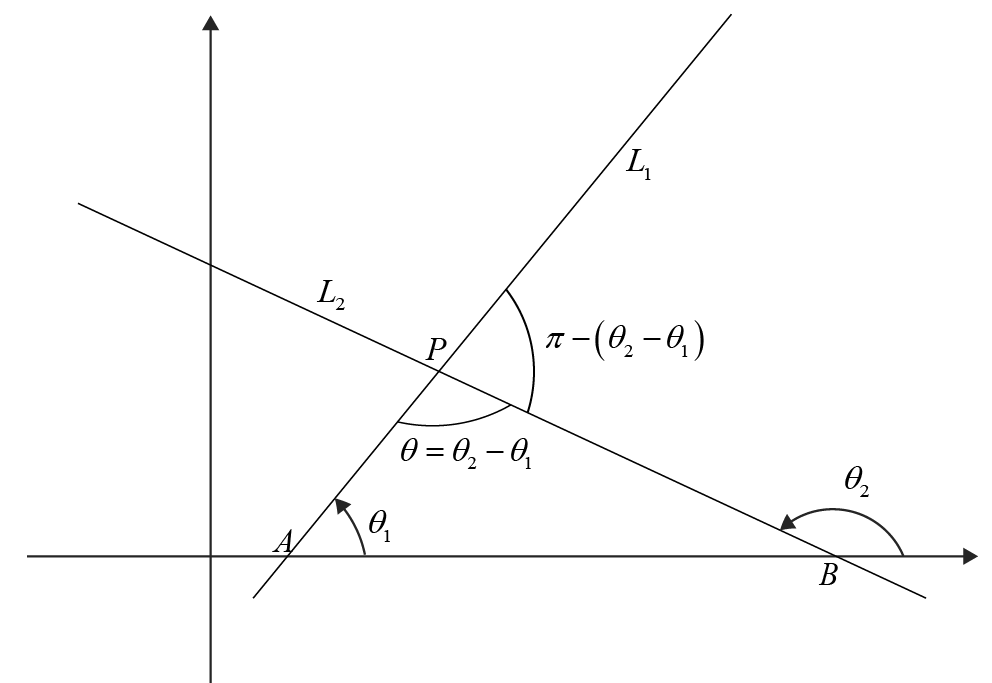
Consider two lines L1 and L2 intersecting at point P in the Cartesian plane. Line L1 forms an angle θ1 with the positive x-axis, while line L2 forms an angle θ2. The angle between the two lines, denoted as θ, is the difference between θ2 and θ1, that is, θ=θ2−θ1.
To find the acute angle θ between L1 and L2, consider the exterior angle θ2 at point B in triangle PAB. The exterior angle of a triangle is equal to the sum of the two non-adjacent interior angles. Hence, θ2=θ+θ1.
Taking the tangent of both sides to find the slope in terms of the angle, we have:
tan(θ)=tan(θ2−θ1)
By the identity for the tangent of the difference of two angles, we have:
tan(θ)=1+tan(θ1)tan(θ2)tan(θ2)−tan(θ1)
Given that tan(θ1)=m1 and tan(θ2)=m2, where m1 and m2 are the slopes of lines L1 and L2 respectively, the equation becomes:
tan(θ)=1+m1m2m2−m1
The other angle formed by the intersection of L1 and L2 is π−(θ2−θ1), and its tangent will be the negative of tan(θ). One of the angle is acute anf the other is obtuse. Since we know that tangent of acute angle is always positive, 1+m1m2m2−m1 gives the tangent of acute angle between the lines.
Thus, the tangent of the acute angle between the lines is given by
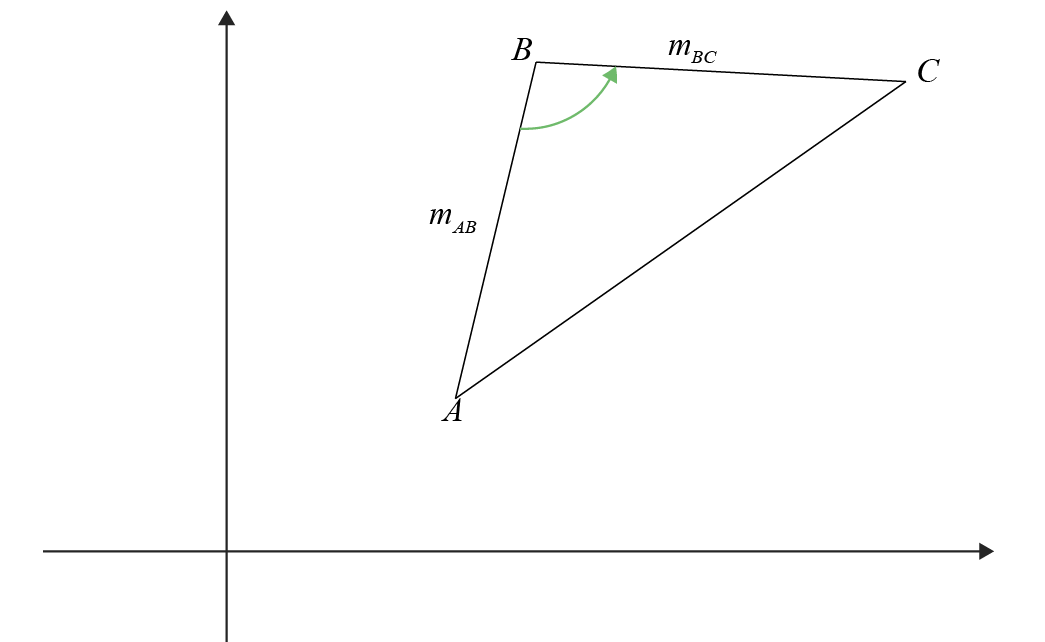
Consider a triangle formed by three distinct points A, B, and C in a Cartesian coordinate system. The objective is to measure all interior angles of the triangle precisely. Typically, plotting the points and visually estimating the angles can lead to uncertainty, especially when distinguishing between acute and obtuse angles. This is due to the potential inaccuracy of graphical representation and the subjective nature of visual estimation.
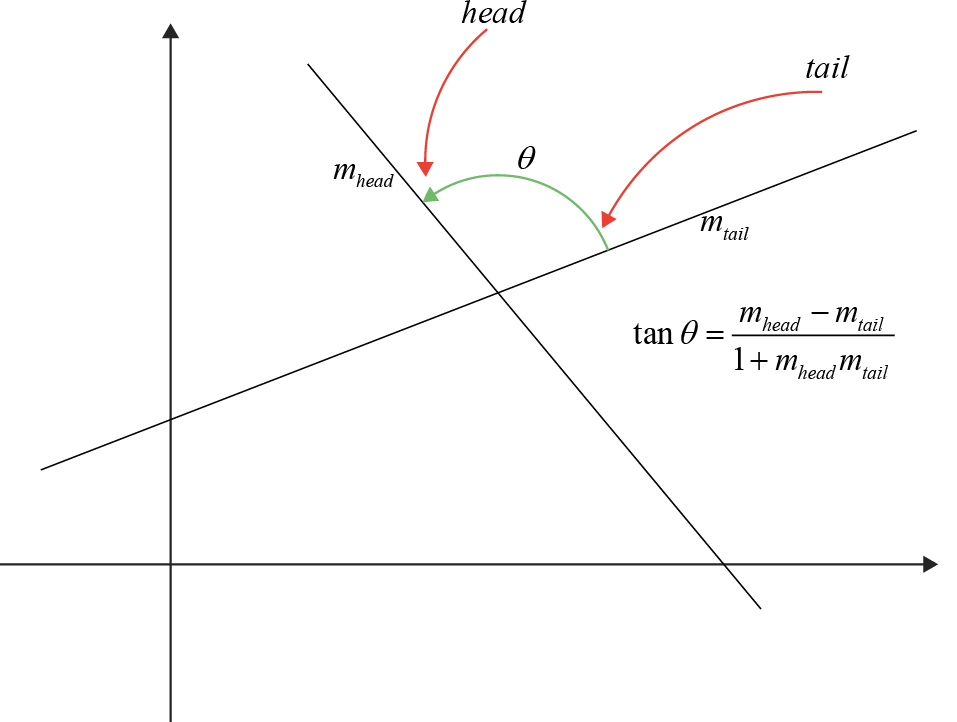
The formula we derived above can only calculate acute angle between two lines. So how do we measure a particular angle between two lines.
Plot the lines and identify the angle that you want to measure. Draw an anticlockwise arc with an arrow at the head.
The formula for the tangent of the angle between these two intersecting lines, where mtail is the slope of the line at the initial side (tail) and mhead is the slope of the line at the terminal side (head), is given by:
tan(θ)=1+mheadmtailmhead−mtail
Tbus, the tangent of the angle ∠ABC can be calculated using the formula for the tangent of the difference of two angles, considering the orientation of the angle measured anticlockwise from line AB to line BC.
tan(∠ABC)=1+mABmBCmBC−mAB
This formula yields the tangent of the angle ∠ABC, regardless of whether it is acute or obtuse. The slopes mAB and mBC can be determined from the coordinates of the points A, B, and C, after which the formula can be used to find the tangent of the measured angle.
For two lines with slopes m1 and m2, the relationship between the slopes and the angle θ between the lines can be expressed using the tangent function:
tan(θ)=1+m1m2m2−m1
Parallel Lines:
If two lines are parallel, the angle θ between them is 0 degrees (or 0 radians). In this case, tan(θ)=tan(0)=0, which leads to the equation:
0=1+m1m2m2−m1
Since the absolute value is zero only when the quantity inside is zero, it implies that m2−m1=0, or m1=m2.
Perpendicular Lines:
For two lines to be perpendicular, θ is 90 degrees (or 2π radians), and thus tan(θ) should be undefined. This is only the case when the denominator of the tangent function is zero:
1+m1m2=0
Solving for m2 gives us m2=−m11, indicating that the slopes of perpendicular lines are negative reciprocals of each other.
Section 1 of 8 · Straight Lines
Mark this section complete when you have worked through its proofs.
Type any topic, theorem, or concept to jump directly to the section.