Transformation of axes is a fundamental concept in coordinate geometry, involving the change from an original coordinate system to a new one through translation, rotation, or a combination of both. This process is pivotal in simplifying the representation of geometric figures and in solving complex geometric problems.
These transformations are essential in coordinate geometry and physics, where they are used to simplify problems, analyze motion, and understand transformations in different coordinate systems. Through these equations, one can effectively rotate, translate, or apply a combination of both to a coordinate system, aiding in the geometrical interpretation and solution of problems.
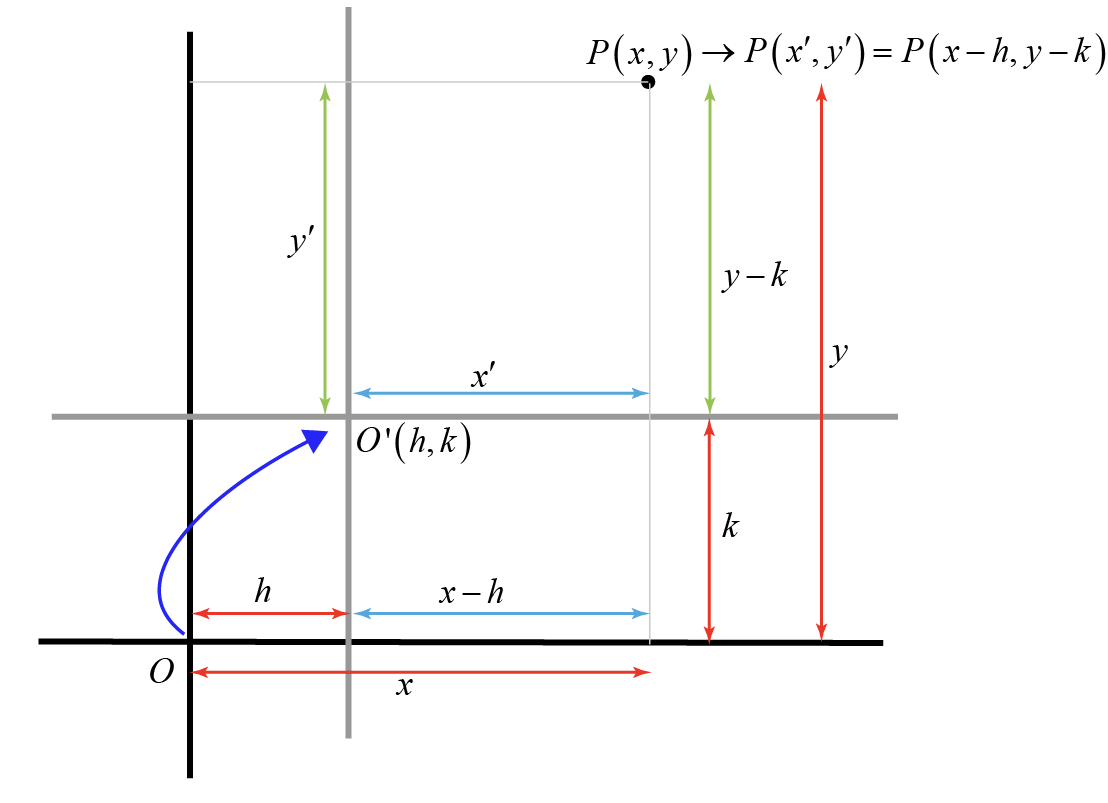
Consider a Cartesian coordinate system with its origin at O. Let P be a point within this system, having coordinates (x,y). Now, if we shift the origin to a new point O′(h,k) without changing the orientation in the original system, we establish a new coordinate system. In this new system, the coordinates of O′ become (0,0), indicating its position as the new origin. As a result of this shift, the coordinates of point P will change to accommodate the new frame of reference. Suppose the new coordinates of P in this shifted system are (x′,y′). Given the translation of the origin and maintaining the orientation of the axes, it follows that the relationship between the old and new coordinates of P can be expressed as x′=x−h and y′=y−k. This transformation effectively recalibrates the coordinate system, considering O′ as the new reference point, thus altering the perceived position of P relative to this new origin.
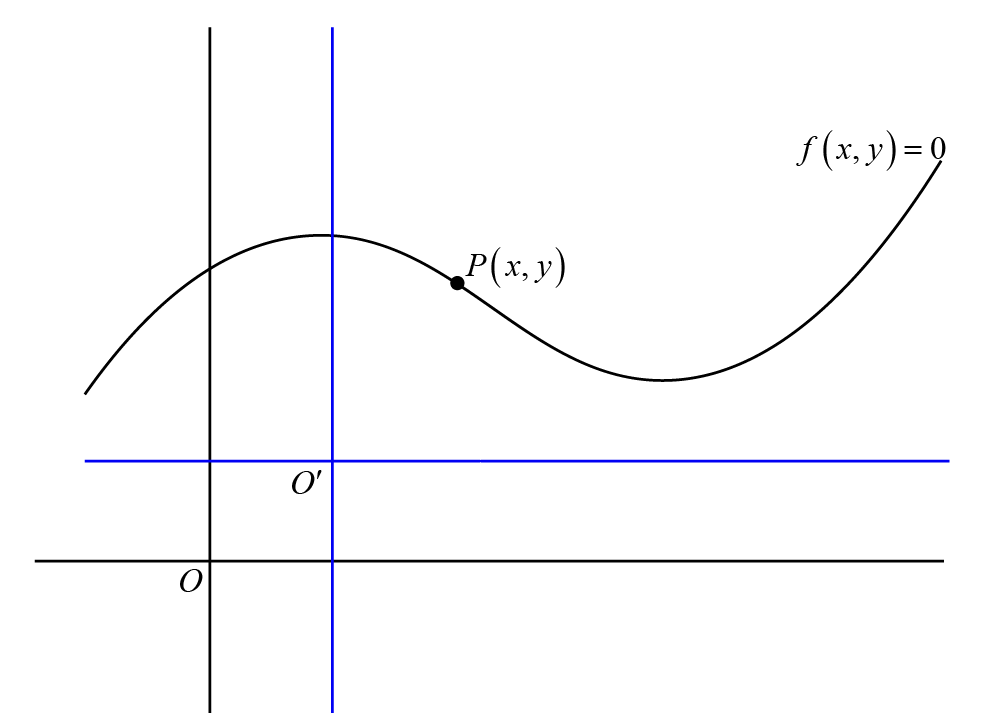
Consider a curve defined by the equation f(x,y)=0. Let P(x,y) be a point on this curve. If we shift the origin of the coordinate system to a new point O′(h,k), the coordinates of point P in relation to this new origin become (x′,y′), where x′=x−h and y′=y−k. This translation alters the frame of reference for the coordinates of points on the curve.
To express the curve in terms of the new coordinates, we first find the relationship between x′ and y′ and the original coordinates. We reverse the translation by writing x=x′+h and y=y′+k. Since the original coordinates x and y satisfy the equation f(x,y)=0, substituting the expressions for x and y in terms of x′ and y′ gives us the new equation of the curve in the translated coordinate system:
f(x′+h,y′+k)=0
This equation represents the new relationship between x′ and y′, and hence, the new equation of the curve in the context of the shifted origin.
For simplicity and to align with common mathematical conventions, we often drop the prime notation in the final expression and simply represent the new coordinates as x and y again. Therefore, to find the equation of the curve in the new coordinate system, we substitute x with x+h and y with y+k into the original equation f(x,y)=0, resulting in:
f(x+h,y+k)=0
This transformed equation describes the curve in the new coordinate system after the origin has been shifted to O′(h,k), effectively incorporating the translation into the equation of the curve.
To understand consider the equation 5(x−2)2+3(y+1)2=1. This is the equation of an ellipse. You will study about why this is an equation of the ellipse in later chapters.
So, given the equation of an ellipse 5(x−2)2+3(y+1)2=1, shifting the origin to the point (2,−1) simplifies the equation. To achieve this simplification, in the given equation, we replace x with x+2 and y with y−1, reflecting the shift of the origin to (2,−1).
Applying these substitutions:
5(x+2−2)2+3(y−1+1)2=1
Simplifies to:
5x2+3y2=1
Thus, after shifting the origin to (2,−1), the new equation of the ellipse becomes 5x2+3y2=1. This process illustrates how shifting the origin to a suitable point can streamline the equation of a geometric figure, making it easier to work with.
Thus, we can say that shifting the origin of a coordinate system is primarily employed to simplify the equations of curves or geometric figures. This transformation can reduce the complexity of mathematical expressions, making both analytical and computational work more efficient. By relocating the origin to a more strategically advantageous position, certain terms in the equation of a curve might be eliminated or reduced, leading to a simpler form. This simplification can facilitate easier analysis, integration, differentiation, or graphical representation of the curve. Essentially, the process of shifting the origin is a tool for making complex problems more manageable by adapting the coordinate system to suit the specific requirements of the problem at hand.
Consider another example. Sometimes we wish to eliminate certain terms of an equation of a curve. We can achieve that many times just by shifting the origin.
The rotation of axes in a two-dimensional plane involves turning the original coordinate system about the origin by a specified angle. When the coordinate axes are rotated anticlockwise by an angle θ, the coordinates (x′,y′) of a point P in the rotated system relate to its coordinates (x,y) in the original system by the transformation equations:
The general second-degree equation ax2+2hxy+by2+2gx+2fy+c=0 encompasses all conic sections—ellipses, hyperbolas, and parabolas—depending on the values of its coefficients. Our focus will be on techniques to simplify this equation through translation and rotation of axes, without delving into the specific nature of the conics it may represent. You need not worry too much about what it represents and how. Our main focus is learning how to eliminate xy term and linear x and y terms.
Translation is used to remove the linear terms 2gx and 2fy by shifting the origin to a suitable point (h,k).
Rotation of axes aims to eliminate the xy term. This is achieved by rotating the coordinate system by a specific angle θ.
By simplifying this equation the study of these curves become much simpler.
To eliminate the linear terms 2gx and 2fy from the general second-degree equation ax2+2hxy+by2+2gx+2fy+c=0, we will translate the origin to the point (α,β) and then replace x with x+α and y with y+β in the general second-degree equation ax2+2hxy+by2+2gx+2fy+c=0. Expanding this transformation step by step yields:
Now, focusing on the linear terms in x and y, to eliminate these terms, we set their coefficients to zero:
aα+hβ+ghα+bβ+f=0,=0.
Solving these equations for α and β will give us the values needed to shift the origin such that the linear terms in the equation are eliminated, simplifying the equation of the conic.
Cross-multiplication yields:
hf−bgx=hg−af−y=ab−h21.
From the cross-multiplication rule, we deduce:
x=ab−h2hf−bg,y=ab−h2hg−af.
Therefore, shifting the origin to (ab−h2hf−bg,ab−h2hg−af) results in elimination of linear terms.
Invariance of Quadratic Terms Under Coordinate Shift**§
Let the general quadratic equation in two variables be given by
ax2+2hxy+by2+2gx+2fy+c=0.
Consider a shift in the coordinate system such that the origin is moved to the point (α,β). Under this transformation, where x is replaced by x+α and y is replaced by y+β, the coefficients of the quadratic terms ax2, 2hxy, and by2 remain unchanged, while the linear and constant terms are transformed.
Proof: Upon replacing x with x+α and y with y+β and expanding, the equation becomes:
The coefficients of ax2, 2hxy, and by2 are preserved post transformation. Thus, the theorem is established, demonstrating the invariance of the quadratic terms with respect to the shift of the coordinate system's origin.
Now we know that by setting α=ab−h2hf−bg and β=ab−h2hg−af, we achieve the elimination of the linear terms 2gx and 2fy in the general quadratic equation ax2+2hxy+by2+2gx+2fy+c=0, while the quadratic terms ax2, 2hxy, and by2 remain as is. This results in an important consequence for the new constant term.
The new constant term, as derived, is given by equation (1):
aα2+2hαβ+bβ2+2gα+2fβ+c.
By utilizing the simultaneous equations (2) ax+bp+g=0 and (3) ha+bp+f=0, the constant term can be expanded as follows:
There are very strong reasons that you will get to learn in future to eliminate xy term. To eliminate the xy term in the general second degree equation ax2+2hxy+by2+2gx+2fy+c=0, a rotation of axes is applied, as a translation of the origin cannot remove terms involving both x and y.
Upon rotating the axes anticlockwise by an angle θ, the new coordinates x′ and y′ can be expressed in terms of x and y as follows:
x′=xcosθ−ysinθy′=xsinθ+ycosθ
Substituting these into the equation, and expanding, we get:
Invariance in mathematics refers to a property or characteristic of an object, operation, or mathematical expression that remains unchanged under a specified set of transformations or operations.
**Invariance in Geometry:
In geometry, invariance refers to properties that remain unchanged under transformations like translation and rotation. Common geometric invariants include area of a closed region, perimeter of a closed figure, angle between two lines, and distance between points.
With respect to rotation of axes, distance of a point from the origin is invariant, but it is not invariant with respect to translation of origin.
Invariance in Algebra:
In algebra, invariance involves expressions or equations maintaining their form under operations such as substitution, scaling, or other algebraic manipulations.
Algebraic invariance in the general quadratic equation§
Translation
In the context of the general second-degree equation ax2+2hxy+by2+2gx+2fy+c=0, when considering transformations such as translations of the coordinate axes, specific coefficients exhibit invariance while others do not.
Invariant Coefficients:
a, h, b: These coefficients, which are associated with the quadratic terms ax2, 2hxy, and by2, remain invariant under translation. This is because these coefficients define the curvature and orientation of the conic section represented by the equation, properties that are independent of the location of the origin of the coordinate system.
Rotation
In the context of rotating the coordinate system for the general second-degree equation ax2+2hxy+by2+2gx+2fy+c=0, certain quantities remain invariant:
a+b: The sum of the coefficients of x2 and y2 remains unchanged by rotation.
h2−ab: This expression, related to the discriminant of the quadratic part of the equation, is invariant under rotation. It is fundamentally connected to the nature of the conic section (ellipse, hyperbola, or parabola) represented by the equation.
c: The constant term in the equation remains invariant under rotation as it does not depend on the orientation of the axes.
Δ: The determinant of the matrix formed by the coefficients a, h, b, g, f, and c, often used in determining the nature of the conic section, also remains invariant under rotation.
Let me demostrante why a+b and c are invariant. Before we obtained this equation after rotation.