
Measuring Distances
Measuring Distances§
Distance between two points§
Theorem: The distance between two points and in the Cartesian coordinate system is given by the formula:
Corrolary: The distance of a point from the origin in the Cartesian coordinate system is given by the formula:
Distance from axes§
The distance of a point from the x-axis and from the y-axis in the Cartesian coordinate system can be determined by considering the perpendicular distances from to these axes.
Distance from the x-axis
The distance of point from the x-axis is equal to the absolute value of the ordinate of the point. This is because the distance from any point to the x-axis is measured vertically (along the y-direction). Therefore, the distance from to the x-axis is:
Distance from the y-axis
Similarly, the distance of point from the y-axis is equal to the absolute value of the abscissa of the point. The distance from any point to the y-axis is measured horizontally (along the x-direction). Thus, the distance from to the y-axis is:
Conversion between Cartesian and Polar Coordinates§
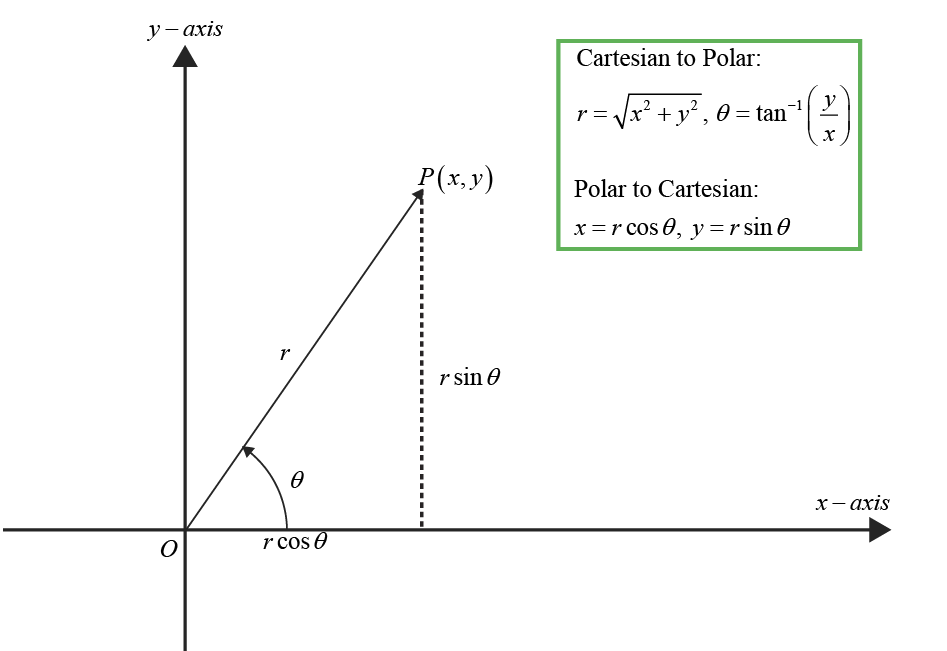
Polar to Cartesian Conversion§
Given polar coordinates , where is the radial distance from the origin and is the angle from the positive x-axis:
-
x-coordinate:
The x-coordinate is found by projecting the radius onto the x-axis, which forms the adjacent side of the right-angled triangle. The length of this side is .
-
y-coordinate:
The y-coordinate is obtained by projecting the radius onto the y-axis, which forms the opposite side of the right-angled triangle. The length of this side is .
Cartesian to Polar Conversion§
Given Cartesian coordinates :
-
Radial distance (r):
The radial distance is the hypotenuse of the right-angled triangle formed by the x and y coordinates. According to Pythagoras' theorem, is the square root of the sum of the squares of the x and y coordinates.
-
Angle ():
The angle is the angle between the radius and the positive x-axis. It is calculated using the arctan function of the ratio of the y-coordinate to the x-coordinate. Note that care must be taken to determine the correct quadrant for , as alone does not distinguish between all four quadrants.
Distance between two points expressed in polar form.§
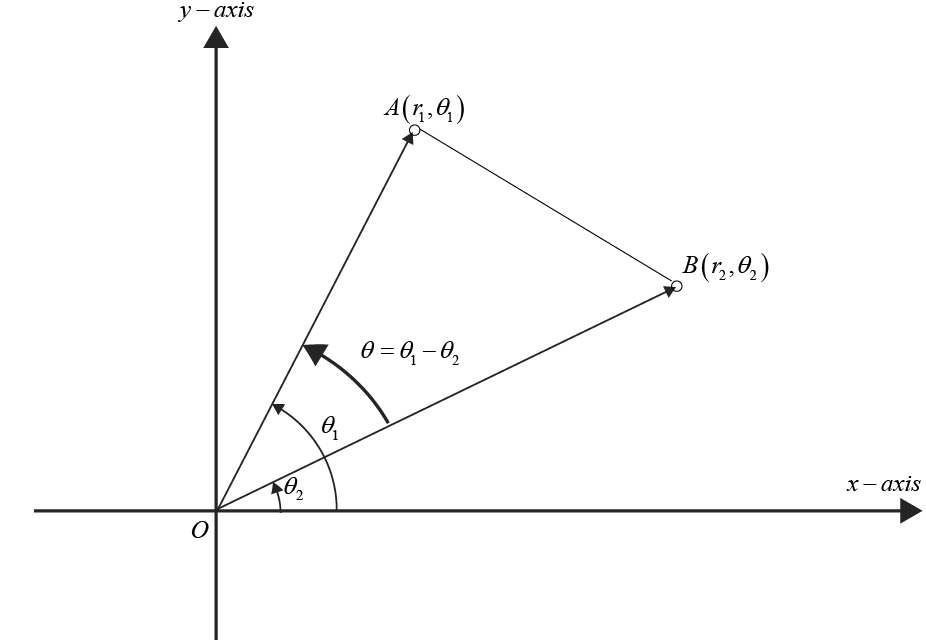
To find the distance between two points and given in polar coordinates without using vector analysis, we construct a triangle where is the origin, and are the points given by their polar coordinates, and is the line segment connecting and .
Applying the Law of Cosines directly to triangle :
Substitute with and with , and recognize that the angle is the difference in the angles of the two polar coordinates, which is or (the cosine function is even, so the sign does not affect the result):
Taking the square root to solve for :
This formula calculates the distance between the two points and in polar coordinates.
Application of distance formula§
With distance formula we are able to convert geomterical distance into algebraic expression. We can use the distance formula to achieve many things.
Collinearity of Three Points§
To check if three points , , and are collinear using the distance formula:
-
Calculate the distances between each pair of points:
-
Verify the collinearity condition:
- Points , , and are collinear if one of the following is true:
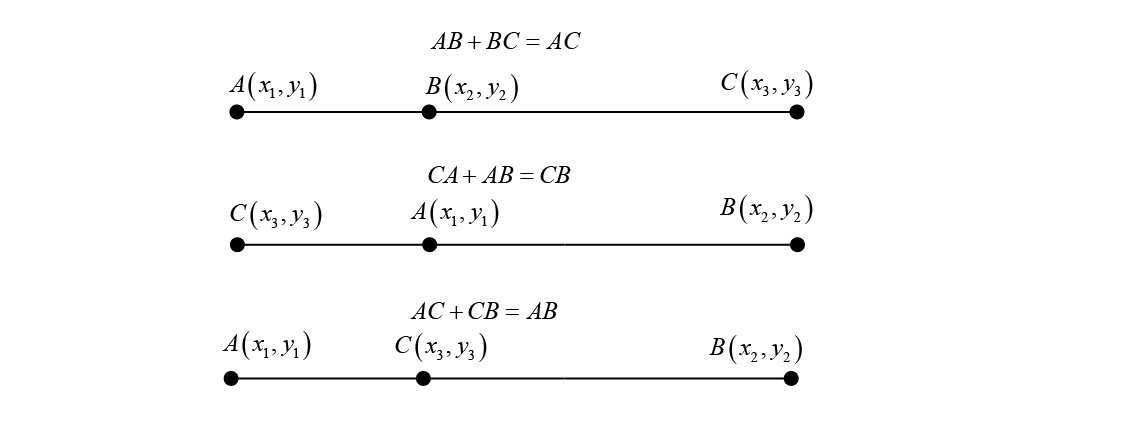
Example:
Consider points , , and .
Calculate distances:
Check the condition:
Since , points , , and are collinear.
Determining the Type of Triangle Using the Distance Formula§
To determine the type of a triangle given three points , , and using the distance formula:
-
Compute the lengths of the sides using the distance formula:
-
Compare the lengths to identify the triangle type:
- Equilateral: All three sides are equal ().
- Isosceles: Exactly two sides are equal (e.g., or or , but not all three).
- Scalene: All sides have different lengths ().
-
To check for right-angled triangles, apply the Pythagorean theorem:
- Right-Angled: One side squared equals the sum of the squares of the other two sides (e.g., , or equivalent permutations).
- Right-Angled Isosceles: It's a right-angled triangle with two equal sides.
-
To determine whether a triangle is acute or obtuse, we approach in the following way:
An acute triangle is one where all the interior angles are less than 90 degrees. In the context of a triangle with sides , , and , for all combinations of the sides, the square of one side is less than the sum of the squares of the other two sides. This can be expressed as:
If these inequalities hold for all three combinations, then the triangle is acute.
For a right-angled triangle, one of these equations becomes an equality, corresponding to the Pythagorean theorem.
For an obtuse triangle, where one angle is greater than 90 degrees, the square of the longest side is greater than the sum of the squares of the other two sides. This yields:
- (if angle is obtuse),
- (if angle is obtuse),
- (if angle is obtuse).
By calculating the side lengths using the distance formula and testing these conditions, you can determine the type of triangle formed by three points. Using these checks, you can classify the triangle formed by the three given points.
Mark this section complete when you have worked through its proofs.