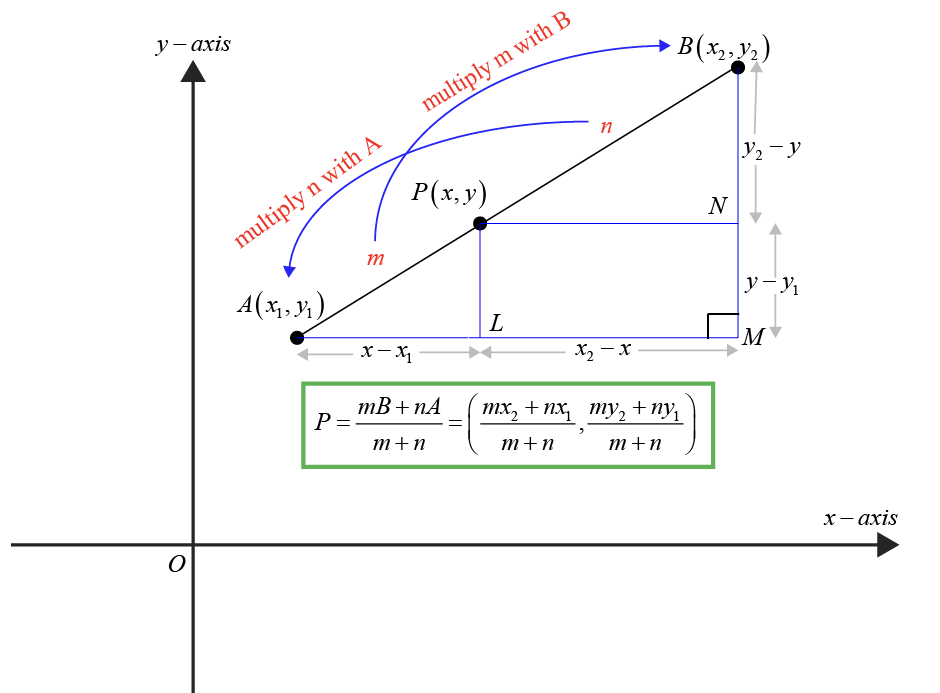
Given points A(x1,y1) and B(x2,y2) and a point P(x,y) that divides the line segment AB internally in the ratio m:n, we can derive the coordinates of point P using the section formula.
In coordinate geometry, when simplifying the algebraic representation of the ratio of division of a line segment, it's common to introduce a parameter λ to represent the ratio nm. This is particularly useful when dealing with problems involving section formulae, as it allows us to express the coordinates of the dividing point P(x,y) in a more streamlined form.
Using λ=nm, the section formula for internal division becomes:
x=λ+1λx2+x1y=λ+1λy2+y1
This is because the original expressions:
x=m+nmx2+nx1y=m+nmy2+ny1
can be rewritten by dividing the numerator and denominator by n (assuming n=0), resulting in:
Hence, the point P dividing the line segment AB internally in the ratio λ:1 (or m:n) has its coordinates given by the simplified section formula above.
The coordinates of a point P(x,y) that divides the line segment joining two points A(x1,y1) and B(x2,y2) in the ratio m:n externally are given by (m−nmx2−nx1,m−nmy2−ny1).
Proof: A similar proof as Internal division ensues. Please try to do it yourself.
Dividing both numerator and denominator by n, we get:
P(x,y)=(nm+1nmx2+x1,nm+1nmy2+y1)
Substituting λ=nm, we obtain:
P(x,y)=(λ+1λx2+x1,λ+1λy2+y1)
This formula compactly expresses the coordinates of P dividing the segment AB in the ratio m:n or equivalently λ:1, where λ can be any real number, capturing both internal and external division scenarios.
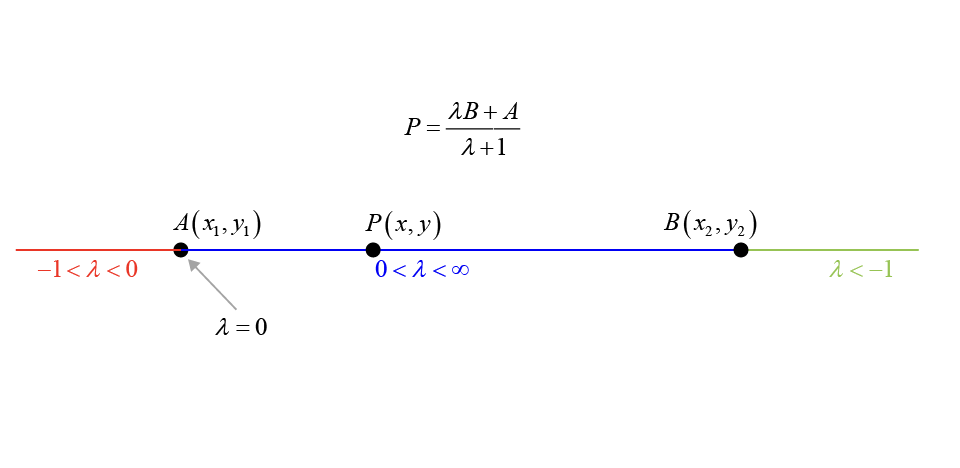
The location of point P, dividing a line segment AB in the ratio λ:1 (where λ=nm), relative to points A and B, varies depending on the value of λ:
λ=0: Point P coincides with point A. This is because the division ratio effectively becomes 0:1, indicating that P is at A.
λ>0: Point P lies between A and B. As λ changes from 0 to ∞, P moves from A towards B.
−1<λ<0: Point P divides AB externally but is closer to A. In this range, λ is negative, signifying external division, but since ∣λ∣<1, P is positioned on the extension of AB on A's side.
λ<−1: Point P divides AB externally on the side of B. Here, the absolute value of λ being greater than 1 means that P not only divides AB externally but also lies closer to B, on the extension of AB beyond B.
These scenarios illustrate how the value of λ determines P's relative location to A and B, spanning both internal and external divisions along and beyond the segment AB.
When the ratio of the lengths of segments AP to AB is taken as λ, that is, AP:AB=λ, a different approach is used to find the coordinates of point P. This implies that AP is a fraction λ of the total length AB. Consequently, the ratio AP:PB can be expressed as λ:(1−λ), since AP+PB=AB and PB=AB−AP.
Given this, the coordinates of point P can be derived from the ratio AP:PB=λ:(1−λ) as follows:
P(x,y)=(1λx2+(1−λ)x1,1λy2+(1−λ)y1)
This formula simplifies to:
P(x,y)=(λx2+(1−λ)x1,λy2+(1−λ)y1)
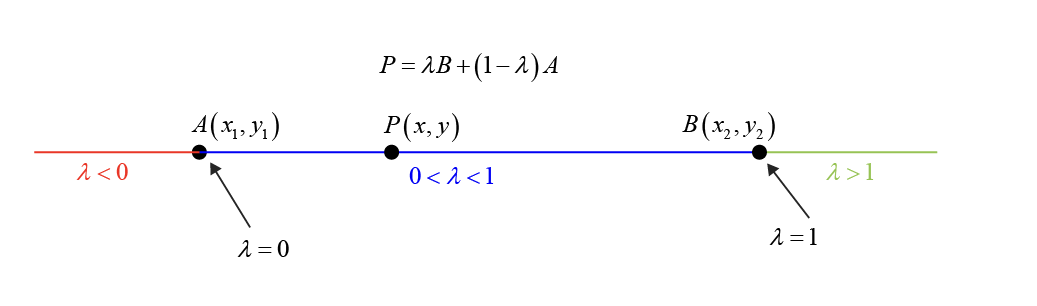
In the approach where the ratio AP:AB=λ, the value of λ directly influences the position of point P relative to points A and B along or beyond the line segment AB:
λ=0: Point P coincides with point A. This corresponds to P being at the very start of the segment AB.
0<λ<1: Point P lies between A and B on the line segment AB. As λ increases from 0 to 1, P moves from A towards B.
λ=1: Point P coincides with point B, marking the end of the segment AB.
λ>1:P divides AB externally on the side of B. In this scenario, P is located on the extension of AB beyond B, indicating that P is further from A compared to B.
λ<0:P divides AB externally on the side of A. Here, P is positioned on the extension of AB beyond A, suggesting an external division where P is closer to A than to B.
This formulation provides a continuous mapping of λ to positions of P along and beyond the segment AB, illustrating how changes in λ translate to different locations of P in relation to A and B.
Given two points A(x1,y1) and B(x2,y2), the midpoint M of the line segment AB divides it in the ratio 1:1. Put lambda=1 in the section formula M=λ+1λB+A.Therefore, the coordinates of M are given by
M=(2x1+x2,2y1+y2).
Points of Trisection
Points of trisection of a line segment are the two points that divide the segment into three equal parts. Let A(x1,y1) and B(x2,y2) be the endpoints of the segment. We aim to find the coordinates of the points P and Q that trisect the line segment AB.
Points of trisection P and Q of a line segment into ratio 1:2 and 2:1 respectively.
Given a line segment AB, the section formula for a point dividing this segment in the ratio m:n is given by the coordinates:
x=m+nmx2+nx1,y=m+nmy2+ny1
For Point P (First Trisection Point):
For P dividing AB in the ratio 1:2 (m=1, n=2), the coordinates xp,yp are calculated as:
xp=1+21⋅x2+2⋅x1,yp=1+21⋅y2+2⋅y1
Simplifying, we obtain:
xp=3x2+2x1,yp=3y2+2y1
For Point Q (Second Trisection Point):
For Q dividing AB in the ratio 2:1 (m=2, n=1), the coordinates xq,yq are determined by:
Let A(x1,y1) and B(x2,y2) be two points on a plane. Suppose a point P divides the line segment AB internally in the ratio m:n, and a point Q divides the same line segment externally in the same ratio m:n. Then, points P and Q are referred to as harmonic conjugates with respect to A and B.
Internal Division by P
For internal division, the coordinates of P(xp,yp) are determined using the section formula:
xp=m+nmx2+nx1,yp=m+nmy2+ny1
External Division by Q
For external division, the coordinates of Q(xq,yq) still follow a similar form but account for the external division by using a negative ratio for n, effectively flipping the sign:
xq=m−nmx2−nx1,yq=m−nmy2−ny1
Given that P and Q are harmonic conjugates with respect to A(x1,y1) and B(x2,y2), where P divides AB internally in the ratio m:n and Q divides AB externally in the same ratio m:n, we aim to find the ratio λ:1 in which A divides the segment PQ.
Step 1: Expressing A, P, and Q Using the Section Formula
For P, which internally divides AB, the coordinates are given by:
xp=m+nmx2+nx1,yp=m+nmy2+ny1
For Q, which externally divides AB, the coordinates are:
xq=m−nmx2−nx1,yq=m−nmy2−ny1
Step 2: Ratio in Which A Divides PQ
According to the problem, A divides PQ in the ratio λ:1, implying:
A=λ+1λQ+P
Expanding this for the x-coordinate (and similarly for y), we have:
x1=λ+1λxq+xp
Substituting xp and xq from above:
x1=λ+1λ(m−nmx2−nx1)+(m+nmx2+nx1)
Step 3: Solving for λ
Multiply both sides by (λ+1)(m−n)(m+n) to clear the denominators:
Collinearity of Three Points using section formulae§
Interestingly, we can verify using section formula whether three points are collinear or not. To verify if three points A(x1,y1), B(x2,y2), and C(x3,y3) are collinear using the section formula, we assume that point B divides the segment AC in the ratio λ:1. The section formula provides a method to calculate the coordinates of a point dividing a line segment internally in a given ratio.
Given that B divides AC in the ratio λ:1, the coordinates of B can be expressed as:
For the x-coordinate:
x2=λ+1λx3+x1
For the y-coordinate:
y2=λ+1λy3+y1
Isolate λ, we rearrange the equations for both x2 and y2:
From the x-coordinate equation:
λ=x3−x2x2−x1
From the y-coordinate equation:
λ=y3−y2y2−y1
Now, for the points A, B, and C to be collinear, the value of λ obtained from the equations involving the x-coordinates must be equal to the value of λ obtained from the equations involving the y-coordinates. This is because the ratio of division by B should be consistent in both dimensions for the points to lie on the same straight line. If the values of λ are not equal, it indicates that the points do not lie on the same straight line, thus not being collinear.
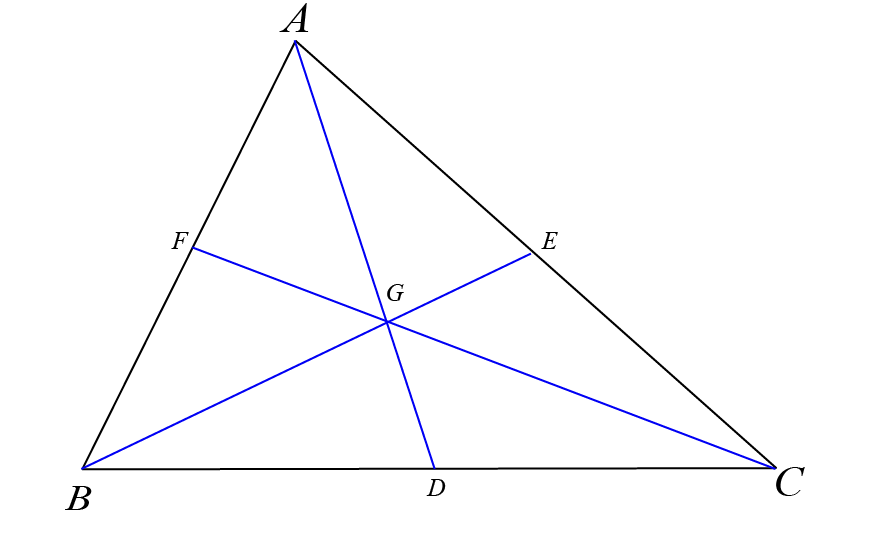
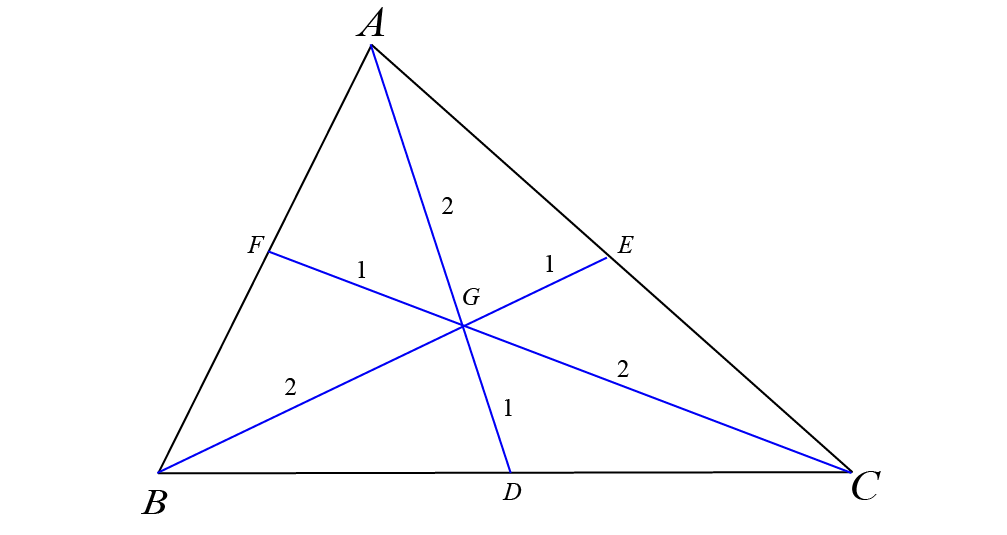
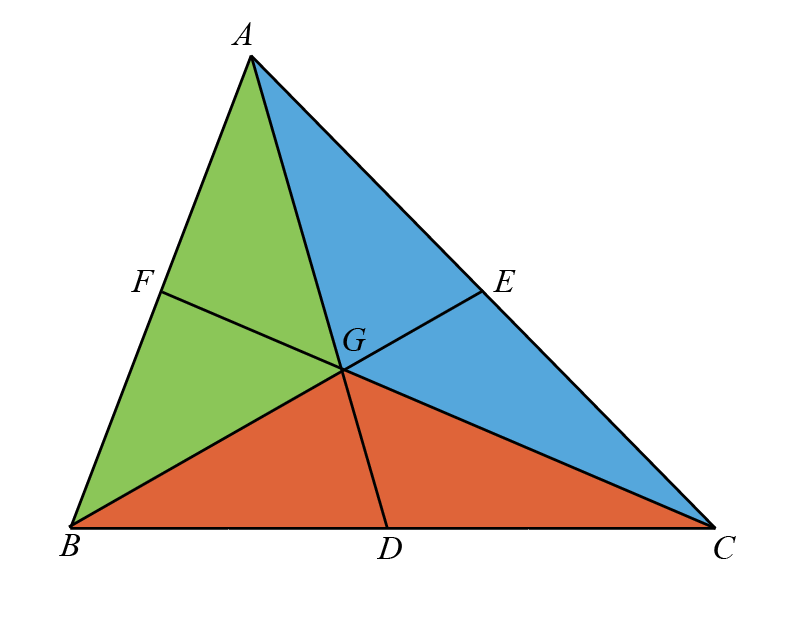
In triangle ABC, a median is a line segment that originates from a vertex and divides the opposite side into two equal parts. Specifically:
The median from vertex A meets the midpoint of side BC at point D, where D is such that BD=DC.
The median from vertex B meets the midpoint of side AC at point E, where AE=EC.
The median from vertex C meets the midpoint of side AB at point F, where AF=FB.
These medians (AD, BE, and CF) bisect the sides of the triangle to which they are drawn, and all three intersect at a single point, known as the centroid of the triangle.
A geometrical proof can be easily written for the fact that all three medians intersect in a common point. But we do not wish to because we will prove this using vectors later on.
Length of Median: Apollonius's Theorem
Apollonius's Theorem states that in any triangle ABC, for a median AD with D as the midpoint of BC, the relationship between the sides of the triangle and the median is given by:
AB2+AC2=2(AD2+BD2)
Here, AD is the median, BD is half the length of BC, and AB, AC are the lengths of the other two sides of the triangle. This theorem provides a method to compute the length of the median AD from the known lengths of the sides AB, AC, and the segment BD.
Given that a=BC, b=AC, and c=AB in triangle ABC, and using Apollonius's Theorem:
AB2+AC2=2(AD2+BD2)
We can express this in terms of a, b, and c:
c2+b2=2(AD2+(2a)2)
To solve for AD, the length of the median from A to D (with D being the midpoint of BC), we isolate AD:
The centroid of triangle ABC is the point of intersection of its three medians, which are the line segments connecting each vertex to the midpoint of the opposite side.
The centroid divides each median in the ratio of 2:1, with the larger segment being between the vertex and the centroid. If G is the centroid and AD is a median, then AG:GD=2:1. Similarly, the centroid divides medians BE and CF in the ratio of 2:1, with BG:GE=2:1 and CG:GF=2:1, where G is closer to vertex B and vertex C respectively, than to points E and F.
Coordinates of the Centroid of a Triangle
Given a triangle ABC with vertices A(x1,y1), B(x2,y2), and C(x3,y3), the centroid G of the triangle has coordinates
G(3x1+x2+x3,3y1+y2+y3).
Proof:
Let D be the midpoint of side BC of triangle ABC. By definition of a midpoint in Cartesian coordinates,
D(2x2+x3,2y2+y3).
Since the centroid G divides median AD in the ratio 2:1, the coordinates of G can be found using the section formula in the ratio 2:1 as follows:
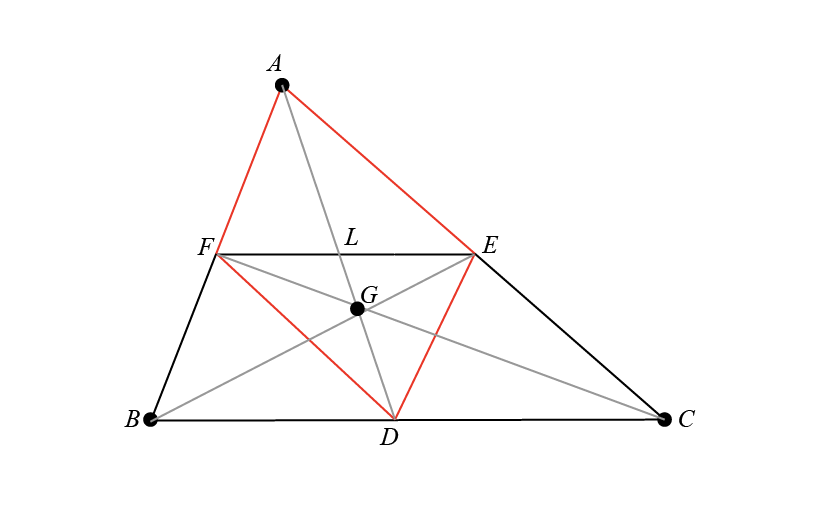
In triangle ABC, let D, E, and F be the midpoints of sides BC, AC, and AB, respectively. When segments FE, FD, and DE are drawn, they create the *medial triangleDEF. By the Midpoint Theorem, segment FE is parallel to BC, segment FD is parallel to AC, and segment DE is parallel to AB. This theorem states that a line segment joining the midpoints of two sides of a triangle is parallel to the third side and half its length. Therefore, medial triangle DEF is formed, whose sides are parallel to the respective sides of triangle ABC and half as long.
The quadrilateral AFDE is a parallelogram. This is due to the fact that FD and AE are both parallel and equal to half of length of BC (as FD and AE are each half the length of BC by the Midpoint Theorem), and AF and DE are both parallel and equal to half of length of AB (again by the Midpoint Theorem).
Within parallelogram AFDE, diagonals AD and FE bisect each other at point L. According to the properties of parallelograms, the diagonals bisect each other, meaning L is the midpoint of both AD and FE. Therefore, by the midpoint formula, L is calculated as:
L=2A+D=2F+E
From this, we deduce that vertex A can be found using the coordinates of D, E, and F:
A=F+E−D
To find the coordinates of vertices B and C, we apply similar logic, considering parallelograms formed by other pairs of triangle medians:
B=D+F−EC=E+D−F
This method is effective for calculating the vertices of a triangle when the midpoints of its sides are known.
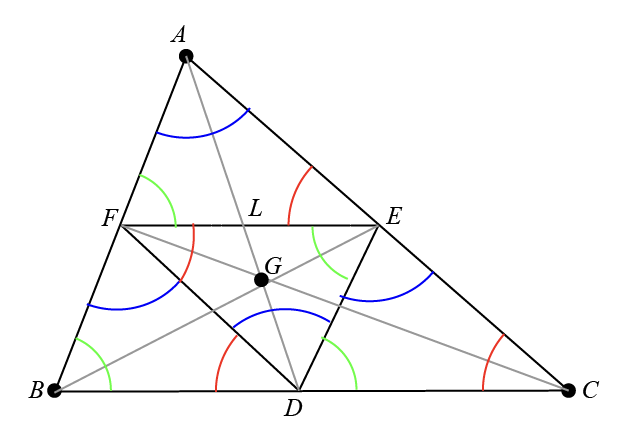
Triangles AFE, BDF, and CDE are congruent to triangle DEF.
The congruency of these triangles can be established through the following properties:
Parallel Sides: Each side of triangle DEF is parallel to one side of triangle ABC.
Proportional Sides: Because the medians divide the sides of triangle ABC into segments of equal length, the corresponding sides of triangles AFE, BDF, and CDE are equal to each other and half the length of the sides of triangle ABC.
Equal Angles: The angles of triangles AFE, BDF, and CDE are equal to the corresponding angles in triangle DEF because they are alternate interior angles created by transversal lines cutting parallel lines.
These properties result in triangles AFE, BDF, CDE, and DEF all being congruent.
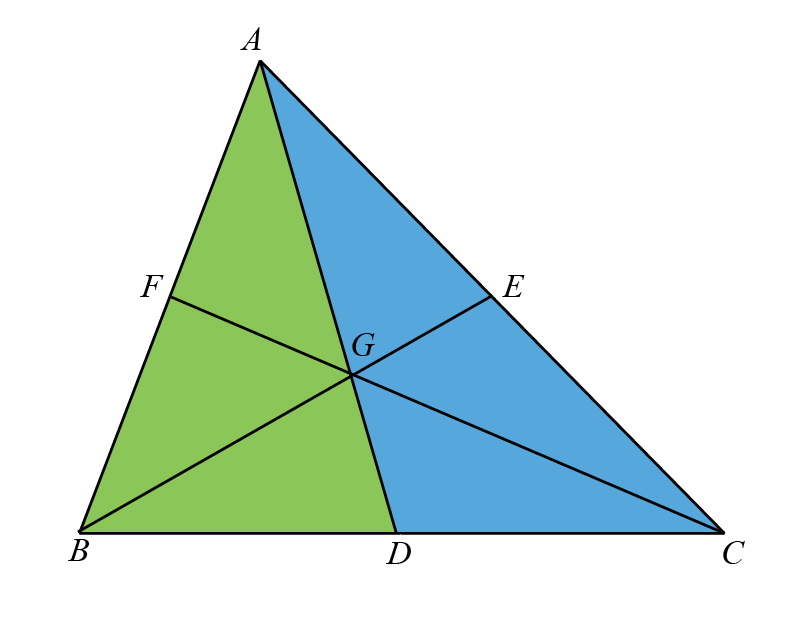
Given that triangles AFE, BDF, CDE, and DEF are congruent, it follows that their areas are equal and thus,
Area of triangle ABD is equal to the area of triangle ACD because D is the midpoint of BC, making AD and DC equal in length, and both triangles share the same height from A perpendicular to BC.
Similarly, the area of triangle BEC is equal to the area of triangle AEB because E is the midpoint of AC, making BE and AE equal in length, with both triangles sharing the same height from B perpendicular to AC.
Finally, the area of triangle AFC is equal to the area of triangle AFB because F is the midpoint of AB, making CF and BF equal in length, with both triangles sharing the same height from C perpendicular to AB.
In any triangle ABC, where G is the centroid, the medians of the triangle divide it into three smaller triangles, AGB, AGC, and BGC, that have equal areas.
Coincidence of Centroids of Triangle ABC and Medial Triangle DEF
The centroid of triangle ABC and the centroid of the medial triangle DEF, formed by the midpoints D, E, and F of the sides BC, AC, and AB of triangle ABC, are the same point.
Proof:
Construct parallelogram AFDE as previously discussed, where AF and DE are parallel, as are AD and FE.
Diagonals AD and FE of parallelogram AFDE intersect at point L, bisecting each other.
Since L is the midpoint of FE, and FE is a side of triangle DEF, segment DL is a median of triangle DEF.
Median AD of triangle ABC coincides with median DL of triangle DEF, as they are collinear and share the common midpoint L.
Similarly, median BE of triangle ABC is collinear with median EL of triangle DEF, and median CF of triangle ABC with median FL of triangle DEF.
The three medians of triangle ABC intersect at the centroid G, which, by the collinearity established in steps 3 and 4, must also be the point where the medians of triangle DEF intersect.
Therefore, the centroid G of triangle ABC is also the centroid of the medial triangle DEF.
By this proof, we have established that the centroids of both triangle ABC and its medial triangle DEF are the same point.
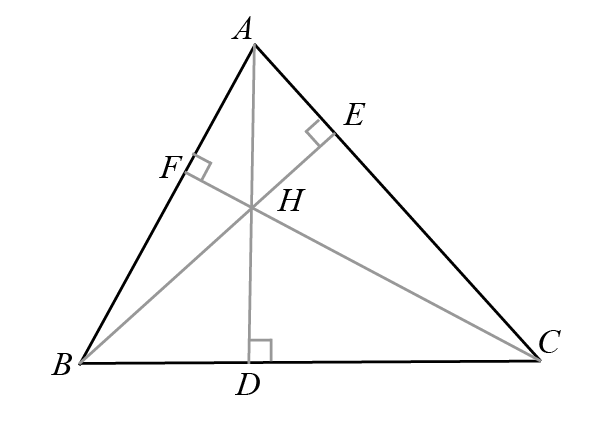
The orthocenter of a triangle is the point where the three altitudes intersect. An altitude of a triangle is a line which passes through a vertex of the triangle and is perpendicular to the opposite side.
In triangle ABC, let the altitudes from vertices A, B, and C be AD, BE, and CF, respectively. The point of intersection of these altitudes is denoted as H, which is the orthocenter of the triangle.
The orthocenter of a triangle, denoted by H, is the common point of intersection of the triangle's three altitudes. An altitude is a perpendicular segment from a vertex to the line containing the opposite side. The location of the orthocenter relative to the triangle depends on the type of triangle:
Acute Triangle: For an acute triangle, where all angles are less than 90 degrees, the orthocenter lies inside the triangle. This is because each altitude will be internal when drawn from a vertex to the opposite side.
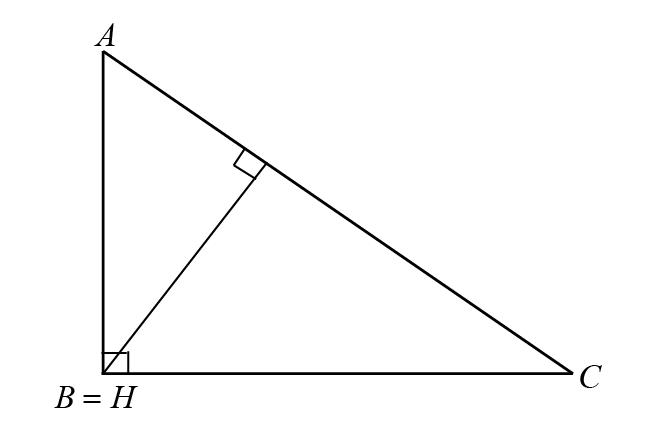
Right Triangle: In a right triangle, the orthocenter coincides with the vertex of the right angle. This happens because the sides of the triangle itself serve as altitudes: one altitude is the vertical side, another is the horizontal side, and the third is the line segment from the right angle vertex to the hypotenuse, which is already perpendicular by definition.
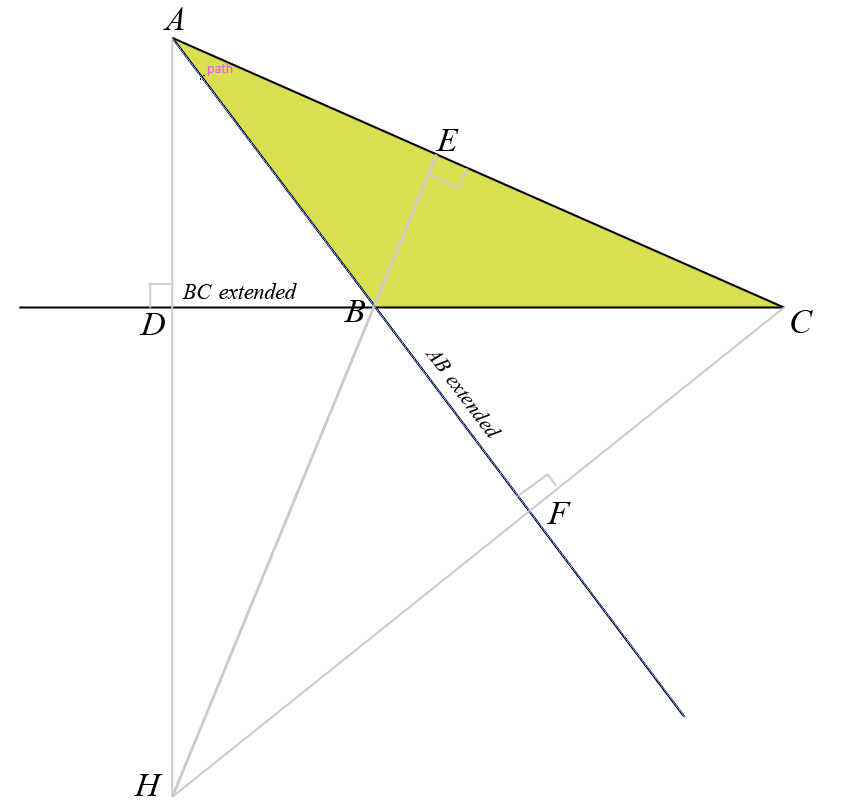
Obtuse Triangle: For an obtuse triangle, which has an angle greater than 90 degrees, the orthocenter falls outside the triangle. To draw the altitudes, extensions of the sides are needed since the perpendicular lines from the vertices opposite the obtuse angle will fall outside the triangle.
In any triangle ABC with altitudes AD, BE, and CF, the point where these three altitudes meet is the orthocenter H. To find H computationally or constructively, it typically requires only two altitudes; their intersection defines the orthocenter's exact location.
ACUTE TRIANGLE
RIGHT ANGLED TRIANGLE
OBTUSE TRIANGLE
Orthocenters of Triangles Formed by Orthocenter and Vertices§
In triangle ABC, if H is the orthocenter, then A is the orthocenter of triangle HBC, B is the orthocenter of triangle HCA, and C is the orthocenter of triangle HAB.
The pedal triangle DEF of a point P relative to △ABC is the triangle formed by the points D, E, and F, which are the feet of the perpendiculars from P to the sides BC, CA, and AB of △ABC, respectively.
PD⊥BC
PE⊥AC
PF⊥AB
If P coincides with the orthocenter H of △ABC, then D, E, and F are the feet of the altitudes of △ABC, and the pedal triangle DEF is also known as the orthic triangle of △ABC.
The incenter of a triangle ABC is the point from which the incircle, the unique circle that touches each of the sides AB, BC, and CA internally, is centered. The points where the incircle touches the sides are called the points of tangency, and they lie directly on the sides AB, BC, and CA, equidistant from the incenter. The radius of the incircle is perpendicular to each side of the triangle at these points of tangency.
In triangle ABC, the incircle is tangent to the sides at points D, E, and F. The center of this incircle is the incenter, denoted as I. The radius of the incircle, such as ID, is perpendicular to the side it touches, in this case, side BC.
Since the segments AE and AF are equal in length, being tangents to the incircle from the same external point A, triangles AIE and AIF are congruent by the Side-Side-Side postulate. This congruency implies that angle IAC is equal to angle IAB, which establishes that AI is the angle bisector of angle A.
Similarly, because the incircle is tangent to AB at F and AC at E, and the tangents from a common external point to a circle are equal, we can deduce that BI and CI bisect angles B and C respectively.
Thus, the incenter I can also be defined as the single point at which the three internal angle bisectors of triangle ABC intersect.
The coordinates of the incenter I of triangle ABC, with vertices A(x1,y1), B(x2,y2), and C(x3,y3) and side lengths a=BC, b=AC, and c=AB, can be found using the formula:
I(a+b+cax1+bx2+cx3,a+b+cay1+by2+cy3)
Proof:
To prove the formula for the incenter I of a triangle ABC, we can employ the Angle Bisector Theorem. This theorem states that an angle bisector in a triangle divides the opposite side into two segments that are proportional to the lengths of the other two sides.
Given:
Triangle ABC with side lengths AB=c, AC=b, and BC=a.
Vertices of the triangle are A(x1,y1), B(x2,y2), and C(x3,y3).
We proceed as follows:
Step 1: Applying the Angle Bisector Theorem to AL
The angle bisector theorem states that the angle bisector divides the opposite side in the ratio of the adjacent sides. If AL is the angle bisector of ∠A, it divides side BC into two segments, BD and DC, such that BD:DC=AB:AC=c:b. Since we know the coordinates of B and C, we can find the coordinates of D as:
D(b+ccx3+bx2,b+ccy3+by2)
Step 2: Length of Segment AL
Using the section formula, the length of segment AL, which is in the ratio c:b to side BC, can be expressed as:
AL=b+cc⋅BC
BC can be found by the distance formula, and then AL can be calculated.
Step 3: Apply the Angle Bisector Theorem to △ABL
Similarly, BI is the angle bisector in △ABL, and it divides AL in the ratio of AB:BL. Given that AB is to BL as c is to ac/(b+c), we have AI:IL=(b+c):a.
The coordinates of I are found by dividing the segment AL in the ratio (b+c):a starting from A to L. If L is the point on segment AL at which BI intersects AL, then I can be determined by the section formula:
I(a+b+cax1+(b+c)xD,a+b+cay1+(b+c)yD)
Substitute the coordinates of D from Step 1 into this equation to get the coordinates of the incenter I.
Now we simplify the expressions for the coordinates of I:
I=(a+b+cax1+cx3+bx2,a+b+cay1+cy3+by2)
Thus, the coordinates of I are obtained by the formula above, giving us the incenter of triangle ABC in terms of the vertices coordinates A(x1,y1), B(x2,y2), and C(x3,y3) and the lengths of the sides opposite these vertices, a, b, and c.
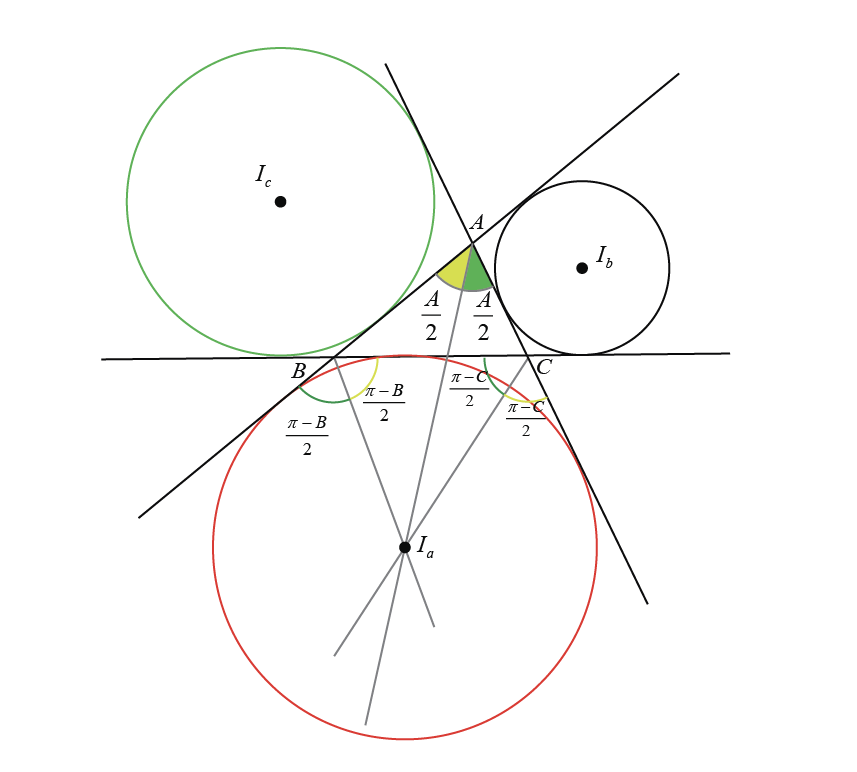
Excenters of a triangle are the centers of the escribed circles, which are circles tangent to one side of the triangle and to the extensions of the other two sides. Each triangle has three excenters, corresponding to each of the triangle's vertices.
To construct an excenter, you need to extend the bisector of one interior angle and the bisectors of the exterior angles at the other two vertices. The point where these three lines intersect is the excenter.
For a triangle ABC, the excenters are often denoted as Ia, Ib, and Ic, opposite to the vertices A, B, and C, respectively.
Formulas for excenters:
Given the vertices A(x1,y1), B(x2,y2), and C(x3,y3), and sides a, b, and c opposite these vertices, the coordinates of the excenters Ia, Ib, and Ic can be found using similar constructions as the incenter but using the exterior angle bisectors. The formulas are as follows:
Excenter Ia opposite of vertex A and corresponding to side a:
Excenter Ib opposite of vertex B and corresponding to side b:
Ib=(a−b+cax1−bx2+cx3,a−b+cay1−by2+cy3)
Excenter Ic opposite of vertex C and corresponding to side c:
Ic=(a+b−cax1+bx2−cx3,a+b−cay1+by2−cy3)
These formulas are based on the concept that to locate an excenter, you must consider the lengths of the sides with respect to the angles being bisected. For example, for the excenter Ia, the angle bisector of A is extended outside the triangle to form the exterior angle, and then the lengths of the other sides are considered with their signs changed accordingly.
[We will study in more detail in the chapter Solutions of Triangle]
The circumcircle of a triangle is the unique circle that passes through all three vertices of the triangle. The center of this circle is known as the circumcenter, and its radius is called the circumradius.
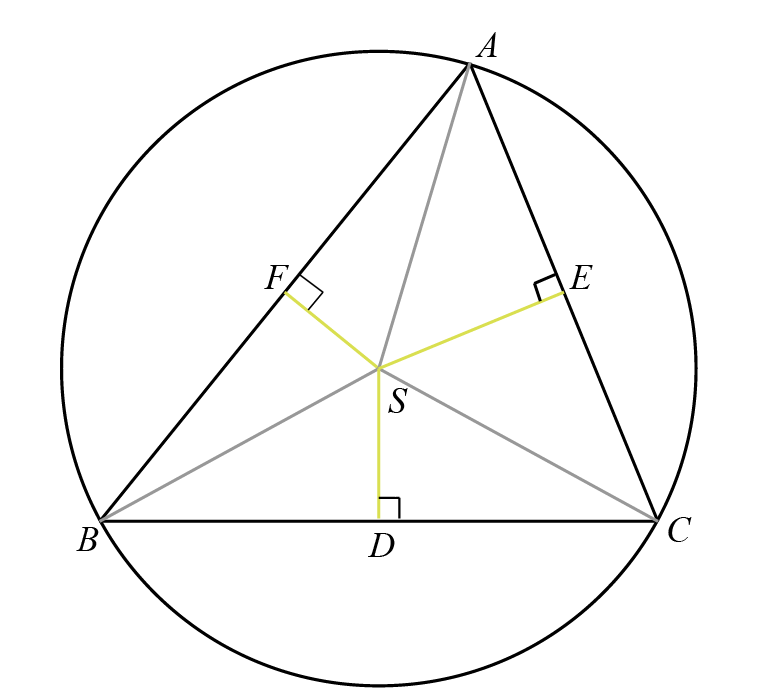
The figure illustrates triangle ABC inscribed in its circumcircle. Point S represents the circumcenter of the triangle. Perpendiculars SD, SE, and SF are dropped from S to the sides BC, AC, and AB respectively, bisecting each side. This bisecting property stems from the fact that a perpendicular drawn from the center of a circle to any chord of the circle bisects the chord. Consequently, the circumcenter S can also be defined as the intersection point of the perpendicular bisectors of the sides of the triangle.
Additionally, the lengths SA, SB, and SC are congruent as they are radii of the circumcircle. This equality is crucial for determining the location of S when the coordinates of A, B, and C are known. The circumcenter is equidistant from all vertices of the triangle.
For a right-angled triangle, the circumcenter lies at the midpoint of the hypotenuse, and the circumradius is equal to half of the length of hypotenuse.
The circumcenter of a triangle may lie inside, on, or outside the triangle depending on the type of triangle:
Acute Triangle: The circumcenter lies inside the triangle. This is because the perpendicular bisectors of the sides intersect at a point that is equidistant from all the vertices, which will be within the bounds of the triangle.
Right Triangle: The circumcenter lies on the triangle, specifically on the midpoint of the hypotenuse. In a right triangle, the hypotenuse serves as the diameter of the circumcircle.
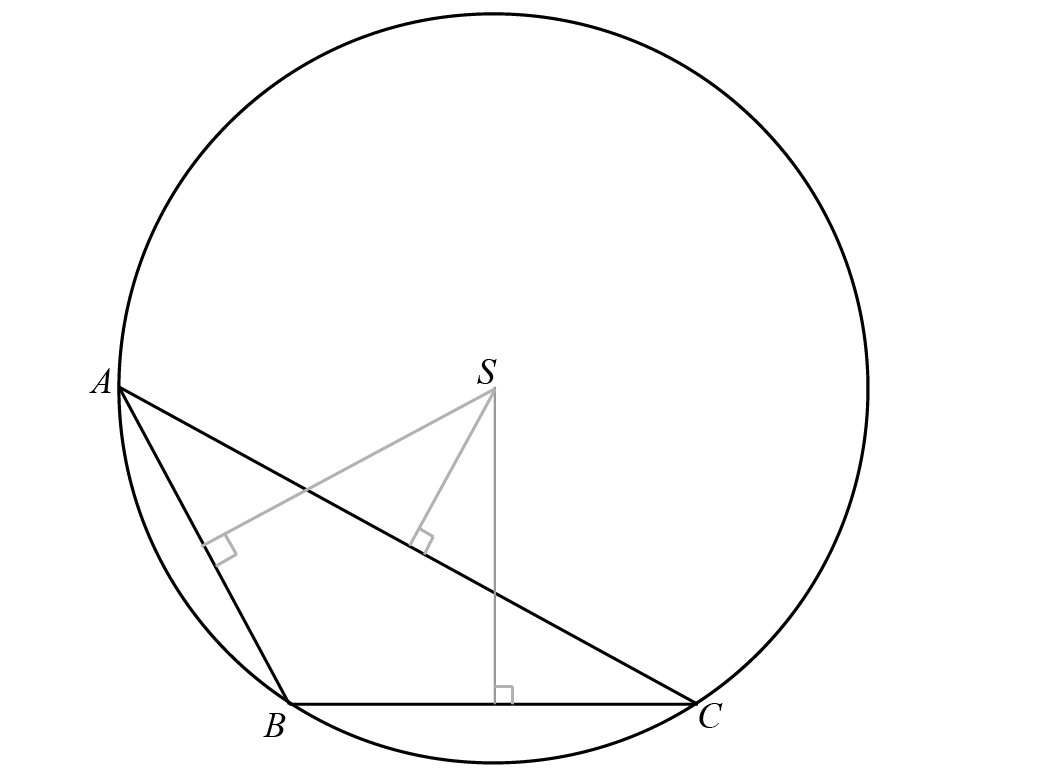
Obtuse Triangle: The circumcenter lies outside the triangle. In an obtuse triangle, the perpendicular bisectors of the sides will intersect at a point outside the triangle, as the angle opposite the longest side (which is obtuse) requires the circumcenter to fall outside to be equidistant from all three vertices. See the figure below:
Some Miscellaneuous Facts based on centres of Circle§
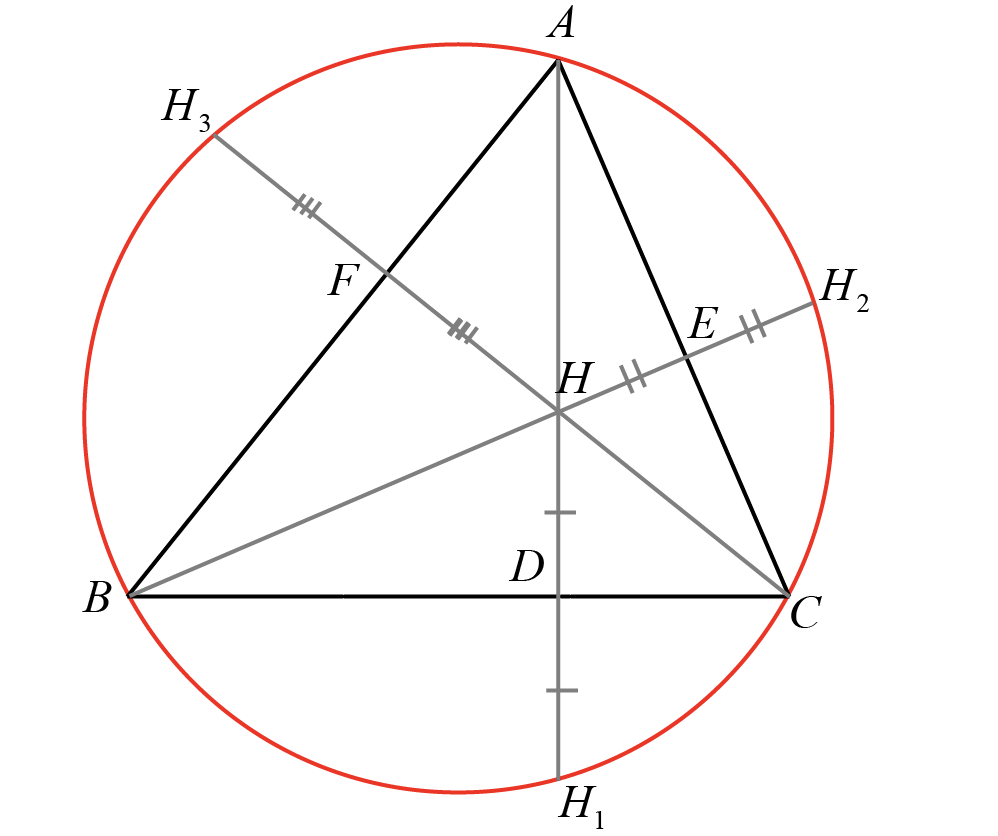
In triangle ABC, let H be the orthocenter, and let H1, H2, and H3 be the reflections of H over sides BC, CA, and AB, respectively. Then, points H1, H2, and H3 lie on the circumcircle of triangle ABC.
The figure displays triangle ABC, with AD, BE, and CF representing the altitudes from vertices A, B, and C, respectively. These altitudes intersect at point H, known as the orthocenter of the triangle. The triangle is inscribed in a circle, known as the circumcircle. The points H1, H2, and H3 are depicted on the sides BC, CA, and AB, respectively, and are the reflections of the orthocenter H across the respective sides of the triangle.
In triangle ABC, let point P be an arbitrary point. The pedal triangle of point P with respect to triangle ABC is constructed by dropping perpendiculars from P to the sides AB, BC, and CA. These perpendiculars meet the sides of ABC at points D, E, and F respectively, which are the vertices of the pedal triangle DEF.
The pedal triangle can be classified as follows based on the location of point P:
When P is the orthocenter of triangle ABC, the pedal triangle DEF is known as the orthic triangle. Points D, E, and F are the feet of the altitudes of ABC.
If P is the centroid of triangle ABC, the pedal triangle DEF is termed the medial triangle. Points D, E, and F are the midpoints of the sides BC, CA, and AB respectively.
When P is the incenter of triangle ABC, the pedal triangle DEF is referred to as the intouch triangle. In this case, D, E, and F are the points of tangency of the incircle with the sides BC, CA, and AB.
When point P lies on the circumcircle of triangle ABC, the feet of the perpendiculars from P to the sides of ABC, namely points D, E, and F, become collinear. This specific line on which D, E, and F lie is known as the Simson line, after Robert Simson.
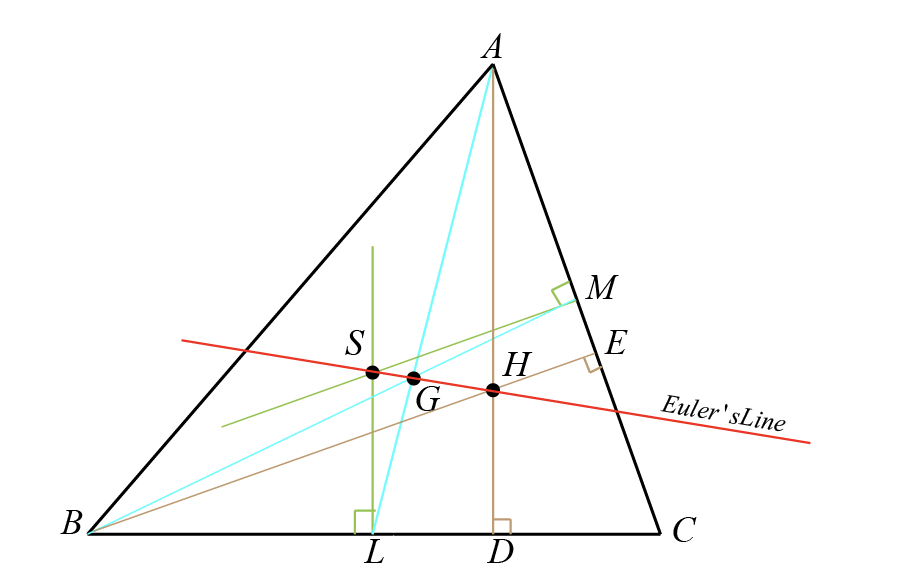
In triangle ABC, Euler's line is defined as the straight line that passes through several of the triangle's important centers: the centroid G, the orthocenter H, and the circumcenter S.
The distances between these points are related in a fixed ratio. The centroid G divides the segment from the orthocenter H to the circumcenter S in the ratio 2:1. This means that HG:GS=2:1. The centroid is twice as far from the orthocenter as it is from the circumcenter.
In the figure of triangle ABC, Euler's line is illustrated by the red line intersecting the orthocenter H, the centroid G, and the circumcenter S.
The orthocenter H is where the altitudes of the triangle meet, specifically altitudes AD and BE, and the third altitude (not shown) would also converge at H.
The centroid G is found at the intersection of the medians of the triangle, with medians AL and BM shown intersecting at G. The third median from vertex C (not depicted) would also intersect at G.
The circumcenter S is the point of intersection of the perpendicular bisectors of the triangle's sides. The perpendicular bisectors through points L and M are shown intersecting at S. The perpendicular bisector of the third side (not labeled) would also pass through S.
Euler's line connects points H, G, and S, affirming their collinearity. The centroid G bisects the line segment joining the orthocenter H and the circumcenter S in a 2:1 ratio, with HG being twice as long as GS.
In an equilateral triangle ABC with vertices A(x1,y1), B(x2,y2), and C(x3,y3), the incenter, centroid, circumcenter, and orthocenter all coincide at the same point due to the symmetry of the triangle. The common point, often referred to as the triangle's center, can be found using the formula for the centroid which applies to all these centers in the case of an equilateral triangle:
(3x1+x2+x3,3y1+y2+y3)
This point is equidistant from all the vertices and also equidistant from all the sides of the equilateral triangle. It serves as the center for the inscribed circle (incircle), the circumscribed circle (circumcircle), and is also the point where the altitudes, which are the same as the medians and the angle bisectors, intersect.
Section 3 of 6 · Coordinate Geometry Fundamentals
Mark this section complete when you have worked through its proofs.
Type any topic, theorem, or concept to jump directly to the section.