MatheramaMatherama
← Straight Lines
Straight Lines·Section 3·19 min read

Interaction of Points with a Line

Introduction§

Given a point P(x1,y1)P(x_1, y_1) and a line described by the equation ax+by+c=0ax + by + c = 0, we explore three significant geometric concepts:

  1. The perpendicular distance from point PP to the line is the shortest distance between the point and any point on the line. It is measured along the line perpendicular to the given line passing through PP.

  2. The foot of the perpendicular from PP to the line is the point of intersection of the line and the perpendicular drawn from PP. This point is significant as it is the closest point on the line to PP.

  3. The image of point PP in the line is the point P′P' such that PP and P′P' are symmetric with respect to the line. The line segment connecting PP and P′P' is bisected by the line, and this segment is perpendicular to the line.

Perpendicular Distance of a Point from a Line§

Let P(x1,y1)P(x_1, y_1) be a point in the plane and let ax+by+c=0ax + by + c = 0 be the equation of a non-vertical line. The perpendicular distance dd from the point PP to the line is given by the formula:

d=∣ax1+by1+c∣a2+b2d = \frac{|ax_1 + by_1 + c|}{\sqrt{a^2 + b^2}}

Coordinates of foot of perpendicular dropped from a point to a line§

The coordinates (xf,yf)(x_f, y_f) of the foot of a perpendicular dropped from a point (x1,y1)(x_1, y_1) to the line ax+by+c=0ax + by + c = 0 are given by the following relations:

xf−x1a=yf−y1b=−ax1+by1+ca2+b2\frac{x_f - x_1}{a} = \frac{y_f - y_1}{b} = -\frac{ax_1 + by_1 + c}{a^2 + b^2}

Proof:

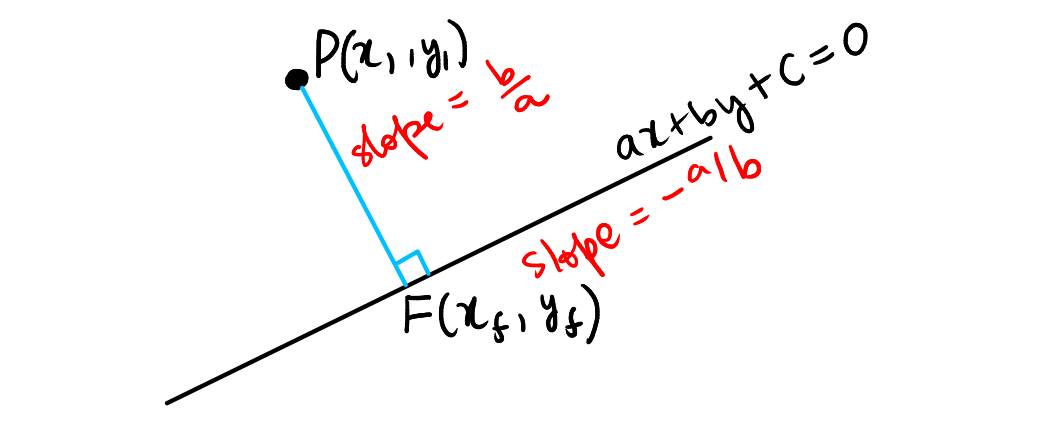
Foot of the point on line L

Draw a perpendicular from P(x1,y1)P(x_1, y_1) to the line ax+by+c=0ax + by + c = 0 having foot at F(xf,yf)F(x_f, y_f).

Slope of the given line is −ab-\frac{a}{b}. Then the slope of PFPF is ba\frac{b}{a}. If PFPF makes an angle θ\theta with the positive x-axis, then tan⁡θ=ba\tan\theta = \frac{b}{a}. This implies that sin⁡θ=ba2+b2\sin\theta = \frac{b}{\sqrt{a^2 + b^2}} and cos⁡θ=aa2+b2\cos\theta = \frac{a}{\sqrt{a^2 + b^2}}.

We write the symmetric form of PFPF as x−x1cos⁡θ=y−y1sin⁡θ=r\frac{x - x_1}{\cos\theta} = \frac{y - y_1}{\sin\theta} = r.

Thus coordinates of FF are xf=x1+rfcos⁡θx_f = x_1 + r_f \cos\theta and yf=y1+rfsin⁡θy_f = y_1 + r_f \sin\theta for some r=rfr = r_f.

F also lies on ax+by+c=0ax + by + c = 0

⇒axf+byf+c=0\Rightarrow ax_f + by_f + c = 0

⇒a(x1+rfcos⁡θ)+b(y1+rfsin⁡θ)+c=0\Rightarrow a(x_1 + r_f \cos\theta) + b(y_1 + r_f \sin\theta) + c = 0

⇒rf=−ax1+by1+cacos⁡θ+bsin⁡θ\Rightarrow r_f = - \frac{ax_1 + by_1 + c}{a \cos\theta + b \sin\theta}

But acos⁡θ+bsin⁡θ=a2a2+b2+b2a2+b2a \cos\theta + b \sin\theta = \frac{a^2}{\sqrt{a^2 + b^2}} + \frac{b^2}{\sqrt{a^2 + b^2}}

=a2+b2= \sqrt{a^2 + b^2}

Thus, xf−x1cos⁡θ=yf−y1sin⁡θ=−ax1+by1+ca2+b2\frac{x_f - x_1}{\cos\theta} = \frac{y_f - y_1}{\sin\theta} = - \frac{ax_1 + by_1 + c}{\sqrt{a^2 + b^2}}

⇒xf−x1a/a2+b2=yf−y1b/a2+b2=−ax1+by1+ca2+b2\Rightarrow \frac{x_f - x_1}{a/\sqrt{a^2+b^2}} = \frac{y_f - y_1}{b/\sqrt{a^2+b^2}} = - \frac{ax_1 + by_1 + c}{\sqrt{a^2 + b^2}}

⇒xf−x1a=yf−y1b=−ax1+by1+ca2+b2\Rightarrow \frac{x_f - x_1}{a} = \frac{y_f - y_1}{b} = - \frac{ax_1 + by_1 + c}{a^2 + b^2}

■\blacksquare

Image of a point with respect to a line§

The image (xI,yI)(x_I, y_I) of the point (x1,y1)(x_1, y_1) in the line ax+by+c=0ax+by+c=0 is given by the relation:

xI−x1a=yI−y1b=−2(ax1+by1+c)a2+b2\frac{x_I - x_1}{a} = \frac{y_I - y_1}{b} = -\frac{2(ax_1 + by_1 + c)}{a^2 + b^2}

Proof:

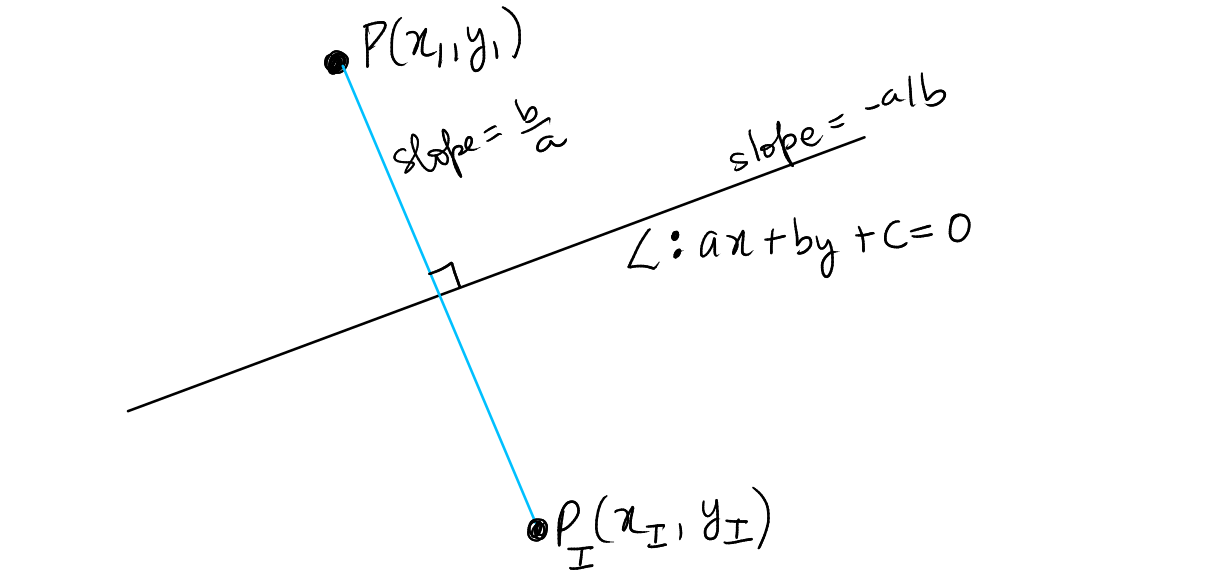
image of a point wrt to the line

The image PI(xI,yI)P_I(x_I, y_I) of the point P(x1,y1)P(x_1, y_1) in the line L:ax+by+c=0L: ax+by+c=0 can be found using the following procedure:

Draw the line joining PP and PIP_I cutting LL at FF. Clearly FF is the midpoint of PP and PIP_I and PPIPP_I is perpendicular to LL.

Slope of LL is −ab-\frac{a}{b} => Slope of PPIPP_I is ba\frac{b}{a}.

Let PPIPP_I make an angle θ\theta with positive x-axis. Then, tan⁡θ=ba\tan\theta = \frac{b}{a} => cos⁡θ=aa2+b2\cos\theta = \frac{a}{\sqrt{a^2+b^2}} and sin⁡θ=ba2+b2\sin\theta = \frac{b}{\sqrt{a^2+b^2}}.

The symmetric form of the line PPIPP_I is x−x1cos⁡θ=y−y1sin⁡θ=r\frac{x-x_1}{\cos\theta} = \frac{y-y_1}{\sin\theta} = r.

Then, coordinates of PIP_I can be written as: xI=x1+rIcos⁡θx_I = x_1 + r_I \cos\theta and yI=y1+rIsin⁡θy_I = y_1 + r_I \sin\theta for some r=rIr=r_I.

Midpoint of PP and PIP_I is FF which lies on LL. Therefore,

a(x1+xI2)+b(y1+yI2)+c=0a\left(\frac{x_1 + x_I}{2}\right) + b\left(\frac{y_1 + y_I}{2}\right) + c = 0

⇒a(2x1+rIcos⁡θ)+b(2y1+rIsin⁡θ)+2c=0\Rightarrow a\left(2x_1 + r_I\cos\theta\right) + b\left(2y_1 + r_I\sin\theta\right) + 2c = 0

⇒rI=−2(ax1+by1+cacos⁡θ+bsin⁡θ)\Rightarrow r_I = -2\left(\frac{ax_1 + by_1 + c}{a\cos\theta + b\sin\theta}\right)

Now acos⁡θ+bsin⁡θ=a2a2+b2+b2a2+b2=a2+b2a\cos\theta + b\sin\theta = \frac{a^2}{\sqrt{a^2+b^2}} + \frac{b^2}{\sqrt{a^2+b^2}} = \sqrt{a^2+b^2}

∴rI=−2(ax1+by1+ca2+b2)\therefore r_I = -2\left(\frac{ax_1 + by_1 + c}{\sqrt{a^2+b^2}}\right)

∴xI−x1a/a2+b2=yI−y1b/a2+b2=−2(ax1+by1+ca2+b2)\therefore \frac{x_I - x_1}{a/\sqrt{a^2+b^2}} = \frac{y_I - y_1}{b/\sqrt{a^2+b^2}} = -2\left(\frac{ax_1 + by_1 + c}{a^2+b^2}\right)

⇒xI−x1a=yI−y1b=−2(ax1+by1+c)a2+b2\Rightarrow \frac{x_I - x_1}{a} = \frac{y_I - y_1}{b} = \frac{-2\left(ax_1 + by_1 + c\right)}{a^2+b^2} ■\blacksquare

Distance of a point from a line measured along another line§

The distance dd of a point P(x1,y1)P(x_1, y_1) from the line ax+by+c=0ax + by + c = 0 measured along another line which makes an angle θ\theta with the positive x-axis is given by:

d=∣ax1+by1+c∣∣acos⁡θ+bsin⁡θ∣d = \frac{|ax_1 + by_1 + c|}{|a\cos\theta + b\sin\theta|}

Proof:

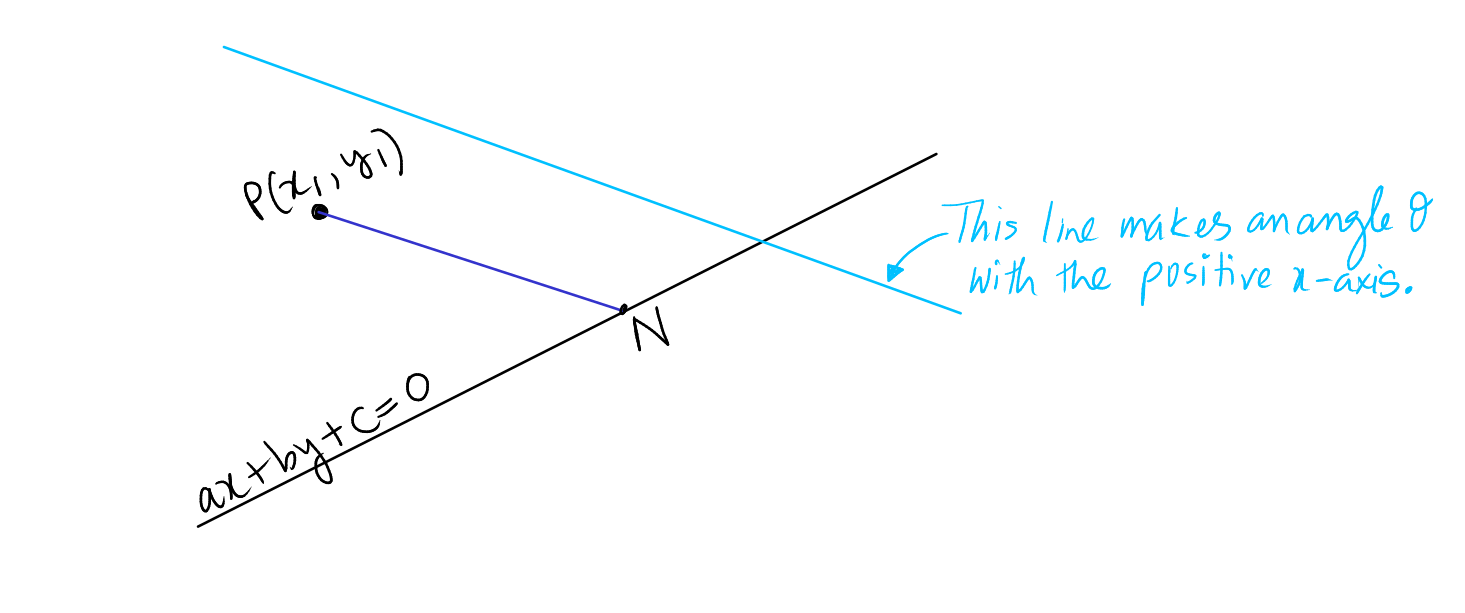
Distance of a point from a line measured along another line

To prove the distance of a point P(x1,y1)P(x_1, y_1) from a line ax+by+c=0ax + by + c = 0 measured along another line making an angle θ\theta with the positive x-axis:

Draw a line PNPN parallel to the line which makes an angle of θ\theta with the positive x-axis. The equation of PNPN in symmetric form is x−x1cos⁡θ=y−y1sin⁡θ=r\frac{x - x_1}{\cos\theta} = \frac{y - y_1}{\sin\theta} = r. Thus, the coordinates of NN can be written as x=x1+rcos⁡θx = x_1 + r\cos\theta and y=y1+rsin⁡θy = y_1 + r\sin\theta for some rr in R\mathbb{R}.

Since NN lies on the line ax+by+c=0ax + by + c = 0, substituting the coordinates of NN we get a(x1+rcos⁡θ)+b(y1+rsin⁡θ)+c=0a(x_1 + r\cos\theta) + b(y_1 + r\sin\theta) + c = 0. Solving for rr gives r=−ax1+by1+cacos⁡θ+bsin⁡θr = -\frac{ax_1 + by_1 + c}{a\cos\theta + b\sin\theta}.

Thus, PN=∣r∣=∣−ax1+by1+cacos⁡θ+bsin⁡θ∣PN = |r| = \left| -\frac{ax_1 + by_1 + c}{a\cos\theta + b\sin\theta} \right|.

This results in the formula for the distance of a point from a line along a given direction:

d=∣ax1+by1+cacos⁡θ+bsin⁡θ∣d = \left| \frac{ax_1 + by_1 + c}{a\cos\theta + b\sin\theta} \right|

Ratio in which a line divides the line segment joining two points§

The ratio in which the line ax+by+c=0ax + by + c = 0 divides the line segment joining points A(x1,y1)A(x_1, y_1) and B(x2,y2)B(x_2, y_2) is given by:

Ratio=λ=−ax1+by1+cax2+by2+c\text{Ratio}= \lambda = -\frac{ax_1 + by_1 + c}{ax_2 + by_2 + c}

Proof:

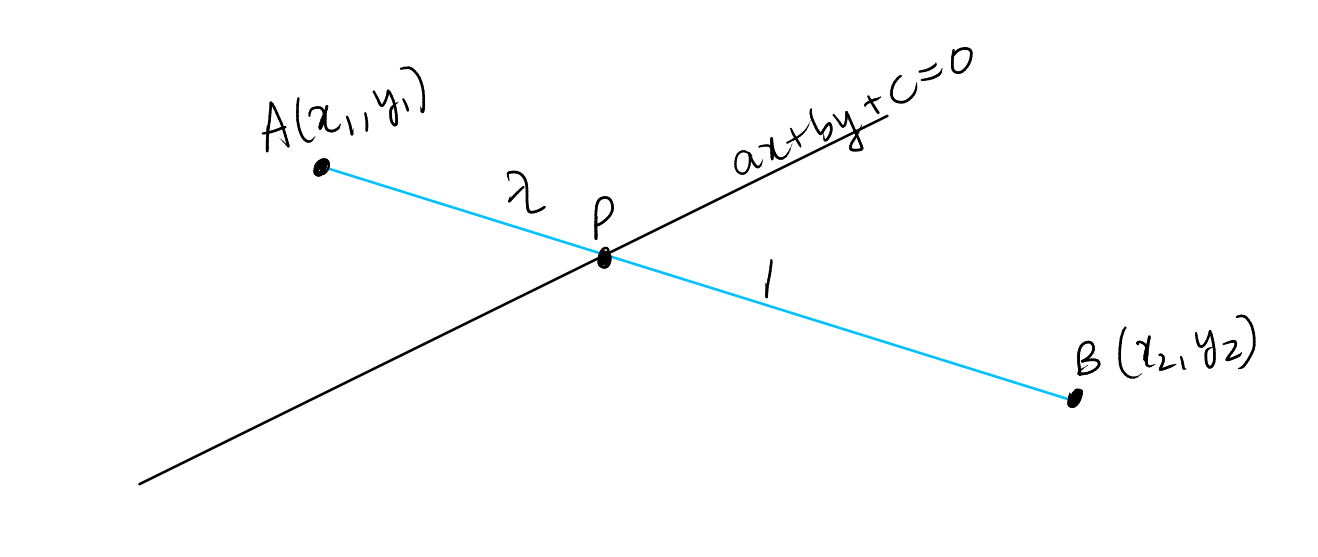
Let the line ax+by+c=0ax + by + c = 0 divide the line joining A(x1,y1)A(x_1, y_1) and B(x2,y2)B(x_2, y_2) in the ratio λ:1\lambda : 1. Let it cut ABAB at PP.

A line dividing a line segment

Thus, APPB=λ\frac{AP}{PB} = \lambda.

Coordinates of PP thus, are

(λx2+x1λ+1,λy2+y1λ+1)\left( \frac{\lambda x_2 + x_1}{\lambda + 1}, \frac{\lambda y_2 + y_1}{\lambda + 1} \right)

PP lies on ax+by+c=0ax + by + c = 0

Thus, substituting PP's coordinates:

a(λx2+x1λ+1)+b(λy2+y1λ+1)+c=0a\left( \frac{\lambda x_2 + x_1}{\lambda + 1} \right) + b\left( \frac{\lambda y_2 + y_1}{\lambda + 1} \right) + c = 0

Multiply through by λ+1\lambda + 1 to clear the denominator:

a(λx2+x1)+b(λy2+y1)+c(λ+1)=0a(\lambda x_2 + x_1) + b(\lambda y_2 + y_1) + c(\lambda + 1) = 0

Reorganize and isolate terms involving λ\lambda:

λ(ax2+by2+c)+ax1+by1+c=0\lambda (ax_2 + by_2+c) + ax_1 + by_1 + c = 0

Solve for λ\lambda:

λ(ax2+by2+c)=−(ax1+by1+c)\lambda (ax_2 + by_2+c) = -(ax_1 + by_1 + c) λ=−(ax1+by1+c)(ax2+by2+c)\lambda = -\frac{(ax_1 + by_1 + c)}{(ax_2 + by_2+c)}

■\blacksquare

Relative Position of two points with respect to a line§

Given a line L(x,y):ax+by+c=0L(x, y): ax + by + c = 0 and two points A(x1,y1)A(x_1, y_1) and B(x2,y2)B(x_2, y_2):

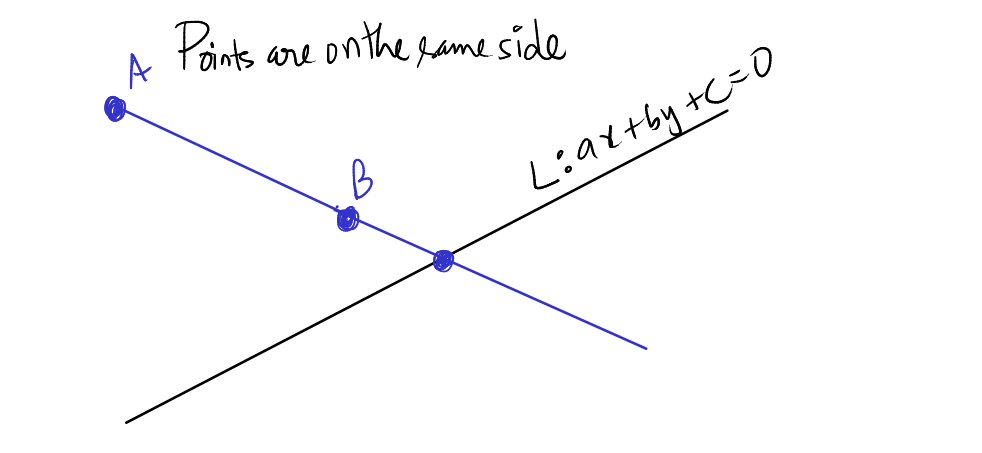
  • The points AA and BB are on the same side of the line LL if the expression (ax1+by1+c)(ax2+by2+c)>0(ax_1 + by_1 + c)(ax_2 + by_2 + c) > 0. As a short notation, we can write as L(x1,y1)×L(x2,y2)>0L(x_1, y_1) \times L(x_2, y_2) > 0.

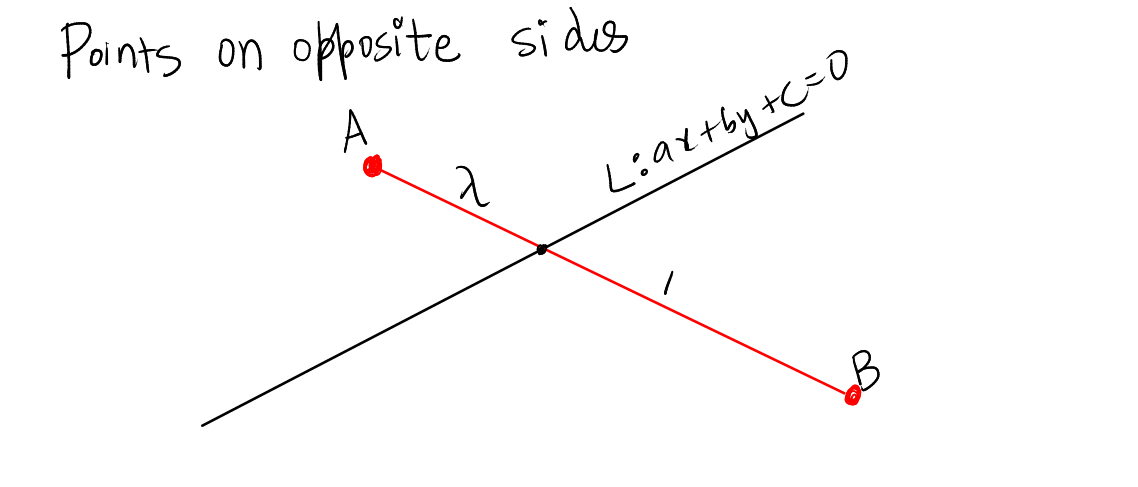
  • The points AA and BB are on opposite sides of the line LL if the expression (ax1+by1+c)(ax2+by2+c)<0(ax_1 + by_1 + c)(ax_2 + by_2 + c) < 0. As a short notation, we can write as L(x1,y1)×L(x2,y2)<0L(x_1, y_1) \times L(x_2, y_2) < 0.

This theorem is used to determine the relative position of two points with respect to a given line without proving their actual positions.

Points on opposite sides

POints on the same side

Proof:

To prove the relative positions of two points A(x1,y1)A(x_1, y_1) and B(x2,y2)B(x_2, y_2) with respect to the line L:ax+by+c=0L: ax+by+c=0, we utilize the concept that if two points are on the same side of the line, then the line LL divides the line segment ABAB externally, and the ratio λ=−(ax1+by1+c)(ax2+by2+c)\lambda = -\frac{(ax_1 + by_1 + c)}{(ax_2 + by_2 + c)} is negative. This is to say that −(ax1+by1+c)(ax2+by2+c)<0-\frac{(ax_1 + by_1 + c)}{(ax_2 + by_2 + c)} < 0 implies (ax1+by1+c)(ax2+by2+c)>0\frac{(ax_1 + by_1 + c)}{(ax_2 + by_2 + c)} > 0, which leads to (ax1+by1+c)(ax2+by2+c)>0(ax_1 + by_1 + c)(ax_2 + by_2 + c) > 0.

If they are on opposite sides, then the line LL divides ABAB internally and thus the ratio λ=−(ax1+by1+c)(ax2+by2+c)>0\lambda = -\frac{(ax_1 + by_1 + c)}{(ax_2 + by_2 + c)} > 0 implies (ax1+by1+c)(ax2+by2+c)<0(ax_1 + by_1 + c)(ax_2 + by_2 + c) < 0. This shows that the products of their algebraic distances from the line have opposite signs, confirming that the points lie on opposite sides of the line. ■\blacksquare

A point lies inside a triangle§

Using Relative location of points

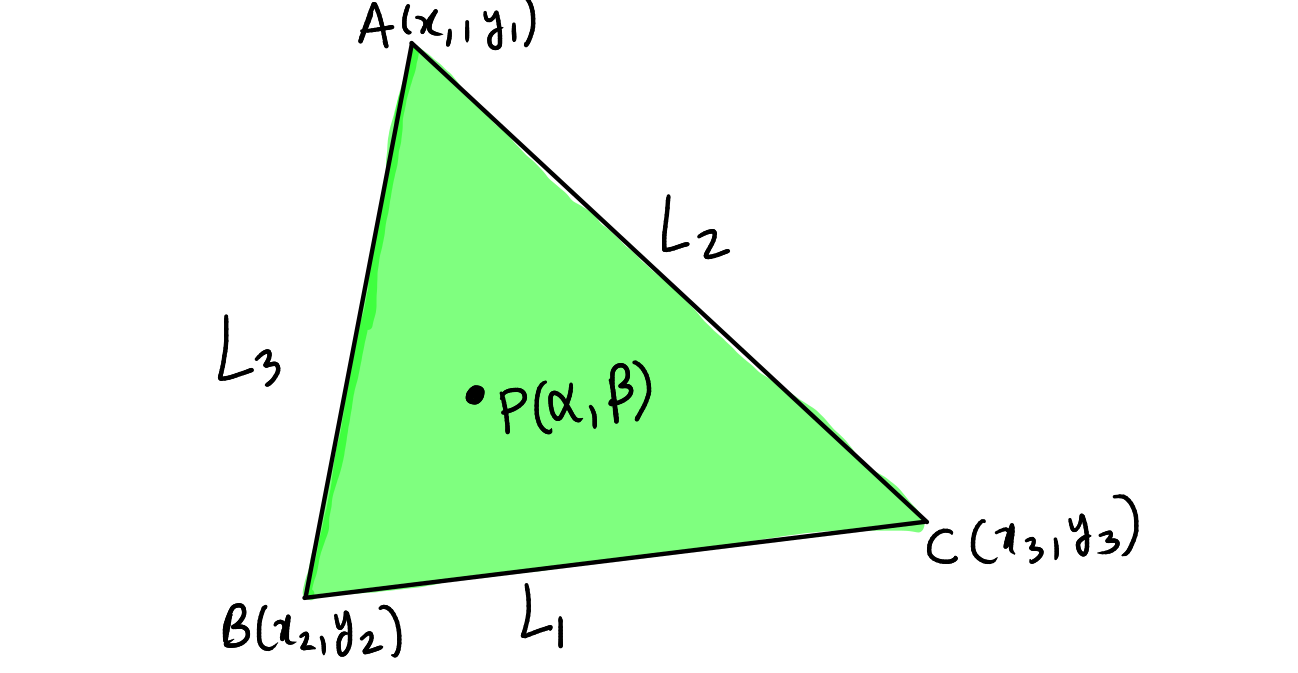
Consider a triangle △ABC\triangle ABC where vertices AA are given as (x1,y1)(x_1, y_1), BB as (x2,y2)(x_2, y_2), and CC as (x3,y3)(x_3, y_3). We want to determine if P(α,β)P(\alpha, \beta) lies inside the triangle. We can do this plotting all points. But, it is not necessary to plot all points. Instead, this can be determined algebraically by finding the line equations for each of the triangle's sides, denoted as L1L_1, L2L_2, and L3L_3.

triangle ABC with point P inside

These equations represent the sides BCBC, CACA, and ABAB respectively. To establish if PP is within △ABC\triangle ABC, it should lie on the same side of each line as the opposite vertex of the triangle. Specifically:

  • PP and AA must be on the same side of L1L_1 (line BCBC).
  • PP and BB must be on the same side of L2L_2 (line CACA).
  • PP and CC must be on the same side of L3L_3 (line ABAB).

This is confirmed algebraically by checking the sign of the expressions:

  • L1(α,β)×L1(x1,y1)>0L_1(\alpha, \beta) \times L_1(x_1, y_1) > 0
  • L2(α,β)×L2(x2,y2)>0L_2(\alpha, \beta) \times L_2(x_2, y_2) > 0
  • L3(α,β)×L3(x3,y3)>0L_3(\alpha, \beta) \times L_3(x_3, y_3) > 0

If all these conditions are satisfied, then P(α,β)P(\alpha, \beta) lies inside △ABC\triangle ABC.

Alternative Method using area of triangles

To determine whether a point P(α,β)P(\alpha, \beta) lies inside a triangle formed by the vertices A(x1,y1)A(x_1, y_1), B(x2,y2)B(x_2, y_2), and C(x3,y3)C(x_3, y_3), we can use the area method. This method involves calculating the areas of the sub-triangles formed by the point PP and the vertices of the triangle.

  1. Calculate the Area of the Triangle ΔABC\Delta ABC

    The area of the triangle ΔABC\Delta ABC can be found using the determinant formula:

    AreaABC=12∣x1(y2−y3)+x2(y3−y1)+x3(y1−y2)∣\text{Area}_{ABC} = \frac{1}{2} \left| x_1(y_2 - y_3) + x_2(y_3 - y_1) + x_3(y_1 - y_2) \right|
  2. Calculate the Area of the Triangle ΔPBC\Delta PBC

    Similarly, the area of the triangle ΔPBC\Delta PBC is given by:

    AreaPBC=12∣α(y2−y3)+x2(y3−β)+x3(β−y2)∣\text{Area}_{PBC} = \frac{1}{2} \left| \alpha(y_2 - y_3) + x_2(y_3 - \beta) + x_3(\beta - y_2) \right|
  3. Calculate the Area of the Triangle ΔPCA\Delta PCA

    The area of the triangle ΔPCA\Delta PCA is:

    AreaPCA=12∣x1(β−y3)+α(y3−y1)+x3(y1−β)∣\text{Area}_{PCA} = \frac{1}{2} \left| x_1(\beta - y_3) + \alpha(y_3 - y_1) + x_3(y_1 - \beta) \right|
  4. Calculate the Area of the Triangle ΔPAB\Delta PAB

    The area of the triangle ΔPAB\Delta PAB is:

    AreaPAB=12∣x1(y2−β)+x2(β−y1)+α(y1−y2)∣\text{Area}_{PAB} = \frac{1}{2} \left| x_1(y_2 - \beta) + x_2(\beta - y_1) + \alpha(y_1 - y_2) \right|
  5. Sum of the Areas of Sub-Triangles

    Calculate the sum of the areas of the sub-triangles ΔPBC\Delta PBC, ΔPCA\Delta PCA, and ΔPAB\Delta PAB:

    Sum of Sub-Triangle Areas=AreaPBC+AreaPCA+AreaPAB\text{Sum of Sub-Triangle Areas} = \text{Area}_{PBC} + \text{Area}_{PCA} + \text{Area}_{PAB}
  6. Compare with the Area of ΔABC\Delta ABC

    If the sum of the areas of the sub-triangles is equal to the area of the main triangle ΔABC\Delta ABC, then the point PP lies inside the triangle. Mathematically:

    AreaABC=AreaPBC+AreaPCA+AreaPAB\text{Area}_{ABC} = \text{Area}_{PBC} + \text{Area}_{PCA} + \text{Area}_{PAB}
Section 3 of 8 · Straight Lines

Mark this section complete when you have worked through its proofs.