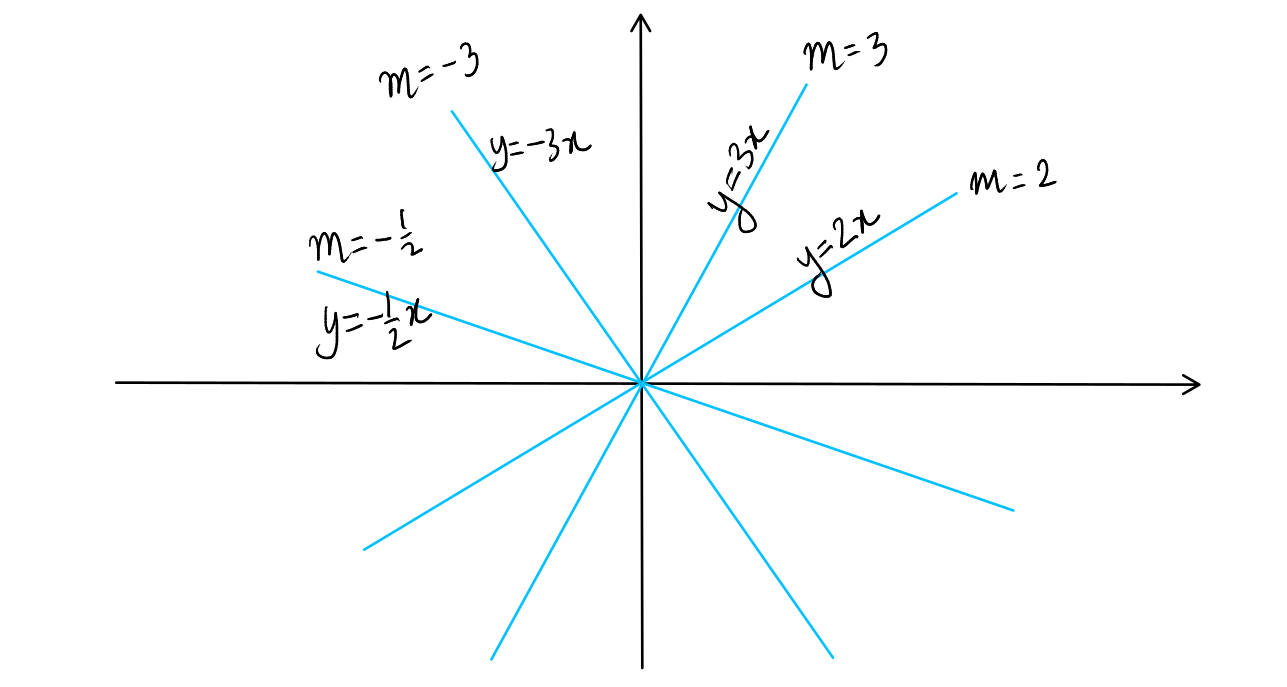
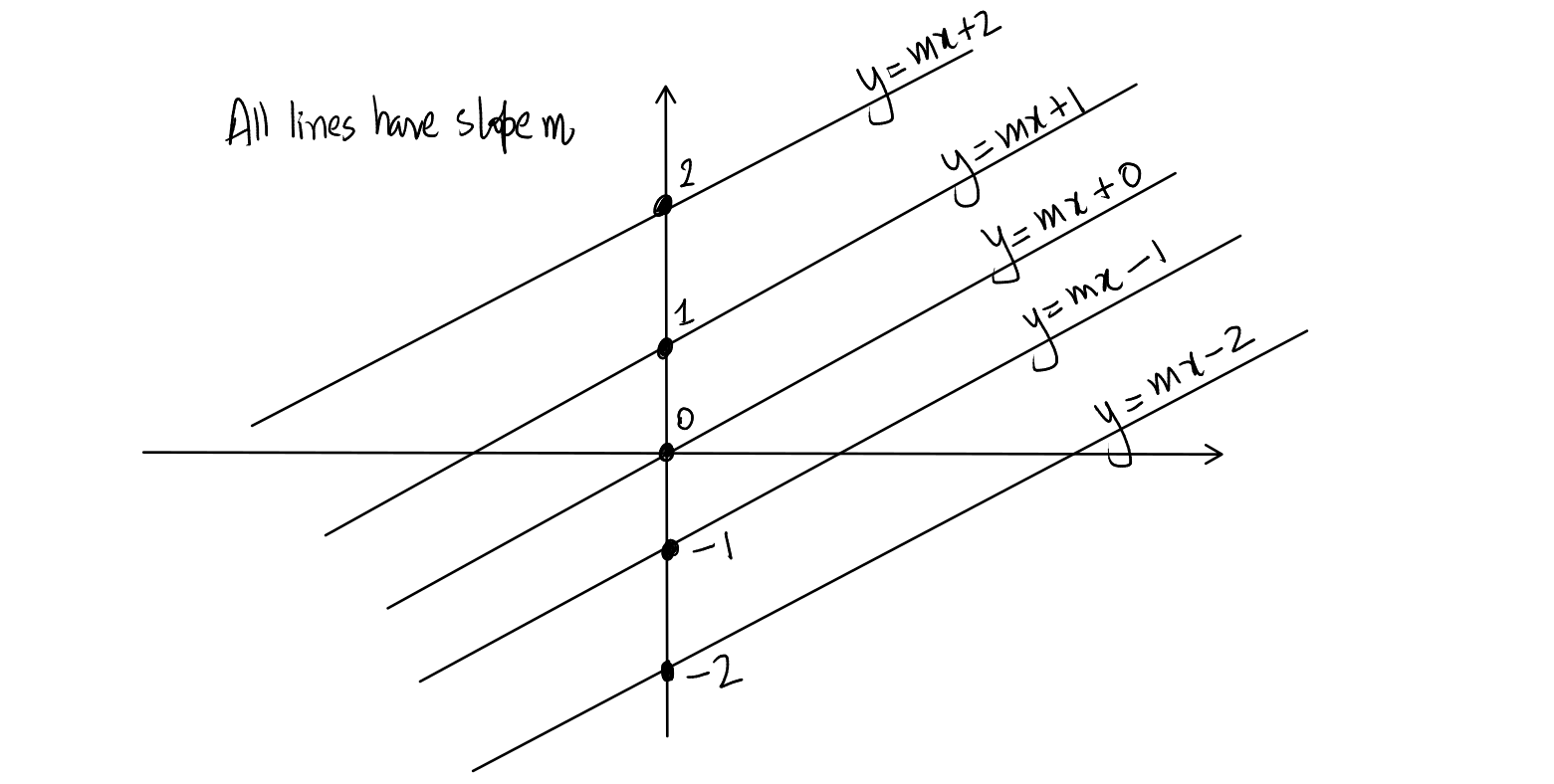
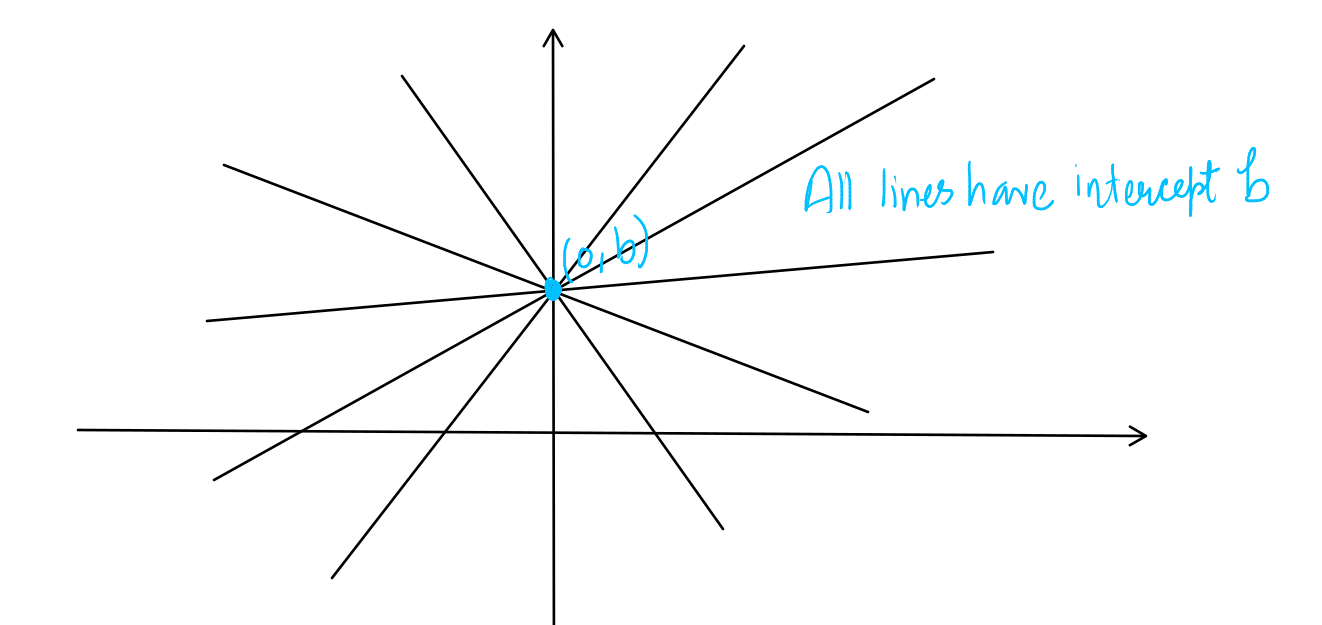
A family of lines is a collection of lines that satisfy a common property or condition. Each member of the family shares this characteristic, but can vary based on a parameter.
For example, consider the family of lines passing through the origin. All lines in this family have the common property that they intersect the origin (0,0). The equation of any line passing through the origin can be written as:
y=mx,
where m is the parameter representing the slope of the line. By assigning different values to m, we obtain different lines within this family. Since m can take any real number value, this family has an infinite number of members. Each value of m generates a unique line that still satisfies the property of passing through the origin.
In general, a family of lines can be defined by a linear equation that includes a parameter. For instance, the family of lines parallel to a given line can be represented as:
y=mx+c,
where m is fixed (indicating a constant slope) and c varies. The parameter c determines the y-intercept of each line. All lines in this family are parallel to each other, sharing the same slope but differing in their vertical displacement.
Another example is the family of lines with a common y-intercept b:
y=mx+b,
where b is fixed and m varies. Here, all lines intersect the y-axis at the same point (0,b) but have different slopes.
In summary, a family of lines is characterized by a specific property, such as passing through a common point or being parallel. The equation of the family includes a parameter that, when varied, generates the different members of the family. These parameters allow for an infinite number of lines, each satisfying the defined property.
Family of Lines passing through intersection points of two lines§
We are particularly interested in the family of lines passing through the intersection point of two non-parallel lines L1 and L2. Let the equations of these lines be:
L1:a1x+b1y+c1=0L2:a2x+b2y+c2=0
The family of lines passing through the intersection point of L1 and L2 is given by the linear combination of these two equations:
L1+λL2=0,
which can be written as:
(a1x+b1y+c1)+λ(a2x+b2y+c2)=0,
or equivalently:
(a1+λa2)x+(b1+λb2)y+(c1+λc2)=0,
where λ is any real number. By varying λ, we obtain different members of this family of lines, all of which pass through the intersection point of L1 and L2.
For example:
Consider two non-parallel lines:
L1:2x+3y−6=0L2:x−y+1=0
We seek the family of lines passing through the intersection point of L1 and L2. The family is given by:
L1+λL2=0
Substituting the equations of L1 and L2:
(2x+3y−6)+λ(x−y+1)=0
Simplifying, we obtain:
(2+λ)x+(3−λ)y+(−6+λ)=0
This is the general form of the family of lines passing through the intersection of L1 and L2. Each value of λ yields a different line in this family.
Section 5 of 8 · Straight Lines
Mark this section complete when you have worked through its proofs.
Type any topic, theorem, or concept to jump directly to the section.